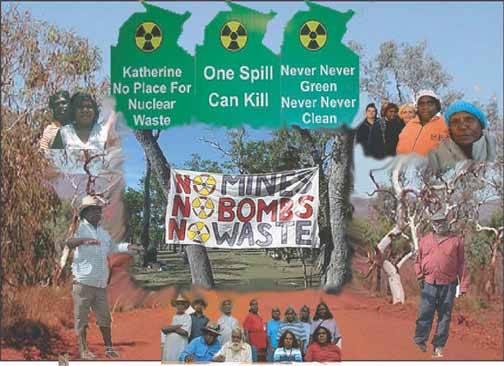
Nuclear decommissioning costs shooting up in Sweden
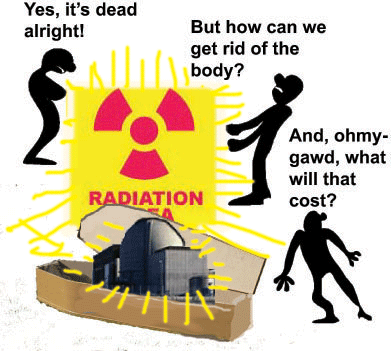 Sweden plans big rise in fees to nuclear decommissioning fund http://economictimes.indiatimes.com/news/international/business/sweden-plans-big-rise-in-fees-to-nuclear-decommissioning-fund/articleshow/37335517.cms By Reuters | 27 Jun, 2014 OSLO: Sweden on Friday proposed a sharp rise in fees nuclear power producers have to pay the country’s nuclear decommissioning fund, saying previous cost estimates were too low.
Sweden has three nuclear power plants with ten reactors in operation, generating about 40 per cent of the country’s electricity needs. The oldest reactors are expected to be shut at the beginning of the next decade.
OSLO: Sweden on Friday proposed a sharp rise in fees nuclear power producers have to pay the country’s nuclear decommissioning fund, saying previous cost estimates were too low. The Swedish Radiation Safety Authority (SSM) said it has proposed raising fees by 73 per cent to 0.038 crowns ($0.01) per kilowatt-hour from 0.022 crowns for 2015.
It said the Swedish Nuclear Fuel and Waste Management Company (SKB) had to recalculate fees to the nuclear decommissioning fund for the period of 2016-2017.
“The SSM has assessed that the costs for decommissioning and final disposal for the Swedish nuclear power industry may be underestimated by SKB by at least 11 billion Swedish crowns ($1.63 billion),” the authority said in a statement.
Sweden’s state-owned utility Vattenfall operates seven reactors and Germany’s E.ON three. Finnish utility Fortum has stakes in six Swedish nuclear reactors.
Britain’s nuclear waste cleanup spirals above £110 billion
Britain’s nuclear clean-up bill soars to £110bn http://www.telegraph.co.uk/finance/newsbysector/energy/10921309/Britains-nuclear-clean-up-bill-soars-to-110bn.html Spiralling costs at Sellafield site in Cumbria contribute to £6.6bn increase in bill for tackling Britain’s nuclear waste By Emily Gosden
8:16PM BST 23 Jun 2014 The bill for cleaning up Britain’s nuclear waste has topped £110bn, after a £6.6bn increase in the cost estimate for work required over the next 120 years
The Nuclear Decommissioning Authority said that the biggest increase derived from a fresh assessment of the work required at Sellafield, the country’s biggest and most toxic nuclear site.
Sellafield, in Cumbria, is now estimated to cost £79.1bn to clean up, but the NDA warned that the total would “increase significantly next year” once it had fully assessed a new “performance plan” for the site.

The NDA controversially renewed a contract with Nuclear Management Partners to manage Sellafield despite fierce criticism from MPs on the Public Accounts Committee and the National Audit Office of the company’s performance.
The NDA’s annual report and accounts make clear the huge scale of uncertainty that exists over the ultimate bill for Britain’s civil and military nuclear waste.
It says it has “reviewed a number of scenarios with a range of possible outcomes” and found that “the estimated cost could have a potential range from £88bn to £218bn”.
The figure of £110bn is on an “undiscounted” basis. Once discounted, the total is £65bn.
The most radioactively poisoned site in America – Hanford
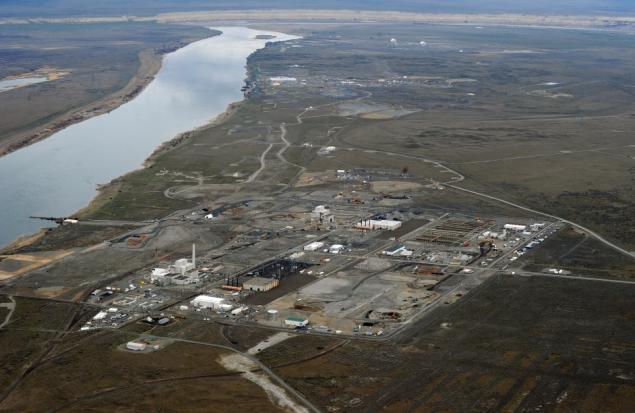
25 years on at America’s most contaminated nuclear waste site BBC News, Washington 10 June 2014 By Taylor Kate Brown The town of Hanford, Washington, has long been the most contaminated nuclear waste site in the US. But critics say poor management has put the site in further danger.
When Susan Leckband moved to eastern Washington state to take a job 30 years ago, radioactive contamination was not on her mind.
“I loved my job,” she says.
But it was only a handful of years before the place she worked, Hanford, turned from a plutonium production complex to a massive environmental clean-up site.
For Leckband, the question is not about the past, but the progress made on cleaning contaminated buildings and soil.
“It’s important to the entire Pacific North-West… the food crops, the salmon, the Indian tribes – it’s a huge, huge obligation,” she says.
Situated on a plain along the Columbia River, the Hanford site is where the US produced plutonium used in the Manhattan Project, for the bomb that destroyed Nagasaki, and for a Cold War stockpile………despite some progress, the site’s most complicated and potentially dangerous waste issue – 56 million gallons (255 million litres) of high-level radioactive waste sitting inside tanks at the centre of the site – is facing more problems.
In the mid-1980s, activists and reporters began to unwind Hanford’s history, detailing safety lapses and environmental hazards across the site. ………
Hanford’s daunting clean-up problem in 1989
100 sq miles (259 sq km) of contaminated groundwater
56 million gallons (254 million litres) of liquid waste, in tanks buried just below ground
More than 1,000 ad hoc burial sites of waste
Hundreds of contaminated buildings
450 billion gallons of contaminated water released at ground level……..http://www.bbc.com/news/magazine-26658719
Fracking brings instability and anxiety to the area around USA’s Waste Isolation Pilot Project (WIPP)

 Will Fracking Cause Our Next Nuclear Disaster? 09 June 2014 By Dahr Jamail, Truthout | The idea of storing radioactive nuclear waste inside a hollowed-out salt cavern might look good on paper. The concept is to carve out the insides of the caverns, deep underground, then carefully move in the waste. Over time, the logic goes, the salt will move in and insulate the containers for thousands of generations. “The whole game is to engineer something that can contain those contaminants on the order of tens of thousands of years,” Tim Judson, the executive director of the Nuclear Information Resource Service(NIRS), told Truthout. NIRS is intended to be a national information and networking center for citizens and environmental activists concerned about nuclear power, radioactive waste, radiation and sustainable energy issues, according to Judson.
Salt-cavern storage was the plan for the Waste Isolation Pilot Project (WIPP), the world’s third-deepest geological repository, constructed and licensed to permanently dispose of radioactive waste for 10,000 years. The repository sits approximately 26 miles east of the town of Carlsbad in southeastern New Mexico.
Since shipments began in 1999, more than 80,000 cubic meters and 11,000 shipments of waste have been transferred to WIPP.
But at the moment, there are several ongoing critical problems at the site, which has been closed and unable to accept shipments of radioactive waste ever since a fire and radiation release in February. Dozens of barrels of radioactive waste from Los Alamos National Lab, like the one that caused the radiation leak, now pose an “imminent” or “substantial” threat to public health and the environment.
Yet, these problems could pale in comparison to what might happen at the site if an earthquake were to strike, or if the protective salt layer were compromised by nearby drilling for oil and gas, and in particular, hydraulic fracturing, commonly known as fracking.
Fracking is a technique used in obtaining gas and petroleum, in which water is mixed with sand and toxic chemicals, and the mixture is injected at extremely high pressure into a wellbore to create small fractures.
Thus, one would logically deduce that fracking should never be done anywhere near WIPP. However, it is being done there, and experts expect it to increase.
“In the last three years, a dozen fracking wells have become operational within five miles of the site [WIPP],” Don Hancock, the director of the Nuclear Waste Safety Program at Southwest Research and Information Center, told Truthout.
Given that it is already well known that fracking causes earthquakes, it is clear that the nuclear waste storage site is now in danger of having its structural integrity compromised.
“These are the major concerns,” Hancock warned. “There is clearly a possibility that the deep fracking can affect the stability, but even more likely is fracking liquids nearing or entering the waste beds – which would be a very bad thing.”
“They Are Drilling All Around It”
Truthout spoke with a state of New Mexico employee who is intimately familiar with the permitting and drilling processes related to WIPP. The employee spoke on condition of strict anonymity, due to a fear of reprisals from the pro-drilling administration of radical right-wing Tea Party Governor Susana Martinez.
“There is so much drilling coming online down there now,” the employee explained. “They are going back into existing fields and drilling horizontally, and the WIPP siteis located right in the middle of all these fields, so they are drilling all around it.”
The source said that the oil and gas companies who are drilling and fracking near WIPP “have permission to go under the [WIPP] boundary to target the reservoirs there, so it appears as though most of the wells are horizontal, and that is a concern.”
According to the employee, “The fracking fluids they are injecting are very unstable, and if it continues like this there could be big problems…. There was a 5.2 [earthquake] in West Texas from fracking, and that’s a big concern given the sensitivity of the WIPP site and what the possible consequences could be.”…….http://www.truth-out.org/news/item/24201-will-fracking-cause-our-next-nuclear-disaster
Whistleblowers fired, as Hanford leaking radioactive waste problem continues
 25 years on at America’s most contaminated nuclear waste site BBC News, Washington 10 June 2014 By Taylor Kate Brown “…….In February, Oregon Senator Ron Wyden accused the DOE of a “never-ending pattern of failing to disclose what it actually knows about conditions at Hanford”. Wyden is most recently concerned about the tanks holding by-products of plutonium production, buried just below the surface at the centre of the site.
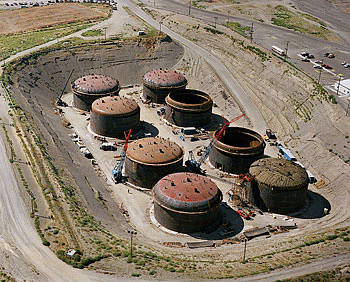
The original containers, single-shell tanks built in the 1940s and 1950s, had already leaked at least 1 million gallons of liquid waste into the ground. Hanford officials built double-shell tanks in the 1970s and 1980s and began transferring the radioactive waste into the newer vessels.
But in October 2012, the energy department announced one of the double-shell tanks was leaking into the space between the two shells. Waste in that tank has not entered the environment.
Wyden released an engineering review that said six other double-shells had similar construction flaws. He accused the agency of hiding what they knew, as the report had been made months after the initial leak announcement, but no other warnings from the DOE had followed.
Meanwhile, Hanford officials have recently submitted a plan to start emptying the leaking tank in two years.
Then, in late March, two dozen workers fell ill because of chemical vapours near the tanks. Workers again noticed vapours around the tanks in May. The composition of the waste in the leaking tank makes it more likely to corrode, Fletcher says. No other double-shell tank holds such a mixture and full inspections on the tanks will now be done more frequently,
But in general, the double-shells must do their job for several more decades until a waste treatment plant – currently under construction – immobilises in glass all 56 million gallons of waste in the tanks.
The treatment plant was scheduled to become operational by 2019, but construction has been slowed or entirely halted on two key parts of the plant for additional testing. Once the treatment plant goes into operation, parts of it must be run entirely by robotics because of the high radioactivity of the waste. Regulators call it a “black-box” system.
Hanford Challenge represents two whistleblowers, Walt Tamosaitis and Donna Busche, who say they have been punished for expressing concerns about the treatment plant’s design.
Carpenter says the whistleblowers are speaking up now because once the plant begins operations, there will be no chance to fix potentially dangerous errors.
Both Tamosaitis and Busche have been fired by URS, one of the contractors at Hanford.
The energy department says it has asked its inspector general to “review the circumstances surrounding the termination of Ms Busche”, a safety manager who alleged continuing harassment since she first brought up concerns in 2011. Meanwhile the waste remains in the aging tanks. http://www.bbc.com/news/magazine-26658719
A Growing Number of Problems at Waste Isolation Pilot Project (WIPP)
Will Fracking Cause Our Next Nuclear Disaster? 09 June 2014 By Dahr Jamail, Truthout “…….Due to the ongoing problems at WIPP, the federal government’s Department of Energy (DOE) recently notified the state of New Mexico that it would be unable to meet a June 30 deadline to remove 3,706 cubic meters of nuclear waste from the mesa at Los Alamos National Lab where it is stored.
“As we work to assess the conditions of the transuranic waste program at the lab, we have decided to halt further shipments until we can reassure the public that it is safe to do so,” DOE Deputy Under Secretary David Klaus said.
As a result of the February radiation leak and fire within the facility, WIPP officials at the site discounted any effect of the current leak on human health, saying no radiation escaped to the surface. But they did not speak about the extent of the problem or how it eventually would be cleaned up.
“Officials at WIPP continue to monitor the situation,” DOE spokeswoman Deb Gillsaid at the time of the leak. “We are emphasizing there is no threat to human health and the environment.”
Contradicting Gill’s assurances, plutonium readings were detected at a DOE field office half a mile from the site. Joe Franco, the manager of the DOE field office, confirmed the readings……… Continue reading
Big contributions to George W Bush and Rick Perry got WIPP nuke waste facility happening
 Breaking Bad: A Nuclear Waste Disaster By Joseph Trento, DC Bureau, June 5th, 2014″…….. Former President George W. Bush and Texas Governor Rick Perry’s single largest political contributor, the late Texas billionaire Harold C. Simmons, founded Waste Control Specialists and used his political influence to get the West Texas nuclear disposal site approved by state and federal licensing officials. The political efforts used to secure the licensing caused years of controversy in Texas. Environmentalists opposed the site because it is on an important aquifer in Texas. Another reason is that one of Simmons’s companies had operated a lead incinerator in Dallas that became an EPA Superfund Site.
Despite this environmental pedigree, LANL and DOE officials chose Waste Control Specialists to administrator their alternative nuclear waste storage site. While technically the company has licenses only for low-level nuclear waste, under its Texas permit, Waste Control can accept certified waste from federal agencies.
DOE officials said the Waste Control site is just a temporary alternative to the disabled WIPP. That is not true. Los Alamos and other national laboratories with high-level nuclear waste have been planning to use the Texas site for years, well before is licenses had been approved. The political promises that were made that it would be only for low-level waste were a ruse. As long as four years ago, during a Savannah River Site Citizens Advisory Board meeting in Aiken, South Carolina, DOE officials and SRS contractors talked openly about using the Texas site to offload uranium waste from SRS.
In late May, DOE investigators became so concerned about the Los Alamos containers being stores in what amounts to an open pit, they halted the shipments to Waste Control. The 112 canisters already at Waste Control were ordered to be isolated and surrounded by large concrete containers as well monitored by television camera. As of May 28, seventy-three Los Alamos containers have been segregated and covered with the cement and gravel-filled barriers.
Harold Simmons’s team lobbied hard to get only the second license in U.S. history from DOE for a private nuclear dump. They got the licensing in the last days of the Bush administration. Prior to the LANL decision to ship containers of transuranic waste to the site, there were warnings to Waste Control that it had already been accepting waste it was not permitted to receive.
Pressure has been building for years for DOE to stabilize and isolate its growing high-level nuclear waste stream. After the WIPP explosion, the DOE suddenly concluded that the thousands of feet below earth in salt beds were no longer needed to store the most deadly radioactive material on earth. Open trenches in the West Texas desert would be good enough. On April 2, tractor trailers hauled the first of the Los Alamos casks of radioactive high-level waste to the Andrews County dump before the WIPP investigation team succeeded in halting the shipments……”.http://www.dcbureau.org/201406059835/natural-resources-news-service/breaking-bad-nuclear-waste-disaster.html
America’s MOX nuclear waste recycling boondoggle

they must stop making this radioactive trash
Failed Nuclear Weapons Recycling Program Could Put Us All in Danger io9, Mark Strauss, 7 June 14, Some government screw-ups are so epic that they require decades of effort. Such was the case for the recently cancelled plan to convert surplus weapons-grade plutonium into nuclear fuel. Not only did the U.S. waste $4 billion dollars, it increased the likelihood that terrorists could obtain bomb-making materials.
It sounded like a good idea at the beginning. Let’s turn megatons into megawatts!
In 2000, the United States and Russia signed the Plutonium Management and Disposition Agreement (PMDA). Each country pledged to dispose of at least 34 metric tons of plutonium from their nuclear weapons programs. U.S. nuclear weapons contain less than four kilograms of plutonium, so the combined total of 68 metric tons is enough for some 17,000 nuclear weapons. Disposing of this plutonium would make it more difficult to reverse U.S.-Russian nuclear weapons reductions and would prevent terrorists from gaining access to the material.
The United States settled on a plan to convert most of its surplus plutonium into fuel for nuclear reactors. A massive reprocessing plant would be built at the Savannah River Site in South Carolina, which, during the Cold War, had refined nuclear material for deployment in warheads. Now, the site would have a new mission: creating nuclear fuel from a mixture of plutonium and uranium oxide, otherwise known as mixed oxide fuel, or MOX. Although nuclear power plants in the U.S. use fuel made from low-enriched uranium (LEU), other countries had demonstrated that MOX was a viable alternative.
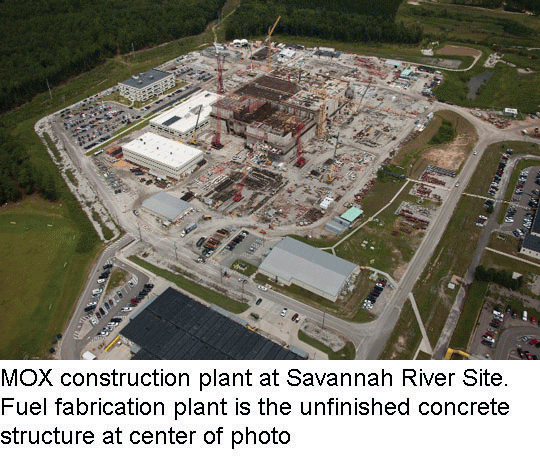
Instead, the final outcome was a mothballed facility and a still-increasing supply of surplus plutonium. Like I said, this isn’t your typical government boondoggle. It was twenty years in the making………. Continue reading
Management Problems in USA’s failed Nuclear Weapons Recycling Program
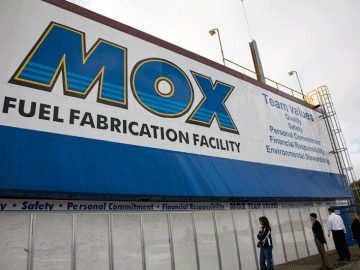 Failed Nuclear Weapons Recycling Program Could Put Us All in Danger io9, Mark Strauss, 7 June 14 “…….In 2004, the National Nuclear Security Administration estimated that the Savannah River MOX facility would cost $1.6 billion. Three years later, that estimate jumped to $4.9 billion. In 2012, the forecasted expenditure increased again, to $7.7 billion. By this time, $4 billion had already been spent and the project employed more than 1,800 construction workers, designers and engineers. Then, in April 2013, an internal review conducted by the Department of Energy revealed that the total lifetime operating cost of the facility—including construction, maintenance and disposal of all the plutonium—would be $24.2 billion.
TJust one example of the poor management that led to cost overruns: NNSA and its primary contractor underestimated the number of safety systems required to meet Nuclear Regulatory Commission (NRC) requirements, which further increased equipment installation costs. More specifically, they were unaware of the costs associated with building a facility that could withstand an earthquake. The source of their confusion? The MOX facility’s design is based on a similar facility in France, but the NRC regulatory requirements differ from those in France.
The Department of Energy was also at fault, because it approved the initial cost and schedule estimate, when the overall design of the MOX facility was only about 58% complete.
A report published two weeks ago by the Department’s Inspector General noted:
In a separate July 2006 memorandum to the NNSA Administrator, NNSA’s Associate Administrator for Infrastructure and Environment expressed his concern regarding the MOX Facility project. He expressed the belief that incomplete project planning could lead to an unintended “design-build-design” process similar to that experienced by other major Departmental projects including the Waste Treatment Plant and the Highly Enriched Uranium Materials Facility. The Waste Treatment Plant at the Hanford Site was given the approval to start construction when the design was only about 45 percent complete. Since then, total project costs for that facility have increased significantly and the project is considerably behind schedule. He pointed out that, similarly, a comprehensive design review had not been conducted on the complete MOX Facility project and that the project had high-risk potential for increasing downstream costs and schedule.
The White House did its part, as well. In 2010, President Obama announced a loan guarantee of $8.3 billion to help the Southern Company build two new nuclear reactors in Georgia. As a result, workers with nuclear engineering design and manufacturing experience were suddenly in very high demand. The MOX construction site had an employee turnover of 20% per year because, after workers completed additional training at the Savannah River Site, they quit to take higher paying jobs in Georgia. The U.S. government was subsidizing its own labor shortfall.
Finally, in March 2014, the White House announced that it would put the whole project on “cold standby”—essentially, preparing it for shutdown—while the administration evaluated “alternative plutonium disposition technologies to MOX that will achieve a safe and secure solution more quickly and cost effectively.”
Adding up the losses
MOX may be mothballed, but the problem of what to do with our surplus weapons-grade plutonium remains. And, despite cool relations between Washington and Moscow, the disposal agreement still stands.
The Department of Energy has established a Plutonium Disposition Working Group that will spend the next 12 to 18 months trying to come up with a plan. You can see an initial working paper here. The options are depressingly similar to the ones suggested by the National Academy of Sciences, 20 years ago.he sticker shock prompted the Department of Energy to note in its Fiscal Year 2014 budget request that, “This current plutonium disposition approach may be unaffordable…due to cost growth and fiscal pressure.”
Any lingering doubts that the MOX program was on its last legs were dispelled when the Government Accountability Office (GAO) published a report in February 2014. Even by GAO standards, the assessment was scathing.
One of the biggest mistakes, according to the GAO, was entrusting this project to the National Nuclear Security Administration, which is a semi-autonomous agency within the Department of Energy:
NNSA has not analyzed the underlying, or root, causes of the Plutonium Disposition program construction cost increases to help identify lessons learned and help address the agency’s difficulty in completing projects within cost and schedule, which has led to NNSA’s management of major projects remaining on GAO’s list of areas at high risk of fraud, waste, abuse, and mismanagement.
………Even if we got this facility up and working, nobody wants what it’s making. The companies that run commercial nuclear reactors have lost confidence in the program. They can’t be certain that it would provide a reliable, steady supply of fuel, or keep enough surplus fuel on hand in case it was needed. And why would commercial nuclear reactors purchase MOX when low-enriched uranium is cheaper, easier to transport and doesn’t present a security risk? Adding to the climate of skepticism: a MOX fuel irradiation test in a commercial reactor had to be prematurely terminated in 2008 because of unanticipated problems.
The loss to the United States can be measured in more than the $4 billion to build the facility and the hundreds of millions of dollars sent to Russia to subsidize their program. The greater loss is that the U.S. could have spent those funds to shore up other nonproliferation programs…….. http://io9.com/failed-nuclear-weapons-recycling-program-could-put-us-a-1586851270
Political donations got the Texas Waste Control site going
Breaking Bad: A Nuclear Waste Disaster By Joseph Trento, DC Bureau, June 5th, 2014 “………Former President George W. Bush and Texas Governor Rick Perry’s single largest political contributor, the late Texas billionaire Harold C. Simmons, founded Waste Control Specialists and used his political influence to get the West Texas nuclear disposal site approved by state and federal licensing officials. The political efforts used to secure the licensing caused years of controversy in Texas. Environmentalists opposed the site because it is on an important aquifer in Texas. Another reason is that one of Simmons’s companies had operated a lead incinerator in Dallas that became an EPA Superfund Site.
Despite this environmental pedigree, LANL and DOE officials chose Waste Control Specialists to administrator their alternative nuclear waste storage site. While technically the company has licenses only for low-level nuclear waste, under its Texas permit, Waste Control can accept certified waste from federal agencies.
DOE officials said the Waste Control site is just a temporary alternative to the disabled WIPP. That is not true. Los Alamos and other national laboratories with high-level nuclear waste have been planning to use the Texas site for years, well before is licenses had been approved. The political promises that were made that it would be only for low-level waste were a ruse. As long as four years ago, during a Savannah River Site Citizens Advisory Board meeting in Aiken, South Carolina, DOE officials and SRS contractors talked openly about using the Texas site to offload uranium waste from SRS.
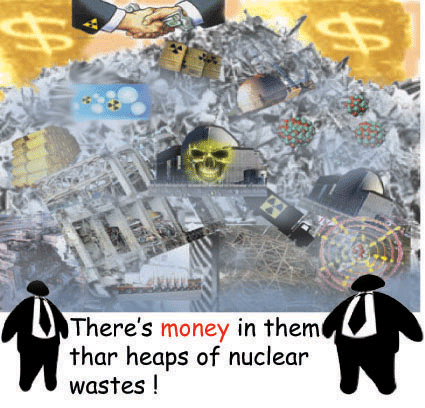
In late May, DOE investigators became so concerned about the Los Alamos containers being stores in what amounts to an open pit, they halted the shipments to Waste Control. The 112 canisters already at Waste Control were ordered to be isolated and surrounded by large concrete containers as well monitored by television camera. As of May 28, seventy-three Los Alamos containers have been segregated and covered with the cement and gravel-filled barriers.
Harold Simmons’s team lobbied hard to get only the second license in U.S. history from DOE for a private nuclear dump. They got the licensing in the last days of the Bush administration. Prior to the LANL decision to ship containers of transuranic waste to the site, there were warnings to Waste Control that it had already been accepting waste it was not permitted to receive.
Pressure has been building for years for DOE to stabilize and isolate its growing high-level nuclear waste stream. After the WIPP explosion, the DOE suddenly concluded that the thousands of feet below earth in salt beds were no longer needed to store the most deadly radioactive material on earth. Open trenches in the West Texas desert would be good enough. On April 2, tractor trailers hauled the first of the Los Alamos casks of radioactive high-level waste to the Andrews County dump before the WIPP investigation team succeeded in halting the shipments……….http://www.dcbureau.org/201406059835/natural-resources-news-service/breaking-bad-nuclear-waste-disaster.html
South Carolina site now to get nuclear trash from Germany?
it is crazy to keep on making nuclear waste
 German nuclear waste may be dumped at US site http://www.news24.com/Green/News/German-nuclear-waste-may-be-dumped-at-US-site-20140605 Charleston – The US department of energy said on Wednesday it will study the environmental risk of importing spent nuclear fuel from Germany that contains highly enriched uranium, a move believed to be the first for the United States.
The department said it is considering a plan to ship the nuclear waste from Germany to the Savannah River Site, a federal facility in South Carolina. The 125Ha site already holds millions of gallons of high-level nuclear waste in tanks. The waste came from reactors in South Carolina that produced plutonium for nuclear weapons from 1953 to 1989.
The Energy Department said it wants to remove 900kg of uranium the United States sold to Germany years ago and render it safe under US nuclear non-proliferation treaties.
A technique for the three-year process of extracting the uranium, which is contained in graphite balls, is being developed at the site in South Carolina, according to the Energy Department.
Some critics question whether the department has fully developed a clear plan to dispose of the radioactive waste.
“They’re proposing to extract the uranium and reuse it as fuel by a process that has never been done before”, said Tom Clements, president of SRS Watch, a nuclear watchdog group in South Carolina.
“There’s no place to take high level waste in the US”, he said. “Uranium that is turned into commercial fuel is not contained inside nuclear waste. It’s pure material.”
A public environmental meeting on the proposed project will be held 24 June in North Augusta, South Carolina.
Clements said shipping the uranium to South Carolina would only add more nuclear waste to the Savannah River Site.
German and US officials signed a statement of intent for the import in March and April. A feasibility study is under way, the Energy Department said.
“The Germans couldn’t quite figure out what to do with it”, Clements said.
German officials have been embroiled in a fight over who will pay for clean-up of nuclear waste from nine remaining decommissioned nuclear plants.
Sources told Reuters in May that German utilities were in talks with the government about setting up a “bad bank” for nuclear plants, in response to German Chancellor Angela Merkel’s decision to close them all by 2022 after Japan’s Fukushima nuclear disaster.
Legal case continues over Australian govt’s plan to dump nuclear waste on Aboriginal land
Indigenous land owners accuse lawyer of manipulating nuclear waste storage report June 4, 2014 – Jane Lee Legal Affairs Reporter for The Age A lawyer who was key to the Howard government’s plan to store nuclear waste on indigenous land has been accused of manipulating the legal process required to ensure its approval.
Traditional owners from four indigenous clans are challenging the Ngapa clan’s 2007 nomination of Muckaty Station for the dump site in the Federal Court in Melbourne. The owners, including Aboriginal elders, argue they did not consent to the nomination, were not consulted on the agreement reached and were misled on the government’s proposal for the nuclear storage site.
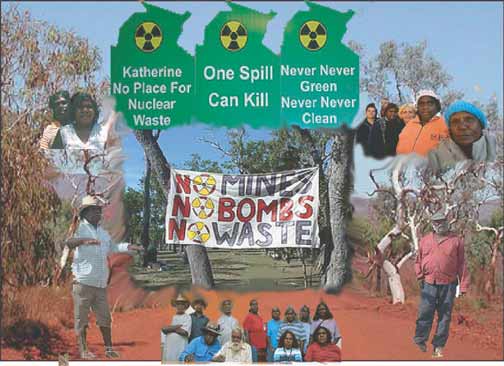
Ron Levy was then the chief legal counsel for the Northern Land Council, which was set up to help indigenous people in the Northern Territory acquire and manage traditional lands. Mr Levy will be called as a witness later in the five-week case before Justice Anthony North.
Ron Merkel, QC, for the traditional owers, told the court on Thursday that Mr Levy “personally edited” anthropologists’ views in a Council report which concluded that only the Ngapa Lauder clan owned the site. Mr Levy also wrote a new section in the final report, reflecting his view that the Land Commissioner could depart from judges’ previous decisions on land claims, “if relevant material was before the commissioner.”
Mr Merkel said that he did this “(so) that the Lauder Ngupas would be recognised by the Northern Land Council as the only traditional owners of the site so their consent could be secured.” The site nomination could then “jump a hurdle” of having to consult in more detail about about the plan with other clans, he said………..
Mr Merkel told the court on Tuesday that Mr Levy, who controlled the consultation process, also failed to tell the full Northern Land Council or traditional owners about the only up-front $200,000 payment given to traditional owners for the site nomination or the terms of their agreement.
But he later told the federal goverrnment that he had all traditional owners’ full consent.
Mr Merkel said there was no explanation for this “unless … Mr Levy had a plan from the outset about how to achieve the end result and he did”. http://www.smh.com.au/federal-politics/political-news/indigenous-land-owners-accuse-lawyer-of-manipulating-nuclear-waste-storage-report-20140604-39jk8.html#ixzz33nhZjp26.
In Australian Federal Court, Aborigines continue the fight against radioactive waste dumping on their land
 Nuclear waste dump on Aboriginal land invalid, court told The West Australian, 3 June 14. Sydney (AFP) – The earmarking of a remote Australian outback area as a nuclear waste dump was invalid because officials failed to contact all traditional Aboriginal landowners affected, a court heard Monday.Muckaty Station in the Northern Territory was nominated in early 2007 as a site to store low and intermediate radioactive waste under a deal negotiated with the Aboriginal Ngapa clan.
While Australia does not use nuclear power, it needs a site to store waste, including processed fuel rods from the country’s only nuclear reactor at Lucas Heights, on the outskirts of Sydney,…..Opponents have fought against the dump for years, with a trial starting in the Federal Court in Melbourne Monday alleging Muckaty’s nomination was invalid due to a failure of the government and the land council to obtain the consent of all Aboriginal owners.
“What we’re here to say is ‘no more’ and that this process was so legally flawed that it is invalid,” Ron Merkel, who is representing traditional owners, told the court.
“The opposition is in no small part based on a spiritual affiliation to the land and that radioactive waste will poison the land,” he said in comments cited by Australian Associated Press.
The court was told the consent of all groups with a claim to the land was required for the facility to go ahead, but some Aboriginals whose country was affected have never had a chance to voice their concerns until now……..Speaking to reporters, Kylie Sambo, of the Warlmanpa people, said the idea of a waste facility on the land, which is in the centre of the country, was “poison”.
“We don’t want it to spoil our country because we love our land and we’ve been there for centuries,” she said. “My uncle once told me, ‘You may think you own the land, but in fact the land owns us’.”
The Australian Conservation Foundation said the case raised questions about the country’s management of long-lived radioactive waste.
“Australia has never has an independent assessment of how best to manage radioactive waste; now we urgently need one,” campaigner Dave Sweeney said.
The case is set to run for five weeks. https://au.news.yahoo.com/thewest/world/a/24084083/nuclear-waste-dump-on-aboriginal-land-invalid-court-told/
Canadian MP calls for caution on underground nuclear waste storage near Great Lakes
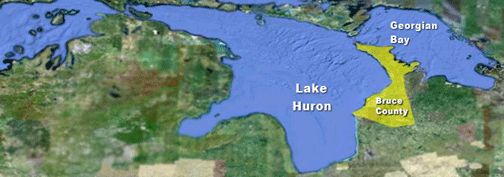 Masse calls for action on underground nuclear waste site near Great Lakes, The Windsor Star, Dave Battagello May 27, 2014 MP Brian Masse (NDP Windsor-West) will table a motion this week expressing concern over a proposed underground nuclear waste facility on the edge of the Great Lakes which critics say has potential to taint the waterway and drinking water.
“We don’t get a second chance on this,” he said following a press conference in Ottawa. “What we are trying to do is get a more full and robust review of nuclear storage around the Great Lakes.
“Several organizations are coming forward confronting (Ontario Power Generation’s) plan at the Bruce Nuclear Site as being a danger to the environment.”
The planned project is to construct and operate a nuclear disposal site over half a kilometre deep in the earth just north of Kincardine on the grounds of the Bruce site — and one kilometre from Lake Huron. The facility would store “low and intermediate” nuclear waste from operations of OPG-owned nuclear generation plants at Bruce, Pickering and Darlington.
There are several above ground nuclear waste storage sites near the Great Lakes, but environmentalists and politicians fear having it stored below ground makes it nearly impossible to address an accident. They say the impact would be devastating if any waste leaks into the Great Lakes……..
Masse hopes by tabling his motion it will bring the nuclear storage issue at Bruce to “a national level” and heighten awareness about potential impacts to the world’s largest freshwater supply.
“We want to ensure the assessment procedures around nuclear storage are strong enough,” he said. “We want to see if there are other ways to deal with this nuclear waste than just this one option.”
A large percentage of opposition to the OPG’s underground nuclear storage plan has come from the U.S. side of the border, Masse said.
“They have a law not to allow this stuff within 10 miles of the Great Lakes,” he said. “The Americans are concerned. This is not a moot issue to them by any means.”…….http://blogs.windsorstar.com/2014/05/27/masse-calls-for-action-in-ottawa-on-nuclear-waste-site-next-to-great-lakes/
USA’s “temporary” radioactive waste containers are becoming permanent
it’s time to stop making this toxic radioactive trash
US Nuclear Power Plants Prepare Long-Term Radioactive Waste Storage http://www.theepochtimes.com/n3/697217-us-nuclear-power-plants-prepare-long-term-radioactive-waste-storage/ By Associated Press | May 26, 2014 WATERFORD, Conn.—Nuclear power plants across the United States are building or expanding storage facilities to hold their spent fuel — radioactive waste that by now was supposed to be on its way to a national dump.
The steel and concrete containers used to store the waste on-site were envisioned as only a short-term solution when introduced in the 1980s. Now they are the subject of reviews by industry and government to determine how they might hold up — if needed — for decades or longer.

With nowhere else to put its nuclear waste, the Millstone Power Station overlooking Long Island Sound is sealing it up in massive steel canisters on what used to be a parking lot. The storage pad, first built in 2005, was recently expanded to make room for seven times as many canisters filled with spent fuel.
Dan Steward, the first selectman in Waterford, which hosts Millstone, said he raises the issue every chance he can with Connecticut’s congressional members.
“We do not want to become a nuclear waste site as a community,” Steward said.
The government is pursuing a new plan for nuclear waste storage, hoping to break an impasse left by the collapse of a proposal for Nevada’s Yucca Mountain. The Energy Department says it expects other states will compete for a repository, and the accompanying economic benefits, and it’s already heard from potential hosts in New Mexico, Texas and Mississippi. But the plan faces hurdles including a need for new legislation that has stalled in Congress.
So plants are preparing to keep the high-level nuclear waste in their backyards indefinitely. Most of it remains in pools, which cool the spent fuel for several years once it comes out of the reactors. But with the pools at or nearing capacity, the majority is expected within a decade to be held in dry casks, or canisters, which are used in 34 states. Only three of the 62 commercial nuclear sites in the U.S. have yet to announce plans to build their own.
In the past few years since the Yucca Mountain plan was abandoned, the government and industry have opened studies to address unanswered questions about the long-term performance of dry cask storage. The Nuclear Regulatory Commission in 2011 began offering 40-year license renewals for casks, up from 20-year intervals. The tests are focusing on how to monitor degradation inside the canisters, environmental requirements for storage sites, and how well the canisters hold up with “high burnup,” or longer-burning fuels that are now widely used by American plants.
“Now that we’ve shown that the national policy is shifting, we’re having to relook at these systems to make sure they still meet the regulations for longer and longer periods of time,” said Eric Benner, an NRC official who has served as the inspections branch chief with its spent fuel storage division.
At Millstone, 19 canisters loaded with spent fuel are arrayed on a concrete pad, which was expanded in October to make room for as many as 135 canisters by 2045. The canisters, which are cooled by air circulation, seal the waste with inert gas inside an inner chamber and are themselves loaded into concrete modules. Workers regularly inspect temperature gauges and, during the winter, shovel snow off the vents.
Millstone’s low-level nuclear waste is shipped to a disposal facility in Barnwell, South Carolina.
The spent fuel is piling up at a rate of about 2,200 tons a year at U.S. power-plant sites. The industry and government decline to say how much waste is currently stored at individual plants. The U.S. nuclear industry had 69,720 tons of uranium waste as of May 2013, with 49,620 tons in pools and 20,100 in dry storage, according to the Nuclear Energy Institute industry group.
Spent nuclear fuel is about 95 percent uranium. About 1 percent is other heavy elements such as curium, americium and plutonium-239. Each has an extremely long half-life — some take hundreds of thousands of years to lose all of their radioactive potency.
Watchdog groups say the dry storage poses fewer safety concerns than the reactors themselves, and many have pushed for spent fuel to be transferred more quickly from the pools. Heavy security is in place to deter sabotage by terrorists.
The administration’s strategy calls for an interim storage facility by 2025 and a geologic repository by 2048.
Peter Lyons, an assistant secretary for nuclear energy at the U.S. Energy Department, said it cannot make plans for individual sites until the passage of legislation creating a new framework for waste policy. But he said the groups in southeastern New Mexico, western Texas and Mississippi are only the most public of potential hosts to express interest in taking in high-level waste.
The idea for the interim facility is to take spent fuel left behind from reactors that have already shut down, as is the case at sites in California, Maine, Massachusetts, Michigan, Wisconsin, Connecticut, Colorado and Oregon.
1 This Month
23-25 October – on Zoom – World BEYOND War’s annual global conferenc


Shut down the radiation-damaged Heysham nuclear reactors now
To see nuclear-related stories in greater depth and intensity – go to https://nuclearinformation.wordpress.com

Say No to NASA’s Reckless Nuclear Reactor on the Moon
Say No to NASA’s Reckless Nuclear Reactor on the Moon

-
Archives
- October 2026 (219)
- September 2026 (339)
- August 2026 (330)
- July 2026 (355)
- June 2026 (287)
- May 2026 (306)
- April 2026 (356)
- March 2026 (251)
- February 2026 (267)
- January 2026 (308)
- December 2025 (358)
- November 2025 (359)
-
Categories
- 1
- 1 NUCLEAR ISSUES
- business and costs
- climate change
- culture and arts
- ENERGY
- environment
- health
- history
- indigenous issues
- Legal
- marketing of nuclear
- media
- opposition to nuclear
- PERSONAL STORIES
- politics
- politics international
- Religion and ethics
- safety
- secrets,lies and civil liberties
- spinbuster
- technology
- Uranium
- wastes
- weapons and war
- Women
- 2 WORLD
- ACTION
- AFRICA
- Atrocities
- AUSTRALIA
- Christina's notes
- Christina's themes
- culture and arts
- Events
- Fuk 2022
- Fuk 2023
- Fukushima 2017
- Fukushima 2018
- fukushima 2019
- Fukushima 2020
- Fukushima 2021
- general
- global warming
- Humour (God we need it)
- Nuclear
- RARE EARTHS
- Reference
- resources – print
- Resources -audiovicual
- Weekly Newsletter
- World
- World Nuclear
- YouTube
-
RSS
Entries RSS
Comments RSS