The dismal history of USA’s failed thorium nuclear experiment
 Thorium: the wonder fuel that wasn’t http://thebulletin.org/thorium-wonder-fuel-wasnt7156 Robert Alvarez May 2014, “Thorium-Fueled Automobile Engine Needs Refueling Once a Century,” reads the headline of an October 2013 story in an online trade publication. This fantastic promise is just one part of a modern boomlet in enthusiasm about the energy potential of thorium, a radioactive element that is far more abundant than uranium. Thorium promoters consistently extol its supposed advantages over uranium. News outlets periodically foresee the possibility of “a cheaper, more efficient, and safer form of nuclear power that produces less nuclear waste than today’s uranium-based technology.”
Early thorium optimism. The energy potential of the element thorium was discovered in 1940 at the University of California at Berkeley, during the very early days of the US nuclear weapons program. Although thorium atoms do not split, researchers found that they will absorb neutrons when irradiated. After that a small fraction of the thorium then transmutes into a fissionable material—uranium 233—that does undergo fission and can therefore be used in a reactor or bomb.
By the early 1960’s, the US Atomic Energy Commission (AEC) had established a major thorium fuel research and development program, spurring utilities to build thorium-fueled reactors. Back then, the AEC was projecting that some 1,000 nuclear power reactors would dot the American landscape by the end of the 20th century, with a similar nuclear capacity abroad. As a result, the official reasoning held, world uranium supplies would be rapidly exhausted, and reactors that ran on the more-plentiful thorium would be needed.
With the strong endorsement of a congressionally created body, the Joint Committee on Atomic Energy, the United States began a major effort in the early 1960s to fund a two-track research and development effort for a new generation of reactors that would make any uranium shortage irrelevant by producing more fissile material fuel than they consumed.
The first track was development of plutonium-fueled “breeder” reactors, which held the promise of producing electricity and 30 percent more fuel than they consumed. This effort collapsed in the United States in the early 1980’s because of cost and proliferation concerns and technological problems. (The plutonium “fast” reactor program has been able to stay alive and still receives hefty sums as part of the Energy Department’s nuclear research and development portfolio.)
The second track—now largely forgotten—was based on thorium-fueled reactors. This option was attractive because thorium is far more abundant than uranium and holds the potential for producing an even larger amount of uranium 233 in reactors designed specifically for that purpose. In pursuing this track, the government produced a large amount of uranium 233, mainly at weapons production reactors. Approximately two tons of uranium 233 was produced, at an estimated total cost of $5.5 to $11 billion (2012 dollars), including associated cleanup costs.
The federal government established research and development projects to demonstrate the viability of uranium 233 breeder reactors in Minnesota, Tennessee, and Pennsylvania. By 1977, however, the government abandoned pursuit of the thorium fuel cycle in favor of plutonium-fueled breeders, leading to dissent in the ranks of the AEC. Alvin Weinberg, the long-time director of the Oak Ridge National Laboratory, was, in large part, fired because of his support of thorium over plutonium fuel.
By the late 1980’s, after several failed attempts to use it commercially, the US nuclear power industry also walked away from thorium. The first commercial nuclear plant to use thorium was Indian Point Unit I, a pressurized water reactor near New York City that began operation in 1962. Attempts to recover uranium 233 from its irradiated thorium fuel were described, however, as a “financial disaster.” The last serious attempt to use thorium in a commercial reactor was at the Fort St. Vrain plant in Colorado, which closed in 1989 after 10 years and hundreds of equipment failures, leaks, and fuel failures. There were four failed commercial thorium ventures; prior agreement makes the US government responsible for their wastes.
Where is the missing uranium 233? As it turned out, of course, the Atomic Energy Commission’s prediction of future nuclear capacity was off by an order of magnitude—the US nuclear fleet topped out at about 100, rather than 1,000 reactors—and the predicted uranium shortage never occurred. America’s experience with thorium fuels faded from public memory until 1996. Then, an Energy Department safety investigation found a national repository for uranium 233 in a building constructed in 1943 at the Oak Ridge National Laboratory. The repository was in dreadful condition; investigators reported an environmental release from a large fraction of the 1,100 containers “could be expected to occur within the next five years in that some of the packages are approaching 30 years of age and have not been regularly inspected.” TheEnergy Department later concluded that the building had “deteriorated beyond cost-effective repair. Significant annual costs would be incurred to satisfy current DOE storage standards, and to provide continued protection against potential nuclear criticality accidents or theft of the material.”
The neglect extended beyond the repository and storage containers; the government had also failed to keep proper track of its stores of uranium 233, officially classified as a Category I strategic special nuclear material that requires stringent security measures to prevent “an unauthorized opportunity to initiate or credibly threaten to initiate a nuclear dispersal or detonation.”
A 1996 audit by the Energy Department’s inspector general reported that the Oak Ridge National Laboratory, the Rocky Flats nuclear weapons facility, and the Idaho National Laboratory “had not performed all required physical inventories ... the longer complete physical inventories are delayed, the greater the risk that unauthorized movement of special nuclear materials could occur and go undetected.” The amounts of uranium 233 that the Oak Ridge and Idaho national labs have reported in their inventories has significantly varied. Based on a review of Energy Department data, there appears to be an inventory discrepancy; 96 kilograms or 6 percent of the U-233 produced is not accounted for. The Energy Department has yet to address this discrepancy, which difference is enough to fuel at least a dozen nuclear weapons.
Uranium 233 compares favorably to plutonium in terms of weaponization; a critical mass of that isotope of uranium—about 6 kilograms, in its metal form—is about the same weight as a plutonium critical mass. Unlike plutonium, however, uranium 233 does not need implosion engineering to be used in a bomb. In fact, the US government produced uranium 233 in small quantities for weapons, and weapons designers conducted several nuclear weapons tests between 1955 and 1968 using uranium 233. Interest was renewed in the mid-1960s, but uranium 233 never gained wide use as a weapons material in the US military because of its high cost, associated with the radiation protection required to protect personnel from uranium 232, a highly radioactive contaminant co-produced with uranium 233.
For a terrorist, however, uranium 233 is a tempting theft target; it does not require advanced shaping and implosion technology to be fashioned into a workable nuclear device. The Energy Department recognizes this characteristic and requires any amount of more than two kilograms of uranium 233 to be maintained under its most stringent safeguards, to prevent “onsite assembly of an improvised nuclear device.” As for the claim that radiation levels from uranium 232 make uranium 233 proliferation resistant, Oak Ridge researchers note that “if a diverter was motivated by foreign nationalistic purposes, personnel exposure would be of no concern since exposure … would not result in immediate death.”
The end of an unfortunate era. After its 1996 safety investigation at the Oak Ridge National Laboratory, the Energy Department spent millions to repackage about 450 kilograms of uranium 233 that is mixed with uranium 235 and sitting in the lab’s Building 3019, and to dispose of diluted uranium 233 fuel stored at the Idaho National Lab. The Energy Department’s nuclear weapons program managed to shift responsibility for the stockpile in Building 3019 from Oak Ridge to the Office of Nuclear Energy, which envisioned using the uranium 233 to make medical isotopes. This plan fell apart, and in 2005 Congress ordered the Energy Department to dispose of the uranium 233 stockpile as waste.
Since then, the Energy Department’s Office of Environmental Management has considered uranium 233 disposal to be an unfunded mandate, disconnected from other, higher-priority environmental cleanup compliance agreements. After several fits and starts, including a turnover of four project managers in less than two years, the Energy Department’s disposition project “had encountered a number of design delays, may exceed original cost estimates, and will likely not meet completion milestones,” the department’s inspector general reported in 2010. The cost of the project increased from $384 million to $473 million—or more than $1 million per kilogram for the disposal of uranium 233.
In an effort to reduce costs, the Energy Department developed a plan to ship nearly 75 percent of the fissile materials in Building 3019, as is, to a landfill at the Nevada Nuclear Security Site by the end of 2014. Because such disposal would violate the agency’s formal safeguards and radioactive waste disposal requirements, the Energy Department changed those rules, which it can do without public notification or comment. Never before has the agency or its predecessors taken steps to deliberately dump a large amount of highly concentrated fissile material in a landfill, an action that violates international standards and norms.
In June 2013, Nevada Gov. Brian Sandoval and members of the state’s congressional delegation announced their opposition to the landfill disposition plan. Energy Secretary Ernest Moniz visited with Sandoval but did not back down from the landfill plan. Even though the Oak Ridge material in its current form meets the legal definition for radioactive waste requiring geologic disposal, the Energy Department has taken the position that the sweeping authority granted to it under the Atomic Energy Act allows the department to dispose of the fissile material however it pleases, regardless of the state’s objection.
The United States has spent nearly $10 billion to discourage practices like landfill dumping of fissile materials in the former Soviet Union, only to have the Energy Department try it at home. Heedless of the discrepancy between overseas and domestic disposal policies, the department’s agenda—which focuses on saving money on guards who would be needed to secure the uranium 233—is placing the United States in an impossible position when it comes to criticizing the nuclear materials security of other countries. So ends America’s official experience with thorium, the wonder fuel.
America’s nuclear waste sites form many ticking time bombs

it is crazy to keep making this stuff!
 AP: Ticking time bombs of nuclear waste at multiple U.S. sites? Lab checking for smoking drums — CNN: “Imminent threat from radiation” — Gundersen:
  Serious public health effects if one blows; “Very, very volatile… like nitroglycerin” (VIDEO) http://enenews.com/cnn-imminent-threat-from-radiation-leak-gundersen-interview-public-to-suffer-serious-health-effects-if-nuclear-waste-drums-blow-up-aboveground-a-major-concern-very-very-volat
AP, May 21, 2014: Los Alamos National Laboratory [LANL] on Wednesday told state government it has isolated and is closely monitoring nuclear waste […] packed with a type of cat litter suspected in a radiation leak at [WIPP]. [LANL] said the 55-gallon barrels have been secured in special containers and moved to an isolated area with a fire protection system. They also are being monitored 24 hours a day for any change in temperature, smoking or other abnormalities. […] More than 100 other suspect containers are being stored temporarily at Waste Control Specialists in Andrews, Texas.
AP, May 23, 2014: Has cat litter turned barrels of New Mexico nuclear waste into ticking time bombs? […] COULD THE OTHER BARRELS BE TICKING TIME BOMBS? [LANL] said it has packed them in special containers, placed them under a dome with a fire extinguishing system and is closely monitoring them. Waste Control Specialists has taken similar precautions. As for the more than 350 containers already at the Waste Isolation Pilot Plant, Flynn has ordered the U.S. Department of Energy to expedite plans for sealing off the underground rooms where the waste is stored. Complicating that effort is the laborious investigative process […] they are still working to see if other containers have been breached.
CNN Interview with Arnie Gundersen, May 21, 2014: ‘Imminent’ threat from radiation leak
- At :15 in — Arnie Gundersen, Fairewinds Chief Engineer: Barrels are above ground and still at Los Alamos, which is a major concern because this material gets more and more unstable as it gets warmer, and of course we’re heading into the summer months on the desert. So those barrels that are above ground, if they were to blow like the one that did below ground, we’d have a serious public health effect. […]
At 1:30 in – Gundersen: When the corn [in the kitty litter] absorbed the moisture, the nitrogen inside got very, very volatile. Almost like in these old movies when you see somebody holding nitroglycerin — any shake will cause it to be disturbed. Well that’s what happened to these canisters that have the organic kitty litter. They’ve got to go back through and find all of those and isolate them and then figure out how to change the litter.
Problems in nuclear reactor decommissioning thrashed out in US Senate hearing
 Senate Hearing on Nuclear Reactor Decommissioning Challenges Energy Collective May 22, 2014 Bemnet Alemayehu, Project Scientist, Nuclear Program, Washington, D.C.
U.S. Senator Barbara Boxer’s Environment & Public Works Committee held a hearing on Wednesday, May 14th, 2014 to assess the challenges of nuclear reactor decommissioning nationwide. Panelists called to testify at Wednesday’s senate hearing included Christopher Recchia, Public Service Department Commissioner of Vermont, Geoffrey Fettus, Senior attorney of NRDC, Donald Mosier, Council Member of the City of Del Mar, Michael Weber, Deputy Executive Director for Compliance Programs of NRC and Marvin Fertel, President & Chief Executive Officer of NEI.
Christopher Recchia’s testimony to the senate opposed a request by operators of the Vermont Yankee nuclear power plant to discontinue off-site emergency planning after the reactor shuts down. He argued that the off-site emergency planning should continue after the reactor shuts down until all of the plant’s spent fuel rods are removed from pools and placed in dry cask storage. ……… Continue reading
Burying nuclear wastes close to Great Lakes is a “shocking idea”
Michigan protests plan to store millions of gallons of nuclear waste next to the Great Lakes RT 221 May 14, A Canadian proposal that calls for a nuclear waste storage facility less than a mile away from the Great Lakes is coming under heavy fire from Michigan lawmakers and environmental groups, who are now attempting to stop the project.Under a plan crafted by energy supplier Ontario Power Generation (OPG), the company would construct a “deep geologic repository” (DGR), which would feature waste storage sites more than 2,200 feet underground to store nearly 53 million gallons of both low- and intermediate-level nuclear waste. The location of the proposed site, however – in Kincardine, Ontario, just three-quarters of a mile away from Lake Huron – has drawn criticism from numerous groups who fear potential contamination.

The fact that Lake Huron is connected to all the other Great Lakes via waterways has also drawn concern, since the five bodies of water make up the largest collection of freshwater lakes on the Earth and provide drinking supplies to tens of millions of Americans and Canadians.
According to the Detroit News, lawmakers from both sides of the aisle have continued criticizing the plan, and are now proposing legislation that calls on the federal government to get involved. In addition to requesting that President Obama stake out a position on the issue, state Senate and House members are asking Secretary of State John Kerry to officially ask the International Joint Commission – established to mediate disputes over the Great Lakes – to rule on the matter.
The legislation would also “stop the importation of radioactive waste into Michigan from Canada.”
“Building a nuclear waste dump less than a mile from one of the largest freshwater sources in the world is a reckless act that should be universally opposed,” Michigan Rep. Dan Lauwers (R-Brockway Township) said in a statement Monday, as quoted by the Huffington Post.
While lawmakers continue to get involved in the situation – Michigan’s Senators in Washington have also urged the State Department to bring the IJC into the debate – environmental groups have come out against the plan.
“Burying nuclear waste a quarter-mile from the Great Lakes is a shockingly bad idea — it poses a serious threat to people, fish, wildlife, and the lakes themselves,” said Andy Buchsbaum, regional executive director for the National Wildlife Federation’s Great Lakes Regional Center, in a statement to the Detroit News………http://rt.com/usa/160564-michigan-canada-nuclear-great-lakes/
USA’s Plutonium facility at Los Alamos ruled not safe
 Federal Safety Board Cautions DOE on LANL Plutonium Facility L0s Alamos Study Group, 20 May 14
Main plutonium facility might “collapse” in earthquake unless repairs are completed; scope of work needed still unknown
Board says full re-start of LANL plutonium facility premature; nuclear criticality accidents not ruled out
On May 16, the Defense Nuclear Facilities Safety Board (DNFSB, Board), cautioned Congress about the structural integrity of the main plutonium facility at Los Alamos National Laboratory (LANL) in the event of an earthquake similar to those which have rocked the site in recent millenia. The building in question, “PF-4,” was built in 1978 to earlier, less stringent earthquake standards.
The Board was established by Congress in 1988 to advise the Department of Energy (DOE) on the safety of DOE’s nuclear facilities.
Also on the 16th, DNFSB Chairman Peter Winokur wrote National Nuclear Security Administration (NNSA) Administrator Frank Klotz about the Board’s concerns regarding LANL’s planned re-start of higher-hazard plutonium operations in PF-4 without first evaluating the potential of those operations to result in nuclear criticality accidents. Such accidents, were they to occur as a result of human error, mechanical failure or any other cause, would invariably involve very high levels of radiation and have often been fatal to surrounding workers. Such accidents have happened before at LANL and at other nuclear facilities in the U.S. and abroad. (See for example this LANL review.)
Regarding the first issue DNFSB writes in its “Report to Congress on the Status of Significant Safety Issues Concerning the Design and Construction of DOE’s Defense Nuclear Facilities” that:
..the Board remains concerned that PF-4 is vulnerable to seismic collapse. The large plutonium inventory of PF-4, coupled with the facility’s proximity to the public, creates the potential for high off-site radiological consequences. DOE is pursuing actions to address the collapse vulnerability, but maintains that PF-4 is safe to operate in the interim and complies with DOE standards for seismic performance. The Board communicated to DOE in a letter dated July 17, 2013, that it does not agree… -: http://lasg.org/press/2014/press_release_20May2014.html#sthash.cCZ6igPz.VLFKX1CD.dpuf
America agonises over what to do with nuclear radioactive trash
that they should stop making this toxic stuff
LEGACY OF AMERICA’S NUCLEAR POWER PLANTS — SPENT FUEL AND NO PLACE TO PUT IT BRATTLEBORO REFORMER BY BOB AUDETTE MAY 19, 2014. BRATTLEBORO — After Vermont Yankee nuclear power plant is closed and when the site is finally cleaned up — perhaps before the end of the next decade — there will still be a lingering reminder of what existed there since 1972.
As at other nuclear power plant sites around the country, spent nuclear fuel — or nuclear waste, as it used to be called prior to a successful rebranding campaign waged by the nuclear industry — might remain in Vernon long after all other reminders of Yankee are gone.
In fact, the Nuclear Regulatory Commission released last year a revised waste confidence rule that stated impacts would be small if spent fuel had to be stored at nuclear sites “indefinitely.”
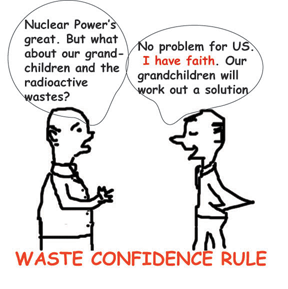
Ernest Moniz, the secretary of the U.S. Department of Energy, was in Vermont last week. During a phone interview with the Reformer, Moniz said his department is focused on developing a way to take care of the nation’s nuclear waste. However, noted Moniz, DOE needs the go-ahead from Congress. Continue reading
How DO you make a sign to warn against radioactive site for 10,000 years?
How To Make A Warning Label For Humans 10,000 Years From Now, Fast Code Design, 18 May 14 Nuclear waste can remain deadly for thousands of years. Plutonium-23, an isotope used in nuclear weapons production, has a half-life of more than 24,000 years. By contrast, some of the earliest human writing emerged only 5,000 years ago. This presents a challenge of near-eternal proportions: How do you create a label that will convey danger to someone thousands of years in the future–someone who probably won’t share any common culture or language with you?……

Episode 114: Ten Thousand Years
German government will not pay costs of burying dead reactors
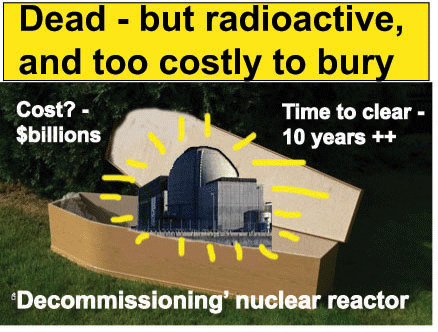 Germany’s Gabriel says state won’t pay for nuclear decommissioning http://uk.reuters.com/article/2014/05/18/uk-germany-energy-nuclear-idUKKBN0DY0EM20140518 BERLIN Sun May 18, (Reuters) – Germany‘s economy minister has joined Angela Merkel in rejecting talk that utilities might hand over responsibility for decommissioning Germany’s nuclear powerplants to a new public entity, as the projected costs of decommissioning rise.
“It should not be tax payers who pay for the clean-up of atomic waste but rather those who made money for decades through running nuclear power stations,” Sigmar Gabriel told the newspaper Bild am Sonntag in an interview published on Sunday.
Two sources told Reuters last weekend that utilities were in talks with the government about setting up a “bad bank” for nuclear plants, in response to Chancellor Angela Merkel’s decision to close them all by 2022 after the Fukushima disaster.
The foundation would use provisions earmarked by the nuclear plant operators but would also take on the risk of unforeseen extra costs, effectively capping the utilities’ liability.
The Environment Ministry said last week the utilities bore full responsibility for safely decommissioning and dismantling the nine nuclear power plants still on the grid.
One of the sources had told Reuters that if the state takes over responsibility for the decommissioning, the utilities might be willing to drop their legal claims against the government for compensation for having to shut the plants. The four operators of nuclear plants in Germany – the German companies E.ON (EONGn.DE), RWE (RWEG.DE) and EnBW (EBKG.DE) and Sweden’s Vattenfall VATN.UL – have set aside total provisions of around 36 billion euros (29.3 billion pounds) for dismantling the plants and disposing of nuclear waste.
Germany’s Spiegel magazine reported on Sunday that government experts predicted a possible shortfall of 3.5 billion euros for the clean up, as costs had risen sharply. (Reporting by Alexandra Hudson; Editing by Larry King)
Tepco to start dumping Fukushima water into the ocean next week
Japan’s TEPCO to Start Dumping Fukushima Water into Ocean Next Week MOSCOW, May 16 (RIA Novosti) – Tokyo Electric Power (TEPCO), the operator of the crippled Fukushima nuclear power plant, plans to begin releasing underground water near the facility into the Pacific Ocean as early as next Wednesday, The Asahi Shimbun reported Friday.
The first water to be released will total around 560 tons, the agency said citing an official from the Ministry of Economy, Trade and Industry. TEPCO will begin releasing the water as soon as it presents results of radiation tests to local government and the fishing industry.
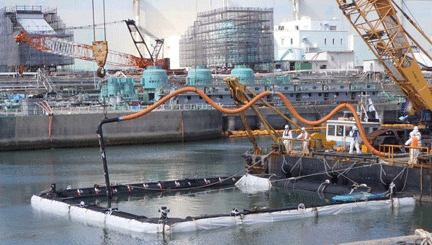
Initial talks between the government and TEPCO agreed that only water with 1,500 becquerels of radiation or less per liter could be released. Tests conducted by TEPCO and two outside agencies have revealed that the Fukushima underground water met the standards, averaging 220 to 240 becquerels of tritium per liter.
TEPCO began pumping out groundwater from the Fukushima nuclear plant in April in an effort to prevent further radioactive leaks.
The company continues to grapple with the problem of contaminated water storage, with about 450,000 tons of highly-radioactive water currently being stored in Fukushima’s underground facilities and tanks. Experts say some 15,000 tons is also being held in a service tunnel. According to recent estimates, up to 400 tons of contaminated water from the damaged plant is seeping into the Pacific Ocean every day.
In an effort to prevent further irradiation, TEPCO has adopted a plan to draw off groundwater from the plant. The fallout from Fukushima is later to be sent for analysis that will determine whether it is safe to be disposed of by dumping into the ocean.
The practice will allow the operator to reduce the accumulation of radioactive water at the plant by 100 tons a day……..https://news.google.com/news?ncl=d_uao6qIU8QsFkM74lsq0LkpKVl4M&q=radiation&lr=English&hl=en&sa=X&ei=l7N2U52sB8mtlQXZ_4HYBw&sqi=2&pjf=1&ved=0CDsQqgIwAw
Top secret cargo. Plutonium from Canada?
 Covert mission: Plutonium source might be Canada Questions being asked about mystery cargo BY IAN MACLEOD, OTTAWA CITIZEN MARCH 30, 2014 The nuclear fuel carrier Pacific Egret slipped into the harbour at Charleston, South Carolina, on March 19 and unloaded a top-secret cargo at the port’s Naval Weapons Station.
Fitted with naval guns, cannons and extensive hidden means of repelling a terrorist assault, the three-year-old British vessel was purpose-built to transport plutonium, highly enriched uranium (HEU) and mixed-oxide (MOX) nuclear fuel on the high seas.
Its previous publicly reported position had been exiting the Mediterranean at the Strait of Gibraltar almost two weeks earlier on March 7, carrying a delicate nuclear cargo loaded at the La Spezia naval base in northern Italy.
As the vessel entered the North Atlantic that day, its tracking image vanished from an online marine traffic monitoring system. The ship the size of a football field became all but invisible to unauthorized eyes.
Questions are now being raised about whether the sensitive cargo included recycled plutonium that originated here in Canada.
The clandestine business of transporting shiploads of fissile nuclear materials between nations rarely comes into public view. An eight-kilogram piece of plutonium-239 the size of a grapefruit could obliterate much of Ottawa in seconds — as it did to Nagasaki in August 1945. It’s aptly named after the ancient Greek god of the underworld……… Continue reading
USA Energy Dept in a fix about legal cases and no answer for nuclear wastes
they should stop making this toxic radioactive trash
Tiny nuclear waste fee added up to billions LA Times, 17 May 14 A charge for electricity that millions of Americans didn’t even know they pay will suddenly disappear Friday, after the Energy Department this week quietly notified utilities across the country that it was suspending its fees for a future nuclear waste dump.
The Energy Department has been collecting $750 million from electricity bills every year  for such a dump since 1983, putting it into a trust fund that now contains $31 billion.
The court-ordered suspension may be a modest victory for consumers, but it reflects the government’s failure over the last 40 years to get rid of what is now nearly 70,000 metric tons of highly radioactive spent fuel, accumulating at 100 nuclear reactors across the nation……… Continue reading
Complex arrangements – a “bad bank” for Germany’s dead nuclear reactors
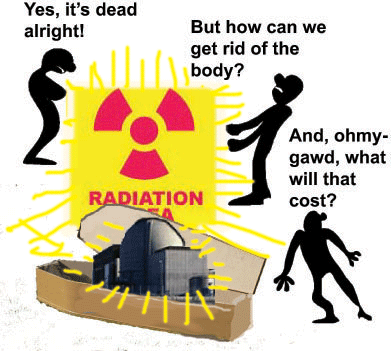 A bad bank for nuclear, as public assumes risk for closure costs http://reneweconomy.com.au/2014/a-bad-bank-for-nuclear-as-public-assumes-risk-for-closure-costs-39365 By Craig Morris on 16 May 2014 Energy Transition Over the weekend, there were reports of talks about the creation of a “bad bank” for German nuclear plants, which are to be shut down successively by the end of 2022.
Critics charge that the proposal is yet another attempt to privatize profits and nationalize losses. But Craig Morris has a bit more understanding for the firms’ position. At the end of February, the German hard coal sector made a proposal that revealed the sector’s actual situation: a bad bank. We continue to hear many reports about coal making a comeback in Germany, but in reality the uptick in 2013 will prove to be short-lived; coal power is already dramatically down in Q1 2014. And going forwards, hard coal in particular will be squeezed out even during the nuclear phaseout.
Now, the firms that run coal and nuclear plants think the idea might be useful to them during the nuclear phaseout. A quick glance at the idea is enough to make your hair stand on end, and the comments on German news websites (such as here – in German) are filled with outrage:
- The provisions set aside for the dismantling of the nuclear plants would be transferred to a state-owned foundation (the bad bank), which would then use the money for the phaseout.
- The government – meaning “the public” – would then run the risks, specifically if the costs exceed the provisions.
- In return, the power firms would drop their lawsuits against the German government with the ICSID (International Centre for Settlement and Disputes) settlements court in DC. Sweden’s Vattenfall has a minority holding in the Brokdorf nuclear plant in Germany along with Eon and is suing the German government in DC.
- Surprisingly, while Eon and EnBW (Vattenfall is apparently not involved in the negotiations for a bad bank) would be able to hand over their provisions, RWE would reportedly need a capital increase – has the firm spent its nuclear provisions on something else?
The case of Vattenfall is especially interesting. In the fall of 2010, the German government reneged on the original nuclear phaseout agreement of 2002 and extended the service lives of nuclear plants by 8 to 14 years, depending on the plant. In return, the government imposed a tax on the nuclear fuel rods to be consumed – allegedly to prevent windfall profits. But after Fukushima – only a few months later – those power plant extensions were revoked, but the tax remained.
In all likelihood, the four utilities agreed that the foreigner – Vattenfall, the one with the smallest nuclear assets – would “test the waters” and see whether a court case against the nuclear tax could be won. Last month, a German court ruled that the nuclear tax was illegal, so the current negotiations may be taking place against that backdrop.
There are, however, different readings of who wants what now. German economics daily Handelsblatt writes in its newsletter on Monday that “the government in Berlin wants to have the roughly 35 billion euros in nuclear provisions from Eon, RWE, EnBW, and Vattenfall,” the four utilities that run nuclear plants and Germany. This report in English at the Financial Times also makes it sound like the German government has plans of its own.
Technically, of course, the public already runs the risks. If anything goes wrong, the liability of these firms is limited. And while this limited liability has often been decried as unfair, we should keep in mind that the power firms themselves – from the US to Germany – never wanted to build nuclear plants. The nuclear power sector was originally an attempt to make the production of nuclear weapons more palatable to the public. The power sector wanted nothing to do with the technology, which they did not understand and did not trust. Once the government had limited their liability, they essentially began building the kind of power plants they understood but merely boiled the water with nuclear fuel rods instead of coal. Some 50 years ago, RWE in particular felt that nuclear would conflict with its fleet of coal plants. The result is hundreds of nuclear plants of crappy design, with numerous design options having barely been investigated.
The German government thus forced these companies into nuclear decades ago and now it is forcing them out. All of this is unfair to these firms. It’s also unfair to the German public, which never asked for nuclear power but has to pay for the entire mess. Whatever the outcome, perhaps the main argument against nuclear is that it’s hard to do it fairly.
Huge and worrying task of cleaning up Zion Nuclear Plant
Decommissioning Of Zion Nuclear Plant Raises Safety Concerns ZION, Ill. (CBS) 15 May 14. — It’s the largest closing of a nuclear plant in the United States, and it’s right in our backyard. The most critical and dangerous part of the process at Zion is underway right now with the transfer of used nuclear fuel. CBS 2’s Jim Williams is the only local TV reporter allowed inside to see firsthand what’s going on and to get answers to concerns about safety in this original report. For us, it was a first: an interview right next to a worker holding a radiation detector………….
The plant stopped operating 16 years ago, but what was left behind is so toxic robots were brought in.
“You don’t want men in there using hand tools and torches,” said Sauger.
By train and truck, they’re shipping the less hazardous material to Texas, Tennessee and Utah where it will be buried.
Dan Pryor is the project manager. He described the less hazardous material as “filters, rags, mops; things that might have been in contact with radiated material and might be contaminated.”
But spent nuclear fuel that had been in this cooling pool is being placed in steel cylinders called casks and then encased in concrete. Dave Kraft of the Nuclear Energy Information Service said, “We call this the nuclear bowling alley,” because all 65 casks will end up together above ground next to the old plant.
Kraft fears they could be a prime target for terrorists in a plane.
“If you have a huge fire from a burning airliner for example, It’s going to affect everything around,” said Kraft.
Kraft and Paul Kakuris, of the Dunesland Preservation Society worry the casks could break open, releasing radiation across the Chicago area and poisoning the Lake.
“We are at risk here. This is the water supply for 20 million people,” said Kakuris………Today, the casks are surrounded by high fences and razor wire. Heavily armed security guards are everywhere there. Still, it’s not enough to satisfy the critics.
“You only get one chance to be wrong,” said Kraft.
Another safety concern is how will those steel and concrete casks hold up over time before a permanent storage site is created? The nuclear regulatory commission expects them to be replaced in 100 years. But, environmentalists fear those casks may wind up sitting there next to Lake Michigan for much longer than that. http://chicago.cbslocal.com/2014/05/14/decommissioning-of-zion-nuclear-plant-raises-safety-concerns/
Lawmakers press for stronger safety regulations for spent nuclear fuel rods
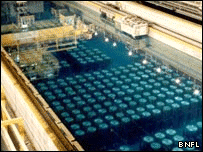 Bills would beef up safety regs for spent nuclear fuel http://thehill.com/regulation/205962-bills-would-beef-up-safety-regs-for-spent-nuclear-fuel By Benjamin Goad – 05/13/14 Lawmakers are pressing to bolster regulations for spent nuclear fuel, contending that pools left to languish for decades at decommissioning plants could prove disastrous in the event of an accident or terrorist attack.
Sens. Barbara Boxer (D-Calif.), Ed Markey (D-Mass.) and Bernie Sanders (I-Vt.) on Tuesday introduced a trio of bills meant to tighten safety and security at plants winding down operations around the country.
“Experts agree that a spent fuel pool accident could have consequences that are every bit as bad as an accident at an operating reactor,” Markey said.
Spent fuel can produce heat and radiation threats long after it is removed from a nuclear reactor’s electricity generating operation. Too dangerous to ship away from the plant altogether for as long as seven years, the spent fuel is left in pools at the plants.
A leak — whether due to accident or attack — could lead to fire and widespread contamination, the lawmakers said, citing various reports. Yet current Nuclear Regulatory Commission (NRC) rules allow for spent fuel to remain in the pools until the reactor completes decommissioning, which can take as long as 60 years, they said.
The Safe and Secure Decommissioning Act of 2014 would bar the NRC from exempting reactor licensees from any safety or security requirements at decommissioning plants until all fuel stored at the site is transferred into safer dry casks.
The lawmakers contend that the NRC has granted every exemption request it has ever received from decommissioning reactors, despite the agency’s own determination that an earthquake could result in a devastating breach. The Dry Cask Storage Act of 2014 is designed to force nuclear reactor operators to adhere to an NRC-approved plan for the transfer of spent fuel to dry cask storage within 7 years of the time the plant’s decommissioning plan is submitted.
Under the lawmakers’ Nuclear Plant Decommissioning Act of 2014, states and local communities would be guaranteed a meaningful role in the preparation of decommissioning plans for retired nuclear plants.
The legislation would require the NRC to publicly approve or reject every proposed decommissioning plan.
“Every state with a nuclear power plant has a strong interest in how that plant is decommissioned,” Sanders said. “This is about making sure that states and local communities can play a meaningful role in a decision.”
Concern about oversight of San Onofre Nuclear Decommissioning
 Del Mar Councilman To Testify At Senate Hearing On Nuclear Power Plant Decommissioning http://www.kpbs.org/news/2014/may/12/del-mar-councilman-testifies-senate-hearing-decomm/, May 12, 2014 By Alison St John U.S. Sen. Barbara Boxer, chairwoman of the Committee on Environment and Public Works, will convene a hearing Wednesday morning in Washington D.C., to look at the challenges of decommissioning nuclear reactors nationwide.
One of the five panelists called to testify is Del Mar City Councilman Don Mosier. Mosier, a biologist at the Scripps Research Institute, said he has concerns about continuing to store 4,000 tons of radioactive waste at San Onofre. The plant, 50 miles north of San Diego, was shut down in 2013 after a small radioactive leak was discovered in the steam generators in 2012.
“When the reactors were closed, we hoped that some of the safety concerns about San Onofre would be diminished,” Mosier said, “but I actually think they’re increased because of the lack of planning for storing all this radioactivity.“
Mosier said he has questions about the spent fuel pools and dry cask storage at San Onofre that were not designed for the kind of “high burn-up” fuel that will be stored there. High burn-up fuel (HBF ) is hotter and more radioactive than previously used fuel rods.
Mosier said the Nuclear Regulatory Commission that oversaw San Onofre when it was in operation, does not have the same level of regulatory authority over the decommissioning process.
“I feel in the absence of federal oversight, one of the things I am going to argue for is more state and local control of the decommissioning process,” Mosier said.
A Citizens’ Engagement Committee set up by Edison, the company that operates San Onofre, is not the independent oversight Mosier hopes to see.
Other panel members at Wednesday’s Senate hearing include Michael Weber, NRC deputy director for waste compliance programs, and Geoffrey Fettus of the Natural Resources Defense Council.
1 This Month
23-25 October – on Zoom – World BEYOND War’s annual global conferenc


Shut down the radiation-damaged Heysham nuclear reactors now
To see nuclear-related stories in greater depth and intensity – go to https://nuclearinformation.wordpress.com

Say No to NASA’s Reckless Nuclear Reactor on the Moon
Say No to NASA’s Reckless Nuclear Reactor on the Moon

-
Archives
- October 2026 (219)
- September 2026 (339)
- August 2026 (330)
- July 2026 (355)
- June 2026 (287)
- May 2026 (306)
- April 2026 (356)
- March 2026 (251)
- February 2026 (267)
- January 2026 (308)
- December 2025 (358)
- November 2025 (359)
-
Categories
- 1
- 1 NUCLEAR ISSUES
- business and costs
- climate change
- culture and arts
- ENERGY
- environment
- health
- history
- indigenous issues
- Legal
- marketing of nuclear
- media
- opposition to nuclear
- PERSONAL STORIES
- politics
- politics international
- Religion and ethics
- safety
- secrets,lies and civil liberties
- spinbuster
- technology
- Uranium
- wastes
- weapons and war
- Women
- 2 WORLD
- ACTION
- AFRICA
- Atrocities
- AUSTRALIA
- Christina's notes
- Christina's themes
- culture and arts
- Events
- Fuk 2022
- Fuk 2023
- Fukushima 2017
- Fukushima 2018
- fukushima 2019
- Fukushima 2020
- Fukushima 2021
- general
- global warming
- Humour (God we need it)
- Nuclear
- RARE EARTHS
- Reference
- resources – print
- Resources -audiovicual
- Weekly Newsletter
- World
- World Nuclear
- YouTube
-
RSS
Entries RSS
Comments RSS

