Britain’s intractable and expensive problem of accumulating nuclear waste

 Britain’s nuclear waste, a problem proving hard to bury, The Conversation, Stuart Haszeldine Professor of Geology at University of Edinburgh 1 Aug 14
A proposal for radioactive waste to appear at a burial site nearby, would be likely to fill the great majority of the UK population with thoughts of danger, cancer – and falling house prices. This illustrates the huge problem of public misperception to overcome when disposing of radioactive waste. Britain’s nuclear reactors have generated low-carbon electricity since 1956, in doing so creating around 260,000m3 (about the size of 700 double-decker buses) of intermediate-level wasteand 3,000m3 of highly radioactive high-level waste, as well as spent fuel, plutonium and uranium. The price for decommissioning past and existing nuclear power plant and disposing of that waste is around £70 billion – the single largest item of expenditure for the UK Department of Energy and Climate Change.
What to do with radioactive waste is a problem that has so far proved to be intractable to successive generations of civil servants and ministers. In the mid-1970s, it was decided that deep burial would provide the optimum secure solution.
Here, radioactive waste would be packaged and contained for one million years, sealed by multiple chemical and physical barriers within a repository dug out around 500 metres below ground level. A serious attempt was made to investigate a site in West Cumbria close to Sellafield in the 1990’s, but that foundered on the complexity of the geology and flow of deep groundwater, making it difficult to predict how well sealed the waste would be into the far future……….
Another review and public consultation was undertaken during 2013-14, from which emerged the White Paper “Implementing Geological Disposal” published in July 2014. The results show the government has done some serious listening, and it provides some distinctly new approaches.
First, a new body Radioactive Waste Management Ltd will be created to pursue a disposal site. The company will be wholly owned by the government and could propose more than one facility for different types of waste. This has been tried in the 1980s and 1990s with UK Nirex – a limited company wholly owned by UK government, which spent £400m investigating just one site. Can you spot any difference? So how this operates will be more important than the definition.
Second, the government states it is keen to “listen and respond to views and concerns”. Yet in the future this search will now become defined as a nationally significant infrastructure project, which means that many powers of local people to decide or influence could be restricted or removed. Specifically, the control and influence of local councils has been removed, combined with a statement that no tier of government will have the right to veto a project. So the responsibility of regional council authorities for managing this waste, and the associated road and rail and excavation infrastructure is also removed.
Third, the search for a site will become national, with a two-year period of geological survey and screening to identify suitable regions (not specific sites). Identifying secure regions may become difficult if the extensive fracking of England goes ahead for shale gas and oil, as, any effect on the underlying geology could affect a site’s long term secure storage potential………
Potentially the most significant statement of all comes from the secretary of state for energy and climate change, Ed Davey, stating that arrangements for waste disposal have to be in place before planning consent will be given for new nuclear power stations. Does this mean that one or more sites need to be specifically identified before construction can start on the new nuclear reactors planned at Hinkley Point and elsewhere? If formal discussions with new volunteers do not even start until 2016, and could conclude as late as 2030 – by which time Hinkley Point C should be generating power – that seems impossible.
Perhaps ministers of the future be satisfied merely to know that the UK “has a plan”? If the past is any guide to the future, relying on such a plan didn’t help to find a nuclear mausoleum in 1978, 1996, or 2012. https://theconversation.com/britains-nuclear-waste-a-problem-proving-hard-to-bury-29917
UK White paper – Implementing Geological Disposal
Written statement to Parliament UK
Publication of Implementing Geological Disposal White Paper 2014
- Department of Energy & Climate Change and The Rt Hon Edward Davey MP
- Delivered on:
- 22 July 2014
- History:
- Published 24 July 2014
- Part of:
- Managing the use and disposal of radioactive and nuclear substances and waste, Energy, Environment and Public
 safety and emergencies
 - Statement by Edward Davey on the publication of a white paper on geological disposal.
I am today publishing a White Paper on implementing geological disposal of higher activity radioactive waste.The White Paper – Implementing Geological Disposal –follows a public consultation that my department carried out during 2013 on potential amendments to the existing siting process established in 2008 for a geological disposal facility (GDF) and reflects key messages from that consultation, as well as lessons learned during the previous siting process.
The UK Government remains committed to geological disposal as the right policy for the long-term, safe and secure management of higher activity radioactive waste……….
- ……….With regard to new nuclear power, UK Government policy is that, before development consents for new nuclear power stations are granted, I will need to be satisfied that effective arrangements exist or will exist to manage and dispose of the waste they will produce…….
- The White Paper is issued jointly by the UK Government and the Northern Ireland Executive. The Welsh Government is currently considering a wider review of its higher activity radioactive waste management policy. The Scottish Government has a separate higher activity radioactive policy.
Today I am also publishing the latest annual report on the geological disposal programme, covering April 2013 to March 2014. This will be laid in the libraries of the House. https://www.gov.uk/government/speeches/publication-of-implementing-geological-disposal-white-paper-2014
40 $billion later America’s biggest nuclear waste site still leaking
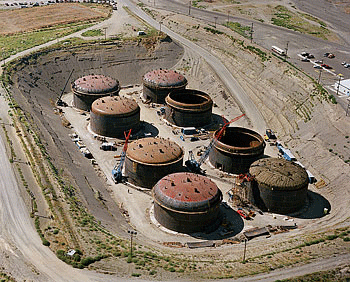 After $40 Billion, America’s Biggest Nuclear Dump Is Still Leaking by Charleston Voice 29 July 14, It’s cost $40 billion so far to clean up America’s biggest nuclear waste site—half the size of Rhode Island—and it’s going to take another 40 years and $100 billion to finish the job.
And delays keep piling up even though at least a third of the aging tanks storing 56 million gallons radioactive waste have leaked or are leaking, pouring some of the world’s most dangerous contaminants into the Columbia River.
Yet the treatment plant to create safe storage for all that waste—which will remain radioactive for hundreds of thousands of years—still isn’t built. It should have been finished three years ago. And the Environmental Protection Agency is skeptical that the plant’s current completion date of 2022 will be met.
Only Another 40 Years to Go The plant is a crucial part of a wider remediation job that’s decades from being done, according to Dennis Faulk, the EPA’s program manager for Hanford
“I think we have another 40 years to go,” Faulk told WhoWhatWhy. “And another $100 billion will be needed over that time.” It costs about $2 billion a year to keep cleaning.
The EPA oversees and enforces the cleanup efforts, which are carried out by the Department of Energy and the contractors it hires. Both Congress and the Department of Energy itself have given those efforts a failing grade.
The Department of Energy’s internal watchdog last year blamed the department and the contractor that’s building the plant, Bechtel National Inc., for the delays. The Department of Energy’s oversight lacked focus and Bechtel implemented scores of design changes without subjecting them to the required nuclear safety review, according to a report from the department’s Inspector General.
Congress’ Government Accountability Office was harsher. It recommended shutting down construction until the design work is completed safely, and said the Department of Energy was prematurely awarding millions in performance incentives to Bechtel. Meanwhile, Bechtel and another contractor are fighting whistleblower lawsuits from two former employees, and guess who’s paying for their legal fees? The Department of Energy is.
All of those complications are worsened by the fact that the search for waste keeps turning up surprises, like nearly 100 pieces of spent fuel found in Native American burial grounds. So as the Herculean task creeps forward, occasional new contamination findings like that add time to the clock, which means the projected completion dates are really only theoretical.
Hanford wasn’t built with an abundance of forethought. The job of making weapons-grade plutonium came first. Everything else, like planning for the waste and telling people about the release of radioactive materials, came second.
Most critical work on the plant has been shut down………..http://chasvoice.blogspot.com.au/2014/07/after-40-billion-americas-biggest.html
Japan struggles to plan disposal area for nuclear waste dumps
According to online newspaper, local residents did not agree to the initial plan and refused to sell their lands, even though most of them are located within 20 kilometers (12 miles) of the Fukushima-1 power plant and are still considered unfit for habitation due to their high levels of radioactive contamination.
The Japanese Environment Ministry decided to lease the land for a 30-year period instead.
Environment Minister Nobuteru Ishihara and Reconstruction Minister Takumi Nemoto explained the new proposal in a meeting with Fukushima Governor Yuhei Sato and the mayors of Okuma and Futaba, whose towns were selected as interim storage facilities……… researchers found radioactive cesium fallout in Fukushima plants and animals. http://en.ria.ru/world/20140729/191432845/Japan-Gives-Up-Plan-to-Buy-Fukushima-Lands-for-Nuclear-Waste.html
New Nuclear Waste Confidence Rule (same nonsense under a new name?)

the only sane thing is to stop making the stuff
Waste Confidence Final Rule Now Before the Commission http://public-blog.nrc-gateway.gov/2014/07/24/waste-confidence-final-rule-now-before-the-commission/ July 24, 2014 Andy Imboden Communications Branch Chief Waste Confidence Directorate

After thousands of public comments, dozens of meetings and hundreds of written pages, the NRC Commissioners are now deliberating the draft final rule and draft generic environmental impact statement on the continued storage of spent nuclear fuel – what used to be called “waste confidence.”
Under NRC procedures, and in support of our agency’s transparency and openness goals, we are making three documents including the draft final rule and environmental impact statement available – you can find them on the NRC’swaste confidence webpage:
- A staff paper, SECY-14-0072: Final Rule: Continued Storage of Spent Nuclear Fuel;
- A draft Federal Register notice on the final rule; and
- A draft NUREG-2157: Generic Environmental Impact Statement for Continued Storage of Spent Nuclear Fuel – Final Report (GEIS).
To be clear, the draft final rule and draft GEIS are not yet final and are not for public comment. NUREG-2157 includes a lengthy Appendix D that summarizes and responds to more than 33,000 written comments we received when the draft GEIS and proposed rule were published for comment last year. They are “draft final” documents because they need Commission approval before they become final agency action. The Commission may approve, modify, or disapprove them.
Some important points to remember: The final Continued Storage rule represents a generic finding on the environmental impacts of continued storage of spent nuclear fuel beyond the licensed operating life of a reactor. It does not license or approve any storage facility or any nuclear power reactors. The facilities are licensed – or licenses are renewed – based on site-specific application reviews.
The rule is to be used as a part of the overall environmental review for new reactor license applications, current reactor renewal applications, and spent fuel storage facility license reviews in these site-specific proceedings. The GEIS serves as the regulatory basis for the rule, and does not replace the staff’s comprehensive environmental review in individual licensing proceedings.
The name change from “waste confidence” to “continued storage” is just one way the new rule differs from previous versions, including the 2010 version that was struck down by the D.C. Circuit U.S. Appeals Court. (That ruling two years ago prompted the current rulemaking effort.) The name change and other changes are in part due to public comment, and are further explained in the staff paper and the Federal Register notice. The latter also includes an extensive question-and-answer section about the staff’s review and conclusions.
UK will pay communities just to “think about” hosting nuclear wastes
 Communities could be paid £40m for considering nuclear waste dump Damian Carrington The Guardian, Thursday 24 July 2014 Renewed effort to find site for underground disposal site will not allow veto for any one level of local government Local communities could be paid over £40m by government for simply considering the building of an underground nuclear waste disposal facility in their area, ministers announced on Thursday.
The renewed effort to find a permanent solution for the UK’s growing stockpile of nuclear waste comes after Cumbria council vetoed a proposed waste dump site in January 2013. But the new approach will not allow any one level of local government to veto future site decisions.
The plan allows for communities to get up to £1m a year for about five years whilst local consultations take place. If the community moves to accepting exploratory drilling, which would take five to 15 years, they would get up to £2.5m a year, meaning a total of over £40m before a decision is taken on whether or not to build the waste burial facility.
Additional and much higher community investment would follow a decision to build the facility. There is no cap on the number of communities that could apply for local consultation.
The Liberal Democrat energy secretary, Ed Davey, said: “Geological disposal provides the secure, long-term solution we need to deal with the radioactive waste we have been creating for more than 60 years.
“Building and running a geological disposal facility will be a multi-billion pound infrastructure project, which will bring significant economic benefits to a community.” He said the new process was “based on a fundamental principle of listening to people”.
But the plan was immediately attacked by the president of the LibDems, Tim Farron, who is a Cumbrian MP. “The geological disposal facility should not be foisted on a community without their wholehearted support. The mooted plans to remove the veto for local councils against a nuclear repository is undemocratic and makes an absolute mockery of the idea of localism.”
Anti-nuclear campaigners dismissed the “no-strings-attached” payments to local communities as “bribes”.
 Following the government’s failure to persuade Cumbria to accept a deep nuclear waste disposal site, the new plan represents another return to the drawing board. Ministers have been trying without success to find a suitable site for over two decades.
David Cameron said in 2007: “The problems of nuclear waste have not been dealt with and they have got to be dealt with to make any new investment possible.” However, the government has already given the green light for a new EDF nuclear power station at Hinkley Point in Somerset…………http://www.theguardian.com/environment/2014/jul/24/communities-could-be-paid-40m-for-considering-nuclear-waste-dump
Washington opposition to transport of intensely radioactive liquid waste from Chalk River

 Chalk River nuclear shipments opposed in Washington, Ottawa Citizen, IAN MACLEOD July 25, 2014 A New York congressman says the proposed trucking of intensely radioactive liquid waste from Chalk River to the United States could cause a “mobile Chernobyl” in the event of a spill while crossing the border at Buffalo.
Representative Brian Higgins brought the issue to the floor of the House Thursday, calling on the Department of Energy to prepare an environmental impact statement (EIS) before the contentious shipments are allowed to proceed.
“An EIS provides a roadmap to make informed decisions on proposals and is especially warranted given the volatile substance and significant impact area involved in this case,” Higgins said in a statement.
“Without a comprehensive review and plan, they are setting us up for a mobile Chernobyl,” a reference to the 1986 nuclear accident in Ukraine.
The exact route of the proposed shipments is secret, but one of the most direct would cross the Peace Bridge linking Fort Erie, Ontario and Buffalo.
Higgins, a Democrat representing western New York State, also has written to Secretary of Energy Ernest Moniz warning that a major contamination on or near the bridge would have dire health and economic consequences. The Buffalo-Niagara region, “sits along two Great Lakes which represent the largest fresh water supply in the world and serves as the centre point of a 500-mile (800-kilometre) radius that includes approximately 55 per cent of the U.S. population and 62 per cent of the Canadian population.
“It is the responsibility of the Department of Energy and all relevant agencies involved in the process to thoroughly assess the safety of this action.”
The planned armed convoys of trucks are to haul specially-designed steel casks containing 23,000 litres of highly-radioactive liquid to the Savannah River Site nuclear complex in Aiken, South Carolina for down-blending into low-enriched uranium fuel feedstock for U.S. commercial power reactors.
Based on U.S. government documents, it would take at least 179 shipments to move the entire contents over the course of at least a few years. U.S. federal budgetary estimates suggest the shipments would begin next year. None would take place in winter.
If approved by regulators on both sides of the border, it would be the first time authorities have trucked highly-enriched uranium (HEU) in a liquid solution. That has prompted nuclear safety advocacy groups to sound the alarm for greater government scrutiny. They say the weapons-grade HEU should be denatured and the liquid waste disposed of in Canada………
A crucial consideration is understanding the liquid’s unique material characteristics. It is now securely stored in a fortified, in-ground tank at Chalk River and carefully monitored, mixed and warmed to prevent the HEU particles from solidifying and – in a worst-case scenario – potentially achieving a self-sustaining chain reaction of fissioning atoms called criticality.
The energy and heat from such a chain reaction could potentially rupture the tank, release the solution into the environment and endanger anyone nearby. http://ottawacitizen.com/news/national/chalk-river-nuclear-shipments-opposed-in-washington
UK government’s approach to nuclear waste disposal ?bullying and bribing
Communities could be paid £40m for considering nuclear waste dump Damian Carrington The Guardian, Thursday 24 July 2014 “……..The government said the new approach to waste disposal will involve two years of work to come up with a “more sophisticated” process by which the views of local communities affect decision taking, but it said the ability of a council to veto had gone.
“All levels of local government must be involved but we are keen that no one level has an absolute veto,” said a spokeswoman for the Department of Energy and Climate Change (Decc).
She said the new plan would give communities access to independent advice. “We hope putting in place these actions will mean volunteer communities will understand better what it is all about,” she said. “One of the lessons from our [Cumbria] experience and experience internationally is that the immediate reaction is negative, because ‘nuclear must be bad’, but once people to get to dig into the detail they get more positive.”
Construction of the underground waste dump, sited between 250m and 1000m down, will then take 10-15 years, meaning it could be almost 2050 before any waste is buried.
Germany, Sweden, Finland and the US are currently considering deep geological disposal for nuclear waste. The UK currently has around 600,000 cubic metres of nuclear waste, enough to fill the Royal Albert Hall six times over. Waste from any new nuclear plants will be more concentrated and current government projection for new reactors would mean another two more Albert Halls’ worth.
The UK underground waste site is estimated to cost £12bn, more than the £9bn Olympic Games in London in 2012. The government says the sum is already accounted for in spending plans of the Nuclear Decommissioning Authority.
Despite extensive previous geological examination, a new national screening process will take place to identify suitable regions, but it will not pinpoint a site.
The chair of the campaign group Nuclear Free Local Authorities (NFLA), councillor Mark Hackett, said: “NFLA welcomes the new policy of carrying out a national geological screening exercise, rather than assuming waste can be buried near Cumbria where the geology has been shown to be unsuitable. We also welcome the idea of assisting communities to obtain independent third party expertise………
Craig Bennett, at Friends of the Earth, said: “We’re still not even close to figuring out an adequate solution for the nuclear industry’s legacy of toxic radioactive waste. The fact that the government is now having to offer bribes to communities to even talk to them, while making it clear they will override their views anyway, makes it crystal clear that this is a technology of the past, not the future. UK governments have wasted immense amounts of money and political effort on nuclear power down the years. If even half of that had been put into renewables and energy efficiency, we’d all be in a much better place”.
Greenpeace UK’s Louise Hutchins said: “This is a bullying and bribing approach by a government that is getting desperate about solving this problem. First David Cameron reneged on his promise [on nuclear waste], now he’s resorting to bribing reluctant communities.”http://www.theguardian.com/environment/2014/jul/24/communities-could-be-paid-40m-for-considering-nuclear-waste-dump
$1.9 million bonus to Mexico nuclear dump operator – 5 days after underground fire!
 Operator of New Mexico nuclear dump reaped $1.9 million bonus after underground truck fire http://www.foxnews.com/us/2014/07/20/operator-new-mexico-nuclear-dump-reaped-1-million-bonus-after-underground-truck/ CARLSBAD, N.M. – The contractor that operates the federal government’s underground nuclear waste dump in southeastern New Mexico received a $1.9 million bonus just five days after an underground truck fire closed the facility.
The Albuquerque Journal reported (http://bit.ly/1nLfPmq) Sunday that the U.S. Department of Energy awarded Nuclear Waste Partnership the funds based on an “excellent” job performance in maintaining the Waste Isolation Pilot Plant in Carlsbad.
Some observers say last February’s fire and the radiation leak that followed nine days later show the contractor failed at its job.
Initial probes by federal regulators into both incidents identified a host of management and safety shortcomings.
The Department of Energy says it is not considering revising or terminating its contract with Nuclear Waste Partnership.
The company has a contract to operate the Waste Isolation Pilot Plant through 2017.
The foul legacy of mounting radioactive nuclear trash
The nuclear option still dogged by waste disposal problems http://www.independentaustralia.net/environment/environment-display/the-nuclear-option-still-dogged-by-waste-disposal-problems,6675 Climate News Network 16 July 2014 Nuclear power is seen as one of the possible solutions to climate change, but the recent closure of five U.S. power stations is forcing the industry to face up at last to the damaging legacy of how to deal with radioactive waste. Paul Brown fromClimate News Network reports.
LONG-TERM employment is hard to find these days, but one career that can be guaranteed to last a lifetime is dealing with nuclear waste.
The problem and how to solve it is becoming critical. Dozens of nuclear power stations in the U.S., Russia, Japan, and across Europe and Central Asia are nearing the end of their lives.
And when these stations close, the spent fuel has to be taken out, safely stored or disposed of, and then the pressure vessels and the mountains of concrete that make up the reactors have to be dismantled. This can take between 30 and 100 years, depending on the policies adopted.
In the rush to build stations in the last century, little thought was given to how to take them apart 40 years later. It was an age of optimism that science would always find a solution when one was needed, but the reality is that little effort was put into dealing with the waste problem. It is now coming back to haunt the industry.
Profitable business
Not that everyone sees it as a problem. A lot of companies view nuclear waste as a welcome and highly profitable business opportunity.
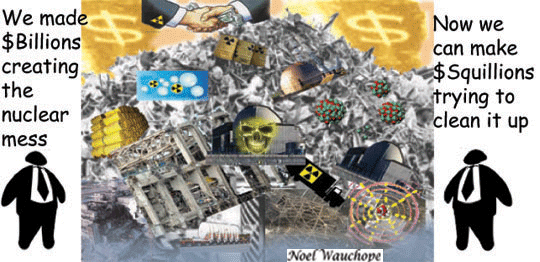
Either way, because of the dangers of radioactivity, it is not a problem that can be ignored. The sums of money that governments will have to find to deal with keeping the old stations safe are eye-wateringly large. They will run into many billions of dollars — an assured income for companies in the nuclear waste business, stretching to the end of this century and beyond.
The U.S. is a prime example of a country where the nuclear waste issue is becoming rapidly more urgent.
The problem has been brought to the fore in the U.S. because five stations have closed in the last two years. The Crystal River plant in Florida and San Onofre 1 and 2 in California have closed down because they were judged too costly to bring up to modern standards. Two more – Kewaunee in Wisconsin and the Vermont Yankee plant – could no longer compete on cost with the current price of natural gas and increased subsidies for renewables.
Nuclear Energy Insider, which keeps a forensic watch on the industry, predicts that several other nuclear power stations in the U.S. will also succumb to premature closure because they can no longer compete.
The dilemma for the industry is that the U.S. government has not solved the problem of what to do with the spent fuel and the highly radioactive nuclear waste that these stations have generated over the last 40 years. They have collected a levy – kept in a separate fund that now amounts to $31 billion – to pay for solving the problem, but still have not come up with a plan.
Legal action
Since it costs an estimated $10 million dollars a year to keep spent fuel safe at closed stations, electricity utilities saddled with these losses, and without any form of income, are taking legal action against the government.
The U.S. government has voted another $205 million to continue exploring the idea of sending the waste to the remote Yucca Mountain in Nevada — an idea fought over since 1987 and still no nearer solution. Even if this plan went through, the facility would not be built and accepting waste until 2048.
The big problem for the U.S., the utility companies and the consumers who will ultimately pay the bill is what to do in the meantime with the old stations, the spent fuel, and the sites. Much of the fuel will be moved from wet storage to easier-to-manage dry storage, but it will still be a costly process. What happens after that, and who will pay for it, is anyone’s guess.
The industry is having a Nuclear Decommissioning and Used Fuel Strategy Summit in October in Charlotte, North Carolina, to try to sort out some of these issues.
But America is not alone. The U.K. has already closed a dozen reactors. Most of the rest are due to be retired by 2024, but it is likely that the French company EDF, which owns the plants, will try to keep them open longer.
The bill for dealing with existing nuclear waste in Britain is constantly rising and currently stands at £74 billion, even without any other reactors being decommissioned.
The government is already spending £2 billion each year trying to clear up the legacy of past nuclear activities, but has as yet found no solution to dealing with the thousands of fuel rods still in permanent store at power stations.
As with the U.S., even if a solution is found, it would be at least 2050 before a facility to deal with this highly dangerous waste could be found. By that time, billions of pounds will have been expended just to keep the used fuel from igniting and causing a nuclear meltdown.
It is hard to know how the industry’s finances could stand such a drain on its resources without going bankrupt.
Similar problems are faced by Germany, which is already closing its industry permanently in favour of renewables, and France, with more than 50 ageing reactors.
Japan, still dealing with the aftermath of the Fukushima accident in 2011, is composed of crowded islands where few people will welcome a nuclear waste depository.
Many countries in the former Soviet bloc with ageing reactors look to Russia – which provided them – to solve their problems. But this may be a false hope, as Russia has an enormous unsolved waste problem of its own.
Dramatic rise
In all these countries, the issue of nuclear waste and what to do with it is a problem that has been put off – both by the industry and politicians – as an issue to be dealt with sometime in the future. But the problem is becoming more urgent as the costs and the volume of waste rises dramatically.
Unlike any other form of generation, even dirty coal plants, getting rid of nuclear stations is no simple matter. To cleanse a nuclear site so that it can be used for another industrial use is difficult. Radioactivity lasts for centuries, and all contamination has to be physically removed.
For many critics of the industry, the nuclear waste issue has always been a moral issue – as well as a financial one – that should not be left to future generations to solve. The industry itself has always relied on its continuous expansion, and developing science, to deal what it calls “back end costs” at some time in the distant future.
But as more stations close, and fewer new ones are planned to raise revenue, putting off the problem no longer seems an option, either for the industry or for the governments that ultimately will have to pick up the bill.
Spent nuclear fuel crisis at closed Kewaunee nuclear plant
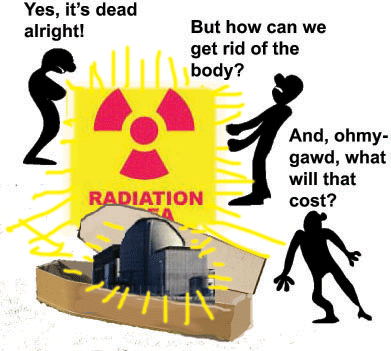 Outcry prompts expedited plan to move fuel at Kewaunee nuclear plant Milwaukee Wisconsin Journal Sentinel by Thomas Content 6 July 14 The Kewaunee nuclear power plant stopped producing electricity more than a year ago, but it left behind highly hazardous waste that has no place to go.
Radioactive rods of used nuclear fuel are cooling in a large storage pool inside the reactor, located east of Green Bay on the shore of Lake Michigan. Plant owner Dominion Resources Inc. wants to speed up plans to empty the pool and put the rods in more secure long-term storage.
Under Dominion’s plan, all of the spent fuel will be moved from the pool by the end of 2016. The rods will be encased in 24 concrete casks, each standing 18 feet tall, that will be moved from the reactor building to a concrete pad outside, said Dominion spokesman Mark Kanz.
Once they’re relocated, it’s unclear how long the radioactive remnants of the nuclear industry will stay in the casks. That’s because the federal government has no long-term plan for disposing of the waste now stored at scores of reactors around the country. According to the Nuclear Energy Institute, Wisconsin has 1,430 tons, or about 2%, of the nation’s spent fuel.
Dominion hired NAC International of Atlanta to build and fill the casks, and move them from the Kewaunee reactor building. Terms of Dominion’s deal with NAC haven’t been disclosed, but the company told federal regulators that it will spend $103 million through 2016 to manage the spent fuel.
The company accelerated plans to remove and encase the spent fuel to address concerns raised by members of the local community, Kanz said.
Last year, residents and officials in the Kewaunee County Town of Carlton criticized Dominion after the company said it would take the full 60 years allowed by the federal government to decommission the power plant.
Taking that long to shutter the plant would cripple efforts to attract economic development to the area, they said………
A nuclear safety watchdog group, the Union of Concerned Scientists, says the risk to the public is decreased when the spent fuel is placed in concrete casks rather than keeping it in spent fuel pools………
The project is being paid for by the customers of three Wisconsin utilities — the former co-owners of the power plant. Those customers paid surcharges over the years into a decommissioning fund.
The value of that fund is less than Dominion says it needs to spend, at $649.3 million at the end of 2013. Dominion says the money is being invested so that it will grow over time and that there should be sufficient money available to pay for the decommissioning.
Dominion has also committed $60 million from its Virginia-based parent company toward the project, in the event funds in the decommissioning fund run short.
Wisconsin’s electric utility customers wouldn’t end up having to pay more, because Dominion bought the plant from Wisconsin utilities and took responsibility for decommissioning at that time.
When Wisconsin regulators approved the sale of the Kewaunee Power Station in 2005, they ordered Dominion to return any unspent decommissioning funds to state ratepayers……
As the stalemate in Washington over waste storage continues, the stockpiles of stored spent nuclear fuel enclosed in concrete casks are multiplying. How long the concrete casks will stay at the Kewaunee, Point Beach and La Crosse reactors in Wisconsin is very much up in the air.
Dominion’s plan calls for concrete casks to start being shipped to the control of the federal government within seven years — but that timeline may be merely wishful thinking, said David Lochbaum of the Union of Concerned Scientists’ nuclear safety project.
“I likely have a better chance of winning the lottery than spent fuel leaving Kewaunee site in 2021 — and I don’t buy lottery tickets,” he said. http://www.jsonline.com/business/outcry-prompts-expedited-plan-to-move-fuel-at-kewaunee-nuclear-plant-b99302369z1-265974071.html
Plutonium flows to the Pacific from Fukushima’s ruptured nuclear reactor containments
 Gov’t Expert: Plutonium is certainly being discharged into Pacific Ocean from Fukushima plant; Flowing out of ruptured containments — TV: Reactor water turns into ‘yellowish, fizzing liquid’ from damaged fuel rods… “It actually vibrates” (PHOTO & VIDEO) http://enenews.com/study-plutonium-being-discharged-fukushima-pacific-ocean-flowing-ruptured-containment-vessels-tv-reactor-water-becomes-yellowish-fizzing-liquid-damaged-fuel-rods-actually-vibrates-video?utm_source=feedburner&utm_medium=email&utm_campaign=Feed%3A+ENENews+%28Energy+News%29
P. Bossew, German Federal Office for Radiation Protection, PLUTONIUM EMISSION FROM THE FUKUSHIMA ACCIDENT (pdf), 2013 (emphasis added): While much has since been published on environmental contamination and exposure to radio-iodine and radio-caesium, little is known about releases of plutonium […] The inability to cool the fuel led to melting of parts of the reactor cores (which parts exactly, is not yet well known) […] [Causes of the containment] ruptures and leaks […] are not entirely clarified […] explosion seems to have produced further structural damage in the containments, at the one hand, and on the other hand released large amounts of radionuclides into the environment. […] the fraction of Pu released into the environment can be expected to be higher [than] atmospheric releases only. Certainly some Pu has been released with liquid effluents and discharged into the ocean. […] The liquid discharges certainly also contained Pu. […]
‘Modern Marvels‘ History Channel (at 19:45 in): It is now 28 hours since the accident at Three Mile Island began. The men in the control room have no way of looking into the reactor…. it now seems clear some of the 36,000 slendertubes holding the uranium fuel have cracked, this is allowing radioactivity to escape into the reactor coolant water. It is imperative operators know how much radioactivity is now in the coolant. Too much, and the nuclear chain reaction could restart… Foreman Ed Hauser agrees to risk his life to take the readings. This is allowing radioactivity to enter the coolant water. He is in for an even greater scare when he draws the coolant water sample. The water from the reactor should be clear; instead he stares at a yellowish, fizzing liquid… It actually vibrates in his hand.
Tough challenge: nuclear cleanup of 1976 ‘Atomic Man’ Hanford disaster site
Nuclear site home to the 1976 ‘Atomic Man’ disaster that exposed worker to ‘500 times’ the occupational standard of radiation to be demolished Daily Mail, 4 July 14
- Harold McCluskey was working at the Hanford Nuclear Reservation when a chemical reaction caused a glass glove box to explode.
- He was exposed to the highest dose of radiation from the chemical element americium ever recorded — 500 times the occupational standard
- It took more than a year for doctors to remove enough radioactive material from his body to make it safe for him to be around other people
- The DOE hopes to have the facility ready for demolition by summer 2016
By DAILY MAIL REPORTER and AP
“……….Hanford contains the nation’s greatest collection of nuclear waste, and for more than two decades has been engaged in the dangerous work of cleaning up that waste. The space now dubbed the McCluskey Room is located inside the closed Plutonium Finishing Plant and is scheduled for cleanup this summer.
‘It’s been largely closed up since the accident,’ Geoff Tyree, a spokesman for the U.S. Department of Energy in Richland, said Wednesday. ‘It was restricted for the potential for airborne radiation contamination.’
Since 2008, the Department of Energy and contractor CH2M HILL Plateau Remediation Company have been preparing the plant for demolition.
‘About two-thirds of the Plutonium Finishing Plant is deactivated — cleaned out and ready for demolition,’ said Jon Peschong, an assistant DOE manager in Richland. ‘Cleaning out the McCluskey Room will be a major step forward.’
When specially trained and equipped workers enter the room this summer, they will encounter airborne radioactivity, surface contamination, confined spaces and poor ventilation, the DOE said.
They will be wearing abrasion-resistant suits that protect them from surface contamination and chemicals. A dual-purpose air system will provide cool air for breathing and cool air throughout the suit for worker comfort, allowing them to work for longer periods of time. The suits are pressurized, to prevent workers from coming into contact with airborne contaminants.
The McCluskey Room ‘is going to be the toughest work ahead of us as we finish cleaning the plant and getting it ready for demolition by the end of September 2016,’ Tyree said. http://www.dailymail.co.uk/news/article-2678623/Department-Energy-plans-demolition-nuclear-site-home-1976-Atomic-Man-disaster-exposed-worker-500-times-occupational-sta
Russia’s huge nuclear waste dumps in Arctic seas
 Russia announces enormous finds of radioactive waste and nuclear reactors in Arctic seas August 28, 2012 by Bellona Enormous quantities of decommissioned Russian nuclear reactors and radioactive waste were dumped into the Kara Sea in the Arctic Ocean north of Siberia over a course of decades, according to documents given to Norwegian officials by Russian authorities and published in Norwegian media. “…..The catalogue of waste dumped at sea by the Soviets, according to documents seen by Bellona, and which were today released by the Norwegian daily Aftenposten, includes some 17,000 containers of radioactive waste, 19 ships containing radioactive waste, 14 nuclear reactors, including five that still contain spent nuclear fuel; 735 other pieces of radiactively contaminated heavy machinery, and the K-27 nuclear submarine with its two reactors loaded with nuclear fuel.
Bellona’s two decades on the case
“Bellona has worked with this issue since 1992 when we first revealed the dangerous nuclear waste laying at the bottom of the Kara Sea,” said Bellona President Frederic Hauge.
He acknowledged, however, that a precise accounting from the Russian side could hardly be expected given Russia’s own ignorance of the extent of the dumped radioactive waste………
Making way for oil exploration
Bellona’s Igor Kurdrik, an expert on Russian naval nuclear waste, said that, “We know that the Russians have an interest in oil exploration in this area. They therefore want to know were the radioactive waste is so they can clean it up before they beging oil recovery operations.” He cautiously praised the openness of the Russian report given to Norway and that Norway would be taking part in the waste charting expedition.
Bellona thinks that Russia has passed its report to Norway as a veiled cry for help, as the exent of the problem is far too great for Moscow to handle on its own.
The most crucial find missing
Kudrik said that one of the most critical pieces of information missing from the report released to the Norwegian Radiation Protection Authority was the presence of the K-27 nuclear submarine, which was scuttled in 50 meters of water with its two reactors filled with spent nuclear fuel in in Stepovogo Bay in the Kara Sea in 1981.
Information that the reactors about the K-27 could reachieve criticality and explode was released at the Bellona-Rosatom seminar in February…….http://bellona.org/news/uncategorized/2012-08-russia-announces-enormous-finds-of-radioactive-waste-and-nuclear-reactors-in-arctic-seas
Plutonium in the playground – Fukushima
 Study: Fukushima plutonium in playground 60 km from nuclear plant — “Proves that indeed Plutonium has been emitted by the accident” — Some “in the form of fuel fragments”? — Up to 14 Billion Bq of Pu-239 and-240 released (MAP) http://enenews.com/study-fukushima-plutonium-in-playground-60-km-from-nuclear-plant-proves-that-indeed-plutonium-has-been-emitted-by-the-accident-some-may-be-in-
P. Bossew, German Federal Office for Radiation Protection, PLUTONIUM EMISSION FROM THE FUKUSHIMA ACCIDENT (pdf), 2013 (emphasis added): […] Apparently no explosive fuel fragmentation occurred, so that little, if any of the release happened in the form of fuel fragments. […] Only scattered data are available from the farther surroundings. It can be assumed that continuous and frequent monitoring of environmental media for Pu from locations more distant than a few km was deemed unnecessary […] Given two different sources (global and Fukushima fallout) with different, but known 238Pu : 239+240Pu ratios, the contributions of the both in a sample which is a mixture of both can be calculated […] we estimated a median 2.28 (95% conf. interval 1.98 –2.58), [15] and 2.19 ± 0.48 (1 ), [14], for Fukushima emissions. […] The background Pu ratio in global fallout has been reported 0.035 ± 0.008 […] a map of the 238Pu : 239+240Pu ratio in the region around the NPP […] The “trace” towards NW from the NPP, in which the Pu ratio deviates strongly from the background […] This proves that indeed Pu has been emitted by the accident […] For 238Pu, the Fukushima contribution is much higher than the global one in many places (as detectable at all) because the Pu ratio is much higher in Fukushima (~2.19) than in global fallout (~0.035). […] Keeping with [the total 137Cs release of] 15 PBq given by NISA […] we find an atmospheric emission of 239+240Pu equal 4.2 GBq. Using the upper estimate of released 137Cs, 50 PBq, a release of 14 GBq is found. [NISA 239+240Pu estimate = 6.4 GBq; Zheng et al. 239+240Pu estimate = 1.0 to 2.4 GBq] […] It should be stressed that the evidence of Pu from Fukushima does not pose any radiological concern […]
P. Bossew, German Federal Office for Radiation Protection, Hirosaki University, Anthropogenic Radionuclides in Environmental Samples from Fukushima Prefecture (pdf), 2013: Three samples [all taken approx. 60 km from FDNPP, 1 from a parking area in Koriyama city and 2 from a playground in Fukushima city] were measured twice […] Sample 4 was too small for a meaningful analysis. […] The result found in this study is consistent with a Pu/ Cs ratio reported by Imanaka et al. (2012) for a highly contaminated place in the Fukushima zone as below 1 E-6 […] Zheng et al. 2011 found 239+240 Pu/137Cs in soil, close to the NPP, as (3.6 ± 1.1) E-7 (only samples with 241Pu>0 considered, and Fukushima contribution 87% to the sample J-village, surface soil , as suggested by the authors), which is in good agreement with the results of this study.
1 This Month
23-25 October – on Zoom – World BEYOND War’s annual global conferenc


Shut down the radiation-damaged Heysham nuclear reactors now
To see nuclear-related stories in greater depth and intensity – go to https://nuclearinformation.wordpress.com

Say No to NASA’s Reckless Nuclear Reactor on the Moon
Say No to NASA’s Reckless Nuclear Reactor on the Moon

-
Archives
- October 2026 (219)
- September 2026 (339)
- August 2026 (330)
- July 2026 (355)
- June 2026 (287)
- May 2026 (306)
- April 2026 (356)
- March 2026 (251)
- February 2026 (267)
- January 2026 (308)
- December 2025 (358)
- November 2025 (359)
-
Categories
- 1
- 1 NUCLEAR ISSUES
- business and costs
- climate change
- culture and arts
- ENERGY
- environment
- health
- history
- indigenous issues
- Legal
- marketing of nuclear
- media
- opposition to nuclear
- PERSONAL STORIES
- politics
- politics international
- Religion and ethics
- safety
- secrets,lies and civil liberties
- spinbuster
- technology
- Uranium
- wastes
- weapons and war
- Women
- 2 WORLD
- ACTION
- AFRICA
- Atrocities
- AUSTRALIA
- Christina's notes
- Christina's themes
- culture and arts
- Events
- Fuk 2022
- Fuk 2023
- Fukushima 2017
- Fukushima 2018
- fukushima 2019
- Fukushima 2020
- Fukushima 2021
- general
- global warming
- Humour (God we need it)
- Nuclear
- RARE EARTHS
- Reference
- resources – print
- Resources -audiovicual
- Weekly Newsletter
- World
- World Nuclear
- YouTube
-
RSS
Entries RSS
Comments RSS

