Massive transport of nuclear waste crossing the ocean from Fukushima
Fukushima forecast used by gov’t shows nuclear waste crossing ocean in single massive cluster — “Maximum concentration propagates eastward in Pacific toward U.S.” — Highest levels worldwide remain along coast of N. America through 2026 (VIDEO) http://enenews.com/fukushima-forecast-govt-shows-nuclear-waste-crossing-ocean-single-massive-cluster-maximum-concentration-propagates-eastward-pacific-highest-levels-world-remain-coast-america-2026-video?utm_source=feedburner&utm_medium=email&utm_campaign=Feed%3A+ENENews+%28Energy+News%29
Nansen Environmental and Remote Sensing Center (Norway), 2013 (emphasis added): The massive nuclear leakage into ocean from Fukushima Nuclear Power Plant was observed on March 25th,2011. The transport of leaked radioactive pollutant from the Fukushima Nuclear Power Plant was simulated… assuming constant and continuous leakage for 20 days (scenario 1) and for one year(scenario 2) starting from March 25th, 2011 and was integrated for 20 years… There is no remarkable difference of transport pathways… for the nuclear waste… The results of the ensembles indicate that the nuclear pollutant for both scenarios transports eastward to eastern Pacific… It takes about 10 to 15 years to reach the coast of East Asia… a realistic sourcefunction is required and atmospheric fallout and role of ocean ecology should also be taken into account, in order to get a more reliable assessment of possible impact of the radioactive leakage on the ocean environment.

Nansen Environmental and Remote Sensing Center, Prof. Ola Johannessen, University of Bergen Geophysical Institute: Ocean spreading of radioactivity from the Fukushima nuclear plant in Japan […] The results show that the maximum concentration propagates eastward in the Pacific toward the United States during a 7-year period while the total concentration drops to 1-2% of the source concentration (100%) after 5 years.
Nansen-Zhu International Research Centre, China: Extraordinary earthquake hit Japan and led the nuclear leakage of Japanese Fukushima reactor to the ocean. Dr. Yongqi Gao with colleagues at NERSC and NZC used the numerical model to simulate the propagation of radioactive elements in the ocean. Model system has been used for EU RADARC (Simulation scenarios for potential radioactive spreading in the 21st century from rivers and external sources in the Russian Arctic coastal zone, 2001-2003) and Norwegian Research Council supported project ARC (Arctic Radioactive Contamination, 2004-2006)… results were also cited by the State Council of China.
Red Wing and Prairie Island Indian Community say new NRC waste ruling is no good

the only sensible thing to do is to STOP MAKING RADIOACTIVE TRASH
Red Wing officials disappointed in feds’ decision on spent nuclear fuel, MINN POST, By Joe Kimball | 09/03/14 Red Wing city officials and leaders of the Prairie Island Indian Community say they are unhappy with a recent Nuclear Regulatory Commission ruling that does little to resolve the ongoing dispute over storage of spent nuclear fuel.
The Prairie Island nuclear power plant is on the Mississippi River in Red Wing, and is adjacent to the Indian reservation.
A story in the Rochester Post Bulletin says the NRC ruling:
“…opens the door for on-site nuclear waste storage for 100 years or more. The language also lifts a suspension on licensing additional nuclear facilities even without the creation of a national repository for nuclear waste.”
Not good, says Red Wing City Council member Peggy Rehder, who has lobbied in Washington, D.C., on the issue, and wasn’t surprised with the ruling……
And Ron Johnson, president of the Prairie Island Indian Community’s Tribal Council, said in a statement:
“…the NRC affirmed a new rule and generic environmental impact statement that concluded that spent nuclear fuel — some of the most dangerous and toxic substances known to mankind — can be safely stored 600 yards from our homes indefinitely if no geologic repository is ever built. No other community sits as close to a nuclear site and its waste storage.”
According to the paper, Xcel Energy says it has “38 casks containing nuclear waste near Red Wing and is permitted to store waste in 64 casks when the current operating licenses end in 2033 and 2034.” http://www.minnpost.com/political-agenda/2014/09/red-wing-officials-disappointed-feds-decision-spent-nuclear-fuel
USA government plans radioactive trash trains to… nowhere

Putting the cart before the horse, the U.S. Department of Energy recently asked companies for ideas on how the government should get the rail cars needed to haul 150-ton casks filled with used, radioactive nuclear fuel.
They won’t be moving anytime soon. The latest government plans call for having an interim test storage site in 2021 and a long-term geologic depository in 2048.
No one knows where those sites will be, Continue reading
Final abandonment of Fukushima communities – as governor agrees to nuclear waste storage

 Fukushima governor accepts ‘temporary’ radioactive waste storage http://www.radioaustralia.net.au/international/2014-09-01/fukushima-governor-accepts-temporary-radioactive-waste-storage/1363279 1 September 2014,
The governor of Fukushima has agreed to accept the “temporary” storage of radioactive waste from the 2011 nuclear disaster. Yuhei Sato has been cajoled with the promises of subsidies if he accepts a Japanese government plan to build a depot on land near the battered Fukushima Daiichi plant.
“I have made an agonising decision to accept plans to construct temporary storage facilities in order to achieve recovery in the environment as soon as possible,” Mr Sato told central government ministers in Tokyo. A magnitude 9.0 earthquake and subsequent tsunami in March 2011 prompted the meltdown of the Fukushima nuclear plant on Japan’s northeast coast.
The resulting plumes of radiation contaminated areas far and wide, rendering a swathe of Fukushima uninhabitable and forcing tens of thousands of people from their homes.Tokyo’s solution has been to try to scrub the radiation from the affected areas, often by lifting topsoil in the hope that contamination levels will go down. This has left the problem of what to do with all the waste, with no community in Japan prepared to accept its permanent storage.
The government’s answer has been to seek a temporary fix while it works on getting a long-term plan in place.Mr Sato’s acquiescence came after prime minister Shinzo Abe’s government offered subsidies worth more than 300 billion yen ($2.9 billion), including land rent for the facility location.
Under the plan, the government will build storage units on an area of 16 square kilometres near the power plant.
While observers have long said the area around Fukushima is the only viable option, people already displaced have seen it as unacceptable because it would in effect finalise the abandonment of their communities.
Nuclear Regulatory Commission’s touching religious faith in future arrival of a solution to wastes of
the only sane action is to stop making radioactive trash

 Nuclear Waste Is Allowed Above Ground Indefinitely NYT, By MATTHEW L. WALDAUG. 29, 2014 As the country struggles to find a place to bury spent nuclear fuel, theNuclear Regulatory Commission has decided that nuclear waste from power plants can be stored above ground in containers that can be maintained and guarded indefinitely.
The decision, in a unanimous vote of the commission on Tuesday, means that new nuclear plants can be built and old ones can expand their operations despite the lack of a long-term plan for disposing of the waste.

The chairwoman of the commission, who voted with the majority but dissented on certain aspects, said Friday that the vote risked allowing Congress to ignore the long-term problem.
“If you make the assumption that there will be some kind of institution that will exist, like the Nuclear Regulatory Commission, that will assure material stays safe for hundreds or thousands of years, there’s not much impetus for Congress to want to deal with this issue,” the chairwoman, Allison M. Macfarlane, said Friday. “Personally, I think that we can’t say with any certainty what the future will look like. We’re pretty damned poor at predicting the future.”………
The commission approved a generic environmental impact statement, under which nuclear activities can continue, but did not address the impact to the environment if the stored nuclear waste were abandoned, which would leave it vulnerable to attack or allow the containers to break down.
Ms. Macfarlane said it was wrong to predict institutional control indefinitely. “Best not to say anything about something so uncertain,” she said, “and just to work with what we can know for sure.”
For decades the commission has allowed nuclear plants to operate under what it called its waste confidence rule, which said that although there was no repository, there would most likely be one by the time it was needed, and in the interim, the storage of the highly radioactive waste in spent fuel pools or in dry casks would suffice. But in June 2012, a court ruled that the commission had not done its homework in studying whether the waste could be stored on an interim basis. As a result, the commission froze much of its licensing activity two years ago.
On Tuesday, however, the commission approved a finding by its staff that waste could be stored — as opposed to disposed of — indefinitely. The vote was 4-0.
Some nuclear opponents say the issue is certain to wind up back in court. At the Natural Resources Defense Council, Geoffrey H. Fettus, the lead lawyer in the original case, said in a statement: “The Nuclear Regulatory Commission failed to analyze the long-term environmental consequences of indefinite storage of highly toxic and radioactive nuclear waste; the risks of which are apparent to any observer of history over the past 50 years. The commission failed to follow the express directions of the court.”……http://www.nytimes.com/2014/08/30/us/spent-nuclear-fuel-is-allowed-to-be-stored-above-ground.html?_r=0
USA Congressman Dan Kildee fighting proposal for nuclear waste dump near Lake Huron
they must also stop making this radioactive trash
U.S. Rep. Dan Kildee to fight proposed Canadian nuclear waste facility on shores of Lake Huron M Live, By Sam Easter | seaster@mlive.com on August 28, 2014 BAY CITY, MI — Standing at the helm of the tall ship Appledore IV, U.S. Rep. Dan Kildee said the schooner based in downtown Bay City was the “perfect” place to make a few points about protecting the Great Lakes from nuclear waste.
Kildee spoke during the afternoon of Thursday, Aug. 28, addressing plans by Ontario Power Generation to build a storage facility for low- to intermediate-level nuclear waste at a proposed underground facility near Kincardine, Ontario.
“Canada is a friend, but it is a country with vast land mass, and I’m sure that the best place for a nuclear storage facility cannot be less than a mile from the shores of Lake Huron,” he said, regardless of whether officials say it’s scientifically sound. A point of contention among Michigan’s state and federal legislators for at least a year, the proposed facililty has also met strong opposition from local governments — officials from Bay County and Essexville both passed resolutions opposing the facility this month.
Kildee on Thursday announced he plant to introduce a Congressional resolution when legislators return from recess on Monday, Sept. 8, that — while lacking regulatory power — would voice the opinion of Congress on the matter. The resolution states that 40 million people in both countries depend on the Great Lakes’ drinking water, and that a nuclear spill “could have lasting and severely adverse environmental, health and economic impacts on the Great Lakes.”
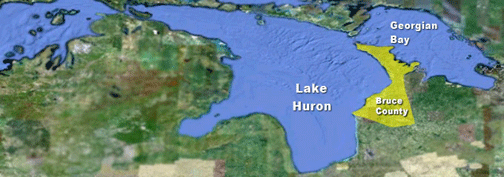
If adopted, the resolution would discourage the Canadian government from building a nuclear storage site in the Great Lakes Basin and urge both President Obama and Secretary of State John Kerry to work with their Canadian counterparts to find an alternate location……..
Multiple officials were present for Kildee’s announcement, including Laura Ogar, Bay County director of environmental affairs and community development, as well as Terry Miller, chairman of the local environmental group Lone Tree Council.
Shirley Roberts is the executive director of BaySail, which owns and operates the Appledore. She said that the Appledore was an appropriate place for the presentation, and that she support’s Kildee’s fight against the facility.
“I have grave concerns about the concept,” she said. http://www.mlive.com/news/bay-city/index.ssf/2014/08/us_rep_dan_kildee_announces_pl.html
USA Nuclear permits to resume , as NRC renews its religious faith in a future solution to radioactive trash problem
U.S. to Resume Nuclear Permits, Relicensing on Waste Rule http://www.bloomberg.com/news/2014-08-26/u-s-to-resume-nuclear-permits-relicensing-on-waste-rule.html
The commission approved a final rule addressing the environmental effects of storing spent nuclear fuel at a plant site, satisfying a court order that it needed to consider the possibility a permanent underground waste repository may never be built in the U.S., according to a statement today.
The Court of Appeals struck down the agency’s “waste confidence” rule in June 2012, saying the regulator also needed to do further studies on spent fuel pool leaks and fires. The agency suspended final licensing decisions on new reactors as well as license renewals for plants and storage facilities while it formulated its response. That suspension will be lifted once the final storage rule becomes effective, 30 days after publication in the Federal Register.
“The completion of this rulemaking is an important step that will facilitate final decisions on industry licensing actions pending,” Ellen Ginsberg, general counsel for the Washington-based industry group the Nuclear Energy Institute, said in a statement.
There are currently eight applications to build reactors awaiting agency action, according to its website. About 74 percent of the 100 operating U.S. reactors have been relicensed, allowing them to operate 20 years beyond their original 40-year lifespan.
Among the plants awaiting relicensing are Entergy Corp. (ETR)’s Indian Point reactors in New York and PG&E Corp.’s Diablo Canyon units in California.
To contact the reporter on this story: Mark Chediak in San Francisco at mchediak@bloomberg.net
To contact the editors responsible for this story: Susan Warren at susanwarren@bloomberg.netTina Davis, Robin Saponar
South Korea – getting “full up” with nuclear radioactive trash
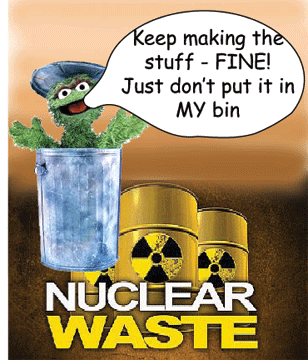
they must just stop making this trash!
South Korea running out of space for nuclear waste http://www.abc.net.au/news/2014-08-18/south-korea-running-out-of-space-for-nuclear-waste/5679626 South Korea is running out of space to store its spent nuclear fuel, with some of its storage facilities set to reach capacity by 2016, according to an independent body that advises the government on nuclear issues.
A Public Engagement Commission, consisting of nuclear experts, professors, and officials, was set up in October 2013 to take account of public opinion on spent nuclear fuel issues and feed into policy decisions.
Commission chairman Hong Doo-seung says it is urgent to find more storage sites for spent fuel.
“We will have to stop nuclear power generation if we fail to find additional temporary space, Continue reading
Mississippi Public Service Commission refusing to take nuclear wastes
Presley to Obama: Mississippi doesn’t want nuclear waste POLITICAL LEDGER Geoff Pender, The Clarion-Ledger10 August 19, 2014 Public Service Commissioner Brandon Presley has forwarded to President Obama resolutions passed by the PSC in opposition to storing nuclear waste in Mississippi.
Last year, federal officials considering alternatives to plans to store the nation’s nuclear waste at Yucca Mountain, Nevada, mentioned Mississippi’s salt domes as a possible option. At the time, the Mississippi Energy Institute issued a report that said creating a nuclear waste center in Mississippi would “serve as a platform for significant opportunities … to develop a massive nuclear energy industry center in the state of Mississippi.”
Presley said that more recently, Assistant Secretary of Nuclear Energy Peter Lyons was quoted as calling Mississippi one of “the most public of potential hosts to express interest in taking high-level waste.”
Presley, Northern District commissioner with the three-member PSC, this week sent Obama recent unanimously-passed PSC resolutions opposing permanent nuclear waste storage in Mississippi, …….http://www.clarionledger.com/story/politicalledger/2014/08/19/nuclear-waste-presley-psc/14283689/
Toxicity of planned wastes raises anxiety about Lake Huron nuclear dump scheme
Lake Huron nuclear dump scheme in trouble Hamilton Spectator by Thomas Walkom 7 Aug 14, Ontario’s plan to bury nuclear waste beside Lake Huron is running into heavy weather.
Ontario Power Generation, the Crown corporation behind the proposed dump site for low and intermediate level radioactive waste, has publicly acknowledged that its long-term safety plans are based, in part, on new technologies that have not yet been invented.
As the Star’s John Spears reported this week, that explanation hasn’t endeared itself to the small but politically important aboriginal communities near the proposed Kincardine dump site.
In a brief to the federal review panel that will eventually rule on the plan, the Saugeen Ojibway Nation reminds OPG of its assurance that no nuclear waste dump will be built without aboriginal consent
Will that consent be given? The first nation doesn’t say. But in its brief, it does express profound unease with what it calls OPG’s vague and open-ended scheme.
Plans for this so-called deep geological repository at Kincardine have been in the works since 2005.
Initially, the proposed dump was supposed to house waste such as the rubber gloves used by nuclear workers — items with relatively low levels of radioactivity.
Right now, nuclear waste from Ontario atomic power generating plants is stored on the surface.
But once federal hearings started last fall, OPG changed tack. It announced it wanted to double the size of the underground dump to roughly 400,000 cubic metres in order to accommodate waste that will be produced when the province’s existing nuclear plants are taken apart.
This so-called decommissioning waste, which includes components such as pressure tubes (but not nuclear fuel), will remain highly radioactive for thousands of years.
Critics cried foul. The three-member federal panel hearing the proposal ordered OPG to better explain how it would handle this more difficult waste.
It also told the Crown utility to look into why a similar U.S. nuclear waste facility near Carlsbad New Mexico — cited by dump proponents as a model — suffered two accidents in February……….http://www.thespec.com/opinion-story/4737032-lake-huron-nuclear-dump-scheme-in-trouble/
Massive, decaying, dangerous, weapons empire at Oak Ridge
Y-12: Poster child for a dysfunctional nuclear weapons complex Robert Alvarez, Bulletin of the Atomic Scientists 6 Aug 14 “……The United States halted production of new nuclear weapons in 1989, with the end of the Cold War. But the US nuclear weapons complex—composed of eight key facilities that have an annual budget exceeding $8 billion—has stumbled on, in the form of a massive, decaying empire that in many cases does its work poorly or dangerously, or both. The Y-12 National Security Complex is the poster child for much of what ails the weapons complex. Although Y-12 has not produced weapons for some 25 years, its annual budgets have increased by nearly 50 percent since 1997, to more than $1 billion a year.

For decades, the Energy Department—which manages the weapons complex through the National Nuclear Security Agency (NNSA)—has not been able to reconcile competing objectives at the 811-acre Y-12 site, whether they involve storage areas for HEU and other fissile materials, the restarting of old weapons facilities, environmental cleanup, the building of new weapons facilities, or the downsizing of the site. As a result, costs have significantly increased, and long-standing problems have continued, unresolved, for years that have run into decades. For every dollar spent to maintain and modernize the US nuclear weapons stockpile, nearly three dollars is spent “to provide the underlying infrastructure” for maintenance and modernization at Y-12.
Long-term secrecy and isolation have created a dangerous form of hoarding at Y-12; a panoply of severe hazards continues to build up, constantly awaiting ever more costly mitigation in the future. But the stark reality is that there are no more cans to kick down the road. Y-12 has inexorably caught up with its future. Its environmental and security problems are too threatening to leave unaddressed, and questions about its mission will have to be answered definitively in an age of budgetary austerity and relatively little need for new nuclear weapons…….
During its heyday, Y-12 produced some 1,000 CSAs per year. Now, its annual production capacity has dwindled to less than 100. Though the NNSA declares that Y-12 has multiple missions, including non-proliferation efforts that involve the downblending of HEU and the provision of fuel for the Navy’s nuclear-powered submarines, nearly 99 percent of its budget comes from funds dedicated to maintain the US nuclear weapons stockpile. More than anything, Y-12 serves to stockpile thousands of CSAs from discarded nuclear weapons, as well as depleted uranium, lithium, and other hazardous chemicals…….. the Government Accountability Office finds that “NNSA’s decision to retain many CSAs … poses significant challenges to Y-12’s ability to plan its disassembly workload.” Although exact numbers have been classified since the 1990s, there are likely several thousand excess CSAs, containing hundreds of tons of HEU, awaiting dismantlement at Y-12. ……
Around New Year’s Eve of 1996, a long-awaited vulnerability assessment of HEU storage at Energy Department sites was released. Y-12 had the most significant problems. Even though fires posed the greatest danger of radiation and chemical exposure to workers and the public, buildings, mostly constructed in the 1940’s, had deteriorated and had insufficient or non-existent fire-protection systems, despite the very real possibility of a truly catastrophic fire and resulting release of radiation. It wasn’t until 14 years later that a replacement facility for the aged wooden structure serving as the main HEU storage warehouse was opened; it cost five times the original construction estimate. That facility gained notoriety in August 2012, after nonviolent peace protestors, including an 84-year-old nun, penetrated its security barriers……..
From 1997 to 2006, there were 21 fires and explosions at Y-12 involving electrical equipment, glove boxes, pumps, waste containers, and nuclear and hazardous chemicals. Several resulted in worker injuries and destruction of property. ……….. In March 2014, a large portion of a concrete ceiling collapsedin a building that was once part of the weapons operation. It was a near miss: Foot-long concrete pieces bounced onto walkways and an area where welders had been working just a day before. …..
In April 2014, the NNSA released a “red team” report, led by the director of Oak Ridge National Laboratory, on the troubled UPF. The team’s most significant recommendation was to rethink a basic, “big-box” approach that would create a UPF to serve multiple functions in one structure. Instead, to hold the line at an estimated $6.5 billion for design and construction costs, the team recommended going back to the drawing board to effectively reduce the size and scope of the project. Meanwhile, in recognition of the growing hazards associated with a deteriorating infrastructure for storing “materials at risk,” the team recommended that greater emphasis should be given to safe consolidated storage of materials, deferred maintenance, and safety upgrading……….
Regardless of the wisdom of or need for an asteroid-protection program, the future of Y-12 should be focused on earthly realities: cleaning up the environment, decontamination and decommissioning of facilities, stabilizing nuclear and other hazardous materials, and the dismantlement of a large excess stockpile of weapons components. There is a very real need to replace the collapsing infrastructure at Y-12 with facilities that can accomplish these goals.
Protecting the planet from asteroids is a poor rationale for failing to deal with the environmental, safety, financial, and health challenges the Y-12 site poses to the people who live in the area, and to the country as a whole. http://thebulletin.org/y-12-poster-child-dysfunctional-nuclear-weapons-complex7361
Fire risk at Waste Isolation Pilot Plant (WIPP)
 Lab Director: Expect radiation spikes coming from US nuclear facility — Gov’t pays for more air monitors to see impact on populated areas — DOE warns of ‘ignitability’ of 368 containers at site; “Significant fire risk” — Top Official: Material at WIPP “just disintegrated… got very hot, very quickly” (VIDEO) http://enenews.com/lab-director-radiation-spikes-expected-nuclear-facility-govt-pays-air-monitors-impact-populated-areas-doe-ignitability-368-containers-wipp-underground-significant-fire-risk-top-official-mater
Dept. of Energy – Carlsbad, NM Field Office (pdf), July 30, 2014: The purpose of this letter is to provide you [New Mexico Environmental Dept.] written notice that the Department of Energy [is] provisionally applying EPA Hazardous Waste Number (code) D001** for the characteristic of ignitability to some nitrate salt bearing waste containers that have been disposed at the WIPP facility. […] This affects up to 368 containers […] in the underground WIPP facility […] The Permittees plan to implement the [plan] to expedite closure of Panel 6 and Panel 7, Room 7 so that a potential release […] will not pose a threat to human health or the environment.
** “Significant fire risk due either to their low flash point, ability to self-combust and burn, or are able to combust or support combustion” –EPA hazardous waste specialist Daniel Stoehr
Reuters, July 26, 2014: A team of government investigators has turned its attention to Los Alamos in recent days […] to determine whether additional barrels are affected, said [New Mexico Senator Peter Wirth]. “We’re making progress in determining what happened. Now we are much more focused on the scope,” he said.
Minutes of the New Mexico Legislature (pdf), published June 26, 2014: In further explaining what occurred [at WIPP, NMED Secretary Ryan] Flynn said that the material holding the bags of magnesium oxide together that had been on top of the drums just disintegrated. By all indications, he added, the area got very hot very quickly […]
Carlsbad, NM Town Hall, July 24, 2014:
- 37:30 in – Question: Is Dr. Hardy saying that radiation from contaminated ventilation system will continue to be released to the environment periodically? Russell Hardy, director of the Carlsbad Environmental Monitoring & Research Center: That is Dr. Hardy’s assumption… we will probably see spikes at Station B, as contamination… makes its way out of the repository.
- 52:30 in – Hardy: We did receive additional funding from DOE to expand our ambient air sampling sites… very soon we will be deploying 3 additional ambient air sampling towers… one will be here in Carlsbad… we think those 3 additions will give us much better coverage in the future with respect to how this release — or the potential for future releases — may impact the area.
Britain’s intractable and expensive problem of accumulating nuclear waste

 Britain’s nuclear waste, a problem proving hard to bury, The Conversation, Stuart Haszeldine Professor of Geology at University of Edinburgh 1 Aug 14
A proposal for radioactive waste to appear at a burial site nearby, would be likely to fill the great majority of the UK population with thoughts of danger, cancer – and falling house prices. This illustrates the huge problem of public misperception to overcome when disposing of radioactive waste. Britain’s nuclear reactors have generated low-carbon electricity since 1956, in doing so creating around 260,000m3 (about the size of 700 double-decker buses) of intermediate-level wasteand 3,000m3 of highly radioactive high-level waste, as well as spent fuel, plutonium and uranium. The price for decommissioning past and existing nuclear power plant and disposing of that waste is around £70 billion – the single largest item of expenditure for the UK Department of Energy and Climate Change.
What to do with radioactive waste is a problem that has so far proved to be intractable to successive generations of civil servants and ministers. In the mid-1970s, it was decided that deep burial would provide the optimum secure solution.
Here, radioactive waste would be packaged and contained for one million years, sealed by multiple chemical and physical barriers within a repository dug out around 500 metres below ground level. A serious attempt was made to investigate a site in West Cumbria close to Sellafield in the 1990’s, but that foundered on the complexity of the geology and flow of deep groundwater, making it difficult to predict how well sealed the waste would be into the far future……….
Another review and public consultation was undertaken during 2013-14, from which emerged the White Paper “Implementing Geological Disposal” published in July 2014. The results show the government has done some serious listening, and it provides some distinctly new approaches.
First, a new body Radioactive Waste Management Ltd will be created to pursue a disposal site. The company will be wholly owned by the government and could propose more than one facility for different types of waste. This has been tried in the 1980s and 1990s with UK Nirex – a limited company wholly owned by UK government, which spent £400m investigating just one site. Can you spot any difference? So how this operates will be more important than the definition.
Second, the government states it is keen to “listen and respond to views and concerns”. Yet in the future this search will now become defined as a nationally significant infrastructure project, which means that many powers of local people to decide or influence could be restricted or removed. Specifically, the control and influence of local councils has been removed, combined with a statement that no tier of government will have the right to veto a project. So the responsibility of regional council authorities for managing this waste, and the associated road and rail and excavation infrastructure is also removed.
Third, the search for a site will become national, with a two-year period of geological survey and screening to identify suitable regions (not specific sites). Identifying secure regions may become difficult if the extensive fracking of England goes ahead for shale gas and oil, as, any effect on the underlying geology could affect a site’s long term secure storage potential………
Potentially the most significant statement of all comes from the secretary of state for energy and climate change, Ed Davey, stating that arrangements for waste disposal have to be in place before planning consent will be given for new nuclear power stations. Does this mean that one or more sites need to be specifically identified before construction can start on the new nuclear reactors planned at Hinkley Point and elsewhere? If formal discussions with new volunteers do not even start until 2016, and could conclude as late as 2030 – by which time Hinkley Point C should be generating power – that seems impossible.
Perhaps ministers of the future be satisfied merely to know that the UK “has a plan”? If the past is any guide to the future, relying on such a plan didn’t help to find a nuclear mausoleum in 1978, 1996, or 2012. https://theconversation.com/britains-nuclear-waste-a-problem-proving-hard-to-bury-29917
UK White paper – Implementing Geological Disposal
Written statement to Parliament UK
Publication of Implementing Geological Disposal White Paper 2014
- Department of Energy & Climate Change and The Rt Hon Edward Davey MP
- Delivered on:
- 22 July 2014
- History:
- Published 24 July 2014
- Part of:
- Managing the use and disposal of radioactive and nuclear substances and waste, Energy, Environment and Public
 safety and emergencies
 - Statement by Edward Davey on the publication of a white paper on geological disposal.
I am today publishing a White Paper on implementing geological disposal of higher activity radioactive waste.The White Paper – Implementing Geological Disposal –follows a public consultation that my department carried out during 2013 on potential amendments to the existing siting process established in 2008 for a geological disposal facility (GDF) and reflects key messages from that consultation, as well as lessons learned during the previous siting process.
The UK Government remains committed to geological disposal as the right policy for the long-term, safe and secure management of higher activity radioactive waste……….
- ……….With regard to new nuclear power, UK Government policy is that, before development consents for new nuclear power stations are granted, I will need to be satisfied that effective arrangements exist or will exist to manage and dispose of the waste they will produce…….
- The White Paper is issued jointly by the UK Government and the Northern Ireland Executive. The Welsh Government is currently considering a wider review of its higher activity radioactive waste management policy. The Scottish Government has a separate higher activity radioactive policy.
Today I am also publishing the latest annual report on the geological disposal programme, covering April 2013 to March 2014. This will be laid in the libraries of the House. https://www.gov.uk/government/speeches/publication-of-implementing-geological-disposal-white-paper-2014
40 $billion later America’s biggest nuclear waste site still leaking
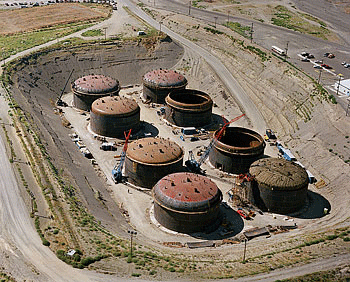 After $40 Billion, America’s Biggest Nuclear Dump Is Still Leaking by Charleston Voice 29 July 14, It’s cost $40 billion so far to clean up America’s biggest nuclear waste site—half the size of Rhode Island—and it’s going to take another 40 years and $100 billion to finish the job.
And delays keep piling up even though at least a third of the aging tanks storing 56 million gallons radioactive waste have leaked or are leaking, pouring some of the world’s most dangerous contaminants into the Columbia River.
Yet the treatment plant to create safe storage for all that waste—which will remain radioactive for hundreds of thousands of years—still isn’t built. It should have been finished three years ago. And the Environmental Protection Agency is skeptical that the plant’s current completion date of 2022 will be met.
Only Another 40 Years to Go The plant is a crucial part of a wider remediation job that’s decades from being done, according to Dennis Faulk, the EPA’s program manager for Hanford
“I think we have another 40 years to go,” Faulk told WhoWhatWhy. “And another $100 billion will be needed over that time.” It costs about $2 billion a year to keep cleaning.
The EPA oversees and enforces the cleanup efforts, which are carried out by the Department of Energy and the contractors it hires. Both Congress and the Department of Energy itself have given those efforts a failing grade.
The Department of Energy’s internal watchdog last year blamed the department and the contractor that’s building the plant, Bechtel National Inc., for the delays. The Department of Energy’s oversight lacked focus and Bechtel implemented scores of design changes without subjecting them to the required nuclear safety review, according to a report from the department’s Inspector General.
Congress’ Government Accountability Office was harsher. It recommended shutting down construction until the design work is completed safely, and said the Department of Energy was prematurely awarding millions in performance incentives to Bechtel. Meanwhile, Bechtel and another contractor are fighting whistleblower lawsuits from two former employees, and guess who’s paying for their legal fees? The Department of Energy is.
All of those complications are worsened by the fact that the search for waste keeps turning up surprises, like nearly 100 pieces of spent fuel found in Native American burial grounds. So as the Herculean task creeps forward, occasional new contamination findings like that add time to the clock, which means the projected completion dates are really only theoretical.
Hanford wasn’t built with an abundance of forethought. The job of making weapons-grade plutonium came first. Everything else, like planning for the waste and telling people about the release of radioactive materials, came second.
Most critical work on the plant has been shut down………..http://chasvoice.blogspot.com.au/2014/07/after-40-billion-americas-biggest.html
1 This Month



9 September – online public forum THREE MILE ISLAND:
7-8:30 PM ET,
Legacy, resistance to reopening – https://us02web.zoom.us/webinar/register/WN_-LGJU4j6TD2Hgf0rpgAr1A#/registration
The nuclear industry and the U.S. Nuclear Regulatory Commission are threatening to restart Pennsylvania’s permanently closed and decommissioning Three Mile Island Unit 1 nuclear power station. Three expert speakers will present the resistance to this dangerous misadventure in a webinar hosted by the Clamshell Alliance, Beyond Nuclear and Massachusetts Peace Action.

No Nuclear in Cwm Llynfi! Stop the nuclear power station near Maesteg.
To see nuclear-related stories in greater depth and intensity – go to https://nuclearinformation.wordpress.com
-
Archives
- September 2026 (116)
- August 2026 (330)
- July 2026 (355)
- June 2026 (287)
- May 2026 (306)
- April 2026 (356)
- March 2026 (251)
- February 2026 (267)
- January 2026 (308)
- December 2025 (358)
- November 2025 (359)
- October 2025 (375)
-
Categories
- 1
- 1 NUCLEAR ISSUES
- business and costs
- climate change
- culture and arts
- ENERGY
- environment
- health
- history
- indigenous issues
- Legal
- marketing of nuclear
- media
- opposition to nuclear
- PERSONAL STORIES
- politics
- politics international
- Religion and ethics
- safety
- secrets,lies and civil liberties
- spinbuster
- technology
- Uranium
- wastes
- weapons and war
- Women
- 2 WORLD
- ACTION
- AFRICA
- Atrocities
- AUSTRALIA
- Christina's notes
- Christina's themes
- culture and arts
- Events
- Fuk 2022
- Fuk 2023
- Fukushima 2017
- Fukushima 2018
- fukushima 2019
- Fukushima 2020
- Fukushima 2021
- general
- global warming
- Humour (God we need it)
- Nuclear
- RARE EARTHS
- Reference
- resources – print
- Resources -audiovicual
- Weekly Newsletter
- World
- World Nuclear
- YouTube
-
RSS
Entries RSS
Comments RSS
 nuclear-news