USA’s Government Accountability Office wants public input into decisions on nuclear waste

 GAO: Nuclear Waste Issue Requires Public Buy-in http://blogs.rollcall.com/energy-xtra/gao-nuclear-waste-issue-requires-public-buy-in/?dcz= By Randy Leonard Nov. 13, 2014 In response to a request from House Republicans, the Government Accountability Office looked into the challenges of the Energy Department’s handling of spent nuclear fuel – which without a central or interim waste storage facilities has been piling up at reactors in 33 states. The office concluded that no matter which path the administration and Congress take, the department needed to conduct a public outreach program.
“Without a better understanding of spent nuclear fuel management issues, the public may be unlikely to support any policy decisions about managing spent nuclear fuel,” the GAO wrote.
The administration in 2010 stalled plans for a geologic repository at Yucca Mountain in Nevada, though a court order last year and Republican control of the Senate will likely meansome further action toward developing the site.
But even proponents of Yucca like Sen. Lamar Alexander, R-Tenn., say that an alternative strategy and facility are needed to process all the waste being generated. He has signed on to a bill that would set up a new administration for handling nuclear waste.
“Officials noted that the department’s strategy cannot be fully implemented until Congress provides direction on a new path forward,” GAO wrote. “However, experts and stakeholders believe that one key challenge – building and sustaining public acceptance of how to manage spent nuclear fuel – will need to be addressed irrespective of which path Congress agrees to take. In this context, they suggested the need for a coordinated public outreach strategy regarding spent nuclear fuel management issues, including perceived risks and benefits, which would be consistent with the administration’s directive to be more transparent and collaborative.”
Even the pro nukes know that burying dead nuclear reactors is a growing and massively costly problem
World Energy Outlook Warns Nuclear Industry On Decommissioning And Disposal 12 Nov (NucNet): The nuclear energy industry needs to be ready to manage “an unprecedented rate” of decommissioning with almost 200 of the 434 reactors that were operating commercially at the end of 2013 to be retired by 2040, a report by the International Energy Agency says. World Energy Outlook 2014 (WEO), released today in London, says “the vast majority” of these reactor retirements will be in the European Union, the US, Russia and Japan. … The IEA estimates the cost of decommissioning plants that are retired to be more than $100 billion.
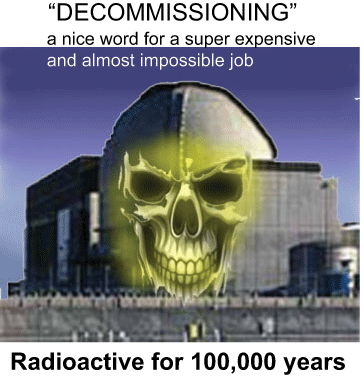
Regulators and utilities need to continue to ensure that adequate funds are set aside to cover these future expenses, WEO says.
It also warns that all countries which have ever had nuclear generation facilities have an obligation to develop solutions for long-term storage.
In one scenario examined in WEO, the cumulative amount of spent nuclear fuel that has been generated (a significant portion of which becomes high-level radioactive waste) more than doubles, reaching 705,000 tonnes in 2040.
Today – 60 years since the first nuclear reactor started operating – no country has yet established permanent facilities for the disposal of high-level radioactive waste from commercial reactors, which continues to build up in temporary storage, WEO says..
An alliance of German activist groups wants to stop nuclear waste export to the USA
 from Diet Simon, 13 Nov 14 An alliance of German environment activists plans to prevent the export of CASTOR containers with highly radioactive fuel pebbles to the USA from Jülich and Ahaus.
When the supervisory board of the Jülich research centre meets on 19 November to discuss what to do with the CASTORS there, activists will mount a protest outside.
The activists argue that several expertises show that the thought-about exports of highly radioactive materials to South Carolina would be illegal. They say government plans to produce legality by simply relabeling the commercially operated Jülich reactor an experimental one won’t work.
“The AVR reactor is without a doubt an output reactor and is listed that way by the Federal Agency for Radiation Protection. That brings it under the law changed last summer which bans the export of radioactive fuel elements and requires the safest possible storage in Germany,” suggests Rainer Moormann, who used to work in the power station and the research centre.
Peter Bastian of the SOFA Münster group emphasises the aspect of societal responsibility: “Though the operators of atomic facilities try to shirk their responsibility for highly radioactive waste, exporting the radiating problems abroad is no solution in our view. An out of sight, out of mind strategy that makes innocent third parties suffer is unacceptable for the disposal of our atomic waste.“
Kerstin Ciesla, of BUND, the German section of Friends of the Earth, demands that the coalition parties in the North-Rhine Westphalian state government, Social Democrats and Greens, keep to their coalition agreement. “That stipulates that the CASTORS, especially those stored in Jülich, will be transported only one more time, and that is to a final repository once a location has been found for one. We will not sit back and watch the coalition agreement being broken, we will try to stop this transport with all the means we can muster.”
The catchcry of the anti-nuclear movement, “Nothing in, nothing out!“ is the basic tenet of the new alliance, currently comprising 13 groups, with more likely to come on board.
At the end of September a tour through Germany with Tom Clements, a South Carolina environmental activist and politician, who heads the Savannah River Site Watch, kicked off the joint activism. The alliance plans to build on that success and decided on continuous cooperation.
The following organisations have joined the alliance:
- Aktionsbündnis Münsterland gegen Atomanlagen, www.urantransport.de/uran.html
- AKW-Nee-Aachen, www.anti-akw-ac.de
- Antiatomplenum Köln, www.antiatomkoeln.de
- Anti Atom-Bündnis Niederrhein, www.antiatom-buendnis-niederrhein.de
- Arbeitsgemeinschaft Schacht Konrad / Atommüll-Alarm, www.ag-schacht-konrad.de
- attac Jülich
- .ausgestrahlt, www.ausgestrahlt.de
- Bündnis Stopp Westcastor, www.westcastor.de
- BUND NRW e.V., www.bund-nrw.de
- Montagsspaziergänger gegen Atomkraft Wegberg
- Robin Wood, www.robinwood.de/Energie.energie.0.html
- Sofa Münster, www.sofa-ms.de
- Strahlenzug Mönchengladbach, www.strahlenzug.de
Russia’s underwater nuclear graveyard- the danger in the Arctic
Sunken Soviet Submarines Threaten Nuclear Catastrophe in Russia’s Arctic, Moscow Times. by Matthew Bodner Nov. 13 2014 While Russia’s nuclear bombers have recently set the West abuzz by probing NATO’s air defenses, a far more certain danger currently lurks beneath the frigid Arctic waters off Russia’s northern coast — a toxic boneyard for Soviet nuclear ships and reactors whose containment systems are gradually wearing out.
Left to decay at the bottom of the ocean, the world is facing a worst case scenario described as “an Arctic underwater Chernobyl, played out in slow motion,” according to Thomas Nilsen, an editor at the Barents Observer newspaper and a member of a Norwegian watchdog group that monitors the situation.

According to a joint Russian-Norwegian report issued in 2012, there are 17,000 containers of nuclear waste, 19 rusting Soviet nuclear ships and 14 nuclear reactors cut out of atomic vessels at the bottom of the Kara Sea.
For extra historical details see: Soviet Nuclear Submarine Wrecks at Bottom of Arctic Ocean (Video) Continue reading
West Chicago needs $millions to carry out radioactive thorium cleanup
Lawmakers press for more thorium cleanup money Daily Herald, Robert Sanchez 21 Oct 14 With money running out to pay for removal of radioactive thorium waste at a former factory site in West Chicago, local officials are appealing to the federal government for help….So far, their request for as much as $40 million in federal funding for the cleanup hasn’t been granted……..
n July, the U.S. House approved legislation that provides $20 million to reimburse work at cleanup projects nationwide. Nearly $6 million of that money could be used in West Chicago.
But the Senate hasn’t approved the measure. It’s proposing legislation that would cut the funding amount to $10 million……
While the roughly 60-acre property is vacant, it used to house a factory that produced radioactive rare earth elements such as thorium for federal atomic energy and defense programs, dating to World War II.
The process created a sandlike material that the factory made available to residents for landscaping and building projects. In addition, a storm sewer from the factory site carried thorium to nearby Kress Creek and the West Branch of the DuPage River.
Then it was determined that thorium causes an increase in cancer.
Kerr-McGee, which bought the factory in 1967, started a massive cleanup to remove thorium from the waterways, hundreds of individual residential properties, Reed-Keppler Park and a wastewater treatment plant.
But after officials spent decades and roughly $1.2 billion cleaning area sites polluted with radioactive thorium waste, the environmental response trust overseeing the work doesn’t have enough money to finish the cleanup of the factory property. Two areas within the fenced site remain contaminated.,…….http://www.dailyherald.com/article/20141021/news/141029730/
Thorium reactors have very little relevance to strategies for dealing with nuclear waste
 Thorium nuclear reactors are unlikely to take over from uranium ones, and are considered irrelevant to strategies to deal with nuclear wastes ,The Engineer finds 27 October 2014 “……..The Cambridge research will explore the pros and cons of different fuel combinations, including thorium, plutonium and the main material the designers are focusing on, uranium silicide, which is more power dense and so more cost-effective than the uranium oxide currently used.
Parks said that because the I2S is an evolution of existing light water reactor designs it could be brought to market more quickly than other reactors proposed for use with a thorium fuel-cycle, suggesting it could even be deployed within a decade and be installed in old nuclear power stations such as Sizewell B.
However, he also admitted that with current uranium stocks there was no major economic necessity to move to a thorium fuel-cycle at the moment and that such a transition would only happen if the government committed to thorium through a long-term flagship research project.
A paper published by the UK’s National Nuclear Laboratory in March 2012 found that ‘the thorium fuel cycle at best has only limited relevance to the UK as an alternative plutonium disposition strategy and as a possible strategic option in the very long term,’ and recommended ‘a low level of engagement in thorium fuel cycle R&D’.”
20 years, $4.5 billion minimum to get rid of San Onofre nuclear power plant
 Shutting down San Onofre to take 20 years, cost $4.4B, NRC says http://fox5sandiego.com/2014/10/28/shutting-down-san-onofre-to-take-20-years-cost-4-4b-nrc-says/ , OCTOBER 28, 2014, BY JAMIE CHAMBERS SAN DIEGO- IT WILL TAKE 20 YEARS AND COST $4.4 BILLION TO DECOMMISSION THE SAN ONOFRE NUCLEAR POWER STATION, REGULATORS SAY.
Activists and residents peppered the members of the Nuclear Regulatory Commission Monday with pointed questions about the decommissioning process. “How can you tell us a price when you can’t even tell us how long the waste will be there,” asked a woman at the meeting.
San Clemente resident Rochelle Becker said she thinks the process will end up costing much more than the commission’s estimate.
“The NRC has never met a budget. Why in the world should they now?” Becker asked rhetorically.
While the commission estimated that it would take 20 years to decommission the reactor, that doesn’t include removing the plant’s spent nuclear fuel rods. The spent nuclear waste will remain on the property for up to 100 years, under the current plan.
There is no federal nuclear waste storage site, so every nuclear reactor faces the same problem. At the end of their life cycle, nuclear power plant will become nuclear waste storage sites until that changes, according to the commission.
German govt sets up commission to seek solution to nuclear waste disposal

 Where Shall We Store Our Radioactive Waste? Red Baron’s Blog, 18 Oct 14, From September 20 to 22, 2014 the Deutsch-Schweizer Fachverband für Strahlenschutz (Swiss-German Radiation Protection Association) held a symposium in Mainz dealing with the topic: Zwischenlager – Dauerlager – Endlager: Wohin mit unserem radioaktiven Abfall? (Intermediate, permanent and final storage: Where shall we store our radioactive waste?)
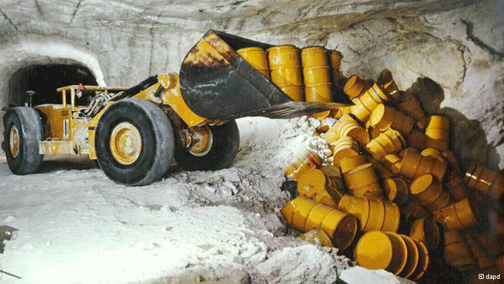
The Federal Government has set up a commission of 33 persons to deal with the deposition of highly-radioactive waste according to the Standortauswahlgesetz(Law for selecting a site). The German government called scientists, members of environmental associations, representatives of the Churches!!, economy, trade unions, members of parliament and state governments into the commission to find a consensus on a site until December 31, 2015. In their initial sessions the members of the commission lost their time on points of order; so I doubt that they will meet the deadline set by the government…….http://mhoefert.blogspot.com.au/
At least 4 years to scrap nuclear reactor barge
NUCLEAR-REACTOR SHIP HEADED TO GALVESTON TO BE SCRAPPED Kristi Nix, The Pasadena CitizenMonday, October 20, 2014 GALVESTON, TX —
Partial report by NRC creates false impression that Yucca Mountain nuclear waste plan could go ahead
 Officials from the state of Nevada, which has fought against Yucca Mountain, challenged the report. Robert Halstead, director of Nevada Agency for Nuclear Projects, said the NRC staff did not fully consider all the probabilities that could affect safety.
“It’s a pretty meek endorsement,” Halstead said. A review of the license application by state scientists and lawyers came up with 229 technical challenges, or contentions, that Nevada is prepared to pursue if the Yucca program moves forward.
The release of only a partial report “creates a false impression that the safety review has been completed,”
NRC staff: Yucca Mountain could meet safety needs http://www.reviewjournal.com/news/nevada/nrc-staff-yucca-mountain-could-meet-safety-needs by STEVE TETREAULT STEPHENS WASHINGTON BUREAU WASHINGTON 17 Oct 14 — A long-awaited report issued Thursday by the Nuclear Regulatory Commission found the Yucca Mountain site — once considered by the government but halted by the Obama administration — could be safe to store nuclear waste.
The federal agency released a staff analysis of a plan that the Department of Energy submitted for a license in 2008 but later disavowed. The 781-page document concluded that the site 100 miles northwest of Las Vegas “with reasonable expectation” could satisfy licensing rules.
The report immediately was seized by supportive lawmakers on Capitol Hill and executives in the nuclear industry as evidence the Yucca Mountain program largely dismantled by the Obama administration should be reassembled.
Sen. Lisa Murkowski, R-Alaska, said the NRC study shows the Nevada site is “a safe, worthwhile investment” that should be allowed to move forward.
If Republicans capture Senate control in the midterm elections next month, Murkowski would likely become chairwoman of the Senate Energy and Natural Resources Committee. Other Republicans have said that fresh votes on Yucca would be among the priorities in a GOP-controlled Congress.
Officials from the state of Nevada, which has fought against Yucca Mountain, challenged the report. Robert Halstead, director of Nevada Agency for Nuclear Projects, said the NRC staff did not fully consider all the probabilities that could affect safety.
“It’s a pretty meek endorsement,” Halstead said. A review of the license application by state scientists and lawyers came up with 229 technical challenges, or contentions, that Nevada is prepared to pursue if the Yucca program moves forward.
The NRC staff report analyzed the most far-reaching aspect of the repository plan: Whether the natural geology of Yucca Mountain coupled with a system of man-made barriers that would be built within the mountain could keep decaying radioactive particles from leaking into groundwater over periods of up to a million years.
After dissecting relevant parts of the license application, NRC analysts concluded it was reasonable to expect it “satisfies the requirements” for long-term nuclear waste storage.
Other aspects of the plan are still being studied by the NRC staff, and are expected to be discussed in other evaluation reports scheduled to be released before the end of the year. The report issued Thursday was Volume 3 of what is envisioned to be a five-volume study. Continue reading
No solution in sight, to South Korea’s mounting tonnes of radioactive trash

 As Nuclear Waste Piles Up, South Korea Faces Storage Crisis, Scientific American, 14 Oct 14 Among the usual commercials for beer, noodles and cars on South Korean TV, one item stands in marked contrast. By Meeyoung Cho SEOUL (Reuters) – Among the usual commercials for beer, noodles and cars on South Korean TV, one item stands in marked contrast.
A short film by a government advisory body carries a stark message: the nation faces a crisis over storing its spent nuclear fuel after running reactors for decades.
The world’s fifth-largest user of nuclear power has around 70 percent, or nearly 9,000 tonnes, of its used fuel stacked in temporary storage pools originally intended to hold it for five or six years, with some sites due to fill by the end of 2016.
It plans to cram those sites with more fuel than they were originally intended to hold while it looks for a permanent solution, suggesting little has been learned from the Fukushima disaster in neighboring Japan.
In the Fukushima crisis in 2011, the storage of large amounts of spent nuclear fuel in elevated pools posed a threat of massive radioactive release on top of meltdowns at three reactors. Spent fuel rods heated up after a quake knocked out water-cooling pumps, underlining the dangers of holding troves of radioactive material in relatively exposed cooling ponds.
“We cannot keep stacking waste while dragging our feet,” said Park Ji-young, director of the science and technology unit at respected think tank the Asan Institute for Policy Studies.
“If we fail to reach a conclusion (on how to manage spent fuel), it would be time to debate if we should stop nuclear power generation.” With South Koreans still spooked by Fukushima and a scandal at home over fake safety certificates for nuclear equipment, the commission has its work cut out to come up with more than a temporary fix to the storage crunch in a report due by year-end………..
OUT OF FAVOR
A permanent solution remains elusive, Continue reading
Nuclear Regulatory Commission – “continued storage rule” takes over from “Waste Confidence Rule”
The action of the commission, although not addressing all potential impacts, is effectively saying, “so what?” “There are no significant environmental impacts from indefinite storage of used fuel.”.
Finding a permanent nuclear storage center, Aiken Standard By CLINT WOLFE Guest columnist Oct 13 2014 “……..In a meeting that took only a few minutes the Nuclear Regulatory Commission passed a ruling regarding continued used nuclear fuel storage……..
A series of court challenges over time has seen the commission stick to its so-called waste confidence rule.
This rule has at least two aspects that are pertinent to this discussion.
One is that “if you don’t have a place to put the used fuel, then you can’t make any more.”
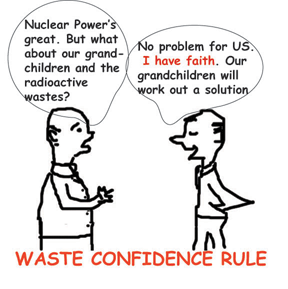
Anti-nuclear activists have pushed this viewpoint that no more nuclear power plants should be licensed until there is a permanent repository.
The commission has responded in the past that they are confident that a repository would be available before it is needed and merely kept changing the date on which that would occur. This approach led to a challenge that the commission was violating the National Environmental Protection Act by proposing a significant new federal project without having determined the environmental impact. This environmental impact could be looked at in every case to significantly slow each new license application.
The commission’s recent action closes out the waste confidence rule and introduces the continued storage rule. Continue reading
Heavy task to dismantle San Onofre’s dead nuclear power plant
 Countdown to dismantling San Onofre UT San Diego By Morgan Lee .OCT. 13, 2014 Heavy work on dismantling the San Onofre nuclear plant may be just three months away.
Today, the U.S. Nuclear Regulatory Commission intends to set in motion the 90-day countdown for major decommissioning activities by confirming receipt of detailed plans for the project, known as a “post-shutdown decommissioning activities report,” from San Onofre operator Southern California Edison. The notice will be published in the Federal Register.
Edison wants to restore most of the Navy-owned site in northern San Diego County during the next 20 years, a relatively quick schedule. The federal government allows up to 60 years for decommissioning, so that high-level radiation can dissipate.
The commission will conduct a public meeting to discuss Edison’s decommissioning plan, cost estimates and related environmental impacts on Oct. 27 from 6 to 9 p.m. at the Omni La Costa in Carlsbad. Beyond the meeting, written comments on the dismantling issue are due to the agency by Dec. 22.
Edison said the job will cost about $4.4 billion. The company announced in June that enough money has been set aside in trust accounts over recent decades to pay for the project.
The utility company is seeking authority to tap decommissioning funds to pay for most San Onofre-related expenses since the facility’s retirement was announced in June 2013.
It also is asking for permission from state utility regulators to cease annual collections of $23 million from its customers that are meant for the trust accounts — and to refund at least $17 million of that money……..http://www.utsandiego.com/news/2014/oct/13/countdown-san-onofre-decomissioning/
South Korea desperately buying time, as another 750 tonnes add yearly to its nuclear waste stack

it’s really stupid to just keep on making the stuff
As Nuclear Waste Piles Up, South Korea Faces Storage Crisis, Scientific American, 14 Oct 14“……….The 23 nuclear reactors in Asia’s fourth-biggest economy add a total of 750 tonnes of spent fuel every year to the 13,300 tonnes that filled 71 percent of its wet and dry storage capacity as of last year, according to reactor operator Korea Hydro and Nuclear Power Co Ltd, owned by state-run Korea Electric Power Corp.
That means storage could fill by 2021, with some pools in danger of reaching capacity by the end of 2016.
Seoul hopes to win time by stacking spent fuel more densely in those concrete-covered pools next to reactor buildings, and by moving waste to pools at 11 new power plants that are set to be built by 2024.
But experts warn that leaving spent fuel in water could be fraught with danger, even in a country that is not anywhere near as seismically active as Japan. They note that the buildings that house pools are typically not as strong as those that hold reactors, which have steel vessels inside concrete domes.
“Spent fuel in a concrete building next to reactor buildings is vulnerable to missile or other attacks from the outside,” said one expert, who declined to be identified due to the sensitivity of the matter.
He said that stacking fuel more densely would compound any risk as it would reduce air circulation.
“Air circulation helps lower chances of spent fuel meltdown if water drains or water-cooling pumps are broken when hit by natural disaster or terror attack.”http://www.scientificamerican.com/article/as-nuclear-waste-piles-up-south-korea-faces-storage-crisis/
USA’s new Generic Environmental Impact Statement (GEIS) not a basis for new nuclear power development
expect to see the issue end up back in federal court, where judges will have to determine whether the NRC’s unwillingness to adopt an actual waste “confidence” policy, instead relying on an assertion that current waste practice is good enough, meets the requirements of the Atomic Energy Act.
 Still no confidence in NRC radwaste policy http://safeenergy.org/2014/09/29/still-no-confidence-in-nrc-radwaste-policy/On June 8, 2012, a federal court threw out the Nuclear Regulatory Commission’s “waste confidence” policy, setting into motion a chain of events that still hasn’t stopped rattling the commission and the entire nuclear power industry.
The court ruled that with the shutdown of the proposed Yucca Mountain, Nevada, radioactive waste repository and no new repository on the horizon, the NRC had no basis to say that it had confidence that radioactive waste would always be managed safely.
Since the Atomic Energy Act requires that the NRC have such confidence in order to issue reactor licenses (and license renewals), the NRC was forced to institute a moratorium on issuance of all reactor licenses.
At the time, the NRC staff said a thorough job on a new policy to replace the “waste confidence” policy would take seven years of work. But the NRC Commissioners decided to rush the job and this summer issued a Generic Environmental Impact Statement (GEIS) that it said functions as a substitute for the policy.
There are a couple (well, at least a couple) problems with this approach. Continue reading
1 This Month
23-25 October – on Zoom – World BEYOND War’s annual global conferenc


Shut down the radiation-damaged Heysham nuclear reactors now
To see nuclear-related stories in greater depth and intensity – go to https://nuclearinformation.wordpress.com

Say No to NASA’s Reckless Nuclear Reactor on the Moon
Say No to NASA’s Reckless Nuclear Reactor on the Moon

-
Archives
- October 2026 (219)
- September 2026 (339)
- August 2026 (330)
- July 2026 (355)
- June 2026 (287)
- May 2026 (306)
- April 2026 (356)
- March 2026 (251)
- February 2026 (267)
- January 2026 (308)
- December 2025 (358)
- November 2025 (359)
-
Categories
- 1
- 1 NUCLEAR ISSUES
- business and costs
- climate change
- culture and arts
- ENERGY
- environment
- health
- history
- indigenous issues
- Legal
- marketing of nuclear
- media
- opposition to nuclear
- PERSONAL STORIES
- politics
- politics international
- Religion and ethics
- safety
- secrets,lies and civil liberties
- spinbuster
- technology
- Uranium
- wastes
- weapons and war
- Women
- 2 WORLD
- ACTION
- AFRICA
- Atrocities
- AUSTRALIA
- Christina's notes
- Christina's themes
- culture and arts
- Events
- Fuk 2022
- Fuk 2023
- Fukushima 2017
- Fukushima 2018
- fukushima 2019
- Fukushima 2020
- Fukushima 2021
- general
- global warming
- Humour (God we need it)
- Nuclear
- RARE EARTHS
- Reference
- resources – print
- Resources -audiovicual
- Weekly Newsletter
- World
- World Nuclear
- YouTube
-
RSS
Entries RSS
Comments RSS

