Nuclear waste burial for Nevada? State and Feds in talks
 Nevada, Feds to Study Nuclear Waste Burial in State http://www.ktvn.com/story/27696890/nevada-feds-to-study-nuclear-waste-burial-in-state Dec 23, 2014 Nevada and the federal government are agreeing to have a panel keep studying whether the U.S. will bury radioactive material from Tennessee at a former nuclear weapons proving ground north of Las Vegas.
Officials say there is no deal yet.
The state has balked at plans to bury low-level waste ranging from contaminated worker uniforms to machine parts from a World War II-era plant in Oak Ridge, Tennessee, at the Nevada National Security Site about 65 miles from Las Vegas.
Security Site spokesman Darwin Morgan says talks are continuing, and the Energy Department is optimistic shipments could begin in early 2015. (AP)
South Korea’s nuclear waste problem
Dealing with nuclear waste in South Korea The Korea Herald/Asia News Network December 21, 2014,The much awaited nuclear waste facility in Gyeongju will begin operations next year following final approval by the Nuclear Safety and Security Commission last week. The Wolseong Low and Intermediate-Level Radioactive Waste Disposal Center, consisting of six silos some 80 meters underground, can hold up to 100,000 barrels of radioactive waste.
A second-phase construction is underway to add a 125,000-barrel holding unit to the site, which is designed to store 800,000 barrels of nuclear waste over the next 60 years before it is sealed off.
A total of 23 nuclear reactors are responsible for about one-third of all power generated in Korea and produce 2,300 barrels of low- and intermediate-level radioactive waste each year.
The country’s first low- and intermediate-level radioactive repository was realized some 28 years after the country started looking for a site. Gyeongju, North Gyeongsang Province, was selected in 2005 after votes in four candidate cities. Almost 90 percent of voters in Gyeongju approved of the facility.
To win over communities that did not want a hazardous waste facility in their midst, the government promised 300 billion won in community support. The local community would also receive annual fees in addition to the initial grant.
The Gyeongju facility is just the first step. The country has yet to draw up a plan for dealing with the growing piles of spent nuclear fuel rods. Some 750 tonnes of spent fuel are produced each year by the country’s 23 nuclear power reactors.
Currently, spent fuel rods are stored temporarily on the reactor site pending the building of a centralized storage facility. About 13,250 tonnes were stored in different nuclear reactor sites as of end-2013 and it is estimated that the sites will become full incrementally between 2016 and 2038.
The Public Engagement Commission of 15 nuclear experts, academics, city council members and a representative of an environmental watchdog group was formed last year to engage the public in discussions about the spent nuclear fuel issues so that their opinions could be incorporated into policy decisions. The Ministry of Trade, Industry and Energy is expected to draw up a plan for disposing of spent fuel based on recommendations by the commission.
So far, the commission has released an interim report suggesting that a permanent disposal facility must be completed by 2055. It has not said where it could be built or what type of storage could be employed. The commission, in the meantime, has extended its mandate to June 2015.
The Gyeongju site for low- and intermediate-level radioactive waste took 28 years to complete. A facility for the more hazardous spent fuel rods will be much more controversial. Hence, the building of a permanent storage site for spent nuclear fuel rods is an urgent matter that requires immediate government attention…….http://www.chinapost.com.tw/commentary/the-china-post/special-to-the-china-post/2014/12/21/424512/Dealing-with.htm
Radioactive waste incineration to begin in Kawauchi , Fukushima Prefecture
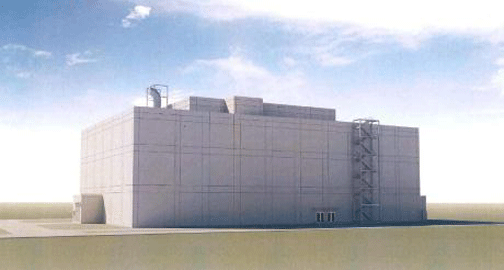 Kawauchi will have radioactive waste incinerator http://www.fukushima-is-still-news.com/2014/11/kawauchi-will-have-radioactive-waste-incinerator.html November 26, 2014 Radioactive waste incinerator built in Fukushima http://www3.nhk.or.jp/nhkworld/english/news/20141126_27.html
A facility to incinerate radioactive debris and other waste is ready to open in a village near the crippled Fukushima Daiichi nuclear power plant.
The Environment Ministry had been building the temporary incineration facility in the village of Kawauchi since May.
Officials and village delegates marked the completion of the work in a ceremony on Wednesday.
The facility is designed to burn 7 tons of waste per day while removing radioactive cesium.
Ministry officials plan to put the facility into full operation in early January following test runs.
The government lifted an evacuation order for part of Kawauchi last month. But about 1,700 tons of debris and other waste stored in the village remain to be disposed of.
Village Mayor Yuko Endo said some residents are worried about radiation and an unsafe living environment. He said he hopes the incineration facility will help ease their concern.
The Environment Ministry says Kawauchi is the first municipality in Futaba County to have an incineration facility. It says it plans to build similar facilities in other municipalities in the county where Fukushima Daiichi is located.
Utah officially rejects nuclear waste storage facility
 Utah nixes nuclear waste storage facility 12/27/2012 http://www.power-eng.com/articles/2012/12/utah-nixes-nuclear-waste-storage-facility.html Plans to park radioactive waste at a storage facility in Utah have been officially called off, The Salt Lake Tribune reports. Utility companies behind the proposed project have asked the NRC to cancel the license request, after Utahns from across the political spectrum and by wide margins came out publicly against the proposal. The 100-acre storage facility would have been situated in the Skull Valley Goshute Reservation, near a bomb testing facility and 45 miles from Salt Lake City. The cash-hungry Goshutes hoped the $3 billion project would have spurred economic development on the reservation.
Major weaknesses found by NRC in bid for Yucca Mountain nuclear waste dump
 NRC finds hole in Yucca Mountain bid, Las Vegas Review Journal, By STEVE TETREAULT
In a report issued Thursday, staff at the Nuclear Regulatory Commission concluded the lack of assured water fails the standard to license a nuclear waste complex.
The NRC report also noted the Department of Energy lacks permanent control of the 230-square-mile site 100 miles northwest of Las Vegas. The project had operated under temporary land withdrawals that have since expired, and would need Congress to set aside the tracts for it to be completed.
The findings delivered a blow to a cadre of lawmakers on Capitol Hill and nuclear industry executives trying to resurrect the nuclear waste project that has been mothballed by the Obama administration.
If the licensing process was revived, the water and land control issues would need to be addressed and corrected. Neither are close to being resolved in the project’s favor.
The state of Nevada in a long legal fight has blocked the government from obtaining water for the Yucca Mountain Project, declaring it is not in the public interest.
A government lawsuit pending in U.S. District Court in Las Vegas challenges the state’s denial of water permits, but it has been largely inactive since the program was deactivated.
Similarly, a Yucca Mountain land withdrawal was proposed in Congress in 2007 but it was not considered and the issue has not been under discussion in recent years.
Sen. Harry Reid, D-Nev., a leading opponent of Yucca Mountain, said the report underscored major weaknesses in the project.
“This is just one reason why the Yucca Mountain project will never be built,” Reid said in a statement……..http://www.reviewjournal.com/news/nevada/nrc-finds-hole-yucca-mountain-bid
Alarming government report on deteriorating nuclear waste tanks at Hanford
Gov’t report sounds alarm on Hanford’s nuclear waste tanks http://www.king5.com/story/news/local/hanford/2014/12/16/hanford-nuclear-waste-tanks-gao-report-december-2014/20489933/ Gary M Chittim, December 16, 2014 Tanks holding millions of gallons of nuclear and chemical waste at the Hanford Nuclear Reservation are deteriorating at a faster rate than previously thought, according to a new report from the U.S. Government Accountability Office (GAO).
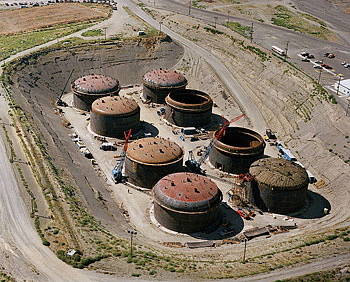
The GAO report was released today by Sen. Ron Wyden (D-Ore.), who is demanding the Department of Energy (DOE) develop a plan to address leaks and other tank issues. He said the DOE must act on the recommendations in the report instead of acknowledging them and then doing nothing, as it has done in the past.
“Agreeing to recommendations is one thing, implementing them is another thing entirely,” Wyden said. “The DOE’s ‘watch-and-wait’ strategy for these tanks leaking nuclear waste into the soil is completely unacceptable. I’m asking for a schedule and a plan of action within 90 days to implement the GAO’s recommendations at Hanford.”
Highlights of the report include new information on the number of older, single-shell tanks (SSTs) at Hanford that are experiencing what’s called water intrusion – 14 as of the fall of 2014. Rain or ground water entering the tanks can cause a host of problems, including mobilizing the waste and giving monitors undependable levels of waste in the tank, making it difficult to detect leaks.
In addition, one of the SSTs (T-111) is leaking at a much higher rate than thought, some 640 gallons per year.
There are concerns the waste, which is leftover from decades of plutonium production at the 586-square-mile reservation in southeastern Washington, could leak through the aging tanks into the groundwater and the nearby Columbia River.
The report also found that several of the newer double-shell tanks (DSTs) share the same design flaws blamed for leaking in the interior wall of AY-102 – a DST found to be leaking in 2012. DOE is in the process of developing a plant that can convert the radioactive waste into stable glass that can be safely stored for hundreds of years. That plant is years behind schedule, billions of dollars over budget and plagued by unresolved design and safety issues.
Critics, including Wyden, have demanded DOE develop a plan for dealing with the stored waste while those issues are resolved. The governors of Oregon and Washington have urged DOE to build additional storage tanks to hold the waste until the treatment plant is finished. The GAO report notes that DOE estimates building new tanks would take eight years and require $800 million in funding.
The DOE’s acting assistant secretary for environmental management, Mark Whitney, responded to the report by saying DOE already has a plan to constantly monitor the tanks and respond to suspected leaks.
“This program includes the use of robotic ultrasound devices, corrosion monitoring probes, and remote video cameras for the DST,” said Whitney in a written response to the report.
Read the full report and the Department of Energy’s response.
US government planning to spend $1 trillion on upgrading nuclear weapons
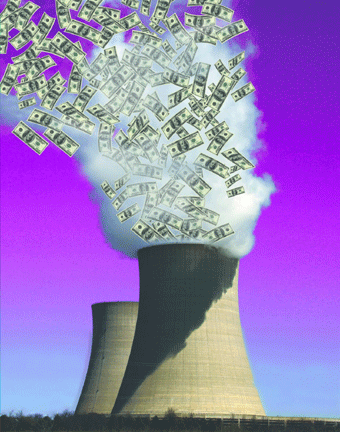 The nuclear money pit, The Economist Does America really need a new plutonium production line? Dec 15th 2014 | LOS ANGELES THE RECENT sabre rattling by Vladimir Putin may have unwittingly done what the United States Congress has failed to do for decades: refocus attention—and billions of additional dollars—on overhauling America’s nuclear arsenal. The $585 billion defence bill for the next fiscal year sailed through the House of Representatives last week with broad bipartisan support, and then did the same in the Senate on December 12th, despite all the fractious squabbling over the $1.1 trillion government funding measure.
More pertinently, the $11.7 billion request for the National Nuclear Security Administration (NNSA), a branch of the Department of Energy that oversees nuclear weapons, naval reactors and nonproliferation activities on behalf of the military, represents a 4% increase over the previous year. The biggest chunk of that—covering work on modernising the country’s nuclear weapons—is to increase by 7%. All this at a time when mandated “sequestration” cuts are supposed to be reducing military spending.
All told, the federal government intends allocating up to $1 trillion to upgrade the country’s missiles, bombers and submarines over the coming decades. Continue reading
Unease in Southern California over San Onofre’s Spent Nuclear Fuel Storage Plan
 The Nuclear Regulatory Commission also ruled earlier this year that radioactive waste can be stored on nuclear plant sites indefinitely. “We’re looking at the waste sitting here for potentially hundreds of years,” Gilmore said, pointing from her home to the coastline below. “We don’t know how many years it’s going to sit here, and the NRC only certifies these casks for 20 years.”
San Onofre’s Spent Nuclear Fuel Storage Plan Worries Some Residents, KPBS, December 11, 2014 By Alison St John Almost 4,000 highly radioactive spent fuel assemblies will have to be stored indefinitely on the narrow strip of land between Interstate 5 and the ocean, where the San Onofre nuclear power plant now stands. That’s because political gridlock nixed a federal long-term storage site for nuclear waste in Nevada. Continue reading
Pacific Ocean is still the sewer for the nuclear industry’s wastes
SWR (German public television broadcaster), 2013 (emphasis added):
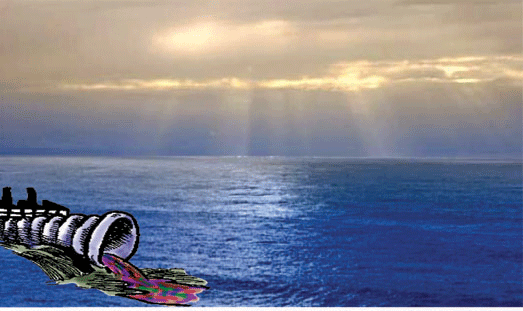
- 25:00 in — The dumping of nuclear waste in the sea was banned worldwide in 1993, yet the nuclear industry has come up with other ways. They no longer dump the barrels at sea; they build kilometers of underwater pipes through which the radioactive effluent now flows freely into the sea. One of these pipes is situated in Normandy [near] the French reprocessing plant in La Hague… The advantage for the nuclear industry? No more bad press… disposal via waste pipes remains hidden from the public eye, quite literally.
- 28:30 in — 400 km from La Hague [as well as] Holland [and] Germany… we find iodine… 5-fold higher tritium value than [reported] by the operator Areva. It’s now obvious why citizens take their own measurements.
- 30:15 in — Molecular Biologist: “The radioactive toxins accumulate in the food chain. This little worm can contain 2,000-3,000 times more radioactivity than its environment. It is then eaten by the next biggest creature and so on, at the end of the food chain we discovered damage to the reproductive cells of crabs… These genetic defects are inherited from one generation to the next… Cells in humans and animals are the same.”
- 32:00 in — The 2nd disposal pipe for Europe’s nuclear waste is located in the north of England… Radioactive pollution comes in from the sea. Their houses are full of plutonium dust… The pipe from Sellafield is clearly visible only from the air… nuclear waste is still being dumped into the sea. Operators argue this is land-based disposal… It has been approved by the authorities.
- 35:45 in — Plutonium can be found here on a daily basis, the toxic waste returns from the sea… it leaches out, it dries, and is left lying on the beach. The people here have long since guessed that the danger is greater than those responsible care to admit… Every day a smallexcavator removes plutonium from the beach… In recent decadesthe operator at Sellafield has tossed more than 500 kg of plutonium into the sea.
- 42:00 in — We take a soil sample… The result turns out to be alarming. The amount of plutonium is up to 10 times higher than the permissible limit.
Yahoo News, Dec 5, 2014: All this radiation from the [Fukushima] disaster has definitely not been isolated to just Japan. Researchers monitoring the Pacific Ocean, in which much of the radiation spilled into, have detected radioactive isotopes this past November just 160 km [100 miles] off the coast of California. So this story will continue to unfold for many years to come.
The disastrous problem of Russia’s mounting spent nuclear fuel waste
 RUSSIAN NUCLEAR INDUSTRY OVERVIEW, Earth Life Johannesburg Vladimir Slivyak Russian environmental group, Ecodefense
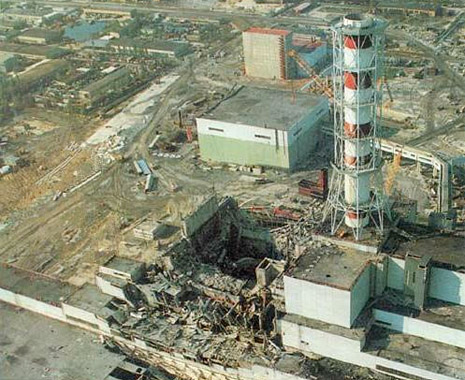 The overall amount of spent nuclear fuel accumulated at Russian nuclear sites is estimated
Indian Point nuclear complex should be closed, not re-licensed, as nuclear spent fuel problem increases
 No Yucca Mountain, and more Indian Point concerns http://www.lohud.com/story/opinion/contributors/2014/11/22/yucca-mountain-spent-nuclear-fuel-storage-stall-shut-indian-point/19288749/ Peter Schwartz November 22, 2014
Indian Point nuclear complex in Buchanan is safe, the Nuclear Regulatory Commission says. But with no long-term spent fuel storage on the horizon, safety mandates a closure of the facility’s reactors that are amid relicensing.
The Nuclear Regulatory Commission is sending mixed signals about nuclear waste from power plants. It recently issued new rules encouraging continued long-term storage of waste on site at the plants and denied environmentalists’ contention that waste buildup at Indian Point nuclear facility in Buchanan was a problem. On the other hand, NRC recently resumed safety evaluations of a proposed national nuclear waste repository at Nevada’s Yucca Mountain.
Whether that means the idea of transporting the waste to Yucca Mountain is alive again is unclear, though it’s quite clear that the NRC doesn’t consider spent fuel buildup any obstacle to continued operation of aging nuclear plants. Meanwhile, for New Yorkers and tri-state area residents, the spent fuel building up at Indian Point is a growing threat.
 “Spent” nuclear fuel is a misnomer. It’s much more dangerous than “unspent” fuel, since it’s many times “hotter” in terms of radioactivity and thermal heat when it comes out of a reactor than when it goes in. Spent fuel rods have high concentrations of lethal isotopes like strontium 90, iodine 131 and cesium 137. They emit 1 million rems of radiation an hour a foot away, enough to kill in seconds, and release part of their energy as heat. They can’t be handled or moved until they’ve cooled in special storage pools for at least five years (spent “High Burnup Fuel” has twice the radioactivity of other spent fuel, and can’t be moved from the pools for 20 years).
Lessons of Fukushima
Aerial photos of the Fukushima disaster illustrated the dangers of storing spent fuel at nuclear plants. Explosions tore the roofs off fuel pools, exposing shoddy construction and more spent fuel than the pools were ever designed to hold, leaving nothing but leaking water between concentrated, lethal radioactivity and the environment.
Our spent fuel situation isn’t like Japan’s. It’s worse. The U.S. has 30 million spent fuel rods, more than any other nation. They’re stored in pools housed in unfortified shed buildings one expert called “the kind you would find in big box stores and car dealerships.” Without a geologic repository like Yucca Mountain, the waste accumulated at nuclear plants, and these vulnerable buildings are now the largest concentrations of radioactivity on the planet.
As of 2011, Indian Point’s spent fuel pools, 25 miles north of Manhattan with 20 million people in a 50-mile radius, contained an estimated 234 million curies and counting. That’s three times the radioactivity of all the fuel pools in the Fukushima complex combined. The 40-year-old pools are deteriorating, leaking tritium- and strontium-laced water into groundwater and the Hudson.
To keep the reactors running until Yucca Mountain was supposed to open in 2010, Indian Point repeatedly “reracked” its pools, putting more spent fuel rods into them than they were designed to hold, packing them more closely together. That increases the risk of “criticality” – accidental nuclear reaction between the rods – that could boil the water, ignite the rods and release their radiation. Boron absorbers built into the racks to shield radiation are degrading, aggravating the risk.
Stop buildup, close plant
When Yucca Mountain failed to materialize, Indian Point began removing some of the fuel rods that had been in the pools the longest and cooled the most, and putting them into dry cask storage. But that only makes room for newer, “hotter” spent fuel, increasing net radioactivity in the pools, while yet more spent fuel accumulates in casks on the ground.
The faster we reverse this buildup and secure the waste, the better. Whether or not a geologic repository ever gets built, we can mitigate spent fuel danger now by shutting down Indian Point’s reactors. Every day they continue to run, they make more “hot” waste, concentrating yet more radioactivity on site. With Indian Point’s 40-year operating licenses expiring, its owner, Entergy, is seeking a 20-year extension, which would only compound the spent fuel problem.
As an engineer who built a business near Indian Point, I’m not especially skeptical of nuclear technology or the idea of a geologic repository. But as a lifelong local resident who developed thyroid cancer, which correlates with radiation exposure, I am highly skeptical of the way that keeping the plant’s reactors running and Entergy’s profits flowing seems to trump confronting safety problems at the plant. Indian Point’s spent fuel is a serious threat to the health, safety and economy of our region. To defuse it, we first need to stop making more waste, by closing the reactors as their licenses expire.
The writer, a Montebello resident, is a mechanical engineer who lives and owns a manufacturing business in Rockland County, within 10 miles from the Indian Point nuclear power plant.
Deeper problems underlie the serious errors at America’s Waste Isolation Pilot Plant (WIPP)
New Mexico nuclear waste accident a ‘horrific comedy of errors’ that exposes deeper problems Jim Green, 27 Nov 2014, The Ecologist February’s explosion at the WIPP dump for long-lived intermediate-level nuclear waste from the US’s nuclear weapons program remains unexplained, writes Jim Green. But with the site’s history of ignored warnings, ‘missing’ safety culture, lack of supervision and dubious contractor appointments, it surely came as no surprise − and further accidents appear inevitable.
The precise cause of the February 14 accident involving a radioactive waste barrel at the world’s only deep geological radioactive waste repository has yet to be determined, but information about the accident continues to come to light.
The Waste Isolation Pilot Plant (WIPP) in New Mexico, USA, is a dump site for long-lived intermediate-level waste from the US nuclear weapons program. More than 171,000 waste containers are stored in salt caverns 2,100 feet (640 metres) underground.
On February 14, a heat-generating chemical reaction − the Department of Energy (DOE) calls it a ‘deflagration’ rather than an explosion − compromised the integrity of a barrel and spread contaminants through more than 3,000 feet of tunnels, up the exhaust shaft, into the environment, and to an air monitoring approximately 3,000 feet north-west of the exhaust shaft.[1] The accident resulted in 22 workers receiving low-level internal radiation exposure.
Investigators believe a chemical reaction between nitrate salts and organic ‘kitty litter’ used as an absorbent generated sufficient heat to melt seals on at least one barrel. But experiments have failed to reproduce the chemical reaction, and hundreds of drums of similarly packaged nuclear waste are still intact, said DOE spokesperson Lindsey Geisler. “There’s still a lot we don’t know”, she said.[2]……….
Compromised response to the accident
A degraded safety culture was responsible for the accident, and the same failings inevitably compromised the response to the accident. Among other problems:[4,6]
- The DOE contractor could not easily locate plutonium waste canisters because the DOE did not install an upgraded computer system to track the waste inside WIPP.
- The lack of an underground video surveillance system made it impossible to determine if a waste container had been breached until long after the accident. A worker inspection team did not enter the underground caverns until April 4− seven weeks after the accident.
- The WIPP computerised Central Monitoring System has not been updated to reflect the current underground configuration of underground vaults with waste containers.
- 12 out of 40 phones did not work so emergency communications could not reach all parts of WIPP in the immediate aftermath of the accident.
- WIPP’s ventilation and filtration system did not prevent radiation reaching the surface, due to neglect.
- The emergency response moved in slow motion. The first radiation alarm sounded at 11.14pm. Not until 9.34amdid managers order workers on the surface of the site to move to a safe location.
Everything that was supposed to happen, didn’t. Everything that wasn’t supposed to happen, did.
Jim Green is editor of Nuclear Monitor and national nuclear campaigner with Friends of the Earth, Australia. This article was originally published in Nuclear Monitor No. 794, November 2014. http://www.theecologist.org/News/news_analysis/2642182/new_mexico_nuclear_waste_accident_a_horrific_comedy_of_errors_that_exposes_deeper_problems.html
Japan’s very problematic law on removing nuclear waste for Fukushima Prefecture
Diet passes legislation to remove nuclear waste from Fukushima in 30 years http://ajw.asahi.com/article/0311disaster/fukushima/AJ201411200041 November 20, 2014 THE ASAHI SHIMBUN
 The Diet passed a bill Nov. 19 mandating that radioactive soil and debris from the Fukushima decontamination work be moved outside the prefecture within 30 years, a step toward building interim storage facilities for the waste.
The law amendment was one of the five conditions set in September when the Fukushima prefectural government agreed to accept interim facilities to store contaminated waste collected during cleanup efforts around the crippled Fukushima No. 1 nuclear power plant.
Environment Minister Yoshio Mochizuki praised the legislation as a “major step forward.” However, hurdles remain high for the interim facilities–planned in Okuma and Futaba near the nuclear plant–to start accepting the waste in January as scheduled.
The bill amends a law regulating operations of the government-affiliated Japan Environmental Safety Corp. (JESCO), which is commissioned to dispose of used polychlorinated biphenyl (PCB).
The revised law stipulates the government will take necessary measures to remove waste from the prefecture for final disposal within 30 years after the interim facilities start operations. It also holds the government responsible for running the interim waste storage facilities and commissions JESCO to operate them.
Among the other conditions set by Fukushima Prefecture, the central government has agreed to earmark construction-related subsidies in its budget and take charge of the operation and maintenance of traffic routes for carrying in the waste.
One big problem for the government, however, is purchasing land for the facilities. The planned construction zone stretches 16 square kilometers, comprising 2,365 land plots belonging to individual owners.
As of the end of September, the government has located the whereabouts of only 1,269 landowners, partly because they live outside their properties as evacuees.
The government first plans to create temporary storage sites on individual land plots it purchases to start accepting radioactive waste there as early as possible. But it has not reached a purchase or lease agreement with a single landowner.
Taking into account this stumbling block, reconstruction minister Wataru Takeshita said Nov. 7 that the government’s plan to open the interim storage facilities in January will likely be pushed back.
(This article was written by Teru Okumura and Takuro Negishi.)
Waste Isolation Pilot Plant contains volatile materials – “potential bombs”
 “Patented explosives” reported inside plutonium waste drums at US nuclear facility — TV: So volatile, experts comparing it to ‘bomb’ — Official: I’m appalled we weren’t told about real and present danger — Over 5,000 drums a threat — Invisible reactions may have already occurred (VIDEO) http://enenews.com/investigation-patented-explosives-drums-plutonium-waste-nuclear-facility-tv-volatile-experts-calling-potential-bomb-5000-drums-threat-invisible-reactions-occurred-other-containters-video?utm_source=feedburner&utm_medium=email&utm_campaign=Feed%3A+ENENews+%28Energy+News%29
Sante Fe New Mexican, Nov. 15, 2014 (emphasis added): The combination [of neutralizer and wheat-based organic litter] turned the waste into a potential bomb that one lab chemist later characterized as akin to plastic explosives, according to a six-month investigation by The New Mexican. [Los Alamos National Lab] then shipped [the waste] to the Waste Isolation Pilot Plant… Feb. 14… the drum’s lid cracked open… Temperatures in the underground chamber soared to 1,600 degrees, threatening dozens of nearby drums… Documents and internal emails show… officials downplayed the dangers… and withheld critical information.
Patented Explosives
- LANL chemist Steve Clemmons [found] the drum’s contents match the makeup of patented plastic, water-gel and slurry explosives… “All of the required components included in the patent claims would be present,” Clemmons wrote… “I am appalled that LANL didn’t provide us this information!” [wrote DOE official Dana Bryson]… On May 27, when they learned of the memo about patented explosives… WIPP abandoned plans for the next day to sample the area where the breach occurred, fearing it was too dangerous. “In a phone call withLANL, they indicated that there is a possibility that any sampling of the kitty litter/drum contents could cause another event,” [wrote] David Freeman, Nuclear Waste Partnership’s chief nuclear engineer… “We have a formal letter on LANL letterhead implying there is a real and present danger in the WIPP underground,” Bryson wrote.
Up to 55 more drums of waste ‘destabilized ‘
- The intense underground flare may have destabilized up to 55 more drums of waste [near the one that ruptured], calling into question whether they, too, had become poised to burst. “[The high heat event] may have dried out some of the unreacted oxidizer-organic mixtures increasing their potential for spontaneous reaction,” the report said. “The dehydration of the fuel-oxidizer mixtures… is recognized as a condition known to increase the potential for reaction.”
Over 5,000 more waste drums a threat
- LANL began treating waste with assorted varieties of organic kitty litter as early as Sept. 2012, spawning thousands of drums of waste that hold the same organic threat… [It] may have been mixed in up to 5,565 containers of waste at LANL.
LANL (pg. 21 of pdf): [The team] evaluated the effect of a heat generating event on the adjacent waste containers [that] could have chemically or physically changed the waste and introduced a reaction hazard. Unreacted drums of nitrate salt waste stream… continue to pose a potential reaction hazard… Reactions may have occurred within some of these drums at levels insufficient to lead to detectable visible evidence.
KOB, Nov. 16, 2014: Nuclear waste so volatile, it’s been called a potential bomb by experts… Greg Mello, former nuclear waste inspector for LANL: “The drum in question was basically kind of a time bomb.”… [A WIPP] assessment… estimates over 5,000 drums of waste may contain the volatile organic kitty litter that caused the one drum to split open.
Nuclear Regulatory Commission’s chief warns that Commission is not geared for needs of decommissioning
 Nuclear Agency Rules Are Ill-Suited for Plant Decommissioning, Leader Says NYT By MATTHEW L. WALDNOV. 17, 2014 WASHINGTON — The Nuclear Regulatory Commission’s rules are not geared for supervising the decommissioning of nuclear reactors, the task that will occupy much of its time in the coming years, the head of the agency, Allison M. Macfarlane, said Monday.
Speaking at the National Press Club in a wide-ranging look at her agency and the industry before she leaves the job at the end of the year, Dr. Macfarlane said the industry had instead set itself up about 15 years ago to oversee more reactor construction, a revival that did not occur. “The industry was really expecting to expand,” she said. “The agency’s not facing the future that five years ago people envisioned.”
Instead, a plunging price of natural gas and slack demand for electricity have made some existing plants uncompetitive, and the pace of retirements has been high. But the commission’s rules on areas like security and emergency planning are geared to operating plants, she said. So shut-down plants are applying for exemptions to the rules that no longer seem to fit the risk that the reactors pose when decommissioned.
As with nuclear waste, the commission’s rules on reactors seem more focused on construction and operation than on the “back end,” said Dr. Macfarlane, a geologist who is returning to academia.
In her comments, Dr. Macfarlane said that the future of a proposed nuclear waste repository near Las Vegas, blocked for years by Senator Harry Reid of Nevada as majority leader, was still far from assured, despite the coming change of party control in the Senate. The commission’s job would be to rule on whether the repository should be licensed, but it could never approve a license without “a willing applicant,” she said.
That applicant would be the Department of Energy, which dropped work on the project after a campaign promise by Barack Obama when he ran for president the first time.
To resume work on the proposed repository, at Yucca Mountain, the Energy Department and the commission would need a new appropriation, she said. And at the time work was stopped, in 2010, “there were more than 300 contentions challenging the application,” she said. Each must be argued before a panel of administrative law judges.
And even then, she noted, Yucca Mountain would not be big enough for all the waste.
In light of the accident at the Fukushima Daiichi plant in March 2011 in Japan, Dr. Macfarlane said that the commission should consider new rules on some reactors whose design does not resemble the ones that melted down in Japan. The commission has required older plants of the General Electric design to improve their systems for venting gases in an emergency, but perhaps other models should have to do the same, she said……..http://www.nytimes.com/2014/11/18/us/nuclear-agency-rules-are-ill-suited-for-plant-decommissioning-leader-says.html?_r=0
1 This Month
23-25 October – on Zoom – World BEYOND War’s annual global conferenc


Shut down the radiation-damaged Heysham nuclear reactors now
To see nuclear-related stories in greater depth and intensity – go to https://nuclearinformation.wordpress.com

Say No to NASA’s Reckless Nuclear Reactor on the Moon
Say No to NASA’s Reckless Nuclear Reactor on the Moon

-
Archives
- October 2026 (219)
- September 2026 (339)
- August 2026 (330)
- July 2026 (355)
- June 2026 (287)
- May 2026 (306)
- April 2026 (356)
- March 2026 (251)
- February 2026 (267)
- January 2026 (308)
- December 2025 (358)
- November 2025 (359)
-
Categories
- 1
- 1 NUCLEAR ISSUES
- business and costs
- climate change
- culture and arts
- ENERGY
- environment
- health
- history
- indigenous issues
- Legal
- marketing of nuclear
- media
- opposition to nuclear
- PERSONAL STORIES
- politics
- politics international
- Religion and ethics
- safety
- secrets,lies and civil liberties
- spinbuster
- technology
- Uranium
- wastes
- weapons and war
- Women
- 2 WORLD
- ACTION
- AFRICA
- Atrocities
- AUSTRALIA
- Christina's notes
- Christina's themes
- culture and arts
- Events
- Fuk 2022
- Fuk 2023
- Fukushima 2017
- Fukushima 2018
- fukushima 2019
- Fukushima 2020
- Fukushima 2021
- general
- global warming
- Humour (God we need it)
- Nuclear
- RARE EARTHS
- Reference
- resources – print
- Resources -audiovicual
- Weekly Newsletter
- World
- World Nuclear
- YouTube
-
RSS
Entries RSS
Comments RSS

