The ever-accumulating tonnage of Canada’s radioactive trash
 the Nuclear Waste Management Organization (NWMO), wants to bury it in what the nuclear industry calls a Deep Geological Repository, or DGR
“Finally,” says Eugene Bourgeois, whose idyllic property lies within a kilometre of the Bruce Power reactors, “it has to be impervious to the potential ignorance or delinquency of people, perhaps ‘peopleoids,’ more than a quarter-million years from now”—which is to say, peopleoids who likely will have no notion even of the languages in which the safety code and signage of the DGR were written.
At the same time, the site can’t be too remote. It must be serviced by roads and rail, so that waste can be brought in, and must have a sufficient population that the thousands of folks who will build the facility and the hundreds who will be employed there long-term will have a place to live

 Inside the race for Canada’s nuclear waste: 11 towns vie to host deep burial site Canada’s nuclear waste will be deadly for 400,000 years. What town would like the honour of hosting it? CHARLES WILKINS TheGlobe and Mail Feb. 26 2015,
……..the Western Waste Management Facility, where Ontario Power Generation stores much of its share of the 48,000 tonnes of waste that have accumulated in Canada during the past 65 years and that the company and other nuclear-power producers hope will eventually be lowered into the national DGR (Deep Geological Repository)
The ever-accumulating tonnage, which in the wrong hands could provide payloads for thousands of atomic bombs, is entombed in a thousand snow-white containers (a half-inch of steel atop reinforced concrete), each the size of, say, a Lincoln Navigator set on end and weighing 70 tonnes……..
The $24-billion cost of a deep repository—to be paid by the producers (hence ultimately their customers) out of a fund that now stands at less than $3 billion—sounds like a lot for the existing quantity of nuclear-fuel waste in the country. NWMO spokesman Mike Krizanc visualizes Canada’s 48,000-tonne waste pile as “enough to cover six NHL-sized hockey rinks to the top of the boards.”
The discrepancy is explained by toxicity. According to Gordon Edwards, a mathematician who has critiqued the nuclear industry for decades as president of the Canadian Coalition for Nuclear Responsibility, irradiated—that is, used—nuclear fuel is “millions of times more radioactive and deadly than when the unirradiated fuel was placed in the reactors.” Studies have connected the various isotopes contained in the waste to cancer, immune system damage and genetic mutation. Those six hockey rinks are enough, say nuclear detractors, that if the waste is buried in the wrong place, or in the wrong way, it could ruin our water, render the landscape useless for agriculture, or, in a darker scenario, render it useless for human habitation…… Continue reading
Abe government “irresponsible” about nuclear wastes – Science Council of Japan
 Nuclear waste disposal problem, Japan Times, FEB 22, 2015 Even as the Abe administration pushes for reactivating idled nuclear power reactors after they have cleared the Nuclear Regulation Authority’s safety screening, an open question remains: How will Japan dispose of highly radioactive waste produced by the nuclear reactors.
The trade and industry ministry has drafted a new policy on the waste scheme that paves the way for changing the disposal method in the future when policies change or new technologies become available, but it is far from clear if the move will facilitate the long-stalled process of finding a site for radioactive waste disposal.
Due to the lack of an established scheme for final disposal of the waste that would be generated after spent fuel is reprocessed, Japan’s nuclear power generation has long been likened to a condominium without a toilet. The absence of a solution was highlighted two years ago when former Prime Minister Junichiro Koizumi vocally expressed opposition to restarting nuclear power reactors that had been idled in the wake of the 2011 meltdowns at Tokyo Electric Power Co.’s Fukushima No. 1 nuclear power plant.

The government in 2000 adopted a policy of disposing of highly radioactive waste by burying it deep underground. A power industry organization has solicited municipalities across the country that would be ready to host the final disposal site. A financially strapped town in Kochi Prefecture came forward in 2007 to apply for a documentary review in the selection process. But the bid was eventually withdrawn when its mayor faced strong opposition from local residents. He was forced out of office in a subsequent election. No progress has since been made on the issue.
Meanwhile, doubts have been raised about the safety and technical viability of vitrifying and burying the radioactive waste — which would need to be managed for tens of thousands of years before its radioactivity declined to levels considered safe — in a country prone to earthquakes and volcanic eruptions. …….
The government may be trying to win public support for restarting the idled reactors by demonstrating flexibility on moving the waste-disposal issue forward. But in its policy proposal now being prepared, the Science Council of Japan criticizes the government for being “irresponsible toward future generations” by seeking to restart the reactors without a decision on the waste-disposal site.
The council says it will be difficult to decide on the waste- disposal site “given that public trust in the government, power companies and scientists has been lost”………http://www.japantimes.co.jp/opinion/2015/02/22/editorials/nuclear-waste-disposal-problem/#.VOpJPXyUcnk
Threats for oil drillers and others, in the Arctic’s submerged radioactive trash from Russia
The Norwegian government has spent more than $126 million on Russian nuclear safety projects in the last two decades, according to the Norwegian Radiation Protection Authority.
The 17,000 dumped containers are also a potential disaster, creating a minefield for oil companies looking to drill in the area, particularly because the exact locations of most of the containers are unknown.
The Soviet Union Dumped A Bunch of Nuclear Submarines, Reactors, and Containers into the Ocean https://news.vice.com/article/the-soviet-union-dumped-thousands-of-nuclear-submarines-reactors-and-containers-into-the-ocean By Laura Dattaro February 21, 2015 The 1986 Chernobyl disaster in Ukraine remains one of the worst nuclear incidents in history and highlighted the risks of generating power by splitting atoms. But it’s not the only nuclear waste the Soviet Union left behind. Scattered across the ocean floor in the cold waters of the Arctic are nuclear submarines and reactors dumped by the Soviets up until the early 1990s.

Now, as energy companies are seeking to drill in those same waters, the Russian government has shown an interest in cleaning up its nuclear waste. But after decades of sitting on the ocean floor, some of the most dangerous pieces may be too unstable to remove, leaving the potential for radioactive material to leak, which could disrupt commercial fisheries and destroy aquatic ecosystems.
“Taking reactors and cutting out the bottom of your ships and letting them sink to the bottom is about as irresponsible as you can get when it comes to radioactive waste,” Jim Riccio, a nuclear expert with Greenpeace, told VICE News. “We’ve had some weird [behavior] in this country where we haven’t been all that great with it but nothing that rose to the level of what the Soviets had done.” Continue reading
Nuclear Regulatory Commission to take over environmental review of Yucca project
 Energy Secretary Ernest Moniz recently reiterated that Yucca Mountain doesn’t have public support and is not a workable solution, a point that three Nevada lawmakers — Senate Democratic Leader Harry Reid and Republicans Sen. Dean Heller of Nevada and Gov. Brian Sandoval — hammered home in a letter to The Washington Post this week.
“If Yucca Mountain has taught us anything, it is that continuing to try to force the repository on Nevada only gets the nation further away from a real solution,” the senators and Sandoval wrote.
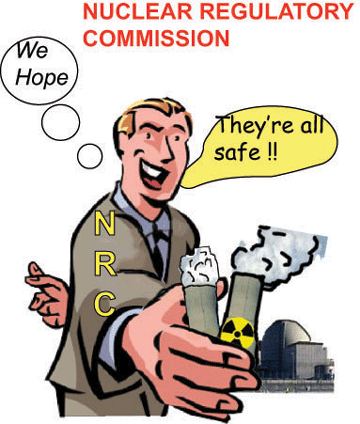 NRC will complete environmental review of Yucca project — chairman http://www.eenews.net/stories/1060013577 Hannah Northey, E&E reporter Greenwire: Tuesday, February 17, 2015 The Nuclear Regulatory Commission intends to complete an environmental review of the contentious waste repository under Yucca Mountain in Nevada because the Energy Department has refused to do so, the NRC’s chairman said today.
“The decision is we will do that since [the Department of Energy] told us they won’t be doing it,” NRC Chairman Stephen Burns told reporters at the Platts 11th Annual Nuclear Energy Conference in Washington, D.C., today. “We have the funds that are left over from the carryover for high-level waste, will cover the preparation of the supplemental [environmental impact statement].” Continue reading
Japan’s government wrestles with the unsolved problem of nuclear wastes
Government explores options on how to store nuclear waste in the long term, Japan Times, 18 Feb 15
KYODO The government said Tuesday it will consider pursuing a final storage site for nuclear waste that can be opened in the event that policies change or better techniques become available to deal with it.
Officials aim to include the plan in a revised basic policy on the final disposal of highly radioactive waste. The government is currently considering the vexed question of what to do with waste in the long-term, as some of it may need management for tens of thousands of years.
Prime Minister Shinzo Abe’s administration wants to fire up nuclear reactors again following the hiatus caused by the 2011 Fukushima meltdowns, but public opinion remains opposed.
Critics accuse the government of pushing a return to nuclear without answering the question of where the waste will go.
Also on Tuesday, the Science Council of Japan, a representative organization of various scientists, rapped the government’s stance as “irresponsible,” urging it and power companies to develop concrete measures for handling nuclear waste as a prerequisite for restarting reactors.
To fend off such criticism, the revised policy will also declare that the “current generation” is not only responsible for generating the waste it will also take action on the storage question. However, it falls short of mentioning a time frame for deciding on the final storage……..
As for how Japan would store its waste, a policy adopted in 2008 envisions reprocessing the waste, then vitrifying it and placing it deep underground…….
This implies a possible review of Japan’s long-standing but stalled policy of a nuclear fuel cycle that aims to reprocess all spent fuel and reuse the extracted plutonium and uranium as reactor fuel…….
The process of finding local governments willing to host a final repository started in 2002, but there was overwhelming opposition and little progress was made.
The government now plans to choose candidate sites based on their scientific value, rather than waiting for municipalities to step forward.
The Science Council of Japan also suggested that waste be temporarily kept in above-ground dry storage for 50 years in principle, during which the government should try to build a consensus on the issue. It also called for national discussions on how to curb, or setting limitations, on the amount of nuclear waste to be generated. http://www.japantimes.co.jp/news/2015/02/17/national/science-health/final-nuclear-waste-dump-may-be-reversible/#.VOP4A-aUcnk
Risky Radioactive Trash Shipments Would be Terrorist Targets
Public Citizen outlined five key objections to the plan, most of which were raised by Texas’s own Commission on Environmental Quality (TCEQ) last year:
 1. Waste shipments would be targets for sabotage or blackmail by terrorists. TCEQ noted that the waste is more vulnerable to accidents or attacks while in transit than if left it where it is, because security is lighter then and fewer radiation shields would be available. Shipments from reactors around the country — passing through dozens of population centers — could last over 24 years. The Energy Dept. estimates that there would be about 10,700 shipments if done by rail; about 53,000 shipments (others say 100,000) if done by truck.
2. WCS would have only limited liability, while the public would be put at risk from transport accidents, leaks and terrorism.
3. So-called “short-term” storage may become permanent — an unearned trophy for the nuclear industry. The complex scientific analysis required for any permanent waste site would take about 10 years and has not been done.
4. The WCS site is too close to the Ogallala Aquifer, which provides water to eight states.

 High-Level Rad Waste Dump Called “All Risk and No Reward for Texas” http://www.counterpunch.org/2015/02/11/high-level-rad-waste-dump-called-all-risk-and-no-reward-for-texas/
A high-level radioactive waste “parking lot” — proposed for West Texas — poses both terrible and unnecessary risks for people throughout the country — Texas in particular — and should not be built.
That’s the position of a coalition of public interest groups that declared its opposition to the plan February 9. Continue reading
AREVA joins US Waste firm to cash in on radioactive trash storage
 AREVA and WCS Sign Agreement for Independent Interim Used Nuclear Fuel Storage Site http://www.newswiretoday.com/news/150345/ NewswireToday – /newswire/ – Paris, Ile-de-France, France, 2015/02/10 – AREVA has signed an agreement with Waste Control Specialists LLC (WCS) to assist with their license application and environmental report for the construction of an interim used nuclear fuel storage facility – WCSTexas.com / AREVA.com.
WCS filed a letter of intent on February 6, 2015 with the Nuclear Regulatory Commission (NRC) stating their intention to seek a license to operate an offsite Independent Spent Fuel Storage Installation at their 14,000-acre facility in Andrews, TX.
WCS filed a letter of intent on February 6, 2015 with the Nuclear Regulatory Commission (NRC) stating their intention to seek a license to operate an offsite Independent Spent Fuel Storage Installation at their 14,000-acre facility in Andrews, TX.
“AREVA is pleased to provide WCS with its licensing experience and global expertise for the safe storage, transport and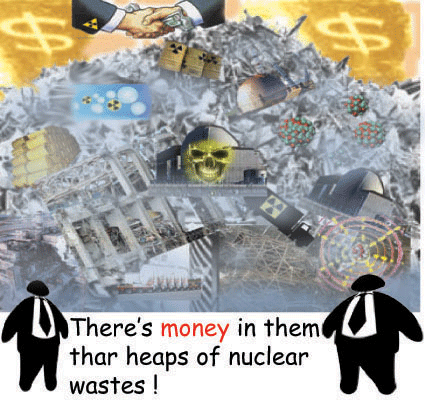 management of used nuclear fuel,” said David Jones, senior vice president, of AREVA’s Back End division, North America. “This initiative, which already has the consent of local stakeholders, will deliver an economically viable option for used fuel management while more permanent solutions are addressed.”
AREVA (areva.com) is a global leader in the transportation and storage of used nuclear fuel. More than 40% of American utilities use AREVA’s advanced NUHOMS® horizontal storage technology. The group has already sold 900 storage canisters in the U.S., making it the leading supplier for this solution.
Southern California Edison’s “Citizen Engagement Panel” (CEP) is a cruel nuclear joke
David Victor, the SCE Community Engagement Panel, and the Darrell Issa Nuclear Waste Dump http://acehoffman.blogspot.com.au/ The comments below were left at the KPBS web site in response to their report on SCE’s CEP meeting last week.
Frankly, the most important thing the CEP could learn — but hasn’t — is that the nuclear waste at San Onofre is NOT SoCal’s biggest problem with nuclear power: Diablo Canyon is. David Victor surely could have learned that by now if he wasn’t so busy kissing up to SCE’s Tom Palmisano and Chris Brown.
And the so-called “national experts” that were brought in by the CEP to “inform” them are anything BUT “experts” on 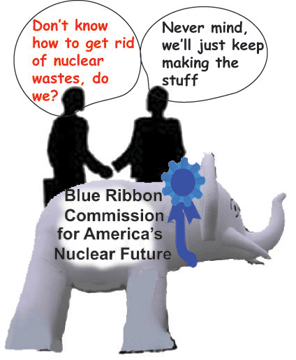 nuclear waste issues. For example, one was on Obama’s utterly useless “Blue Ribbon Commission” (BRC) which could not resolve a single thing about nuclear waste except to suggest that democracy should be thrown out with the waste (in other words, we should force states to accept waste if small communities or tribal areas within the state want to accept money along with the waste). He did not even know that stainless steel canisters can suffer from stress corrosion cracking within just two years, and yet he’s considered an “expert” helping the CEP to make decisions for soCal which could impact us for hundreds or even thousands of years!
Admitting what a terrible mess we’ve gotten ourselves into is the first step, and the CEP hasn’t even done that yet. If the CEP came out with a strong statement suggesting Diablo Canyon shut down because they’re just making their waste problem worse and we here near SanO know that’s a bad thing, then the CEP will have at least accomplished something. Right now the CEP is destructive to the goal of engaging the community.
Pennsylvania Nuclear-Dump Cleanup Gets Complicated
Nuclear-Dump Cleanup Gets Complicated – Federal Report on Pennsylvania Site Foresees Costlier Work WSJ By JOHN R. EMSHWILLER Jan. 29, 2015 The cleanup of a radioactive-waste dump in a small Pennsylvania town will likely be more complicated and potentially riskier than originally envisioned, and cost nearly 10 times as much, according to a revised federal plan.
Meanwhile, some officials, spurred by a citizen activist, are trying to determine whether all the waste in the area has been located………
Several decades ago, large amounts of radioactive waste were buried at the dump site by Nuclear Materials & Equipment Corp., or Numec, a local company that did atomic work for the federal government and other entities.
Numec was subsequently bought by Babcock & Wilcox Co. , an energy products and services provider. A B&W spokesman declined to comment.
The Corps, after years of planning, began excavating one of 10 known waste trenches at the site in the summer of 2011. Digging abruptly halted several weeks later and hasn’t resumed……….
Among the added costs are further measures to prevent a “nuclear criticality.” That can occur if enough fissionable materials, such as bomb-grade uranium or plutonium, are brought together to produce a chain reaction, said Robert Alvarez, a former Energy Department official. Such an event could produce dangerous quantities of radiation, he added.
The Corps document said officials now believe they might find more types of radioactive materials buried at the site than previously anticipated. Michael Helbling, the Corps’ project manager, said he couldn’t be more specific. “We want to be prepared for anything we find,” he said, adding that excavation is expected to resume in 2017 and take as long as 10 years to finish. http://www.wsj.com/articles/pennsylvania-nuclear-dump-cleanup-gets-more-complicated-1422558579
Britain’s government broke promise not to build nuclear reactors until a waste solution found
Ill-founded hope The belief was always that science would find some way of neutralising the dangerous radioactivity, and then it could be buried as simply as any other rubbish. This hope has proved to be ill-founded.
The British government promised four years ago it would not build any more nuclear power stations until it had found a solution to this 50-year-old problem. But it has abandoned the promise
Still No Solution to Storage of High-Level Radioactive Nuclear Waste http://ecowatch.com/2015/01/25/no-solution-radioactive-nuclear-waste/ Paul Brown, Climate News Network | January 25, 2015 A private consortium formed to deal with Europe’s most difficult nuclear waste at a site in Britain’s beautiful Lake District has been sacked by the British government because not sufficient progress has been made in making it safe.
It is the latest setback for an industry that claims nuclear power is the low-carbon answer toclimate change, but has not yet found a safe resting place for radioactive rubbish it creates when nuclear fuel and machinery reaches the end of its life.
Dealing with the waste stored at this one site at Sellafield—the largest of a dozen nuclear sites in Britain—already costs the UK taxpayer £2 billion a year, and it is expected to be at least as much as this every year for half a century.
Hundreds of people are employed to prevent the radioactivity leaking or overheating to cause a nuclear disaster, and the cost of dealing with the waste at this site alone has already risen to £70 billion.
Dangerous to humans
This extraordinary legacy of dangerous radioactive waste is present in every country that has adopted nuclear power as a form of electricity production, as well as those with nuclear weapons. No country has yet solved the problem of how to deal with waste that remains dangerous to humans for thousands of years. Continue reading
UK’s toxic waste of money in attempting to clean up Sellafield’s toxic nuclear waste
Nuclear clean-up has been a toxic waste of public money MARK LEFTLY  The Independent 23 JANUARY 2015 WESTMINSTER OUTLOOK A HAPLESS CONSORTIUM LED BY URS (NOW PART OF US RIVAL AECOM) WAS FINALLY AXED FROM LEADING THE CLEAN-UP OF CUMBRIA’S SELLAFIELD LAST WEEK.
Over-budget and behind schedule on numerous projects on what is, admittedly, one of the most hazardous nuclear detoxifications in history, this consortium had been remarkably fortunate to see its contract renewed in 2013. After it had regained its contract, Nuclear Management Partners (NMP) even apologised to MPs for its dismal performance…..
At a price tag of nearly £80bn, the Sellafield deal is one of the most significant commercialisations of what, historically, would have been public sector work. Davey, who I think has otherwise emerged from Coalition as a quietly formidable secretary of state, must ask himself why he did not block the contract extension in 2013.
It was a poor call from a minister who has otherwise earned the compliment of being a safe pair of hands. While he should be congratulated for finally getting this right, the GMB is equally correct that NMP should not stay in place any longer.
Time, on this project in particular, is money – and we cannot allow taxpayer funds to be mishandled for another 15 months. http://www.independent.co.uk/news/business/comment/mark-leftly-nuclear-cleanup-has-been-a-toxic-waste-of-public-money-9997054.html
Too massively expensive to really think about – getting rid of the world’s old nuclear reactors
Getting Rid Of Old Nuclear Reactors Worldwide Is Going To Cost Way More Than People Think, Business Insider, NINA CHESTNEY, GEERT DE CLERCQ LONDON/PARIS (Reuters) 20 Jan 15 – German utility E.ON’s breakup has led to worries that funds set aside for decommissioning reactors will not suffice, but globally the cost of unwinding nuclear is uncertain as estimates range widely.
As ageing first-generation reactors close, the true cost of decommissioning will be crucial for the future of the nuclear industry, already ailing following the 2011 Fukushima disaster and competition from cheap shale gas, falling oil prices and a flood of renewable energy from wind and solar.
The International Energy Agency (IEA) said late last year that almost 200 of the 434 reactors in operation around the globe would be retired by 2040, and estimated the cost of decommissioning them at more than $US100 billion.
But many experts view this figure as way too low, because it does not include the cost of nuclear waste disposal and long-term storage and because decommissioning costs – often a decade or more away – vary hugely per reactor and by country.
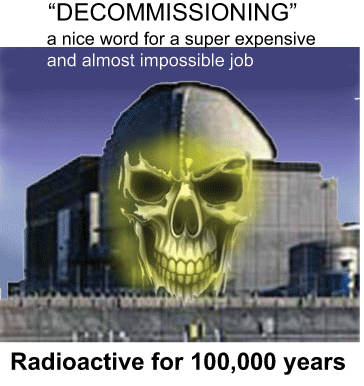
“Half a billion dollars per reactor for decommissioning is no doubt vastly underestimated,” said Mycle Schneider, a Paris-based nuclear energy consultant.
The IEA’s head of power generation analysis, Marco Baroni, said that even excluding waste disposal costs, the $US100 billion estimate was indicative, and that the final cost could be as much as twice as high. He added that decommissioning costs per reactor can vary by a factor of four.
Decommissioning costs vary according to reactor type and size, location, the proximity and availability of disposal facilities, the intended future use of the site, and the condition of the reactor at the time of decommissioning.
Although technology used for decommissioning might gradually become cheaper, the cost of final waste depositories is largely unknown and costs might spiral over time. Reactor lifespans are measured in decades, which means financing costs and provisions depend strongly on unpredictable interest rate levels.
“The IEA estimate is, without question, just a figure drawn out of the air. The reality is, the costs are quite phenomenal,” said Paul Dorfman honorary senior research associate at the Energy Institute, University College London………
The IEA’s Baroni said the issue was not the exact cost per reactor.
“What matters is whether enough funds have been set aside to provide for it,” he said. (Additional reporting by Vera Eckert in Frankfurt, Svetlana Burmistrova in Moscow, Scott DiSavino in New York and Aaron Sheldrick in Tokyo; Editing by Dale Hudson) http://www.businessinsider.com.au/r-global-nuclear-decommissioning-cost-seen-underestimated-may-spiral-2015-1
Nations make (optimistic) guesses at the cost of getting rid of old nuclear reactors
Getting Rid Of Old Nuclear Reactors Worldwide Is Going To Cost Way More Than People Think Business Insider, NINA CHESTNEY, GEERT DE CLERCQ LONDON/PARIS (Reuters) 20 Jan 15 –”…….The U.S. Nuclear Regulatory Commission estimates that the cost of decommissioning in the United States – which has some 100 reactors – ranges from $US300 million to $US400 million per reactor, but some reactors might cost much more.
 France’s top public auditor and the nuclear safety authority estimate the country’s decommissioning costs at between 28 billion and 32 billion euros ($US32-37 billion).
 German utilities – such as E.ON, which last month said it would split in two, spinning off power plants to focus on renewable energy and power grids – have put aside 36 billion euros..
 Britain’s bill for decommissioning and waste disposal is now estimated at 110 billion pounds ($US167 billion) over the next 100 years, double the 50 billion pound estimate made 10 years ago.
Japanese government estimates put the decommissioning cost of the country’s 48 reactors at around $US30 billion, but this is seen as conservative. Russia has 33 reactors and costs are seen ranging from $US500 million to $US1 billion per reactor……… http://www.businessinsider.com.au/r-global-nuclear-decommissioning-cost-seen-underestimated-may-spiral-2015-1
Plenty of work for nuclear clean-up firms
U.S. nuclear cleanup specialist goes from Hanford to Fukushima LEDGER INQUIRER BY ROB HOTAKAINENMcClatchy Washington BureauJanuary 18, 2015 “……After working at the Hanford nuclear site in Washington state for 12 years, he’s helping to lead the cleanup at the Fukushima Daiichi nuclear plant, which melted down in March 2011……… it’s the work that drives him, using American technology to help the Japanese people deal with the catastrophe at Fukushima.
McCormick works for Kurion Inc., a company headquartered in Irvine, Calif., that focuses on managing nuclear and hazardous waste. The company built a mobile processing system that’s helping to remove radioactive strontium from 400,000 tons of contaminated water stored near the Fukushima Daiichi plant. McCormick said the company was the only U.S. firm to win a contract from the Tokyo Electric Power Co., which is overseeing the entire cleanup project.
Choosing to do the initial work in a nuclear-free environment, Kurion designed and built the treatment system in Washington state’s Tri-Cities area and shipped it to Japan on a cargo plane. It arrived in July and began operating in October, after a series of tests.
“Our contract was to build it in America, using American nuclear standards that are equivalent to the Japanese standards,” McCormick said.
As McCormick does his work, he’s avoiding the public debate over whether Japan should restart some of the 48 nuclear plants that were shut down after the Fukushima disaster………
a recent poll found that most Japanese citizens want the plants to remain closed, fearing another catastrophe.
“We don’t even know the final disposal place of the Fukushima waste. We should discuss this after we decide where to dispose of the waste,” said Hatsuhiko Aoki, an artist from Gifu Prefecture. Yoshitaka Mukohara, the president of a publishing company and the secretary-general of the Anti-Nuclear Kagoshima Network, said the Abe administration was acting irresponsibly. “There are some places that are not decontaminated, but the government is sending people back,” Mukohara said. “What they are doing is acting like nothing ever happened.”
McCormick has no interest in weighing in on the controversy.
“It’s really a decision that the Japanese people have to make, in terms of how they get their energy,” McCormick said. “I’ve been focused on the cleanup.”
But McCormick said part of the work in Japan would involve building public support for the cleanup and convincing people that it was a long-term project.
It’s a skill he used at Hanford, lobbying Congress to include cleanup money in annual appropriation bills.
“The cleanup of Fukushima, if you compare it to Hanford, is on the same scale: tens of billions of dollars,” McCormick said. “And it’s going to take many decades to complete.” http://www.ledger-enquirer.com/2015/01/18/3520793/us-nuclear-cleanup-specialist.html
Japanese government gives up its plan to begin transporting radioactive wastes to interim storage sites
 Ube : Gov’t to postpone moving radioactive waste to interim storage sites http://www.4-traders.com/UBE-INDUSTRIES-LTD-6491266/news/Ube–Govt-to-postpone-moving-radioactive-waste-to-interim-storage-sites-19704037/ 18 Jan 15 Environment Minister Yoshio Mochizuki said Friday the government has given up its plan to begin this month transporting radioactively contaminated soil and other waste, collected during decontamination work following the 2011 Fukushima nuclear crisis, to interim storage sites at nearby towns.
The government now aims to begin such transportation by March 11 this year on the fourth anniversary of the disaster at the Fukushima Daiichi nuclear power station, Environment Ministry officials said.
The delay was due to difficulties obtaining agreement from residents near the interim storage sites and local municipalities, the officials said.
Under the government plan, the radioactively contaminated waste will be kept in the interim facilities in the towns of Futaba and Okuma in Fukushima Prefecture and will be permanently disposed of outside the prefecture within 30 years, as requested by the Fukushima prefectural government in accepting the storage.
The site for final disposal of the radioactive waste has yet to be decided.
Meanwhile, Reconstruction Minister Wataru Takeshita offered an apology over the delay.
In October 2011, the government led by then Prime Minister Yoshihiko Noda released the target to begin the delivery of contaminated waste to interim storage sites in January 2015.
1 This Month
23-25 October – on Zoom – World BEYOND War’s annual global conferenc


Shut down the radiation-damaged Heysham nuclear reactors now
To see nuclear-related stories in greater depth and intensity – go to https://nuclearinformation.wordpress.com

Say No to NASA’s Reckless Nuclear Reactor on the Moon
Say No to NASA’s Reckless Nuclear Reactor on the Moon

-
Archives
- October 2026 (219)
- September 2026 (339)
- August 2026 (330)
- July 2026 (355)
- June 2026 (287)
- May 2026 (306)
- April 2026 (356)
- March 2026 (251)
- February 2026 (267)
- January 2026 (308)
- December 2025 (358)
- November 2025 (359)
-
Categories
- 1
- 1 NUCLEAR ISSUES
- business and costs
- climate change
- culture and arts
- ENERGY
- environment
- health
- history
- indigenous issues
- Legal
- marketing of nuclear
- media
- opposition to nuclear
- PERSONAL STORIES
- politics
- politics international
- Religion and ethics
- safety
- secrets,lies and civil liberties
- spinbuster
- technology
- Uranium
- wastes
- weapons and war
- Women
- 2 WORLD
- ACTION
- AFRICA
- Atrocities
- AUSTRALIA
- Christina's notes
- Christina's themes
- culture and arts
- Events
- Fuk 2022
- Fuk 2023
- Fukushima 2017
- Fukushima 2018
- fukushima 2019
- Fukushima 2020
- Fukushima 2021
- general
- global warming
- Humour (God we need it)
- Nuclear
- RARE EARTHS
- Reference
- resources – print
- Resources -audiovicual
- Weekly Newsletter
- World
- World Nuclear
- YouTube
-
RSS
Entries RSS
Comments RSS

