South Carolina – problem of nuclear wastes at coal plant
Nuclear waste, arsenic at SC coal plant raise concern BY SAMMY FRETWELL sfretwell@thestate.com March 7, 2015 HARTSVILLE, SC — Just a few hundred yards from Lake Robinson lies an old waste pond that, until this year, was among the least of Duke Energy’s worries in the Carolinas……..documents that have surfaced recently show the unlined 55-acre basin has leaked arsenic – and it has the unusual legacy of being a dump site for low-level nuclear waste. Both findings are producing new questions about how to cleanse the mess at Duke Energy’s H.B. Robinson power station……..
in the 1980s, at least 69,000 cubic meters of radiation-tinged sediment wound up in the coal ash pond from the nuclear plant, a rare occurrence because most power plants don’t include both coal-and nuclear-fired units.
State regulators in South Carolina said they knew of no other power plant site where atomic waste wound up in a coal ash pond. A spokesman for the Nuclear Regulatory Commission in Atlanta said the practice is rare…….http://www.thestate.com/2015/03/07/4031773_nuclear-waste-arsenic-at-sc-coal.html?rh=1
Depleted uranium for Utah – mind boggling scenario

 Will Utah bury nation’s leftover depleted uranium?
 The Utah Department of Environmental Quality just received this week additional information from EnergySolutions related to potential erosion and other “deep time” problems suspected to impact its Tooele County disposal site, pushing back the start of a public review to April 13.
Helge Gabert, project manager for the state on the depleted uranium issue, said the requested information was about a month late. It was submitted Wednesday for review. It will be incorporated into a subsequent analysis or safety evaluation that the agency will release for public comment about a week beyond its earlier time frame.
In addition, a pair of public meetings will be held the week of May 4, with a decision on disposal due July 1 from Rusty Lundberg, director of the Utah Division of Radiation Control.
To take the nation’s leftovers of 750,000 metric tons of depleted uranium, EnergySolutions has to first convince Utah regulators that its site will be safe for 10,000 years. Beyond that, it has to prove that the threat to public health will be minimal in the advent of a return of a Lake Bonneville or other “deep time geologic events” over 2.1 million years.
It is a mind boggling scenario, planning for all manner of circumstances that could play out, modeling time and performance over such an extended period that it is difficult to grasp.
EnergySolutions must account for the farmer who wanders onto the disposal site, unaware of the radiological hazard underneath his feet. Or the burrowing rodent that could cause vulnerabilities to the at-grade disposal site.
The company must try to figure out how the wind will deposit the sand, how dunes will form and when the lake returns — as some say it inevitably will — how the water might disperse the radiological hazard from an anticipated breach of the disposal barrier.
Such planning is something Utah is requiring because of the unique nature of depleted uranium, which is the byproduct of the uranium enrichment process for nuclear fuel. While depleted uranium has commercial applications, such as antitank armaments, demand for it is far outpaced by the amount that is generated. The U.S. Department of Energy has responsibility for its disposal.
Depleted uranium gets more radioactive as its isotopes try to get back to their natural state, and as these “daughter products” break down, they not only multiply, but increase in intensity.
The instability that occurs in the decay process occurs over 2.1 million years, with what was once classified as “low-level” radioactive waste breaching Utah-imposed limits on what is allowed to be buried in the state.
Gabert said there is no question that by 40,000 years, depleted uranium will violate the state’s prohibition on anything “hotter” than Class A waste, so it becomes a policy issue for current regulators to decide if its disposal is acceptable in the here and now.
“You could argue why does not the state just make the decision based on the science, but we have not made that. We are willing to hear out what the facility has to say,” Gabert said.
The deep time analysis looks in particular if the threat will be mitigated enough — if the doses of radioactivity would be diluted to the degree that even exposure to a higher “category” of waste would not cause harm.
Critics of the EnergySolutions’ proposal to dispose of the depleted uranium say no amount of assurances or analysis can safeguard human health given the sheer amount of unknowns.
Nuclear wastes out of control? Fukushima’s bags of radioactive trash pile up
The fruits of the laborers’ efforts are stacked in those giant sacks—5.5 million of them and counting. They are spread out across Fukushima province, along roadsides, in parking lots and backyards. They are tagged and bar-coded so authorities know what’s inside and how radioactive it is – and when the bags might start to wear out.
As the bags pile up and workers fan out across the landscape, some locals are questioning the cost-benefit analysis.
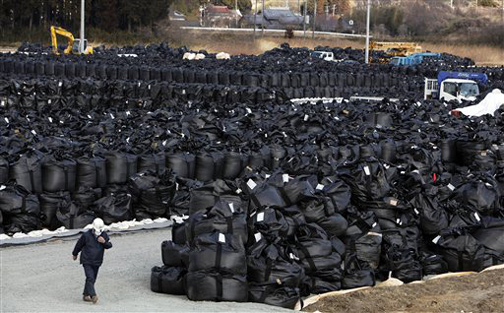
Fukushima nuclear plant cleanup has cost $13 billion and counting After 4 years, Fukushima nuclear cleanup remains daunting, vast LA Times, By JULIE MAKINEN contact the reporter 12 Mar 15 “…..Karimata is in charge of the work here in an evacuation zone about 12 miles north of the Fukushima Dai-ichi nuclear plant—part of the most extensive, and expensive, nuclear cleanup ever attempted.
The scale and complexity of what Japan is trying to do in the aftermath of the 2011 meltdown at Fukushima is mind-boggling. Decontamination plans are being executed for 105 cities, towns and villages affected by the accident at Fukusima Dai-ichi, 140 miles northeast of Tokyo.
Many Japanese regard this massive undertaking as a solemn obligation to right a terrible wrong. Others, even some of the people directly affected, question whether it’s a quixotic waste of resources.
Karimata’s delegation marches up a side street to check on a brigade of laborers wearing gloves, masks, helmets and fluorescent vests with radiation detectors tucked in their chest pockets. Some are spreading fresh soil in the yard of an uninhabited home. Next door, workers are up on a scaffold, preparing to wipe down the roof and gutters.
Across the street, near a bamboo grove, two men are erecting a plastic frame to support a massive double-lined garbage bag about the size of a hot tub. Dozens of identical black sacks, each weighing about a ton and stuffed with radiation-contaminated soil, leaves, wood chippings and other debris, stretch out behind them, awaiting transport at some uncertain date to a yet-unspecified final resting place.
Four years after the Great Tohoku Earthquake shook northern Japan to its core, touched off a deadly tsunami and precipitated the Fukushima Dai-ichi disaster, hundreds of square miles remain off-limits for habitation due to radioactivity. Some 79,000 people still cannot return home.
But unlike the 1986 accident at Chernobyl, where authorities simply declared a 1,000 square-mile no-habitation zone, resettled 350,000 people and essentially decided to let the radiation dissipate over decades or centuries, Japan is attempting to make the Fukushima region livable again. It is an unprecedented effort.
The sheer manpower and money dedicated to the house-to-house effort is staggering: Continue reading
Japanese public to bear the costs of scrapping 5 old nuclear reactors

 Five ageing nuclear reactors to be scrapped in Japan Sun Daily, 12 March 2015 -TOKYO: Japanese power companies are expected to announce the decommissioning of five ageing nuclear reactors next week, local media reported Thursday.
Four operators – Kansai Electric Power Co, Japan Atomic Power Co, Chugoku Electric Power Co and Kyushu Electric Power Co – will decide on Wednesday to scrap the reactors, which went into service in the 1970s, Kyodo News agency reported without citing any sources.
The operators will avoid the cost of beefing up safety measures to meet higher standards following Japan’s worst nuclear accident in Fukushima prefecture in 2011, Kyodo said.
The Industry Ministry said in January that the cost of decommissioning reactors, which can run to hundreds of millions of dollars and take decades until the property is ready for other uses, should be met by the general public……..http://www.thesundaily.my/news/1353191
Japan must face the problems and politics of demolishing dead nuclear reactors
Questions remain over future plan for Japan’s aging nuclear plants Japan Times, 12 Mar 15 BY ERIC JOHNSTON As the debate about what to do with Japan’s aging nuclear reactors intensifies, questions remain about the ramifications of decommissioning plants, and how to tear down the facilities in a way that’s efficient, affordable, safe, and that has the support of the local community.
In the United Kingdom, these concerns formed the basis of a policy that has led to the decommission of numerous power stations, two of which began operating in the 1950s……
Seven of Japan’s 48 commercial reactors are at least 40 years old — in principle their maximum operating life. Another five are at least 35 years old and their fate will have to be decided within the next few years.
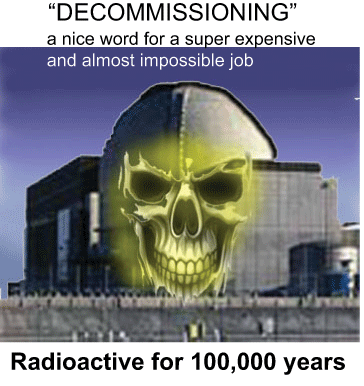
Kyushu Electric plans to decommission the 40-year-old Genkai No. 1 plant, while Kepco is expected to shut down the Mihama No. 1 and 2 reactors, both of which are over 40 years old. Chugoku Electric plans to decommission the 41-year-old Shimane No. 1 reactor, while the Tsuruga No. 1 reactor, which is 45 years old and run by Japan Atomic Power, will be closed.
Decommissioning a plant is a decades-long process that does not necessarily immediately involve the most crucial step of tearing down the reactors and hauling away radioactive material.
“During the decommissioning of the Berkeley power station in southwest England, we’ve left the reactor building standing because it’s safer to remove the nuclear material in another 60 years,” Franklin said. “We’ve closed the doors on the reactor building until 2074.”
However, he acknowledged publicly visible gestures were important because they could help reassure local communities that the plant was actually being dismantled.
“A skyline change helps garner support for the decommissioning process and for difficult decisions, such as not tearing down and hauling away nuclear materials in reactor buildings,” he said.
“In one case, we destroyed the plant’s cooling towers, which were not actually a major hazard but could be seen for miles. If you live nearby and you see them come down, you feel progress is being made, and that’s more effective than simply telling people about the progress.”
Perhaps the biggest lesson the U.K. learned was that effective decommissioning starts with addressing the corporate and bureaucratic culture at a nuclear plant.
“Changing your culture from making something — electricity — to actually taking power stations down requires a huge cultural change on a nuclear site. That’s something we’re really working on sharing with Japanese nuclear operators,” Franklin said. http://www.japantimes.co.jp/news/2015/03/11/national/questions-remain-over-future-plan-for-japans-aging-nuclear-plants/#.VQH9CNKUcnk
Japan’s piles of radioactive trash
Radioactive Fukushima, Asia One Reuters, Mar 11, 2015 “…..Today, four years after the disaster, residents are torn over government’s plan to build a radioactive waste storage site in the shadow of the wrecked nuclear plant, reported Reuters.
Norio Kimura, 49, who lost his father, wife and daughter in the tsunami, walks to where his house used to stand before it was washed away by massive waves.
Kimura knows the brokers are circling, ready to offer a deal for his land to build the waste storage facility.
He has vowed not take it.
“I can’t believe they’re going to dump their trash here after all we’ve been put through,” he told Reuters.
Japan has allocated more than US$15 billion (S$20.7 billion) to an unprecedented project to lower radiation in towns around Fukushima. Every day teams of workers blast roads with water, scrub down houses, cut branches and scrape contaminated soil off farmland.
That irradiated trash now sits in blue and black plastic sacks across Fukushima, piled up in abandoned rice paddies, parking lots and even residents’ backyards.

Tokyo plans to build a more permanent storage facility over the coming years in now-abandoned towns close to the Fukushima nuclear plant – but like Kimura, many locals are angry that the government is set to park 30 million tons of radioactive debris on their former doorstep.
According to Reuters, some 2,300 residents who own plots of land in Futaba and Okuma which the government needs for the waste plant face what many describe as an impossible choice. The storage site will be built if the government can lease or buy enough land – whatever concerns the last hold-outs may have.
– See more at: http://news.asiaone.com/news/asia/radioactive-fukushima#sthash.gzfTklgA.dpuf
Massive buildup of radioactive debris at Fukushima No 1 nuclear plant
FOUR YEARS AFTER: Radioactive debris continues to stack up at Fukushima No. 1 nuclear plant http://ajw.asahi.com/article/0311disaster/fukushima/AJ201503080013 March 08, 2015 By HIROMI KUMAI/ Staff Writer
FUTABA, Fukushima Prefecture–With nowhere to put it, refuse and debris contaminated with radioactive materials continue to pile up at the crippled Fukushima No. 1 nuclear power plant here.
A total of 258,300 cubic meters of radioactive debris was produced from the March 2011 accident to the end of this January in the plant, where decommissioning work is under way.
The amount is equivalent to the capacity of about 650 25-meter-long swimming pools.
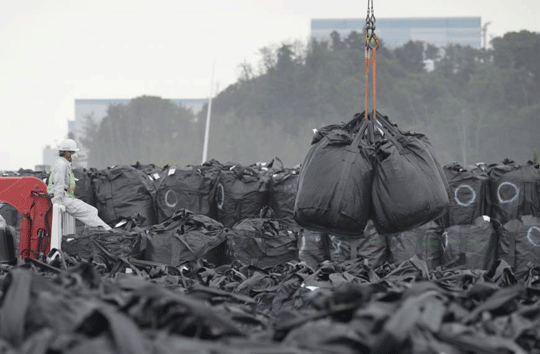
Of the 258,300 cubic meters, 178,600 cubic meters were mainly debris that had been scattered around reactor buildings, wood refuse produced in the work in the plant and protective suits used by workers, according to the plant’s operator, Tokyo Electric Power Co.
The remaining 79,700 cubic meters were trees that were felled to create space for tanks storing radioactive water. There were also 1,846 objects that absorbed radioactive materials from contaminated water.
According to the road map worked out by the government and TEPCO, the basic plan for disposing of the radioactive waste will be released in fiscal 2017.
Japanese government to start campaign to encourage hosting of nuclear wastes
 Government to start campaign on nuclear waste disposal sites , Japan Times, 9 Mar 15 KYODO The government plans to launch a campaign in major cities to promote the need for permanent disposal facilities for high-level nuclear waste from power plants, sources close to the matter said Saturday.
Prime Minister Shinzo Abe’s administration is looking to restart nuclear plants shut after the Fukushima disaster, and has faced criticism over promoting nuclear power without resolving where the waste will ultimately be disposed.
Symposiums are planned for Sapporo, Sendai, Tokyo, Nagoya, Osaka, Fukuoka and roughly four other cities, hosted by the Ministry of Economy, Trade and Industry and the Nuclear Waste Management Organization of Japan, which was previously solely responsible for the disposal plan……..
The government is also considering launching an information campaign on social networking services, with the details to be discussed at a METI task force meeting set for Tuesday, the sources said.
The current disposal policy, adopted in 2008, calls for waste to be vitrified and placed in facilities deep underground. Revisions to the policy at the end of the month are expected to include the selection of candidate sites on scientific grounds, without waiting for local authorities to volunteer to host the facilities. http://www.japantimes.co.jp/news/2015/03/08/national/government-start-campaign-nuclear-waste-disposal-sites/#.VPy51tKUcnk
Tawian has serious problems in its nuclear waste management
 Questions raised over nuclear waste management, Taipei Times By Tang Chia-ling / Staff reporter 9 Mar 15 The Atomic Energy Council (AEC) has detected greater-than-class-C (GTCC) nuclear waste at the nuclear-waste storage facility on Orchid Island (Lanyu, 蘭嶼) in Taitung County, despite the facility being designed for only low-radioactive materials, raising questions over the management of nuclear waste.
The council originally ordered Taiwan Power Co (Taipower, 台電) to introduce new rules on nuclear-waste classification by the end of last year, after it discovered the GTCC nuclear waste on the outlying island.
However, Taipower has failed to meet the deadline due to technical difficulties in compiling a nuclear-waste inventory, so the deadline has been extended, the council said.
According to the US Nuclear Regulatory Commission classification system, nuclear waste with a concentration of cesium-137 or strontium-90 greater than 4,600 and 7,000 curies per cubic meter respectively, or with a concentration of nickel-63 greater than 700 curies per cubic meter, is considered GTCC waste.
Citing a report by the Institute of Energy Research, Yang Mu-huo (楊木火), adviser to Democratic Progressive Party (DPP) Legislator Chen Ou-po (陳歐珀), said GTCC waste is mainly made up of components of decommissioned nuclear reactors and resins derived during the maintenance of nuclear power plants.
Class B nuclear waste is required to be stored in containers for 300 years, while class C waste needs to be stored for 500 years. GTCC waste is generally unacceptable for near-ground storage and requires a special disposal plan, the report shows.
Yang questioned why storage canisters designed for storage of up to 100 years had been used for the waste on Orchid Island and why authorities did not propose a special disposal plan for the GTCC materials……..http://www.taipeitimes.com/News/front/archives/2015/03/09/2003613111
Halliburton & Co used fracking to Inject Nuclear Waste Underground for Decades
Shock: Fracking Used to Inject Nuclear Waste Underground for Decades By Aaron Dykes and Melissa Melton Global Research, March 06, 2015 Activist Post 5 March 2015 Unearthed articles from the 1960s detail how nuclear waste was buried beneath the Earth’s surface by Halliburton & Co. for decades as a means of disposing the by-products of post-World War II atomic energy production.
Fracking is already a controversial practice on its face; allowing U.S. industries to inject slurries of toxic, potentially carcinogenic compounds deep beneath the planet’s surface — as a means of “see no evil” waste disposal — already sounds ridiculous, dangerous, and stupid anyway without even going into further detail.Alleged fracking links to the contamination of the public water supply and critical aquifers, as well as ties to earthquake upticks near drilling locations that are otherwise not prone to seismic activity have created uproar in the years since the 2005 “Cheney loophole,” which allowed the industry to circumvent the Safe Drinking Water Act by exempting fracking fluids, thus fast tracking shale fracking as a source of cheap natural gas.
Now, it is apparent that the fracking industry is also privy to many secrets of the nuclear energy industry and, specifically, where the bodies are buried, err… dangerous nuclear waste is buried, rather — waste that atomic researchers have otherwise found so difficult to eliminate. Continue reading
£53bn cost now – the ever more expensive Sellafield nuclear clean-up
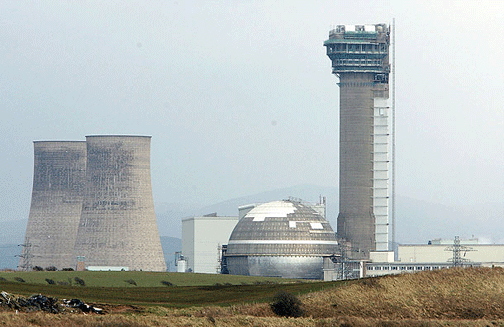 Sellafield clean-up costs rise to £53bn, says NAO BBC News 4 Mar 15 The cost of decommissioning and cleaning up the Sellafield nuclear site in Cumbria has increased by £5bn to £53bn, says the National Audit Office.
Margaret Hodge MP, chair of the Public Accounts Committee (PAC) which commissioned the report, said the cost hike was “astonishing.”
A year ago, the Nuclear Decommissioning Authority, the body responsible for the clean up, said the cost would be £48bn.
The work is also behind schedule, the report said.
The Authority gave the £9bn Sellafield clean-up contract to Nuclear Management Partners (NMP), but following criticism of NMP’s competence, decided in January to cancel the contract.
“It is galling that breaking the contract will cost the public purse £430,000,” said Mrs Hodge, whose committee recommended the Authority consider doing this a year ago.
‘Escalation’
The Nuclear Decommissioning Authority, the Department of Energy and Climate Change, NMP, and Sellafield Ltd. are due to appear before the Committee on 11 March.
Mrs Hodge said she expected them to “tell me how the escalation in cost of cleaning up Sellafield will be stopped and performance put back on track.”
Chris Jukes, regional officer of the GMB union, said: “GMB has been absolutely clear all along that the NMP model did not work at Sellafield…….
The total cost of cleaning up the UK’s 17 nuclear sites is “around £70bn”, the NAO says.
Sellafield is the “UK’s largest and most hazardous nuclear site”, including two nuclear fuel reprocessing plants, waste management and storage plants, as well as storage ponds and silos containing waste from the UK’s first nuclear plants.
The Authority aims to clear the site by 2120. http://www.bbc.com/news/business-31725365
Areas in Creighton, Saskatchewan and Schreiber assessed, not likley to be suitable for nuclear wastes

they should stop making radioactive trash – with nowhere to put it
NWMO Concludes Studies in Creighton, Saskatchewan and Schreiber, Ontario TORONTO, March 3, 2015 – The Nuclear Waste Management Organization (NWMO) is concluding preliminary assessment work in two communities engaged in learning about Adaptive Phased Management (APM), Canada’s plan for the long-term management of used nuclear fuel.
One way to dispose of SOME of the nuclear waste burden
 Can’t We Just Throw Our Nuclear Waste Down A Deep Hole? http://www.forbes.com/sites/jamesconca/2015/03/05/cant-we-just-throw-our-nuclear-waste-down-a-deep-hole/ James Conca 5 Mar 15 Um…yes, we can. It’s called Deep Borehole Disposal and is pretty easy for some nuclear waste. Especially some highly radioactive materials that have sat in some fairly small capsules for almost 40 years.
This was exactly the topic of discussion in Washington this week when Secretary of Energy Ernest Moniz answered questions from Rep. Dan Newhouse (R-WA) at a House Science, Space and Technology committee hearing (Tri-City Herald).
The answer from Moniz was positive. He discussed a pilot project that would demonstrate the idea of deep borehole disposal using these capsules.
Deep borehole disposal is simple. Drill a very deep hole – 3 miles or so – put the waste in it and fill it up with some special layers, but mainly crushed rock and cement. As geologists, we know how many millions of years it takes for anything to get up from that depth in the Earth’s crust.
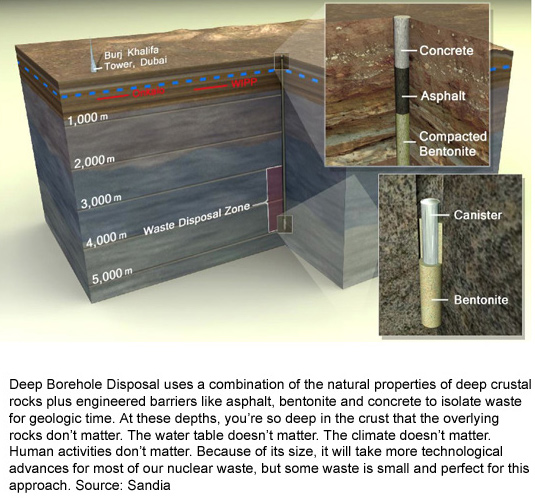
As long as you don’t put it under an active volcano!
The nice thing about deep borehole disposal is that it doesn’t matter where you put it in the country. At that depth, you’re so deep in the crust that the overlying rocks don’t matter. The water table doesn’t matter. The climate doesn’t matter. Human activities don’t matter.
But why these capsules? Because the material, cesium-137 and strontium-90 chloride salts (137CsCl and 90SrCl2), is in an easy waste form compared to that sludgy gooey stuff that makes up most of the tank waste left over from weapons production. These capsules are dry solid material in relatively small containers – less than 3-inches in diameter and only 2-feet long – very small compared to the large spent fuel assemblies and high-level waste glass logs usually discussed in geologic disposal plans.
Deep borehole disposal for the larger waste containers is trickier and more expensive because we haven’t yet drilled large-diameter holes that deep. Like all technological advances, we will (Sandia National Labs; Ethan Bates et al 2014). But these capsules are less than 3-inches wide, and we’ve drilled 6 and 8 inch holes that deep many times, so nothing really new needs to be developed for this project.
There are 1,936 capsules filled with radioactive 137CsCl and 90SrCl2 that are stored underwater at the Waste Encapsulation Storage Facility at DOE’s Hanford site in Washington State. Because these radionuclides, left over from plutonium production for weapons, are the primary heat-generator in nuclear waste, they were separated from the rest of the waste almost 40 years ago to reduce heat in the tanks, as well as to use in research.
But there is a time-sensitive nature to these capsules. Although CsCl doesn’t melt until 645°C (1,193°F), it goes through a bizarre solid-state phase change at 450°C (842°F). This means that without melting it’s atoms change their arrangement in space from one structure to another with a very different density. So as the temperature changes across this boundary, the material swells and shrinks. And that tends to degrade the containers it’s in.
The existing containers are beginning to get a little degraded, so best to get rid of them as soon as possible. They’re small, so deep borehole disposal would be cheap and easy.
Since there isn’t much of this boutique nuclear waste, only 5 cubic yards, and it’s in a great form, this is a perfect opportunity to demonstrate deep borehole disposal and clean out this facility.
Like all really hot nuclear waste, these capsules were destined for the proposed deep geologic nuclear waste repository at Yucca Mountain, Nevada, which was halted in 2010. Since a new permanent federal repository for high-level waste won’t be chosen for decades, we need to rethink our nuclear disposal program.
And this is a good idea, one of the few looked at by thePresident’s Blue Ribbon Commission on America’s Nuclear Future that was formed to come up with a new strategy in the wake of Yucca Mountain’s closure. Their recommendations were basically to pick disposal options suited to the waste and the need. And to get everyone to buy off on them before you start!
These capsules “could be very well suited perhaps for much earlier disposal through a borehole approach,” Moniz said. “We have to drill — we have to do the demonstration project, do the science, which is what we want to do in 2016.”
Budget proposal documents show $2 million for technology development to support plans in fiscal 2016 for what is anticipated to be a multi-year test using a non-radioactive waste substitute. Since Yucca Mountain was projected to cost over $200 billion, this is a steal.
The test would demonstrate technology for sealing the borehole, tools to characterize waste in the borehole and controls on waste isolation. DOE has also sought communities interested in being the site for the borehole test.
Fort Calhoun nuclear waste not going anywhere?
Fort Calhoun Nuclear Waste Needs A Home By: Brian Mastre – WOWT.com , Feb 27, 2015 Nebraskans have paid hundreds of millions of dollars to the federal government to store used nuclear fuel from the state’s two nuclear power plants, but the feds aren’t doing anything with it. Yet, the government keeps the money. Where is the nuclear waste going in the meantime and what’s happening to our dollars?…….http://www.wowt.com/home/headlines/Fort-Calhoun-Nuclear-Waste-Needs-A-Home-294370321.html
The massive costs and massive dangers of hosting a radioactive nuclear trash dump
 Inside the race for Canada’s nuclear waste: 11 towns vie to host deep burial site Canada’s nuclear waste will be deadly for 400,000 years. What town would like the honour of hosting it?CHARLES WILKINS TheGlobe and Mail Feb. 26 2015,
“If I piled any quantity of shit out there and left it with no disposal plan, I’d be shut down and condemned within weeks. And here’s an industry with the capacity for global devastation, with no permanent plan for their garbage, the most dangerous stuff on Earth, and they’re allowed to keep producing it indefinitely.”
There is in fact a plan for that waste. A federally mandated body, the Nuclear Waste Management Organization (NWMO), wants to bury it in what the nuclear industry calls a Deep Geological Repository, or DGR. First, though, the organization must complete its quest—in effect, a competition, although the NWMO doesn’t see it that way—to find a municipality that will serve as a “willing host” for the repository. Among the contenders for the distinction are the municipalities of Huron-Kinloss, South Bruce and Central Huron, all of them close neighbours to Fran and Tony McQuail.
If it doesn’t seem like a competition any municipality would want to win, consider that spending on the project will likely run as high as $24 billion. And, the construction phase aside, the jobs involved are not the sort that will last only until another, perhaps cheaper, location is found. According to the NWMO’s plan, 400,000 years or more will pass between the point at which the waste is buried and the happy day when any sort of safety sticker is likely to be affixed to the vast toxic grave.
One morning in October, 1957, the principal of Keyes Public School in Deep River, Ontario, came into our Grade 5 classroom and declared that we, the children of the town, had “nothing to be afraid of.” We were to pay no attention to rumours that the reactors at nearby Chalk River would be among the Soviet Union’s first targets should the Cold War suddenly heat up.
Because we had older siblings ever willing to heighten our appreciation of reality, we already knew that if the reactors got hit, the explosion would be the equivalent of a thousand, maybe a million, H-bombs. We knew, too, that Deep River was located exactly seven miles from the reactors because that was the minimum distance at which human life would be spared if the plant ever got hit.
Mercifully, the missiles never came. And the plant never blew.
Others did: Three Mile Island (1979), Chernobyl (1986), Fukushima (2011).
Most of the reactor stories we heard as kids turned out to be fables. Yet more than half a century later, they remain bristling little allegories not just of the risks of splitting the atom but of the doggedness of those who continue to tell us we have “nothing to fear” from an industry that in 1945 said hello to humanity by incinerating 80,000 citizens of Hiroshima…….http://www.theglobeandmail.com/report-on-business/rob-magazine/inside-the-race-for-canadas-nuclear-waste/article23178848/
1 This Month
23-25 October – on Zoom – World BEYOND War’s annual global conferenc


Shut down the radiation-damaged Heysham nuclear reactors now
To see nuclear-related stories in greater depth and intensity – go to https://nuclearinformation.wordpress.com

Say No to NASA’s Reckless Nuclear Reactor on the Moon
Say No to NASA’s Reckless Nuclear Reactor on the Moon

-
Archives
- October 2026 (219)
- September 2026 (339)
- August 2026 (330)
- July 2026 (355)
- June 2026 (287)
- May 2026 (306)
- April 2026 (356)
- March 2026 (251)
- February 2026 (267)
- January 2026 (308)
- December 2025 (358)
- November 2025 (359)
-
Categories
- 1
- 1 NUCLEAR ISSUES
- business and costs
- climate change
- culture and arts
- ENERGY
- environment
- health
- history
- indigenous issues
- Legal
- marketing of nuclear
- media
- opposition to nuclear
- PERSONAL STORIES
- politics
- politics international
- Religion and ethics
- safety
- secrets,lies and civil liberties
- spinbuster
- technology
- Uranium
- wastes
- weapons and war
- Women
- 2 WORLD
- ACTION
- AFRICA
- Atrocities
- AUSTRALIA
- Christina's notes
- Christina's themes
- culture and arts
- Events
- Fuk 2022
- Fuk 2023
- Fukushima 2017
- Fukushima 2018
- fukushima 2019
- Fukushima 2020
- Fukushima 2021
- general
- global warming
- Humour (God we need it)
- Nuclear
- RARE EARTHS
- Reference
- resources – print
- Resources -audiovicual
- Weekly Newsletter
- World
- World Nuclear
- YouTube
-
RSS
Entries RSS
Comments RSS

