Exelon has 60 years in which to remove Oyster Creek’s 650 metric tons of spent fuel
Oyster Creek: After 2019, what then?, asbury park press, Randy Bergmann, @appopinion10 May 3, 2015 For people who had lived in the shadow of the Oyster Creek nuclear power plant in Lacey for decades, the news in 2009 that it was to close 10 years earlier than allowed under its license extension was warmly welcomed. Finally, the health and safety threats posed by the plant would be coming to an end.
Well, not really — at least no time soon.
That “good news” has been tempered by the fact plant owner Exelon, which agreed to mothball the reactor in exchange for the state not requiring it to install cooling towers, has up to 60 years to remove the 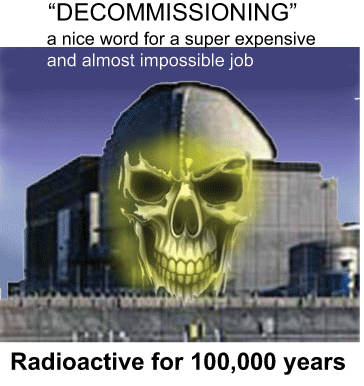 from its elevated spent fuel pool, totally dismantle the plant and clean up the site.
A Nuclear Regulatory Commission rule change in 2011 extended the period in which closed nuclear reactors were allowed to decommission from 30 years to 60 years. Although Exelon has yet to establish a timetable for when that will be done, the company’s president and CEO, Christopher Crane, has said it will be no sooner than 10 years, as stipulated in its agreement with the state, and up to 60 years.
In some ways, the risks posed by a closed plant that has yet to be decommissioned can be as great as one that continues to operate and is closely monitored by the NRC.
What are the odds of a disaster occurring at Oyster Creek? They’re remote. But given the nightmarish consequences of such a disaster occurring at a site around which 4.5 million people reside within a 50-mile radius, they’re not remote enough for citizens and the state to sit back and allow the Nuclear Regulatory Commission, which has a well-deserved reputation as an industry lapdog, to dictate the process every step of the way……..
What is the likelihood of another major nuclear disaster occurring in the future?Researchers Spencer Wheatley and Didier Sornette at ETH Zurich in Switzerland and Benjamin Sovacool at Aarhus University in Denmark last month calculated that there is a 50-50 chance a Chernobyl-like event or worse will occur in the next 27 years, a 50-50 chance another Fukushima event will take place within 50 years and a 50-50 chance a Three Mile Island-type event will take place within 10 years.
Long odds, for sure. But citizens and the state must do everything they can to ensure every step that can increase the margin of safety is taken.
Here are the top six reasons citizens, state and local officials and New Jersey’s federal representatives must pay close attention to the decommissioning of Oyster Creek:
1. The soonest the plant will be decommissioned under the agreement Exelon reached with the state to close the plant early is 2029. If Exelon chooses to close at the end of 60 years, Oyster Creek, the oldest commercial reactor in the nation, would be 110 years old…..
2. Oyster Creek is one of just three nuclear plants with the identical design of Fukushima I, which was the first of three units to melt down. ….
3. Keeping spent fuel in elevated spent fuel pools, as is the case with older plants like Oyster Creek and Fukushima, is believed by some critics to pose greater risks than spent fuel kept in dry casks.
Spent fuel contained in spent fuel pools is the leading cause for concern of those worried about the safety risks of plants that are closed but not fully decommissioned
4. No public participation or input by the state is required under NRC regulations in the development of a decommissioning plan….
5. It isn’t clear whether there will be sufficient funds to provide a safe dismantling of the plant when it is ultimately decommissioned…..
6. If an accident were to occur, the experience from superstorm Sandy demonstrated that the evacuation plan would not work…..
Five steps N.J. can take to improve safety margins………http://www.app.com/story/opinion/columnists/2015/05/01/oyster-creek-nuclear-reactor-decommissioning/26735703/
This week, report on burying nuclear waste near Lake Huron due this week
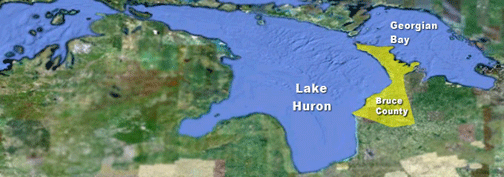 Report on burying nuclear waste near Lake Huron expected this week http://www.cbc.ca/news/canada/kitchener-waterloo/report-on-burying-nuclear-waste-near-lake-huron-expected-this-week-1.3059419 By Colin Perkel, The Canadian Press Posted: May 03, 2015 A Canadian environmental assessment of a proposal to bury nuclear waste deep underground near the shores of Lake Huron is expected this week amid fierce opposition to the idea from home and abroad.
Ontario Power Generation argues that storing the radioactive material in a huge underground bunker set in rock — the deep geological repository or DGR — is the safest way to deal with waste that is potentially dangerous for centuries.
For decades, the waste has been stored above ground at the Bruce nuclear power plant near Kincardine, Ont., and OPG says it could continue doing so safely but says a long-term solution is needed.
The proposed facility would be about 680 metres deep and close to the Bruce reactors and house hundreds of thousands of cubic metres of what is considered to be low- and intermediate-level waste from facilities across Ontario.
Stable bedrock and shale would essentially seal the facility, protecting both the surface and nearby lake for thousands of years, proponents say.Very favourable geologic features make the Bruce site in Kincardine one of the best possible locations,” OPG states.
Opponents say proposal is dangerous
Opponents, however, argue no system is foolproof and any problems – especially with a facility about one kilometre from a major water source for millions of people – could be catastrophic.
While the municipality, where many jobs and the economy are closely tied to the power generator, is officially a “willing host community” for the repository, grassroots groups have sprung up in the area to give voice to those concerns.
One of them, Stop the Great Lakes Nuclear Dump, has collected almost 75,000 signatures on an online petition and is already pledging to keep fighting the plan if the review panel green-lights it.
Group spokeswoman, Bev Fernandez, argues the intermediate-level waste — components from within the reactors — is almost as dangerous as spent nuclear fuel for which authorities are also seeking a permanent storage solution.
“This Kincardine waste dump is really the Trojan horse,” Fernandez says. “There is absolutely nothing stopping OPG from putting the high-level waste, the nuclear spent fuel, into this (repository); all it would take is a stroke of the pen.”
U.S. senator opposes underground storage of nuclear waste
Opposition has also been heard much farther afield. More than 150 communities, many in Michigan and Illinois, have passed resolutions opposing such underground storage.
Earlier this month, for example, Sen. Debbie Stabenow of Michigan introduced a resolution in the U.S. Senate calling on the Canadian government to ban any nuclear waste repository within the Great Lakes basin.
“A spill of nuclear waste into the Great Lakes could have lasting and severely adverse environmental, health, and economic impacts,” the resolution states.
The report from the three-person review panel will go first to the federal minister of the environment before being made public, likely Wednesday or Thursday.
Still, a positive environmental assessment will hardly be the last word on the project.
The minister will have four months to study the report and recommendations before deciding whether to give Ottawa’s stamp of approval.
Also required will be consultations with area First Nations as well as further approvals before construction can begin — which OPG hopes will happen in 2018 — with operations slated for 2025 if all goes well.
“There have been numerous studies that have proven this repository will not put the lake at risk,” Jerry Keto, an OPG vice-president has said. “We’ve been examining this rock for a decade.”
Cheap, efficient deep bore waste disposal would abort nuclear reprocessing
successfully developing deep-hole disposal techniques would be a great development for society
it could be devastating for next-generation nuclear developers attempting to utilize existing used nuclear fuel stockpiles
 Why Sending Nuclear Waste to the Center of the Earth is Bad News for General Electric,Motley Fool By Maxx Chatsko April 30, 2015 “………the U.S. Department of Energy is set to experiment with a technique to dispose of nuclear wastes by drilling 3-mile boreholes into the Earth’s crust and then, well, dropping radioactive materials into their geological tombs. For good
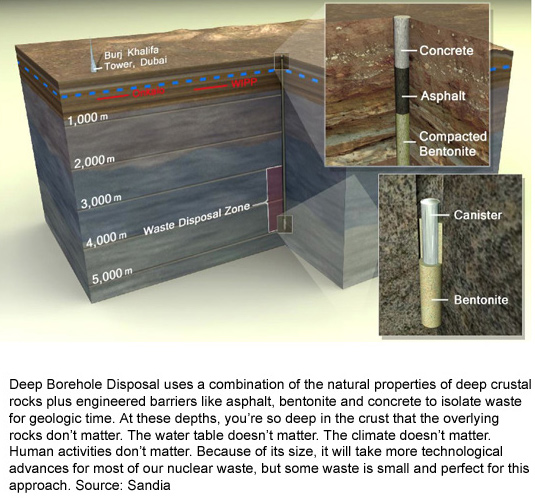
………Fergus Gibb, the technique’s pioneer, told The Engineer that each bore hole, measuring roughly 3 miles deep and 2 feet wide, would cost just a few tens of millions of dollars to drill. …
Highly hazardous clean-up begins, of Sellafield’s radioactive sludge

Around 1,500 cubic metres of radioactive material is being emptied from an area which was built to store nuclear fuel for recycling in the 1950s.
Sellafield’s reactor is being decommissioned but reprocessing continues
The storage vessels were brought to Sellafield in separate sections and welded together, before being carefully slid into a reinforced concrete building to safeguard against leaks.
But there is an added complication: the pond is full of large metal boxes of nuclear fuel which they will have to work around and make sure remain fully submerged at all times.
Andy Lindley, from the Office for Nuclear Regulation, said: “This is highly hazardous waste and its removal will take some years to complete….http://news.sky.com/story/1450799/radioactive-sludge-clear-up-at-sellafield
Uranium effluent discharged into Malawi river by Australian company Paladin
Malawi: Paladin Starts Discharging Uranium Wastes Into Public Rivers, AllAfrica, By Bishop Witmos Karonga April 23: Few months after Paladin Africa Limited differed with civil society organizations (CSOs) and some chiefs in Karonga over the disposition of uranium wastes into public water, the company has started discharging the effluent into Sere River.

Paladin Africa Limited, a member of the Paladin Energy group of companies, suspended its operations at Kayelekera Mine in the district in May, 2014, due to unstable uranium prices at an international market. The project is now on care and maintenance.
Malawi News Agency (Mana) has established Paladin invited Paramount Chief Kyungu and the District Commissioner (DC) for Karonga, Rosemary Moyo, to a meeting in Lilongwe early April this year (2015),to brief them about the company’s recent decision.
Paladin Africa Acting General Manager in Malawi, Greg Walker, confirmed in a telephone interview that the company, indeed, started releasing the uranium wastes into the public rivers………
Sere River flows into North Rukuru River, then into Lake Malawi.
When asked why the company decided to brief Paramount Chief Kyungu and the Karonga DC about their action in Lilongwe instead of explaining it to the general populace of Karonga, Walker said the company conducted enough meetings with relevant authorities in the district……..
Despite the decision by Paladin to start discharging its effluent into the public water, some people in the district feet it would have been safer if the company had constructed another dam where the wastes would be transferred into.
Chairperson for Karonga District Council, Patrick Kishombe, said in an interview the plan to release the waste water from the storage dam into Sere River is raising fears amongst communities who feel the water is not fully treated and could be a health hazard.
“This, I believe, will lead into many hazards, like killing of fish in Lake Malawi and may also cause skin cancer to some people,” said Kishombe.
Uranium contains gamma rays, particles that cause skin cancer to human kind, according to experts.
In developed nations, mining companies construct a stable tank that stores all the wastes, ready for transportation to recommended disposal sites. ……http://allafrica.com/stories/201504231621.html
Russia’s thirst for Arctic mining causes effort to retrieve sunken nuc lear submarines
The most dangerous cast offs, say scientists, are the submarines, as the nuclear fuel in their reactors could ignite a 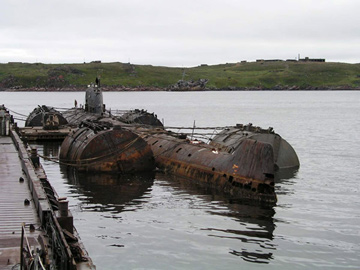 serious emergency.
the K-27 poses the most dangers for retrieval because its reactor might explode.
Raising sunken nuclear subs finally taking center stage , Bellona, April 22, 2015 by Anna Kireeva anna@bellona.ru, Charles Digges charles@bellona.no MURMANSK─ Two nuclear submarines lost or sunk by the Russian and Soviet Navies still lay at the bottom of the sea posing a possible source of contamination and laying tripwires to Moscow’s ambitious plans to develop the industrial and oil infrastructure of the Arctic.
The issue was one under discussion at a joint conference held by Bellona and Russian state nuclear corporation Rosatom last week in Murmansk. Authorities say lifting the K-27, scuttled by the Soviet navy after an accident, and the K-159, which the Russian navy lost while towing it to dismantlement, will require substantial research – and financing. The question of moving the submarines has long been on the table,but has gained little momentum in past year.
Now, though, they are standing in the way of Russia’s new national preoccupation with developing the Arctic for industry, oil and gas. The push early this week took antic proportions when Russian Deputy Prime Minister Dmitry Rogozin made a surprise visit Satuday to the Norwegian archipelago of Svalbard with no visa and despite sanctions against him not to enter the Europe for his role in in destabilizing the conflict in Eastern Ukraine……..
To realize the jingoistic mission, Russia has prioritized a giant Arctic pollution cleanup operation that would include dealing with decades of nuclear dumping in Arctic seas.
As revealed by Bellona in 2012, such litter includes nuclear submarines and ships, former military port infrastructure, sunken containers of spent nuclear fuel and nuclear waste…..
The waste includes 17,000 containers of radioactive waste; 19 ships containing radioactive waste; 14 nuclear reactors including five that still contain spent nuclear fuel; 735 other pieces of radioactively contaminated heavy machinery, two subs – the K-27, dumped in the shallows of the Kara Sea’s Novaya Zemlya Archipelago in 1981, and K-127, which sunk in 2003. Continue reading
Not in South Carolina’s interest to continue to host nuclear wastes
In addition to legal issues compromised if proposed German3 and other international spent fuel is sent to SRS, international waste will require the use of aging facilities, long-term oversight, management, and financial responsibilities. Waste imports continue to be contrary to South Carolina interests.
 Continued nuclear waste storage not in S.C.’s interest http://www.statehousereport.com/2015/04/17/my-turn-continued-nuclear-waste-storage-not-in-s-c-s-interest/04/17/2015 By Suzanne Rhodes | Nuclear wastes at Savannah River Site (SRS) have been leaking for decades. The League of Women Voters of South Carolina has been observing the slow progress of managing the legacy weapons wastes for over 30 years. It now appears likely that not only wastes from SRS, but also international wastes, will stay at the Aiken County site for the foreseeable future.
Two reports released late in 2014 indicate legal and political opposition will obstruct current U.S. nuclear waste storage plans. Neither Yucca Mountain nor any other site for geologic high-level waste disposal — not even “interim” storage of commercial spent fuel — is likely to develop, according to the Government Accountability Office. It blames the public’s lack of confidence in U.S. Department of Energy (DOE). GAO is an arm of Congress, which should have been the origin and supporter of nuclear waste management policy. Instead, Congress has consistently undermined progress at Yucca Mountain through inattention, program changes and unreliable funding.
The Nuclear Regulatory Commission states that DOE lacks the land rights and water rights necessary to license the site, according to its 5-volume Safety Evaluation Report on Yucca Mountain. A series of Nevada governors and attorneys general — NOT just U.S. Sen. Harry Reid — has opposed Yucca Mountain. Nevada seems to have succeeded in blocking the repository. [See Volume 4 of the report.]
If/when a geologic repository becomes available, the nuclear power industry will have political influence and community support to move commercial spent fuel off to a repository. Weapons wastes were included in the 1980s legislation only because three highly-regarded governors and their delegations were concerned about weapons wastes abandoned in their states. Decades ago, they united to initiate the Nuclear Waste Policy Act, which is now basically obsolete. Unfortunately, we lack such leadership today.
S.C. Sen. Tom Young of Aiken established last summer that international wastes have been received at SRS, have not been treated and there are no plans for treatment. The League’s strongest ally has been Tom Clements of SRS Watch, who has been concerned about nuclear waste issues since the Allied General Nuclear Services plant was proposed ‘next door’ to SRS back in the 1970s. One of his many successes has been uncovering mysterious, long-planned international shipments of wastes to SRS from very capable countries that potentially could become regional leaders in international nuclear waste management.
Fortunately, all of the puzzling ‘transuranic’ wastes at SRS have been successfully packaged for shipment to the Waste Isolation Pilot Plant (WIPP) in New Mexico. There was a tragic explosion at WIPP in February 2014 and it appears unlikely to reopen. The League has repeatedly praised the SRS technical staff for tackling the old legacy packages, which were poorly documented and might have been ignored at another weapons facility. The remaining wastes will remain at SRS, packaged for shipping, unless the state of New Mexico allows reopening of WIPP.
Fortunately, SRS technical staff has done an outstanding job of making wastes as safe as practicable, thus far. However, staff engineering design goals have been for temporary storage at SRS in forms ultimately suitable for the Yucca Mountain repository site or WIPP. Up to 50 more years of congressional appropriations and successful cleanup will be required to continue to treat the wastes now at SRS. Delays have been the result of lack of appropriations from Congress. Recent budget cuts have slowed SRS cleanup for more than a decade.
In addition to legal issues compromised if proposed German3 and other international spent fuel is sent to SRS, international waste will require the use of aging facilities, long-term oversight, management, and financial responsibilities. Waste imports continue to be contrary to South Carolina interests.
Suzanne Rhodes of Columbia is coordinator or nuclear waste policy with the League of Women Voters of South Carolina.
Jean-Paul Baquiast – a nuclear war against Russia would finish USA
 US Will Not Survive a Nuclear War Against Russia – Jean-Paul Baquiast
http://sputniknews.com/us/20150417/1021016791.html#ixzz3Xd8u2w8E A nuclear strikes exchange between the United States and Russia will lead to the complete destruction of the United States, leaving Russia and China in a far better position, editor of the French portal Europesolidaire Jean-Paul Baquiast said.
His comment came in the wake of recent internet speculation about the US’ possible intent to carry out a preemptive nuclear attack on Russia. The concerns have risen after General Robin Rand was appointed as head of the US Air Force Global Strike Command.
There are assumptions that he might take an example from American General Curtis LeMay who became famous in 1949 for preparing a plan for a massive nuclear attack on the Soviet Union.
Unable to subdue Russia by conventional methods, Washington is preparing to destroy it with its armed forces, Jean-Paul Baquiast wrote. In the event of an armed conflict, American politicians may carry out a preemptive nuclear strike.
“Chances of the United States to destroy Russia without consequences for itself are small,” Baquiast said.
However, even the highly efficient S-500 missile system, which Russia is currently working on, would be unable to protect the country against a massive launch of ballistic missiles from US submarines, he noted.
In turn, Russia would launch its missiles from its submarines off the coast of the United States. And if the Americans manage to hit only a part of the Russian territory due to its large size, the US will be destroyed completely, the journalist wrote.
Nuclear power – a really dirty form of energy – big mistake for Japan to restart it
‘Fukushima lessons: Any notion that nuclear power is clean is obsolete’ Rt.com : April 17, 2015 The world must phase out nuclear power because it is absolutely not clean from the mining processing of uranium to the generation of high-level radioactive waste, Kevin Kamps for the radioactive waste watchdog Beyond Nuclear, told RT.
It’s been four years since the most powerful earthquake in Japan’s history struck the Fukushima nuclear power plant. All of Japan’s 43 operable reactors have been shut down since 2013, because of safety checks required after the accident. The operator of the nuclear plant has sent a second robot inside the Fukushima reactor to collect data from it. The first robot became immovable after recording some footage from inside the reactor.
RT: Since the disaster, Japan has allocated more than $15 billion to an unprecedented project to lower radiation in towns near the power plant. However few locals believe Tokyo’s assurances that the site will eventually be cleaned up. Do you think their fears are reasonable?
Kevin Kamps: Yes, it is an unprecedented catastrophe. Of course there was Chernobyl, but in this area of Japan – it is so densely populated all over. So when they are trying to clear the landscape down to a certain depth, it is going to be more and more expensive. When you add all of the projects from decommissioning of the nuclear power plant to trying to clean up the landscape to loss of economic activity – we’re talking hundreds of billions of dollars all together. It is going to be very difficult for anything like normal life ever to return there.
RT: In addition to massive radioactive remains, Japan’s greenhouse gas emissions are on the rise following the increase in coal-fired power. Should environmentalists sound the alarm here?
KK: Just in recent days there have been the admissions by high-ranking Tokyo Electric officials that the decommissioning of the nuclear power plant could take more like 200 years because of the lack of technology to do the job. They are going to have to invent all of these robotic systems and engineering processes to try to remove the melted cores at Fukushima Daiichi because that is their current plan unlike Chernobyl with the sarcophagus. The current plan in Japan is to remove those melted cores to somewhere else – perhaps to geologic disposal, they haven’t said. But it is going to be very challenging…………http://rt.com/op-edge/250509-fukushima-nuclear-power-danger-disaster/
New report indicates that deep burial of plutonium better and cheaper than MOX reprocessing
 NuClear News, April 15 Alternatives to MOX A new report by Frank von Hippel and Gordon MacKerron reviews programs in France, Japan, the UK and the US to dispose of large stocks of separated plutonium in nuclear power reactor mixed-oxide (MOX) fuel. Most of these efforts have suffered long delays and large cost increases and all have failed to reduce plutonium stockpiles. This has led some of these countries to consider alternatives.
A less costly and more effective approach may be to treat plutonium as a waste to be processed into a stable form and deeply buried. These alternative approaches include disposal with radioactive waste or spent fuel or disposal down a 3-mile (5-kilometer) deep borehole. The report recommends that more than one direct-disposal approach be pursued. It also recommends that the countries that share the problem of plutonium disposal collaborate on exploring direct-disposal options.
Finally, it recommends that the quantities of plutonium disposed by the weapon states be verified by the IAEA. The huge cost overruns in the under-construction MOX plant at the DOE’s Savannah River Site in South Carolina led the Obama Administration to conclude in 2013 that plutonium disposal via MOX “may be unaffordable.”
This has revived policy interest in the U.S. in the possibilities of direct disposal of plutonium as a waste. Efforts to convert foreign separated plutonium into MOX fuel encountered technical problems in the UK, forcing the abandonment of the Sellafield MOX Plant. The UK has therefore looked, in at least a pro forma way, at direct-disposal alternatives.
In the late 1990s, the U.S. studied in considerable depth a “can-in-canister” option in which immobilized plutonium would be embedded in some of the high-level reprocessing waste from which it had been originally separated. This was a way to create a radiation barrier around the plutonium like that around the plutonium in spent fuel, which makes plutonium inaccessible except via chemical and mechanical operations controlled remotely from behind thick radiation shields.
The can-in-canister approach also shares the merit with MOX that it just adds marginally to the quantity of an already existing waste form for which a geological repository has to be found in any case. This option may still be of particular interest in the US, which will be disposing of reprocessing waste for several decades into the future.
In France and the UK, where high-level waste vitrification has been ongoing in parallel with reprocessing, it may be impossible to pursue the “can-in-canister” option unless it is planned well before reprocessing ends. There are other options, however. One that appears increasingly attractive is deep borehole disposal. It does not involve a radiation barrier, but retrieval would be much more difficult than from a closed geological repository.http://www.no2nuclearpower.org.uk/nuclearnews/NuClearNewsNo73.pdf
Utah State regulators have safety concerns about plans to bury nuclear wastes
 Regulators question plan to store depleted uranium in Utah By MICHELLE L. PRICE, Associated Press, April 13, 2015 SALT LAKE CITY (AP) — State regulators on Monday cited a number of concerns they need resolved before approving a plan to bury in Utah’s western desert a type of nuclear waste that grows more radioactive over a million years.
The Utah Department of Environmental Qualityreleased a 250-page report Monday that examines a plan from Salt Lake City-based EnergySolutions to store depleted uranium at its site about 80 miles west of Salt Lake City. The company said its plan would allow for it to safely bury the waste in a way that weathers changes in climate, civilization and other disruptions.
The state report highlights eight areas where regulators say EnergySolutions hasn’t answered enough questions about how the storage site will hold up in various scenarios, including large-scale geologic changes to the planet.
State officials had begun accepting public comment on the plan through May and may reconsider their conclusions based on that feedback. The division will also hold public meetings in Tooele and Salt Lake City in May……..
While the Monday report from Utah’s Department of Environmental Quality doesn’t make a final conclusion about the plan, some environmental groups said they’re hopeful about the state’s response.
Matt Pacenza, the executive director of HEAL Utah, said after reading the state report that he’s optimistic that regulators may lean toward rejecting the plan.
“You can’t possibly take waste that’s dangerous for two million years,” Pacenza said, “if you have a whole host of unanswered questions and huge gaps in scientific knowledge.” http://www.greenwichtime.com/news/science/article/Regulators-question-plan-to-store-depleted-6196824.php
Utah Radiation Control Board insists on public input to review of depleted uranium waste plan
Utah Radiation Control Board insists depleted uranium hearings go on By BRIAN MAFFLY | | The Salt Lake Tribune, 14 Apr 15 EnergySolutions wants to put the process on hold after state faulted its proposal to accept radioactive waste. Utah Radiation Control Board members Tuesday pushed back against EnergySolutions’ request to delay a public review of the company’s plans to bury depleted uranium in Tooele County.
Board members told company executives they want to move forward with a public process that will culminate this summer with a decision whether to accept the nation’s 700,000-metric-ton stockpile of radioactive waste that is low-level now, but becomes increasingly hotter over the next 2 million years.
“This literally is of national interest, and we keep punting it down the road,” said radiation board chairman Peter Jenkins. “It is time to get additional opinions on it.”
On Monday the state Department of Environmental Quality (DEQ) released a long-anticipated safety evaluation of EnergySolution’s plan to bury the waste at its Clive landfill 80 miles west of Salt Lake City……..
Depleted uranium is a byproduct of the enrichment process required to produce fissionable material for nuclear bombs and fuel. The nation’s stockpile of the waste is currently stored at three federal sites, in Kentucky, Ohio and South Carolina.
EnergySolutions proposes burying most of the waste in an 80-acre, west desert landfill cell, covering 55-gallon barrels of the stuff with concrete, clay and rocks.
Meanwhile, 5,800 drums already have been shipped to Clive from the U.S. Department of Energy’s Savannah River, S.C. site. After the state blocked further shipments, those barrels were placed in a metal warehouse in Clive.
EnergySolutions also has buried 49,000 tons of depleted uranium under previous disposal contracts………
Eight technical issues remain unresolved, including questions about frost damage, infiltration, evaporation and erosion of the cell that would hold the depleted uranium, as well as how the waste could affect the environment in “deep time” — tens of thousands of years from now. http://www.sltrib.com/home/2399963-155/utah-radiation-control-board-insists-depleted
Scientists advise deep bore burial for high level nuclear wastes
Nuclear waste: Bury nuclear waste down a very deep hole, say scientists, Science Daily April 14, 2015 Source: University of Sheffield
The concept — called deep borehole disposal — has been developed primarily in the UK but is likely to see its first field trials in the USA next year. If the trials are successful, the USA hopes to dispose of its ‘hottest’ and most radioactive waste — left over from plutonium production and currently stored at Hanford in Washington State — in a deep borehole………
Deep borehole disposal (DBD) has a number of advantages over the current solution envisaged for all UK nuclear waste, which is in a mined repository at 500m depth:
- DBD is effectively ‘pay-as-you-go’ disposal. A mined repository can cost from hundreds of millions to tens of billions of dollars to construct before any waste can be disposed of; DBD costs a few tens of millions of dollars per borehole.
- There are more geological sites suitable for DBD as the granite layer that is required can be found at appropriate depths under most of the continental crust.
- A borehole could be drilled, filled and sealed in less than five years, compared to the current timescale for a UK mined repository, which is to open in 2040 and take its first waste by 2075 (although a site has not yet been agreed).
- As DBD disposes of nuclear waste at greater depths and with greater safety and because there are more potential sites available, it should be easier to obtain public and political acceptance of the technology.
- DBD has limited environmental impact and does not require a huge site: the holes are a maximum 0.6m in diameter and can be positioned just a few tens of metres apart. Once a borehole is complete, all physical infrastructure on the surface can be removed.
- While seismic activity might damage the containers within the borehole, fracture the surrounding rock and disrupt some of the nearest barriers in the borehole, it would still not destroy the isolation of the waste or make it possible for radioactivity to reach the surface or any ground water.
The demonstration borehole in the USA will be drilled just under half a metre in diameter and trials will be conducted to ensure waste packages can be inserted into the borehole and recovered if required. Initial results are expected in 2016. If these results are positive, disposal of the Hanford waste capsules would then take place in another borehole, just 0.22m in diameter.
Story Source:
The above story is based on materials provided by University of Sheffield. http://www.sciencedaily.com/releases/2015/04/150414100956.htm
Taiwan’s nuclear waste storage problem may cause early retirement of nuclear reactor
Nuclear generator may be retired early: Taipower CNA April 13, 2015 TAIPEI--The state-owned Taiwan  Power Co. (Taipower, 台電) warned Sunday that the No. 1 generator at the country’s first nuclear power plant may have to go offline sooner than expected because of limited storage space for spent nuclear fuel. On Feb. 17, Taipower issued an invitation for foreign companies to tender for the reprocessing of spent nuclear fuel from Taiwan’s first and second nuclear power plants but withdrew the request on April 2 amid a budget controversy.
Taipower had allocated NT$11.257 billion (US$360 million) for the overseas reprocessing of 1,200 clusters of spent fuel rods, 300 of which were to be shipped out by the end of the year.
But lawmakers failed to approve the budget in March, saying that Taipower and the Ministry of Economic Affairs were trying to initiate a bidding process with foreign companies without legislative oversight and were accessing the nation’s nuclear back-end management fund before the establishment of legal guidelines for its use……..
Taipower said that if the fuel storage problem is not resolved in time, the No. 1 generator would have to go offline in mid-2016, ahead of the decommissioning of the first nuclear power plant in New Taipei City, which is scheduled to begin in 2018 and be completed by 2023.
The generator, in fact, has been down since last December due to a component failure, and the Atomic Energy Council has not yet given approval for it to be put back online……..
Several civic groups, including Mom Loves Taiwan and Green Citizens’ Action Alliance, have lodged strong protests against Taipower’s proposed reprocessing of nuclear fuel.
The groups have said is “absurd” to consider sending fuel rods overseas for reprocessing since Taiwan should be phasing out nuclear power.http://www.chinapost.com.tw/taiwan/national/national-news/2015/04/13/433515/Nuclear-generator.htm
Only now, 29 years after the nuclear catastrophe, are Chernobyl reactors 1, 2 and 3 to be finally shut

 Final shutdown work authorized at Chernobyl nuclear power plant, Rt.com April 10, 2015 The Chernobyl nuclear power plant has officially launched the decommissioning and dismantling of its first three units. The move to fully shutdown the plant comes 29 years after it became site of the world’s worst nuclear disaster.

Though the Unit 4 reactor had been rendered inoperative in the 1986 meltdown, the first three continued to work for years after the devastating accident. Unit 2, 1 and 3 were put off the line in 1991, 1996 and 2000, respectively.Work will now be carried out to bring the three units into a “conserved” state in several stages, the first of which will take at least ten years, according to a statement on the plant’s website.……..A Chernobyl site operator said last year when the project was announced that its aim was to bring the three units “to a condition that ensures safe, controlled storage of radioactive substances and sources of ionizing radiation within them.”
A giant radiation shield is also currently being built around the site of the wrecked Unit 4 reactor as part of an effort to contain the radiation the site continues to leak. ……..http://rt.com/news/248737-shutdown-chernobyl-power-plant/
1 This Month
23-25 October – on Zoom – World BEYOND War’s annual global conferenc


Shut down the radiation-damaged Heysham nuclear reactors now
To see nuclear-related stories in greater depth and intensity – go to https://nuclearinformation.wordpress.com

Say No to NASA’s Reckless Nuclear Reactor on the Moon
Say No to NASA’s Reckless Nuclear Reactor on the Moon

-
Archives
- October 2026 (219)
- September 2026 (339)
- August 2026 (330)
- July 2026 (355)
- June 2026 (287)
- May 2026 (306)
- April 2026 (356)
- March 2026 (251)
- February 2026 (267)
- January 2026 (308)
- December 2025 (358)
- November 2025 (359)
-
Categories
- 1
- 1 NUCLEAR ISSUES
- business and costs
- climate change
- culture and arts
- ENERGY
- environment
- health
- history
- indigenous issues
- Legal
- marketing of nuclear
- media
- opposition to nuclear
- PERSONAL STORIES
- politics
- politics international
- Religion and ethics
- safety
- secrets,lies and civil liberties
- spinbuster
- technology
- Uranium
- wastes
- weapons and war
- Women
- 2 WORLD
- ACTION
- AFRICA
- Atrocities
- AUSTRALIA
- Christina's notes
- Christina's themes
- culture and arts
- Events
- Fuk 2022
- Fuk 2023
- Fukushima 2017
- Fukushima 2018
- fukushima 2019
- Fukushima 2020
- Fukushima 2021
- general
- global warming
- Humour (God we need it)
- Nuclear
- RARE EARTHS
- Reference
- resources – print
- Resources -audiovicual
- Weekly Newsletter
- World
- World Nuclear
- YouTube
-
RSS
Entries RSS
Comments RSS


