in Fukushima Prefecture, Japan’s govt to nationalise private site for nuclear waste dump
 Ministry to nationalize Fukushima site to bury radioactive waste, Asahia Shimbun June 06, 2015 By YU KOTSUBO/ Staff Writer FUKUSHIMA--The Environment Ministry said it will nationalize a privately owned site in Fukushima Prefecture to dispose of radioactive waste generated by the 2011 nuclear disaster there.
 The decision effectively makes the government responsible for safety of the site.
Environment Minister Yoshio Mochizuki met with Fukushima Governor Masao Uchibori, Tomioka Mayor Koichi Miyamoto and Naraha Mayor Yukiei Matsumoto on June 5, and told them that the government will purchase a site in Tomioka to bury the radioactive waste. A transportation route to the site runs through Naraha.
The material to be buried includes “designated waste,” whose concentration of radioactive materials exceeds 8,000 becquerels per kilogram.
“We made the decision to secure the safety of the project,” Mochizuki said during the meeting held at a Fukushima prefectural government office.
Mochizuki sweetened the deal by pledging to take measures to promote the local economy, including a provision of grants that can be used freely by local governments. The nationalization and the economic promotion measures had been requested by the local governments………
The government is also facing difficulties in determining disposal sites in other prefectures because of strong opposition from local residents……http://ajw.asahi.com/article/0311disaster/fukushima/AJ201506060036
Danger and deception in nuclear waste deal for Idaho?
Virtually everyone involved in trying to solve this country’s nuclear waste problem recognizes a key impediment: No one trusts the federal government’s ability, or even its intention, to live up to its commitments. The current situation is a perfect illustration. The government gave the go-ahead to practices that might make nuclear waste even more difficult to handle.

 Beatrice Brailsford: Nuclear waste deal wrong for Idaho http://www.spokesman.com/stories/2015/jun/07/beatrice-brailsford–nuclear-waste-deal-wrong-for/
At the beginning of 2015, the U.S. Department of Energy succeeded in wresting a preliminary agreement from Idaho’s governor and attorney general to allow two shipments of “research quantities” of commercial-spent nuclear fuel into Idaho. The proposal, if implemented, will almost certainly open the state to substantially more nuclear waste in the near future.
Imports of commercial-spent fuel are banned by the 1995 Settlement Agreement, which was reached after decades of nuclear waste shipments into Idaho raised opposition throughout the state. The framework for research quantities of spent fuel was set in a 2011 memorandum of agreement between the Idaho National Laboratory and the state. Continue reading
Dead nuclear reactors in Plymouth – expensive to maintain, and a cause of local anxiety
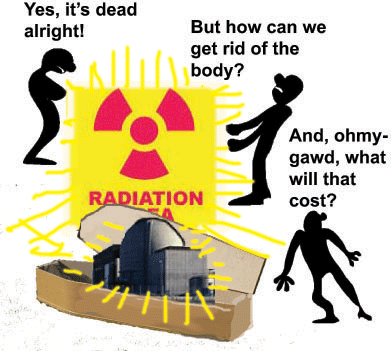 Fears over nuclear reactors in Plymouth as UK spends £16m keeping unwanted submarines By Plymouth Herald June 03, 2015 Campaigners have raised fears over the safety of nuclear reactors in Plymouth after it emerged the MoD is spending £16million to store old submarines it no longer wants – 12 of them in the city.
It has cost the UK £16million to store and maintain Britain’s 19 laid-up nuclear submarines over the last five years – 12 of them at Devonport in Plymouth – while a decision is being made about their future.
The boats which have been taken out of service have been kept in Plymouth since 1994 while the MoD decides where to finally store their nuclear reactors.
The BBC has obtained the figures regarding the upkeep of the submarines, seven of them in Rosyth, Scotland, from the Ministry of Defence through a Freedom of Information request.
Another eight submarines are to leave service over the next 15 to 20 years.
The submarines are having to be stored and maintained as no location has yet been found for storage of the sub’s nuclear reactors.
A site is set to be named this year.
Ian Avent, of Plymouth campaigners Community Awareness Nuclear Storage and Radiation, told the BBC: “The big problem is that eight submarines on Devonport still have their fuel on board and that is potential for [a] disaster.” http://www.plymouthherald.co.uk/Fears-nuclear-reactors-Plymouth-UK-spends-16m/story-26626000-detail/story.html#ixzz3c2NipJ8q
German nuclear utilities don’t have enough money for decomissioning reactors
German utilities have ‘set aside too little’ for nuclear exit http://www.rechargenews.com/wind/1401381/german-utilities-have-set-aside-too-little-for-nuclear-exit Andrew Lee May 28 2015 Provisions set aside by German utilities for nuclear decommissioning aren’t sufficient and should be transferred into a public fund for safe keeping, says a study by the respected DIW Berlin economic think-tank.
Germany’s top four utilities E.ON, RWE, EnBW, Vattenfall have set aside €38bn ($41.4bn) to pay for the decommissioning of the country’s remaining nuclear power stations and the final storage of highly radioactive waste.But preliminary estimates assume the costs for the nuclear decommissioning and waste storage to cost at least €50-70bn, the DIW says.
Also, the provisions aren’t protected from insolvencies, and the utilities could also try to escape their responsibility by restructuring their businesses, claim the authors of the DIW study – energy experts Claudia Kemfert, Christian von Hirschhausen and Cornelia Ziehm.
It is also questionable what value the provisions will have in a couple of years given the declining profitability of large utilities.”Seen these great risks, the provisions of the nuclear corporations should be transferred into a publicly administered fund as soon as possible,” von Hirschhausen proposes.
German utilities have always said their provisions for the nuclear exit are sufficient. But Germany’s largest utility, E.ON, late last year announced its split into a company for renewables, grids and customer solutions that will keep its current brand name, and another one to be named Uniper that will bundle its current nuclear and fossil activities.
Although debt-free at its onset next year, there are doubts whether Uniper can stay profitable over the long run, while the remaining E.ON may be exempt from the nuclear responsibility.
The DIW study also said that Germany’s electricity supply will be safe also after the last nuclear plant has been switched off in 2022 as the country currently is producing far more power than it needs, a situation that isn’t expected to change even with the nuclear phase-out.
E.ON will switch off its 1.3GW Grafenrheinfeld nuclear power plant in Bavaria state in the second half of next month. The 10 terawatt hours it produces per year can be compensated by coal and gas-fired energy, the DIW says. Separately, Vattenfall and E.ON today said they have closed a cooperation agreement for the decommissioning and dismantling process of joint nuclear plants.
Transport of radioactive material from Dounreay to Sellafield
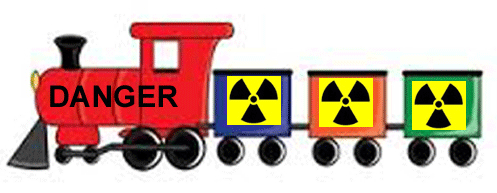
 Dounreay to Sellafield nuclear shipments completed http://www.bbc.com/news/uk-scotland-highlands-islands-32919502 The transfer of 11 tonnes of nuclear material from Scotland to England for reprocessing has been completed.
Work to move the irradiated uranium, a material used in the making of fuel for nuclear power stations, from Dounreay to Sellafield started in December 2012.
Dounreay, an experimental nuclear power complex in Caithness, is being demolished and the site cleaned up.
A further 33 tonnes of material still inside the Dounreay Fast Reactor will also eventually be moved to Sellafield.
The first 11 tonnes were transported in 32 shipments by rail.
Japan’s spent fuel problem will escalate, casting doubt on nuclear restart plans
 Spent-nuclear fuel issues plague restarts http://www.japantimes.co.jp/news/2015/05/26/national/spent-nuclear-fuel-issues-plague-restarts/#.VWTjIdKqpHw JIJI MAY 26, 2015Spent fuel at the Hamaoka nuclear power station in Shizuoka Prefecture could exceed the capacity of storage pools some two years after the plant is restarted — much sooner than the previously assumed eight years, according to sources.
The faster pace is because the storage pools for reactors 1 and 2 at the Chubu Electric Power Co. plant will be removed from the complex’s total storage capacity following the decommissioning of the two units.
Previously, Chubu Electric planned to continue using the two reactors’ storage pools. The operations of the two reactors ended in 2009.
Last month, four power suppliers, including Kansai Electric Power Co., decommissioned a combined five aging reactors, significantly reducing storage pool capacity.
As of the end of March, the Hamaoka plant’s storage capacity fell by 440 tons in the past six months to 1,300 tons, reflecting the exclusion of the reactor 1 and 2 pools, according to Chubu Electric’s semiannual report to the Federation of Electric Power Companies. Meanwhile, the amount of spent fuel stored at the plant stood at 1,130 tons.
If the remaining three reactors at the plant are brought back online, the amount of spent fuel would exceed the storage capacity in 2.3 years, compared with the eight years estimated before the company’s decision not to use the reactor 1 and 2 pools.
Of all 15 domestic nuclear plants that operators are seeking to restart, storage space capacity appears to be lowest at the Hamaoka plant.
Only four of the plants have more than 10 years before they run short of capacity, including Hokkaido Electric Power Co.’s Tomari plant, which has the longest time, at 16.5 years. The three others are Tohoku Electric Power Co.’s Higashidori plant, with 15.1 years, Hokuriku Electric Power Co.’s Shika plant, with 14.4 years, and Kyushu Electric Power Co.’s Sendai plant, with 10.7 years.
All nuclear reactors in Japan are now offline.
Some nuclear plant operators are working to increase their spent-fuel storage capacities while pinning hopes on fuel recycling at Japan Nuclear Fuel Ltd.’s facilities in the village of Rokkasho, Aomori Prefecture.
Chubu Electric has applied to build a dry-cooling storage facility at the Hamaoka plant to boost its total capacity to store spent fuel. It hopes to put the facility into operation in fiscal 2018 if the plan is approved by the Nuclear Regulation Authority.
A Chubu Electric official said storage capacity prospects remain unclear at the plant because it is uncertain if any reactors will be allowed to restart.
Unable to get volunteer locations, Japan will now impose nuclear waste sites
 METI changes tactics after search for nuclear waste host proves futile http://www.japantimes.co.jp/news/2015/05/22/national/meti-changes-tactics-search-nuclear-waste-host-proves-futile/#.VV-6ZdKeAXB
KYODO The government will select potential areas to host nuclear dump sites instead of waiting for communities to volunteer, according to the revised policy on permanent disposal of high-level radioactive waste that was adopted by the Cabinet on Friday.
The revision, the first in seven years, was prompted after towns, villages and cities throughout Japan snubbed requests to host nuclear waste dumps. The government has been soliciting offers since 2002.
The move is seen as a sign that the government wants to address the matter as it proceeds with its pursuit of reactor restarts. All commercial units have largely sat idle since the triple meltdown at the Fukushima No. 1 plant in 2011.
It remains unclear when a final depository could be built, because the policy mentions no time frame. The government also plans to expand its storage capacity for spent fuel by building new interim facilities as a short-term fix.
“We will steadily proceed with the process as (resolving the problem is) the current generation’s responsibility,” minister of economy, trade and industry Yoichi Miyazawa told reporters, adding there will be “quite a few” candidate sites.
They will be chosen on scientific grounds, the policy says.
Prime Minister Shinzo Abe’s administration is seeking to revive atomic power, although the majority of the public remains opposed in light of the Fukushima disaster, which left tens of thousands homeless. Critics have attacked the government for promoting atomic power without resolving where all the waste will end up.
Permanent disposal of high-level nuclear waste requires that a depository be built more than 300 meters underground, where the materials must lie for up to 100,000 years until radiation levels fall to the point where there is no harm to humans or the environment.
About 17,000 tons of spent fuel is stored on the premises of nuclear plants and elsewhere in Japan, but some would run out of space in three years if all the reactors got back online.
Under the revision, the government said it will allow future generations to retrieve high-level waste from such facilities should policy changes or new technologies emerge.
Worldwide, only Finland and Sweden have been able to pick final depository sites. Finland is building the world’s first permanent disposal site for high-level waste in Olkiluoto, aiming to put it into operation around 2020.
But many other countries with nuclear plants are struggling to find a site for such a facility. In the United States, President Barack Obama decided in 2009 to call off a plan to build a disposal site in Nevada’s Yucca Mountain due to local opposition.
New private consortium to decommission nuclear power stations – will cut 1600 jobs
Magnox nuclear decommissioning consortium to cut up to 1,600 jobs, Guardian, Terry Macalister, 22 May 15 Cavendish Fluor Partnership says plans reflect ‘stepdowns’ in work at nuclear plants around UK The new private consortium that recently won the £4.2bn management contract for the decommissioning of 12 Magnox nuclear power stations has revealed plans to cut up to 1,600 jobs. Cavendish Nuclear, a division of Babcock International, plus its US partner Fluor, said the cuts reflected “planned stepdowns in the work programme” at a number of atomic sites around the UK.
The move comes amid speculation that Babcock is preparing to demand millions of pounds of extra subsidies from the Nuclear Decommissioning Authority (NDA) on the grounds that the workload was much heavier than anticipated.

Unions expressed shock that staff, agency and contract workers would lose their jobs between now and September 2016, although the Cavendish Fluor Partnership said it would try to find some alternative posts. Eleven of the plants have already shut down and the remaining one in operation – Wylfa on Anglesey in North Wales – is due to stop generating power at the end of the year.
Problems with the decommissioning of the separate Sellafield site in Cumbria have recently led to the private consortium there which includes Amec and Areva of France – being thrown off the management contract.
The 12 nuclear power sites managed by the Cavendish consortium for Magnox include Berkeley, Gloucestershire; Bradwell, Essex; and Hinkley Point A in Somerset.
EDF last month announced plans to cut 400 construction jobs at the site of the planned new atomic plant of Hinkley Point C.
The reduction in workers comes amid continuing delays over a final investment decision on the £24.5bn project as negotiations with potential investors continue to move more slowly than expected. http://www.theguardian.com/business/2015/may/21/magnox-nuclear-decommissioning-consortium-cut-1600-jobs
US Navy considers privatising disposal of old nuclear ships
Scrap War: US May Compete Nuclear Ship Disposal Deal, Defense News By Christopher P. CavasMay 17, 2015 WASHINGTON — All nuclear-powered US Navy ships go to die at Puget Sound Naval Shipyard in Bremerton, Washington. That’s been an immutable mantra since the early 1990s, when the shipyard developed a recycling plan to dispose of old submarines and cruisers that were piling up as they reached the end of their lives.
Under the shipyard’s direction, shipboard nuclear reactors are defueled, the reactor vessels and their compartments are removed, encased and barged to the federal government’s Hanford Nuclear Reservation in southern Washington State, and the ships’ remains are cut up for scrap and recycling. The program has successfully disposed of more than 100 nuclear submarines and eight nuclear cruisers.
As the only US-certified facility with experience recycling nuclear ships, the plan has long been that, sometime in early 2017, Puget Sound would take on its largest disposal job by far — that of the aircraft carrier Enterprise, one of the most famous ships of the Cold War era.
But now, the Navy is considering throwing open the job to commercial bidders — a clear break from prior practice that could open the nuclear ship-disposal world to more competition……….http://www.defensenews.com/story/defense/naval/ships/2015/05/17/aircraft-carrier-enterprise-newport-news-puget-sound-naval-shipyard-nuclear-shipbreaking-ship-scrapping-recycling-brownsville-disposal-navy-navsea/27321139/
Safety limits relaxed at Sellafield nuclear facility
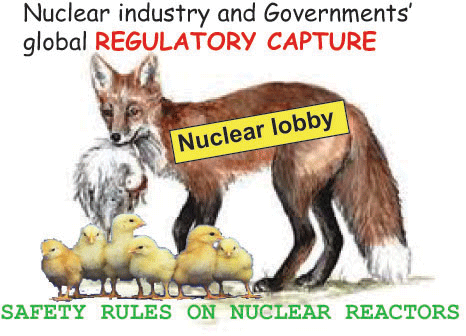 Trusting Sellafield to comply with the new operating rule to control waste stocks was like asking a fox to guard chickens,
Sellafield nuclear waste storage safety limit relaxed following accident, Guardian, Rob Edwards, 14 May 15 Amount of radioactive waste that can be kept in tanks allowed to breach legal limits to help cope with backlog caused by an accident in November 2013. Safety limits on the storage of some of the world’s most dangerous nuclear wastes at Sellafield in Cumbria have been relaxed after an accident knocked out a treatment plant.
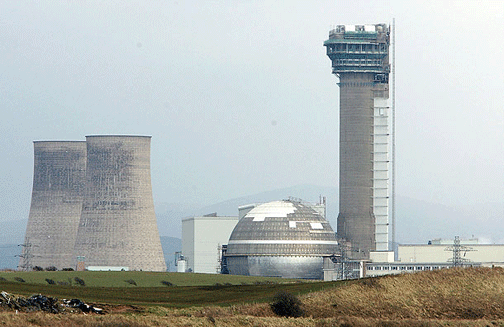
The government’s safety watchdog, the Office for Nuclear Regulation (ONR), has permitted the private company that runs Sellafield to breach legal restrictions on the amount of hot, high-level radioactive waste that can be kept in tanks. The limits are likely to be exceeded by up to 350 tonnes between April 2014 and July 2016. Continue reading
Serious concerns over the safety of Ukraine’s nuclear waste storage
 Ukrainian nuclear waste stored in open air 200km from warzone, Alternative News May 13, 2015 Serious concerns have been raised by experts and environmentalists over the ‘shocking’ way spent nuclear fuel is being stored at Zaporizhia nuclear power plant, Europe’s largest, just 200km away from the front line in Donbass.
More than 3,000 spent nuclear fuel rods are being stored in the open air in mental casks close to the perimeter fence at the Zaporizhia nuclear power plant in conditions that have shocked environmentalists, The Guardian reports.
Nuclear experts say the waste should have another secondary containment structure, such as a building with a roof.
“With a war around the corner, it is shocking that the spent fuel rod containers are standing under the open sky, with just a metal gate and some security guards waltzing up and down for protection. It is unheard of when, in Germany, interim storage operators have been ordered by the court to terror-proof their casks with roofs and reinforced walls,” Patricia Lorenz, a Friends of the Earth nuclear spokeswoman who visited the plant on a fact-finding mission, told the paper.
Although the front line is for now too far away from the nuclear plant to be at any risk, the potential consequences of the conflict engulfing the power station is major worry to locals……..
The current Zaporizhia nuclear fuel storage unit was built to a US design and did involve testing to withstand a terrorist attack.
However a dry storage container with a bomb resilient roof and contained ventilation system would offer much greater protection. However this would be impossible to build on the current site and it would have to be constructed somewhere else nearby and then all the nuclear casks would have to be moved inside at even greater expense.
“It is obvious that if you do not have an array of dry cast [interim] stores with secondary containment around it, then that will have a greater risk of release of radioactive material,” said Antony Froggatt, a senior research fellow and European nuclear specialist at Chatham House, London.
Although sources at the European Bank for Reconstruction and Development (EBRD) told The Guardian that any request for funding for such a structure would be seriously considered. The bank has already made 300 million euros available to extend the lifespan of Ukraine’s ageing nuclear plants………http://www.angrysummit.com/%E2%80%8Bukrainian-nuclear-waste-stored-in-open-air-200km-from-warzone
Ontario Power Generation waste dump plan does not have the necessary approval of area First Nations.
“Of course we are opposed to it,” Saugeen First Nation Chief Vernon Roote said Thursday. “In our community that I represent … there are no members that are agreeable to the burial at the site at this time.”
The proposal by Ontario Power Generation cleared a key hurdle this week when a federal review panel approved the plan.
OPG continued to insist Thursday approval by the Saugeen Objiway Nation is necessary for the project to proceed.
“As we have stated in the past and we will state again, we will not build this project without SON support,” OPG spokesperson Neal Kelly said.
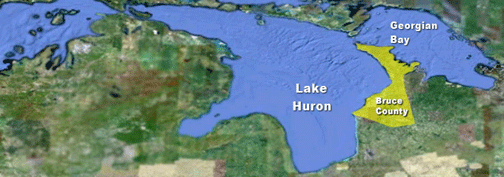
Roote said he’s concerned about possible contamination of the Great Lakes. “If something were to happen with the disposal or the leakage of nuclear waste, I wouldn’t want to be drinking the water downstream,” he said. “That means the balance of Lake Huron, Lake Erie, Lake Ontario and also anyone drinking from those lakes, even into the U.S.A.”
OPG wants to bury low- and intermediate-level radioactive waste from Ontario’s three nuclear plants in a shaft deeper than the CN tower is tall at the Bruce nuclear site near Kincardine, Ont.
The site is in the traditional territory of the Saugeen Objiway Nation that includes Saugeen and Chippewas of Nawash First Nations. Chippewas of Nawash Chief Arlene Chegahno couldn’t be reached for comment Thursday.
Federal Environment Minister Leona Aglukkaq has 120 days to review the environmental assessment report before deciding if she will authorize the panel to issue the licence to prepare the site for the so-called deep geological repository.
In its report, the panel concluded the project is “not likely to cause significant adverse environmental effects.”
That conclusion dismayed Erika Simpson, an associate professor of international relations at Western University in London, Ont., who has written about the proposal.
“I can’t understand why they can claim the science says it’s permissible. The testimony, which I’ve read, had many scientists, many geologists, questioning the science,” she said…………http://www.torontosun.com/2015/05/08/first-nations-oppose-ont-nuclear-waste-burial-project
Up to 592 Trillion Bq of Plutonium equivalent involved in disaster at US nuclear dump
 Gov’t Analysis: Up to 592 Trillion Bq of Plutonium equivalent involved in disaster at US nuclear dump – Over 5,000 times amount in waste drum blamed for WIPP release — Official: “We thought for sure” there were multiple ruptured drums — “It actually was measured” in city many miles away (VIDEO) http://enenews.com/govt-analysis-592-trillion-becquerels-involved-release-nuclear-dump-5000-times-waste-drum-being-blamed-wipp-disaster-official-thought-sure-multiple-ruptures-actually-measured-city-many-miles-aw?utm_source=feedburner&utm_medium=email&utm_campaign=Feed%3A+ENENews+%28Energy+News%29
DOE Town Hall in Los Alamos on WIPP Leak Findings (mp3), Apr 23, 2015 (emphasis added):
- Question (at 1:43:15 in): So you’ve come up with an amount that you think was in the drum, and you’ve been able to forensically track that. The underground is pretty contaminated at this point, the walls are contaminated, the filters are contaminated — andit actually was measured in Carlsbad 30 miles away. So that’s a significant quantity of plutonium or other isotopes. How is that quantity matching with what is in the drum?
- Ted Wyka, US Dept. of Energy Chief Nuclear Safety Advisor and chairman of DOE’s Accident Investigation Board: You’re right, any release is obviously too much. We do have hundreds of surveys… We think we have a pretty good source term calculation to the extent that we need to identify it as one drum…
- Question: I don’t feel like that answers my question, which is of course is your job, right?… There’s so much plutonium, americium, or whatever those secret ingredients were, and now it’s spread all over in a layer and it’s leaked into the air — what is that quanity?…
- Wyka (at 1:49:15 in): Does that mean there’s no other sympathetic secondary releases from other drums? I can’t tell you that.
U.S. DOE Accident Investigation Board (AIB) Report Phase 2, Radiological Release at WIPP(pdf), Apr 2015: The inventory in drum 68660 [was] 2.84 PE-Ci [plutonium equivalent curies]… Source terms initially released in Panel 7 Room 7 [is estimated at] 2 to 10 PE-Ci.
Savannah River National Laboratory WIPP Source Term Attribution Analysis (pdf), Aug 2014:
> ESTIMATES OF TOTAL INVENTORY OF ACTIVITY INVOLVED
- Source Term (ST) = MAR [Material at Risk] x DR [Damage Ratio] x ARF [Airborne Release Fraction] x RF [Respirable Fraction]
- Assume a 2 Ci release from Room 7 based on assessment from previous slide
- Bounding Case 1… MAR = ST / (DR x ARF x RF) = 2 Ci / 0.5 x 0.0005 x 0.5 = 16,000 Ci[592,000,000,000,000 becquerels]
- Bounding Case 2… MAR = ST / (DR x ARF x RF) = 2 Ci / 0.5 x 0.01 x 1.0 = 400 Ci
Note the AIB reports the total inventory of activity in drum 68660 was 2.84 Ci. SRNL’s estimate of total inventory of activity involved was 400-16,000 Ci (141-5,634 times drum 68660 inventory).
This may explain Wyka’s statement at the Carlsbad town hall, “We went in thinking there’s another drum…We thought for sure we’d see something. Most of the analysis team thought so.”
Lake Huron is NOT the answer to Canada’s nuclear waste problem- Dr. Benishek
Dr. Benishek: Canada’s plan to store nuclear waste near Great Lakes unacceptable http://www.upnorthlive.com/news/story.aspx?id=1201537#.VUvfhY6qpHw 05.07.2015WASHINGTON D.C. –– More than seven million cubic feet of nuclear waste could be stored in less than a half of mile from Lake Huron.
A joint Review Panel in the Canadian government gave favorable recommendation Thursday on a proposal to place a permanent, underground, nuclear waste storage facility.
“The recommendation by the Canadian Joint Review Panel to approve a plan to bury waste from nuclear power plants less than a mile from Lake Huron is unacceptable,” said Dr. Benishek. “While I support the need to find long term storage solutions for nuclear waste, burying waste this close to the Lake Huron is not the answer. The Great Lakes play a tremendous role in our economy and way of life here in Northern Michigan and we must remain stewards of this natural resource. I am please there is bipartisan support in the House that is opposed to Canada’s plan, and I will continue to work with my colleagues to ensure that there is not permanent storage of nuclear waste in the Great Lakes Basin.”
The nuclear decommissioning problem – a financial disaster looming
 the coming closures could drag on for decades and place unexpected burdens on investors, consumers or taxpayers.
The question is who will pay — for Humboldt Bay, and for dozens of other reactors that are in the process of closing or might soon.
 Nuclear operators like PG&E are supposed to lay up enough money to cover the costs, similar to how corporations fund pensions. Turns out, most haven’t.
PG&E’s Humboldt Bay trust fund, for instance, is currently $308 million short, according to a company filing to the U.S. Nuclear Regulatory Commission. PG&E customers will shoulder the cost in the form of higher electricity bills.
“Somebody’s got to pay for it — the money doesn’t come from magic,” said Allison M. Macfarlane, a former NRC chairman. Brittany McKannay, a PG&E spokeswoman, said the company is committed to operating and decommissioning its nuclear plants safely.
The U.S. nuclear industry is feeling its age. Once touted as a source of electricity that would be “too cheap to meter,” plants need expensive upgrades to protect them from terrorism and natural disasters.
At the same time, they face growing competition from renewables and natural gas. Five new reactors are under construction, but current economics give little incentive to build more. Looming is an unprecedented wave of closures.
Yet 82 of the 117 U.S. nuclear power plants, including seven in the process of shutting down, don’t have enough cash on hand to close safely, according to NRC records. And closing tends to cost more than operators expect. Based on NRC filings, the actual combined cost may be somewhere in the neighborhood of $100 billion — $43 billion more than the current balance of the trust funds.
So the coming closures could drag on for decades and place unexpected burdens on investors, consumers or taxpayers.
“The public has a right to demand that all nuclear power plant operators are secure in their funding,” Sen. Edward J. Markey, a Massachusetts Democrat on the Environment and Public Works Committee, said in a statement in response to questions from Bloomberg.
Among the underfunded plants are FirstEnergy Corp.’s Three Mile Island in Pennsylvania, site of the 1979 partial meltdown, and Entergy Corp.’s Indian Point, about 35 miles north of New York City……..http://www.japantimes.co.jp/news/2015/05/05/world/u-s-nuclear-dilemma-reactors-aging-decommissioning-cash-billions-short-permanent-waste-site-eludes/#.VUldaI6qpHw
1 This Month
23-25 October – on Zoom – World BEYOND War’s annual global conferenc


Shut down the radiation-damaged Heysham nuclear reactors now
To see nuclear-related stories in greater depth and intensity – go to https://nuclearinformation.wordpress.com

Say No to NASA’s Reckless Nuclear Reactor on the Moon
Say No to NASA’s Reckless Nuclear Reactor on the Moon

-
Archives
- October 2026 (219)
- September 2026 (339)
- August 2026 (330)
- July 2026 (355)
- June 2026 (287)
- May 2026 (306)
- April 2026 (356)
- March 2026 (251)
- February 2026 (267)
- January 2026 (308)
- December 2025 (358)
- November 2025 (359)
-
Categories
- 1
- 1 NUCLEAR ISSUES
- business and costs
- climate change
- culture and arts
- ENERGY
- environment
- health
- history
- indigenous issues
- Legal
- marketing of nuclear
- media
- opposition to nuclear
- PERSONAL STORIES
- politics
- politics international
- Religion and ethics
- safety
- secrets,lies and civil liberties
- spinbuster
- technology
- Uranium
- wastes
- weapons and war
- Women
- 2 WORLD
- ACTION
- AFRICA
- Atrocities
- AUSTRALIA
- Christina's notes
- Christina's themes
- culture and arts
- Events
- Fuk 2022
- Fuk 2023
- Fukushima 2017
- Fukushima 2018
- fukushima 2019
- Fukushima 2020
- Fukushima 2021
- general
- global warming
- Humour (God we need it)
- Nuclear
- RARE EARTHS
- Reference
- resources – print
- Resources -audiovicual
- Weekly Newsletter
- World
- World Nuclear
- YouTube
-
RSS
Entries RSS
Comments RSS

