Summary of the issues in “Low Level” Nuclear Waste
 “Low Level” Nuclear Waste Summary by NIRS-Sierra Club-SEED: Comment to US NRC by one minute to midnight, NYC-DC-ET, tonight USNRC Comment: Low-Level Radioactive Waste Disposal (aka nuclear waste burial) ID: NRC-2011-0012-0077 Due Jul 24 2015, at 11:59 PM EThttp://www.regulations.gov/#!documentDetail;D=NRC-2011-0012-0077Document for comment: http://www.gpo.gov/fdsys/pkg/FR-2015-03-26/pdf/2015-06429.pdf Docket ID: NRC-2011-0012 Nuclear Regulatory Commission (NRC), 10 CFR 60 and 61
The US is burying deadly, long-lived nuclear waste, including plutonium and depleted uranium, in Utah and west Texas. As discussed yesterday, the cost charged is so outrageous that it could be put in good quality containers, in proper above ground facilities, making this burial deadly highway robbery.
The following excellent summary of the so-called “low level” nuclear waste problem was submitted by NIRS, SEED and Sierra Club of South Carolina, for a similar comment period last September. These are some important highlights: “Obviously the NRC is fully committed to deregulating nuclear waste. The public, however, is more committed to preventing it. We ask NRC to stop pushing all the many creative forms of Below Regulatory Concern or BRC.
After NRC’s BRC policies were overturned by Congress in the Energy Policy Act of 1992, NRC sought international nuclear agency assistance to set clearance standards could be used to force the US to deregulate nuclear waste. The public has fought repeated efforts by NRC and other agencies in various forms over a dozen times in the past 29 years. Cities, counties, states, community, religious and environmental groups, labor unions and individuals have passed resolutions, petitioned, written, demonstrated and in every other democratic way expressed opposition to the deliberate release of manmade radioactive waste from regulatory control.”
“We call in NRC to stop wasting its resources trying to come up with more ways to let nuclear waste out of control and to charge those who make the wastes with whatever costs are needed to isolate and regulate them for at least 10 to 20 half-lives of the radionuclides present.”……………….https://miningawareness.wordpress.com/2015/07/24/low-level-nuclear-waste-summary-by-nirs-sierra-club-seed-comment-to-us-nrc-by-one-minute-to-midnight-nyc-dc-et-tonight/
Safety concerns about the San Onofre site as a long-term waste-storage site
 Nuke storage by the sea http://www.sandiegoreader.com/news/2015/jul/21/ticker-nuke-storage-plan-san-onofre/# Aguirre equates Southern California Edison to “drunken frat boys” By Dave Rice, July 21, 2015 Concerns over nuclear waste generated by the now-defunct San Onofre Nuclear Generating Station expressed by environmental activists for years took another turn in the spotlight on Monday (July 20), as local activist attorney Mike Aguirre called attention to what he terms “SCUD,” or Southern California Uranium Dump.
Today, July 21, county supervisors are considering a $1.6 million agreement with San Onofre operator Southern California Edison to provide offsite emergency planning in the event of an on-site catastrophe. The specter for such an event looms as long as spent nuclear fuel, which remains highly volatile for millions of years, remains stored at the former power-generating facility.
Concerns about the San Onofre site as a long-term waste-storage site include several nearby earthquake faults. Experts have called for the fuel to be stored in dry casks after an initial five years’ cooling-off period in open pools of water, which Edison officials say they’ll do. Still, the casks are only expected to safely contain radioactive waste for about 25 years, though no long-term waste-storage facility exists and, even if one were cleared for construction immediately, it could be decades before waste is ready to leave the seaside locale near a public beach and within a potential evacuation zone that could displace millions of residents in a worst-case scenario.
“It is ludicrous that the same company that created the disaster by skirting safety rules is now responsible for the cleanup,” decried Aguirre in a release Monday afternoon. “They have behaved like drunken frat boys, leaving a mess on the beach for the adults to clean up. Can we really trust them to do it properly?”
Nuclear power station running out of space for radioactive trash fuel rods
 Peach Bottom nuclear power plant could run out of spent fuel storage space in 2019 There is no available off-site storage for spent fuel rods, ydr.com Local News, By Brett Sholtis bsholtis@ydr.com @BrettSholtis on Twitter 07/18/2015 Most
 people will never get a chance to stare down at nuclear fuel rods submerged in the eerie blue water of a spent fuel pool.
For Peach Bottom Atomic Power Station employees, however, working near tens of thousands of used fuel rods — still lethally radioactive — is business as usual.
Some of those rods have been in the fuel pool since 1976, according to Krista Connelly, spokeswoman for the southern York County power plant.
But with nowhere off-site to store the fuel, Connelly said Peach Bottom is running out of places to put it. Continue reading
21 years after shutdown, USA’s Experimental Breeder Nuclear Reactor-II (EBR-II) is entombed
USA’s Experimental Breeder Reactor-II now permanently entombed, World Nuclear News
01 July 2015 The main clean-up contractor at the US Department of Energy’s (DOE’s) Idaho Site, has entombed an historic nuclear reactor in place and treated the reactor’s remaining sodium coolant….CH2M-WG, Idaho, LLC (CWI) said yesterday that crews with the Decontamination and Decommissioning (D&D) Program recently completed pouring more than 3400 cubic yards of concrete grout into the basement of the Experimental Breeder Reactor-II (EBR-II) building to fill in any remaining void spaces and effectively entomb the reactor.
Workers also removed and treated the last of the sodium coolant from the reactor’s nine heat exchangers. The exchangers were used to cool the liquid metal and direct the steam to a generating turbine to produce electricity when the reactor was operating.
The EBR-II was the basis of the US Integral Fast Reactor (IFR) program…….. The reactor was shut down in 1994 and its fuel was removed and transported to another site facility for safe storage.
The DOE grouted the reactor in place instead of removing it to protect workers from industrial hazards and radiological risks, CWI said. Crews filled the reactor vessel with grout over two years ago and recently completed the remainder of grouting at the facility under CWI’s contract.
New impediments to plans for Yucca nuclear waste storage
The Plan for Storing US Nuclear Waste Just Hit a Roadblock Wired 16 July 15 AMERICA’S FAVORITE PROBLEM to ignore—what to do with radioactive waste—just got worse. Since 1987, the grand (and controversial) idea was to put it all in one place, a series of tunnels deep below Nevada’s Yucca Mountain. Well, last week America got three new national monuments, including the 704,000 acres of the Basin and Range National Monument. And guess what? The train that was supposed to carry all that nuclear guck to Yucca Mountain runs right through it.
“It’s another nail in the coffin for Yucca Mountain,” says Timothy Frazier, a former Department of Energy official who now works on nuclear waste for the Bipartisan Policy Center. “It certainly adds time, and would require more money to resolve.”………
radioactive waste doesn’t disappear if you ignore it. The US has 75,000 tons of high-level radioactive waste—spent reactor fuel and the byproducts of processing it—that now sit in pools or dry casks at nuclear power plants, facilities never intended for long-term storage. The risk of leaks is high. Because the stuff stays radioactive for millennia, the safest course of action is supposed to be entomb ingit in rock like at Yucca Mountain, where it can remain inaccessible to future humans.
Now, Yucca Mountain plans have dragged on so long that all the high-level radioactive waste in the country exceeds its storage capacity. The Department of Energy hasn’t even built the repository yet, and the country already needs a second…….http://www.wired.com/2015/07/plan-storing-us-nuclear-waste-just-hit-roadblock/
The staggeringly huge problem of Los Alamos’ radioactive contamination

 ‘Los Alamos will never be clean’, Local News, Santa Fe New Mexican, By Staci Matlock 13 July 15 “……….The scientists knew this canyon was contaminated back in the 1950s and ’60s,” said Greg Mello, a former inspector with the state Environment Department and now a partner in the nuclear watchdog Los Alamos Study Group with his wife, Trish. “Their children played here.”
As people this year commemorate the 70th anniversary of the first atomic bomb, which helped lead to the end of World War II, often left out of the conversation is the legacy of environmental waste left behind from the making of that bomb and the thousands that followed.
Acid Canyon is among more than 2,000 dumpsites around the lab’s 43-square-mile property and thousands of other dumpsites at 108 locations in 29 states around the nation where waste from the Manhattan Project and subsequent nuclear weapons research was discharged, tossed or buried.

Efforts to clean up the contamination have taken decades and billions of dollars. The work isn’t finished yet, and it may never be complete in some places. Millions of cubic meters of hazardous waste still await cleanup, along with hundreds of contaminated buildings demolished or awaiting demolition at Savannah River in South Carolina, the Hanford plutonium processing plant along Washington’s Columbia River, Los Alamos and a dozen other sites.
A legacy of waste
Air, land, water and people all were exposed to hazardous and radioactive waste products while scientists and engineers were producing the Trinity test bomb and subsequent nuclear weapons.
Uranium miners, scientists, lab technicians and people living near research facilities or test sites around the United States during the heyday of the Manhattan Project were exposed to the highest immediate levels of radiation. They’ve sought compensation from the federal government for a litany of maladies and cancers related to their work on nuclear weapons.
The waste dumped in canyons, buried in unlined trenches or discarded in out-of-the-way places has represented longer-term hazards to people living in or near places where the components of nuclear weapons were processed. In the 1980s, the U.S. Department of Energy and the Army Corps of Engineers began cleaning up the waste sites around the country.
The danger from the waste depends on its radioactivity and how much of it people or animals are exposed to. People regularly are exposed to some level of radiation, which occurs naturally in the environment, such as uranium in soil and radon gas. The legacy waste adds to natural radiation levels in the environment and, left untreated, can increase the risks of cancers and other health problems.
At Los Alamos, lab workers dumped waste in trenches and pits, including those at Area G, a 63-acre dumpsite that opened in 1957. This includes thousands of cubic feet of low-level and mixed transuranic waste such as old lab coats, tools and other debris.
Nuclear waste is exempt from many federal environmental laws such as the Clean Water Act. The New Mexico Environment Department, after a court battle, gained some measure of regulatory control over the lab’s legacy waste only because it is mixed with other hazardous chemical waste. Under an agreement with the state, the lab in 2014 was on track to remove 3,706 cubic meters of hazardous and radioactive waste stored in above-ground containers and ship it to the nation’s only underground nuclear waste repository near Carlsbad when a lab container ruptured at the underground facility, halting operations.
A lab official said last year LANL still had thousands of cubic feet of contaminated waste left in 35 pits and 200 shafts at Area G. “The main concern is that Area G is smack dab over the regional aquifer,” said Scott Kovac, of Nuclear Watch New Mexico, noting the groundwater table is between 900 and 1,000 feet below the surface.

The Department of Energy and state environment officials are grappling with whether the increasing costs of cleanup at the lab and at other legacy waste sites outweighs the health risks of leaving waste where it is and capping it. Mello, who issued the first notice of violation to the lab for noncompliance with federal hazardous waste regulations in 1984, contemplated the trade-off: “Los Alamos will never be clean. It will always have tons of buried waste. Whether the waste is a health hazard is debatable.”
Costs of nuclear cleanup
The legacy costs of the Trinity Site test and the Cold War can be counted in human and environmental price tags……….
“It is costing a lot of money, taking a lot of time, and we’re leaving behind a lot of workers who have suffered,” Alvarez said.
Uranium miners and millers developed lung cancer and kidney cancers, among other illnesses. Scientists and other workers exposed to radiation from above-ground tests developed cancers of the lung, thyroid, esophagus, stomach and pancreas, as well as leukemia and other maladies.
More than 107,141 nuclear research workers and their families have received some of more than $11.6 billion in compensation and medical coverage as of July 5, according to the U.S. Department of Labor. More than a fourth of workers filing claims have cancer types recognized by the federal government as ones that can be caused by exposure to radioactive materials.
More than 4,900 former Los Alamos National Laboratory workers from World War II to the present have received $566 million for health problems related to their work at the lab……..
The costs of cleaning up legacy waste continue to climb. The Department of Energy’s life-cycle environmental liability for thousands of contaminated facilities and management of massive quantities of radioactive waste rose to $427 billion in 2014 from $297 billion in 2006, according to the agency’s fiscal report. The life cycle includes all of the department’s liabilities until the waste is finally cleaned up to federal standards — a process still years away in some locations.
The estimated liability for the legacy waste is higher than the combined state budgets of New Mexico, Texas, California, Arizona and Colorado.
The total life-cycle costs of managing environmental cleanup of legacy waste at Los Alamos were estimated at $2.9 billion in the Department of Energy’s fiscal year 2016 budget request to Congress. For Hanford, it is $63 billion, and for the Savannah River site, it is $71 billion.
“We keep on spending and yet the estimated environmental liability keeps growing,” said Jay Coghlan, executive director of Nuclear Watch New Mexico…………. Contact Staci Matlock at 986-3055 or smatlock@sfnewmexican.com. Follow her on Twitter @StaciMatlock. http://www.santafenewmexican.com/news/local_news/los-alamos-will-never-be-clean/article_a3cc7ce1-8af0-5113-8f38-5d4aa673fd7a.html
Southern Ohio’s Piketon enriched uranium plant will get on-site radioactive trash disposal
On-site Piketon uranium disposal OK’d in decades-long plan Columbus Dispatch, By Kantele FrankoAssociated Press • Monday July 13, 2015 Waste from the decontamination and decommissioning of a Cold War-era uranium plant in southern Ohio will go to an on-site disposal facility under a U.S. Department of Energy plan approved by the Ohio Environmental Protection Agency.The Portsmouth Gaseous Diffusion Plant in Piketon produced enriched uranium until 2001, and the shutdown left behind old buildings, industrial chemicals and radioactive areas……..The disposal plan had support from local officials and lawmakers representing the area. Pike County Commissioner Blaine Beekman said the long-awaited decision is critical to get the cleanup rolling and to support lawmakers’ efforts to secure continued federal funding for the project.
But unanswered questions remain, including which types of waste will go where, said United Steelworkers local president Herman Potter, who represents hundreds of Piketon workers……..Some area residents and environmental activists also have objected.
U.S. Sen. Rob Portman, a Republican from southwestern Ohio, said the community agreed to on-site disposal to accelerate the cleanup but remains concerned about the site’s future now that the Energy Department estimates the work will take another three decades. http://www.dispatch.com/content/stories/local/2015/07/13/on-site-disposal-okd-in-decades-long-plan.html
Beautiful but deserted Pacific Runit Island with its hazardous radiation tomb
Deadly dome of gorgeous Pacific island leaking radioactive waste news.com.au , JULY 07, 2015 A PICTURESQUE coral atoll that lies northeast of Australia in the Pacific Ocean harbours a deadly secret.
A giant, concrete dome filled with radioactive waste looms above Runit Island, and it’s leaking. Locals call it “The Tomb”.
Runit (or Cactus) dome was used for Cold War nuclear testing by the US government for 10 years from 1948. There were 42 tests in total on Enewetak Atoll, including 22 explosions on platforms, barges and underwater in the space of just three months in 1958, just before a moratorium on atomic testing.
In the late 1970s, an estimated 73,000 cubic metres of contaminated topsoil was deposited in the Cactus nuclear test crater beneath the dome, according to a report commissioned by the US government.
It was only supposed to be a temporary measure — but the dome remains.
Scientists now fear that a major storm, typhoon or other natural disaster coulddamage the 46cm-thick concrete dome, releasing nuclear waste into the sea, The Guardian reports.
The US Department of Energy insists cracks in the dome are merely cosmetic, a result of drying and shrinking of the half-submerged dome, but there are plans for repairs. The 2013 report states that this is to satisfy local concerns, but adds that rainwater could infiltrate through the cracks, possibly affecting groundwater flow and “radionuclide migration into the marine environment”.

Inhabitants of Runit were resettled on nearby Enewetak Island in 1980. Even in the early days, concerns were raised over human exposure to radiation through locally grown food, with resettlers resorting to cans of spam, Columbia University’s Michael Gerrard wrote last year in The New York Times.
Runit remains uninhabited, home only to abandoned bunkers and cables, but locals still visit to fish and salvage scrap metal. It sounds dangerous, but impoverished Marshall Islanders say they have no choice.
And just because Runit is remote, doesn’t mean other countries are totally immune from its influence. A report published in the Environmental Science and Technology journal last year traced plutonium found in Guangdong province in the South China Sea back to the Marshall Islands…….. Continue reading
Multiple dangers of MOX fuel used in Fukushima’s No 3 nuclear reactor
MOX fuel rods used in Japanese Nuclear Reactor present multiple dangers, DC Bureau By Joseph TrentoMarch 15th, 2011 The mixed oxide fuel rods used in the compromised number three reactor at the Fukushima Daiichi complex contain enough plutonium to threaten public health with the possibility of inhalation of airborne plutonium particles. The compromised fuel rods supplied to the Tokyo Electric Company by the French firm AREVA.
Plutonium is at its most dangerous when it is inhaled and gets into the lungs. The effect on the human body is to vastly increase the chance of developing fatal cancers.

Masashi Goto, a reactor researcher and designer for Toshiba, told the Foreign Correspondents Club in Toyko the mixed oxide (MOX) fuel used in unit 3 of the Fukushima Daiichi nuclear facility uses plutonium, which is “much more toxic than the fuel used in the other reactors.”
Goto said that the MOX also has a lower melting point than the other reactor fuels. The Fukushima facility began using MOX fuel in September 2010, becoming the third plant in Japan to do so, according to MOX supplier AREVA.
Part of the process of making MOX fuel is to grind plutonium into a fine power before it is robotically inserted into fuel rods. Experts agree these tiny plutonium particles once airborne are extremely dangerous to human health. One of the unique characteristics of mixed oxide fuel is that relatively little of the plutonium in the fuel rods is used up in the fuel cycle in a reactor. “When the plutonium in the fuel rods goes into a reactor for commercial power, a very little of it is going to be consumed. I don’t know what percentage, maybe half percentage or something like that, but it’s going to generate an extraordinary amount of contamination throughout the fuel rods…,” says William Lawler, an expert on radioactive waste…….
Mixed oxide fuel is a combination of finely ground up plutonium particles and uranium oxide fabricated into fuel rods at an AREVA subsidiary in La Hague, France. The fuel is made from reprocessing old reactor fuel. Reprocessing was abandoned by the United States in the 1970s because of the dangers of weapons proliferation.
The CIA has reported that Japan’s nuclear power program was not limited to the peaceful production of electrical power. The program had its roots in a secret weapons program that caused the CIA to conclude as far back as 1964 that Japan could assemble within months a nuclear weapon.
Because of the Japanese public’s fear of nuclear weapons, the various subsequent Japanese governments have kept the program secret and have repeatedly denied its existence when news organizations made inquiries. http://www.dcbureau.org/20110315782/natural-resources-news-service/mox-fuel-rods-used-in-japanese-nuclear-reactor-present-multiple-dangers.html#sthash.NydPfWmn.dpuf
When France shuts its nuclear reactors, it will be left with a monumental radioactive trash problem
 French nuclear waste will triple after decommissioning: agency http://www.reuters.com/article/2015/07/01/us-france-nuclear-waste-idUSKCN0PB4TM20150701
In a report released on Wednesday, Andra estimated that final nuclear waste volumes will eventually reach 4.3 million cubic meters, up from 1.46 million at the end of 2013 and an estimated 2.5 million in 2030.
That is based on an average lifespan of 50 years for utility EDF’s 58 nuclear reactors and including a new reactor under construction in Flamanville. Most of that waste will be only slightly radioactive, such as building rubble and clothing used during decommissioning, but because of its bulk, it requires increasing amounts of space.
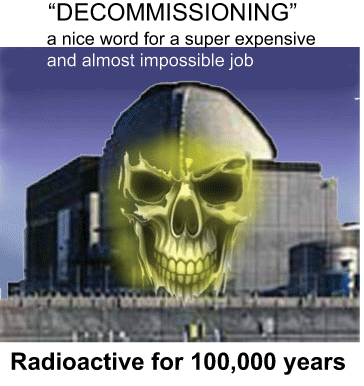
Andra, which publishes a nuclear waste inventory every three years, expects its low-level waste facility in Morvilliers, in the Aube region, would fill up between 2020 and 2025.
“We want to warn that the storage centers are filling up and that we need to optimize waste management because storage facilities are a rare resource,” Andra executive Michele Tallec told Reuters.
Volumes of highly radioactive, long-life waste – which represent just 0.2 percent of the volume but 98 percent of the radioactivity – should rise from 3,200 cubic meters at the end of 2013 to about 10,000 cubic meters when all France’s nuclear plants reach their end of life.
This waste is scheduled to be buried in the controversial deep-storage site in Bure, in eastern France, which already has a test facility but has not received any nuclear waste.
his year, Andra plans to present the French government and nuclear regulator ASN a technical dossier on Bure, which aims to bury nuclear waste 500 meters underground in thick layers of argillite rock, which Andra says will prevent most radioactive particles from traveling more than a few meters over hundreds of thousands of years.
Andra plans to put in a formal request to build the 35 billion euro facility – which faces resistance from environmental groups and local residents – in 2017 and hopes to start construction in 2020 with a view to open it for first testing in 2025.(Reporting by Benjamin Mallet and Michel Rose, writing by Geert De Clercq, editing by David Evans)
Nuclear Waste Tomb in Marshall Islands – becoming more dangerous because of climate change
This dome in the Pacific houses tons of radioactive waste – and it’s leaking, Guardian 3 July 15 The Runit Dome in the Marshall Islands is a hulking legacy of years of US nuclear testing. Now locals and scientists are warning that rising sea levels caused by climate change could cause 111,000 cubic yards of debris to spill into the ocean Black seabirds circle high above the giant concrete dome that rises from a tangle of green vines just a few paces from the lapping waves of the Pacific. Half buried in the sand, the vast structure looks like a downed UFO.

At the summit, figures carved into the weathered concrete state only the year of construction: 1979. Officially, this vast structure is known as the Runit Dome. Locals call it The Tomb.
Below the 18-inch concrete cap rests the United States’ cold war legacy to this remote corner of the Pacific Ocean: 111,000 cubic yards of radioactive debris left behind after 12 years of nuclear tests.
Brackish water pools around the edge of the dome, where sections of concrete have started to crack away. Underground, radioactive waste has already started to leach out of the crater: according to a 2013 report by the US Department of Energy, soil around the dome is already more contaminated than its contents.
Now locals, scientists and environmental activists fear that a storm surge, typhoon or other cataclysmic event brought on by climate change could tear the concrete mantel wide open, releasing its contents into the Pacific Ocean.
“Runit Dome represents a tragic confluence of nuclear testing and climate change,” said Michael Gerrard, director of the Sabin Center for Climate Change Law at Columbia University, who visited the dome in 2010.
“It resulted from US nuclear testing and the leaving behind of large quantities of plutonium,” he said. “Now it has been gradually submerged as result of sea level rise from greenhouse gas emissions by industrial countries led by the United States.” Continue reading
German government requiring nuclear utilities to pay up in costs for disposing of radioactive trash
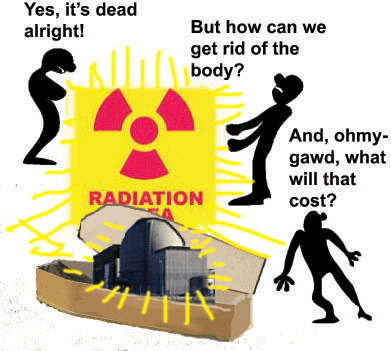 Berlin says utilities can’t dodge responsibility for nuclear waste http://www.reuters.com/article/2015/07/03/us-germany-energy-nuclear-waste-idUSKCN0PD18A20150703
BERLIN
German Economy Minister Sigmar Gabriel said on Friday that if the provisions by utilities for shutting down nuclear power plants were not sufficient, the government needed to discuss asking the companies to make further payments.
Gabriel also said that Berlin wanted to rule out quickly by law the possibility for utilities to reduce their financial liability regarding the de-nuclearization of the country.
Germany’s four nuclear operators — E.ON, RWE, EnBW and Vattenfall — have set aside around 36 billion euros ($39.99 billion) in provisions for shutting down nuclear power plants and building a safe disposal site for highly radioactive waste.
(Reporting by Gernot Heller; Writing by Michael Nienaber; Editing by Michelle Martin)
Depleted uranium especially hazardous – gradually becomes more radioactive – a problem for Utah
 Federal regulators hear Utah testimony on depleted uranium By Amy Joi O’Donoghue, Deseret News, June 25 2015 “…………The NRC is proposing to adopt a rule that for the first time specifically addresses the disposal of the material, which is a waste stream generated from the enrichment process of uranium in the nuclear fuel cycle.
Depleted uranium poses unique disposal challenges because it does not hit its peak radioactivity until 2.1 million years, and actually grows more radioactive over time. In its disposal stage, however, depleted uranium contains radioactivity that falls under the lowest level classified by the federal government — that of class A — and is legally within limits on what can be buried in Utah at EnergySolutions’ Clive facility.
Matt Pacenza, executive director of the radioactive waste watchdog organization called HEAL Utah, believes that the NRC is making a huge mistake by classifying depleted uranium as class A.
“Right now, a regulatory loophole could allow waste that does not reach a peak hazard for 2.1 million years to be treated just like waste which loses 90 percent of its hazard in less than 200,” his presentation asserted.
Pacenza, who spoke at the briefing Thursday, said the safety of the public and the environment cannot be assured given the complex nature of depleted uranium and its long-lived radioactivity.
HEAL Utah has lobbied hard against any depleted uranium being disposed of at EnergySolutions’ commercial facility in Tooele County ever since the Salt Lake-based company inked a contract with the U.S. Department of Energy in 2009 to begin accepting stockpiles of the waste — with the initial shipments reaching 10,500 tons.
Utah Gov. Gary Herbert intervened, successfully getting some of those shipments turned around after he launched objections with the federal agency over the uncertainties associated with the material’s disposal.
State regulators then convened multiple hearings and crafted their own rules governing the disposal of any significant amounts of depleted uranium, including the requirement that EnergySolutions develop a site-specific performance assessment designed to specifically contemplate depleted uranium’s unique character……….
The NRC’s proposed rule on depleted uranium would affect commercial facilities in Utah and Texas, as well as Washington and South Carolina.
Mike Garner, executive director of the Northwest Interstate Compact — a regional alliance with oversight of low-level radioactive waste management — argued before the commission that the proposed rule should not be hoisted on states that aren’t planning to take depleted uranium, a concern echoed by the Nuclear Energy Institute that argued the proposal would be unnecessarily costly and burdensome.
Pacenza, too, added that the proposal is undergoing significant modifications that show how much industry — particularly EnergySolutions — is influencing the potential regulation of depleted uranium……
Comments on the rule can be submitted atwww.regulations.gov
Email: amyjoi@deseretnews.com, Twitter: amyjoi16 http://www.deseretnews.com/article/865631459/Federal-regulators-hear-Utah-testimony-on-depleted-uranium.html?pg=all
Japan – no idea what to do with its nuclear trash now stored in France

they should just stop making radioactive trash
Japan faces dilemma over 16 tonnes of plutonium stored in France http://www.timeslive.co.za/world/2015/06/18/Japan-faces-dilemma-over-16-tonnes-of-plutonium-stored-in-France Reuters | 18 June, 2015
Still dealing with the huge clean up after the Fukushima crisis and debating its future use of atomic energy, Japan now faces another nuclear conundrum – what to do with 16 tonnes of its plutonium sitting in France after being reprocessed there. The question will be among the issues that come under the spotlight on Thursday and Friday as nuclear proliferation experts meet with legislators and government officials in Tokyo.
With its reactor fleet shut down in the wake of Fukushima, Japan is unable to take fuel made from the plutonium at the moment and could be forced to find other countries to use it.
The matter has taken on greater urgency as Areva, the French nuclear company that owns the La Hague reprocessing facility holding the plutonium in western Normandy, faces billions of dollars of losses.
“In this whole mess (at Areva) we have a huge amount of Japanese plutonium,” said Mycle Schneider, an independent energy consultant, adding Japan would need to resolve the problem sooner rather than later.
An Areva spokesman said the company had long-standing contracts with Japanese utilities to take nuclear fuel made from the plutonium. Frank von Hippel, one of the founders of the International Panel on Fissile Materials (IPFM), a group of arms-control and proliferation experts, will discuss Japan’s stock of plutonium in France when he meets with Japanese legislators, according to a draft of a presentation he will give that has been seen by Reuters.
The group argues the world’s growing inventory of plutonium from civilian use is a “clear and present danger” as it could be used in so-called dirty bombs. apanese government officials did not immediately respond to requests for comment.
 Schneider, who is a contributor to a soon to be released IPFM report on plutonium separation in nuclear power programmes, said the alternative to taking back the plutonium would be to pay other countries to use it in their reactors.
He said that France would be one option, but that the cost would likely be high, especially as that country has its own stockpile to deplete. He did not give an exact cost.
“Giving its plutonium away and paying for it would expose the Japanese to the reality of plutonium as a liability rather than an asset,” said Schneider.
A precedent for that kind of deal could be set in Britain, where the government has offered to take ownership of 20 tonnes of Japanese plutonium stored at the Sellafield processing plant, according to the IPFM.
“This is a kind of win-win deal,” said Tatsujiro Suzuki, a former vice chairman of the Japan Atomic Energy Commission, who will join Von Hippel in meeting with legislators on Thursday.
“The British side would make money and the Japanese would lose less,” said Suzuki.
South Korea running out of space for spent nuclear fuel
they should just stop making this toxic stuff
South Korea needs new facility for spent nuclear fuel: advisory group, Reuters, SEOUL | BY MEEYOUNG CHO Editing by Richard Pullin 11 June 15, South Korea should build a new temporary facility to store spent nuclear fuel from 2030 and consider permanent underground storage from the middle of the century, a government advisory body said on Thursday.
South Korea is the world’s fifth-biggest user of nuclear power, but has yet to find a permanent solution for its spent nuclear fuel, with temporary sites at individual nuclear plants likely to start to fill up from 2019.
The Public Engagement Commission, an independent body that advises the government on nuclear issues, said Seoul should select a domestic site by 2020 for an underground laboratory that could conduct safety checks and provide temporary storage.
The facility could become the site for a long-term storage facility, which would bury the country’s nuclear waste 500 meters (1,640 ft) underground and start operations from 2051.
The commission’s recommendations, which are subject to parliamentary hearings, will be given to the country’s energy minister.
Public trust in nuclear energy in South Korea has been undermined by a 2012 scandal over the supply of reactor parts with fake security certificates and the 2011 Fukushima crisis in Japan…http://www.reuters.com/article/2015/06/11/us-nuclear-southkorea-spentfuel-idUSKBN0OR0AT20150611
1 This Month
23-25 October – on Zoom – World BEYOND War’s annual global conferenc


Shut down the radiation-damaged Heysham nuclear reactors now
To see nuclear-related stories in greater depth and intensity – go to https://nuclearinformation.wordpress.com

Say No to NASA’s Reckless Nuclear Reactor on the Moon
Say No to NASA’s Reckless Nuclear Reactor on the Moon

-
Archives
- October 2026 (217)
- September 2026 (339)
- August 2026 (330)
- July 2026 (355)
- June 2026 (287)
- May 2026 (306)
- April 2026 (356)
- March 2026 (251)
- February 2026 (267)
- January 2026 (308)
- December 2025 (358)
- November 2025 (359)
-
Categories
- 1
- 1 NUCLEAR ISSUES
- business and costs
- climate change
- culture and arts
- ENERGY
- environment
- health
- history
- indigenous issues
- Legal
- marketing of nuclear
- media
- opposition to nuclear
- PERSONAL STORIES
- politics
- politics international
- Religion and ethics
- safety
- secrets,lies and civil liberties
- spinbuster
- technology
- Uranium
- wastes
- weapons and war
- Women
- 2 WORLD
- ACTION
- AFRICA
- Atrocities
- AUSTRALIA
- Christina's notes
- Christina's themes
- culture and arts
- Events
- Fuk 2022
- Fuk 2023
- Fukushima 2017
- Fukushima 2018
- fukushima 2019
- Fukushima 2020
- Fukushima 2021
- general
- global warming
- Humour (God we need it)
- Nuclear
- RARE EARTHS
- Reference
- resources – print
- Resources -audiovicual
- Weekly Newsletter
- World
- World Nuclear
- YouTube
-
RSS
Entries RSS
Comments RSS

