Japan’s highly dangerous plutonium stockpile
Japan’s plutonium stockpile worries Oxford specialist, Global Post, Xinhua News Agency Aug 17, 2015 NEW YORK, — The handling of Japan’s huge plutonium stockpile remains a challenge for the whole world, an Oxford environmental expert has warned.
When Japan marked the 70th anniversary of Nagasaki’s obliteration by a plutonium bomb on Aug. 9, its own cache of weapons-usable plutonium was more than 47 metric tons, enough to make nearly 6,000 warheads like the one that flattened the Japanese city, Dr. Peter Wynn Kirby of University of Oxford wrote in an op-ed on Monday’s New York Times……..
Japan’s 48 standard reactors burn uranium fuel, a process that yields plutonium, a highly radioactive and extremely toxic substance.
Although these reactors were shut down after the Fukushima tragedy, Japan still stores nearly 11 tons of plutonium on its territory, with the rest in Britain and France. Stockpiling plutonium in Japan remains hazardous given seismic instability in the country and the risk of theft by terrorists, warned Kirby…..
As a byproduct of burning uranium, plutonium itself can be processed in so-called fast-breeder reactors to produce more energy. That step also yields more plutonium, and so in theory this production chain is self-sustaining — a kind of virtuous nuclear-energy cycle, noted Kirby.
“In practice, however, fast-breeder technology has been extremely difficult to implement. It is notoriously faulty and astronomically expensive, and it creates more hazardous waste,” wrote Kirby.
Many other countries that experimented with fast-breeder reactors, including the United States, had phased them out by the 1990s. But Japan continued to invest heavily in the technology, noted Kirby.
While Japan’s record with nuclear waste is abysmal, no other country has found a safe or economically sustainable way to reuse such substances, especially not plutonium, he noted. Given Japan’s many vulnerabilities, particularly seismic activity, nuclear waste should no longer be stored in the country, he argued. “The Japanese government should pay its closest allies to take its plutonium away, permanently.”
Britain and France respectively holds 20 tons and 16 tons of Japan’s plutonium under contracts to reprocess it into usable fuel. Under current arrangements, this fuel, plus all byproducts, including plutonium, are to be sent back to Japan by 2020.
“Japan should pay, and generously, for that plutonium to stay where it is, in secure interim storage. And it should help fund the construction of secure permanent storage in Britain and France,” he said.
The Japanese government should also pay the United States to remove the nearly 11 tons of plutonium currently in Japan, he argued.
“Handling Japan’s plutonium would be a great burden for receiver countries, and Japan should pay heftily for the service. But even then the expense would likely amount to a fraction of what Japan spends on its ineffectual plutonium-energy infrastructure,” wrote the specialist.
Making Japan free of plutonium stockpile, thus preventing nuclear catastrophe as a result of earthquakes, would be in the whole world’s interest, he concluded.http://www.globalpost.com/article/6632161/2015/08/17/japans-plutonium-stockpile-worries-oxford-specialist
Canada’s radioactive trash dump plan, all too close to USA border
Canada Might Start Dumping Nuclear Waste Near the US Border, VICE, By Arthur White August 19, 2015 A Canadian plan to build an underground nuclear waste dump less than a mile from Lake Huron is getting unfriendly attention from US lawmakers, who are trying to force the Obama administration to invoke a 106-year-old treaty against its northern neighbor.

Though a Canadian review panel declared that the proposed Deep Geologic Repository will have “no significant adverse effects on the Great Lakes,” opponents wonder why a site so close to the world’s largest freshwater system was chosen. One environmental group even warned that the project could give terrorists the opportunity to steal radioactive materials and blow up a “dirty bomb” in downtown Toronto.
The project would bury 7 million cubic feet worth of low and intermediate level nuclear waste — including contaminated mop heads, paper towels, floor sweepings, but also filters and reactor components — 2,230 feet underground. Ontario Power Generation, which operates two nuclear power plants in Canada’s most populous province, has chosen a site just north of the lakefront town of Kincardine, after getting approval from the municipality.
The power company claims that the site is “ideal” for containing the waste, which will lay ensconced in limestone under a 660-foot layer of shale, a boundary they call “impermeable.” The risk from earthquakes is low, they say, and the rock formations have been stable for millions of years.
Data from a government earthquake database reveal that over the past 10 years there have been about a half dozen earthquakes roughly 20 miles north of the site. At less than 2 on the Richter scale, all of those tremors were extremely weak. The most powerful quake in the region, which hit 4.3 on the scale, was about 50 miles away.
This March, a review panel recommended that the government approve the dump, claiming that the health risks to people living around the lakes are “virtually zero………
That report was sent to Canada’s environment minister, who is expected to announce a decision in early December.
But many challenge the panel’s impartiality, with the Sierra Club Canada saying it’s stacked with ex-nuclear industry officials, and the Canadian Environmental Law Agency (CELA) calling its report biased, incomplete, and “fundamentally flawed.”
“The members of the panel support nuclear power from the outset,” the Sierra Club’s program director, John Bennett, told VICE News. “They’ve never not approved a project.”
CELA blasted the panel and the power company for only considering a “hypothetical” alternative to the DGR plan, without looking at a single other real-world site to bury the waste………https://news.vice.com/article/canada-might-start-dumping-nuclear-waste-near-the-us-border
UK’s nuclear waste dumping must overcome a “nuclear perception problem”
 ‘Nuclear waste dumping must overcome public opposition’ – expert concedes https://www.rt.com/uk/312735-nuclear-waste-dumping-fears/ 18 Aug, 2015 Nuclear lobbyists have admitted that public opposition to radioactive waste is a major challenge to finding new disposal sites for the deadly material.

A government agency tasked with nuclear waste management conceded that “nuclear dread” was a common feeling among British citizens, who fear the idea of living near radioactive waste dumps. Continue reading
UK faces ‘social and political challenges’ to nuclear waste disposal

 ‘Social and political challenges’ to nuclear waste disposal, Yahoo News Press Association – Mon, Aug 17, 2015 Nearly a third of the UK, excluding Scotland, could be suitable for the deep burial of dangerous radioactive waste, experts believe. New £4 billion plans for geological disposal could see containers of nuclear material sunk into boreholes and caverns 200 to 1,000 metres below ground.
There it would remain safe for hundreds of thousands of years while its radioactivity slowly waned.
A public information campaign aimed at winning support for the proposals is due to be launched early next month.
But planning and consultation is set to take so long that the first batch of nuclear waste is not expected to be placed in the ground until 2040. Earlier proposals for a geological disposal facility in West Cumbria were scotched in 2013 because of local opposition.
Alun Ellis, science and technology director of Radioactive Waste Management, the Nuclear Decommissioning Authority subsidiary tasked with delivering geological disposal, said surveys indicated around 30% of the UK might be suitable for nuclear waste burial.
Speaking at a background briefing at the Science Media Centre in London, he added: “It’s a substantial proportion. There’s a substantial part of the UK that is technically suitable to host a geological disposal facility, but as we found in Cumbria that’s only half the problem.
“The other half of the problem, the more difficult half, is how we overcome the social and political challenges.”
With that in mind the aim is now to involve the public every step of the way before deciding where to bury the nuclear waste.
Early next month communities will be consulted on how to conduct an information-gathering exercise paving the way for screening potential sites.Scotland does not form part of the plans because geological disposal is not supported by Scottish government.
An estimated 4.5 million cubic metres of nuclear waste either exists already in the UK or will be generated in the near future – four times the volume of Wembley Stadium.
Of this, 90% can be re-used, recycled or permanently disposed of in surface facilities.
But a long-term solution has to be found for what to do with the remaining 10%, some of which could remain a radiation hazard for thousands of years. Currently the waste is stored in surface facilities where its safety cannot be guaranteed in decades to come, creating a burden for future generations.
“The international consensus is that geological disposal is the safest and most sustainable solution for managing these wastes and also that it is technically feasible,” said Mr Ellis………https://uk.news.yahoo.com/social-political-challenges-nuclear-waste-disposal-150045495.html#BDSfEnV
Norway’s dangerous plan to dump nuclear trash on island
 Norway wants to dump nuclear waste on island, The Local, 14 Aug 2015 Norway’s government wants to dump 1,200 tons of radioactive waste on an island an hour south of Oslo, even though the waste company which owns the site believes it is too dangerous. According to Norway’s VG newspaper, Norway’s Ministry of Industry has hired a Swedish consultant in order to overall the objections from NOAH, which owns the waste dump on Langøya, and so force it to take radioactive sludge from the Søve mines an hour inland.
Germany’s new nuclear waste plan shows how dangerous radioactive trash is
the plan for dealing with the waste has a much longer time-scale, one which makes clear just how dangerous nuclear waste is to dispose of.
an actual location won’t be chosen until 2031, and it will take until 2050 to convert that site until it is ready to store the waste. The process of moving the waste there will then take several more decades.
Germany draws up new plan to dispose of nuclear waste http://www.dw.com/en/germany-draws-up-new-plan-to-dispose-of-nuclear-waste/a-18645069 12 Aug 15 The German government has presented its plan for permanently disposing of nuclear waste. Critics say the proposal is a tacit admission that it is a bigger problem than it has ever acknowledged before. Pausing only to get the okay from the cabinet, Environment Minister Barbara Hendricks gave a press conference on Wednesday to present the government’s brand new plan for dealing with radioactive waste. Continue reading
How the BBC distorted the story of Sellafield
The spectre of the new nuclear renaissance
Al’Khalili then went on to give every impression that high level nuclear waste can be safely stored using the process of ‘vitrification’, that is, turning it in glass, and so binding the waste safely into a permanent, impermeable matrix.
What he failed to mention is that the glass is by no means permanent and durable storage medium for “thousands of generations” as the glass is liable to break down – and that the problem of long term disposal of these wastes remains unsolved. For example, asR C Ewing and colleagues wrote in 1995 in the journal Progress in Nuclear Energy,
“the post-disposal radiation damage to waste form glasses and crystalline ceramics is significant. The cumulative α-decay doses which are projected for nuclear waste glasses … are well within the range for which important changes in the physical and chemical properties may occur, e.g. the transition from the crystalline-to-aperiodic state in ceramics.”
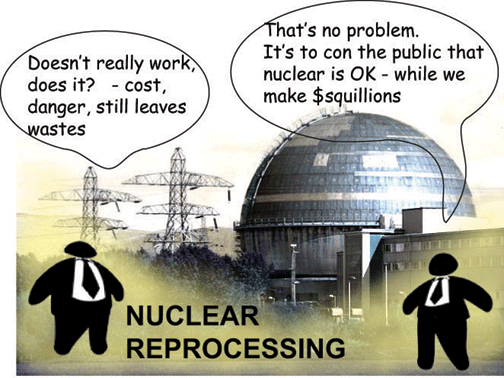
 ‘Inside Sellafield’ and military plutonium – the BBC’s nuclear lies of omission http://www.
theecologist.org/reviews/2984689/inside_sellafield_and_military_plutonium_the_bbcs_nuclear_lies_
of_omission.html Dr David Lowry 12th August 2015
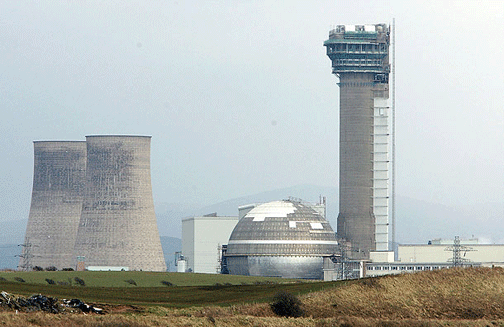 Lowry – understating the severity of accidents, concealing the role of the UK’s nuclear power stations in breeding military plutonium, and giving false reassurance over the unsolved problems of high level nuclear waste.
For one of these programmes the BBC commissioned Baghdad-born Professor Jameel ‘Jim’ Al-Khalili, theoretical physicist and Chair in the Public Engagement in Science from the University of Surrey, to research and present one programme called ‘Britain’s Nuclear Secrets: Inside Sellafield‘.
As a regular BBC broadcaster, hosting the long-running The Life Scientific on Radio 4, and maker of several science television programmes on television, including on quantum physics and the history of electricity, he was eminently qualified to make this programme.
However the programme was highly misleading thanks to major omissions, concealing the severity of accidents, and how the UK’s entire ‘civilian’ nuclear programme was subverted into producing military plutonium that fed into the Sellafield bomb factory. Continue reading
Japan restarting nuclear reactor – but what about Japan’s intractable problem of wastes?
 Nuclear restart highlights government dilemma over lack of waste disposal sites, Japan Times BY KAYO MIMIZUKA KYODO AUG 11, 2015 With an unpopular return to nuclear power generation, Japan can no longer ignore the elephant in the room: where is the country’s highly radioactive nuclear waste going?
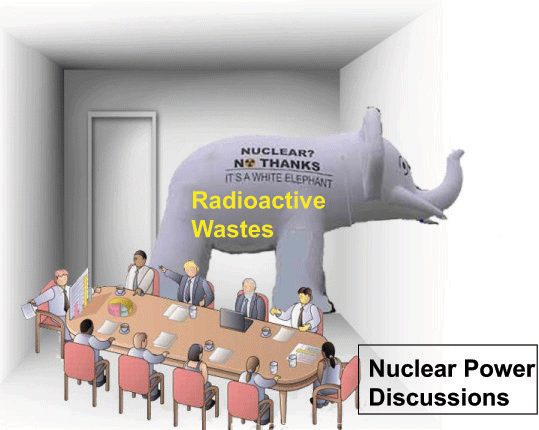
The reboot Tuesday of a reactor at Kyushu Electric Power Co.’s Sendai plant in Kagoshima Prefecture comes as the government struggles to find a final disposal site for high-level nuclear waste.
Currently, around 17,000 tons is sitting in temporary storage pools across the country, and the restart means the generation of even more.
Spent fuel pools at some nuclear plants will reach their capacity in as soon as three years.
A spokeswoman at Kyushu Electric said the Sendai plant’s storage pools “still have enough room,” suggesting the utility is not planning to immediately take further measures. But they are expected to become full in roughly 11 years, according to official data.
International concerns are also growing over the increase in Japan’s possession of plutonium due to its potential for falling into the wrong hands and being used to make nuclear weapons. As of the end of 2014, Japan had 47.8 tons of plutonium, up 0.7 tons from a year earlier.
Under Japan’s nuclear fuel recycle policy, plutonium extracted by reprocessing conventional uranium fuel is consumed by reactors in the form of plutonium-uranium mixed oxide fuel, known as MOX. But its feasibility remains uncertain, given public concerns after the Fukushima disaster.
Currently, the government plans to store nuclear waste at a final repository more than 300 meters underground. It would sit there for up to 100,000 years until radiation levels fall low enough and there is no harm to the environment……
In May, the Cabinet of Prime Minister Shinzo Abe introduced a scheme allowing the government to choose candidate sites based on scientific grounds, including resistance to earthquakes……
Hideyuki Ban, co-director of the Citizens’ Nuclear Information Center, said finding a location to build a disposal site in Japan is even more difficult than in other countries due to the public’s sensitivity to nuclear power given the Fukushima crisis.
“For now, there is no national consensus at all on what to do with nuclear power generation down the road,” Ban said. “As the majority of people oppose nuclear power, surely there will be a backlash” against the government’s plan.
Since May, the government has been briefing municipalities on how it selects candidate sites.
Such meetings have been held in all 47 prefectures except Fukushima, but officials from some communities refused to take part out of fear their attendance might be considered a sign of their intention to accept a disposal site.
Questions have also arisen over the transparency of the process……http://www.japantimes.co.jp/news/2015/08/11/national/nuclear-restart-highlights-government-dilemma-lack-waste-disposal-sites/#.VcrZ3LKqpHx
Japan’s govt pursuing nuclear power, while having no effective plan for wastes
It was bureaucrats who made the plan to demand each prefecture to build it. There has been no viable explanation why each prefecture has to be responsible for the solution.
This is a typical example of negative aspect of top-down style bureaucracy in Japan
No Exit for Radioactive Wastes http://hitaku7664.blogspot.com.au/2015/08/no-exit-for-radioactive-wastes.html While Government of Japan promotes nuclear policy of resuming some nuclear power plants, the people in the area suffered from radioactive materials emitted by broken First Fukushima Nuclear Power Plant are still living with great amount of contaminated soil, grass or trees. Although the government decided that those contaminated wastes should be treated by each prefecture, programs to build processing facilities are deadlocked by firm opposition by the residents. The government is facing a necessity for changing their plan.
Ministry of Environment designated radioactive waste, caused by the accident in Fukushima, with 8,000 Becquerel per kilogram or more as necessary to be under control of public sector. Concerning firm opposition from Fukushima, if those waste would be concentrated to Fukushima, the ministry decided that the disseminated waste should be processed in each prefecture.
Among five prefectures around Fukushima in need of building processing facility, Miyagi and Tochigi have been seeing strong protest of the residents. In Tochigi, although the ministry determined the place for the facility in Shioya Town, the people there organized broad movement against the plan. They pointed out fundamental contradiction of Ministry of Environment that it was building environmentally harmful facility in the place close to a water source which the ministry had formerly registered as a pure water source to be protected.
Chiba has been regarded as the place where the facility would be build first. Tokyo Electric Power Company offered an unused land in Chiba city for the facility. But, residents started protesting activities, arguing that the reason of selecting the place was unclear or liquidation caused by great earthquake would be concerned. Two thousand metric tons of radioactive waste in Chiba has still no way to go.
Now, the question is whether the decision of Ministry of Environment to process radioactive waste in each prefecture was right or wrong. The lawmakers passed a law which determined that national government would deal with radioactive waste caused by Fukushima accident. But the law did not require each prefecture to build processing facility. It was bureaucrats who made the plan to demand each prefecture to build it. There has been no viable explanation why each prefecture has to be responsible for the solution.
This is a typical example of negative aspect of top-down style bureaucracy in Japan. The key is whether bureaucrats would admit their wrong decision and change the course to plan B.
Postponed indefinitely – the opening of U.S. government’s Waste Isolation Pilot Plant
The opening of an underground nuclear waste dump in New Mexico just got delayed indefinitely http://www.businessinsider.com.au/r-officials-delay-reopening-of-new-mexico-nuclear-waste-site-2015-8 JOSEPH J. KOLB ALBUQUERQUE, N.M. (Reuters) – The planned March 2016 reopening of an underground nuclear waste dump in New Mexico has been pushed back indefinitely because of unanticipated challenges, U.S. officials said.
A radiation leak at the U.S. government’s Waste Isolation Pilot Plant that originated in a disposal chamber half a mile (1 km) below ground at the center near Carlsbad, New Mexico, exposed more than 20 workers to small amounts of radiation in February 2014, officials have said.
The accident led to the suspension of key operations at the site, the Energy Department’s only permanent underground repository for certain types of radiological waste tied to U.S. nuclear labs and weapons sites.
Dana Bryson, acting manager for the Department of Energy’s Carlsbad Field Office, said in a statement on Friday: “We are disappointed that we will not meet the original target date for beginning waste emplacement.”
He did not provide a date for reopening the facility.
“While the WIPP recovery program continues to make significant progress, the original target date of March 2016 for resuming waste emplacement operations is no longer viable due to a variety of unanticipated issues,” said a news release from the U.S. Department of Energy that contained Bryson’s statement.
Key challenges that remain include the need to implement heightened safety standards from the Department of Energy and to resolve problems with the ventilation system, officials said.
“The department is committed to resuming operations at the Waste Isolation Pilot Plant as soon as it is safe to do so,” Bryson said.
(Editing by Alex Dobuzinskis)
Local anxieties in Germany, over French nuclear waste plan
French nuclear waste plan irks Germans near site, DW, 4 Aug 15 France wants to build a permanent nuclear waste storage facility not far from the German border. The plan has irked many in the region, but the government in Berlin sees no need for action.
Nuclear power plants produce radioactive waste, which emits radiation for thousands of years. Even Germany, which is set to phase out nuclear power, is looking for a final repository for its spent nuclear fuel, but has not yet decided on the location. Finding a geologically suitable site is not the problem, but rather, the protests over the location. Nobody wants to live with a nuclear waste dump at their doorstep.
For many decades, France has focused and relied on nuclear power, and now, plant operators are under pressure to find repositories for the radioactive waste.
The French government seems to have its sights set on Bure, a town in eastern France, around 120 kilometers (74 miles) from the German border. There, scientists have spent years investigating whether highly and moderately radioactive waste can be disposed of 500 meters underground. ANDRA, the French national agency for radioactive waste, believes that Bure offers what a repository requires: Nuclear waste can be stored there for 100 years; then, the site can be closed off and ultimately, the nuclear waste can decay there for 100,000 years until the radiation no longer poses a threat to humans.
‘Unbearable coup’
Opponents of the site feel less bothered by the repository itself then by the decision-making process that led to choosing it. In mid-July, the government added a last minute clause to a legislative package promoting business development but did not hold a debate or vote in parliament. And since no other potential nuclear waste sites have been explored in France, critics believe that the Bure location was practically predetermined. The Green party group in the French national assembly calls the procedure an “unbearable coup,” while the nation’s nuclear regulatory body and the French Institute for Radiological Protection and Reactor Safety (IRSN) have expressed “numerous reservations” about the plans………http://www.dw.com/en/french-nuclear-waste-plan-irks-germans-near-site/a-18627896
Dispute in Spain about where to put radioactive trash
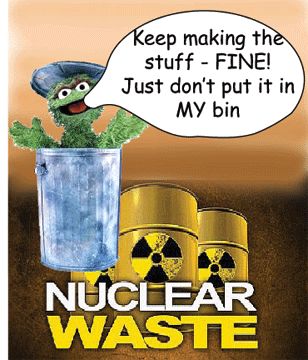 Row threatens Spain’s first nuclear graveyard, The Local, Jul 2015 Spain’s conservative government and the central region of Castilla-La Mancha locked horns Thursday over plans to build the nation’s first-ever temporary storage facility for highly radioactive waste. The country’s nuclear security council on Monday approved a report that gives the green light for the facility to be built near the village of Villar de Cañas in Castilla-La Mancha.
Enresa, the state-owned company responsible for Spain’s nuclear facilities, in 2011 chose the site from a list that included eight other communities which bid to house the nuclear dump.
But on Tuesday the new Socialist government of Castilla-La Mancha moved to block the construction of the facility by approving the expansion of a protected area for birds so it includes land earmarked for the radioactive waste site.
“This will protect an area where endangered species live,” regional government spokesman Nacho Hernando told a news conference. The Socialists took power in the region on July 4th following May local elections, ousting the conservative Popular Party which rules at the national level.
Energy Minister Jose Manuel Soria warned on Thursday that Spain would have to abandon nuclear power if the facility is not built………The government wants to store all the spent fuel produced at Spain’s eight nuclear power stations at the site.
Each power station currently stores the spent fuel which they produce in on site storage pools that are starting to fill up.
Spain has since 2008 stored low to medium-grade nuclear waste at a facility at El Cabril in Cordoba province in the southwest……..
environmental groups including Greenpeace accuse the dump’s supporters of putting money before safety and have lobbied to have the project shelved. http://www.thelocal.es/20150731/row-over-plans-for-spains-first-nuclear-graveyard
UK’s Slow Progress on Plutonium Stockpiles.
NuClear news August 2015 Since the Government confirmed in December 2011 that its preferred management option for the UK’s plutonium stockpile was to convert the ‘asset of zero value’ into Mixed Oxide (MOX) fuel, further progress on the option has been conspicuous by its absence, says Cumbrians Opposed to a Radioactive Environment (CORE). (1)
US State and federal agencies agree on plan to demolish southern Ohio uranium plant
Demolition plan OK’d in southern Ohio uranium plant cleanup, WT, By KANTELE FRANKO – Associated Press – Friday, July 31, 2015
COLUMBUS, Ohio (AP) – State and federal agencies have agreed on a plan for demolishing huge buildings and other facilities from a Cold War-era uranium plant in southern Ohio.
It is the latest development in the lengthy decontamination and decommissioning process for the Portsmouth Gaseous Diffusion Plant in Piketon, which was built in the 1950s and produced enriched uranium for defense and commercial uses until 2001. Its shutdown left old buildings, chemicals and radioactive areas that must be addressed……..the structures slated for demolition include the three process buildings, each with more than 30 acres under one roof. The cleanup plans allow for recycling of equipment and building materials if that can be done in a safe, cost-effective way…….. http://www.washingtontimes.com/news/2015/jul/31/demolition-plan-okd-in-southern-ohio-uranium-plant/
No idea what to do with the radioactive trash, but Japan still plans to make more of it
While moves are being made to restart nuclear reactors in Japan, the weaknesses in nuclear power that have led to nuclear plants being likened to “apartments without toilets,” remain unsolved.
Despite moves to restart reactors, Japan lacks nuclear waste disposal site http://mainichi.jp/english/english/perspectives/news/20150708p2a00m0na018000c.html
Chief Cabinet Secretary Yoshihide Suga said at a news conference on July 7 that the government would restart nuclear reactors that met new safety standards established by the nation’s Nuclear Regulation Authority (NRA).
The same day, Kyushu Electric Power Co. began loading fuel into a reactor at its Sendai Nuclear Power Plant in Kagoshima Prefecture. The Federation of Electric Power Companies of Japan released a statement saying, “This is one important step. Preparation for reactivation is progressing step by step.” Within the electric power industry, hopes are spreading that if one reactor is restarted, then the screening of other reactors will move ahead more smoothly.
Later this month, the government will formally adopt a proposal stating that nuclear power account for 20-22 percent of Japan’s energy mix by fiscal 2030. Based on this, Prime Minister Shinzo Abe has made an international declaration that Japan will cut its greenhouse gas emissions by 26 percent from 2013 levels.
It is evident that the long-term idling of nuclear reactors has strained electric power companies financially, and both power companies and the government are aligned in seeking to restart these reactors, but the process is not all smooth sailing.
Under the Nuclear Reactor Regulation Law, the life of nuclear reactors is set at 40 years in principle. To extend this period, reactors must pass stringent NRA guidelines before this 40-year mark is reached. In fiscal 2030, there will be just 22 reactors in Japan that have been operating less than 40 years. To have nuclear power account for 20-22 percent of the nation’s energy mix, around 35 reactors would need to be in operation, according to Minister of Economy, Trade and Industry Yoichi Miyazawa. This would mean the life of a dozen or so reactors would need to be extended.
And yet the problem of nuclear waste remains. About 17,000 tons of spent fuel sits in Japan, and the pools for spent fuel at the nation’s nuclear power plants are nearly full. In the case of the Genkai Nuclear Power Plant, which Kyushu Electric Power Co. is hoping to get back online together with the Sendai Nuclear Power Plant, the pools for spent fuel would be full after just three years of operation. Finding a place to store this fuel is an urgent task.
The government has positioned the “nuclear fuel cycle,” under which spent nuclear fuel is reprocessed, allowing uranium and plutonium to be reused as nuclear fuel, as a central part of the nation’s energy policy. However, the Rokkasho Nuclear Fuel Reprocessing Facility in Aomori Prefecture has been plagued with problems, with the schedule for its completion being delayed 21 times. Moreover, the fast-breeder reactor Monju, which uses plutonium, has hardly operated at all over the past 20 years, effectively leaving the cycle broken.
Furthermore, there is currently no prospect of settling on a final disposal site for the highly radioactive waste that is produced after reprocessing. In May this year, the government switched to a policy of naming scientifically “promising” disposal sites, preparing the way to reactivate nuclear reactors.
From the same month, the Ministry of Economy, Trade and Industry has held explanations for workers of local government bodies across Japan, but about 30 percent of these bodies have not attended. One in Tokushima Prefecture argued that attending would give local residents the impression that it has accepted disposal site plans.
The explanations have been held behind closed doors, sparking criticism at a ministry meeting of experts that it appears things are being done in secret.
While moves are being made to restart nuclear reactors in Japan, the weaknesses in nuclear power that have led to nuclear plants being likened to “apartments without toilets,” remain unsolved.
1 This Month
23-25 October – on Zoom – World BEYOND War’s annual global conferenc


Shut down the radiation-damaged Heysham nuclear reactors now
To see nuclear-related stories in greater depth and intensity – go to https://nuclearinformation.wordpress.com

Say No to NASA’s Reckless Nuclear Reactor on the Moon
Say No to NASA’s Reckless Nuclear Reactor on the Moon

-
Archives
- October 2026 (209)
- September 2026 (339)
- August 2026 (330)
- July 2026 (355)
- June 2026 (287)
- May 2026 (306)
- April 2026 (356)
- March 2026 (251)
- February 2026 (267)
- January 2026 (308)
- December 2025 (358)
- November 2025 (359)
-
Categories
- 1
- 1 NUCLEAR ISSUES
- business and costs
- climate change
- culture and arts
- ENERGY
- environment
- health
- history
- indigenous issues
- Legal
- marketing of nuclear
- media
- opposition to nuclear
- PERSONAL STORIES
- politics
- politics international
- Religion and ethics
- safety
- secrets,lies and civil liberties
- spinbuster
- technology
- Uranium
- wastes
- weapons and war
- Women
- 2 WORLD
- ACTION
- AFRICA
- Atrocities
- AUSTRALIA
- Christina's notes
- Christina's themes
- culture and arts
- Events
- Fuk 2022
- Fuk 2023
- Fukushima 2017
- Fukushima 2018
- fukushima 2019
- Fukushima 2020
- Fukushima 2021
- general
- global warming
- Humour (God we need it)
- Nuclear
- RARE EARTHS
- Reference
- resources – print
- Resources -audiovicual
- Weekly Newsletter
- World
- World Nuclear
- YouTube
-
RSS
Entries RSS
Comments RSS

