Closure of Pilgrim nuclear station opens a new era of costly, dangerous, radioactive trash clean-up
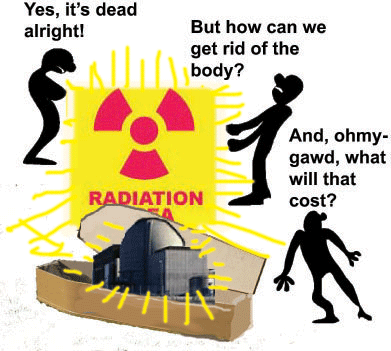 Decommissioning Pilgrim could take decades, millions Boston Globe By Nestor Ramos and David Abel GLOBE STAFF OCTOBER 13, 2015 Shutting off the power at a nuclear plant takes only a few minutes. But decommissioning one — safely removing and storing dangerous radioactive material and closing down the plant for good — can take decades.
In announcing Tuesday that it planned to close the Pilgrim Nuclear Power Station, owner Entergy Corp. revealed few details about how it plans to decommission its aging plant in Plymouth, rated among the least safe in the country. But recent history at nuclear plants in New England and beyond suggests that the process could be long, contentious and cost hundreds of millions of dollars.
Entergy has 60 years to close the plant, according to Nuclear Regulatory Commission guidelines, and that clock may not even start running until 2019, the year by which the company plans to cease operations at Pilgrim. That means it could be 2079 before radioactivity is reduced to safe levels — the ultimate goal of decommissioning.
Company officials say Pilgrim shouldn’t take that long. “We don’t intend to wait until 60 years,” said Bill Mohl, president of Entergy Wholesale Commodities, which oversees most of its nuclear plants.
Still, decommissioning any nuclear power plant takes time. Giant industrial edifices such as the reactor, where the fuel generates heat that is converted to steam, would be difficult to dismantle even if they were not brittle and dangerously radioactive. Radioactive nuclear fuel must remain in storage pools for years after the plant has ceased to generate power.
And even after the fuel is stowed in giant canisters called dry casks, deciding where to store the nuclear waste is still tied up by debate in Washington, and remains years away.
“It’s going to take years in any event,” said Geoffrey Fettus, a senior attorney at the Natural Resources Defense Council. “It’s very complicated, very expensive industrial cleanup.” Continue reading
Burial of radioactive trash at San Onofre? NOT a good idea
 Kelly Slater Weighs In on the State Decision to Bury Nuclear Waste at San Onofre, The Inertia,
OCTOBER 9, 2015 Kelly is pissed. And it’s with good reason. Despite widespread opposition, the California Coastal Commission approved on Tuesday the controversial plans to bury 2,700 steel castes of spent nuclear fuel in concrete bunkers 125 feet from the sea wall at San Onofre Beach. One proponent of the project claimed, “I wish that there were other options that were available now, but frankly I don’t see them.” Really? Burying them 125 feet from the water’s edge is the most viable solution? Kelly Slater thinks not:
So they’re planning on burying San-o’s nuclear waste at San-o for the next 20 years. Then what? They really gonna take it ‘away’? To where? At what point will we wake up before the fact and stop listening to people trying to sell Nuclear to the masses claiming it’s the safest and least expensive option? The endgame of this stuff is no joke. It won’t go away during our time on earth. We have the technology to move past this nowadays. Humans are a mess. What we leave in our wake is just a symptom of our ways of thinking. But now back to San onofre…thoughts?
Bill Alley, author of Too Hot to Touch, a book about the problems associated with storing nuclear waste, suggests that it would be much safer to transport the fuel to dry casks rather than leaving it in cooling ponds on site at San Onofre.
“The casks are fine for a couple of decades—certainly better than the pools,” Alley said. “But there’s no solution in the longer term, and that’s what really needs to be worked through.”
Alley and Slater touch on an important note: this is just a temporary solution to a much bigger problem. We must look beyond 20 years if we truly want to safeguard from another disastrous incident. After all, this is precisely the mentality that contributed to the most catastrophic oil and nuclear waste spills. Metal and concrete are NOT indestructible. Period……
With the daunting thought of “The Big One” looming in the minds of California residents, a quick, long-term solution is of the utmost importance. That is, unless we want a repeat of Fukishima, in which case the entire world should be concerned. Let’s do something about this and let’s do it now.

Germany says nuclear utilities can pay for decommissioning reactors
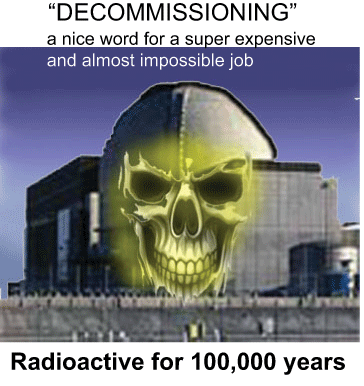 Germany Says Utilities’ Reserves Adequate for Nuclear-Power http://www.wsj.com/articles/germany-says-utilities-reserves-adequate-for-nuclear-power-exit-1444464002 Exit In wake of Fukushima, country plans to exit nuclear power by 2022 By STEFAN LANGE And MONICA HOUSTON-WAESCH Oct. 10, 2015 FRANKFURT—German utilities’ reserves for the country’s planned exit from nuclear power are adequate, the ministry for economics and energy said, citing a government-commissioned report on the matter.
“The affected companies have fully covered the costs with the designated provisions,” economics minister Sigmar Gabriel said in a statement.
The Federal Ministry of Economic Affairs and Energy had called for the stress test to determine whether utilities’ reserves are up to the task of financing nuclear waste and the decommissioning of plants. In the wake of the Fukushima disaster in 2011, Chancellor Angela Merkel said Germany would exit nuclear power by 2022, taking utilities by surprise. In the interim, politicians have voiced concern that nuclear operators could try to duck the long-term costs, leaving taxpayers with the bill.
Existing reserves for the country’s nuclear exit amount to €38.3 billion, the report said. In a worse-case scenario, costs could come to as much as €77 billion, however this assumes an average interest rate of a negative 1.6% until the year 2099, a highly unlikely event, the report noted.
Utilities have said that since the government supported the construction of nuclear facilities, it should also participate in dismantling them. Earlier this month, the economics ministry dashed those hopes.
“There will be no state assistance,” a ministry spokeswoman said on Oct. 5.
Separately, Germany’s cabinet is due to pass a draft law within days, giving utilities longer-lasting liabilities for the costs of a nuclear exit. In mid-September, shares of RWE AG and E.ON SE, the two largest utilities in the country, plummeted over 10% amid speculation that initial results of the test showed utilities’ reserves were inadequate. At the time, Mr. Gabriel said no preliminary results were available, and that the stress test was just one factor of many in determining future policy.
At the end of 2014, E.ON had earmarked €16.6 billion, while RWE set aside €10.4 billion in reserves for the nuclear exit.
“In real terms, these are the highest provisions for an asset like this on the planet,” E.ON chief executive Johannes Teyssen said in September following his company’s decision to retain its German nuclear operations. E.ON has three nuclear plants in operation and minority stakes in a number of others.
Mr. Teyssen made the comments after the company scrapped plans to shift its nuclear operations to a new company, Uniper. E.ON will proceed with plans to split, moving conventional power, trading and exploration and production to Uniper, but E.ON will keep its German nuclear operations, it said. At the time, the company also said it expected a substantial net loss for the full year.
Write to Stefan Lange at stefan.lange@wsj.com and Monica Houston-Waesch at nikki.houston@wsj.com
European regulators approve nuclear waste plan – all too generous to the operators
 Nuclear energy is a sensitive political issue in Europe that pits the European Union’s biggest economy Germany – and its plans to phase out atomic energy and pin costs on its utilities – against supporters of the energy source, such as Britain and France.
Britain wants to build a facility to store nuclear waste, with the operating date planned around 2040 and disposal expected to start around 2075 and last until 2140.
It sought approval from the European Commission for a pricing formula that limits the price that plant operators will pay for disposing of nuclear waste.
The Commission, responsible for setting a level playing field in the 28-country bloc, gave the green light, saying that the plan was in line with EU state aid rules.
“The Commission’s assessment showed that the UK pricing methodology makes sure that operators of new power plants will bear the disposal costs for their spent fuel and intermediate level waste,” the EU executive said in a statement.
Greenpeace however said the regulator should have sought more feedback before issuing its decision and the taxpayer was likely to face a huge long-term bill. “It’s a transfer of risk to the taxpayer,” Doug Parr, Greenpeace policy director, said.
“It’s odd that the Commission did not see the need to have a full enquiry when other countries are facing different circumstances.”
While some member states support nuclear power, others question whether Britain’s plans to fund new nuclear reactors at Hinkley Point in conjunction with EDF are illegal state aid, even though the Commission approved them.
Germany‘s E.ON is smarting from having to take on liability for billions of euros of decommissioning costs and a court ruling that a German tax, contested by the big utilities, on the use of nuclear energy, does not break EU laws.
(Editing by David Clarke and Adrian Croft)
San Onofre site to get “concrete monolith” for high level radioactive trash – spent nuclear fuel
 Watchdog: Nuclear waste can be stored at new San Onofre site, Coastal Commission says, Orange County Register, by Teri Sforza, Oct. 6, 2015 The California Coastal Commission on Tuesday approved construction of a controversial “concrete monolith” to bury spent fuel at the shuttered San Onofre nuclear power plant, despite many unknowns — including precisely how the casks containing the deadly waste will be monitored.
The permit is only for 20 years, but critics fear it could be forever.
Opponents blasted the plan, saying it creates “America’s largest beach-front nuclear waste dump” just 100 feet from the plant’s sand and sea wall, and vowed legal action to block it.
Instead, opponents said, the Coastal Commission should demand that Southern California Edison – majority owner of the closed San Onofre Nuclear Generating Station – move spent fuel to the Palo Verde nuclear power plant in Arizona. Edison is a co-owner of that plant. Or, opponents say, the fuel should be moved to a remote spot in the desert, or to a private waste storage facility planned in Texas.
San Onofre’s waste would be safer there, critics insisted. There are simply too many unknowns attendant to burying it for decades in thin, hard-to-monitor steel canisters next to the beach in a densely populated area vulnerable to earthquakes and flooding…….http://www.ocregister.com/articles/coastal-686400-commission-plan.html
St Louis landfill fire: risk to nearby nuclear waste prompts plan for disaster

 Disaster plan developed for use if St. Louis landfill fire reaches buried nuclear waste US News By JIM SALTER, Associated Press ST. LOUIS (AP), 6 Oct 15, — Beneath the surface of a St. Louis-area landfill lurk two things that should never meet: a slow-burning fire and a cache of Cold War-era nuclear waste, separated by no more than 1,200 feet.
Government officials have quietly adopted an emergency plan in case the smoldering embers ever reach the waste, a potentially “catastrophic event” that could send up a plume of radioactive smoke over a densely populated area near the city’s main airport.
Although the fire at Bridgeton Landfill has been burning since at least 2010, the plan for a worst-case scenario was developed only a year ago and never publicized until this week, when St. Louis radio station KMOX first obtained a copy. County Executive Steve Stenger cautioned that the plan “is not an indication of any imminent danger.” “It is county government’s responsibility to protect the health, safety and well-being of all St. Louis County residents,” he said in a statement.
Landfill operator Republic Services downplayed any risk. Interceptor wells — underground structures that capture below-surface gasses — and other safeguards are in place to keep the fire and the nuclear waste separate……….
Directly next to Bridgeton Landfill is West Lake Landfill, also owned by Republic Services. The West Lake facility was contaminated with radioactive waste from uranium processing by a St. Louis company known as Mallinckrodt Chemical. The waste was illegally dumped in 1973 and includes material that dates back to the Manhattan Project, which created the first atomic bomb in the 1940s.
The Environmental Protection Agency is still deciding how to clean up the waste. The landfill was designated a Superfund site in 1990.
The proximity of the two environmental hazards is what worries residents and environmentalists. At the closest point, they are 1,000 to 1,200 feet apart. If the underground fire reaches the waste, “there is a potential for radioactive fallout to be released in the smoke plume and spread throughout the region,” according to the disaster plan……..
The plan calls for evacuations and development of emergency shelters, both in St. Louis County and neighboring St. Charles County. Private and volunteer groups, and perhaps the federal government, would be called upon to help, depending on the severity of the emergency………Last month, Koster said he was troubled by new reports about the site. One found radiological contamination in trees outside the landfill’s perimeter. Another showed evidence that the fire has moved past two rows of interceptor wells and closer to the nuclear waste…….http://www.usnews.com/news/us/articles/2015/10/06/disaster-plan-developed-in-case-fire-reaches-nuclear-waste
Storage of radioactive debris on beach near San Onofre nuclear facility!
 NBC: Radioactive debris on beach at California nuclear plant — Magazine: Bombshell report reveals radiation cover-up — Experts: “Unbelievable what they’re doing there”… “We still don’t know how high those levels were” (VIDEO)http://enenews.com/nbc-radioactive-debris-beach-california-nuclear-plant-magazine-bombshell-report-reveals-radiation-cover-experts-unbelievable-theyre-doing-dont-high-levels-video?utm_source=feedburner&utm_medium=email&utm_campaign=Feed%3A+ENENews+%28Energy+News%29
East County Magazine, Sep 26, 2015 (emphasis added): NBC TV Investigation Finds Evidence Of Radioactive Debris On Beach At San Onofre — An investigation by KNSD-TV Channel 7 , the NBC affiliate in San Diego, has dropped a bombshell regarding efforts to cover-up lax handling of nuclear waste and radiation leaks at the San Onofre Nuclear Generating Stations… NBC’s investigation found high radiation levels endangered Southern California employees in trailers, including radiation levels so alarming that Nuclear Regulatory inspectors at times refused to perform routine radiation surveys… Hundreds of pieces of contaminated radioactive equipment were stored on both sides of Interstate 5, which bisects the San Onofre nuclear waste dump now under construction… Nuclear power expert Joe Hopenfeld told NBC 7 that San Onofre was “very, very sloppy, very very careless in handling radioactive material.”… Some have reportedly been pressured to sign non-disclosure agreements to prevent negative information from being made public… NBC reported that SDG&E did not respond to its requests for comments, nor did the Marines… Due to secrecy shrouding the San Onofre high nuclear readings… [Charles Langley is a former public advocate at the Utility Consumers’ Action Network who was terminated for being a whistleblower] observes, “We still don’t know how high those radiation levels were. And if Edison gets its way, we will never know… The answer is probably worse than we think.”
NBC San Diego, Sep 23, 2015: Documents Detail How Nuclear Material Was Handled at San Onofre Nuclear Generating Station… The documents were released to individuals involved with the secret negotiations about the current condition and future handling of the 25-acre property… According to the source, the team representing the utilities has told all involved they want nondisclosure agreements signed so no one can go public with any information disclosed during the negotiations [and] the utilities are reluctant to provide full disclosure on what has occurred on the property since they took possession of it… Joe Hopenfeld, an expert on the nuclear power industry, said, “It was unbelievable what they were doing there“… The report says it was determined the cubicle was “responsible for most of the radiation measured on the beach.”… The other document NBC 7 Investigates received is dated April 10, 2014… This document was provided by the utilities to “identify those locations at the Mesa that were affected by the inappropriate presence of radioactive materials.”… After reading in the report about a steam generator system pipe that was “hot,” Hopenfeld said, “You have hot spots, you don’t know what they are.”… “This is an indication of the mentality and the culture at the time at SONGS,” he said. [Former San Onofre Safety Officer Vinrod Arora ] said the plant grounds should be thoroughly inspected by an independent third party and not by SCE or SDGE or any of their subcontractors. “Be very careful of the goods they accept from Edison with the blessings of the NRC,” Arora warned. The concern, he said, is not just for the land but for those that might someday use it.
French govt uses amendment to impose nuclear waste dump without parliament vote
The CIGEO project, managed by l’Agence nationale pour la gestion des déchets radioactifs (ANDRA), aims to bury nuclear waste 500 meters under the village of Bure. The wastes consist of 80,000 cubic meters of high-level, long-lived waste produced by French nuclear facilities. The project was estimated to cost 16.5 billion euros in 2005, but an estimate done in 2009 set the figure at 36 billion euros. The final cost is unknowable. For several years, anti-nuclear activists and residents have opposed what they call a “nuclear garbage dump.”
So how did nuclear waste find its way into a bill with 400 articles related to economic growth?

 Executive Privilege Invoked for Approving French Nuclear Waste Site http://nf2045.blogspot.jp/2015/09/executive-privilege-invoked-for.html
For many years, the French nuclear establishment has been struggling to overcome public opposition and legislative obstacles to its plans to bury high-level, long-lived nuclear waste in the rural village of Bure. During the summer of 2015, the socialist government of Francois Hollande took the desperate measure of tacking the issue onto an omnibus bill called the loi Macron, which is supposed to be concerned only with growth, equality and economic opportunity.
Just about anything could be subjectively judged to promote economic growth, so the government took an expansive view and included whatever it wanted under a very flexible definition of matters which favor “growth, equality and economic opportunity.” Once the nuclear waste project was in the Macron Bill, the government then took advantage of an executive privilege called Article 49.3.
About Article 49.3 Continue reading
Not one drop of nuclear waste treated after 25 years of costly Hanford project
The Waste Treatment and Immobilization Plant project there, known as WTP, is meant to exhume the waste, freeze it in glass, and give it a proper burial. But it’s been plagued by delays. It was expected to cost $4.3 billion and be built by 2011. Instead, the cost has swelled past $12 billion to date, with an estimated $7 billion in work left to be done. So far, not a drop of waste has been processed.
Nuclear cleanup project haunted by legacy of design failures and
whistleblower retaliation, Center for Public Integrity, Twenty-five years after the project began, the Waste Treatment and Immobilization Plant at Hanford is nearing a three-fold cost overrun, and not a single drop of waste has been treated By Patrick Malone 2 Sept 15
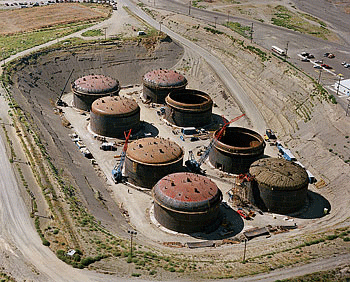
But it hasn’t fully turned the corner yet, according to recent comments by the federal officials now overseeing its operation. Continue reading
Radioactive trash mounting in South Korea, with no solution in sight
At all of the sites visited, the author found local opinion leaders making clear their concerns about the safety of spent fuel management in addition to their concerns about the overall safety of nuclear power plant operations
As they grapple with safety concerns regarding nearby nuclear facilities, local residents typically lack unbiased information on the issues involved
 The Search for Interim Spent Nuclear Fuel Storage in South Korea, Nautilus, By Jungmin
  Kang 31 August 2015
I. Introduction
Plans call for a continued expansion in South Korea’s fleet of nuclear reactors, but at the same time, facilities for the temporary storage of spent fuel, mostly in at-reactor pools, continue to fill up. Negotiations between the nuclear industry and central government agencies on one side, and local host communities on the other, for siting of interim spent fuel storage facilities, let alone permanent waste disposal facilities, have been largely ineffective to date, due in large part to a combination of the tactics used by authorities in approaching local communities, and a lack of unbiased information about nuclear facilities on the part of local stakeholders. In the last few years, a new effort to engage host communities has been undertaken, and shows some promise, though much work remains before agreements on facility siting can be reached.
Nuclear Spent Fuel is Accumulating at Reactor Sites in South Korea
As of 2015 about 760 metric tons of spent fuel is discharged annually from 23 reactors in South Korea.[1] About half of this total comes from four CANDU heavy water reactors (HWRs) and the other half from 19 pressurized light-water reactors (PWRs).[2] As of the end of 2013, 6,541 tHM (tonnes heavy metal) in spent PWR fuel and 7,258 tHM in spent HWR fuel were stored in the spent fuel storage facilities at four different nuclear power plants clustered into four coastal sites: Hanul (Ulchin), Wolsong and Kori along the East coast and Hanbit (Yonggwang) on the West coast. Continue reading
Call for USA Department of Energy accountability on Idaho’s radioactive trash importation
these contractors are doing work for the Department of Energy, a federal agency using taxpayer dollars. The federal government must be held accountable in Idaho at all times.
Idaho’s role in the national nuclear waste and research strategy deserves more scrutiny. The proposed fuel rods contain some of the most radioactive material on earth. The industry and government have not determined how to “safely” handle and store waste that has a half-life longer than any human civilization has existed. Perhaps, instead of raising alarmist notions that Idaho’s economy depends on begging for nuclear waste imports, the DOE could first finish what it started with the waste we already have.
Idahoans should demand accountability on nuclear waste. BY KELSEY JAE NUNEZ HTTP://WWW.IDAHOSTATESMAN.COM/2015/08/29/3961694/GUEST-OPINION-IDAHOANS-SHOULD.HTML August 29, 2015 The state of Idaho should stand tall while demanding that the Department of Energy honor its commitments to the people of Idaho.
While the Idaho National Laboratory may be an economic force in our state, the history of the site is plagued by the federal government’s irresponsible and shortsighted practices involving disposal of nuclear waste. These actions contaminated the air, the soil, and the Snake River Aquifer with radioactive materials that will remain hazardous until the end of fathomable time. Real people suffered. Decades of dumping and controversial plans to continue shipping nuclear waste from around the world into Idaho caused outrage among many of its citizens. Litigation led to the now-famous 1995 Settlement Agreement, which is hardly outdated — the deadlines have just recently starting to come due.
The 1995 Settlement Agreement represents a set of negotiated promises from the federal government to Idahoans — promises to clean up the nuclear waste it brought here, and promises to limit the importation of more. Enforcing the agreement is Idaho’s legal and moral obligation, and the people should not tolerate manipulative tactics and attempts to bully Idaho into abandoning it. Continue reading
Disposal of plutonium; burial is cheaper than MOX processing
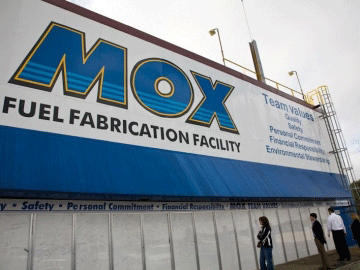
 nuClear news No.77, September 20156. Plutonium Conundrum A US Energy Department-commissioned study, which has been leaked to the Union of Concerned Scientists, concludes that it would be cheaper and far less risky to dispose of 34 metric tons of U.S. surplus plutonium at a federal nuclear waste repository in New Mexico than convert it into mixed-oxide (MOX) fuel for commercial nuclear power plants at the MOX Fuel Fabrication Facility in South Carolina.
The unreleased report describes in detail the delays and massive cost overruns at the half-built MOX facility, located at the federal Savannah River Site. High staff turnover, the need to replace improperly installed equipment, and an antagonistic relationship between the local federal project director and the contractor are only some of the factors undermining the project. The new report also notes that there are “no obvious silver bullets” to reduce the life-cycle cost of the MOX approach.
According to UCS, a better alternative to turning the surplus plutonium into commercial nuclear fuel would be to “downblend” it, a method the Energy Department has already used to dispose of several metric tons of plutonium. It involves diluting the plutonium with an inert, nonradioactive material and then sending it to the nuclear waste site in New Mexico, the Waste Isolation Pilot Plant (WIPP), for burial. The new report’s analysis supports that assessment. …….
Leaked review tells of ‘Significant Design Vulnerabilities’ at Hanford radioactive trash site
‘Significant Design Vulnerabilities’ Plague Massive Nuclear Waste Site, Leaked Internal Review Reveals, Common Dreams,
‘The fact that the Department of Energy has not released this report, prepared last year, is alarming and indicative of a safety-last culture.’
A leaked internal review of the nation’s largest nuclear clean-up site found hundreds of “significant design vulnerabilities” and begs questions about the Energy Department’s transparency, a watchdog group says.
The Hanford Nuclear Reservation near Richland, Washington houses radioactive waste from the production of plutonium for nuclear weapons, and the decades-long clean-up effort has been costly and plagued by leaking underground nuclear waste storage tanks.
Seattle-based Hanford Challenge, which advocates for safe clean-up of the site, says it received the Department of Energy document from a whistleblower who has worked at the site for many years as an engineer.
“The fact that the Department of Energy has not released this report, prepared last year, is alarming and indicative of a safety-last culture,” said Tom Carpenter, Executive Director of the group.
The document is a 2014 draft review called “Low-Activity Waste Facility Design and Operability Review and Recommendations.” That LAW facility, Hanford Challenge explains in a statement, “is designed to treat waste from Hanford’s high-level nuclear waste tanks that will be pre-treated to remove the highly-radioactive materials before being mixed with glass formers in a facility designed to vitrify the low level waste.”
From the executive summary of the leaked report: ……
The leaked review comes the same month as whistleblower Walter Tamosaitis, who raised safety concerns regarding operations at the site, reached a $4.1 settlement with Hanford subcontractor AECOM.
And last year, documents obtained by the Associated Press showed there were “significant construction flaws” in some of the double-shell storage tanks at the facility. U.S. Sen. Ron Wyden (D-Ore.) urged the Energy Department to provide an action plan of how it would deal with the risks the flaws pose, writing in a letter (pdf) to Energy Secretary Ernest Moniz: “It is time for the Department to stop hiding the ball and pretending that the situation at Hanford is being effectively managed.”
The Washington site has proven itself an “intractable problem” that “costs taxpayers a billion dollars a year,” author and history professor Kate Brown wrote earlier this year. “Corporate contractors hired to clean up Hanford have made hundreds of millions of dollars in fees and surcharges, and, since little has been accomplished, the tab promises to mount for decades.”http://www.commondreams.org/news/2015/08/26/significant-design-vulnerabilities-plague-massive-nuclear-waste-site-leaked-internal
Boeing wanted to quietly dispose of radioactive trash, without accountability
 Judge rejects Boeing’s bid to demolish and dispose of radioactive waste without accountability Eturbo News, SANTA MONICA, CA, Jan 2015 – Sacramento Superior Court has denied Boeing’s motion for summary judgment in a California Environmental Quality Act (CEQA) lawsuit over the demolition and disposal of radioactively contaminated structures from the site of a partial nuclear meltdown near Los Angeles, Consumer Watchdog said today.
“This is an important step on the way to ensuring that state regulators must consider the demolition and disposal of any radioactively contaminated structures at the Santa Susana Field Lab in their environmental assessment of the cleanup of this site,” said Consumer Watchdog Litigation Director Pam Pressley.
 Boeing had claimed that the Department of Toxic Substances Control (DTSC) has no regulatory
authority over the demolition and disposal of radioactively contaminated structures in the nuclear portion of the Santa Susana Field Lab (SSFL) in Simi Hills. The lab had tested small-scale nuclear reactors, rocket engines, and fuels and suffered a partial nuclear meltdown in 1959 that has never been fully cleaned up……http://www.eturbonews.com/54422/judge-rejects-boeings-bid-demolish-and-dispose-radioactive-waste
South Carolina court blasts state’s environmental protection agency over poor oversight of leaking nuclear waste dump
For the second year in a row, the S.C. Court of Appeals has ripped the state’s environmental protection agency for failing to properly oversee a leak-prone nuclear waste dump in Barnwell County.
But this time, the appeals court isn’t telling regulators when to resolve problems at the 44-year-old site.
In an Aug. 12 ruling that disappointed landfill critics, the court backed away from requiring a specific timetable to improve conditions at Chem-Nuclear’s dump near the Savannah River.
Last year, the appeals court ordered the Department of Health and Environmental Control and site operator Chem-Nuclear to develop a written plan for correcting problems within 90 days. Both then appealed for a rehearing, which delayed the 90-day requirement and ultimately resulted in last week’s decision.
Sierra Club lawyer Bob Guild said this year’s decision leaves DHEC — the agency that has failed to properly manage the site — the discretion to react to the court ruling at its own leisure.
“We have an agency that has been lawless for years in not enforcing its own regulations, and now, the court is giving it another open-ended opportunity to review itself,’’ Guild said. “That is unfortunate. We are going to monitor this very carefully.’
Guild’s group filed suit 10 years ago in an attempt to force tougher disposal practices at the unlined landfill, where radioactive tritium leaks first were detected in the 1970s. A plume of tritium extends downhill from the site and has for years trickled into a creek that flows toward the nearby Savannah River.
Sierra Club officials say DHEC has been lax in making Chem-Nuclear follow rules at the disposal site through the years.
The appeals court acknowledged problems, saying that DHEC “failed to enforce the law of South Carolina’’ in monitoring the 235-acre landfill outside the town of Snelling.
The court said DHEC, as the agency overseeing Chem-Nuclear’s activities, did not enforce a handful of specific regulations established to protect the environment. It also said Chem-Nuclear had failed to follow some of the rules on nuclear waste disposal. Except for the timetable, the court’s decision last week was similar to last year’s ruling that took DHEC and Chem-Nuclear to task.
“It is important that DHEC enforce its own regulations and require Chem-Nuclear to take action to comply with the technical requirements,’’ the ruling said in sending the matter back to DHEC for consideration……….
An array of critics, however, say tritium is still toxic and often is a forerunner of other, more dangerous pollutants that will one day wash into groundwater. Leaks were discovered within a decade of the Barnwell County site’s opening in 1971, despite initial assurances from state regulators.
The disposal site once took low-level nuclear waste from atomic power plants, hospitals and other places from across the country. Today, the landfill is open only to South Carolina, Connecticut and New Jersey, and waste volumes have dropped sharply. But the Sierra Club has pressed ahead with its 2005 lawsuit, saying better disposal practices will prevent tritium leaks from getting any worse.
One of the major concerns centers on rain that falls into open burial trenches. Environmentalists for years have pushed the state to require the placement of tents or roofs atop the burial trenches. That would cut down on the amount of rain that pours in, picks up radioactive pollutants from the waste and leaks through the bottom of the landfill and into groundwater, they say.
The court said Chem-Nuclear had done nothing to keep rain out of the burial pits, even though a state regulation says it is supposed to minimize movement of water in the pits. And the court said DHEC had not forced the company to comply with the rule intended to keep rain out of the pits — or acted to prevent rain from leaking through the bottom and into groundwater………http://www.thestate.com/news/local/article31585892.html
1 This Month
23-25 October – on Zoom – World BEYOND War’s annual global conferenc


Shut down the radiation-damaged Heysham nuclear reactors now
To see nuclear-related stories in greater depth and intensity – go to https://nuclearinformation.wordpress.com

Say No to NASA’s Reckless Nuclear Reactor on the Moon
Say No to NASA’s Reckless Nuclear Reactor on the Moon

-
Archives
- October 2026 (209)
- September 2026 (339)
- August 2026 (330)
- July 2026 (355)
- June 2026 (287)
- May 2026 (306)
- April 2026 (356)
- March 2026 (251)
- February 2026 (267)
- January 2026 (308)
- December 2025 (358)
- November 2025 (359)
-
Categories
- 1
- 1 NUCLEAR ISSUES
- business and costs
- climate change
- culture and arts
- ENERGY
- environment
- health
- history
- indigenous issues
- Legal
- marketing of nuclear
- media
- opposition to nuclear
- PERSONAL STORIES
- politics
- politics international
- Religion and ethics
- safety
- secrets,lies and civil liberties
- spinbuster
- technology
- Uranium
- wastes
- weapons and war
- Women
- 2 WORLD
- ACTION
- AFRICA
- Atrocities
- AUSTRALIA
- Christina's notes
- Christina's themes
- culture and arts
- Events
- Fuk 2022
- Fuk 2023
- Fukushima 2017
- Fukushima 2018
- fukushima 2019
- Fukushima 2020
- Fukushima 2021
- general
- global warming
- Humour (God we need it)
- Nuclear
- RARE EARTHS
- Reference
- resources – print
- Resources -audiovicual
- Weekly Newsletter
- World
- World Nuclear
- YouTube
-
RSS
Entries RSS
Comments RSS

