Taiwan’s unsafe nuclear waste storage
Taipower panned over nuclear waste storage,Taipei Times, 28 Feb 16 RECKLESS:Storing nuclear waste in close proximity to the sea was not safe, as the containers could be submerged during a tsunami, a Japanese waste expert said By Chen Wei-han / Staff reporter Nuclear experts and a legislator yesterday criticized Taiwan Power Co (Taipower ) for its nuclear waste treatment during a visit to the Guosheng Nuclear Power Plant in New Taipei City’s Wanli District (萬里), saying the company’s temporary storage solution is problematic and its management is not transparent.
A visit by nuclear experts and activists to examine the plant’s dry cask storage facilities, a radioactive waste incinerator and a cooling pond was canceled after Taipower denied Japanese nuclear waste expert Masako Sawai access to the facilities due to a visa issue……….
Despite not being able to personally examine the facilities, Sawai criticized Taipower’s dry cask storage based on its design.
The company plans to store high-level radioactive waste in steel cylinders surrounded by concrete shells placed outdoors as a temporary solution until a permanent depository is constructed.

“Instead of being constructed as a single and seamless piece, the steel cylinder is designed to be welded, but welding points might corrode and crack over an extended period, and the likelihood of corrosion is greater when casks are stored outdoors and exposed to winds containing sea salt,” Sawai said.
The casks should be portable, but Taipower’s concrete cask, each weighing about 200 tonnes, could not be transported in case of an emergency, Sawai added.
“Although concrete casks are 20 percent cheaper than the metal casks used in Japan and many European nations, safety is more important than costs,” she said.
Choosing a storage area that is at close proximity to sea was improper, because casks would be submerged during a tsunami, as was the case with the Fukushima Dai-ichi nuclear disaster, Sawai said.
He criticized the company’s incinerator for burning low-level nuclear waste. He said it runs on diesel instead of plasma torch technology as claimed on the Atomic Energy Council’s Web site.
Incinerators powered by diesel could only reach about 1,000?C, 90 percent lower than the temperature reached by plasma torch, leading to incomplete burning of radioactive waste, He said. He also criticized the location of a cooling reservoir on a hill above the plant’s two reactors, which is designed to pump water to the cooling system using the force of gravity during a nuclear accident if electrical power is cut, saying that the reservoir was not placed high enough to have the pressure required to pump water into the reactors to prevent a possible meltdown.
“The improper design of the reservoir and incinerator arises from the fact that the designer and supervisor of the nuclear waste treatment are the same institution, which is the Atomic Energy Council’s Institute of Nuclear Energy Research. It is time for the council to be replaced,” he said. http://www.taipeitimes.com/News/taiwan/archives/2016/02/29/2003640493
USA Energy Dept keen to reopen New Mexico Nuclear waste Station: others not so sure
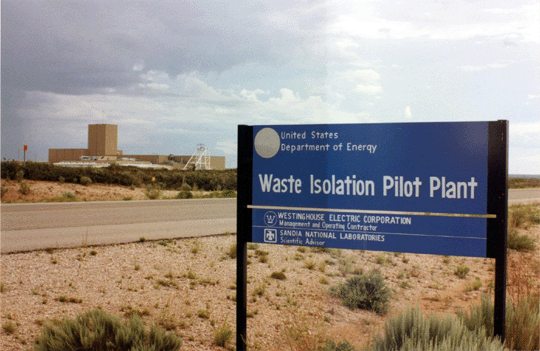 New Mexico Presses Ahead on Nuclear-Waste Plant Reopening Burial site’s closure caused by 2014 accident left waste piling up across the country, WSJ By JOHN R. EMSHWILLER Feb. 28, 2016
Despite a nine-month delay in the planned reopening of an underground nuclear-waste repository in New Mexico damaged by a radiation accident, progress is being made in resuming operations, said a top state official overseeing the effort.
In January, the Energy Department said it had pushed the reopening date of the federal facility near Carlsbad, N.M., to December from March. The closure caused by the February 2014 accident has left nuclear waste destined for the repository piling up at sites around the country……
Among the issues still being addressed, he said, are residual contamination from the accident and ensuring adequate and safe air flows in the complex.
While officials want to see WIPP reopen as soon as possible, “we have to make sure it is done right,” said Mr. Flynn, whose agency must give its approval before the site can accept waste again. He said he thinks December is a reasonable target date.
Not everyone is as sanguine. Given the remaining challenges, “I think it’s very unlikely the December date will be met,” said Don Hancock, director of the nuclear-waste safety program at the Southwest Research and Information Center, an Albuquerque, N.M., environmental group.
Earlier this month, U.S. Energy Secretary Ernest Moniz said he expects resumption of full operations at the repository to take a few years……..
The Energy Department has said it would cost about $240 million to bring WIPP back into operation and tens of millions of dollars more in additional capital costs, including revisions to the ventilation system.
WIPP, which began operations about 17 years ago, was designed to dispose of a specific type of nuclear waste from the atomic-weapons program. More than 171,000 waste containers are buried there………http://www.wsj.com/articles/new-mexico-presses-ahead-on-nuclear-waste-plant-reopening-1456655406
TEPCO now burning thousands of radioactive work clothes
TEPCO begins burning radiation-tainted work clothes at Fukushima plant Asahi Shimbun, February 26, 2016 By HIROMI KUMAI/ Staff Writer OKUMA, Fukushima Prefecture--Tokyo Electric Power Co. has started to incinerate the thousands of boxes of lightly contaminated waste, including clothing used by workers, at the Fukushima No. 1 nuclear power plant to reduce the amount of tainted waste on the site.
TEPCO, the plant operator, fired up a special on-site incinerator on Feb. 25 to burn protective suits, gloves, socks and other work clothes worn by plant workers that became contaminated with low-level radiation.
The operation will reduce the amount of tainted work clothing accumulating at the plant during decommissioning operations since the nuclear disaster unfurled in March 2011. The garments cannot be processed outside the plant due to the radiation.
The clothing being incinerated are items with the lowest levels of contamination that have been stored in tens of thousands of 1 cubic-meter special boxes. The number of containers reached 66,000 at the end of last year…….http://ajw.asahi.com/article/0311disaster/fukushima/AJ201602260071
Germany’s nuclear utilities will have to transfer nuclear clean-up cash by 2022
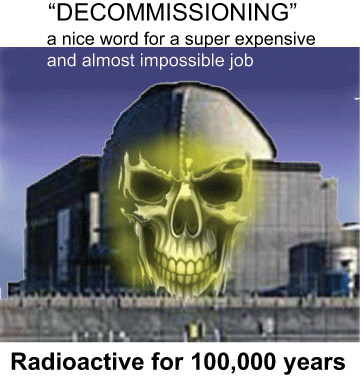 Nuclear commission proposes firms transfer cash by 2022 to pay for clean-up http://af.reuters.com/article/commoditiesNews/idAFB4N10000F
Mon Feb 22, 2016BERLIN Feb 22 (Reuters) – Germany’s utilities will have to transfer provisions set aside to pay for the interim and final storage of nuclear waste to a fund in cash by 2022, according to a draft report from a government-appointed committee seen by Reuters on Monday.
The report recommends that Germany’s “big four” utilities — E.ON, RWE, EnBW and Vattenfall — remain liable for the cost of up to double the 18 billion euros ($19.8 billion) allocated so far to pay for interim and final storage.
The companies will also have to set aside a further 1.3 billion euros in provisions, according to the report which is due to be presented at the end of the month. ($1 = 0.9084 euros) (Reporting by Markus Wacket; Writing by Caroline Copley; Editing by Christoph Steitz)
Crisis mode continues at Fukushima nuclear wreck
5 Years Later, the Fukushima Nuclear Disaster Site Continues to Spill Waste
The cleanup effort could take decades; meanwhile the amount of radioactive material the plant leaks grows, Scientific American By Madhusree Mukerjee on March 1, 2016 “……..
Today the disaster site remains in crisis mode. Former residents will not likely return anytime soon, because levels of radioactivity near their abodes remain high. Even more troublesome, the plant has yet to stop producing dangerous nuclear waste: its operator, the Tokyo Electric Power Company (TEPCO), currently circulates water through the three melted units to keep them cool—generating a relentless supply of radioactive water. To make matters worse, groundwater flowing from a hill behind the crippled plant now mingles with radioactive materials before heading into the sea.
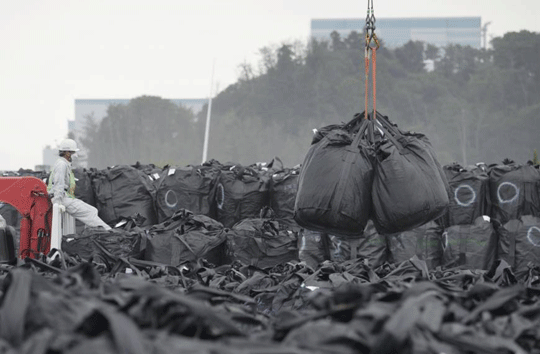
TEPCO collects the contaminated water and stores it all in massive tanks at the rate of up to 400 metric tons a day. Lately the water has been processed to reduce the concentration of radionuclides, but it still retains high concentrations of tritium, a radioactive isotope of hydrogen. Disputes over its final resting place remain unresolved. The same goes for the millions of bags of contaminated topsoil and other solid waste from the disaster, as well as the uranium fuel itself. Health reports, too, are worrisome. Scientists have seen an increase in thyroid cancers among the children who had lived in Fukushima at the time, although it is too early to tell if those cases can be attributed to the accident…….http://www.scientificamerican.com/article/5-years-later-the-fukushima-nuclear-disaster-site-continues-to-spill-waste/
No straightforward answers to nuclear waste – except to stop making it
More money and some jobs would be offset by the stigma inevitably attached to radioactivity and by the risks involved, including accidents, radioactive leaks to underground water systems, and radioactive emissions to the air.
Recent accidents at nuclear waste dumps in Germany, New Mexico and France are deeply concerning. It is difficult to credibly predict cumulative environmental effects should a radioactive incident occur underground.
There are no straightforward answers. Given the dangers of radioactive waste, McKenna should invoke the precautionary principle which is enshrined in environmental laws worldwide. It states projects should not be undertaken if they might have serious adverse consequences, even if we don’t know whether these consequences will happen.
 The next step would be to stop making more nuclear waste.
Dealing with nuclear waste is so difficult that phasing out nuclear power would be the best option http://www.lfpress.com/2016/02/26/dealing-with-nuclear-waste-is-so-difficult-that-phasing-out-nuclear-power-would-be-the-best-option Erika Simpson and Ian Fairlie, Special to Postmedia Network Environment Minister Catherine McKenna has dealt a setback to Ontario Power Generation’s plan for a nuclear waste burial site on the shores of Lake Huron. In a letter to interested parties last week,
McKenna delayed a decision on whether to approve the proposed deep geologic repository (DGR) for low- and intermediate-level radioactive waste and set a short April 18 deadline for OPG to furnish a timeframe within which it could provide an updated list of commitments to mitigate potential damage from the site.
Furthermore, she stated she will seek a further extension for the review from cabinet at a later date. We are probably in for long delays. Continue reading
Disastrous problem of nuclear waste just won’t go away
A disaster waiting to happen: nuclear waste and Lake Huron, Michigan Radio, By JACK LESSENBERRY , 25 Feb 16 Michigan has been so preoccupied with our own environmental disaster in Flint that we may have missed the announcement that Canada last week indefinitely delayed a decision about whether to bury low-level nuclear waste near Lake Huron……..
Had the conservative government of Prime Minister Stephen Harper been reelected last fall, the decision announced last week would almost certainly have been to bury the waste here. But Harper’s party lost in an unexpected landslide to Justin Trudeau’s more environmentally conscious liberals.
The outcome may be especially welcome in poor, battered Flint. The city hopes to eventually switch to a new water provider using Lake Huron, and the last thing anyone wants to worry about is radioactive waste leaching into the water, as unlikely as that may be.
But this also means we still don’t have an answer to what is to be done with 200,000 cubic feet of nuclear waste, currently stored in above-ground containers near Ontario’s immense Bruce nuclear generating station.
Even more important is finding a permanent home for all those highly radioactive, spent nuclear fuel rods in both our nations. Scientific American estimated seven years ago that the United States alone had produced 64,000 metric tons of those rods.
There’s more now, and any effort to establish a permanent burial site has been killed by narrow, NIMBY, not-in-my-backyard thinking, as it has in Canada.
This is a disaster waiting to happen – there’s tons of this stuff in “temporary,” above-ground storage everywhere from Monroe to Charlevoix, where an old nuclear plant was torn down nearly twenty years ago.
If the apparent decision to not bury low-level waste near Lake Huron makes us forget this far bigger problem, then it is no kind of victory at all. http://michiganradio.org/post/disaster-waiting-happen-nuclear-waste-and-lake-huron#stream/0
Out of control- Fukushima nuclear wastes, but they plan Olympic events there!
 Fukushima – Deep Trouble CounterPunch, FEBRUARY 22, 2016 by ROBERT HUNZIKER The Fukushima Daiichi Nuclear Power Plant disaster may go down as one of history’s boundless tragedies and not just because of a nuclear meltdown, but rather the tragic loss of a nation’s soul.
Imagine the following scenario: 207 million cardboard book boxes, end-to-end, circumnavigating Earth, like railroad tracks, going all the way around the planet. That’s a lot of book boxes. Now, fill the boxes with radioactive waste. Forthwith, that’s the amount of radioactive waste stored unsheltered in one-tonne black bags throughout Fukushima Prefecture, amounting to 9,000,000 cubic metres
But wait, there’s more to come, another 13,000,000 cubic metres of radioactive soil is yet to be collected. (Source: Voice of America News, Problems Keep Piling Up in Fukushima, Feb. 17, 2016).
And, there’s still more, the cleanup operations only go 50-100 feet beyond roadways. Plus, a 100-mile mountain range along the coast and hillsides around Fukushima are contaminated but not cleansed at all. As a consequence, the decontaminated land will likely be re-contaminated by radioactive runoff from the hills and mountains.
Indubitably, how and where to store millions of cubic metres of one-tonne black bags filled with radioactive waste is no small problem. It is a super-colossal problem. What if bags deteriorate? What if a tsunami hits? The “what-ifs” are endless, endless, and beyond.
“The black bags of radioactive soil, now scattered at 115,000 locations in Fukushima, are eventually to be moved to yet-to-be built interim facilities, encompassing 16 square kilometers, in two towns close to the crippled nuclear power plant,” Ibid.
By itself, 115,000 locations each containing many, many, mucho one-tonne bags of radioactive waste is a logistical nightmare, just the trucking alone is forever a humongous task, decades to come.
According to Japanese government and industry sources, cleaning up everything and decommissioning the broken down reactors will take at least 40 years at a cost of $250 billion, assuming nothing goes wrong. But dismally, everything that can possibly go wrong for Tokyo Electric Power Company (“TEPCO”) over the past 5 years has gone wrong, not a good record.
And, Japan is hosting the 2020 Olympics?
Yet, Fukushima Daiichi Nuclear Power Plant remains totally out of control with no end in sight. As far as that goes, Olympic events alongside an out of control nuclear meltdown seem unfathomable.
As recently as October 30, 2015, The Japan Times reported: “Extremely high radiation levels and the inability to grasp the details about melted nuclear fuel make it impossible for the utility to chart the course of its planned decommissioning of the reactors at the plant.”
On the other hand, according to TEPCO, preparation is underway for removal of the melted nuclear fuel, scheduled to begin in 2021. “But it is difficult to know what is happening inside the reactors, and there are no established methods for doing so… It is not difficult to get a camera inside the reactor. The problem is the camera breaks down due to high levels of radiation,” according to Toru Ogawa, director of the Japan Atomic Energy Agency’s Collaborative Laboratories for Advanced Decommissioning Science (Kiyoshi Ando, senior staff writer, Long Road Ahead for Fukushima Cleanup, Nikkei Asian Review, Feb. 19, 2016)……….
“Sporting events at the 2020 Tokyo Olympics are to be held in the Japanese region of Fukushima… Spectators and athletes in the Olympic village will be served with food from the region as part of an effort to restore the reputation of Fukushima, formerly one of Japan’s richest agricultural regions,” Fukushima to Host Olympic 2020 Events, The Times, Feb. 25, 2015.http://www.counterpunch.org/2016/02/22/fukushima-deep-trouble/
Germany struggles with nuclear waste storage problem

 German nuclear exit plan fails to solve waste storage puzzle http://uk.reuters.com/article/uk-germany-nuclear-storage-idUKKCN0VW1Y9 Feb 23, 2016 FRANKFURT | BY CHRISTOPH STEITZ When Germany committed itself five years ago to phasing out nuclear power by 2022, there was one big gap in its plans — what to do with the waste that can remain toxic for hundreds of thousands of years.
That issue remains unresolved even after a government-appointed nuclear commission came up with ideas on how to ensure funding for shutting down all of the country’s atomic reactors.
According to a draft proposal, utilities E.ON, RWE, EnBW and Vattenfall [VATN.UL] could be saddled with up to 56 billion euros ($61.6 billion) in costs to cover their share of the cost of the nuclear exit.
But the final bill could climb even higher and the extra cost may have to be met by German taxpayers.
The main uncertainty centres on the difficulty of finding a permanent storage site to house highly radioactive material.
Local opposition has ruled out turning an interim waste storage site in salt formations in the small village of Gorleben in northwest Germany into a final site, with the location having ultimately been excluded by law.
The nuclear commission has proposed capping the utilities’ liability for storage costs at 36 billion euros — twice the size of current provisions made by the four utilities for that part of the process.
This proposal would put a ceiling on costs for the power firms and remove a major source of investor concern.
But there is caution that this is only a draft settlement which does not settle the practical problem of finding a storage site.
Analysts at Jefferies are among those who “remain concerned about the potential for future cost escalations and the negative balance sheet implications that it may have for German utilities”.
GOING UNDERGROUND?
Underlining the tensions around the storage issue, German utilities have sued the government over the Gorleben decision, claiming a ban is politically motivated and will force them to incur additional costs.
The OECD’s Nuclear Energy Agency says it is impossible to gauge the future costs of storage sites because each country’s geography is different and there are no previous projects to serve as examples.
In contrast, the dismantling of nuclear plants, for which utilities have set aside about 20 billion euros in provisions, is more predictable in terms of costs.
Several plants have already been torn down and several more are being dismantled after the German government decided to end nuclear in the wake of the Fukushima disaster in 2011.
More fanciful ideas to dispose of the nuclear waste include shooting it into outer space, but underground storage remains the most feasible option.
Finland and Sweden are most advanced in their preparations for such a solution to their own waste issues, hoping to be the first countries to put high-level waste into underground caverns in the next decade. ($1 = 0.9088 euros)
(Editing by Keith Weir)
USA Dept of Energy wants to dump nuclear waste on Sacred Native American Lands

 Sacred Native American Lands Could Become Nuclear Waste Dump Derrick Broze February 22, 2016 (ANTIMEDIA) Nye County, Nevada —During the 1970s and 80s, a large movement of antinuclear and anti-war activists protested the growing acceptance of nuclear power and the possibility of an impending global nuclear war. The protesters were not only concerned with the Cold War breaking down into a hot war, but also with the dangers that nuclear technology presented to the environment and the health of the public……..
Unfortunately, Native communities in the region are not new to this type of exposure to radiation. From 1951 to 1992, the U.S. government used a 1,300-square mile patch of land known as the Nevada Test Site for nuclear weapons testing. 928 American and 19 British nuclear tests were conducted at the Nevada Test Site. Although no official tests have been conducted to examine the health effects on the Paiute and the Shoshone, the communities believe the radiation has affected their health — and the health of the land…….
The DOE is currently accepting public comment from communities, states, tribes, and other stakeholders regarding how to establish a nuclear waste repository with respect to the community. The DOE says it aims “to establish an integrated waste management system to transport, store, and dispose of commercial spent nuclear fuel and high level defense radioactive waste.” The public comment period ends on June 15, and the DOE and Nuclear Regulatory Commission will likely issue statements shortly after.
Ian Zaparte, representative of the Western Shoshone government, says the NRC and the DOE are ignoring the possibilities for danger in the area.
“There are 26 faults, seven cinder cone volcanoes, 90 percent of the mountain is saturated with 10 percent water,” Zaparte told MintPress. “If you heat the rock, it will release that water. If the water comes up and corrodes the canisters, it will take whatever is in storage and bring it into the water and into the valley.”
However, Ian Zaparte takes his criticism of the project even further. He believes the actions taken by the U.S. government constitute acts of genocide against the Western Shoshone and other tribal nations who have been subject to the effects of nuclear testing and power. He is determined to fight for his people’s way of life and the land that his ancestors fought for. http://theantimedia.org/sacred-native-american-lands-could-become-nuclear-waste-dump/
Nuclear industry AND tax-payer funds both may be needed to cover nuclear shutdown costs
SHUTDOWN COSTS Picking Up the Nuclear Tab, Handelsblatt BY KLAUS STRATMANN 23 Feb 16, A leaked draft report on Germany’s exit from nuclear power recommends the nation’s four big utilities foot the €19.7 billion bill for decommissioning their power plants – but any costs above that may be carried by taxpayers.
FACTS In 2011, Germany announced a complete phase-out of nuclear power by 2022, with a target of 80 percent renewable energy by 2050.
The four major power firms in Germany, E.ON, RWE, EnBW and Vattenfall, and plant operator Krümmel have set aside €39.6 billion for their share of the phase-out costs.
A government financial commission has now devised a structure for dividing the responsibilities and clarifying the financial liabilities of industry and government. Germany moved a step closer this week to deciding how to pay for its forced exit from nuclear power. The government is moving toward requiring four nuclear plant operators pay the first €19.7 billion ($22 billion). Any costs above that — including hard-to-estimate expenses for storing nuclear fuel — would be paid for by taxpayers.
The recommendations are included in a draft of a government report on the issue obtained by Handelsblatt. The document was described as a preliminary recommendation and could have been leaked as a trial balloon.
The draft recommends making E.ON, RWE EnBW and Vattenfall, the four utilities, pay for “decommissioning and demolition” of their nuclear power plants. The government would then step in assume the costs of the trickier task of removing and storing radioactive waste.
The utilities together have set aside about €39.6 billion ($43.6 billion) to cover their costs of decommissioning. But there is a strong possibility that final costs may rise well beyond that.
The cost of waste disposal and storage, in particular, is seen as particularly difficult to gauge, promting fears among consumer advocates that the utilities could end up saddling taxpayers with the majority of costs.
The report recommends that a state fund be set up to pay for the waste disposal, financed in part by the four utilities, which would transfer in about half of their total reserves. But the report stops short of saying how costs would be divided between industry and taxpayers if disposal costs are greater than expected…… https://global.handelsblatt.com/edition/374/ressort/politics/article/utilities-wont-escape-nuclear-clean-up-costs
Germany’s “big four” utilities liable for nearly 40 billion euros for nuclear waste storage
Nuclear commission proposes firms transfer cash by 2022 to pay for clean-up http://af.reuters.com/article/commoditiesNews/idAFB4N10000F Feb 22, 2016 BERLIN (Reuters) – Germany’s utilities will have to transfer provisions set aside to pay for the interim and final storage of nuclear waste to a fund in cash by 2022, according to a draft report from a government-appointed committee seen by Reuters on Monday.
The report recommends that Germany’s — E.ON, RWE, EnBW and Vattenfall — remain liable for the cost of up to double the 18 billion euros ($19.8 billion) allocated so far to pay for interim and final storage.
The companies will also have to set aside a further 1.3 billion euros in provisions, according to the report which is due to be presented at the end of the month. ($1 = 0.9084 euros) (Reporting by Markus Wacket; Writing by Caroline Copley; Editing by Christoph Steitz)
Inadequate environmental assessment for Kincardine nuclear waste site
 Kincardine nuclear waste site’s paused timeline not enough for opponents, The Star.com
Environment and Climate Change Minister Catherine McKenna has said the environmental assessment is insufficient. By: Jennifer Wells Business Columnist, Feb 21 2016
For opponents of the Deep Geologic Repository proposed by Ontario Power Generation, the news that Environment and Climate Change Minister Catherine McKenna has “paused the timeline” on the project is not good news enough.
Opposition voices have been crying for an outright “no” from Ottawa, as the deadline loomed for what had been promised as a March 1 decision on the plan to bury 200,000 cubic metres of low and intermediate-level radioactive waste approximately 1.2 km from the Lake Huron shore.
Yet in asking for further studies McKenna has signalled that the Environmental Assessment Report of the joint review panel, four years in the making, is insufficient, a decision that hardly seemed likely in the Stephen Harper era. And her request for additional technical studies and information on potential environmental effects highlights what has always been a fundamental flaw in OPG’s proposal: that no other site was drill-tested and environmentally assessed.
OPG’s plan as is consists of constructing a crypt on the Bruce nuclear power site, plunging 680 metres deep beneath sedimentary rock to a strata of limestone. The DGR would be the first in the world to use limestone as the host rock…….. http://www.thestar.com/business/2016/02/21/kincardine-nuclear-waste-sites-paused-timeline-not-enough-for-opponents.html
How to warn future generations about waste dumps? – Nuclear Semiotics
they established the field of nuclear semiotics……. an “atomic priesthood”

The message walls would have the faces as well as simple messages

Temple of Doom: How do we warn the future about nuclear waste?, Triple J Hack, by James Purtill, 19 Feb 16 This week the South Australian Royal Commission released “tentative findings” recommending the state take more than 100 tonnes of high-level radioactive waste and store it in the desert for hundreds of thousands of years.
……..If the facility goes ahead, the designers may consider a problem that has baffled linguists and semioticians (sign experts): how to tell the distant future don’t dig up the dump?
Atomic priesthoods and ‘ray cats’
In 1991, the Department of Environment hired linguists, scientists and anthropologists at a cost of about $1 million to answer what is basically a conundrum of labelling. How do you warn far-off civilisations or scattered bands of post-apocalyptic survivors that invisible beams of energy emanating from the earth could kill them, and this was not a trick, there’s no buried treasure?
The report runs to 351 pages and has the (rather dry) title: Expert Judgement on Markers to Deter Inadvertent Human Intrusion into the Wasteland Isolation Pilot Plant.
Here’s some of the problems they identified:
- Languages evolve too fast to communicate with the future: Few English speakers understand Old English, which was spoken about 1000 years ago.
- The meanings of symbols is too ambiguous: For example, the physicist Carl Sagan was invited to join the researchers, couldn’t make it, and wrote to suggest they simply use the skull-and-crossbones symbol to signify danger. But this symbol has only been current for a few hundred years, has meant ‘poison’ for the last 100, and is no longer very threatening. It’s on ‘pirate theme’ drink bottles.
- Even if they understand the warnings, future trespassers might not believe them. Curses associated with the burial sites of the Egyptian Pharaohs did not deter grave robbers.
In 1981 the Department of Energy assembled a gun team of engineers, anthropologists, nuclear physicists, and science fiction authors to figure out how to prevent future access to a proposed deep geological repository at a place called Yucca Mountain in Nevada.
They were known as the Human Interference Task Force and they established the field of nuclear semiotics.
One of the team suggested creating an “artificial myth” that a certain area was dangerous and should be avoided. There was no need to explain radioactivity, but just convince people it was dangerous and they should avoid the place.
But how to ensure the myth was preserved? He suggested “a commission, relatively independent of future political currents, self-selective in membership, using whatever devices for enforcement at its disposal, including those of a folkloristic character.”
This effectively meant, he admitted, an “atomic priesthood”……….
‘This place is not a place of honour’
The 1990s study for WIPP eschewed ray cats and atomic priesthood in favour of gargantuan architecture, message walls in many languages, and faces contorted in expressions of pain and sickness.
The names of the enormous earthworks proposals are evocative: ‘landscape of thorns’, ‘black hole’, and ‘rubble landscape’, ‘forbidding blocks’ and ‘menacing earthworks’, ‘leaning stone spikes’ and ‘spike field’. There are animated versions of these designs in the documentary Contamination.
The message walls would have the faces as well as simple messages in the six languages of the United Nations (Arabic, English, Spanish, French, Russian, and Chinese), as well as Navajo. There would be a blank area for the message to be inscribed in another language when these other seven languages grow too ancient “to read comfortably”.
The authors boiled down what they wanted to tell the future to key points, including:
Though it may have been discredited, nuclear semiotics has entered the popular imagination through movies like Alien, Mad Max, The Road, Terminator and even Waterworld.
If the South Australian repository goes ahead, it’s likely it will play into public debate.
It popped up in Finland with the 2010 feature documentary film Into Eternity, about the construction of the country’s new deep geological repository.
These visions of hell – landscape of thorns and walls of screaming faces – are a graphic representation of the fear inspired by nuclear waste, but also of the need to find the safest possible repository.
A potential ‘scare campaign’ cuts both ways.
Most of the world’s high level nuclear waste is currently stored above ground in thick steel and concrete casks. Some say a relay system of these casks will be sufficient.
“The problem I see with dry casks technically is they last for some decades, maybe for 100 years even, but at some point they fall apart and we have to change out the waste into other casks,” says Macfarlane.
“The problem is you’re not sure of the control of this material. You can make the assumption you’re going to have caretaker governments like we have now in the US and Australia, and they’re going to monitor and make sure these don’t leak.”
“But do we have any guarantee of it?
“The institutional control side of things is unknown.”
Temporary storage is only as good as the government responsible for monitoring and upkeep. And as nuclear semiotics proves, you can’t predict the future. http://www.abc.net.au/triplej/programs/hack/temple-of-doom-how-do-we-warn-the-future-about-nuclear-waste/7181278
Nuclear wastes will outlast the repositories by thousands of years!
Temple of Doom: How do we warn the future about nuclear waste?, Triple J Hack, by James Purtill, 19 Feb 16 “…….This week the South Australian Royal Commission released “tentative findings” recommending the state take more than 100 tonnes of high-level radioactive waste and store it in the desert for hundreds of thousands of years…….
Finland is building the world’s first deep underground repository for high level nuclear waste and Sweden is close behind. The Finnish site is scheduled for completion in 2023.
A better example of the kind of repository proposed for South Australian is the United States’ Waste Isolation Pilot Plant (WIPP), deep in the New Mexico desert. It’s the only working long-lived nuclear waste repository in the world. It holds barrels of gloves and masks and machines and bomb parts contaminated by nuclear testing. The site is designed to last for 10,000 years.
WIPP is scheduled to close in the 2040s. It will be sealed up and left alone. Centuries will pass and become millennia. On the surface, civilisations will rise and fall.
China, the world’s oldest continuous civilisation, stretches back about 5,000 years. The world’s oldest inscribed clay tablets date from about the same time.
 The half-life of plutonium-239, which can produce fatal radiation doses during short periods of direct exposure, is 24,000 years – the time it takes to decay to half its level of radioactivity. In 10 times that period, or 240,000 years, it decays to uranium-234, which is fairly harmless.
Homo sapiens began to evolve about 200,000 years ago………..http://www.abc.net.au/triplej/programs/hack/temple-of-doom-how-do-we-warn-the-future-about-nuclear-waste/7181278
1 This Month


31st January – Challenging the War Machine – a DECLASSIFIED UK SUMMIT



Website of the Week
Now until to February 10, 2026 Radioactive waste storage in France: the debate is finally open! How to participate?
-
Archives
- January 2026 (227)
- December 2025 (358)
- November 2025 (359)
- October 2025 (377)
- September 2025 (258)
- August 2025 (319)
- July 2025 (230)
- June 2025 (348)
- May 2025 (261)
- April 2025 (305)
- March 2025 (319)
- February 2025 (234)
-
Categories
- 1
- 1 NUCLEAR ISSUES
- business and costs
- climate change
- culture and arts
- ENERGY
- environment
- health
- history
- indigenous issues
- Legal
- marketing of nuclear
- media
- opposition to nuclear
- PERSONAL STORIES
- politics
- politics international
- Religion and ethics
- safety
- secrets,lies and civil liberties
- spinbuster
- technology
- Uranium
- wastes
- weapons and war
- Women
- 2 WORLD
- ACTION
- AFRICA
- Atrocities
- AUSTRALIA
- Christina's notes
- Christina's themes
- culture and arts
- Events
- Fuk 2022
- Fuk 2023
- Fukushima 2017
- Fukushima 2018
- fukushima 2019
- Fukushima 2020
- Fukushima 2021
- general
- global warming
- Humour (God we need it)
- Nuclear
- RARE EARTHS
- Reference
- resources – print
- Resources -audiovicual
- Weekly Newsletter
- World
- World Nuclear
- YouTube
-
RSS
Entries RSS
Comments RSS
 nuclear-news