Complications in who pays for costs of Germany’s nuclear phase-out
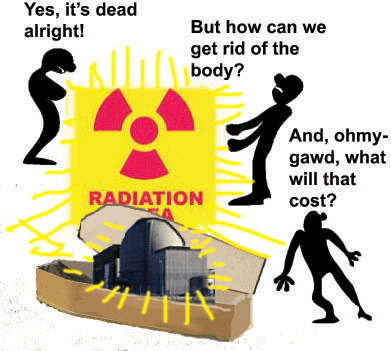 Who pays for Germany’s nuclear phase-out?,DW Hilke Fischer 1 July 16 Germany’s decision a few years ago to phase out nuclear power was an abrupt move. But it still remains unclear who foots the bill for shutting down the nation’s nuclear plants, as utilities seek damages from the state. Months after a Tsunami resulted in a nuclear disaster at the Fukushima Daiichi plant in Japan, Germany’s coalition government, led by Chancellor Angela Merkel, decided to phase out nuclear power in the country.
Immediately after Fukushima, eight of 17 functioning nuclear plants were shut down, and the government’s decision established a timeline of taking the remaining plants offline by 2022.
Five years later, it’s gradually becoming clear how much this hasty exit could cost. Feeling dispossessed by the move, major utilities have filed a raft of lawsuits claiming damage payments from the government amounting to around 20 billion euros ($22.3 billion).
An eagerly awaited ruling
Complying with the government’s nuclear moratorium, Germany’s biggest energy provider Eon had to shut down its power plants Isar 1 and Unterweser. The company has therefore sued both the federal government as well as the state governments of Bavaria and Lower Saxony, seeking damage payments to the tune of around 380 million euros. The state court of Hanover is expected to deliver its ruling on the case on Monday, July 4………..
the energy companies take issue not only with the moratorium. They – RWE, Eon and Vattenfall – have also lodged numerous cases at the constitutional court in Karlsruhe against the government’s entire policy mandating an accelerated exit from nuclear power……..
State responsible for disposal costs?
Lodging cases before the constitutional court is a pressure tactic, said Green Party politician Oliver Krischer in March. “It’s to obtain concessions over the financing of nuclear waste disposal,” he remarked, pointing to the nuclear commission the government had set up to advise it on how to allocate the costs of storage and disposal of nuclear waste as well as the decommissioning of the power stations.
At the end of April, the commission presented its recommendations: The companies have to bear the costs of decommissioning the nuclear power plants. Furthermore, Eon, RWE, Vattenfall and EnBW are to pay 23.3 billion euros into a fund to manage the storage and disposal of nuclear waste.
In return, the state is to take on all the residual financial risks associated with radioactive waste management. A number of scientists and economists argue that the costs would be much higher than the 23.3 billion euros, and that the taxpayers would be on the hook for those cost overruns.
Germany’s parliament is expected to vote on the recommendations after the summer break, and should it approve them, they would come into force at the end of the year. http://www.dw.com/en/who-pays-for-germanys-nuclear-phase-out/a-19372796
Federal regulators declined to review a license application for high level nuclear waste dump
Federal regulators declined to review a license application submitted by Waste Control Specialists (WCS) for a high-level radioactive waste dump in Andrews County, records revealed.
WCS, a Dallas-based company with a nearly 15,000-acre site in western Andrews County, filed the application with plans to expand its existing low-level radioactive waste site.
The proposed facility would house spent fuel rods from nuclear reactors across the country for at least 40 years.
However, U.S. Nuclear Regulatory Commission (NRC) officials determined the company’s license application lacked “sufficient technical information” and safety-related details, according to a letter dated June 22 from the commission to WCS.
Company representatives did not immediately return calls for comment…….“The incomplete WCS license application reflects disregard for people around Texas who would be put at radioactive risk,” Smith said. “Andrews County should rescind their approval of this project and only reconsider it if and when WCS can prove they can handle this waste safely.” http://www.newswest9.com/story/32351938/paperwork-for-andrews-nuclear-waste-dump-missing-key-safety-security-details#.V3aIhr1ZZzQ.twitter
Hinkley nuclear power plan, and the costs of its radioactive wastes
Short term tombs for radioactive trash, in Texas
Why a West Texas Nuclear Dump May Be a Short-Term Fix, KUT org By MICHAEL O’BRIEN, 28 JUNE 16, “…….Waste Control Specialists in Andrews County — currently storing contaminated rags, gloves, and other low-level nuclear waste — submitted an application in April which would allow them to receive high-level spent fuel.
The fuel would sit on-site, entombed in concrete-steel casks, until the DOE comes up with a permanent solution……..the majority of spent fuel sits near the reactor in 45-foot deep, industrial grade pools.
Spent fuel is so hot when it comes out of the reactor that it has to sit submerged for a few years before it can be safely transported or even placed in those casks……
The Nuclear Regulatory Commission’s (NRC) official stance is that the pools are so safe that there is no reason to spend billions of dollars moving all the spent fuel – the spent fuel cool enough to even move – into the dry-casks.
But the National Academy of Sciences warns that the NRC has under-estimated the risk. In May, the Academy published the final phase of its report on Fukushima and nuclear safety where it recommends “expediting” the spent fuel out of the pools and into the casks.
The pools are more vulnerable to accident or sabotage than the casks, the report states. The pools also hold much more fuel than does an individual cask – just one ruptured pool could cause a devastating radioactive fire capable of contaminating thousands of square miles……The heavily-guarded pools will continue to hold decades worth of spent fuel until the DOE comes up with a permanent storage solution or the NRC changes its guidelines. http://kut.org/post/why-west-texas-nuclear-dump-may-be-short-term-fix
Illinois nuclear plant shutdown situation – defacto radioactive dump
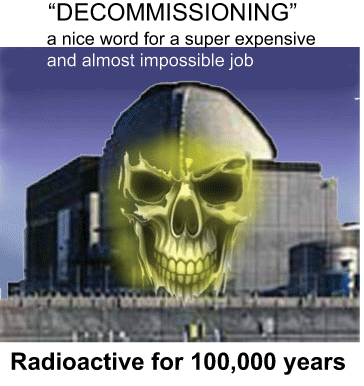 Nuclear plant shutdown in Illinois could offer lessons for SLO County Power plant in Zion, Illinois, closed nearly 2 decades ago because of an employee’s mistake. Tribune, 26 June 16
Community leaders say storage of spent nuclear fuel is preventing redevelopment of desirable lakefront property
They are leading a push to obtain federal financial compensation for communities that become de facto storage sites for waste BY STEPHANIE FINUCANE sfinucane@thetribunenews.com. Nearly 20 years after the shutdown of a nuclear power plant in the small community of Zion, Illinois, the city’s finance director describes the local economy in a single word: struggling.
“We’ve lost about $18 million communitywide,” said David Knabel, referring to the annual property tax that used to be generated by the power plant. “That tax burden got shifted to businesses and residents.”
Since the plant closed, property tax rates rose 143 percent, according to city documents. That’s made it tough to attract new employers.
“With the tax rate going through the roof … who wants to buy a house or bring businesses in?” asked Knabel.
Yet Zion isn’t blaming the nuclear power plant. As local pastor and City Commissioner Mike McDowell pointed out, that was a business decision.
The city is upset, though, that it’s become a long-term storage site for highly radioactive spent fuel — something it never signed on for.
Officials say the spent fuel is preventing redevelopment of the prime lakefront property where the plant was built, and they’re looking to the federal government for financial relief.
“We can’t get the federal government to move it,” said McDowell, “and at this point, we’re not being compensated for the impact.”……..
Once the decommissioning is complete, the property will be returned to Exelon Corp., the parent of Zion’s operator, Commonwealth Edison.
Officials in the city of Zion don’t know when that will be, nor do they know how much of the property could be permanently off-limits because of the spent fuel storage facility.
Like reactor communities across the nation — including San Luis Obispo County — the citizens of Zion did not expect to store spent nuclear fuel indefinitely. They believed the federal government would make good on its commitment to accept the waste, which at one time was destined for Yucca Mountain, Nevada. That plan fell apart, however, and the federal government has yet to identify an alternative site for permanent storage.
Zion is leading a push for federal legislation that would provide financial compensation to communities that have become de facto storage sites for spent fuel………http://www.sanluisobispo.com/news/local/article86054762.html
USA’s Department of Energy seeks “consent-based” #nuclear waste sites
 Nuclear waste, anyone? Feds look to willing states, The Orange County Register, June 22, 2016 By TERI SFORZA / STAFF WRITER Federal officials unleashed bubbles of hope in San Juan Capistrano on Wednesday – we’re developing a plan that can remove deadly nuclear waste from San Onofre earlier than we thought! – while others worked feverishly to pop them.
Speaking to a raucous audience at the San Juan Capistrano Community Center, John Kotek, the U.S. Department of Energy’s acting assistant secretary for nuclear energy, detailed the federal government’s new push for temporary nuclear waste storage in regions allegedly eager for the business.
Several such “consent-based” sites – currently envisioned in West Texas and New Mexico – could be up and running while the prickly question of finding a permanent home for the waste is hashed out……..
Some in Texas and New Mexico say they’ll never consent to importing our deadly castoffs, and they’re ready to do battle.
“Please be aware that many people in Texas and New Mexico are solidly opposed to having high-level radioactive waste stored in our region,” said Karen Hadden of the Sustainable Energy & Economic Development Coalition, a Texas-based nonprofit focusing on clean energy and public health, in a letter to San Onofre officials.
The DOE scheduled eight meetings about consent around the country, but none in Texas or New Mexico, the targeted region. … Dumping this dangerous waste on communities that are largely Hispanic and lack the resources to fight back, people who never had a say in the nuclear reactors to begin with or benefited from any electricity from them, would be an extreme example of environmental injustice.”
The Texas Democratic Party has gone on record opposing the import of nuclear waste, conjuring the stalemate at Yucca Mountain. The federal government spent $10 billion to put a permanent repository there, despite the opposition of Nevada residents. That effort is essentially dead……
 Former Nuclear Regulatory Commission Chairwoman Allison Macfarlane explained the tortured landscape: a Congress that only sees two, four and six years into the future, and is satisfied that the waste is safe where it is today, at 75 different sites across the nation; utilities that want to reduce costs, and thus aren’t eager to make changes; a Department of Energy that doesn’t have the legal authority to solve the problem entirely; and a Department of Justice that is paying billions to utilities from a judgment fund of taxpayer money, because the federal government promised the utilities it would permanently dispose of that waste in exchange for payments, but has failed utterly to do so……
It’s our ethical responsibility to not stick this problem to future generations, Macfarlane said to applause from the audience.
“I’m not hopeful new physics will be discovered to magic this stuff away. We have to grapple with it. It’s there.” http://www.ocregister.com/articles/waste-720291-nuclear-new.html
83-year-old environmentalist Kay Drey will not give up on quest for cleanup of St Louis’ nuclear waste area
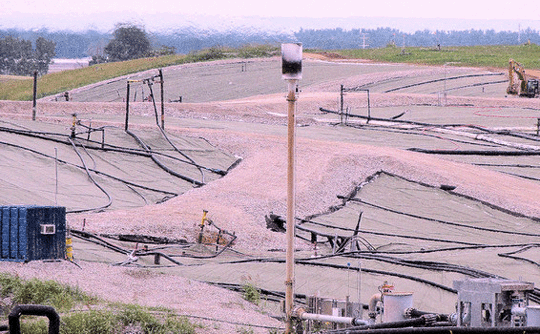 Messenger: Activist won’t back down in quest to rid St. Louis of nuclear waste By Tony Messenger St. Louis Post-Dispatch Jun 17, 2016 “…….For decades now, 83-year-old environmentalist Kay Drey has been on a quest: Get the federal government to excavate and move the waste. It’s a story that can get more complicated the deeper you dig. It involves multiple federal agencies, dense reports on various radiological elements and their “daughter products,” half-lives, warring special interest groups, lawsuits and, ultimately, a dispute over who will pay the hundreds of millions of dollars to clean it up or otherwise protect the citizens who live near the landfill.
But Drey has a way of simplifying things.
“It’s in the Missouri River flood plain,” she says of the nuclear waste. “I can’t think of a worse location. The Missouri River floods all the time. We cannot leave it there.”
That was the basic theme of the first of two reports she gave me. It’s 14 pages of testimony she submitted to the U.S. Environmental Protection Agency and the Missouri Department of Natural Resources 10 years ago. In painstaking detail, Drey outlines what is known of the waste, how it might affect groundwater and the potential for disaster if the Missouri River were to reclaim its floodplain now protected by the Earth City levee.
She quotes two old Nuclear Regulatory Commission reports, one from 1982 and the other from 1988, that outline how “hot” the waste is in West Lake and call for some sort of “remedial action.” She quotes one of the foremost flooding experts in the region, Bob Criss from Washington University, who said, “This is the wrong place to store hazardous material. It does not belong in a flood plain.”
Nobody who read Drey’s words from a decade ago would have been surprised by the release this week of a secret EPA report that reached similar conclusions.
The report, internal findings by EPA scientists that had been kept secret since 2013, concluded that it was feasible to remove the nuclear waste from West Lake. The scientists also found that doing so would reduce long-term risks.
Money.
The EPA has long wanted to simply put a cap over the waste and leave it there, at a cost of $40 million or so. It’s much less expensive than having the Army Corps of Engineers unearth the waste and dispose of it elsewhere, which might cost 10 times as much. Putting a cap in place is the preferred option of Republic Services, the company that currently owns the landfill.
Drey doesn’t care about the cost. She doesn’t care about how long cleaning up the waste would take. And she doesn’t want Republic to pay, either.
“The government put it there,” she said. “The government needs to clean it up. If we can keep making bombs, we can find the money to clean up the waste from the 1940s.”
The U.S. Senate passed a bill this year to carry out Drey’s preferred solution — have the Corps of Engineers take over the project and clean it up. But the measure appears to be dead in the House. Here’s what lawmakers need to know about Drey:
She’s not giving up…… “We need to get both houses of Congress to say they’re going to clean it up,” Drey says. “It just can’t stay there.” http://www.stltoday.com/news/local/columns/tony-messenger/messenger-activist-won-t-back-down-in-quest-to-rid/article_3da42a06-a587-53cc-bd86-e3844af3d6e1.html
Ukraine’s very dangerous nuclear waste storage situation

 Nuclear waste stored in ‘shocking’ way 120 miles from Ukrainian front line, Guardian, Arthur Neslen, 13 May 2015, Experts raise concerns over waste stored in the open air at Europe’s largest nuclear power station, as the conflict increases Ukraine’s reliance on power from its ageing plants C
oncerns have been raised by environmentalists and atomic power experts over the way waste is being stored at Europe’s largest nuclear power station, in crisis-ridden Ukraine.
More than 3,000 spent nuclear fuel rods are kept inside metal casks within towering concrete containers in an open-air yard close to a perimeter fence at Zaporizhia, the Guardian discovered on a recent visit to the plant, which is 124 miles (200km) from the current front line.
“With a war around the corner, it is shocking that the spent fuel rod containers are standing under the open sky, with just a metal gate and some security guards waltzing up and down for protection,” said Patricia Lorenz, a Friends of the Earth nuclear spokeswoman who visited the plant on a fact-finding mission.
“I have never seen anything like it,” she added. “It is unheard of when, in Germany, interim storage operators have been ordered by the court to terror-proof their casks with roofs and reinforced walls.”
Industry experts said that ideally the waste store would have a secondary containment system such as a roof…….
Plant security at Zaporizhia is now at a ‘high readiness’ level, while air force protection and training exercises have been stepped up. Officials say that if fighting reaches the plant, there are plans for the closure of access roads and deployment of soldiers.
But they say that no containment design could take the stresses of military conflict into account. “Given the current state of warfare, I cannot say what could be done to completely protect installations from attack, except to build them on Mars,” Sergiy Bozhko, the chairman of the State Nuclear Regulatory Inspectorate of Ukraine (SNRIU) told the Guardian……
Antony Froggatt, a senior research fellow and European nuclear specialist at Chatham House agreed that a secondary containment system would offer greater protection from internal or external explosions.
“It is obvious that if you do not have an array of dry cast [interim] stores with secondary containment around it, then that will have a greater risk of release of radioactive material,” he said…..
Sources at the European Bank of Reconstruction and Development (EBRD) told the Guardian that any funding request from Ukraine for such a structure would be seriously considered. The bank has already made €300m available for nuclear lifetime extension programmes in Ukraine, before the regulators have even signed off on them.
We know about the weak links in the plant [security]… But I doubt that that these should be disclosed
A pall was cast over security arrangements at Zaporizhia last May when the plant was the scene of an armed confrontation between security guards and paramilitaries from the ultra-nationalist ‘right sector’, which is allied with neo-Nazi groups. The gunmen reportedly wanted to ‘protect’ the plant from pro-Russian forces, but were stopped by guards at a checkpoint…….
Westinghouse has lobbied the Ukrainian government at ministerial level to commit to buying their fuel for at least five reactors. Plant managers say that it will be used in Zaporizhia by 2017.
But local people in the reactor’s shadow say they fear the consequences of a patched up Soviet-era plant cranking up to generate electricity into the 2020s.
“History teaches us that history doesn’t teach us anything,” Ivanovic said. “Another catastrophe could happen again.” https://www.theguardian.com/environment/2015/may/06/nuclear-waste-stored-in-shocking-way-120-miles-from-ukraine-front-line
The media ignored the fiasco of AREVA’s nuclear waste storage facility at Chernobyl
 Areva’s Incredible Fiasco in Chernobyl http://journaldelenergie.com/nucleaire/arevas-incredible-fiasco-in-chernobyl/
Le 17 février 2016 par Martin Leers INVESTIGATION. The EPR reactor is not Areva’s first failure in the field of nuclear engineering. The French nuclear company was involved in another disgraceful fiasco in Chernobyl, which the press has not wasted any time exposing.
In the heart of the exclusion zone, just 2.5 kilometers from the ruins of Chernobyl’s reactor no. 4, lies a strange pile of concrete boxes, and two horizontal beams with multiple oval holes drilled into them extending for hundreds of meters. This unusual assemblage is called ISF2, which stands for “Interim Spent Fuel Storage Facility 2”. It is a nuclear waste storage facility, which Ukraine commissioned Areva to build. The French nuclear group made a major design error in the facility, which has rendered it inoperable. This facility, considered by the international community to be as vital to the nuclear safety of Chernobyl as the giant arch over the damaged reactor, is still not functioning to this day, largely because of Areva’s initial errors.
After the explosion of Chernobyl’s reactor no. 4, 29 years ago, the nuclear power plant, which housed three additional units, continued to operate for more than 14 years.[1] The dismantling of these three reactors and the management of their nuclear waste is the other major project for Chernobyl’s nuclear safety, concurrent with the giant arch meant to cover the “sarcophagus” of the ruined reactor.
Areva pledged to produce a « turnkey » installation where spent nuclear fuel from Chernobyl’s reactors no. 1, 2 and 3 would be stored for at least 100 years
In 1999, Areva’s branch devoted to nuclear reactors and engineering (Areva NP then Framatome) signed a contract with the Ukrainian government corporation Energoatom to build ISF2, a center for dry cask storage where the spent nuclear fuel from Chernobyl’s reactors no. 1, 2 and 3 would be stored for at least 100 years. This marked a first for storing fuel from Soviet-designed RBMK nuclear reactors.[2] Areva pledged to produce a « turnkey facility » by the Summer of 2005 and began construction in the Spring of 2000. This storage facility was financed mainly by 16 donor countries from a fund reserved for “urgent nuclear safety improvements” managed by the European Bank for Reconstruction and Development (EBRD), which also contributed to it. The European Union (EU) and nine EU member countries have been major contributors to this fund, which is separate from the fund earmarked for financing works on the containment of reactor no. 4. Continue reading
South Korea’s nuclear waste dilemma: will have to build waste dump
 South Korea looks to build used fuel store http://www.neimagazine.com/news/newssouth-korea-looks-to-build-used-fuel-store-4907688 30 May 2016 South Korea will select a site for an underground storage facility to permanently dispose used nuclear fuel, or high-level radioactive waste, by 2028 and complete the construction of the facility by 2053, according to the first roadmap for the project released by the Ministry of Trade, Industry and Energy on 25 May.
“A further delay in building the facility will put a drag on future generations, considering the saturation level of interim storage units located in the nuclear power complexes nationwide, ” Chae Hee-bong, the ministry’s energy policy director, told a press briefing.
Korea has 24 nuclear power units which produce more than 700t of used nuclear fuel annually. According to ministry data, the first used fuel storage unit to become full will be at the Wolsong NPP in Gyeongju, North Gyeongsang Province, in 2019.

Korea has no other choice than storage as it is strictly banned from reprocessing under a 1973 treaty with the USA. The government has been trying to find a site for the wastes since 1983, but has failed nine times because of local protests. The government said the country is running out of storage units.
To minimize public resistance in the course of a site selection, the ministry will adopt an open competition among geologically qualified sites. It will launch an independent committee to lead the site selection next year, following an approval by the National Assembly on the roadmap in the latter part of this year. The roadmap will be updated in five years embracing changing external conditions, the ministry added.
The ministry’s ‘road map’ is based on recommendations from the Public Engagement Commission, an independent advisory group set up in 2013. The ministry will hold a public hearing next month, followed by an inter-agency meeting chaired by the prime minister in July.
Park Dong-il, director of the nuclear power environment division at the ministry said: “It will take about 12 years to select the location and we will hear what they want to receive from the government and make deals during this period,” said. He added that the government will decide what kind of benefits or incentives to give to areas that want to build storage facilities.
According to the ministry, it will take the government about eight years to select the site and get feedback from local residents, and another four years to investigate the geological chracteristics of the site. The project was expected to cost some KRW53,000bn ($44.8bn) in 2013 but a government official said it is now looking at an estimated cost of KRW63,000bn.
Meanwhile, the Korean government opened its first low-and intermediate-level radioactive waste facility in Gyeongju, North Gyeongsang, last year. The government wanted to build a high-level facility there but faced opposition from residents.
Taiwan’s nuclear waste problem – sees overseas reprocessing as the answer
 Taiwan wants to send nuclear waste overseas for reprocessing, Japan Times, AFP-JIJI 16 June 16 TAIPEI – Taiwan has unveiled a plan to process nuclear waste overseas for the first time as it runs out of storage space at its power plants, sparking criticism from environmental groups.
The state-run Taiwan Power Co. on Tuesday began soliciting bids from overseas reprocessing companies for 1,200 used fuel rods from the island’s first and second nuclear plants.
The two plants, which currently store the spent fuel rods, were launched in 1978 and 1981 and will each be decommissioned once they have been operational for 40 years.
But Taipower has said it may be forced to shut down or decommission the plants earlier than scheduled, as they are reaching storage capacity for spent nuclear fuel.
Some environmental groups accused Taipower of seeking ways to keep the two plants in operation even though they are set to be decommissioned.
“We strongly protest the plan. It’s absurd to send the fuel rods abroad to be reprocessed since Taiwan is no longer building nuclear power plants,” said the National Nuclear Abolition Action Platform.
“It’s clear that Taipower is in a rush to ship the nuclear waste abroad because the first nuclear power plant will be shut down if it fails to do so, which will mean that its plan to push for extended operation of the plant will fall through.”
The government is under growing public pressure over its unpopular nuclear facilities as safety concerns have mounted since the Fukushima No. 1 nuclear disaster in 2011.
Like Japan, Taiwan regularly suffers earthquakes. In September 1999 a magnitude-7.6 quake killed around 2,400 people in the island’s deadliest natural disaster in recent history.
Last year the authorities were forced to seal off a new power plant due to open in 2015, pending a referendum on its future…….
Companies from England, France and Russia have expressed interest in bidding for the work, which is expected to cost $11.25 billion New Taiwan dollars ($356 million), local media reported. http://www.japantimes.co.jp/news/2015/02/18/asia-pacific/taiwan-wants-to-send-nuclear-waste-overseas-for-reprocessing/#.V2Mxz9J97Gj
Entergy’s Pilgrim Nuclear Power Station decrepit facility with radioactive waste problem
 OF NUCLEAR INTEREST: Pilgrim’s nuclear waste dilemma http://plymouth.wickedlocal.com/news/20160616/of-nuclear-interest-pilgrims-nuclear-waste-dilemm Entergy’s Pilgrim Nuclear Power Station is a decrepit facility based on 1950s design. By Janet Azarovitz Jun. 16, 2016
Entergy’s Pilgrim Nuclear Power Station is a decrepit facility based on 1950s design. The design was acknowledged to be substandard by the time Pilgrim went online in December 1972. Its main design flaw is in the containment vessel, which is known to be incapable of “containing” the radiation if an accident in the reactor were to occur. The design also led to the construction of the “spent fuel pool” within the reactor building to store “spent” fuel rods, which are made of uranium and packaged in assemblies.
For the past 44 years and until Pilgrim shuts down in 2019, every 18 months one-third of Pilgrim’s fuel rods in the reactor core become spent. This means that they become too hot to control in the reactor and must be replaced. These spent rods must be kept in 40 feet of water in the spent fuel pool to shield radiation and be constantly cooled to prevent a fire that would release huge amounts of radioactivity.
Although Pilgrim’s spent fuel pool was originally designed to hold 880 assemblies, it now holds more than 3,000. Since there is no offsite national repository planned (i.e., Yucca Mountain was not approved), Pilgrim’s spent fuel pool is seriously over-crowded. There are currently discussions about centralized siting of nuclear waste by the U.S. Department of Energy, however it will be a long time before these discussions help those of us living in the shadow of Pilgrim. Even after Pilgrim shuts down in 2019, the pool will contain highly unstable radioactive fuel for many years.
America’s Hometown will be a hazardous waste dump for this nuclear fuel for many years to come. When the pool is finally emptied, the spent nuclear fuel will still be stored onsite. Entergy, the present owner of Pilgrim, has designed and constructed an “Independent Spent Fuel Storage Installation” (ISFSI) for the storage of spent fuel in “dry casks.” Three casks have been filled so far and approximately 100 casks will be needed to hold all of Pilgrim’s nuclear waste.
These dry casks are supposed to last 100 years, but we know that some don’t. Generally, scientists agree that dry cask storage is a safer system than wet pool storage, because electricity and pumping water are not required for cooling casks. Nor do casks require the critical, yet high-maintenance, boron panels that the densely packed pools need to prevent a nuclear reaction from occurring. For decades these panels have been known to deteriorate. A recent incident of “boron slippage” was reported last month at Pilgrim.
Unfortunately, no one, not the town of Plymouth, nor the U.S. Nuclear Regulatory Commission (NRC) reviewed the location of Entergy’s ISFSI. The facility is about 120 feet from Cape Cod Bay and only a few short feet higher than the outdated flood zone. There is currently a citizen lawsuit challenging the town of Plymouth Zoning Board of Appeals’ decision that allowed the construction of the ISFSI without review. The trial will occur this August, and if successful residents will have another opportunity to get real answers.
It is critically important that the problem of Pilgrim’s nuclear waste storage is addressed and its spent fuel is moved to dry casks as quickly as possible, and sited in a safe location away from flooding and extremists. It is essential that regulatory agencies deal with where this dangerous material will go and how it will get there, since leaving it by the ocean when the sea level is rising and storms are getting worse is clearly a recipe for disaster.
Janet Azarovitz is a Falmouth resident and a member of Cape Downwinders Cooperative, which works to protect the welfare of residents of the Cape and the Islands from nuclear-related risks. She is also a representative of the Pilgrim Legislative Advisory Coalition, which seeks to achieve passage of nuclear-related legislation. Cape Downwinders Cooperative works collaboratively with Cape Cod Bay Watch.
U.S. Court of Appeals rules nuclear waste can stay on indigenous land
Ruling will keep nuclear waste at Prairie Island indefinitely, Post Bulletin Brian Todd, btodd@postbulletin.com 16 June 16, WELCH — A ruling from the U.S. Court of Appeals for the District of Columbia Circuit will leave the spent nuclear fuel at the Prairie Island Nuclear Generating Plant right where it’s sitting for the foreseeable future.
The Court of Appeals on June 3 upheld a 2014 ruling that allows for the continued onsite storage of radioactive material, mostly spent nuclear fuel. The 2014 ruling is from a case brought by several states regarding the environmental impact, and potential health and safety concerns regarding on-site storage of radioactive materials.
Shelley Buck, Prairie Island Indian Community Tribal Council president, said the community’s worst fear is that the nuclear waste will remain on the tribe’s ancestral homeland forever.

“Our fears are much closer to reality because of this ruling,” Buck said.
Buck described the spent fuel as “some of the most dangerous and toxic substances known to mankind.” That nuclear waste, she said, is stored 600 yards from the homes of some of the community’s members.
“We are frustrated that the U.S. Court of Appeals has failed to consider the very real health and safety impacts of permanent on-site storage of highly radioactive nuclear waste,” she said…….http://www.postbulletin.com/news/local/ruling-will-keep-nuclear-waste-at-prairie-island-indefinitely/article_c2774613-7455-5c92-a87d-8bc0bd2d3339.html
The alarming hidden costs of nuclear power stations
 The scary hidden cost of building a nuclear power station, http://www.rdm.co.za/business/2016/06/13/the-scary-hidden-cost-of-building-a-nuclear-power-station
Even assuming that SA can find the funds, we would do well to take into account the non-negotiable costs of decommissioning and waste management BRENDA MARTIN
13 JUNE 2016 Consider decommissioning costs before committing to new nuclear power investment

As South Africa prepares to invest in new nuclear power, we may do well to consider the other end of such investment: decommissioning. In the north of Germany, the Greifswald nuclear power plant (also known as Lubmin) has been undergoing the process of decommissioning since 1990. Before its closure, with a total planned capacity of 8 x 400MW plant built, but with only 5 reactors fuelled, Lubmin was to be the largest nuclear power station in East Germany prior to reunification. The reactors were of the VVER-440/V-230 type, or so-called second generation of Soviet-design. When it is concluded, the full process of decommissioning at Lubmin will have taken 30 years from first shutdown. In 1990 the company responsible for decommisioning this 8 x 400MW nuclear power plant, Energiewerke Nord, estimated a cost of half a billion DM per unit. Later this estimate was adjusted to 3.2 billion/unit. Today 4.1 billion/unit is a conservative final estimate (Energiewerke Nord, 2016).
More recently, early in 2012, following the Fukushima disaster in March 2011, the German government announced the immediate withdrawal of the operating licenses of eight German nuclear power plants and revived its plans to phase out nuclear power — by 2022. As this process unfolds, it will be possible to move beyond speculation, to actual data on costs, process and skills required for decommissioning.
What is involved in decommissioning a nuclear power plant?
Nuclear decommissioning is the process whereby a nuclear power plant site as a whole is dismantled to the point that it no longer requires measures for radiation protection to be applied. It is both an administrative and a technical process, including clean-up of all radioactive materials and then progressive demolition of the plant. Once a facility is fully decommissioned it should present no danger of radiation exposure. After a facility has been completely decommissioned, it is released from regulatory control and the plant licensee is no longer responsible for its safety.
The costs of decommissioning are spread over the lifetime of a facility and given that most nuclear power plants operate for over 40 years, funds need to be saved in a decommissioning fund to ensure that future costs are provided for.
What are the current estimates for nuclear power plant decommissioning?
This year, on April 28, an independent commission appointed by the German government (Kommission zur Überprüfung des Kernenergieausstiegs, KFK) presented its recommendations to the Ministry of Economics and Energy. The commission recommended that reactor owners — EnBW, EOn, RWE and Vattenfall — pay an initial sum of €23.3-billion ($26.4-billion) over the next few years, into a state-owned fund set up to cover the costs of decommissioning of the plants and managing radioactive waste. This sum includes a “risk premium” of around 35% to close the gap between provisions and actual costs.
According to the ministry, there will be approximately 10 500 tonnes of used fuel from 23 nuclear power plants, which will need to be stored in about 1 100 containers. A further 300 containers of high- and intermediate-level waste are also expected from the reprocessing of used fuel, as well as 500 containers of used fuel from research and demonstration reactors. In addition, some 600 000 cubic meters of low- and intermediate-level waste will need to be disposed of, including waste from industry, medicine and research.
Just before KFK started its work in October 2015, a study conducted by German audit firm Warth & Klein Grant Thornton for the Ministry of Economics and Energy had estimated the following costs for decommissioning 23 nuclear power plants, in 2014 money i.e. the cost if plants were to be decommissioned in 2014:
- Closure and decommissioning: €19.7-billion
- Containers, transport: €9.9-billon
- Intermediate storage: €5.8-billion
- Final low heat waste storage: €3.75-billion
- Final high active waste storage: €8.3-billion
i.e. a total of €47.5-billion.
However, decommissioning of all of Germany’s 23 nuclear power plants will not be undertaken at the same time. Most costs will be incurred in the future. Annexure 9 of the Warth & Klein Grant Thornton report provides an estimate of likely decommissioning costs when taking into account projected interest rate and inflation scenarios, as well as various likely nuclear-specific cost increases. Their conclusion? Total costs of decommissioning all nuclear power plants in Germany could reach up to €77.4-billion.
Given these emerging figures, even assuming that SA can find the necessary funds needed for new nuclear power investment, we would do well to take into account the increasingly known, non-negotiable related costs of decommissioning and waste management — of both old and new nuclear-related investment.
Secure Nuclear Waste Coalition formed to call public to action on San Onofre nuclear waste danger
 New group wants action on nuclear waste storage at San Onofre, Orange County Register, eritchie@ocregister.com June 8, 2016 LAGUNA BEACH – Earthquakes, tsunamis or terrorism.
That’s what a newly created group of scientists, medical experts, activists and elected officials from Orange and San Diego counties say pose ominous threats to the more than 10 million people living within a 50-mile radius of the shuttered San Onofre Nuclear Generating Station.
“If one of those events happen, the amount of radiation could be 89 times more than what was released at Chernobyl,” said Rita Conn, a spokeswoman for the newly created Secure Nuclear Waste Coalition and chairwoman of Let Laguna Vote, a nonpartisan organization dedicated to government transparency.
On Wednesday, Conn kicked off a Secure Nuclear Waste Coalition educational forum and called the public to action.
Members of the group include Mayor Pam Patterson from San Juan Capistrano; Nina Babiarz of Nuclear Waste Transportation; Charles Langley, executive director of the Public Watchdogs; Robert Pope, a geologist; and Dr. William Honigman.
Panelists told more than 200 people inside a packed Laguna Beach City Council chambers that plans by Southern California Edison to temporarily bury millions of pounds of nuclear waste 42 yards from the ocean at San Onofre State Beach must be stopped.
The experts testified about the dangers the public faces by potential exposure to radiation or radiation leaks. They questioned the lack of security at the shuttered plant. They discussed the potential for it to become a terrorist target.
“There is an obscene level of unpreparedness,” Honigman said. “How do we deal with radiation exposure on a massive level?”
They advocated that Edison move the spent nuclear fuel rods to a temporary storage site in West Texas or New Mexico – an idea being explored by lawmakers and regulators.
They criticized the California Coastal Commission’s approval of a “concrete monolith” to house spent fuel in temporary, dry-cask storage at the site. The contained radioactive material is expected to remain in place until 2049.
“Edison must not be allowed to store the highly radioactive fuel rods in the ‘experimental’ … thin-walled stainless steel canisters that have never been used in the damp marine environment, have no proven track record, no means to support transport and no means to inspect for radiological leaks,” Conn said.
The California Coastal Commission last year approved plans for the temporary burial of the San Onofre nuclear waste – which has been stored in liquid tanks – after political paralysis prevented the federal government from coming up with a permanent burial solution for the nation’s nuclear waste……..http://www.ocregister.com/articles/waste-718742-nuclear-san.html
1 This Month


31st January – Challenging the War Machine – a DECLASSIFIED UK SUMMIT


Website of the Week
Now until to February 10, 2026 Radioactive waste storage in France: the debate is finally open! How to participate?
-
Archives
- January 2026 (220)
- December 2025 (358)
- November 2025 (359)
- October 2025 (377)
- September 2025 (258)
- August 2025 (319)
- July 2025 (230)
- June 2025 (348)
- May 2025 (261)
- April 2025 (305)
- March 2025 (319)
- February 2025 (234)
-
Categories
- 1
- 1 NUCLEAR ISSUES
- business and costs
- climate change
- culture and arts
- ENERGY
- environment
- health
- history
- indigenous issues
- Legal
- marketing of nuclear
- media
- opposition to nuclear
- PERSONAL STORIES
- politics
- politics international
- Religion and ethics
- safety
- secrets,lies and civil liberties
- spinbuster
- technology
- Uranium
- wastes
- weapons and war
- Women
- 2 WORLD
- ACTION
- AFRICA
- Atrocities
- AUSTRALIA
- Christina's notes
- Christina's themes
- culture and arts
- Events
- Fuk 2022
- Fuk 2023
- Fukushima 2017
- Fukushima 2018
- fukushima 2019
- Fukushima 2020
- Fukushima 2021
- general
- global warming
- Humour (God we need it)
- Nuclear
- RARE EARTHS
- Reference
- resources – print
- Resources -audiovicual
- Weekly Newsletter
- World
- World Nuclear
- YouTube
-
RSS
Entries RSS
Comments RSS
 nuclear-news