Japan’s Nuclear Regulation Authority approves closure of Monju nuclear reprocessing reactor by next April
 Nuclear watchdog approves scrapping Monju reactor https://www3.nhk.or.jp/nhkworld/en/news/20161228_19/ Japan’s Nuclear Regulation Authority has approved the government’s decision to scrap the Monju prototype fast-breeder nuclear reactor. The education, science and technology ministry briefed the NRA on Wednesday about the government’s decision last week about the troubled reactor in Fukui Prefecture on the Sea of Japan coast.
NRA Chairman Shunichi Tanaka said the decision is in line with the recommendation it made in November last year.
In it, the NRA urged an overhaul of a research and development project involving the reactor. It said scrapping the reactor would be an option unless a new operator were found for it.
The ministry also told the NRA on Wednesday that it will draw up a basic plan for decommissioning the reactor by next April.
It added that to eliminate possible safety risks soon, it will instruct reactor operator Japan Atomic Energy Agency to remove nuclear fuel from the reactor in about 5 and half years.
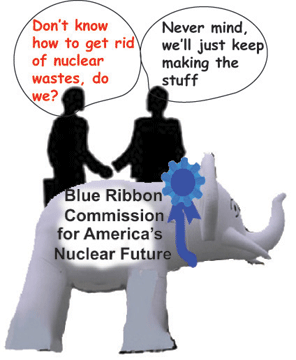
America’s ineffective white elephant Blue Ribbon Commission on nuclear wastes
 The Commission has entirely ignored the immense evidence that DOE’s plans for disposal of
  several types of defense waste pose much greater threats to water resources, most especially at Hanford
“I am dismayed that the Commission saw fit to recommend that the Department of Energy (DOE) have a large upfront role in both the next steps for repository program, … DOE was in large part responsible for the mess the program is in now,
 Radioactive Wastes From Nuclear Bomb Program Given Short Shrift In Blue Ribbon Commission Report EnEws Park Forest, TAKOMA PARK, MD–(ENEWSPF)–January 27, 2012. Arjun Makhijani, Ph.D., President of the Institute for Energy and Environmental Research, today commented on some of the recommendations of the final report of the Presidential Blue Ribbon Commission (BRC) on America’s Nuclear Future.
The commission was created to address U.S. nuclear waste issues after the Obama administration cancelled the Yucca Mountain program….
….On wastes from the nuclear bomb program:
Makhijani: “It is tragic that the Commission did not substantively address the most pressing radioactive waste contamination threats to precious water resources – for instance hundreds of times the drinking water limit at Hanford, Washington on the banks of the Columbia River.
The Commission had a charter to conduct a ‘comprehensive’ review of the nuclear waste problem, including defense wastes from the nuclear bomb program. Yet, it simply said it did not have the resources to deal with all the problems and punted the nuclear weapons waste issue to Congress while focusing on commercial spent fuel at nuclear reactor sites.” Continue reading
Just another little increase in costs for Hanford nuclear clean-up – increase of $4.5 billion
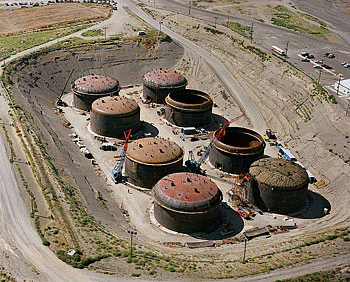 The price tag for cleaning up nuclear waste at Hanford site just went up another $4.5 billion LA Times, 16 Dec 16 Ralph Vartabedian Contact Reporter The U.S. Energy Department said Friday that its long-troubled attempt to build a plant to process highly radioactive sludge at a former nuclear weapons site in central Washington state will cost an additional $4.5 billion, raising the project’s price tag to $16.8 billion.
The Hanford treatment plant, a small industrial city with some two dozen facilities on a desert plateau along the Columbia River, is more than a decade behind schedule and will cost nearly four times the original estimate made in 2000.
The government aims to transform 56 million gallons of deadly sludge stored in leaky underground tanks into solid glass, which theoretically could then be stored safely for thousands of years.
But the effort has involved an extended history of errors, miscalculations and wrongdoing. The result has been a massive, partially built concrete facility that has been under a stop-work order for three years because of serious technical doubts.
The biggest technical problems involve two giant facilities, a melter building for high-level radioactive waste and a pretreatment building to prepare the sludge for chemical processing.
After an exhaustive technical review, the Energy Department at the beginning of this year ordered fixes for more than 500 problems, some of them fundamental design deficiencies at the melter. Construction of the building and equipment was 78% complete at the time of the review.
And in November, the Justice Department settled a False Claims Act suit against two major contractors at the plant, San Francisco-based Bechtel Corp. and AECOM, an engineering, design and construction management company based in Los Angeles. The allegations originally were brought by three engineers at the plant, who had long raised concerns that the fundamental design of the plant was flawed. The two companies agreed to pay $125 million in damages, a portion of which will be awarded to the three whistle-blowers……..
outside watchdogs say the giant cost increase could jeopardize the cleanup at a time when the incoming president, Donald Trump, has already sharply criticized high-cost government projects and contracts.
Tom Carpenter, executive director of the Hanford Challenge, which has helped whistle-blowers disclose problems at the site, said the new cost estimate puts a target on the plant that could lead the Energy Department to begin searching for lower-cost and less safe solutions to the waste problem.
One potential lower-cost remedy at Hanford, which has been used at other former nuclear waste sites, would be to pour concrete into the tanks to solidify the waste and then simply leave it in place. The risk is that the concrete might eventually break down, leak radioactivity into the groundwater and contaminate the Columbia River about seven miles away, Carpenter said.
“There are a lot of question marks about the fate of this facility,” Carpenter said.
The revised plan disclosed Friday is part of an effort to get the waste treatment plant started up sooner, though the estimated delay for full operational status seems to be growing.
In 2013, then-Energy Secretary Steven Chu stopped most construction on the project after a whistle-blower warned about a potential for explosion from accumulated hydrogen gas in the melter tanks. In an effort to get the cleanup moving again, Chu’s successor, Ernest J. Moniz, ordered that some of the lower-level waste be solidified without any pretreatment — a so-called direct feed system — and on a faster schedule at the low-level melter.
The early processing could begin in 10 years or less, but the full capability for the most highly radioactive sludge that requires the high-level melter is now scheduled for a 2036 start-up, some 20 years past the original schedule, Carpenter said.
“It is an astounding date,” he said. http://www.latimes.com/nation/la-na-hanford-cost-20161216-story.html
Mismanagement and incompetence as the nuclear industry plunders Britain’s public purse
 Nuclear plundering of the public purse – the Sellafield and Moorside billions, Ecologist, Martin Forwood 13th December 2016
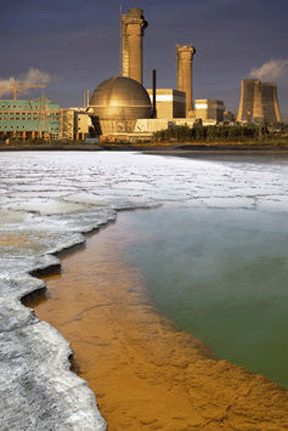
While the government is cutting vital public expenditure across the board there’s one industry for which no costs are too great, writes Martin Forwood. The price of an ‘evaporator’ at the Sellafield nuclear complex is escalating towards £1 billion, while billions more of taxpayer finance are being lined up to finance cooling systems, power lines and transport links for the adjacent Moorside new-build nuclear power plant.
The Brexit vote and Donald Trump’s elevation to the US Presidency have turned the international status quo upside down.
But some things – like the nuclear industry’s insatiable appetite for taxpayers’ money – never change.
Sellafield’s Evaporator D project, with NuGen’s Moorside in hot pursuit, is a prime example as it limps along, sustained only by ever increasing helpings from the public purse.
With nuclear power rightly acknowledged as being a hideously expensive way of boiling a kettle, then Evaporator D – known to the Sellafield workforce as the ‘Big Kettle’ – must be breaking all records.
Initially costed at £90 million (2007) and originally due to come into operation in 2010/11, the cost has increased eight-fold to £740m – as at September 2015. With a ‘challenging’ operational date currently pencilled in as 2017/18, and with updated figures yet to be published, the sky is clearly the limit for Evaporator D.
The tortured progress of the new Evaporator, designed to reduce (by evaporation) the volume of the dangerous liquid High Level Wastes (HLW) produced by spent fuel reprocessing, reveals a catalogue of project mismanagement and eye-watering cost hikes that show little sign of abating.
Promoted specifically by BNFL and subsequently by the NDA as being urgently needed to support continued reprocessing operations in the B205 (magnox fuel) and THORP (oxide fuel) plant, Evaporator D is currently being shoe-horned into the HLW complex.
There it will join its three fellow but semi-crippled evaporators (A,B & C) whose increasing unreliability through age and internal corrosion had underpinned the urgency for Evaporator D.
A tale of mismanagement and incompetence
Despite claiming not to recognise the £90m estimate of 2007, the NDA was nevertheless happy to confirm a price tag of £100m in 2008, since when the cost of Evaporator D has risen in almost annual increments – with the biggest hike to over £600m.
That number comes in a damning report by the National Audit Office that was highly critical of the NDA’s project management and that of its subsequently sacked contractor Nuclear Management Partners (NMP) who had acted for the NDA as Sellafield’s Parent Body Organisation since 2008. As the NAO reported,
“Gaps in the capability of subcontractors in the supply chain to undertake work to the standards required for nuclear installations have had direct consequences for the speed and efficiency of project delivery. For example, the Authority estimates that £50 million of the £244 million increase in the cost of evaporator D and part of the 18-month delay since 2009 is because the subcontractor lacked experience in welding to the necessary nuclear quality standards.
“The Authority was aware of these risks when it approved the start of construction. It relied on Sellafield Limited’s assurances that its subcontractor could manage the risks. The Authority did not obtain assurance from Sellafield Limited that it had put in place appropriate quality assurance and training.”
The cramped conditions in and around the HLW complex was a major factor in employing the novel option of having the main elements of the Evaporator built off-site (by Interserve at Ellesmere Port) and delivered by barge to Sellafield beach in the form of 11 modules, the largest weighing 500 tonnes and measuring 12.5 x 7.5 x 27 metres tall. The Evaporator, whose top and bottom sections are shown above being fabricated at Ellesmere Port, will operate in an upright position once installed at Sellafield.
Novel as the option was, it soon fell foul of a range of problems that included a disorganised supply chain, design changes, the quality of module fabrication, and seismic qualification.
With the modules delivered to Sellafield beach and hauled onto site between 2011 and 2013, Evaporator D’s cost increases from 2013 onwards are largely attributed by the NDA to the ‘transfer of incomplete modules to site’. This resulted in extensive additional cutting and welding work being needed – in a confined work space – to connect together the component parts of the Evaporator system.
And now Evaporator D looks set to miss the ‘reprocessing boat’
The greatest irony of all is, of course, that despite the early hullabaloo about its urgent and crucial support role for reprocessing at Sellafield, Evaporator D can be of service to THORP reprocessing (due to finish in 2018) for no more than one year at best.
At worst it will be of service only for THORP’s post-2018 clean out, the remnant days of B205 reprocessing which is due to end around 2020 and other site decommissioning work.
Faced with this prospect and the embarrassing reality that its much vaunted Evaporator D could indeed miss the THORP reprocessing boat for which it was primarily designed, the NDA and Sellafield Ltd damage limitation teams have recently swung into top gear – by stressing the Evaporator’s future decommissioning role through its ability to deal with the larger waste particles expected to be encountered during the coming years of clean-up work.
For a project whose £740m cost will undoubtedly escalate further, aggrieved taxpayers may take some comfort from Sellafield’s 2012 announcement that plans for a fifth (£600m) Evaporator E had been scrapped. But they should now cast a wary eye to NuGen’s new-build project just across the road from Sellafield where the prospect of further pilfering from the public purse is simmering on the back-burner.
Moorside nuclear power plant – another massive drain on taxpayers’ money …….
Cheap and dangerous nuclear cleanup in Winnipeg?
Cheap nuclear ‘cleanup’ dangerous http://www.winnipegfreepress.com/opinion/analysis/cheap-nuclear-cleanup-dangerous-406711405.html By: Dave Taylor 12/15/2016 Just as Manitobans were beginning to think the toxic mess at Whiteshell Laboratories in Pinawa would soon be moved off-site and the lands returned to their natural state, we now learn the federal government has given the Canadian Nuclear Labs (CNL) free rein to cheap out on the cleanup.
The most striking part of the plan to entomb the defunct WR1 reactor is that the cement or grout they are developing to seal it will break down well before the rotting hulk is safe. According to CNL officials who have relied on international research findings, “initial chemical degradation of grout is modelled to begin around 350 years,” well short of the thousands of years for which this sarcophagus will be toxic to all living things.
Since CNL are just the contractors responsible for the immediate decommissioning, long-term monitoring is beyond the scope of their work and it will ultimately be left to future Manitobans. Sure, it would cost the federal government four times as much to dismantle it now, but imagine the costs for our distant descendants who will have to deal with radioactive groundwater leaking into the Winnipeg River from a crumbling block of poisonous concrete several generations in the future.
Due to a very serious accident at the reactor in 1978, it is likely far more radioactive than it would normally be. The radiological report on that accident has not been made public, but when a pump failed, the geiger counters were going off at 3 million counts-per-minute, and a worker in protective clothing using a safety rope had to descend through a hatch to close valves with a hand-wheel as the fuel rods in the core of the reactor became damaged. It is an accident that remains shrouded in secrecy. This has become part of the unsustainable 50-year legacy that the nuclear industry has left us.
Two decades ago, Canada’s nuclear crown corporation, Atomic Energy of Canada Ltd., conducted similar “grout” research for the purpose of disposing of high-level radioactive waste in the Canadian Shield and started building a “test facility” at Lac du Bonnet called the Underground Research Lab. The objective of this plan was to seal off huge mine shafts with “bentonite grout” and entomb high-level radioactive waste from reactors across Canada and potentially from around the world. The lab leaked like a sieve as groundwater poured into the shaft, confirming that groundwater is almost unstoppable. Manitobans realized the folly in this idea and lobbied for the enactment of the High Level Radioactive Waste Act, which is still the law in our province.
And just where does our provincial government sit on this ill-conceived plan? Local politicians have remained incredibly silent on this issue, yet the act clearly states that any radioactive waste with levels comparable to spent fuel cannot be disposed of in this province, period. It also states clearly that in the case of a corporation, “a fine of not more than $1,000,000 for each day that the offence continues” will be levied.
Cathy Cox, our minister of sustainable development, has a responsibility to get the straight goods on how tainted this reactor is and to enforce the laws of our land, because, as the saying goes, “we do not inherit the earth from our ancestors; we borrow it from our children.”
Dave Taylor is an instructor at the University of Winnipeg, and has been a watchdog of the nuclear industry for over 40 years.
The lengthy process for decommissioning Palisades (or any) nuclear power station
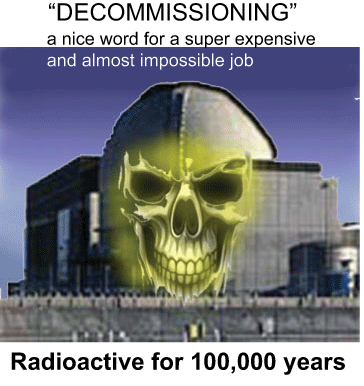 Decommissioning Palisades nuclear plant a lengthy process, NRC says http://www.mlive.com/news/kalamazoo/index.ssf/2016/12/decommissioning_palisades_nucl.html COVERT, MI — When nuclear plants open, they are required to provide for their eventual closing.
Entergy Corp., owner of the Palisades nuclear plant in Covert Township near South Haven, had set aside $384.16 million in 2014, according to the most recent report submitted to the Nuclear Regulatory Commission in 2015. (The next report, due in 2017, will show the numbers for 2016.).
Entergy Corp announced Thursday that it plans to close the Palisade plant in October 2018.
Viktoria Mitlyng, spokesperson for the NRC Midwestern Region near Chicago, said Entergy has 30 days from Thursday’s announcement to formally notify the NRC of its intentions.
Closing nuclear plants is a complicated process with “lots of moving parts,” she said. “Our role as a nuclear safety regulator, is to oversee that process, including the removal of all fuel from the reactor to a “spent fuel pool” withing the facility, to its eventual placement, for an indefinite period, in dry cask storage.”
Throughout the process, Mitlyng said, the NRC requires that security is maintained and that detailed safety protocols are The very last phase of decommissioning requires that radiation levels in the area meet NRC requirements for decommissioning.
There is not yet a site, nationally, for long-term storage of spent fuel, an ongoing policy issue in which the NRC is not involved, Mitlyng said.
Until such a facility is planned – “and there is nothing on the drawing board at this point as far as we know,” she said — spent fuel remains in dry cask storage on site.
The storage is monitored by the NRC.
During final decommissioning, plant is taken apart — all radioactive systems are removed — and the plant has 60 years to get to final phase where the decommissioning is complete and meets NRC requirements.
After the plant is totally decommissioned, only the dry cask storage remains.
Some companies perform decommissioning activities themselves, others hire another company to take down the plant. If that is done, though, the license must be transferred, with NRC approval, Mitlyng said. The NRC also monitors the status of the decommissioning fund, which cannot be used for any other operations, she said.
“I want to emphasize that our responsibility as the Nuclear Regulatory Commission is to ensure that a plant is safe, whether in operation or during decommissioning,” she said. “We have inspections for all stages of that process to assure that it is done in a way to protect people.”
Safety requirements do not change, whether a plant is operational or closing, Mitlyng said. “There is no change in the NRCs posture, none at all.”
Dozens of canisters of radioactive waste to be repackaged at USA’s Waste Isolation Pilot Plant
Officials set to repackage radioactive waste in New Mexico, Huron daily Tribune, Susan Montoya Bryan, Associated Press, December 1, 2016 ALBUQUERQUE, N.M. (AP) — Isolated in a temperature-controlled storage area at one of the nation’s premiere nuclear weapons laboratories, dozens of containers of radioactive waste similar to one that ruptured in 2014 remain under 24-hour surveillance, awaiting treatment so they can be stabilized and disposed of.
The U.S. Department of Energy announced this week that treatment of the 60 containers is expected to begin next spring following a series of safety assessments and upgrades to the building where the work will be performed…….
The work is one step in a yearslong effort to get the federal government’s multibillion-dollar cleanup program back on track at Los Alamos and other installations around the country where decades of Cold War-era waste — from gloves and tools to clothing and other material —have piled up.
The shipment of that waste to an underground disposal facility in southern New Mexico was put on indefinite hold in February 2014 when a container sent from Los Alamos to the Waste Isolation Pilot Plant breached, contaminating a significant portion of the underground storage area……
The incident resulted in an overhaul of policies, costly work to mitigate the contamination, and a multimillion-dollar settlement with the state of New Mexico for numerous permit violations.
The Energy Department had hoped to resume some work at the Waste Isolation Plant by the end of the year. But the agency still needs to submit a readiness report to state regulators for review and an onsite inspection needs to be done.
Even if the site is cleared to begin moving waste into the underground, state officials say shipments will be sent slowly before they are ramped up………All of the work will be done inside an enclosed box in a specially engineered building with filters. Technicians will handle the waste only through gloved ports. http://www.michigansthumb.com/news/article/Feds-prepare-to-repackage-radioactive-waste-in-10646737.php
US Navy to build a new facility for stranded radioactive nuclear wastes
 US to build $1.6B Idaho facility for warships’ nuclear waste,WNTV.com 6 Dec 16 By KEITH RIDLER Associated Press BOISE, Idaho (AP) – A $1.65 billion facility will be built at a nuclear site in eastern Idaho to handle fuel waste from the nation’s fleet of nuclear-powered warships, the Navy and U.S. Department of Energy announced Tuesday.
Officials said the new facility is needed to keep nuclear-powered aircraft carriers and submarines deployed.
The new construction will be at the Naval Reactors facility on the Energy Department’s southeastern Idaho site that covers about 890-square-miles of high-desert sagebrush steppe. The area also includes the Idaho National Laboratory, considered the nation’s primary lab for nuclear research.
“This action will provide the infrastructure necessary to support the naval nuclear reactor defueling and refueling schedules to meet the operational needs of the U.S. Navy,” the Department of Energy said in a statement.
Officials said site preparation is expected to begin in 2017 with construction of the facility likely to start in 2019, creating 360 on-site jobs. The facility is expected to start operating in late 2024. The Department of Energy formally announced the plan with publication of what’s called a record of decision in the Federal Register. The record of decision made public Tuesday was signed last month by Admiral James F. Caldwell Jr., director of the U.S. Naval Nuclear Propulsion Program.
The record of decision concludes a lengthy and public environmental process that also looked at continuing using outdated facilities at the eastern Idaho site or overhauling them…..
The Naval Nuclear Propulsion Program, a joint Navy and Energy Department organization, has been sending spent Navy fuel to the Idaho site since 1957. It’s transported by rail from shipyards. Dahl declined to describe security at Navy site.
“Appropriate security will be provided for the new facility,” he said.
Officials also declined on Tuesday to describe security measures at the rest of site, but access roads have armed checkpoints and visitors must leave passenger vehicles far from facilities and ride buses into secured areas.
Nuclear waste coming into Idaho prompted lawsuits when state leaders in the late 1980s and early 1990s thought the site was becoming a permanent nuclear waste repository. The lawsuits culminated in a 1995 agreement, then a 2008 addendum, limiting such shipments and requiring most nuclear waste to be removed from the federal site by 2035. The deal applies to the Navy’s spent nuclear fuel.
Under the agreement, fuel waste coming to the new facility after 2035 will only remain for the six years it takes to cool in pools. After that, it’s required to be put in dry storage and taken out of Idaho. However, the nation has no repository for spent nuclear fuel at this time, so where it will go is not clear…..http://www.wbtv.com/story/33941726/us-to-build-16b-idaho-facility-for-warships-nuclear-waste
Nuclear industry’s legacy – stranded wastes, safety fears, collapsing communities
As nuclear plants age, risks rise, telegram.com Christine Legere, Dec 4, 2016
Britain’s planned new nuclear reactors will produce twice as much highly radioactive trash as now exists
The nuclear industry and government have repeatedly said the volume of nuclear waste produced by new reactors will  be small, approximately 10% of the volume of existing wastes; implying this additional waste will not make a significant difference to finding a GDF for the wastes the UK’s nuclear industry has already created. However, the use of volume as a measure of the impact of radioactive waste is highly misleading.
A much better measure would be the likely impact of wastes and spent fuel on the size or “footprint” of a GDF. New reactors will use so-called ‘high burn-up fuel’ which will be much more radioactive than the spent fuel produced by existing reactors. As a result it will generate more heat, so it will need to be allocated more space in the GDF’s disposal chambers. So rather than using volume as a yardstick, the amount of radioactivity in the waste – and the space required in a GDF to deal with it – are more appropriate ways of measuring the impact of nuclear waste from new reactors.
 The activity of existing waste – mostly stored at Sellafield amounts to 4,770,000 TBq. The proposed reactors at Moorside would produce spent fuel and ILW with an activity of around 4,206,012 TBq making a total of 8,976012 TBq stored in Cumbria. However the activity of spent fuel and ILW stored at new reactor sites outwith Cumbria would amount to 15,586,988 TBq – almost twice as much. And if we assume that the reactors at Bradwell goahead it will probably be more than twice as much.
NuClear News No 90 4. Nuclear Waste Updates The Department of Business, Energy and  Industrial Strategy – BEIS – (formerly called ‘DECC’) was planning to hold two public consultations, on the draft National Policy Statement for a Geological Disposal Facility and on Working With Communities based on the work of the Community Representation Working Group, this autumn, but the uncertainty caused by recent turbulence in the wider political environment means that these now look likely to be delayed until early 2017.
Energy Minister Baroness Lucy Neville-Rolfe hailed a “nuclear renaissance” when she addressed the Office for Nuclear Regulation Industry Conference in Cumbria. She said that as well as Hinkley Point C and proposals for new reactors at Moorside the Government is “going further, with proposals to develop 18GW of nuclear power across six sites in the UK.”
She said the Government would be launching a new siting process for a Geological Disposal Facility (GDF) in 2017. The Whitehaven News reported that the site for the GDF would almost certainly be in West Cumbria, but this was not in the Minister’s published speech. (1)
Just to finally knock on the head the idea that most of the nuclear waste is in Cumbria already so we might as well build the GDF there, nuClear News has done some number crunching:
Radioactive Waste Management Ltd (RWM) has developed a detailed inventory of radioactive waste for disposal in its proposed GDF which it calls the ‘Derived Inventory’. This inventory is subject to uncertainty due to a range of factors such as uncertainty about the life of the AGR reactors and what happens to the UK’s plutonium inventory, and, of course proposals for new reactors.
The Derived Inventory is therefore updated periodically to take into account new information. RWM published a new 2013 Derived Inventory in July 2015. This can be compared with the previous 2010 Derived Inventory to obtain further information about the impact of a new reactor programme. The table below is from an RWM report which does just that. (2)
The 2010 inventory showed a derived inventory (2010 DI) which did not include any spent fuel or other waste from new reactors and an upper inventory (2010 UI) – which did include spent fuel and wastes from a 10GW new reactor programme. On the other hand the 2013 Derived Inventory has only one set of figures which includes spent fuel and waste from a 16GW new reactor programme. As mentioned above this could increase in future to take account of the fact that the Government now anticipates the size of the new reactor programme will be 18GW, to allow for the latest additional to the proposed fleet – Bradwell B. Beyond that there are ambitions to build between 7 and 21GW of Small Modular Reactor (SMR) capacity by 2035.
The nuclear industry and government have repeatedly said the volume of nuclear waste produced by new reactors will be small, approximately 10% of the volume of existing wastes; implying this additional waste will not make a significant difference to finding a GDF for the wastes the UK’s nuclear industry has already created. However, the use of volume as a measure of the impact of radioactive waste is highly misleading.
A much better measure would be the likely impact of wastes and spent fuel on the size or “footprint” of a GDF. New reactors will use so-called ‘high burn-up fuel’ which will be much more radioactive than the spent fuel produced by existing reactors. As a result it will generate more heat, so it will need to be allocated more space in the GDF’s disposal chambers. So rather than using volume as a yardstick, the amount of radioactivity in the waste – and the space required in a GDF to deal with it – are more appropriate ways of measuring the impact of nuclear waste from new reactors. The total activity measured in Terabecquerels (TBq) of the 2010 Derived Inventory, (not including any wastes from new reactors) was 4,770,000 TBq.
The total activity given in the 2013 Derived Inventory, which includes waste and spent fuel from a 16GW new reactor programme, was 27,300,000 TBq. Not all of this huge increase in activity is down to new reactors. For instance there is a big jump in the activity of legacy spent fuel and 3,700,000 TBq from spent mixed plutonium-uranium oxide (MoX) fuel – a category which does not appear at all in the 2010 inventory. However, 19,793,000 TBq is activity from new reactor wastes and spent fuel. So the activity of radioactive waste from a new reactor programme would be roughly four times the activity in the total 2010 inventory.
Of course this figure is for a 16GW new reactor programme. For an 18GW programme the total activity of spent fuel and intermediate level waste would be about 22,267,125 TBq or almost five times the activity of existing waste.
[Table on original]
These numbers are significant because of the amount of repository space taken up by existing waste mostly located in Cumbria compared with waste stored on reactor sites outwith Cumbria. The NDA has estimated the total repository footprint for a baseline inventory (the total waste expected to be created by the existing programme) of between 5.6 km2 and 10.3km2 depending on the rock-type. However, the footprint from a maximum inventory which includes a 16GW new reactor programme would be between 12.3km2 and 25km2. (3) [Table on original]
So the activity of existing waste – mostly stored at Sellafield amounts to 4,770,000 TBq. The proposed reactors at Moorside would produce spent fuel and ILW with an activity of around 4,206,012 TBq making a total of 8,976012 TBq stored in Cumbria. However the activity of spent fuel and ILW stored at new reactor sites outwith Cumbria would amount to 15,586,988 TBq – almost twice as much. And if we assume that the reactors at Bradwell goahead it will probably be more than twice as much. http://www.no2nuclearpower.org.uk/nuclearnews/NuClearNewsNo90.pdf
Hanford’s nuclear site ‘the most toxic place in America’
Former nuclear site in Washington state is ‘causing workers to develop terminal illnesses’ – and it won’t be cleaned up for another 50 more years (photos)
- The Hanford Site in Washington state was used to produce plutonium from 1943 through the end of the Cold War
- Washington River Protection Solutions is now cleaning up the site
- Workers at the site say they are being exposed to radioactive fumes
- A watchdog group says that three workers have died as a result of exposure to nuclear waste on the job
- Just this year, 61 workers have allegedly been exposed to toxic materials
- But the government contractor says that everyone who has been checked out for possible exposure has been cleared to return to work
A former nuclear site in Washington state is poisoning workers and threatening the health of those who live around it, according to a new investigation.
Some experts have called the former Hanford nuclear plant ‘the most toxic place in America’ and ‘an underground Chernobyl waiting to happen’.
The site, located in a rural area along the Columbia River, was commissioned by the Manhattan Project to produce plutonium for the atomic bombs dropped on Hiroshima and Nagasaki at the end of World War II.
It remained an active nuclear site until the end of the Cold War, when it was decommissioned and the Department of Energy subcontracted Washington River Protection Solutions to start the clean-up.
But current and former workers at the site have told NBC that the underground containers holding the site’s nuclear waste are leaking, and that they have been exposed to the toxic fumes because the company has not given them the right safety equipment.
Their health issues include dementia, nerve damage, memory loss and respiratory problems.
Watchdog group Hanford Challenge says that at least three workers’ deaths have been linked to exposure at the site, but officials with Washington River Protection Solutions have refused to admit they are putting their workers in danger. Those workers are Gary Sall, Deb Fish and Dan Golden.
But several studies show that’s not the case and just this year, 61 workers have allegedly been exposed to toxic materials.
For their story, NBC spoke to DOE Deputy Assistant Secretary Mark Whitney, who said that all workers who have been evaluated for possible exposure have been cleared to return to work. http://www.dailymail.co.uk/news/article-3986750/Former-nuclear-site-Washington-state-causing-workers-develop-terminal-illnesses-won-t-cleaned-50-years.html#ixzz4RctEncj2
Chernobyl nuclear reactor now encased in steel tomb
Chernobyl reactor entombed in giant steel shield 30 years after worst nuclear disaster in history [Excellent photos] Mirror, 1 Dec 16 Thirty years after an explosion ripped apart the Chernobyl power plant and spewed radioactive dust across Europe, the devastated reactor number four has finally been sealed off. Built with bolts from Wrexham and overseen by a man from Bury, this gigantic steel shield encases the reactor responsible for the worst nuclear disaster in history.

Thirty years after an explosion ripped apart the Chernobyl power plant and spewed radioactive dust across Europe, the devastated reactor number four has finally been sealed off. Six years in the making, the 108-metre-high arch is the largest moveable land structure ever built. Its completion brings an end to a nightmare that has scarred two generations.
At a ceremony inside the radiation exclusion zone in Ukraine, British engineer David Driscoll, 66, told of his vital role as health and safety manager overseeing one of the most daunting construction projects ever undertaken….
The shimmering steel structure looms large over the frozen wasteland rendered uninhabitable by the catastrophe on 26 April, 1986.
More than 200,000 people were evacuated from their homes in the weeks afterwards as the then Soviet Union government slowly reacted to the poisoned legacy of the leak.
Deserted houses by the roadside in the exclusion zone have been slowly devoured by the forest.
In Pripyat, the Soviet city next to Chernobyl, the shells of deserted apartment blocks serve as a permanent reminder of the scale of the catastrophe.
At the top of one tower block is a faded Communist hammer and sickle………
Waterproof and temperature-controlled, the structure is fitted with an overhead crane to allow for the future dismantling of the previous, crumbling Soviet-era shelter and the remains of reactor four.
Igor Gramotkin, director-general of the Chernobyl Nuclear Power Plant, said: “We were not building this arch for ourselves.
“We were building it for our children, our grandchildren and our great-grandchildren.
“This is our contribution to the future, in line with our responsibility for those who will come after us.”
Ostap Semerak, Ukraine’s Minister of Ecology and Natural Resources, said of the completion of the project: “The sliding of the arch over reactor four at the Chernobyl Nuclear Power Plant is the beginning of the end of a 30-year long fight with the consequences of the 1986 accident.” http://www.mirror.co.uk/news/world-news/chernobyl-reactor-entombed-giant-steel-9360959
Pilgrim Nuclear Station – a disturbing example of America’s radioactive trash crisis
“…….the slow and expensive process of transferring some of the older, colder fuel rods—no longer potent enough to efficiently power the reactor, but still hazardous for millennia—into dry casks. The concrete-and-steel canisters, eighteen feet tall and weighing a hundred and eighty tons, have now begun to line up on Pilgrim’s concrete pad, a football field’s length from the Bay. Many in the scientific and activist communities see dry-cask storage as preferable to pools, but the fear among those in Plymouth and surrounding towns is that the casks will become a permanent fixture on the Cape. As John Mahoney, a town selectman in Plymouth, told us, “They’re going to stand on a concrete pad overlooking Massachusetts Bay for centuries, just like those statues on Easter Island.”…
the spent fuel would be moved from plants in thirty states to a handful of regional, aboveground storage facilities—what Kevin Kamps, a waste specialist at the watchdog Beyond Nuclear, has called “parking-lot dumps.” There the waste would sit, on concrete pads similar to the one at Pilgrim, for twenty, forty, maybe even a hundred years, until the federal government finds a more permanent scheme.
 Dry casks must be hauled on heavy, slow-moving trucks, or on freight trains, which at times pass through densely populated parts of the country. Moving the casks once is arduous and expensive enough, but the D.O.E.’s proposed solution—bringing them to a temporary way station, then to a final resting place—requires doing it at least twice. “Interim storage is, in my mind, a waste of time, money, and resources,” Gregory Jaczko, a physicist and former chairman of the Nuclear Regulatory Commission, told us.
 In the meantime, the casks are stacking up, vulnerable not only to the powerful storms and rising seas that come with climate change but also to deliberate attack. A terrorist group could sabotage the plant’s power supply or cooling system, mount a direct assault on its personnel, fire a rocket
PILGRIM’S PROGRESS: INSIDE THE AMERICAN NUCLEAR-WASTE CRISIS, New Yorker, By Gregg Levine and Caroline Preston, NOVEMBER 25, 2016, “…..Pilgrim is one of the worst-rated nuclear facilities in the United States. Ever since it generated its first kilowatt of electricity, in December of 1972, it has been beset with mechanical failures and lapses in safety. In a single four-week stretch this summer, the plant was offline for a total of fifteen days because of a malfunctioning steam-isolation valve, elevated water levels in the reactor, and other problems. For years, Pilgrim’s detractors have kept steady pressure on Entergy and state officials through local protests, a sit-in at the governor’s office, and legal action. Last October, in a partial victory for activists, the company announced plans to shutter the plant, citing the expense of keeping it running in the face of cheap, abundant natural gas and increasingly competitive “renewable-energy resources.” The reactor is scheduled to go dark on May 31, 2019.
In the past two years, Entergy has started the slow and expensive process of transferring some of the older, colder fuel rods—no longer potent enough to efficiently power the reactor, but still hazardous for millennia—into dry casks. The concrete-and-steel canisters, eighteen feet tall and weighing a hundred and eighty tons, have now begun to line up on Pilgrim’s concrete pad, a football field’s length from the Bay. Many in the scientific and activist communities see dry-cask storage as preferable to pools, but the fear among those in Plymouth and surrounding towns is that the casks will become a permanent fixture on the Cape. As John Mahoney, a town selectman in Plymouth, told us, “They’re going to stand on a concrete pad overlooking Massachusetts Bay for centuries, just like those statues on Easter Island.”…
With waste still piling up at Pilgrim and sixty-some sites across the country, the federal government has been forced to pay the nuclear industry hundreds of millions of dollars each year for breach of contract—money that plant operators are not specifically required to spend on storage. “We are really much, much further behind than we were in 1983,” Arjun Makhijani, a nuclear engineer and the president of the Institute for Energy and Environmental Research, said……
The Department of Energy, the agency with ultimate responsibility for the nation’s roughly seventy thousand tons of nuclear waste, has a plan—or, at least, a plan for a plan. This spring and summer, the D.O.E. held forums in cities across the country, including Boston, to discuss a “consent-based siting initiative.” This initiative—not the identification of places to put the waste, per se, but a framework for gaining buy-in from a mistrustful public—could result in any number of storage scenarios. “We’re trying to continue making progress toward the development of what we call an integrated waste-management system,” John Kotek, the acting assistant secretary for the Office of Nuclear Energy, told us.
One option is consolidated interim storage. Under this plan, the spent fuel would be moved from plants in thirty states to a handful of regional, aboveground storage facilities—what Kevin Kamps, a waste specialist at the watchdog Beyond Nuclear, has called “parking-lot dumps.” There the waste would sit, on concrete pads similar to the one at Pilgrim, for twenty, forty, maybe even a hundred years, until the federal government finds a more permanent scheme. The D.O.E. sees this interim plan as a way to relieve communities like Plymouth of their waste burden (and the U.S. government of its payouts to the industry). But critics offer a weighty list of objections, chief among them that removing the waste from one community’s back yard requires putting it in another’s, creating more contaminated sites requiring future cleanup. The D.O.E. expects that some communities will step up and take the waste on anyway, but many people at this summer’s forums accused the agency of using public consent as a substitute for scientific and regulatory rigor.
Once sites are identified, then there’s the problem of transportation. Dry casks must be hauled on heavy, slow-moving trucks, or on freight trains, which at times pass through densely populated parts of the country. Moving the casks once is arduous and expensive enough, but the D.O.E.’s proposed solution—bringing them to a temporary way station, then to a final resting place—requires doing it at least twice. “Interim storage is, in my mind, a waste of time, money, and resources,” Gregory Jaczko, a physicist and former chairman of the Nuclear Regulatory Commission, told us. Diane Turco, who retired early from her job as a special-education teacher to devote more time to the Cape Downwinders—she is now the organization’s president—doubts that the government could make the plan happen anyway. “We think it’s just a big show to placate the public,” she said. “We don’t see it going anywhere.” Some local officials and residents, recognizing that progress is liable to be slow, have asked the government to compensate them for serving as a de-facto nuclear dump.
In the meantime, the casks are stacking up, vulnerable not only to the powerful storms and rising seas that come with climate change but also to deliberate attack. A terrorist group could sabotage the plant’s power supply or cooling system, mount a direct assault on its personnel, fire a rocket from the Bay, or launch a suicide attack from the air—not such a difficult proposition, as Rifkin’s helicopter experiment proved. ….
a radioactive sword of Damocles, to a federal government legally obligated to solve America’s ever-growing nuclear-waste crisis. “If we don’t do something,” Allison Macfarlane, the chair of the Nuclear Regulatory Commission from 2012 to 2014, said, “if we don’t have a plan, there’s a one-hundred-per-cent guarantee that this stuff gets into the environment.” ….http://www.newyorker.com/tech/elements/pilgrims-progress-inside-the-american-nuclear-waste-crisis
The absurdity of continuing nuclear power, with waste disposal unsolved
“The costs associated with rehabilitating WIPP – the only underground nuclear waste repository in the country – have ballooned since 2014.”
whatever method proves the most advantageous in the US, site selection will be an essential and hard-to-navigate obstacle to overcome if the country is ever going to face up to a nuclear waste backlog that is getting longer every year.

Why doesn’t anyone ever suggest just stopping making the stuff?
Waste storage: America’s nuclear hot potato A 2014 leak at a nuclear waste repository in New Mexico has raised far-reaching questions about long-term storage in the US. On top of the political and economic fallout from the incident, it has reignited the debate about finding a permanent storage site for commercial nuclear waste, a problem that looks no closer to a solution than it did 30 years ago. Power Technology by Chris Lo, 21 Nov 16,
While the US Department of Energy (DOE) was quick to downplay the immediate risks the leak posed to plant workers and nearby communities, the long-term ramifications of the incident – both in terms of direct consequences and wider implications – have added salt to the open wound that is America’s ongoing nuclear waste storage issue.
The plant, which has been used as a long-term storage site for transuranic radioactive waste from US nuclear weapons research and production since 1999, is not scheduled to resume full operations until 2021. The political and economic fallout from the incident could last much longer, with significant knock-on effects for the nation’s fleet of commercial nuclear plants.
WIPP leak: the political and economic fallout
The costs associated with rehabilitating WIPP – the only underground nuclear waste repository in the country – have ballooned since 2014, with delays and complications bringing the total cost of the clean-up to a potential minimum of $2bn, according to analysis published by the Los Angeles Times in August. This puts it on par, in terms of cost, with the clean-up after the infamous partial meltdown of the Three Mile Island nuclear plant in 1979.
On top of the approximately $640m cost of the clean-up itself, the expense of potentially extending the facility’s operation for an additional seven years to make up for the prolonged closure could add $1.4bn to the bill.
Further costs include a $74m settlement paid by the federal government to the state of New Mexico for the leak and a truck fire that occurred just days before, as well as the added expense of continuing to store and maintain nuclear research waste at temporary sites such as the Hanford Site in Washington state, which is waiting to ship 24,000 drums of waste to WIPP. The delays caused by the leak also exacerbate already fractious relations between nuclear storage states and the federal government over the need to move waste from temporary processing facilities.
“The costs associated with rehabilitating WIPP – the only underground nuclear waste repository in the country – have ballooned since 2014.” “Safe and successful clean-up of the nuclear waste stored at Hanford is of utmost priority for the people of Washington state and the Pacific Northwest,” said Washington Governor Jay Inslee in March 2014, just a month after the WIPP incident. “The federal government has a moral and legal obligation to oversee the successful cleanup of the waste that remains. Fifty-six million gallons of hazardous and radioactive waste continue to be held in Hanford’s storage tanks – now decades beyond their intended use.”
Politically, the loss of the New Mexico site would be damaging to the US government’s commitment to dispose of plutonium, about which it has signed mutual agreements with Russia. This is yet another reason why the DOE seems unwilling to consider abandoning WIPP, despite the huge cost and complex technical issues associated with its repair.
“The facility was never designed to operate in a contaminated state,” said the Southwest Research and Information Center’s director of nuclear waste safety Don Hancock in an interview with the LA Times in August. “It was supposed to open clean and stay clean, but now it will have to operate dirty. Nobody at the Energy Department wants to consider the potential that it isn’t fixable.”
Commercial waste storage: if not WIPP, then where?
Perhaps of most concern to the operators of commercial nuclear power plants is the loss of WIPP as a potential permanent storage site for nuclear waste from the civil energy industry. The facility and its use of salt formations to seal waste has been mooted as a potential frontrunner model to permanently store non-defence, uranium-based nuclear waste from power plants.
The prospect of expanding WIPP to host commercial as well as defence-related waste had been mooted, but this seems highly unlikely given the incident and the plant’s now-compromised situation. This is a problem for the US civil nuclear fleet, which has by now accumulated around 75,000 tonnes of spent nuclear fuel, at a rate of approximately 2,200 tonnes a year.
The vast majority of this high-level radioactive waste is currently being stored on an interim basis at temporary facilities, usually at the sites of the operating or decommissioned power stations themselves. These sites, which store spent fuel in pools to cool for five years before being transferred to dry casks, are not intended for long-term storage, and their continued use represents both a leak risk and an enormous cost to plant operators, who spend millions to process and maintain waste, and to the government, which is liable for part of these storage costs as a result of industry lawsuits related to its failure to take possession of spent fuel by the required date of 1998. DOE figures put the amount paid in damages to the nuclear energy industry thus far at $4.5bn, with an estimated $22.6bn in future liabilities. As such, the need for a permanent storage site for commercial nuclear waste is acute.
Case in point: WIPP was originally suggested as a replacement for another long-term nuclear storage option that has been on the table in the US since as far back as 1987, when the Nuclear Waste Storage Act of 1982 was amended by Congress to make it the only site under consideration as a permanent solution. That site is Yucca Mountain in Nevada, the development of which is a decades-long saga that has left the US no closer to solving its waste dilemma. ……
It seems unlikely that Yucca Mountain will go ahead as a permanent storage site after decades of stalwart opposition. The DOE is now considering various technologies and sites after promising in 2015 to develop a new “consent-based” approach to finding a new site. Storage methods such as deep boreholes, salt beds, underground salt domes, and granite and shale repositories are on the table and, in many cases, in active development in Europe and elsewhere. But whatever method proves the most advantageous in the US, site selection will be an essential and hard-to-navigate obstacle to overcome if the country is ever going to face up to a nuclear waste backlog that is getting longer every year. http://www.power-technology.com/features/featurewaste-storage-americas-nuclear-hot-potato-5673043/
Savannah River Site could be stuck with stranded nuclear wastes from Canadian research reactor
“We are concerned that DOE is planning to bring more HEU-related waste to SRS over the coming years, with no plan for their removal from South Carolina and without the public being properly informed about these waste-imports and long-term storage and disposition plans,”
Shipments of nuclear material to Savannah River Site could continue http://www.aikenstandard.com/news/shipments-of-nuclear-material-to-savannah-river-site-could-continue/article_52996fce-adc7-11e6-853a-3b61beb03e76.html By Thomas Gardiner tgardiner@aikenstandard.com Nov 18, 2016
Spent fuel from a research reactor at the University of Alberta in Canada could soon be en route to South Carolina’s Savannah River Site.
According to documentation provided by the Nuclear Regulatory Commission, shipping casks for the transfer are being reviewed and a planned shipping route has been approved.
The exact route through the U.S. begins at the Sweet Grass, Montana, border crossing, and ends near Aiken County at the Savannah River Site. According to Nuclear Regulatory Commission spokesperson Roger Hannah, actual routes are not publicized because of security concerns. However, the journey from Sweet Grass to Aiken County is close to 2,300 miles along major U.S. highways, depending on which cities the route goes through.
The spent fuel is U.S.-origin, highly-enriched uranium. It was used for research in a reactor called a “safe low-power kritical experiment,” or SLOWPOKE reactor. In the documents related to the shipping cask review, the SLOWPOKE reactor core is also included in the review.
The Department of Energy has shipped SLOWPOKE reactor cores in the past, with one now residing at Savannah River Site’s L-Basin.
Tom Clements, director of SRS Watch, said in a release, “In September 2015, a SLOWPOKE core was shipped from Jamaica to SRS, where it is now stored with no long-term disposition plans.”
The new material also would be destined for L-Basin. However, with the scrapped Yucca Mountain project and the backlogged waste isolation pilot plant, or WIPP, it is unclear what pathway exists to get the material back out of South Carolina. In multiple conversations about nuclear material coming into the Palmetto State, Gov. Nikki Haley has repeatedly said she refuses to let South Carolina becoming a nuclear dumping ground.
“We believe it is prudent to halt to shipment of HEU-bearing waste to SRS until such time as a plan is presented for removal of such waste from the site,” Clements said.
“We are concerned that DOE is planning to bring more HEU-related waste to SRS over the coming years, with no plan for their removal from South Carolina and without the public being properly informed about these waste-imports and long-term storage and disposition plans,” he said.
According to NRC documents, cask approval could come in March 2017. If that approval is issued, the material could hit the road in 2018. That timeline matches up with presentation given to the Citizens Advisory Board early this year, that showed shipments from Alberta, Canada, expected in 2018.
The route was approved Nov. 9 and won’t expire until Dec. 31, 2021.
1 This Month
23-25 October – on Zoom – World BEYOND War’s annual global conferenc


Shut down the radiation-damaged Heysham nuclear reactors now
To see nuclear-related stories in greater depth and intensity – go to https://nuclearinformation.wordpress.com

Say No to NASA’s Reckless Nuclear Reactor on the Moon
Say No to NASA’s Reckless Nuclear Reactor on the Moon

-
Archives
- October 2026 (199)
- September 2026 (339)
- August 2026 (330)
- July 2026 (355)
- June 2026 (287)
- May 2026 (306)
- April 2026 (356)
- March 2026 (251)
- February 2026 (267)
- January 2026 (308)
- December 2025 (358)
- November 2025 (359)
-
Categories
- 1
- 1 NUCLEAR ISSUES
- business and costs
- climate change
- culture and arts
- ENERGY
- environment
- health
- history
- indigenous issues
- Legal
- marketing of nuclear
- media
- opposition to nuclear
- PERSONAL STORIES
- politics
- politics international
- Religion and ethics
- safety
- secrets,lies and civil liberties
- spinbuster
- technology
- Uranium
- wastes
- weapons and war
- Women
- 2 WORLD
- ACTION
- AFRICA
- Atrocities
- AUSTRALIA
- Christina's notes
- Christina's themes
- culture and arts
- Events
- Fuk 2022
- Fuk 2023
- Fukushima 2017
- Fukushima 2018
- fukushima 2019
- Fukushima 2020
- Fukushima 2021
- general
- global warming
- Humour (God we need it)
- Nuclear
- RARE EARTHS
- Reference
- resources – print
- Resources -audiovicual
- Weekly Newsletter
- World
- World Nuclear
- YouTube
-
RSS
Entries RSS
Comments RSS

