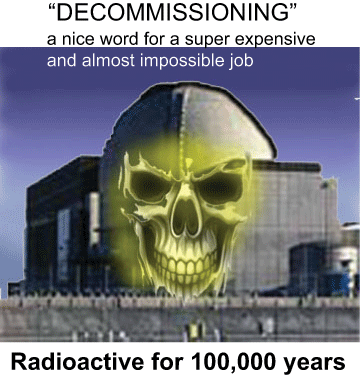
Hanford, Oak Ridge, Los Alamos and West Lake provide only a snapshot of the wider picture. Consider the Rocky Flats Plant, a former nuclear weapons production site not far from Denver, Colorado.
“It’s a Cover-Up, Not a Clean-Up”: Nuclear Waste Smolders in Sites Across the US truth Out March 30, 2017 By Daniel Ross, Truthout | Report Renowned wartime journalist Wilfred Burchett described the damage from the atomic bomb that flattened Hiroshima as “far greater than photographs can show.” When it comes to the enduring legacy of the Manhattan Project on home soil, the damage to the environment and human health is proving similarly hard to grasp.
The covert project to create the world’s first atomic weapon during WWII, coupled with the nuclear proliferation of the Cold War era, has left a trail of toxic and radioactive waste at sites across the nation that will necessitate, by some margin, the largest environmental cleanup in the nation’s history. The amount of money that has been poured into remediating the waste already is staggering. Still, it appears that the scale of the problems, and the efforts needed to effectively tackle them, continue to be underestimated by the authorities responsible for their cleanup.
Since 1989, the Department of Energy’s (DOE) Office of Environmental Management — the agency charged with cleaning up “legacy” radioactive waste — has spent over $164 billion disposing of nuclear waste and contamination, completing the cleanup at 91 of 107 sites across the country. And yet between 2011 and 2016, the DOE’s Environmental Management environmental liability grew by roughly $94 billion.
Though the president’s proposed 2018 budget siphons $6.5 billion into the DOE’s Environmental Management program, up slightly from $6.2 billion this year and last, that figure is still below the roughly $8.5 billion (after adjustment for inflation) the program received in 2003. It is also well below the amount required to effectively meet urgent issues head on, said Don Hancock, director of the Nuclear Waste Program at the Southwest Research and Information Center……..
The fight over what the final budget will look like has only just begun. But beyond these hovering questions marks is something much more concrete: the sheer magnitude of the legacy waste problem, which can be traced all the way back to that game-changing atomic project of the 1940s.
Decades-old war over Yucca Mountain nuclear dump resumes under Trump budget plan, LA Times, Ralph Vartabedian, 29 Mar 17 An abandoned tunnel in the desolate Nevada desert, barricaded only by a chain-link fence, is all that remains of the nation’s tortured effort to create a permanent repository for nuclear waste 100 miles northwest of Las Vegas.
After spending $11 billion, the Energy Department met with unrelenting opposition from Nevada and was forced to shut down the program at Yucca Mountain — the only remotely viable option for storing tons of deadly waste that currently has nowhere to go — in 2010……..
At an estimated cost of $100 billion, the Yucca Mountain nuclear waste dump would rival the International Space Station in cost and complexity, requiring construction of roughly 300 miles of new railroad tracks to transport the waste, development of advanced robots to work underground and fabrication of special titanium shields to keep the waste intact for, it is hoped, hundreds of thousands of years.
The $120 million outlined by Trump this month in his budget blueprint would restart the ponderous licensing process that was abandoned by the Obama administration and begin plans for a temporary storage facility at an undetermined location…….
Nevada officials have put every ounce of their political muscle into stopping the dump…….The state is quickly gearing up for a new fight, readying new legal strategies and pushing a resolution through the state Legislature.
“The Trump administration’s attempt to revive Yucca Mountain is naive and a waste of taxpayer dollars,” said Sen. Catherine Cortez Masto (D-Nev.), who successfully fought off the Energy Department for years when she was the state’s attorney general. “It is a nonstarter.”
Cortez Masto said the state is united against the dump across party lines, including Republican Gov. Brian Sandoval, another former attorney general……..
Nevada has filed some 300 legal “contentions” against the Energy Department’s license, each of which must be examined by a special board. The state is swinging into action to file even more contentions if the license action is resumed, said Robert Halstead, chief of the state’s nuclear office.
“They think because Reid is gone, this will be a cakewalk. Wrong,” Halstead said. “I see them going through a licensing procedure that will cost $1.5 billion and take five years, with a 50% chance of success.”……
The Energy Department’s failure to keep its promise to move forward with a disposal project, even while it collected the money, has created a swamp of litigation.
Most of the nation’s commercial reactors, including the shuttered San Onofre plant in northern San Diego County, are located on rivers, lakes and oceans — a risky location for storing highly radioactive fuel rods. And much of the nation’s nuclear weapons waste, which could also end up at Yucca Mountain, is stored in leaky tanks and steel drums.
The nation’s nuclear utilities have won judgments and settlements of $6.1 billion, arguing that the government’s failure to take the waste has increased their storage and operation costs, said Jay Silberg, an attorney representing the industry. And the Energy Department has projected that it may be liable for up to $25 billion more…….http://www.latimes.com/local/california/la-na-yucca-revival-20170329-story.html
Workers demolish site of nuclear mishap in Washington state , San Franciso Chronicle, NICHOLAS K. GERANIOS, ASSOCIATED PRESS, March 30, 2017, SPOKANE, Wash. (AP) — Workers at the Hanford Nuclear Reservation in Washington state have finished demolishing the site of a famous nuclear accident during the Cold War that exposed a man to the highest dose of radiation from the plutonium byproduct americium ever recorded, the U.S. Department of Energy announced Thursday.
The McCluskey Room was named for Harold McCluskey, who in 1976 survived the horrifying accident and died 11 years later of unrelated causes after becoming known as the Atomic Man.
A contractor recently demolished the room — the first of four main buildings that made up the Plutonium Finishing Plant complex that will be torn down.
“Completing demolition on this building was years in the making and is both historic and a significant risk reduction,” said Tom Teynor, project director for the Department of Energy.
Hanford, located in southeastern Washington, began making most of the plutonium for the nation’s nuclear arsenal during World War II.
Plutonium production has ended and the site is now engaged in a massive cleanup of nuclear waste. That work is expected to take decades and cost tens of billions of dollars.
Among the materials with no disposition plan include weapons-grade plutonium, depleted uranium oxide, highly enriched uranium and heavy water.
Specifics about the quantity and timetables were redacted from the report. Lastly, the DOE report states that there is no disposition path for surplus plutonium stored at K-Area.
The DOE’s short-term strategy of continuing nuclear shipments to SRS runs counter to South Carolina’s long-held aversion to the state becoming a dumping ground for nuclear waste.
The latest data dump from SRS Watch includes the 2016 SRS Nuclear Materials Management Plan the group said it obtained through the Federal Freedom of Information Act.
Documents confirm that plutonium from Japan, Germany and Switzerland was shipped to the site last year, as previously reported by the Aiken Standard. The 2016 report further states the U.S. Department of Energy plans further shipments of plutonium, uranium and tritium, with some shipments expected to continue for 18 years.
“The most significant issue with respect to the current inventory of SNM (spent nuclear material) at SRS is the lack of an assigned disposition path for certain SNF (spent nuclear fuel) and plutonium materials,” the report says.
Among the materials with no disposition plan include weapons-grade plutonium, depleted uranium oxide, highly enriched uranium and heavy water.
Further, only a portion of spent nuclear fuel stored at L-Area is approved for processing at H Canyon, the report continues.
L-Area is where high and low enriched uranium used fuel is stored. H Canyon downblends this waste into low enriched uranium, which is then used to fuel Tennessee Valley Authority reactors, according to the SRS website.
Additionally, more foreign and domestic materials are expected to be shipped to L-Area through 2019 and 2035, respectively, the DOE report states.
Specifics about the quantity and timetables were redacted from the report. Lastly, the DOE report states that there is no disposition path for surplus plutonium stored at K-Area.
Options for disposing of surplus plutonium are limited. Construction of the Yucca Mountain facility in Nevada halted a few years ago, while the Waste Isolation Pilot Plant in New Mexico also isn’t equipped to handle SRS materials.
The long-term strategy for disposing of defense plutonium remains completion of the Mixed Oxide Fuel Fabrication Facility, or MOX, which would convert waste into fuel for commercial reactors.
MOX, though, is only reportedly 70 percent complete, billions of dollars over budget and years behind schedule……
The DOE’s short-term strategy of continuing nuclear shipments to SRS runs counter to South Carolina’s long-held aversion to the state becoming a dumping ground for nuclear waste.
SRS Watch Director Tom Clements said in prepared comments the DOE report illustrates why importing nuclear materials to the site must cease.
“While it is clear that DOE hopes to maintain SRS as a site that receives and processes an array of nuclear materials, that role is clearly diminishing and continues to distract from the all-important clean-up mission at SRS,” Clements said in a statement. n recent years, MOX has only received minimal funding from Congress. The DOE assessment says this trend must change.
“Decisions/funding need to be made on the appropriate disposition path; which will include processing for use as mixed oxide fuel, another use, or a waste disposition,” the DOE report states.
The DOE’s short-term strategy of continuing nuclear shipments to SRS runs counter to South Carolina’s long-held aversion to the state becoming a dumping ground for nuclear waste.
SRS Watch Director Tom Clements said in prepared comments the DOE report illustrates why importing nuclear materials to the site must cease.
“While it is clear that DOE hopes to maintain SRS as a site that receives and processes an array of nuclear materials, that role is clearly diminishing and continues to distract from the all-important clean-up mission at SRS,” Clements said in a statement.
“More effort must be put into a permanent and near-term halt to the inflow of nuclear materials into SRS and the development of acceptable disposition paths for hard-to-manage materials already at the site,” the statement continued.
A federal judge recently ruled that the DOE failed to abide by legal obligations to remove or dispose of 1 metric ton of defense plutonium per year from SRS.
But the March 20 order doesn’t impose any sanctions for missing that milestone, nor does it prevent the continued flow of nuclear materials into Aiken County.
UK nuclear decommissioning debacle costs government nearly £100m
Business secretary orders inquiry into flawed tendering process for dismantling old reactors at 12 sites as US firms get paid for out of court settlement, Guardian, Adam Vaughan, 27 Mar 17, The government has been forced to pay nearly £100m in a settlement with two US companies for mishandling the way it awarded a £6.1bn nuclear decommissioning contract.
Ministers have ordered an inquiry headed by the former boss of National Grid to find out why the procurement process was so flawed. Labour said the payout showed “dramatic levels of incompetence”.
The government body tasked with decommissioning old reactors will also terminate the contract it awarded for cleaning up a dozen of the UK’s old nuclear sites nine years early……..
The government now has the daunting task of starting a new tendering process for the 12 sites, as the deal with Cavendish Fluor Partnership will end early, in September 2019 instead of 2028…….
The contract is being terminated early because the NDA underestimated the scale of the decommissioning required to clean up the Magnox sites, which form part of the UK’s first generation of nuclear power stations.
The share price of Babcock International Group, which has a stake in the Cavendish Fluor Partnership, has fallen by more than 3% since the government announcement…….
“Canada is facing a critical decision that will impact generations in both our countries,” said Senator Stabenow. “A nuclear waste spill near the Great Lakes could have a devastating impact on our health and environment and threaten our Michigan way of life. Given what is at stake, I urge our Canadian neighbors to make the right choice and shelve plans for this site once and for all.”
“The Canadian proposal to build a permanent nuclear waste repository less than a mile from Lake Huron could cause significant, lasting damage to the Great Lakes and undermine the progress we have made cleaning up the water quality in the Great Lakes Basin,” said Senator Peters. “President Trump and Secretary of State Tillerson should make every effort to prevent the Canadian government from moving forward with this proposal and work to find an alternative solution that does not jeopardize the health of the Great Lakes.”
“Permanently storing nuclear waste less than a mile from Lake Huron just doesn’t make sense and poses a great risk to our Great Lakes,” said Congressman Kildee. “From Detroit to Toronto, a growing number of people – in both the U.S. and Canada – have voiced opposition to this dangerous plan. Surely in the vast land mass that comprises Canada, there must be a better place to permanently store nuclear waste than on the shores of Lake Huron.”
U.S. Senators Amy Klobuchar (D-MN), Kirsten Gillibrand (D-NY), Sherrod Brown (D-OH), Al Franken (D-MN), and Dick Durbin (D-IL) are also original co-sponsors of the Senate resolution. Mike Bishop (MI-08), Debbie Dingell (MI-12), David Joyce (OH-14), Marcy Kaptur (OH-09), Louise Slaughter (NY-25), Mark Pocan (WI-02), David Trott (MI-11), Jackie Walorski (IN-02), Luis Gutiérrez (IL-04), Sander Levin (MI-09), Paul Mitchell (MI-10), Brian Higgins (NY-26), Jan Schakowsky (IL-09), and John Moolenaar (MI-04) are also original co-sponsors of the House resolution.
Over 40 million people in Canada and the United States get their drinking water from the Great Lakes and the highly toxic waste could take tens of thousands of years to decompose to safe levels. Ontario Power Generation is currently seeking approval from the Canadian Ministry of Environment to build a deep geologic repository to permanently store 7 million cubic feet of low- and intermediate-level radioactive waste. The facility would be located less than 1 mile from Lake Huron in Kincardine, Ontario.
The resolution urges the President and Secretary of State to work with their counterparts to prevent a permanent nuclear waste repository from being built within the Great Lakes Basin. It further states that the U.S. and Canada should develop a safe and responsible solution for the long-term storage of nuclear waste.
Trump’s budget could help get rid of the nuclear waste along the San Onofre coastline http://www.latimes.com/business/la-fi-nuclear-waste-20170320-story.htmlRob Nikolewski A sense of momentum is building about finding a way to deal with the massive amounts of radioactive waste from nuclear power plants, including Southern California’s San Onofre Nuclear Generating Station.
Last week’s Trump administration “skinny budget” proposal, which calls for boosts in defense spending but cuts in domestic funding and federal agencies, found $120 million for starters to “initiate a robust interim storage program” while also looking at reviving the Yucca Mountain nuclear waste repository in Nevada.
Decommissioning San Onofre Nuclear Generating Station
“These investments would accelerate progress on fulfilling the federal government’s obligations to address nuclear waste, enhance national security and reduce future taxpayer burden,” a note said in the section reserved for the U.S. Department of Energy. (The Energy Department’s budget came in for a 5.6% reduction.)
A president’s budget proposals are ultimately subordinate to what Congress decides. But David Victor, chairman of the SONGS Community Engagement Panel, said the appropriation for nuclear waste may be one of the only topics in the current political environment that can generate support from members of both parties.
There are 3.6 million pounds of nuclear waste sitting along the coastline at the San Onofre plant, part of the 76,000 metric tons of spent fuel at sites nationwide.
“There’s a lot of Trump’s proposed budget that horrifies me, in particular around cutting funding for science and energy, but [long-term nuclear storage] is an area where I think the nation is now starting to make some progress,” Victor said.
Rep. Darrell Issa (R-Vista), who has introduced a bill called the Interim Consolidated Storage Act, said he thinks the chances for funding the White House nuclear waste proposal are “extremely good.”
“You have an active group of members, some of whom are Democratic members, who have a vested interest” in moving legislation forward, Issa said. “And … the fingerprints of whoever wanted to force it out would show all over.”
“As a budget line item it’s not a bad number at all,” Issa said in a telephone interview from Washington. “It’s sufficient to do the feasibility of these sites.”
Consolidated interim storage sites are designed to be built in isolated locations where multiple nuclear facilities could deposit their waste.
Two potential interim storage locations have been discussed — one in western Texas and another in eastern New Mexico.A company in Andrews, Texas, has filed an application to accept 5,000 metric tons of nuclear material. The district is represented by Republican Rep. Mike Conaway, who has co-sponsored Issa’s bill.
Getting the massive nuclear waste repository at Yucca Mountain, located about 100 miles from Las Vegas, back on track assuredly would involve a battle on Capitol Hill.
Democrats as well as Republicans from Nevada blasted the Trump proposal. “Washington needs to understand what Nevada has been saying for years: We will not be the nation’s nuclear waste dump,” said Sen. Dean Heller (R-Nev.).
The federal government spent about $15 billion to build the facility at Yucca Mountain to house nuclear waste from sites across the country. But then-Sen. Harry Reid (D-Nev.) led the fight to shut the repository down, and in 2010 President Obama suspended licensing for the site.
Yucca Mountain was scheduled to open in 2017.
While taking a tour of San Onofre last month with Issa, Rep. John Shimkus (R-Ill.), who is chairman of the House subcommittee that reviews nuclear sites, was asked if Yucca Mountain was coming back onto the bargaining table.
“It’s never been off the table,” Shimkus said.
Issa’s bill would be paid for by using part of the federal government’s Nuclear Waste Fund, which is worth upward of $40 billion and was funded by ratepayers in areas powered by nuclear plants.
A 2014 court order stopped the federal government from taking fees from electricity customers because, with Yucca Mountain sidelined, the government had no place to send nuclear waste.
“We’re paying a lot of money for the privilege of not having a solution that we were obligated to have,” Issa said. “It’s not free. It’s going to cost every taxpayer money until there’s a working solution.”
But even if Congress adopts a plan roughly similar to the White House proposal, there are a series of practical and regulatory hurdles to clear.
For example, sites such as San Onofre, which closed in 2013, would still need to place some of their spent fuel into canisters. Then federal law would need to be changed to install a reliable funding mechanism for interim sites, and a strategy would need to be adopted in order to move the waste from one place to another.
“There is still a long way to go,” Victor said. “We could have troubles on any of those fronts, but I think what’s encouraging is that on every single one of those fronts, we’re starting to see progress.”
Millions of people live within 50 miles of San Onofre, which hasn’t produced electricity since January 2012 after a steam generator leaked a small amount of radiation.
Southern California Edison is the majority owner of the plant, which is in the process of being decommissioned.
Edison officials said they were heartened by the news of $120-million proposal.
“We are pleased to see funding proposed to restart the Yucca licensing process, and continue to also support interim storage proposals that would enable [Southern California Edison] to move San Onofre’s used fuel to an off-site location,” spokeswoman Maureen Brown said
Lobbyists debate responses to the nuclear power crisis, Online opinion, .By Jim Green – , 27 March 2017The Era of Nuclear Decommissioning (END) “……….The ageing of the global reactor fleet isn’t yet a crisis for the industry, but it is heading that way. The assessment by the ‘Environmental Progress’ lobby group that 151 GW of worldwide nuclear power capacity could be shut down by 2030 is consistent with figures from the World Nuclear Association (132 reactor shut-downs by 2035), the International Energy Agency (almost 200 shut-downs between 2014 and 2040) and Nuclear Energy Insider (up to 200 shut-downs in the next two decades)
It looks increasingly unlikely that new reactors will match shut-downs. Another 20 years of stagnation is possible, but only if China continues to do the heavy lifting. And if China’s nuclear program slows, worldwide nuclear decline is certain.
Perhaps the best characterisation of the global nuclear industry is that a new era is approaching – the Era of Nuclear Decommissioning (END). Nuclear power’s END will entail:
a slow decline in the number of operating reactors (unless growth in China can match the decline elsewhere);
countless battles over lifespan extensions for ageing reactors;
many battles over the nature and timing of decommissioning operations;
many battles over taxpayer bailouts for companies and utilities that haven’t set aside adequate funding for decommissioning;
more battles over proposals to impose nuclear waste repositories on unwilling or divided communities; and
battles over taxpayer bailouts for companies and utilities that haven’t set aside adequate funding for nuclear waste disposal.
Nuclear power is likely to enjoy a small, short-lived upswing in the next couple of years as reactors ordered in the few years before the Fukushima disaster come online. Beyond that, the Era of Nuclear Decommissioning sets in, characterised by escalating battles ‒ and escalating sticker-shock ‒ over lifespan extensions, decommissioning and nuclear waste management.
In those circumstances, it will become even more difficult than it currently is for the industry to pursue new reactor projects. A positive feedback loop could take hold and then the industry will be well and truly in crisis………http://onlineopinion.com.au/view.asp?article=18929&page=0
March 17, 2017 (Mainichi Japan) Tokyo Electric Power Company Holdings Inc. (TEPCO) has informally decided to decommission the No. 1 reactor at its Fukushima No. 2 Nuclear Power Plant, it has been learned.
In the wake of the March 2011 Great East Japan Earthquake and tsunami and ensuing meltdowns at the Fukushima No. 1 plant in Fukushima Prefecture, local bodies and residents of the area who suffered extensive damage requested that all four reactors at the No. 2 plant also be decommissioned.
TEPCO had avoided stating a clear position on the No. 2 plant’s reactors, but there had been pressure from the government and ruling coalition for it to make a decision. The company accordingly decided to decommission the plant’s No. 1 reactor, which suffered the most damage, and will consider what to do with the other three reactors in the future.
The No. 1 reactor of the Fukushima No. 2 plant began operating in 1982. It was flooded by tsunami on March 11, 2011, and all four reactors at the plant remain idled. The No. 2 plant suffered less damage than the No. 1 plant, and if it passed screening by the Nuclear Regulation Authority, its reactors could be restarted. But the Fukushima Prefectural Government and all 59 local assemblies have asked TEPCO and the government to decommission all reactors in the prefecture.
TEPCO has remained busy handling compensation claims relating to the Fukushima nuclear disaster and the disaster cleanup. If it were to decommission all of the No. 2 plant’s reactors, they would lose value and it would have to write down huge losses. Company president Naomi Hirose has therefore avoided taking a clear position on the issue, saying, “I would like to consider it and make a decision as a business operator.”
Last year, however, officials decided to create a fund to cover the huge cost of handling the nuclear disaster, which is expected to reach 21.5 trillion yen, nearly double the original prediction. There was accordingly pressure from the government for TEPCO to reach an early decision on the fate of the No. 2 plant’s reactors.
The No. 1 reactor at the No. 2 plant is the oldest of the plant’s four reactors. It temporarily lost its cooling functions in the March 2011 disaster, and suffered the most damage among the four reactors. TEPCO believes that by limiting decommissioning to one reactor for the time being, it will be able to hold the decommissioning cost below 100 billion yen, minimizing the impact on company finances and on decommissioning work at the Fukushima No. 1 plant. However, a decision to decommission only one reactor at the No. 2 plant is unlikely to win public approval.
Dean Heller (R-NV) got a nasty surprise this week when he discovered that President Donald Trump’s proposed budget would revive the Yucca Mountain storage facility for nuclear power plant waste in his home state.
Heller, by far the most vulnerable Republican in the senate in the 2018 midterm elections, railed against Trump’s proposal in a statement released Thursday, as he insisted that his state would “not be the nation’s nuclear waste dump.”
“As has been stated in the past, Yucca is dead and this reckless proposal will not revive it,” he said. “Washington needs to understand what Nevada has been saying for years: we will not be the nation’s nuclear waste dump. This project was ill-conceived from the beginning and has already flushed billions of taxpayer dollars down the drain.”
Heller also vowed to fight any effort to revive the Yucca Mountain project tooth and nail.
The Las Vegas Review Journal notes that, while Trump would increase funding to revive the Yucca Mountain facility, his budget would also slash the Office of Science’s $5 billion budget by a whopping $900 million, which would dramatically cut the amount of research that it now funds at more than 300 universities and at 10 national labs.
Nevada lawmakers speaking out against plan to revive Yucca Mountain,ktnv.com , Joyce Lupiani, Mar 16, 2017 The White House is proposing to revive the Yucca Mountain nuclear waste plan. The 2018 budget plan for the U.S. Department of Energy includes $120 million to restart licensing for the proposed dump.
Yucca Mountain has been studied since the 1970s as a potential repository for the nation’s radioactive waste. President Obama withdrew the license to store waste at Yucca in 2010 because of opposition by then-Senate Majority leader Harry Reid.
Some of Nevada’s lawmakers are speaking out against the idea: A partial statement from Congresswoman Jacky Rosen reads: “Worst of all, the budget requests $120 million in funds for Yucca Mountain to make our state the country’s dumping ground for nuclear waste.”
And Rep. Ruben J. Kihuen issued this statement:
“Yucca Mountain has been dead for years. Now, President Trump wants to run roughshod over the people of Nevada and throw away funding that could be better spent on infrastructure and creating jobs. Nevada is not a dumping ground for the rest of the country’s nuclear waste and our rights shouldn’t be trampled over just because President Trump wants to put an unsavory waste facility in our backyard. The Nevada delegation was united in sponsoring the Nuclear Waste Informed Consent Act earlier this year, demanding that states be consulted before nuclear waste repositories can be built by the federal government. I urge President Trump and Secretary Perry to reconsider their reckless and haphazard scheme to throw away federal tax dollars, especially without thinking about the safety and well-being of the people of Nevada.”
Governor Sandoval also issued a statement:
“Regarding Yucca Mountain, let me make my position clear – for the remainder of my term I will vigorously fight the storage of high-level nuclear waste in Nevada. Any attempt to resurrect this ill-conceived project will be met with relentless opposition, and maximum resources. Continuing down a path that seeks to force this unsafe and unwanted project on Nevada is a waste of time and money and only gets the country farther away from solving its nuclear waste problem.
Nevada Attorney General Adam Paul Laxalt released this statement:
The White House’s 2018 budget plan for the U.S. Department of Energy includes $120 million for nuclear waste programs including the restart of licensing for Nevada’s Yucca Mountain, a project stalled for years by lawsuits and local opposition.
The move signals that President Donald Trump may consider that nuclear waste solutions could extend the lives of existing U.S. nuclear power plants and speed up innovations in next- generation nuclear plants that backers say are safer than previous reactors.
Congress will debate the budget and it is uncertain whether funds for waste will remain in the plan.
While Yucca Mountain would store waste on a practically permanent basis, the budget money would also support programs for storing waste at interim sites before Yucca opens.
“These investments would accelerate progress on fulfilling the federal government’s obligations to address nuclear waste, enhance national security, and reduce future taxpayer burden,” according to a summary of the budget.
Yucca has been studied by the U.S. government since the 1970s as a potential repository for the nation’s radioactive waste and billions of dollars have been spent on it.
But Yucca has never opened because of legal challenges and widespread opposition from local politicians, environmentalists and Native American groups.
In 2010, then-President Barack Obama withdrew the license to store waste at Yucca amid opposition from then-Senate Majority Leader Harry Reid, a fellow Democrat from Nevada.
Maria Korsnick, the head of the Nuclear Energy Institute industry group, said the industry was encouraged by the plan for waste projects but that nuclear energy innovators were “nervous” about cuts to programs that have supported public-private partnerships to bring new nuclear technologies to market.
The budget eliminates funding for the Advanced Research Projects Agency for Energy and an innovative technology loan guarantee program that have been popular with both Democrats and many Republicans.
Trump’s energy secretary, Rick Perry, told lawmakers at his confirmation hearing that restarting the Yucca Mountain project could not be ruled out, but that he would collaborate with states.
“I am very aware that this is an issue this country has been flummoxed by for 30 years. We have spent billions of dollars on this issue,” Perry told the hearing in January. “I’ll work closely with you and the members of this committee to find the answers to this issue.”
The White House proposal for the Department of Energy budget calls for an overall cut of 5.6 percent.
Texas sues feds — including Rick Perry — for failing to license nuclear waste facility TEXAS TRIBUNE BY JIM MALEWITZ, MARCH 15, 2017 In a lawsuit filed Tuesday, Texas Attorney General Ken Paxton accuses U.S. agencies of violating federal law by failing to license a nuclear waste repository in Nevada. Texas is trying to take the federal government to task for failing to find a permanent disposal site for thousands of metric tons of radioactive waste piling up at nuclear reactor sites across the country.
In a lawsuit filed Tuesday night, Texas Attorney General Ken Paxton accuses U.S. agencies of violating federal law by failing to license a nuclear waste repository in Nevada — a plan delayed for decades amid a highly politicized fight.
Paxton’s petition asks the U.S. Court of Appeals for the 5th Circuit to force the Nuclear Regulatory Committee to cast an up-or-down vote on the Yucca Mountain plan. It also seeks to prevent the federal Department of Energy from spending billions of dollars in fees collected from utilities on efforts to find another disposal site before such a vote……
Karen Hadden, executive director of the Sustainable Energy and Economic Development Coalition, a group fighting the Andrews County site’s expansion, agreed with Paxton’s criticism of the Yucca Mountain process — “a waste of money,” she said. But Hadden worries that the lawsuit could force the government to permit a site ill-equipped to protect public health and safety.
Struggling With Japan’s Nuclear Waste, Six Years After Disaster https://www.nytimes.com/2017/03/11/world/asia/struggling-with-japans-nuclear-waste-six-years-after-disaster.html?_r=0 by MOTOKO RICHFUKUSHIMA DAIICHI NUCLEAR POWER STATION — Six years after the largest nuclear disaster in a quarter-century, Japanese officials have still not solved a basic problem: what to do with an ever-growing pile of radioactive waste. Each form of waste at the Fukushima Daiichi Nuclear Power Station, where three reactors melted down after an earthquake and a tsunami on March 11, 2011, presents its own challenges.
The estimated 6,000 cleanup workers at the site put on new protective gear every day. These hazmat suits, face masks, rubber gloves and shoe coverings are thrown out at the end of each shift. The clothing is compressed and stored in 1,000 steel boxes stacked around the site.
To date, more than 64,700 cubic meters of gear has been discarded, the equivalent of 17 million one-gallon containers. Tokyo Electric says it will eventually incinerate all this contaminated clothing to reduce the space needed to store it.
Branches and Logs From 220 Acres of Deforested Land The plant’s grounds were once dotted with trees, and a portion was even designated as a bird sanctuary. But workers have cleared about 220 acres of trees since the meltdown spewed radiation over them.
Now, piles of branches and tree trunks are stacked all over the site. Officials say there are about 80,000 cubic meters of this waste, and all of it will have to be incinerated and stored someday.
200,400 Cubic Meters of Radioactive RubbleExplosions during the meltdown filled the reactors with rubble. Workers and robots are slowly and carefully trying to remove this tangled mass of crushed concrete, pipes, hoses and metal.
Tokyo Electric estimates that more than 200,400 cubic meters of rubble — all of it radioactive — have been removed so far and stored in custom-made steel boxes. That is the equivalent of about 3,000 standard 40-foot shipping containers.
3.5 Billion Gallons of SoilThousands of plastic garbage bags sit in neat rows in the fields and abandoned towns surrounding the Fukushima plant. They contain soil that was scraped from land that was exposed to radiation in the days after the accident.
Japan’s Ministry of the Environment estimates that it has bagged 3.5 billion gallons of soil, and plans to collect much more. It will eventually incinerate some of the soil, but that will only reduce the volume of the radioactive waste, not eliminate it.
The ministry has already begun building a massive, interim storage facility in Fukushima prefecture and negotiating with 2,360 landowners for the thousands of acres needed to complete it. And that is not even a long-term solution: The government says that after 30 years it will need another site — or sites — to store radioactive waste.
1,573 Nuclear Fuel Rods
The ultimate goal of the cleanup is to cool and, if possible, remove the uranium and plutonium fuel that was inside the three reactors at the time of the disaster.
Hundreds of spent fuel rods are in cooling pools inside the reactors, and the company hopes to have cleared away enough rubble to begin removing them next year. The much bigger challenge will be removing the fuel that was in use in the reactor core at the time of the meltdown.
The condition and location of this molten fuel debris are still largely unknown. In one reactor where a robot was sent in January, much of the melted fuel is believed to have burned through the bottom of the inner reactor vessel and burrowed into the thick concrete foundation of the containment structure.
The plan is to completely seal the containment vessels, fill them with water and use robots to find and remove the molten fuel debris. But the rubble, the lethal levels of radiation and the risk of letting radiation escape make this an exceedingly difficult task.
In January, the robot sent into one of the reactors discovered radiation levels high enough to kill a person in less than a minute. Another had to be abandoned last month after debris blocked its path and radiation disabled it.
Tokyo Electric hopes to begin removing fuel debris from the reactor cores in 2021. The entire effort could take decades. Some say the radioactive material may prove impossible to remove safely and have suggested leaving it and entombing Fukushima under a concrete and steel sarcophagus like the one used at Chernobyl.
But the Japanese government and Tokyo Electric say they are committed to removing all the waste and cleaning the site, estimated at a cost of $188.6 billion.
“We want to return it to a safe state,” said Yuichi Okamura, general manager of the company’s nuclear power and plant siting division. “We promised the local people that we would recover the site and make it a safe ground again.”
The request also raises new concerns about the amount of radioactive waste being stored on the lab’s property, which has been threatened by catastrophic wildfires at least twice in the past 20 years, and about the lab’s long-troubled history of waste management, which has been a frequent subject of federal oversight reports.
Work was stalled for a number of years at the facility because of safety concerns with the building, including an inadequate fire safety system and its potential inability to withstand an earthquake.
“The desire to make more waste is actually competing with [the] desire to get on top of their safety and [existing] waste issues”
The continued storage of above-ground waste also raises questions about the safety of the drums in the event of a fire
The lab in January asked the state for permission to modify its 2010 hazardous waste permit in order to use two waste rooms and an outdoor storage pad near the lab’s plutonium facility to hold 1,700 waste drums, or 95,000 gallons, of radiologically contaminated materials — enough to fill six backyard swimming pools.
The new waste would join millions of gallons of radioactive waste and other hazardous contaminants stored in shallow pits and above ground throughout the lab’s 43-square-mile property, some of it dating back to the Manhattan Project. The request underscores the nuclear weapons industry’s continuing struggle to find places to dispose of its growing stockpiles of radioactive waste, an endeavor that was set back in part by the nearly three-year closure of the Waste Isolation Pilot Plant in Southern New Mexico. An improperly packaged waste drum from the lab burst in an underground chamber in February 2014, causing a radiation leak.
Even with the reopening of WIPP in January, the facility is unlikely to return to full speed for several years, and new rules for accepting radioactive waste will only further delay shipments from Los Alamos.
The request also raises new concerns about the amount of radioactive waste being stored on the lab’s property, which has been threatened by catastrophic wildfires at least twice in the past 20 years, and about the lab’s long-troubled history of waste management, which has been a frequent subject of federal oversight reports.
Officials said the newly generated waste has been accumulating at the lab since WIPP stopped accepting shipments. Continue reading →