USA govt censoring severity of WIPP nuclear waste problem, $2 Billion Cleanup
“There is no question the Energy Department has downplayed the significance of the accident,” said Don Hancock, who monitors the dump for the watchdog group Southwest Research and Information Center.
a federal investigation found more than two dozen safety lapses at the dump.
Nuclear Accident In New Mexico Is Still Being Censored, $2 Billion Cleanup
Nuclear accident in New Mexico ranks among the costliest in U.S. history, http://www.latimes.com/nation/la-na-new-mexico-nuclear-dump-20160819-snap-story.html Ralph Vartabedian, 23 Aug 16 When a drum containing radioactive waste blew up in an underground nuclear dump in New Mexico two years ago, the Energy Department rushed to quell concerns in the Carlsbad desert community and quickly reported progress on resuming operations.
The early federal statements gave no hint that the blast had caused massive long-term damage to the dump, a facility crucial to the nuclear weapons cleanup program that spans the nation, or that it would jeopardize the Energy Department’s credibility in dealing with the tricky problem of radioactive waste.
But the explosion ranks among the costliest nuclear accidents in U.S. history, according to a Times analysis. The long-term cost of the mishap could top $2 billion, an amount roughly in the range of the cleanup after the 1979 partial meltdown at the Three Mile Island nuclear power plant in Pennsylvania.
The Feb. 14, 2014, accident is also complicating cleanup programs at about a dozen current and former nuclear weapons sites across the U.S. Thousands of tons of radioactive waste that were headed for the dump are backed up in Idaho, Washington, New Mexico and elsewhere, state officials said in interviews.
Washington state officials were recently forced to accept delays in moving the equivalent of 24,000 drums of nuclear waste from Hanford site to the New Mexico dump. The deal has further antagonized the relationship between the state and federal regulators.
“The federal government has an obligation to clean up the nuclear waste at Hanford,” Democratic Gov. Jay Inslee said in a statement. “I will continue to press them to honor their commitments to protect Washingtonians’ public health and our natural resources.”
Other states are no less insistent. The Energy Department has agreed to move the equivalent of nearly 200,000 drums from Idaho National Laboratory by 2018.
“Our expectation is that they will continue to meet the settlement agreement,” said Susan Burke, an oversight coordinator at the state’s Department of Environmental Quality.
The dump, officially known as the Waste Isolation Pilot Plant, was designed to place waste from nuclear weapons production since World War II into ancient salt beds, which engineers say will collapse around the waste and permanently seal it. The equivalent of 277,000 drums of radioactive waste is headed to the dump, according to federal documents.
The dump was dug much like a conventional mine, with vertical shafts and a maze of horizontal drifts. It had operated problem-free for 15 years and was touted by the Energy Department as a major success until the explosion, which involved a drum of of plutonium and americium waste that had been packaged at the Los Alamos National Laboratory.
The problem was traced to material — actual kitty litter — used to blot up liquids in sealed drums. Lab officials had decided to substitute an organic material for a mineral one. But the new material caused a complex chemical reaction that blew the lid off a drum, sending mounds of white, radioactive foam into the air and contaminating 35% of the underground area.
“There is no question the Energy Department has downplayed the significance of the accident,” said Don Hancock, who monitors the dump for the watchdog group Southwest Research and Information Center.
Though the error at the Los Alamos lab caused the accident, a federal investigation found more than two dozen safety lapses at the dump. The dump’s filtration system was supposed to prevent any radioactive releases, but it malfunctioned.
Twenty-one workers on the surface received low doses of radiation that federal officials said were well within safety limits. No workers were in the mine when the drum blew.
Energy Department officials declined to be interviewed about the incident but agreed to respond to written questions. The dump is operated by Nuclear Waste Partnership, which is led by the Los Angeles-based engineering firm AECOM. The company declined to comment.
Federal officials have set an ambitious goal to reopen the site for at least limited waste processing by the end of this year, but full operations can not resume until a new ventilation system is completed in about 2021.
The direct cost of the cleanup is now $640 million, based on a contract modification made last month with Nuclear Waste Partnership that increased the cost from $1.3 billion to nearly $2 billion. The cost-plus contract leaves open the possibility of even higher costs as repairs continue. And it does not include the complete replacement of the contaminated ventilation system or any future costs of operating the mine longer than originally planned.
An Energy Department spokesperson declined to address the cost issue but acknowledged that the dump would either have to stay open longer or find a way to handle more waste each year to make up for the shutdown. She said the contract modification gave the government the option to cut short the agreement with Nuclear Waste Partnership.
It costs about $200 million a year to operate the dump, so keeping it open an additional seven years could cost $1.4 billion. A top scientific expert on the dump concurred with that assessment.
In addition, the federal government faces expenses — known as “hotel costs” — to temporarily store the waste before it is shipped to New Mexico, said Ellis Eberlein of Washington’s Department of Ecology.
The Hanford site stores the equivalent of 24,000 drums of waste that must be inspected every week. “You have to make sure nothing leaks,” he said.
The cleanup of the Three Mile Island plant took 12 years and was estimated to cost $1 billion by 1993, or $1.7 billion adjusted for inflation today. The estimate did not include the cost of replacing the power the shut-down plant was no longer generating.
Other radioactive contamination at nuclear weapons sites is costing tens of billions of dollars to clean up, but it is generally the result of deliberate practices such as dumping radioactive waste into the ground.
For now, workers entering contaminated areas must wear protective gear, including respirators, the Energy Department spokesperson said. She noted that the size of the restricted area had been significantly reduced earlier this year.
Hancock suggested that the dump might never resume full operations.
“The facility was never designed to operate in a contaminated state,” he said. “It was supposed to open clean and stay clean, but now it will have to operate dirty. Nobody at the Energy Department wants to consider the potential that it isn’t fixable.”
Giving up on the New Mexico dump would have huge environmental, legal and political ramifications. This year the Energy Department decided to dilute 6 metric tons of surplus plutonium in South Carolina and send it to the dump, potentially setting a precedent for disposing of bomb-grade materials. The U.S. has agreements with Russia on mutual reductions of plutonium.
The decision means operations at the dump must resume, said Edwin Lyman, a physicist and nuclear expert at the Union of Concerned Scientists.
“They have no choice,” he said. “No matter what it costs.”
Environmental groups in America take legal action against transport of nuclear wastes

 Greens Sue to Stop Nuclear Waste Transport http://www.courthousenews.com/2016/08/15/greens-sue-to-stop-
 nuclear-waste-transport.htm By BRITAIN EAKIN WASHINGTON (CN)– The U.S. Energy Department’s unprecedented proposed transfer of “a toxic liquid stew” containing nuclear waste between Canada and the U.S violates federal law, seven environmental groups claim in court.
Terry J. Lodge, attorney for the environmental groups, did not respond Monday to an emailed request for comment.
Taiwan organising to dump its nuclear wastes on Orchid Island
 Tsai to visit Orchid Island to discuss nuclear waste storage, Focus Taiwan, Taipei, Aug. 14 (CNA) President Tsai Ing-wen (蔡英文) is scheduled to visit Taiwan’s offshore Orchid Island on Monday to discuss the issue of nuclear waste storage with the local people, the Presidential Office said Sunday.
The president will meet with a senior member of the indigenous Tao tribe and visit a kindergarten. She will also attend a forum during which she will address such issues as nuclear waste storage and garbage disposal on the island, the office said……..
Before finding a permanent solution for the nuclear waste, Tsai said her government will provide the Tao tribe with appropriate compensation.
Local residents had received over NT$2.1 billion (US$66.9 million) in payments as of the end of May 2016 from state-run utility Taiwan Power Co. and the Atomic Energy Council since a low-level nuclear waste storage facility was built on Orchard Island in 1982.
USA needs to face up to the nightmare of high burn-up, and indeed, of all, nuclear wastes
Spent nuclear power fuel accumulated over the past 50 years is bound up in more than 241,000 long rectangular assemblies containing tens of millions of fuel rods. The rods, in turn, contain trillions of small, irradiated uranium pellets. After bombardment with neutrons in the reactor core, about 5 to 6 percent of the pellets are converted to amyriad of radioactive elements with half-lives ranging from seconds to millions of years. Standing within a meter of a typical spent nuclear fuel assembly guarantees a lethal radiation dose in minutes.
Heat from the radioactive decay in spent nuclear fuel is also a principal safety concern. Several hours after a full reactor core is offloaded, it can initially give off enough heat from radioactive decay to match the energy capacity of a steel mill furnace. This is hot enough to melt and ignite the fuel’s reactive zirconium cladding and destabilize a geological disposal site it is placed in. By 100 years, decay heat and radioactivity drop substantially but still remain dangerous. For these reasons, the US Government Accountability Office (GAO) informed the Congress in 2013 that spent nuclear fuel is “considered one of the most hazardous substances on Earth.”
US commercial nuclear power plants use uranium fuel that has had the percentage of its key fissionable isotope—uranium 235—increased, or enriched, from what is found in most natural uranium ore deposits. In the early decades of commercial operation, the level of enrichment allowed US nuclear power plants to operate for approximately 12 months between refueling. In recent years, however, US utilities have begun using what is called high-burnup fuel. This fuel generally contains a higher percentage of uranium 235, allowing reactor operators to effectively double the amount of time the fuel can be used, reducing the frequency of costly refueling outages. The switch to high-burnup fuel has been a major contributor to higher capacity factors and lower operating costs in the United States over the past couple of decades.
While this high-burnup trend may have improved the economics of nuclear power, the industry and its regulator, the Nuclear Regulatory Commission (NRC), have taken a questionable leap of faith that could, according to the Electric Power Research Institute, “result in severe economic penalties and in operational limitations to nuclear plant operators.” Evidence is mounting that spent high-burnup fuel poses little-studied challenges to the temporary used-fuel storage plans now in place and to any eventual arrangement for a long-term storage repository.
High burnup significantly boosts the radioactivity in spent fuel and its commensurate decay heat. Of particular concern is the effect of high-burnup fuel on the cladding that contains it in the fuel assemblies used in commercial reactors. Research shows that under high-burnup conditions, that cladding may not be relied upon as the primary barrier to prevent the escape of radioactivity, especially during prolonged storage in the “dry casks” that are the preferred method of temporary storage for spent fuel. Resolution of these problems remains elusive.
For instance, research shows that in regard to high-burnup waste the fuel cladding thickness of used fuel is reduced and a hydrogen-based rust forms on the zirconium metal used for the cladding, and this thinning can cause the cladding to become brittle and fail. In addition, under high-burnup conditions, increased pressure between the uranium fuel pellets in a fuel assembly and the inner wall of the cladding that encloses them causes the cladding to thin and elongate. And the same research has shown that high burnup fuel temperatures make the used fuel more vulnerable to damage from handling and transport; cladding can fail when used fuel assemblies are removed from cooling pools, when they are vacuum dried, and when they are placed in storage canisters.
The NRC and the nuclear industry do not have the necessary information to predict when storage of high-burnup fuel may cause problems. To err on the side of caution, high-burnup fuel might have to be left in cooling pools for 25 years—as opposed to the current three to five years for lower burnup spent fuel— to allow cladding temperatures to drop enough to reduce risks of cladding failure before the fuel is transferred to dry storage. Also, the cooling pools at US commercial reactors are rapidly filling, with more than 70 percent of the nation’s 77,000 metric tons of spent fuel in reactor pools, of which roughly a fourth is high burnup. So far, a small percentage of high-burnup used fuel assemblies are sprinkled amid lower burnup fuel in dry casks at reactor sites. But by 2048—the Energy Department’s date for opening a permanent geologic disposal site—the amount of spent fuel could double, with high burnup waste accounting for as much as 60 percent of the inventory.
What’s next? In 2014, the NRC adopted a “continued storage” rule that recognized the strong likelihood of long-term surface storage of used nuclear fuel—but that rule basically ignored high-burnup spent fuel. Under the rule, the agency currently permits dry storage casks to accommodate a uniform loading of spent fuel below a certain level of use in reactors. The average burnup for the US reactor fleet is measured by the amount of energy produced, expressed in gigawatt days per metric ton of uranium; at present, used fuel assemblies are allowed to go up to 62,000 gigawatt days per metric ton.
Accordingly, a few high burnup assemblies, with higher decay heat, may be mixed with lower burnup assemblies in a storage canister. But there is little guidance on how this can be done without exceeding NRC peak temperature requirements. NRC’s current regulatory guidance concedes that “data is not currently available” supporting the safe transportation of high burn spent nuclear fuel. Owners of the shuttered Maine Yankee and Zion reactors are not taking a chance and have packaged high burnup spent fuel as it were damaged goods, stored in double-shell containers instead of single-shell, to allow for safer transport.
The impacts of decay heat from high-burnup spent fuel on the internal environment of commercial dry casks are virtually impossible to monitor, according to a 2014 NRC-sponsored study, “because of high temperatures, radiation, and accessibility difficulty.” The uncertainties of storing a mix of high- and low-burnup spent fuel in a canister are compounded by the lack of data on the long-term behavior of high-burnup spent fuel. This problem was highlighted by the Nuclear Waste Technical Review Board, an expert panel that provides scientific oversight for the Energy Department on spent fuel disposal. That panel said there is little to no data to support dry storage and transport for spent fuel with burnups greater than 35 gigawatt days per metric ton of uranium. In a May 2016 letter to the Energy Department, the board raised elemental questions that should have been answered before the NRC and reactor operators took this leap of faith: “What could go wrong? How likely is it? What are the consequences?” The board provided no answers to those questions.
It will take the Energy Department at least a decade to complete a study involving temperature monitoring in a specially designed dry cask containing high burnup fuel. Meanwhile, as high-burnup inventories increase, the higher amounts of radioactivity and decay heat associated with high-burnup fuel assemblies are putting additional stress on cooling pool storage systems.
This is happening at a time when concerns over spent fuel pool storage conditions are increasing. “As nuclear plants age, degradations of spent fuel pools … are occurring at an increasing rate,” a study by Oak Ridge National Laboratory concluded in 2011. “During the last decade, a number of NPPs [nuclear power plants] have experienced water leakage from the SFPs [spent fuel pools] and reactor refueling cavities.” As a result of increasing high burnup loadings, spent nuclear pool storage systems are likely to require upgrading, which will certainly drive up costs at a time when age and deterioration are of growing concern.
These concerns were given greater prominence in May of this year by a National Academy of Sciences panel established by Congress to review the response of the NRC to the Fukushima nuclear accident. In its report, the panel warned the NRC about terrorist attacks for the second time since 2004 and urged the agency to “ensure that power plant operators take prompt and effective measures to reduce the consequences of loss-of-pool-coolant events in spent fuel pools that could result in propagating zirconium cladding fires.” Allison Macfarlane, then chair of the U.S. Nuclear Regulatory Commission (NRC), noted in April, 2014 that “land interdiction [from a spent nuclear fuel pool fire at the Peach Bottom Reactor in Pennsylvania] is estimated to be 9,400 square miles with a long term displacement of 4,000,000 persons.”
Down the road, it is likely that spent nuclear fuel will have to be repackaged to mitigate decay heat into smaller containers ahead of final disposal. High-burnup fuel will only complicate the process, and increase costs, currently estimated in the tens of billions of dollars. Depending on the geologic medium, a maximum of four assemblies for high burnup, as opposed to the dozens in current storage casks, would be permitted after 100 years of decay; larger packages containing no more than 21 assemblies might have to be disposed if there is forced ventilation for 50 to 250 years—driving up repository costs.
The basic approach undertaken in this country for the storage and disposal of spent nuclear fuel needs to be fundamentally revamped. Instead of waiting for problems to arise, the NRC and the Energy Department need to develop a transparent and comprehensive road map identifying the key elements of—and especially the unknowns associated with—interim storage, transportation, repackaging, and final disposal of all nuclear fuel, including the high-burnup variety. Otherwise, the United States will remain dependent on leaps of faith in regard to nuclear waste storage—leaps that are setting the stage for large, unfunded radioactive waste “balloon mortgage” payments in the future.
Finland failed to be transparent on nuclear waste burial, unlike Sweden
The foremost reason is that as the project was being discussed with the public, SKB’s research was found to be incomplete and, in certain cases, inaccurate.
When, in 2011, Sweden’s SKB first applied for a license to build the Forsmark repository, the KBS-3 project documentation was published, which made it possible to give the project a review that would be independent from the nuclear industry’s own evaluation.
In February 2016, a special expert group appointed by the government, called the Swedish National Council for Nuclear Waste (Kärnavfallsrådet), published a 167-page report entitled “Nuclear Waste State-of-the-Art Report 2016: Risks, uncertainties and future challenges.” Among other things, it identifies the repository project’s risks and uncertainties having to do with earthquake impacts, with the long-term prospects of financing and monitoring the site’s condition, and with the health effects of low doses of radiation.
Finland has no such expert body. The concept of the repository, under construction in Euroajoki municipality, is criticized by many Finnish scientists, but the government is not taking notice and is likewise ignoring the scientific objections coming from its neighbor Sweden.

 When haste makes risky waste: Public involvement in radioactive and nuclear waste management in Sweden and Finland – How did it happen that in Sweden, the country that developed the technology for deep geological disposal of radioactive waste, construction of a such a repository – a first of its kind in the world – has been suspended for recognized risks and uncertainties, whereas Finland, which has copied the Swedish approach, is moving full speed ahead with building one? Bellona has looked for the answer on a fact-finding visit of the two countries. Bellona August 9, 2016 by Andrei Ozharovsky, translated by Maria Kaminskaya
“……..Out of sight, out of mind?
The deep geological disposal concept was first suggested over 40 years ago to solve the problem of spent nuclear fuel, the nuclear industry’s most dangerous byproduct. To a certain degree, this was a continuation of the “bury and forget about it” principle, applied to the less radioactive and thus less dangerous waste – radioactive waste. But where radioactive waste could be placed in shallow trench-type reservoirs or semi-buried near-surface concrete vaults, for nuclear waste, disposal facilities – repositories or burial sites – were proposed for construction in rock formations at a depth of several hundred meters. To date, no such deep geological repository has been created anywhere in the world. Continue reading
Many decades after closure, UK’s Dounreay Fast Reactor is still dangerously radioactive
Coolant removed from Dounreay Fast Reactor, WNN 05 August 2016 A ten-year process to remove 68 tonnes of highly-radioactive liquid metal coolant from the primary circuit of the UK’s Dounreay Fast Reactor (DFR) has now been completed, marking a major milestone in its decommissioning.
Dounreay’s experimental fast breeder reactor, housed inside a steel sphere, led British nuclear R&D during the 1950s and 60s. It became the world’s first fast reactor to provide electricity to a national grid in 1962…..Dounreay Site Restoration Limited (DSRL) announced today that some 68 tonnes of the liquid metal coolant – a blend of sodium and potassium called NaK – have been removed from the primary circuit of the DFR and destroyed over a ten-year period.

Most of the NaK had been removed by 2012, since when work has been under way to remove the last of the coolant from the difficult to access pipework and base of the structure…….
DSRL said the destruction of the DFR’s liquid metal coolant has removed “one of the highest hazards remaining in the Nuclear Decommissioning Authority (NDA) estate”.
NDA chief operating officer Pete Lutwyche said, “The difficulty of this task can’t be understated, and I welcome the news that this work is complete. Everyone involved should be proud of their achievement.”
The focus of decommissioning work at the DFR will now be the removal of some 1000 breeder elements that remain in the reactor vessel, DSRL said. This must be completed before cleaning and removal of the reactor and its nine kilometres of cooling pipework. http://www.world-nuclear-news.org/WR-Coolant-removed-from-Dounreay-Fast-Reactor-0508164.html
Will USA’s nuclear Waste Isolation Pilot Plant really be ready by December?
Don Hancock, a nuclear waste expert with the nonprofit Southwest Research and Information Center, is skeptical officials will make the December 2016 deadline. He thinks it could take several million dollars more and a few more years to fully reopen WIPP.
“DOE was overly optimistic about scheduling and overly optimistic about costs,” Hancock said. “Unfortunately, DOE continues to not learn from its past. This is not unique to WIPP.”
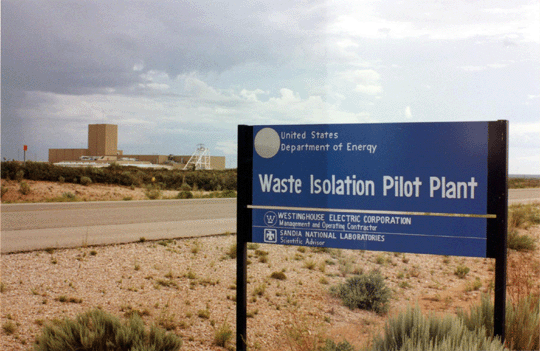 Feds: Highly likely nuclear dump will open in December http://www.houstonchronicle.com/news/article/Fed-says-it-is-80-percent-certain-WIPP-to-open-in-9126263.php August 6, 2016 SANTA FE, N.M. (AP) — The U.S. Department of Energy says it is 80 percent confident that the federal government’s only underground nuclear waste repository will partly reopen in December.
The New Mexico plant has been closed since February 2014, when an inappropriately packed container of waste from Los Alamos National Laboratory ruptured and contaminated part of the facility.
The closure derailed cleanup at federal sites around the nation and recovery is costing the Energy Department hundreds of millions of dollars.
A Government Accountability Office audit released this week said the agency knew it had only a 1 percent chance of meeting that March 2016 deadline.
In 2015, the agency admitted it couldn’t safely reopen the Waste Isolation Pilot Plant, even for limited operations, until at least December 2016 — and at a higher cost. Now auditors say even the revised cost estimate was flawed. The agency “did not follow all best practices for cost and schedule estimates,” federal auditors found, including having an independent analyst review them.
The report says the Energy Department also admitted in May 2015 that the pressure to meet the March 2016 deadline “contributed to poor safety practices in WIPP recovery efforts.”
The result of missteps in the process of reopening the facility, according to auditors, was a nine-month delay and a price tag $64 million higher than the original cleanup estimate. The Energy Department initially estimated it would cost $242 million to restore WIPP for limited waste disposal and an additional $77 million to $309 million to install a new ventilation system critical to providing clean air to workers.
The delays led to an additional $61.4 million in operating costs at WIPP, and the cost to prepare the facility for limited activity went up another $2 million.
Don Hancock, a nuclear waste expert with the nonprofit Southwest Research and Information Center, is skeptical officials will make the December 2016 deadline. He thinks it could take several million dollars more and a few more years to fully reopen WIPP.
“DOE was overly optimistic about scheduling and overly optimistic about costs,” Hancock said. “Unfortunately, DOE continues to not learn from its past. This is not unique to WIPP.”
AREVA- not making money from nuclear build, but cleaning up from waste cleanup?
New facility in Moyock makes massive spent nuclear fuel storage casks By Jeff Hampton The Virginian-Pilot MOYOCK, N.C., 7 Aug 16 Marlin Stoltz put on a hard hat and bright yellow vest before walking out into the four-acre work area of the Moyock Casting Facility, a new operation in the business of spent nuclear fuel storage.
A line of concrete cases, each 21 feet long and weighing 100 tons, rested along a rail spur, ready for shipment. Several men stood atop a steel form where hydraulic power vibrated and settled four truckloads of concrete for the next case. A concrete plant operated less than 100 yards away.
“This allows us to work very efficiently,” said Stoltz, supervisor of the Moyock Casting Facility and a deputy of the services business line for parent company Areva TN, a division of Areva, Inc, based in Charlotte.
Areva, Inc. has operations within the entire nuclear cycle, including uranium mining.
The Moyock facility with 25 employees opened in January. It makes concrete modules that encase steel canisters containing spent nuclear fuel. From here, the modules head to nuclear plants elsewhere……
demand for spent fuel storage remains strong, Stoltz said. The Moyock plant means to deliver.
“The back end of the business is growing,” he said. http://pilotonline.com/news/local/new-facility-in-moyock-makes-massive-spent-nuclear-fuel-storage/article_82fb08bd-19f9-5c03-b976-47eeeb130604.html
No German spent nuclear fuel for Savannah – Citizens’ Advisory Board votes
Savannah River board votes to officially oppose accepting German spent
nuclear fuel, Augusta Chronicle By John Boyette NEW ELLENTON — The Savannah River Site Citizens Advisory Board is not in favor of accepting spent nuclear fuel from Germany. In two separate votes Tuesday, the group voted down a draft recommendation to accept the spent fuel and endorsed a draft position statement that opposes receiving the spent fuel for treatment and storage in the U.S.
The spent fuel, which comes from two German reactors that have ceased operations, originated in the U.S. It takes the form of about one million graphite spheres that contain uranium and thorium and are currently stored in 455 casks…….
The draft recommendation failed to pass, getting only six votes in favor. Eleven board members voted against, and one abstained.
The position statement, which opposed receiving the spent fuel, was voted on next. It passed 13 to five.
The board also voted in favor of a position statement that opposes the storage of commercial spent nuclear fuel and high level radioactive waste atSRS until 2048 or longer.
Tom Clements, the director of nuclear watchdog group SRS Watch, was pleased with the outcome of the votes.
“I thought it was quite strange that they allowed the two positions that had opposite statements to get this far,” Clements said. “I think they should have resolved this in the committee and presented one unified statement and not two.”
Clements said that a final Environmental Assessment from the Department of Energy is pending on the German spent nuclear fuel issue. He said it was supposed to be released in June but now there is no timetable.
“I personally think part of the reason for that is what’s happening in Germany, both the terrorism issue, and that there may be hesitancy to pay more to Savannah River National Laboratory for a program they don’t think is going to go forward.” fuel http://chronicle.augusta.com/news/government/2016-07-26/srs-board-votes-officially-oppose-accepting-german-spent-nuclear-fuel
Germany an example to the world of the massive radioactive waste costs of the nuclear industry
Sticker Shock: The Soaring Costs Of Germany’s Nuclear Shutdown, Yale Environment 360 25 JUL 2016: REPORT German Chancellor Angela Merkel’s 2011 decision to rapidly phase out the country’s 17 nuclear power reactors has left the government and utilities with a massive problem: How to clean up and store large amounts of nuclear waste and other radioactive material. by joel stonington 26 july 16 The cavern of the salt mine is 2,159 feet beneath the surface of central Germany. Stepping out of a dust-covered Jeep on an underground road, we enter the grotto and are met by the sound of running water — a steady flow that adds up to 3,302 gallons per day.
“This is the biggest problem,” Ina Stelljes, spokesperson for the Federal Office for Radiation Protection, tells me, gesturing to a massive tank in the middle of the room where water waits to be pumped to the surface.
The leaking water wouldn’t be an issue if it weren’t for the 125,000 barrels of low- and medium-level nuclear waste stored a few hundred feet below. Most of the material originated from 14 nuclear power plants, and the German government secretly moved it to the mine from 1967 until 1978. For now, the water leaking into the mine is believed to be contained, although it remains unclear if water has seeped into areas with waste and rusted the barrels inside.
The mine — Asse II — has become a touchstone in the debate about nuclear waste in the wake of German Chancellor Angela Merkel’s 2011 decision to end the use of nuclear power following Japan’s Fukushima disaster. The ongoing closures have created a new urgency to clean up these nuclear facilities and, most importantly, to find a way to safely store the additional radioactive waste from newly decommissioned nuclear reactors. Nine of the country’s 17 nuclear power reactors have been shut down and all are expected to be phased out by 2022.
In addition to Asse II, two other major lower-level nuclear waste sites exist in Germany, and a third has been approved. But the costs associated with nuclear waste sites are proving to be more expensive, controversial, and complex than originally expected.
And Germany still hasn’t figured out what to do with the high-level waste — mostly spent fuel rods — that is now in a dozen interim storage areas comprised of specialized warehouses near nuclear power plants. Any future waste repository will have to contain the radiation from spent uranium fuel for up to a million years.
Given the time frames involved, it’s not surprising that no country has built a final repository for high-level waste. In Germany, a government commission on highly radioactive nuclear waste spent the last two years working on a 700-page report, released this month, that was supposed to recommend a location. Instead, the report estimated that Germany’s final storage facility would be ready “in the next century.” Costs are expected to be astronomical.
“Nobody can say how much it will cost to store high-level waste. What we know is that it will be very costly – much higher costs can be expected than [what] the German ministry calculates,” said Claudia Kemfert, head of energy, transportation, and environment at the German Institute for Economic Research. The exact number, she said, “cannot be predicted, since experience shows that costs have always been higher than initially expected. ”
At the Asse II mine, roughly $680 million has been spent in the six years since the cleanup began, and the price tag for operations last year totaled $216 million. A 2015 report by Germany’s Environment Ministry noted, “There are currently no technical plans available for the envisaged waste recovery project which would allow a reliable estimate of the costs.”
No one expects to start moving the barrels at the mine until 2033, and estimates of finishing the process extend to 2065. Total costs for moving the waste to a future storage site will almost certainly be in the billions of dollars, with current estimates of just disposing of the recovered waste at $5.5 billion.
The waste issue is one reason nuclear power has been so controversial in Germany and why there is broad support among the public for phasing it out, with three-quarters of the German population saying they are in favor of Merkel’s decision, according to a survey this year by the Renewable Energy Hamburg Cluster.
“Nuclear in Germany is not popular,” Kemfert said. “Everybody knows it is dangerous and causes a lot of environmental difficulties. Nuclear has been replaced by renewables – we have no need for nuclear power any more.”…………..
With both nuclear waste storage and decommissioning, governments and power companies around the world have often opted for halfway solutions, storing waste in temporary depots and partially decommissioning plants. Worldwide, 447 operational nuclear reactors exist and an additional 157 are in various stages of decommissioning. Just 17 have been fully decommissioned.
In Europe, a recent report by the European Union Commission estimated that funds set aside for waste storage and decommissioning of nuclear plants in the EU’s 16 nuclear nations have fallen short by $137 billion. Dealing with nuclear waste in the United Kingdom is also a highly charged issue. At one location — a former weapons-manufacturing, fuel-reprocessing, and decommissioning site called Sellafield — the expected cleanup cost increased from $59 billion in 2005 to $155 billion in 2015. ……
despite recently completing a new plant, the United States is also struggling with decommissioning. The cost estimates of shuttering U.S. nuclear plants increased fourfold between 1988 and 2013, according toBloomberg News. Many governments are slowly starting to realize how much those costs have been underestimated.
As Antony Froggatt, a nuclear expert and researcher at Chatham House — a London-based think tank— put it, “The question is, how do you create a fair cost to cover what will happen far into the future?” http://e360.yale.edu/feature/soaring_cost_german_nuclear_shutdown/3019/
German situation shows the complex problem of who pays for nuclear wastes disposal
 Sticker Shock: The Soaring Costs Of Germany’s Nuclear Shutdown, Yale Environment 360 25 JUL 2016: REPORT “…….In Germany, negotiations with utilities over who will pay the denuclearization costs have often centered on how much the utilities can afford. The four nuclear utilities in Germany – publicly-traded RWE; E.ON; EnBW, which is majority publicly-owned; and Swedish-owned Vattenfall – are struggling economically as decentralized wind and solar power have undercut wholesale electricity prices and eaten into profits. Last year, E.ON, Germany’s largest utility, lost $7.7 billion.
The four companies have already set aside $45 billion for decommissioning nuclear power plants. But in April, Germany’s Commission to Review the Financing for the Phase-Out of Nuclear Energy recommended that the utilities pay an additional $26.4 billion into a government-controlled fund meant to cover the costs of long-term storage of nuclear waste.
The utilities were unhappy with the commission’s conclusions and released a joint statement saying $26.4 billion would “overburden energy companies’ economic capabilities.” Even so, few experts expect those sums to cover the total eventual costs.
“Some billions now are better than making them bankrupt,” said Michael Mueller, who chairs a government commission on highly radioactive nuclear waste. “So, it’s a compromise that had to be made.”
The utilities are clear about where they see the responsibility: “The temporary and final storage of nuclear waste in Germany is an operative task of the German government, which is politically responsible for this,” the utilities said in a statement. Indeed, if the commission’s recommendation becomes law, then the German government will be on the hook for any storage costs beyond the $26.4 billion paid by the utilities.
“Asse II shows us that radioactive waste storage is a complex problem that is not just about dumping it somewhere,” said Jan Haverkamp, a nuclear energy expert at Greenpeace. “There are many open questions, and those questions are going to lead to a lot more costs………” http://e360.yale.edu/feature/soaring_cost_german_nuclear_shutdown/3019/
Germany still struggling with legacy of old nuclear wastes
Sticker Shock: The Soaring Costs Of Germany’s Nuclear Shutdown, Yale Environment 360 25 JUL 2016: REPORT“……….Radioactive water was first detected leaking at Asse II in 2008, and the German Bundestag passed a law five years later that mandated removal of the waste. Above ground, the complex is just a few fenced-in buildings amid forests and farms. Underground, passageways have closed or collapsed. One main elevator shaft going down into the mine can be used for transporting large machinery, such as front loaders, some of which has to be welded together in underground workshops. As for the areas with actual waste, workers have spent years drilling into just one of 13 chambers to test for gas and radioactivity.
“No one goes in,” said Stelljes. “We haven’t even developed the machines we would need for moving the waste.”
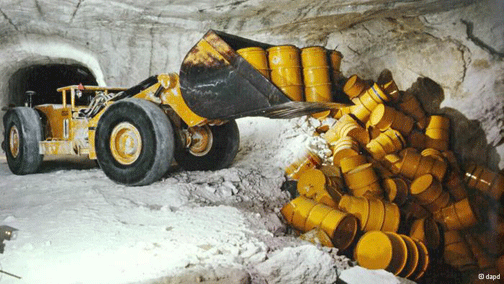
A former iron mine, Konrad, is being converted into a site to store low- and medium-level waste; it is expected to be completed in 2022. Low- and medium-level waste account for 90 percent of Germany’s total nuclear waste, but just 0.1 percent of the total radioactivity of the nation’s waste.
The most dangerous and controversial waste is heavy-metal-laden, heat-producing waste from spent fuel rods. Germany expects the total of that high-level waste to take up 28,100 cubic meters (1 million cubic feet) — a fraction of the volume of low- and medium-level waste the country must eventually store. Preliminary plans from Germany’s Federal Office for Radiation Protection call for a high-level waste repository to be built by 2050, with storage complete by 2130, and final sealing of the repository as late as 2170.
“No one has a finished concept [for storage of high-level waste], so no one can give us a finished budget,” Haverkamp said. “I won’t give an estimate anymore, but the numbers are in the billions. How many? No one knows. That’s the problem in Germany, you have to reserve a certain amount of money, but how much?” …. http://e360.yale.edu/feature/soaring_cost_german_nuclear_shutdown/3019/
Legal dispute in Britain over £7bn nuclear waste clean-up contract

 High court to rule on £7bn nuclear clean-up contract https://next.ft.com/content/5c2dbe24-4f39-11e6-8172-e39ecd3b86fc A win for Energy Solutions would raise questions about procurement process y: Gill Plimmer, 24 July 16
Britain’s Nuclear Decommissioning Authority is in the High Court this week for the final ruling in a long-running damages claim on a £7bn deal to clean up Britain’s oldest nuclear power plants.
Energy Solutions, a US-based company, filed a high court writ in 2014 after losing the contract to engineering company Babcock and Texas-based Fluor. It had been managing the nuclear sites for 14 years and in documents filed to the court alleged that the NDA did not follow its own procedures when the new contract was awarded and that its point scoring system was flawed.
At the heart of the dispute is one of the largest contracts ever put out to tender by the government, which involves about 3,000 workers cleaning 12 of Britain’s 25 nuclear sites. These include Sizewell, Hinkley and Dungeness — built in the 1960s to produce plutonium to make nuclear weapons but now at the end of their lives.
If the NDA loses the case it could cost the government hundreds of millions of pounds and will again raise questions over the way large and sensitive public-sector contractsare awarded.
The judgment is expected on July 29 and will rule whether the NDA made serious errors in awarding the contract. If so, there will be further hearings, which could stretch into 2017, to decide any payment for damages.
Although Energy Solutions competed for the contract in partnership with the US company Bechtel, Energy Solutions is taking legal action alone.
Energy Solutions, which has since been taken over by the construction and support services company Atkins, declined to comment. Atkins said it had “no economic interest in or any control over the resolution of the … claim, which has been retained by the remaining part of the Energy Solutions business”.
A series of botched contracts has raised concerns over the government’s procurement processes. The referral of G4S and Serco to the Serious Fraud Office for overcharging on electronic tagging contracts for offenders and the West Coast main line rail franchising debacle two years ago are among examples.
In 2012, FirstGroup won a 13-year deal to manage the rail network linking London to Scotland, only for Virgin Trains to challenge the decision in court and eventually force a government U-turn.
An NDA spokesperson said: “We continue to await the judgment being handed down and cannot comment before this time.”
EPA’S OWN EXPERTS DISAGREE ON ASSESSMENT OF WASTES AND SOLUTION AT WEST LAKE LANDFILL
 NEW REPORT SHOWS EPA’S OWN EXPERTS DISAGREE ON REGION 7 ASSESSMENT OF WASTES AND SOLUTION AT WEST LAKE LANDFILL, Just Moms St Louis, 07/22/2016
New Report shows EPA’s own experts disagree on Region 7 assessment of wastes and solution at West Lake Landfill.A new report released by Bob Alvarez and Lucas Hixson draws conclusion from the newly released EPA National Remedy and Review Board critique as well as documents and emails discussing the 2008 decision to cap-and-leave the wastes at West Lake Landfill. This report is short and a must read for everyone. There are links to source documents at the end of the report.This report clearly describes the disastrous decisions being made by Region 7, despite EPA’s own top scientists.
This, in fact, is why Missouri’s Federal Representatives and Senators all cast a vote of no confidence in EPA’s ability to successfully manage and remediate the atomic weapons waste at the landfill. Thus, prompting legislation this past fall to take control of the radioactive wastes away from EPA and give jurisdiction to the Army Corps of Engineers FUSRAP.
Based on the linked report, It sounds like EPA’s review board and top scientists have also cast their own vote of no confidence in Region 7.
You can find the report here.
To learn more about FUSRAP and its involvement in St. Louis clickhere.
To follow the status of bipartisan legislation, HR4100, click here.
Dangerous events that were not considered in the 2008 EPA Record of Decision.
An underground fire, or smoldering subsurface event, has been burning since 2010 and is expected to burn for another 5-10 years. This underground fire is the size of 6 football fields. Everyday this fire burns it is inching its way closer to the known nuclear waste. Attorney General Chris Koster warned that a Chernobyl-like event could occur if the fire meets the radioactive waste, i.e. radioactive particles could attach to steam or smoke and be released into the atmosphere……… http://www.stlradwastelegacy.com/new-report-shows-epas-own-experts-disagree-on-region-7-assessment-of-wastes-and-solution-at-west-lake-landfill-07222016/
San Onofre nuclear waste stranded on the beach
“That site will not survive for 10,000 years, just based on the normal erosion and other factors,”
“For most in Congress, their political horizon is two years, four years, six years out,” McFarlane said. “They’re not motivated.”

 FOCUS: WHY SAN ONOFRE’S NUCLEAR WASTE STAYS ON THE BEACH Policy stalemate leaves toxic spent fuel stranded, San Diego Union Tribune BY ROB NIKOLEWSKI July 22, 2016 Some 3.6 million pounds of nuclear waste at the shuttered San Onofre Nuclear Generating Station is all stored up with no place to go.
The plant has not produced electricity since January 2012 for the nearly 19 million people served by Southern California Edison, the majority owner of the facility, andSan Diego Gas & Electric, which owns 20 percent.
Edison officials overseeing the plant’s decommissioning have set a target date of the end of 2032 to remove nearly every remnant of the generating station, which hugs the Southern California coastline at the northern tip of San Diego County in Camp Pendleton.
The operative word is “nearly” because, in all likelihood, the waste — also called spent fuel or used fuel — will stay behind for years to come, stranded until a long-term solution is reached on what to do with it. Going back to the 1960s when the plant broke ground, anti-nuclear critics and Edison officials have not often seen eye-to-eye. But when it comes to the spent fuel, they are in complete agreement: Both sides want it off the premises as soon as possible.
“This is not the right solution, putting the waste on the beach,” said Ray Lutz, El Cajon resident and founder of the nonprofit Citizens Oversight. Lutz made the comment on June 22, just before a Community Engagement Panel, one of a series of public meetings Edison hosts every three months.
“It’s very frustrating,” Tom Palmisano, Edison’s vice president of decommissioning and the chief nuclear officer, said earlier this month.
So why is the waste stuck near the beach? Continue reading
1 This Month


31st January – Challenging the War Machine – a DECLASSIFIED UK SUMMIT


Website of the Week
Now until to February 10, 2026 Radioactive waste storage in France: the debate is finally open! How to participate?
-
Archives
- January 2026 (220)
- December 2025 (358)
- November 2025 (359)
- October 2025 (377)
- September 2025 (258)
- August 2025 (319)
- July 2025 (230)
- June 2025 (348)
- May 2025 (261)
- April 2025 (305)
- March 2025 (319)
- February 2025 (234)
-
Categories
- 1
- 1 NUCLEAR ISSUES
- business and costs
- climate change
- culture and arts
- ENERGY
- environment
- health
- history
- indigenous issues
- Legal
- marketing of nuclear
- media
- opposition to nuclear
- PERSONAL STORIES
- politics
- politics international
- Religion and ethics
- safety
- secrets,lies and civil liberties
- spinbuster
- technology
- Uranium
- wastes
- weapons and war
- Women
- 2 WORLD
- ACTION
- AFRICA
- Atrocities
- AUSTRALIA
- Christina's notes
- Christina's themes
- culture and arts
- Events
- Fuk 2022
- Fuk 2023
- Fukushima 2017
- Fukushima 2018
- fukushima 2019
- Fukushima 2020
- Fukushima 2021
- general
- global warming
- Humour (God we need it)
- Nuclear
- RARE EARTHS
- Reference
- resources – print
- Resources -audiovicual
- Weekly Newsletter
- World
- World Nuclear
- YouTube
-
RSS
Entries RSS
Comments RSS
 nuclear-news