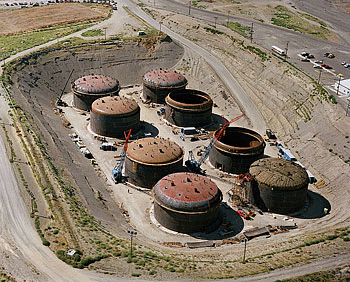
 Nuclear Waste From the Cold War Is Being Stored in Unsafe Conditions. Time to Fix the Problem is Running Out, TIME, Nicholas K. Geranios and Manuel Valdes / AP, May 11, 2017 (RICHLAND, Wash.) — The collapse of a tunnel containing radioactive waste at the Hanford nuclear weapons complex underscored what critics have long been saying: The toxic remnants of the Cold War are being stored in haphazard and unsafe conditions, and time is running out to deal with the problem.
“Unfortunately, the crisis at Hanford is far from an isolated incident,” said Kevin Kamps of the anti-nuclear group Beyond Nuclear.
For instance, at the Savannah River Site in South Carolina, which opened in the 1950s and produced plutonium and tritium, the government is laboring to clean up groundwater contamination along with 40 million gallons of radioactive liquid waste stored in tanks that are decades past their projected lifespan. The job is likely to take decades.
In addition to the tunnel collapse discovered Tuesday, dozens of underground storage tanks at the Hanford Nuclear Reservation in Washington state — some dating to World War II — are leaking highly radioactive materials.
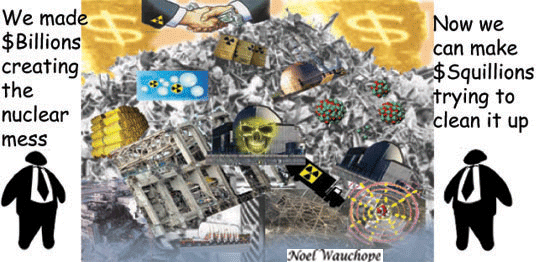
The problem is that the U.S. government rushed to build nuclear weapons during the Cold War with little thought given to how to permanently dispose of the resulting waste.
Safely removing it now is proving enormously expensive, slow-going, extraordinarily dangerous and so complex that much of the technology required simply does not exist. The cleanup has also been plagued with political and technical setbacks.
For example, the nation’s only underground nuclear waste repository, in New Mexico, closed to new shipments in 2014 after an improperly packed drum of waste ruptured. The site just recently reopened.
The U.S. Department of Energy spends about $6 billion a year on managing waste left from the production of nuclear weapons. “The temporary solutions DOE has used for decades to contain radioactive waste at Hanford have limited lifespans,” said Sen. Ron Wyden, an Oregon Democrat and frequent Hanford critic. “The longer it takes to clean up Hanford, the higher the risk will be to workers, the public and the environment.”
U.S. Energy Secretary Rick Perry acknowledged the problem with nuclear waste, saying the nation can no longer delay fixing the problem because lives are at stake.
During a tour Wednesday of the Los Alamos National Laboratory in New Mexico, Perry said the federal government has failed to remove the waste in a timely manner and he pledged to make progress.
A recently approved bipartisan federal budget deal for this fiscal year includes $2.3 billion for the ongoing Hanford cleanup, which matches the amount that Sen. Patty Murray, a Washington Democrat, worked to include last year. President Donald Trump is expected to release his 2018 proposal later this month.
Washington Gov. Jay Inslee said the state plans to issue an order making sure the federal government determines the cause of the tunnel collapse. The order will also require the Energy Department to assess if there’s an immediate risk of failures in any other tunnels and take actions to safely store waste in the tunnels until a decision is made about how to permanently handle the material.
Thousands of workers at Hanford were told to stay home as efforts began to plug the 400-square-foot (37-square-meter) sinkhole in the earth over the unoccupied storage tunnel…….http://time.com/4775268/tunnel-collapse-nuclear-waste-hanford/
May 12, 2017
Posted by Christina Macpherson |
safety, USA, wastes |
Leave a comment
Nuclear Waste From the Cold War Is Being Stored in Unsafe Conditions. Time to Fix the Problem is Running Out, TIME, Nicholas K. Geranios and Manuel Valdes / AP, May 11, 2017 (RICHLAND, Wash.) “………Officials said they detected no release of radiation and no one was injured in the collapse, though thousands of workers were forced to take shelter for several hours as a precaution. The cause of the collapse was not immediately known.
A gravel road was built to the collapse site, and workers wearing protective suits and breathing masks planned to fill the hole with 50 truckloads of dirt, the Energy Department said.
The rail tunnel was built in 1956 out of timber, concrete and steel, topped by 8 feet of dirt. It was 360 feet long (110 meters). Radioactive materials were brought into the tunnel by railcars. The tunnel was sealed in 1965 with eight loaded flatbed cars inside.
Gerry Pollet, a Washington state legislator and longtime Hanford critic, said the collapse of a waste storage tunnel at Hanford had been feared for years.
“This disaster was predicted and shows the federal Energy Department’s utter recklessness in seeking decades of delay for Hanford cleanup,” he said.
He noted the Energy Department last year received permission to delay removing waste from the tunnels until 2042. The waste was supposed to be gone by 2024, Pollet said.
The radiation levels of the waste in the tunnel that collapsed would be lethal within an hour, Pollet said.
Hanford, a 500-square-mile expanse in remote interior Washington about 200 miles from Seattle, was created during World War II as part of the Manhattan Project to build the atomic bomb.
Hanford made most of the plutonium for the nation’s nuclear weapons, including the bomb dropped on Nagasaki, Japan, during the war. It now contains the nation’s greatest volume of radioactive waste left over from the production of weapons plutonium.
The cleanup there has cost $19 billion to date and is not expected to be finished until 2060, at an additional cost of $100 billion.
The most dangerous waste at Hanford is 56 million gallons stored in 177 underground tanks, some of which have leaked.
Plans to embed the toxic stew in glass logs for burial have floundered. Construction of a $17 billion glassification factory has stopped because of design and safety issues.
The plan is to bury the glass logs at a nuclear waste dump carved inside Nevada’s Yucca Mountain, a project that has been on the drawing board for three decades but has run into resistance from Nevada politicians, including former U.S. Sen. Harry Reid.
President Donald Trump has proposed $120 million to restart the licensing process for the dump.
Associated Press writers Susan Montoya Bryan in Los Alamos, New Mexico, and Matthew Daly in Washington contributed to this story. http://time.com/4775268/tunnel-collapse-nuclear-waste-hanford/
May 12, 2017
Posted by Christina Macpherson |
safety, wastes |
Leave a comment
 Beyond Nuclear, TAKOMA PARK, MD, May 9, 2017 — A tunnel at the Hanford Nuclear Site in Washington State collapsed today on top of railcars stored there that contain “mixed” radioactive waste, an accident that local watchdog group, Hanford Challenge, describes as a “crisis.”
The tunnel is located next to the Plutonium Uranium Extraction Facility, also known as PUREX, and contains substances classified as “dangerous waste.” The collapse prompted an initial evacuation of workers in the area that then spread to a “take cover” order for the entire site.
The already embattled Hanford site was originally part of the Manhattan Project, and a major supplier of military plutonium. It houses 177 storage tanks containing liquid radioactive sludges, some of which have been leaking radioactive effluent that could eventually threaten the Columbia River. Cleanup at the site did not begin until 1989. The Hanford tunnel collapse may have been caused by soil subsidence due to vibrations from nearby road works.
“The current unfolding crisis at Hanford, the bursting barrel at Waste Isolation Pilot Plant (WIPP) in New Mexico in 2014, and the exploding radioactive waste dump in Beatty, Nevada in 2015, show that radioactive waste management is out of control,” said Kevin Kamps, Radioactive Waste Watchdog at Beyond Nuclear
”That’s why the Yucca Mountain dump in Nevada, the Canadian dump targeted at the Great Lakes shore, and the parking lot dumps in Texas and New Mexico must be blocked, to prevent future disasters,” Kamps added.
WIPP, a radioactive waste repository mainly for military waste and situated near Carlsbad, NM, suffered an accident on February 14, 2014. The explosion there released radioactivity that exposed workers who were stationed above ground at the time and forced an almost three-year shutdown of the site. The disaster cost $2 billion and counting. As at Hanford, a relatively minor event — the use of the wrong kitty litter for cleanup — was blamed for the WIPP accident, prompting serious questions about competence and safeguards at such critically dangerous sites.
A leak in a massive nuclear waste storage tank at Hanford in April 2016 was described as “catastrophic” by a former tank farm worker there, even as the U.S. Department of Energy tried to downplay the problem.
Most commercial radioactive waste is currently stored at reactor sites around the country. However, military radioactive waste has continued to pose an on-going storage nightmare. Beyond Nuclear advocates for commercial reactor waste to be stored on-site but in facilities known as Hardened On-Site Storage, or HOSS, and not in the risky pools and inadequate waste casks, as is the current practice. -30- Beyond Nuclear aims to educate and activate the public about the connections between nuclear power and nuclear weapons and the need to abandon both to safeguard our future.
Beyond Nuclear advocates for an energy future that is sustainable, benign and democratic. The Beyond Nuclear team works with diverse partners and allies to provide the public, government officials, and the media with the critical information necessary to move humanity toward a world beyond nuclear. Beyond Nuclear: 6930 Carroll Avenue, Suite 400, Takoma Park, MD 20912. Info@beyondnuclear.org. www.beyondnuclear.org.
May 10, 2017
Posted by Christina Macpherson |
USA, wastes |
1 Comment
Dismantling nuclear: German power firms sell new skills,http://www.reuters.com/article/us-toshiba-accounting-nuclearpower-decom-idUSKBN1850GP 9 May 17, By Christoph Steitz | FRANKFURT\ Energy groups E.ON and EnBW are tearing down their nuclear plants at massive cost following Germany’s decision to abandon nuclear power by 2022, but they are seeking to turn a burden into business by exporting their newfound dismantling skills.

Germany is the only country in the world to dump the technology as a direct consequence of Japan’s Fukushima disaster in 2011, a decision that came as a major blow to the two energy firms which owned most of Germany’s 17 operational nuclear stations.
E.ON and EnBW have already shut down five plants between them and must close another five by 2022. Not only are they losing a major profit driver – a station could earn 1 million euros ($1.1 million) a day – but are also facing combined decommissioning costs of around 17 billion euros.
This tough new reality has nonetheless forced them to rapidly acquire expertise in the lengthy and complex process of dismantling nuclear plants – presenting an unlikely but potentially lucrative business opportunity in a world where dozens of reactors are set to be closed over the next 25 years.
They say their skills are attracting the interest of international customers. Continue reading →
May 10, 2017
Posted by Christina Macpherson |
decommission reactor, Germany |
Leave a comment

 Big Win for Enviros in Texas as Nuclear Waste Bill Is Amended https://www.citizen.org/media/press-releases/big-win-enviros-texas-nuclear-waste-bill-amended
AUSTIN, Texas — Today marked a win for environmentalists and opponents of nuclear waste storage in Texas. Under pressure from his peers in the legislature, Texas Rep. Brooks Landgraf (R-Odessa) removed key provisions from his bill (CSHB 2662) proposing to expand storage capacity at the low-level radioactive waste site in Andrews County, Texas.
Public Citizen mobilized its members in Texas to oppose the bill.
“This was the latest attempt by Waste Control Specialists to expand its low-level radioactive waste site,” said Adrian Shelley, director of Public Citizen’s Texas office. “The company is in dire financial straits already, and digging another pit won’t change that. It would have created an expensive radioactive mess that the people of Texas would have been left to clean up.”
“The pared-back bill is a great victory for the health and safety of Texans,” said Karen Hadden, director of the SEED Coalition. The bill, which the House of Representatives approved, only commissions a study of storage capacity at the site.
The Senate companion bill, SB 1137, is pending in committee and contains the original language to expand nuclear waste storage capacity at the Andrews County site. But in floor comments, Landgraf, pledged to stick with his House version of the bill during future negotiations with the Senate.
“They can study this all they want,” added Shelley. “They’re going to find that it’s a bad idea.”
May 10, 2017
Posted by Christina Macpherson |
USA, wastes |
Leave a comment
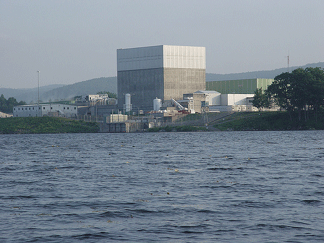
 Vermont Yankee: Expert says faster reuse unrealistic amid national waste dilemma, Brattelboro Reformer, May 5, 2017 By Lissa Weinmann, BRATTLEBORO — Hopes for an expedited decommissioning and eventual reuse of the shuttered Vermont Yankee nuclear reactor are unrealistic and potentially misplaced, according to a radioactive waste policy expert and activists who will visit Brattleboro for a community discussion on “Nuclear Waste: The Road from Vermont Yankee to Texas” on Saturday, May 6, from 4:30 to 6 pm at the community room at the Brattleboro Food Co-op.
The presentation comes as federal and state authorities consider the sale of the plant to NorthStar Industries Inc., which has touted a faster decommissioning at a lower price than Entergy had planned.
Kevin Kamps, Radioactive Waste Watchdog for Maryland-based Beyond Nuclear, who has studied nuclear waste issues in the U.S. and globally for 25 years and is to be featured at the event, said he expects decommissioning will be hampered by deeper levels of radioactive contamination and reuse delayed by the continued presence of high level nuclear waste in dry cask storage on the Yankee site for many decades to come.
Kamps’ warning of a long wait amid hot controversy was underscored by testimony at an April 26 House Energy and Commerce Committee hearing on the draft Nuclear Waste Policy Amendments Act, which would break with current law to allow private companies like Waste Control Specialists, a Texas-based partner in the proposed Yankee sale, to build consolidated interim storage facilities to accept waste from the power plant site before a permanent deep geologic repository that could best contain lethal material for hundreds of thousands of years is available. ……
The Trump Administration’s congressional budget request in March 2017 includes “$120 million to restart licensing activities for the Yucca Mountain nuclear waste repository and initiate a robust interim storage program.” The nuclear industry in 2014 stopped paying a fee on nuclear energy generation to build a central repository; That $46 billion Nuclear Waste Fund falls far short of the “trillions” the DOE anticipates will be required to fund the facility.
WCS applied to the NRC in April 2016 for a license to construct and operate a centralized interim storage site adjacent to its lower-level radioactive dump (where thousands of tons of concrete and other waste from the Vernon site will be transported) in Andrews, Texas, stipulating that the DOE must bear sole and full liability for the waste even though, under current law, liability and title remain with the generators until the waste is taken away to an operating repository.
But the effort to quickly clean up the Vernon site was dealt a significant blow when Rod Baltzer, Waste Control Specialists president and chief executive officer, wrote a letter asking the NRC to “temporarily suspend” its review of the company’s application for a high-level waste dump. Baltzer cited a “magnitude of financial burdens.” The cost of the NRC review now is estimated at $7.5 million, “which is significantly higher than we originally anticipated,” he wrote.
“The bottom line for this push to interim storage is that nuclear companies want to reduce their liability for this highly problematic waste product as quickly as possible,” said Kamps. “Republican leaders in Congress and the nuclear companies who contribute to them want to weaken the law to allow privately owned de facto permanent parking lot dumps in Texas and New Mexico where liability for any problems is transferred to the U.S. taxpayer.”……..
UCS has yet to see an analysis demonstrating that the benefits of interim storage clearly outweigh the additional costs and risks associated with siting and licensing new storage facilities and the extra transportation that would be required,” Dr. Edwin Lyman, Senior Scientist at the Union of Concerned Scientists — a group that is not against nuclear power — testified to Congress, adding that interim sites raise the potential of terrorists getting bomb-making material.
“Transporting waste is the weakest link of a nonsensical interim plan that has nothing to do with finding a permanent repository,” Kamps said. “It plays musical chairs with deadly waste on US highways and rail lines, exposing millions of people to addition risk for no good reason.”
Advocates of interim storage say radioactive materials are transported all the time without incident, but Kamps said incidents do occur and that NorthStar partner Areva had acknowledged `numerous violations of surface contamination many hundreds of times above the allowable limits’ when transporting waste in France.
“CAN advocates for hardened on site storage to protect reactor communities until there is a scientifically sound and environmentally just solution for this toxic waste,” Katz said. “The communities targeted for nuclear waste are routinely rural, low income people of color and Native Americans. It is terrible to put people in the position of having to choose between short term economic survival and long term health and safety. Reactor and targeted communities need to work together to advocate for solutions that do the least harm.”……
Kamps says there is a reason that Entergy estimated $1.2 billion cleanup and NorthStar is estimating it will take less than half of that. “I have no doubt that the site is massively contaminated. We don’t know how long the underground pipes Entergy lied about having were leaking radioactive particles into the ground.”
Katz agreed. “NorthStar will find a much larger problem as all nuclear decommissionings have, but on a fixed contract, it will devise every trick in the book to limit cleanup,” so the public must remain vigilant, Katz said. “With Yankee Rowe and Connecticut Yankee, we had to bring documents to the state to show them that Yankee was putting the test wells exactly where the contamination wasn’t.”…….http://www.reformer.com/stories/vermont-yankee-expert-says-faster-reuse-unrealistic-amid-national-waste-dilemma,506578
May 10, 2017
Posted by Christina Macpherson |
USA, wastes |
Leave a comment
Nuclear Decommissioning Citizens Advisory Panel strategizes with selectmen, Wicked Local, Plymouth By Frank Mand fmand@wickedlocal.com , 9 May 17 – The state’s Nuclear Decommissioning Citizens Advisory Panel will hold its first meeting in Plymouth on May 24, but there is already concern that that Plymouth’s representatives on the panel will have little say in the decommissioning process of the Pilgrim Nuclear Power Plant.
Based on the numbers alone, Plymouth’s interests should be well represented on the panel……..
Their basic mission, Grassie said, was to meet four times a year, advise the governor, general court and the public on the issues, “serve as a conduit of communications and encourage public involvement” and receive and issue reports.
Meanwhile, Grassie said, Entergy would hold its own meetings, including with the NRC, and making decisions including, as happened with the recently closed Entergy-owned Vermont Yankee nuclear plant, selling the decommissioning function to a separate entity altogether……..
The basic priorities that town officials and panelists will take are, however, becoming clear.
Because of safety concerns the town does not want spent fuel to be left in the pool inside the reactor building. Fortunately Entergy likely doesn’t want that either because, when the spent fuel is out of the pool they can dramatically reduce on-site staff and, therefore, reduce their management costs as well.
The town does not want spent fuel stored forever on site permanently. Unfortunately there is neither a temporary or permanent national spent fuel storage facility available at this time.
In the event that spent fuel in dry cask storage remains on site for the foreseeable future the town wants to be fairly compensated.
The town does not want to see the decommissioning fund used to pay for other costs associated with the continued presence of radioactive materials at the site. That has been happening at Vermont Yankee, where the decommissioning fund has been used to pay the tax payments charged by the host community……
The town wants the rights to the so-called “1,500 acres,” the largely pristine buffer around the plant that stretches from the waterfront around the plant, to the top of the Pine Hill.
The town wants a lot but the question on the minds of the panel members right now is simple: How can they influence the process effectively toward those goals?……..http://plymouth.wickedlocal.com/news/20170506/nuclear-decommissioning-citizens-advisory-panel-strategizes-with-selectmen
May 10, 2017
Posted by Christina Macpherson |
decommission reactor, USA |
Leave a comment
 Budgets approved to fight Yucca Mountain, https://www.reviewjournal.com/news/2017-legislature/budgets-approved-to-fight-yucca-mountain/ By Sean Whaley Las Vegas Review-Journal,May 7, 2017 CARSON CITY — The budgets for the state agencies charged with fighting the Yucca Mountain high-level nuclear waste dump were approved Saturday by the Senate Finance and Assembly Ways and Means committees.
The budget for the Agency for Nuclear Projects totals $3.8 million for the next two years, with most of the money going to fight against restarting Yucca Mountain. Of that total, $1.3 million will be spent fighting the expected restart of licensing proceedings.
The attorney general’s office budgets also were approved by the panels, including $3.4 million over two years to fight the project.
Sandoval, state Attorney General Adam Laxalt and most state lawmakers strongly oppose any restart of the Yucca Mountain licensing hearings. A resolution stating the Legislature’s opposition will get a committee hearing Monday.
But some Nevada elected officials, including Nye County Commissioner Dan Schinhofen, argue the licensing proceedings should be allowed to go forward to determine decisively whether Yucca Mountain is a suitable site for the dump. Attorneys for Nevada have raised scores of issues challenging the site’s suitability.
Despite past claims that the project has been long dead, President Donald Trump’s budget blueprint, issued in March, included $120 million in new funds to the Energy Department and the Nuclear Regulatory Commission to restart Yucca Mountain licensing activities.
The omnibus funding bill Congress approved this past week did not include any Yucca Mountain funding. But the funding could be included in the federal fiscal year 2018 budget, which begins Oct. 1.
The House Energy and Commerce Subcommittee on the Environment held a hearing on Yucca on April 26 and is expected to draft legislation for licensing proceedings to commence.
The Agency for Nuclear Projects indicated that the first step in the process is expected to be the reconstituting of the Yucca Mountain Construction Authorization Boards, followed by a case management conference. The restart proceedings could take up to a year, with hearings on challenges to the licensing application lasting three or more years.
Nevada officials estimate that a licensing hearing would require more than 400 days, taking an estimated four to five years at a cost to the Energy Department $1.66 billion.
Yucca Mountain is in Nye County, about 100 miles northwest of Las Vegas.
Contact Sean Whaley at swhaley@reviewjournal.com or 775-461-3820. Follow @seanw801 on Twitter.
May 10, 2017
Posted by Christina Macpherson |
politics, USA, wastes |
Leave a comment
Indian Point lawsuit dead before arrival, Rye City Review, May 5, 2017 by James Pero A lawsuit seeking to halt the shutdown of a long controversial nuclear power plant located at Indian Point in Buchanan is dead on arrival after staunch opposition from Westchester County’s Democratic lawmakers.
Last week, the Board of Legislators’ Democratic caucus voted to kill the lawsuit, proposed by County Executive Rob Astorino, a Republican, earlier this month, before it was even sent to committee, and well short of a vote by the full Legislature, which is required by law.
“Instead of engaging in a wasteful lawsuit where both sides are funded with taxpayer money, the best approach is to work with all of the affected communities on how to mitigate the economic, social, and environmental impacts of Indian Point closing,” said Democratic Majority Leader Catherine Borgia, of Ossining……..
County Democrats say they plan to host community meetings with affected residents and stakeholders in Indian Point as a part of their own initiative.
To lessen the economic impact on workers at the plant, Cuomo has floated a potential transition into the renewable energy sector for workers laid off by the plant’s closure.
Details of what the decommissioning process will look like will continue to be hashed out by a recently formed task force, which consists of both state and local lawmakers as well as various officials from Cuomo’s administration. http://www.ryecityreview.com/lead-stories/indian-point-lawsuit-dead-before-arrival/
May 10, 2017
Posted by Christina Macpherson |
decommission reactor, USA |
Leave a comment

Radioactive Cats and Nuclear Priests: How to Warn the Future About Toxic Waste, Motherboad, DANIEL OBERHAUS, May 7 2017
Nuclear waste can remain toxic for tens of thousands of years. How do you warn the future that they’re standing on nuclear waste when there’s no one around to translate?
This is a series around POWER, a Motherboard 360/VR documentary about nuclear energy. Follow along here.
In 1999, the Waste Isolation Pilot Plant outside of Carlsbad, New Mexico accepted its first deposit of mid-level nuclear waste. A massive network of tunnels extending nearly a quarter of a mile into the Earth, WIPP is tasked with safely storing the United States’ growing stockpile of nuclear waste for the next million years.
Due to the timescales involved when handling nuclear waste, designing deep geological repositories like WIPP is one of the most challenging engineering problems ever faced by our species. But, as it turns out, the main problem has less to do with engineering, and more to do with linguistics: namely, how to design a warning message about the repository that will be intelligible to future generations of humans who might happen across it hundreds of thousands of years from now.
The solution isn’t as simple as it seems. Humans have only been writing for about 5,500 years, and many ancient languages have forever been lost to history. The idea of using a language to write out a warning message that would last 200 times longer than the most ancient languages seems improbable at best. Even conventional warning symbols like the skull and crossbones are far from universal.
As for building giant, foreboding monuments to scare people away? One need only look to the great pyramids to see how well that worked at keeping people out. Another idea was simply to bury the waste and forget about it, which raises a significant ethical issue: Do we have an obligation to warn future generations about our nuclear waste?
In 1981, the US Department of Energy convened an eclectic panel of experts to design a warning message that would last millennia. Known as the Human Interference Task Force, the group was led by the renowned semiotician Thomas Sebeok.
The group’s message was being designed for Yucca Mountain, a controversial high-level waste repository in Nevada that is still not open for business, largely due to the extremely complex nature of designing a million-year nuclear vault.
Following the initial call for ideas, a poll was conducted by the German Journal of Semiotics between 1982 and 1983 that asked for proposals addressing the question of how to communicate the dangers of a nuclear waste repository to people 10,000 years in the future. The most compelling was Sebeok’s plan for a nuclear priesthood, which would pass on information to future generations through myths and rituals. It was based on the idea of the Catholic Church, which has managed to transmit its messages for nearly 2,000 years.
Less formal styles of oral tradition, such as Icelandic family sagas, have also been shown to retain a high degree of accuracy after 1,000 years.
Other ideas were slightly more outlandish. Stanislaw Lem, a Polish sci-fi writer, suggested periodically putting satellites into orbit that would transmit information about the sites to Earth for hundreds of years at a time. A similar proposal was put forth by Philipp Sonntag, who advocated for “an artificial moon in the sky” as the safest place to store information about the repository. Another of his ideas was to encode information about the site into the DNA of plants, which would then be planted around the repository opening.
In a similar vein, the Italian semiotician proposed breeding “
radiation cats” that would change color when they came near radioactive sites. The thinking was that, based on the long history of human-feline cohabitation, there was a good chance that this would continue into the future and our feline friends could warn us of the danger.
After two years of deliberation, the Human Interference Task Force issued a large technical report for the Department of Energy containing their final recommendations. Perhaps unsurprisingly, neither ray cats nor radioactive flowers made the cut. Instead, the task force proposed creating a large monument over the site, consisting of several stone monoliths inscribed with information in all human languages, as well as a subterranean vault with more detailed information, and a number of earthen walls making access to the site intentionally difficult.
Furthermore, the group recommended dispersing detailed information about the site to libraries around the globe, to prevent some sort of cataclysmic, Library of Alexandria-type of information loss should a disaster strike one of the sites……… https://motherboard.vice.com/en_us/article/radioactive-cats-and-nuclear-priests-how-to-warn-the-future-about-toxic-waste
May 8, 2017
Posted by Christina Macpherson |
2 WORLD, wastes |
Leave a comment
SOME PREDICT TROUBLE OVER RUBBLE AT VERMONT YANKEE, VT DIGGER
MAY. 3, 2017, BY MIKE FAHER VERNON – Tearing down Vermont Yankee could produce more than 2.1 million cubic feet of crushed concrete.
And new documents show that more than half of that concrete – 1.1 million cubic feet – might be buried on site as part of a “rubblization” plan developed by NorthStar Group Services, the company that wants to buy the shut-down Vernon nuclear plant.
Both NorthStar and current plant owner Entergy pledge that only clean concrete will be used as fill. And administrators are touting the plan’s benefits, saying it will save millions of dollars and keep thousands of trucks off local roads.
Vermont Yankee has “large quantities of uncontaminated concrete acceptable for reuse as fill that would provide economic benefits, with no health or safety risk due to residual radioactivity, and avoid unnecessary traffic, transportation and disposal offsite,” Steven Scheurich, an Entergy vice president, wrote in documents filed with the state Public Service Board.
But the proposal could prove to be a sticking point for state officials and activists. Ray Shadis, a technical adviser with the watchdog group New England Coalition, argues that NorthStar is planning, “in essence, a capped landfill.”
“It’s a very important issue for us,” Shadis said. “It’s a major issue.”
Entergy is seeking approval from the Vermont Public Service Board and the federal Nuclear Regulatory Commission to sell Vermont Yankee to NorthStar, a New York-based decommissioning company.
May 8, 2017
Posted by Christina Macpherson |
USA, wastes |
Leave a comment
 Japan seeks final resting place for highly radioactive nuclear waste http://www.dw.com/en/japan-seeks-final-resting-place-for-highly-radioactive-nuclear-waste/a-38709488, 5 May 17,
With communities refusing to come forward to host the by-product of Japan’s nuclear energy industry, the Japanese government is drawing up a map of the most suitable locations for underground repositories.
The Japanese government is putting the finishing touches to a map of the country identifying what its experts consider to be the safest location for a repository for 18,000 tons of highly radioactive nuclear waste for the next 100,000 years. The map is expected to be released next month and will coincide with the government holding a series of symposiums across the country designed to explain why the repository is needed and to win support for the project.
Given that the disaster at the Fukushima Dai-ichi nuclear plant in March 2011 is still fresh in the memory of the Japanese public, the government’s plan is not expected to win much understanding or support.
The original proposal for a repository for the waste from the nation’s nuclear energy sector was first put forward in 2002, but even then there were few communities that were willing to be associated with the dump. Fifteen years later, and with a number of Japan’s nuclear reactors closed down for good in the wake of the Fukushima accident, the need for a permanent storage site is more pressing than ever.
Radioactivity release
The disaster, in which a 13-meter tsunami triggered by an off-shore earthquake crippled four reactors at the plant and caused massive amounts of radioactivity to escape into the atmosphere, also underlined just how seismically unstable the Japanese archipelago is and the need for the repository to be completely safe for 100,000 years.
Aileen Mioko-Smith, an anti-nuclear campaigner with Kyoto-based Green Action Japan, does not believe the government can deliver that guarantee.
“You only have to look at what happened in 2011 to realize that nowhere in Japan is safe from this sort of natural disaster and it is crazy to think otherwise,” she told DW.
Given the degree of public hostility, Mioko-Smith believes that the government will fall back on the tried-and-trusted tactic of offering ever-increasing amounts of money until a community gives in.
Government funds
“They have been trying to get this plan of the ground for years and one thing they tried was to offer money to any town or village that agreed to even undergo a survey to see if their location was suitable,” she said.
“There were a number of mayors who accepted the proposal because they wanted the money – even though they had no intention of ever agreeing to host the storage site – but the backlash from their constituents was fast and it was furious,” Smith added.
“In every case, those mayors reversed their decisions and the government has got nowhere,” she said. “But I fear that means that sooner or later they are just going to make a decision on a site and order the community to accept it.”
The security requirements of the facility will be exacting, the government has stated, and the site will need to be at least 300 meters beneath the surface in a part of the country that is not subject to seismic activity from active faults or volcanoes. It must also be safe from the effects of erosion and away from oil and coal fields. Another consideration is access and sites within 20 km of the coast are preferred.
High-level waste
The facility will need to be able to hold 25,000 canisters of vitrified high-level waste, while more waste will be produced as the nation’s nuclear reactors are slowly brought back online after being mothballed since 2011 for extensive assessments of their safety and ability to withstand a natural disaster on the same scale as the magnitude-9 earthquake that struck Fukushima.
Stephen Nagy, a senior associate professor of international relations at Tokyo’s International Christian University, agrees that the government will have to pay to convince any community to host the facility.
“They will probably peddle it as subsidies for rural revitalization, which is a tactic that all governments use, but there are going to be some significant protests because Fukushima has created a nuclear allergy in most people in Japan,” he said.
“I expect that the government would also very much like to be able to phase out nuclear energy, but that is simply not realistic at the moment,” he said.
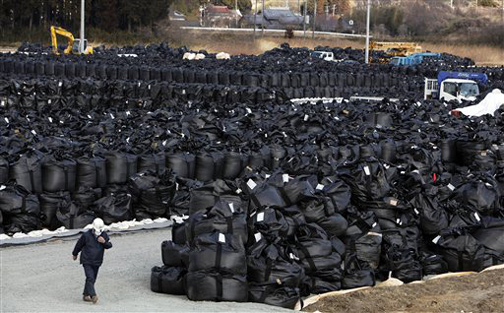
When it is released, the government’s list is likely to include places in Tohoku and Hokkaido as among the most suitable sites, because both are relatively less populated than central areas of the country and are in need of revitalization efforts. Parts of Tohoku close to the Fukushima plant may eventually be chosen because they are still heavily contaminated with radiation from the accident.
May 6, 2017
Posted by Christina Macpherson |
Japan, wastes |
Leave a comment

Brussels plans to saddle UK with EU nuclear waste Britain’s impending split from Euratom indicative of complexity of Brexit, Ft.com by: Arthur Beesley in Brussels and Andrew Ward in London, 4 May 17 Britain will be on the hook for large volumes of dangerous radioactive waste — some of it imported from the rest of Europe — under proposals by Brussels to transfer ownership of a range of nuclear materials to the UK after it leaves the EU.
Almost 130 tonnes of plutonium stored at Sellafield in Cumbria is among the nuclear material that would formally shift to UK control, according to draft documents issued by Michel Barnier, the EU’s chief Brexit negotiator. All “special fissile material” — forms of uranium and plutonium used in nuclear fuels and some of the resulting waste — within the EU are technically owned by Euratom, the pan-European regulator of civilian nuclear activity.
Mr Barnier’s provisional negotiating position calls for a Brexit agreement to “ensure, where appropriate, the transfer to the United Kingdom” ownership of “special fissile material” currently controlled by Euratom within the UK. Such an agreement would make the UK legally responsible not only for its own nuclear material but also reprocessed spent fuel imported over several decades from Germany, Sweden and elsewhere for recycling at Sellafield. “What was a joint European legacy now becomes a UK home brew, with potentially dire economic consequences for the UK given the sheer expense and weight of this radiological inventory,” said Paul Dorfman, honorary senior researcher at the Energy Institute at University College London……..
Mr Barnier’s proposal for the UK to assume “all rights and obligations associated with the ownership of [fissile] materials or property transferred” is seen in Brussels as a necessary housekeeping exercise to remove Euratom’s claim on nuclear fuel used in UK power stations as well as uranium isotopes used in radiotherapy. But it highlighted the uncertainty facing Britain’s nuclear industry — responsible for about a fifth of domestic electricity generation — in the run-up to Brexit. Euratom is a separate legal entity to the EU but is governed by EU institutions and the UK government says it has no option but to leave both at the same time. A UK government spokeswoman said: “Leaving Euratom is a result of the decision to leave the EU as they are uniquely legally joined.”
As well as nuclear fuel and reprocessed waste, the UK would also take ownership of Euratom property used to safeguard the material, such as inspection and monitoring equipment, according to the EU proposals. The negotiation directives, which are subject to the agreement of the 27 remaining member states, were published on Wednesday as Mr Barnier set out his hardline opening position for talks with London…….
https://www.ft.com/content/4cd8a146-3039-11e7-9555-23ef563ecf9a
May 5, 2017
Posted by Christina Macpherson |
politics international, UK, wastes |
Leave a comment
Government to release map of potential final nuclear disposal sites this summer, Japan Times, 3 May 17 KYODO, STAFF REPORT, The government has set the criteria for a map meant to identify potential final disposal sites for high-level radioactive nuclear waste, paving the way for its release as early as this summer.
The process of finding a host for nuclear waste could face challenges amid public concerns over safety.
Based on the map, the government will approach select municipalities to allow research to be conducted for suitable sites to store waste from nuclear power generation.
For permanent disposal, high-level nuclear waste needs to be stored at a final depository more than 300 meters underground for up to about 100,000 years until radiation levels fall and there is no longer potential harm to humans and the environment.
The government plans to create a permanent underground repository somewhere in stable bedrock so the canisters can be stored for tens of thousands of years.
The map is likely to classify which areas are geologically suitable for such a structure to be built deep enough underground. This would rule out areas near active faults and volcanoes as well as oil and coal fields.
Based on waste transport criteria, the map is likely to show that zones within 20 km of the coastline are favorable to host final disposal sites.
The government hopes other municipalities — not just the ones located near nuclear power plants — may also become interested in hosting the disposal facilities. It also wants to show that a variety of places nationwide are suitable for nuclear waste management.
The map was originally planned for a 2016 release but the publication date was later postponed, as some local governments were wary that disposal sites would be imposed on them.
About 18,000 tons of spent fuel currently exist in Japan. Including spent fuel that has already been reprocessed, the country’s total jumps to about 25,000 canisters of vitrified high-level waste, all of which needs to be managed.
The process to find local governments willing to host final storage started in 2002, but little progress was made due mainly to opposition from local residents.
In May 2015, the central government introduced a plan announcing that final depository site selection would be based on scientific grounds, rather than waiting for municipalities to volunteer.
Before presenting the map, the government will hold symposiums between mid-May and June at nine cities to explain the map criteria to the public. The cities include Tokyo, Nagoya and Fukuoka…….http://www.japantimes.co.jp/news/2017/05/02/national/government-release-map-potential-final-nuclear-disposal-sites-summer/#.WQlFDEWGPGg
May 3, 2017
Posted by Christina Macpherson |
Japan, wastes |
Leave a comment
 The final mission for Cassini, Enformable, 26 Apr 17, Karl Grossman Despite protests around the world, the Cassini space probe—containing more deadly plutonium than had ever been used on a space device—was launched 20 years ago. And this past weekend—on Earth Day—the probe and its plutonium were sent crashing into Saturn.
The $3.27 billion mission constituted a huge risk. Cassini with its 72.3 pounds of Plutonium-238 fuel was launched on a Titan IV rocket on October 17, 1997 despite several Titan IV rockets having earlier blown up on launch.
At a demonstration two weeks before in front of the fence surrounding the pad at Cape Canaveral from which Cassini was to be launched, Dr. Michio Kaku, professor of theoretical physics at the City University of New York, warned of widespread regional damage if this Titan IV lofting Cassini exploded on launch. Winds could carry the plutonium “into Disney World, University City, into the citrus industry and destroy the economy of central Florida,” he declared………
on an Earth “flyby” by Cassini , done on August 18, 1999, it wouldn’t have been a regional disaster but a global catastrophe if an accident happened.
Cassini didn’t have the propulsion power to get directly from Earth to its final destination of Saturn, so NASA figured on having it hurtle back to Earth in a “sling shot maneuver” or “flyby”—to use Earth’s gravity to increase its velocity so it could reach Saturn. The plutonium was only used to generate electricity—745 watts—to run the probe’s instruments. It had nothing to do with propulsion.
So NASA had Cassini come hurtling back at Earth at 42,300 miles per hour and skim over the Earth’s atmosphere at 727 miles high. If there were a rocket misfire or miscalculation and the probe made what NASA in its “Final Environmental Impact Statement for the Cassini Mission” called an “inadvertent reentry,” it could have fallen into Earth’s atmosphere, disintegrating, and releasing plutonium. Then, said NASA in its statement, “Approximately 7 to 8 billion world population at a time … could receive 99 percent or more of the radiation exposure.”
The worst accident involving space nuclear power occurred in 1964 when a satellite powered by a SNAP-9A plutonium system failed to achieve orbit and fell to Earth, breaking apart and releasing its 2.1 pounds of Plutonium-238 fuel, which dispersed all over the planet. According to the late Dr. John Gofman, professor of medical physics at the University of California at Berkeley, that accident contributed substantially to global lung cancer rates……….
the U.S. Department of Energy working with NASA has started up a new production facility at its Oak Ridge National Laboratory in Tennessee to produce Plutonium-238 for space use. Other DOE labs are also to participate.
Says Gagnon of the Maine-based Global Network: “Various DOE labs are rushing back into the plutonium processing business likely to make it possible for the nuclear industry to move their deadly product off-planet in order to ensure that the mining operations envisioned on asteroids, Mars, and the Moon will be fully nuclear-powered. Not only do the DOE labs have a long history of contaminating us on Earth but imagine a series of rocket launches with toxic plutonium on board that blow up from time to time at the Kennedy Space Center. They are playing with fire and the lives of us Earthlings. The space and the nuke guys are in bed together and that is a bad combination—surely terrible news for all of us.”
“The Global Network,” said Gagnon, “remains adamantly opposed to the use of nuclear power in space.” http://enformable.com/2017/04/the-final-mission-for-cassini/?utm_source=feedburner&utm_medium=email&utm_campaign=Feed%3A+Enformable+%28Enformable%29
April 28, 2017
Posted by Christina Macpherson |
- plutonium, safety, technology, USA |
Leave a comment