Long term safety of spent nuclear fuel storage canisters is far from assured
 Premature failure of U.S. spent nuclear fuel storage canisters, San Onofre Safety,
 “……. The dry cask systems …..may fail within 30 years or possibly sooner, based on information provided by Nuclear Regulatory Commission (NRC) technical staff.
There is no technology to adequately inspect canisters.
There is no system in place to mitigate a failed canister……..
Canisters may need to be replaced within 30-42 years or sooner.…
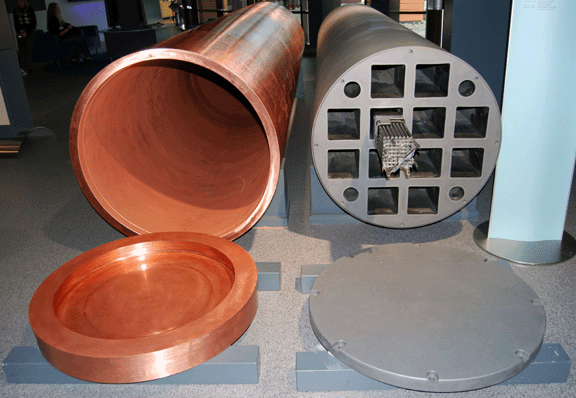

Spent nuclear fuel canisters vulnerable to failure as they age
Premature failure of U.S. spent nuclear fuel storage canisters, San Onofre Safety.org, “……Stainless Steel Dry Canister Problems Darrell Dunn, an NRC materials engineer, stated stainless steel dry storage canisters are vulnerable to failure within about 25 – 42 years. If any of the fuel cladding in the canister fails, there is no protective barrier and we could have a serious radiation release.
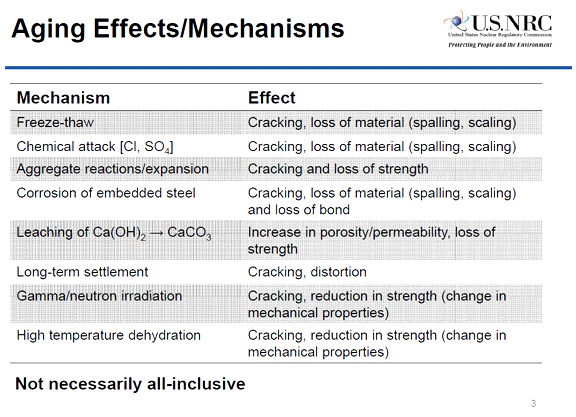
The NRC said they have no current mitigation plan for that consequence. They suggested we MIGHT be able to put the fuel back in the spent fuel pool. However, Edison plans to destroy the spent fuel and transfer pools. And there is no technology to repair the canisters. The NRC said they HOPE there will be a solution for mitigation in the future. Even an NRC May 2nd High Burnup Fuel letter admits there are mitigation problems.
No Inspections of Stainless Steel Canisters EPRI 2012 presentation To make matters worse, these stainless steel canisters are not inspected after they are loaded into the unsealed concrete overpacks (Areva NUHOMS) or concrete casks (Holtec and NAC Magnastor). The NRC proposed having each nuclear plant inspect the outside of only ONE stainless steel canister before they receive a license renewal and then do that once every 5 years. The industry balked at having to even check one canister at every plant. The problem with the stainless steel canisters is they do not protect against gamma rays; so it’s not a simple task to remove a canister from the concrete overpack/cask to examine the exterior for corrosion or other degradation. And since welded canisters do not have monitoring for helium leaks, we may not have any warning of an impending radiation release.
Concrete Overpack Corrosion Problems Darrell Dunn discussed serious corrosion problems with the concrete overpacks/casks, especially in coastal environments…….. https://sanonofresafety.org/2014/08/21/premature-failure-of-u-s-spent-nuclear-fuel-storage-canisters/
Nuclear power leaves a terrible legacy of radioactive trash – new book
The Legacy of Nuclear Power,This fascinating short article on four nuclear communities tellingly demonstrates why radioactive waste is a moral issue and explains what the priorities for its management should be. Routledge, By Andy Blowers. 7 Oct 16
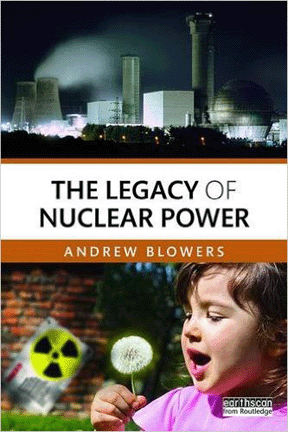
1. Hanford, USA
Scattered across a vast site in Washington state in America’s North West is Hanford, one of the most contaminated places in the world. During the war Hanford was the scene of frenzied activity as the chosen location for the manufacture of the plutonium for the ‘Fat Man’ nuclear weapon that devastated Nagasaki on 9 August, 1945. In the subsequent Cold War, Hanford’s nuclear activities expanded comprising eight nuclear reactors along the banks of the Columbia River, the sinister looking reprocessing ‘canyons’ in the middle of the reservation and a variety of production and experimental facilities scattered around its fringes. Production at Hanford has ceased but a vast nuclear legacy remains especially in the tank farms containing high-level liquid waste and sludge, some leaking towards the Columbia, in the abandoned reactors and decommissioned reprocessing works and in waste management facilities and clean-up projects. Cleaning up the legacy is a long-term, costly ($2billion federal funding a year), intractable and complex task but it is an inescapable one.
2. Sellafield, UK
Sellafield, the heart of the UK’s plutonium economy, is in a stage of transition from production to clean-up. Like Hanford, Sellafield’s nuclear legacy stretches back to the early days of the military nuclear programme when little attention was paid to the wastes. Unlike Hanford, the Sellafield site is very compact, a mere 2 sq. km., but crammed on to it is around two-thirds of all the radioactivity from the UK’s nuclear programme. The legacy comprises all the country’s high level wastes, most of the spent fuel, a stockpile of around 140 tonnes of plutonium and complex streams of wastes. Hemmed in within a complex of buildings, many of them redundant, are large grey anonymous structures containing often unrecorded mixtures of fuel, skips and other highly radioactive debris tipped into the notorious ponds and silos which pose what has been called an ‘intolerable risk’ to the public and the environment. Cleaning up this legacy is a task that stretches decades ahead absorbing around £1.7 billion from the government a year.
3. La Hague, France
In France, where three-quarters of the country’s electricity is produced by its 58 reactors, the nuclear industry is mainly focused around the reprocessing facilities at La Hague at the tip of the Cotentin peninsula in Normandy. At this remote location spent fuel is reprocessed for recycling in the form of mixed oxide fuel (MOX) or vitrified and stored pending disposal. After much searching, an underground laboratory has been developed in eastern France at Bure, a nuclear no-man’s land, stealthily and steadily becoming established as the country’s nuclear disposal site, but still a long way off. Meanwhile, the French nuclear legacy continues to accumulate at power stations soon to be decommissioned, at La Hague and other sites of reprocessing and experimental reactors.
4. Gorleben, Germany
In Germany there has been fierce resistance for more than three decades to the prospect of shipping casks of highly radioactive wastes across the country to Gorleben in the middle of the country. The casks are sent to an interim store for possible burial in a neighbouring excavated salt mine. Gorleben has played both a symbolic and political role in bringing down the German nuclear industry. The symbols of protest festoon the countryside. There are the ubiquitous wooden yellow crosses on farms and villages, the bright orange sun on a green background displayed on posters and flags proclaiming the ‘Free Republic of Wendland’ and the slogan ‘Stop CASTOR’ (the soubriquet for the flasks) daubed on walls and electricity sub-stations. These gave identity to this fiercely independent land of forest, heath and waterlands close by the River Elbe. Drawing on this real and invented cultural legacy, the Gorleben movement became an inspiration for the wider German anti-nuclear protest.
Places on the Periphery
These four places, Hanford, Sellafield, La Hague/Bure and Gorleben with their different histories exemplify and explain the physical imprint and social conditions that are the continuing legacy of nuclear power. They constitute what may be defined as peripheral communities, places where hazardous activities are located and which are, as it were, physically and socially set apart from the mainstream. They tend to be geographically remote. They may be located at the edge whether of a country, as at La Hague, in relatively inaccessible sub-regions as at Sellafield or in areas of sparse population as Hanford was before the war and as Bure is today. They may be areas with a distinctive (real or invented) cultural identity or isolation like Gorleben, in the self-declared Wendland once on the border with Eastern Germany. Peripheral communities tend also to be economically marginal, monocultural and dependent on government investment and subsidy or state owned companies………..https://www.routledge.com/posts/10360?utm_source=adestra&utm_medium=email&utm_campaign=160701303
The inherently immoral nuclear industry and its radioactive trash problem
There’s been the usual evasion and wilful dishonesty on the part of both EdF and the Government as to exactly how the costs of managing that waste over the projected 30-year lifetime of Hinkley Point will be paid for. In the first instance, how best should EdFbe required to accrue for a sufficient share of revenue to cover those costs arising during the reactor’s lifetime – and then for decades/centuries beyond that once HinkleyPoint has stopped generating?
This is such a huge issue – financially and morally. The sums of money involved in treating, storing and finally disposing of nuclear waste are eye-watering, and if they were properly factored into the day-to-day operating costs of all nuclear power stations, it would make the whole ludicrous edifice finally topple over.
this is not just a managerially incompetent, technologically redundant, financially bankrupt and wilfully dishonest industry – it is inherently immoral.
The Hinkley Horror Story: Don’t Mention the Waste! http://www.jonathonporritt.com/blog/hinkley-horror-story-dont-mention-waste I haven’t been able to bring myself to write anything about Hinkley Point since the UK Government gave the go-ahead on 15th September. I suppose I’ve lived for so long with the inevitability of this insane project being approved, at some point, notwithstanding the endless delays, that I wasn’t particularly surprised when it happened. Just a weird mixture of resigned, weary and enraged.
Deep down, I still don’t believe that Hinkley Point will ever be completed. I’ve no doubt work will start in one or two years’ time (just as soon as a mountain of continuing problems at EdF’s project at Flamanville have either been resolved or permanently buried), but it won’t be long before the inherent ‘unconstructability’ of this particular reactor design (the EPR) sees exactly the same inevitable delays and cost overruns kick in – and keep on kicking in from that point on.
And somewhere along the way, there’s an equally strong likelihood of EdF/Areva going bust – or having its role comprehensively redefined by the French Government so that it focusses solely on managing upgrades in the French reactor fleet and dealing with all the legacy issues.
And those legacy issues are vast. As they are for all nuclear operators all around the world. Which is the main reason, I suspect, why hardly anyone has been talking about what’s been agreed in terms of dealing with all the new nuclear waste that would be generated by Hinkley Point.
There’s been the usual evasion and wilful dishonesty on the part of both EdF and the Government as to exactly how the costs of managing that waste over the projected 30-year lifetime of Hinkley Point will be paid for. In the first instance, how best should EdFbe required to accrue for a sufficient share of revenue to cover those costs arising during the reactor’s lifetime – and then for decades/centuries beyond that once HinkleyPoint has stopped generating?
This is such a huge issue – financially and morally. The sums of money involved in treating, storing and finally disposing of nuclear waste are eye-watering, and if they were properly factored into the day-to-day operating costs of all nuclear power stations, it would make the whole ludicrous edifice finally topple over.
Nobody’s thought more about these legacy issues, going back to the origins of the nuclear industry here in the UK in the 1950s, than Andy Blowers. His new book, ‘The Legacy of Nuclear Power’, has just been published, and even for those who have been tracking this particularly wretched aspect of an almost entirely wretched industry, it’s a pretty mind-boggling story that emerges.
Here are the words that I contributed by way of an endorsement for ‘The Legacy of Nuclear Power’:
“The nuclear industry invites us, all the time, to look forward – never to look back. Andy Blowers’ compelling study shows why: its legacy, all around the world, is a shocking one, with no long-term solutions to the problem of nuclear waste in sight, and countless communities blighted, in one way or another, by the nuclear incubus in their midst.”
Unbelievably, the UK’s dismal record in managing its nuclear waste (for both military and civilian facilities) is no worse than that of the USA (with the Hanford site in Washington State posing equally horrendous, ongoing legacy issues as Sellafield here in the UK) or of France, with its reprocessing waste management facilities at La Hague. Only Germany can demonstrate a rather better record – though that has little to do either with the industry or with the German Government, and everything to do with an implacably hostile anti-nuclear movement which has fought for decades to ensure that Germany’s nuclear waste should not be dumped at the designatedGorleben site and then forgotten about.
Andy has written an excellent summary article about these four sites.
(And for the story about what’s going on at Sellafield – in terms of the UK’s nuclear fuel reprocessing debacle – check out this article from Ian Fairlie, commenting on BBC Panorama’s recent exposé.)
What I most admire about Andy’s analysis is that it not only covers the all-but-unbelievable financial consequences of our nuclear legacy, but forces people to confront the moral implications of an industry that defers costs not just into the future but across generations.
One of the reasons why I’m still passionate about the concept of sustainable development (rather than the environment per se) is its unwavering advocacy ofintergenerational justice: being explicit about what any one generation owes to all those generations that succeed it. The nuclear industry today only survives by ruthlessly ignoring those intergenerational obligations: the economics of nuclear power only ‘work’ because it dumps the intractable problems of managing its waste onto future generations.
In other words, this is not just a managerially incompetent, technologically redundant, financially bankrupt and wilfully dishonest industry – it is inherently immoral.
And yet, even now, there are a few misguided environmentalists who tell us that our low-carbon future depends on investing yet more countless billions of dollars in this failed horror story of an industry.
There should be no new nuclear build. We cannot manage the existing nuclear wastes, let alone more
The focus should be on managing it where it is rather than a premature search for new places and possibly new communities for deep disposal. The problem we already have is difficult enough and will only be compounded if new reactors are built extending the time-scales for implementation for very long, unknowable periods in the future. The burden of the existing legacy is unavoidable; we should not entertain having to deal with the avoidable wastes of a new build programme………
The Legacy of Nuclear Power,This fascinating short article on four nuclear communities tellingly demonstrates why radioactive waste is a moral issue and explains what the priorities for its management should be. Routledge, By Andy Blowers. 7 Oct 16
Peripheral communities tend also to be politically powerless. Although nuclear industries tend to have a dominant position in their dependent communities, strategic decisions are taken elsewhere by governmental and corporate institutions. Key political decisions affecting peripheral communities are vested in national governments to which local governments, even in federal systems like the USA and Germany, are subordinated in terms of nuclear decision making.
These nuclear peripheral communities also express distinctive cultural characteristics. Although it is difficult to pin down the complex, ambiguous and sometimes contradictory values and attitudes encountered in these places, there does seem to be a particular ‘nuclear culture’, that is both defensive and aggressive. This may be summarised in three distinguishing and complementary cultural features – realism, resignation and pragmatism – which combine to convey a resilience that provides the flexibility and resolution necessary for cultural survival.
Nuclear communities fulfil a fundamental social role in that they take on (or more usually have to accept) the radioactive legacy of nuclear power. They bear the burden of cost, risk and effort necessary to manage the legacy on behalf of the wider society, a responsibility extending into the far future. This social role enables places like Sellafield, La Hague and Hanford to exercise some economic and political leverage. Economically they are relatively secure for, once production ceases, there remain decades of clean up activity often sustaining a large workforce with continuing and open ended commitment from the state. Politically they are able, with varying success, to gain compensation, investment and diversification. By contrast, there are those communities which have mobilised resources of power sufficient to prevent or halt the progress of nuclear power. The story of the Gorleben movement provides a compelling example of the power of resistance. https://www.routledge.com/posts/10360?utm_source=adestra&utm_medium=email&utm_campaign=160701303
Finding a Solution
It is in places like Hanford, La Hague and Sellafield that the nuclear legacy has accumulated and which face the problem of managing it now and for generations to come. There is a recognised obligation, stated in principle by the International Atomic Energy Agency, that the legacy shall be managed in ‘such a way that will not impose undue burdens on future generations’ (IAEA, Principle 5). Much of this effort to find a final solution has been focused on deep geological disposal, removing the problem altogether by burying it deep underground. Yet, this solution is controversial since some radionuclides remain harmful for thousands of years and over infinitely long time-scales the uncertainties about safety and security of engineered barriers and geological containment in a repository become incommensurable……….
Seeking and securing disposal sites which is the contemporary approach, has in most countries thus far proved a slow, tedious and unsuccessful process. Successive attempts to secure political or social blessing for a site near Sellafield have failed and in Germany the resistance of Gorleben has been legendary. The history of trying to find sites for a repository for radioactive wastes is littered with examples where, to transcribe a biblical expression, many sites have been called but few chosen. The idea of the accumulating legacy of nuclear wastes from existing nuclear programmes being neatly and routinely packaged and transferred to a welcoming and pristine repository there to be entombed for ever is, with rare exceptions, little more than a distant prospect at this point in time……..
Given the time-scales involved there is no need to hurry towards a disposal solution that may, in terms of proving a concept and finding a site, be difficult to implement. Society can, and should, take its time in dealing with its nuclear legacy. Meanwhile the focus should be on managing it where it is rather than a premature search for new places and possibly new communities for deep disposal. The problem we already have is difficult enough and will only be compounded if new reactors are built extending the time-scales for implementation for very long, unknowable periods in the future. The burden of the existing legacy is unavoidable; we should not entertain having to deal with the avoidable wastes of a new build programme………
This article previews a new book by Andrew Blowers, The Legacy of Nuclear Power, Routledge, 2016, isbn 9780415869997. It is published at a critical time when the future of nuclear energy is high on the political agenda across the world. With the political focus on whether to build new nuclear power stations, this important book is a timely reminder that nuclear energy comes with a legacy of radioactive waste and clean-up that will be a burden on communities and generations far into the future. Written from the author’s perspective of active involvement in nuclear policy making, as academic, politician, government advisor and activist, this is a book that demonstrates the scale of the problem of nuclear’s legacy. https://www.routledge.com/posts/10360?utm_source=adestra&utm_medium=email&utm_campaign=160701303
Federal compensation wanted by town of Rowe, for hosting stranded nuclear wastes
Rowe Board of Selectmen chair Marilyn Wilson said the town over the summer heard from Illinois Republican Rep. Robert J. Dold concerning a bill that would help towns that host a “stranded spent nuclear fuel storage site.”
A plainclothes guard with an assault-style rifle stood at the front gate. Reporters were told to point their cameras away from the facility.
Rowe seeks federal compensation for hosting nuclear waste at former atomic power plant http://www.masslive.com/news/index.ssf/2016/10/rowe_seeks_federal_compensatio.html ROWE — Yankee Rowe Nuclear Power Station shut down in 1992, and was demolished and decommissioned by 2007, but the fenced and isolated site on the upper Deerfield River still hosts 127 tons of spent fuel and high-level radioactive waste in 16 concrete casks under 24-hour security.
The tiny town of Rowe is one of about a dozen communities nationwide affected by the presence of nuclear waste, but no longer benefiting economically from the presence of a functioning reactor.
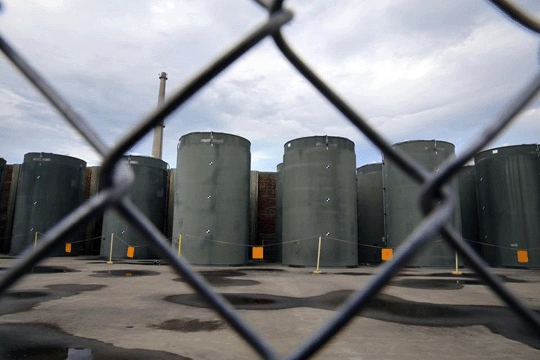
On Monday, U.S. Rep. Richard Neal and state Sen. Paul Mark (D-Peru) toured the site as guests of the Rowe Board of Selectmen. Mark is a member of the Yankee Rowe Spent Fuel Storage & Removal Citizens Advisory Committee. Neal, who represents the state’s 1st Congressional District, assured local officials that he supports bipartisan legislation in Washington that would compensate communities that are forced to store nuclear waste.
The “Interim Spent Nuclear Fuel Storage Compensation Act” would seek up to $100 million for 13 towns ranging from Zion, Illinois to Wiscasset, Maine.
“The federal government is obligated to provide mitigation costs to communities such as Rowe, considering that the Department of Energy failed to remove the waste as promised,” said Neal, a Democrat.
It was never the intention of the federal government for small towns such as Rowe to host spent fuel rods forever.
The Nuclear Waste Policy Act of 1982 directed the U.S. Department of Energy to take ownership of the nation’s nuclear waste. The plan was to build a repository at Yucca Mountain in Nevada, but the facility was never built. Capping decades of gridlock, the Obama administration withdrew support for the plan in 2011.
Various nuclear plant owners, who over the years paid into a Department of Energy Fund to handle their waste, repeatedly sued the government over the broken promise, and dozens of settlements to date have cost taxpayers a combined $4 billion.
Rowe Board of Selectmen chair Marilyn Wilson said the town over the summer heard from Illinois Republican Rep. Robert J. Dold concerning a bill that would help towns that host a “stranded spent nuclear fuel storage site.” She said the proposed bill recognizes that such communities have become de facto interim nuclear waste sites.
Wilson said when Yankee Rowe was fully operational, the company paid for the town’s police, fire, and emergency response budgets, on top of paying substantial property taxes. Now taxes are diminished and public safety expenses are borne by local taxpayers. The town continues to bear other plant-related costs, she said.
Event without the nuke, Rowe enjoys a solid tax base thanks to several hydro-electric facilities on the Deerfield River. With a population of 358, its own elementary school, and hundreds of acres of conservation land, the residential tax rate remains at $6.03 per thousand valuation. The commercial and industrial tax rate stands at $13.31. The tax history of the Yankee Rowe plant was not immediately available. The company owns more than 1,700 acres.
Members of the press, initially invited by Neal’s office to attend Monday’s tour, were blocked from attending by plant officials, who cited security reasons. A plainclothes guard with an assault-style rifle stood at the front gate. Reporters were told to point their cameras away from the facility.
Robert Capstick, a spokesman for Yankee Rowe, said he is as eager as town officials to see a solution. The company spends millions every year to host the waste that the government failed to remove, he said. In New England, other plants with stranded waste are Maine Yankee, Vermont Yankee, and Connecticut Yankee.
Meanwhile, the Department of Energy is considering privately-owned interim storage to overcome the impasse in Congress over authorizing a permanent site. Waste Control Specialists proposes an interim facility for 40,000 tons of nuclear waste in West Texas. Energy Secretary Ernest Moniz has said siting of interim facilities would be done under a “consent-based” model.
Moniz still acknowledges the need for an permanent, underground geological repository. About 2,000 metric tons of spent nuclear fuel is created every year.
China’s growing nuclear waste problem
waste levels are growing rapidly. The government-backed China Nuclear Energy Association said that by the end of 2020, the nation’s nuclear plants will have to get rid of more than 1,000 tonnes of spent fuel each year……
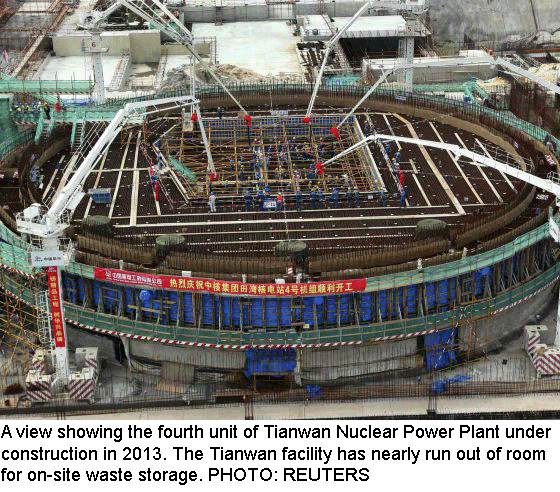
The Tianwan facility as well as the Daya Bay nuclear plant complex in the southern city of Shenzhen have nearly run out of room for on-site waste storage, said Mr Chai Guohan, chief engineer at the Ministry of Environmental Protection’s Nuclear and Radiation Safety Centre.
Spent-fuel issues cloud China’s nuclear expansion Questions raised over country’s ability to handle radioactive waste as storage space runs out, Today, BEIJING , 2 Oct 16— A Chinese nuclear power plant construction programme has been on a fast track ever since the government’s four-year moratorium on building such facilities was lifted this year.
Now, five years after Japan’s 2011 Fukushima disaster led to the moratorium, China is fully engaged in an expansion that is scheduled to add 24 new reactor units to the nation’s existing 32.
But nuclear plant construction projects have stirred controversy in China, particularly due to questions surrounding incomplete plans for handling a dangerous by-product of nuclear energy — radioactive waste.
In August, hundreds of people took to the streets to protest a government plan to build a nuclear waste recycling facility in the Jiangsu province city of Lianyungang. The protest prompted the local authorities to suspend work on a feasibility study that would have moved the project forward.
Indeed, public scepticism about nuclear power in China has persisted ever since an earthquake-induced tsunami destroyed the Fukushima plant.
Some analysts have linked that scepticism to a lack of transparency among government agencies that oversee nuclear power plants and the energy companies that build them.
In the wake of the Lianyungang protests, for example, neither the central nor local government authorities have said when work on the feasibility study might resume, nor whether officials might consider building the plant elsewhere.
The proposed Lianyungang recycling plant would be built by state-owned China National Nuclear Corporation and French energy company Areva under an agreement they signed in 2013…….
China plans to open a permanent storage facility for high-level radioactive waste, perhaps in the remote west, by 2020. Waste reprocessing and recycling, which have the potential for squeezing energy out of spent fuel, are also part of the equation.
Radioactive waste generated by reactors at existing nuclear plants across the country is currently being stored at each plant site.
Moreover, medium and low-level wastes are currently stored at sites in Gansu province and Guangdong province. Plans call for opening five additional facilities for this kind of waste by 2020……
Medium and low-level waste can be safely stored at near-ground-level storage facilities, according to Mr Zhao Chengkun, a former director of the National Nuclear Safety Administration.
But waste levels are growing rapidly. The government-backed China Nuclear Energy Association said that by the end of 2020, the nation’s nuclear plants will have to get rid of more than 1,000 tonnes of spent fuel each year……
The controversial plan for a Lianyungang recycling centre was drafted due to rising demand for a new place to put waste from the Tianwan nuclear complex near the city. The complex includes two operating reactors and two that are now under construction.
The Tianwan facility as well as the Daya Bay nuclear plant complex in the southern city of Shenzhen have nearly run out of room for on-site waste storage, said Mr Chai Guohan, chief engineer at the Ministry of Environmental Protection’s Nuclear and Radiation Safety Centre.
The proposed Lianyungang facility, with a capacity for treating 800 tonnes of spent fuel every year, was originally slated to be up and running before 2030.
China has for years been looking at reprocessing spent fuel using a system commonly used in other countries called “plutonium uranium redox extraction” (Purex). The Lianyungang plant would use this system.
Dr Ma Yuefeng, a researcher from the China Institute for Radiation Protection, said that although Purex can reduce the amount of nuclear waste on hand, public health can be threatened by chemical pollutants that are by-products of the process……..http://www.todayonline.com/chinaindia/china/spent-fuel-issues-cloud-chinas-nuclear-expansion
Wildfire danger to stranded radioactive wastes
 Feds Leave Radioactive Waste Stranded In Wildfire Danger
Zone http://www.mintpressnews.com/feds-leave-radioactive-waste-stranded-wildfire-danger-zone/191781/ DOE announces it will not meet deadline for removal of radioactive containers held above-ground at northern New Mexico nuclear weapons lab, By The Department of Energy admitted Friday it will not meet a deadline to remove dangerous radioactive waste, currently stranded above-ground in unsafe conditions at a New Mexico nuclear weapons laboratory, before wildfire season hits.
At least 3,706 cubic meters of radioactive waste are being stored at the Los Alamos National Laboratory complex after the Waste Isolation Pilot Plant, an underground nuclear waste dump in southeastern New Mexico, was shut down indefinitely in February due to an airborne radiation leak.
Officials in New Mexico have warned that the waste at Los Alamos could be within the reach of wildfires and must be transferred elsewhere by the end of June. According to the Associated Press, “The agreement for removal of the waste by June 30 was reached after a massive wildfire lapped at the edge of lab property three years ago, raising concerns about the thousands of barrels of waste that were being stored outside.”
“The waste at Los Alamos is trapped with no place to go,” Arnie Gundersen, chief engineer and nuclear safety advocate at Fairewinds Associates, told Common Dreams.
The Los Alamos radioactive materials are “transuranic waste” that is described by the DOE as “clothing, tools, rags, debris, soil and other items contaminated with radioactive material generated during decades of nuclear research and weapons development.”
Concerns have been raised about the safety of these barrels after it was posited that changes in methods of packaging at Los Alamos, from use of inorganic to organic cat litter to absorb moisture, may be responsible for a chemical reaction with nitrate salts and set off the “heat event” behind the WIPP leak. Officials are still trying to determine the cause of the accident and are investigating the potential danger of the more than 500 nuclear waste containers originating from Los Alamos that were packed with organic cat litter.
The DOE had been sending some Los Alamos radioactive waste to a Texas facility for temporary storage until WIPP is functional. Upon discovering that Los Alamos shipments may be dangerous, the DOE halted all shipments, citing public safety.
But Gundersen warns that these barrels of waste could pose a threat in Texas and Los Alamos, where they are being stored above-ground. “It is worse in the summer, because it is hotter in the summer, and the reactions become less stable,” he said.
In a statement (pdf) released Friday, the New Mexico Environment Department said it is “disappointed, but not surprised” that the DOE will not meet its deadline to remove the waste.
Meanwhile, it is still not clear when WIPP will reopen. The facility, which was never supposed to leak, is the bedrock of the U.S. government’s current approach to dispose of military-generated plutonium-contaminated transuranic waste from decades of nuclear bomb production and testing.
Critics have warned that WIPP’s failure raises serious questions about the overall federal strategy for disposing of nuclear waste.
San Onofre’s nuclear wastes a great danger to public safety
Critics Question Plans For Nuclear Waste Storage At San Onofre Nuclear expert says it’s a “witches brew of radioactivity” 7 San Deiego By JW August , 30 Sept 16 The threat of a nuclear meltdown is no longer a concern at the San Onofre Nuclear Generating Station because it’s shut down.
A shuttered nuclear plant does present another potential threat to public safety, according to an editorial in the April 2016 edition of Scientific American Magazine. The article warns of a greater danger, and says “more threatening than a meltdown, it’s the steady accumulation of radioactive waste.”

The San Onofre Nuclear Generating Station was permanently retired by its owners, Southern California Edison, SCE, and SDG&E in 2013. The plant’s operations left 3.6 million pounds of radioactive waste behind.
If all goes as planned that radioactive waste is headed to bluffs just north of the dead reactors above San Onofre State Beach. It will sit near Interstate 5 in Southern California between two major metropolitan areas, San Diego and Los Angeles, where 17 million people call home.
Fifty canisters of radioactive leftovers, from fuel burned before the plant closed, are already in storage on the plant’s property. It accounts for about 30 percent of the radioactive waste on site. In the spring of 2017, the remaining radioactive waste will begin to be moved out of the pools of cooling water where it is currently stored and into 100 stainless steel dry casks which will also be encased in a cement pad.
Daniel Hirsch, the Director of the Program on Environmental and Nuclear Policy at UC Santa Cruz, said it is imperative the fuel rods be moved out of the pools and into dry casks as soon as possible.
“It is the most dangerous stuff on earth; a witches brew of radioactive material,” he said.
A fuel rod is a long zirconium metal tube containing pellets of fissionable material, which provide fuel for nuclear reactors.
“Those pools are so densely packed, that if you lose the coolant you could have a fire in them,” Hirsch said.
According to a report from Robert Alvarez, a former policy advisor to the U.S. Department of Energy, a pool fire would release more radioactivity than a reactor meltdown. Hirsch, a long-time critic of the industry told NBC 7 Investigates the clock is ticking, something the plant’s owners agree with.
The location of the waste storage is something the plant’s owners and nuclear waste critics do not agree with.
“They’re going to be stored on the beach in the worst possible location you can imagine,” Charles Langley, who opposes the storage plans at San Onofre, said. Langley tracks all things related to San Onofre and the nuclear waste storage plans for Public Watchdogs, a San Diego based non-profit website.
The proposed storage site is northwest of the plant’s units one and two; the two reactor domes that can be seen from the freeway.
Currently, the San Onofre Nuclear Generating Station is the largest privately-owned coastal nuclear storage site in the country. When compared to government owned sites, it’s the second largest in the country, behind the Hanford Site in Washington where the first plutonium reactor was built and the bomb dropped on Nagasaki, Japan was created.
Langley said the location selected is all about money. “It’s the cheapest alternative,” he said. “It’s what’s best for the stockholders. It’s not what’s best for the people of Orange and San Diego County.”
SCE does not agree. Neither does the Nuclear Regulatory Commission, NRC, and the California Coastal Commission, which both approved the Pacific coastline location.
It’s not a case of no risk, the utilities argue, but low risk.
In January, due to El Nino weather conditions, there was considerable erosion of the beaches and bluffs around the San Onofre plant, the same area where the canisters will be stored.
Nina Babiarz, a transportation consultant and former journalist, said the location for the nuclear waste storage is a poor one. “It’s on an earthquake fault in a tsunami zone,” she said. NBC 7 Investigates reviewed weather reports and found rising sea levels at and around the nuclear waste storage location could continue.
A Pacific Institute report on sea level rise, with contributions by the Scripps Institution of Oceanography, found “flooding and erosion” risks will increase. According to the report, “in areas where the coast erodes easily, sea level rise will likely accelerate shoreline recession” and “may expose previously protected areas to flooding.” The United States Geological Service found the same dynamics: extreme bluff, cliff and beach erosion, accelerating over time.
The City of Del Mar, located 33 miles from San Onofre and with a similar coastline, did its own risk assessment of projected impact from sea level rise, storm surges and coastal flooding. In its assessment it describes the potential for extensive flooding and cliff collapses. …………http://www.nbcsandiego.com/news/local/Critics-Question-Plans-For-Nuclear-Waste-Storage-At-San-Onofre-395305981.html
At the end of the Hinkley nuclear power story – massive radioactive clean-up costs
Hinkley Point C developers face £7.2bn cleanup bill at end of nuclear plant’s life
French and Chinese developers will be the first nuclear operators in the UK that will have to pay to decommission the site, Guardian, Adam Vaughan, 30 Sept 16 , The French and Chinese companies that are to build the £18bn Hinkley Point C nuclear power station will have to pay up to £7.2bn to dismantle and clean it up.
Documents published yesterday reveal for the first time how much the developers, EDF and China General Nuclear Power Group (CGN), will have to pay to decommission the plant, beginning in 2083.
The new reactors in Somerset will be unique in British nuclear history, as they are the first for which the operator will have to pay to make good the site afterwards.
“Waste transfer contracts signed today mean that, for the first time in the UK, the full costs of decommissioning and waste management associated with the new power station are set aside during generation and are included in the price of the electricity,” EDF said in a statement.
Decommissioning costs ate up around half the budget for the now-disbanded department of energy and climate change, after the liabilities for cleaning up old nuclear plants were effectively nationalised in 2004 and 2005 when two companies faced financial problems.
The Hinkley Point C decommissioning costs are estimated at £5.9bn to £7.2bn, with the dismantling of the plant expected to begin in 2083. The government, EDF and CGN anticipate the winding up of the new reactors will continue well into the 22nd century. The plant is expected to be fully decommissioned “from 2138” when the final spent fuel is disposed of.
Experts said the cost estimate was likely to be on the low side. “The reality in terms of decommissioning is that it always costs more than people say,” said Dr Paul Dorfman, of the Energy Institute at University College London.
He claimed that the precedent of the government taking ownership of the liabilities of British Nuclear Fuels Limited and British Energy more than a decade ago showed that the government would be forced to shoulder the costs if Hinkley’s developers had a shortfall.
The body charged with dismantling 17 of Britain’s old nuclear power plants puts the cost of cleanup at £117bn over 100 years in its latest annual report, more than twice the cost estimated a decade ago. A large proportion of the cost is due to the complexity of Sellafield……..https://www.theguardian.com/environment/2016/sep/30/hinkley-point-c-developers-face-72bn-cleanup-bill-at-end-of-nuclear-plants-life?CMP=twt_a-environment_b-gdneco&utm_content=buffer99004&utm_medium=social&utm_source=twitter.com&utm_campaign=buffer
Japan to formally decide to decommission Monju nuclear reprocessing reactor by end of year
JAPAN SIGNALS END FOR $10BN NUCLEAR PROTOTYPE, Eyewitness News, 30 Sept 16 Tokyo believes it would be difficult to gain public support to spend several hundreds of billion yen. Reuters |
TOKYO – Japan signalled on Wednesday it would scrap a costly prototype nuclear reactor that has operated for less than a year in more than two decades at a cost of 1 trillion yen (£7.6 billion).
Tokyo believes it would be difficult to gain public support to spend several hundreds of billion yen to upgrade the Monju facility, which has been plagued by accidents, missteps and falsification of documents.
There is also a strong anti-nuclear sentiment in Japan in reaction to the 2011 Fukushima atomic disaster and calls to decommission Monju have been growing in the ruling Liberal Democratic Party, with scant results from using around 20 billion yen of public money a year for maintenance alone.
Monju was designed to burn plutonium from spent fuel at conventional reactors to create more fuel than it consumes…….A formal decision to decommission Monju is likely to be made by the end of the year, government officials said. http://ewn.co.za/2016/09/30/Japan-signals-end-for-10-billion-nuclear-prototype
The 100 billion pound bill for decommissioning Europe’s old nuclear power stations
 Standard and Poor’s: dismantling Europe’s old nuclear power plants will run up a hundred billion pound bill for EDF EON RWE and others
 Nuclear liabilities of the largest eight nuclear plant operators in Europe totaled €100bn at the end of last year, representing around 22 per cent of their aggregate debt, according to credit rating agency Standard & Poor’s.
Operators are legally responsible for decommissioning nuclear power plants, a process which can take several decades to implement, meaning the associated costs are high. Europe’s main nuclear operators include France’s EDF, Germany’s E.ON and RWE. They are legally responsible for decommissioning nuclear power plants, a process which can take several decades to implement, meaning the associated costs are high.
While the analysis by S&P treats nuclear liabilities as debt-like obligations, it recognises that several features differentiate them from traditional debt. But given the size of the liabilities against a company’s debt, they can impact a company’s credit metrics, and their credit rating.
The report noted that a company’s nuclear provisions are difficult to quantify, as well as cross compare, because accounting methods vary between different countries.
It also foresees many operational challenges ahead, including a reality check on costs and execution capabilities.
Opposition to South Carolina becoming a nuclear waste dumping ground
Environmentalists say there is no need to move spent nuclear fuel off of atomic power plant sites. They contend it can be stored safely. Transporting it to a disposal area near Barnwell would increase risks to the public, they said
Plan surfaces for new nuclear disposal ground in SC Casks of spent nuclear fuel are stored above ground at many atomic energy plants because there is no national disposal site for the material U.S. Nuclear Regulatory Commission BY SAMMY FRETWELL AND JEFF WILKINSON\ sfretwell@thestate.com,jwilkinson@thestate.com, COLUMBIA, SC
A plan has surfaced to establish another nuclear waste disposal ground in South Carolina, a state with a history of taking atomic refuse from across the country.
An organization called the Spent Fuel Reprocessing Group wants federal approval to open a disposal area near Barnwell and the Savannah River Site nuclear weapons complex. Spent fuel, a type of highly radioactive waste, would be moved from the state’s four nuclear power plant sites and stored indefinitely at the new facility, records show.
The U.S. Nuclear Regulatory Commission in July received notice of the plan. The proposal is a long way from becoming reality, but if eventually approved by the federal government, it would create a place for nuclear waste disposal that is likely to draw opposition.
Several environmental groups said this week they are preparing to fight any effort to create what they called an atomic waste dumping ground. Politicians, including Gov. Nikki Haley, also expressed reservations Monday. The subject of nuclear waste disposal is a touchy one in South Carolina because many people say the state has shouldered more than its share of the nuclear waste burden.
South Carolina already stores highly radioactive material from around the country and world at the Savannah River Site. It also has a low-level waste dump in Barnwell County that was used for decades to bury nuclear garbage from power plants across the country. That site has leaked radioactive tritium into groundwater.
Now, the government is being asked to allow an interim disposal site for high-level nuclear waste from power plants in South Carolina. The site would be near the Barnwell low-level waste dump, environmentalists said Monday. The site would be considered an interim disposal ground that would hold the nuclear waste while the government figures out what to do with it in the long run…….
Environmentalists say there is no need to move spent nuclear fuel off of atomic power plant sites. They contend it can be stored safely. Transporting it to a disposal area near Barnwell would increase risks to the public, they said. If a permanent disposal site were eventually developed nationally, the material would have to be transported again from the interim South Carolina site, according to Savannah River Site Watch, the S.C. League of Women Voters and the state Sierra Club.
“Packaging of the spent fuel for transport, unloading it at the consolidated storage site and eventually repackaging it to transport to a federal facility would unnecessarily pose a high economic cost and a logistical nightmare, both of which can be avoided if the spent fuel is left where it is now stored until such time as a geologic facility is available,’’ according to the groups…….
Community protest has stopped development of deep borehole waste disposal method in USA
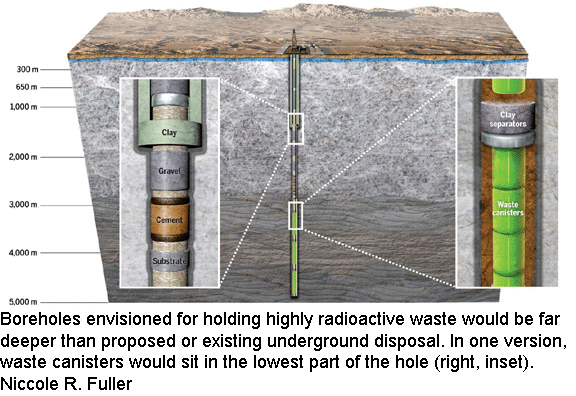
Protests spur rethink on deep borehole test for nuclear waste http://www.sciencemag.org/news/2016/09/protests-spur-rethink-deep-borehole-test-nuclear-waste By Paul VoosenSep. 27, 2016 DENVER—Along the way to testing an old-but-new concept in nuclear waste storage—burying spent fuel in a hole drilled kilometers below the surface—the U.S. Department of Energy (DOE) and its contractors relearned a lesson that seems frequently forgotten: Get the locals on board first.
Failure to gain the trust and approval of residents in rural North and South Dakota doomed the start of a $35 million project that would have drilled a borehole 5 kilometers beneath the prairie into crystalline basement rock. Early this year, the agency tapped Battelle Memorial Institute, a large research nonprofit based in Columbus, to lead the effort. The hole would not have been used for radioactive material, but was rather intended to garner insight to the geology and technical challenges of such drilling.
That message would not be heard by residents of Pierce County in North Dakota or Spink County in South Dakota said Mark Kelley, the Battelle project manager who had the “dubious honor” of leading the effort for only half a year, at a presentation yesterday at the annual meeting of the Geological Society of America. “They were not to be convinced,” he said. “They were quite opposed to it.”
This summer, DOE and Battelle agreed to scrap the 5-year effort, which had moved to South Dakota after failing in North Dakota. In August, the agency solicited new bids for the project, due next month, that explicitly require public engagement from the outset, including staff that will remain on site day to day to hear local concerns. Bidders are also expected to find a way of showing how the project could benefit locals through science education or additional research. The agency will likely select multiple contractors for the project’s first phase, keeping its options open on new potential sites.
Battelle had thought its South Dakota site, to be drilled on private land into Precambrian basement rock, might succeed where North Dakota failed. They promised to engage locals earlier, and not repeat the same mistakes, such as when local officials first learned of the project from local newspaper articles. But similar fears that the project would open the county up to a future as a disposal site, or that drilling could go awry and pollute aquifers, led the Spink County’s board of commissioners in June to reject the zoning approval the project needed. It didn’t help, Kelley added, that some of the North Dakota protesters traveled south to keep their opposition going.
Though the concept of borehole disposal, which would see radioactive waste entombed far deeper than traditional repositories, has existed for decades, the idea has been revived in recent years, spurred by troubles in finding a long-term home for the country’s spent fuel. Such boreholes could not house most of the country’s waste, like fuel rods from nuclear power plants, but could have potential for smaller, long-lived radioactive materials. Energy Secretary Ernest Moniz has frequently touted borehole disposal as one alternative to Yucca Mountain, the stalled repository in Nevada.
Many of the scientists working on the borehole project continue to believe in it—if they can only find a community willing to take it on.
“We want to test the things that would be difficult to do,” said Kristopher Kuhlman, a hydrogeophysicist at Sandia National Laboratory in Albuquerque, New Mexico, during the meeting. “If we want to put waste where we’ll never see it again,” he added, it should go at the bottom of a deep borehole.
Russia’s nuclear marketing: sell nukes, then sell the clean-up, too!
 Making nuclear power plants safe after they shut down RBTH, September 24, 2016 ANDREI RETINGER, The problems of dealing with spent nuclear fuel, radioactive waste and the decommissioning of nuclear facilities (experts call it “back end”) did not immediately become apparent to the countries developing their nuclear industries. But now the world market for back end services is booming and its value is estimated to total about $347 billion until 2030.
A number of nuclear facilities in the UK are scheduled for decommissioning, and all the 17 nuclear power plants that are still operating in Germany are due to close down by 2020. Japan must rehabilitate the areas after the accident at Fukushima, and the United States and Russia need to solve the problems of radioactive waste storage and reprocessing. Not all countries have the ability to solve these problems, but Russian technologies and facilities can come to their aid…..
in 2008, Russia was faced with a catastrophic situation because of the accumulation of radioactive waste and spent fuel remaining from the time of the creation of nuclear weapons and the Cold War. Storage sites were almost full and had not been provided with reliable insulation, creating a threat to people and the environment.
In this situation, Russia had no choice but to tackle the problem urgently. In 2007, it adopted a state program on nuclear and radiation safety, which was developed by the Rosatom State Atomic Energy Corporation. Then it approved a law on radioactive waste management, taking into account the latest standards and requirements………https://rbth.com/science_and_tech/2016/09/24/making-nuclear-power-plants-safe-after-they-shut-down_632711
1 This Month


31st January – Challenging the War Machine – a DECLASSIFIED UK SUMMIT



Website of the Week
Now until to February 10, 2026 Radioactive waste storage in France: the debate is finally open! How to participate?
-
Archives
- January 2026 (220)
- December 2025 (358)
- November 2025 (359)
- October 2025 (377)
- September 2025 (258)
- August 2025 (319)
- July 2025 (230)
- June 2025 (348)
- May 2025 (261)
- April 2025 (305)
- March 2025 (319)
- February 2025 (234)
-
Categories
- 1
- 1 NUCLEAR ISSUES
- business and costs
- climate change
- culture and arts
- ENERGY
- environment
- health
- history
- indigenous issues
- Legal
- marketing of nuclear
- media
- opposition to nuclear
- PERSONAL STORIES
- politics
- politics international
- Religion and ethics
- safety
- secrets,lies and civil liberties
- spinbuster
- technology
- Uranium
- wastes
- weapons and war
- Women
- 2 WORLD
- ACTION
- AFRICA
- Atrocities
- AUSTRALIA
- Christina's notes
- Christina's themes
- culture and arts
- Events
- Fuk 2022
- Fuk 2023
- Fukushima 2017
- Fukushima 2018
- fukushima 2019
- Fukushima 2020
- Fukushima 2021
- general
- global warming
- Humour (God we need it)
- Nuclear
- RARE EARTHS
- Reference
- resources – print
- Resources -audiovicual
- Weekly Newsletter
- World
- World Nuclear
- YouTube
-
RSS
Entries RSS
Comments RSS
 nuclear-news