Japan struggling to decommission Fukushima nuclear reactors http://pulsenews.co.kr/view.php?sc=30800023&year=2017&no=395464 , By Hwang Hyung-gyu, 2017.06.13 It appears that much has changed at the Fukushima Daiichi Nuclear Power Plant in Japan since the worst nuclear disaster since Chernobyl six years ago. The ongoing restoration work evidently made progress, but decommissioning is still an uphill battle – posing as a lesson for South Korea as it has recently decided to retire the country’s first nuclear reactor and phase out of commercial nuclear power.
All ordinary visitors, including reporters, must wear a protective gear such as two layers of socks, gloves, a helmet, a filter mask covering the mouth and nose, a safety vest and rubber shoes before approaching a point just 80 meters away from the crippled power station. A hazmat suit which had been required just six months ago was no longer recommended as the radiation level was lowered.
The passage route to the first reactor was flanked by gigantic storage tanks that hold contaminated water.
Reactors still showing skeletal steel frames and roof debris remind a 17-meter-high tsunami which flooded the facility on March 11 in 2011 and caused a hydrogen explosion, bringing the plant to a complete standstill.
Molten fuel rods were completely retrieved from the reactor Unit 4, but progress is much slow in Unit 2, where an internal survey is not even started. The six-year clean-up work for the four nuclear reactors was only a fraction of time.
Tokyo Electric Power Co. (Tepco), the operator of the plant, has deployed 7,000 workers including its own staff to the site. Their first priority is to tackle the influx of contaminated groundwater. Workers erected a cutoff wall and pumped out upstream groundwater, but still, about 100 to 150 tons of contaminated water is generated every day, according to Tepco. The amount of the contaminated water in storage tanks reaches nearly 1 million tons. It has not yet been decided how to treat the water.
The operation for complete decommissioning is a long way to go. It will take 30 years to finish the job, including the treatment of contaminated water, said Yuichi Okamura, Tepco communication manager.
The Japanese government is going all out to develop advanced robot and drone technology to accurately grasp the internal situation of the reactors to support decommissioning.
June 14, 2017
Posted by Christina Macpherson |
decommission reactor, Japan |
Leave a comment
 For Nadezhda Kutepova, fighting for the rights of people living in the villages along the Techa river came with a price. First, the organization she founded in the 1990s, Planeta Nadezhd (Planet of Hopes), was declared «foreign agents» by the Justice Ministry in April 2015. The law labeling NGOs as «foreign agents» aims to close down activities of groups working with political questions and get funding from abroad. Recently afterwards, the federal TV channel Rossiya 1 aired the news that Planeta Nadezhd used American money to conduct industrial espionage.
Nadezhda’s group is one of 11 environmental NGOs to end up on the «foreign agents» list since the law was introduced in 2012.
Activist in exile says Norway’s nuclear waste support is irresponsible, Barents Observer, Thomas Nilsen, June 07, 2017
Nadezhda Kutepova was forced to flee Russia after fighting for the rights of the residents in radioactive contaminated villages near Mayak, the site where all spent nuclear fuel from Andreeva Bay will be sent.
On June 27, the first shipment of containers with highly radioactive spent fuel elements will leave Andreeva Bay on the Kola Peninsula. Destination: Mayak reprocessing plant in the South-Ural.
For 20 years, Norway has financed infrastructure upgrades aimed at shipping spent nuclear fuel away from Andreeva Bay. The rundown facility is located 55 kilometers from the border to Norway on the Barents Sea coast and is considered to be the worst storage facility for Cold War nuclear waste in the Russian Arctic.
When the nuclear waste shipment sails away with the first few of an estimated 3,000 containers, Norway’s Foreign Minister Børge Brende and State Secretary Marit Berger Røsland will be on site and wave farewell.
This landmark event, though, is not welcomed by activists fighting for the rights of the people effected by radioactive contamination in the vicinity of Mayak.
«I think it is a irresponsible decision by Norway,» says Nadezhda Kutepova to the Barents Observer. She says out of sight, doesn’t mean out of mind.
I’m sure the Norwegian government knows about the situation in Mayak only from officials represented by Rosatom.»
Rosatom is Russia’s state nuclear corporation in charge of operating the reprocessing plant in Mayak where all accumulated naval spent nuclear fuel from the fleet of submarines will be treated. In total, some 22.000 spent fuel elements are to be shipped from Andreeva Bay, first with boat to Murmansk, then by rail to the Mayak plant north of Chelyabinsk. Both the vessel to sail in shuttle between Andreeva Bay and Atomflot in Murmansk and the railwagons are special designed to assure best possible safety. Each container takes seven fuel assemblies. In total, 3.143 container transports will be needed before the storage tanks are empty. In other words, the containers will be shuttling back and forth between the Kola Peninsula and the Chelyabinsk region for years to come.
«Mayak’s reprocessing activities are dangerous. It is a very bad idea to send more waste. In reality, Norway can never check what happens there,» says Nadezhda Kutepova.
«Supporting the activities of Mayak, like reprocessing, Norway increases violations of human rights for the people who are living in the vicinity of the nuclear waste storages. Especially those living along the Techa river,» Kutepova explains.
Techa river became heavily contaminated by radioactive waste products from the production of plutonium for nuclear weapons that started at Mayak in 1949. Other accidents, like the 1957 Kyshtym disaster, have contaminated other areas in the neighborhood where tens of thousands of people were living.
Radioactive water from Mayak goes to a system of reservoirs. «Mayak can’t prevent leakages from the reservoirs into the Techa river. Espesially in the spring. They are lying,» Kutepova claims and says there are still some 5000 people living in four villages downstream the contaminated Techa river.
For Nadezhda Kutepova, fighting for the rights of people living in the villages along the Techa river came with a price. First, the organization she founded in the 1990s, Planeta Nadezhd (Planet of Hopes), was declared «foreign agents» by the Justice Ministry in April 2015. The law labeling NGOs as «foreign agents» aims to close down activities of groups working with political questions and get funding from abroad. Recently afterwards, the federal TV channel Rossiya 1 aired the news that Planeta Nadezhd used American money to conduct industrial espionage.
Nadezhda’s group is one of 11 environmental NGOs to end up on the «foreign agents» list since the law was introduced in 2012. Others working with nuclear safety in northern Russia are Ecodefense, Kola Eco Centre and Bellona Murmansk. The last played a key-role as whistleblower and solution seeker for radiological safety projects at Andreeva Bay. Like many other NGOs, Bellona Murmansk decided to close down the organization after being branded «foreign agents.»
When accused of treason in media Kutepova fled to France seeking asylum. She is afraid the accusations presented on federal TV were just the beginning of what could be formal prosecution.
Talking to the Barents Observer from Paris, Nadezhda Kutepova explains how people die from cancer in the area polluted by Mayak. She should know. Growing up in the closed town of Ozyorsk – formerly known as Chelyabinsk-65 – her father and grandparents were victims of the nuclear industry they worked for. They died of cancer.
She says Norwegian authorities should talk to NGOs that have worked in the area. They can tell another story than officials from Rosatom will tell.
«They should visit the villages along the Techa river where peoples should have been evacuated long ago but still live there.»
«It would be better not to waste the money. They should have supported another storage from the first moment, but I know this isn’t an easy decision. But they need to study the issue better,» Kutepova argues.
Norwegian officials are well aware of the troubles in Mayak. Ingar Amundsen is head of section for international nuclear safety with the Radiation Protection Authorities. …..
The reprocessing plant in Mayak, named RT-1, started operation in 1977 and has until now only processed spent nuclear fuel from the first and second generation of Russian designed water cooled reactors from nuclear power plants. Recent upgrades, however, now make it possible to reprocess fuel also from submarine and icebreaker reactors……
At the reprocessing plant in Mayak, the spent nuclear fuel will be chemically separated, a process where plutonium and uranium will be recovered. Reprocessing, though, does not reduce the volum of high-level waste. It creates an increased volum in liquid form. Also, radiation from the remaining isotopes is high and therefore does not eliminate the need for a highest possible technical and security storage options. At Mayak, limited information is available in public domains about technical solutions for both the reprocessing itself and storage solutions for the waste products.
Ph. D. Natalia Mironova, a former Member of the Regional Duma in Chelyabinsk, has earlier told the Barents Observer that there are better options than reprocessing.
«Alternative to reprocessing is well known; dry storage.»
«Legacy of reprocessing spent nuclear fuel at Mayak has been a heavy burden for many generations. It is a big injustice for the local people,» Mironova says.
«Reprocessing is dangerous. We have bad experience in handling liquid radioactive waste,» she argues.
Mironova also points to the risks of transport and reloading the containers with fuel.
«Transportation is a risky process. Minimization of the risk is best strategy. Safe storing with less transport and far away from Mayak would be the best strategy.»
Most other nuclear power countries in the world chose to store the waste and not reprocess it.
On June 28, the joint Norwegian-Russian commission on nuclear and radiation safety will meet in Kirkenes, Norway’s border town to the Kola Peninsula in the north. Ingar Amundsen informs that future project cooperation related to Andreeva Bay will be discussed.
With project funding from the Ministry of Foreign Affairs, some 2 billion kroner are granted by Norway to nuclear safety projects in northern Russia over the last two decades. ……..
The storage dump in Andreeva Bay was built soon after the Soviet navy got its first nuclear powered submarine in the early 1960s. A pool type storage, given the code-name Building No. 5, had a leakage in the early 80s and the lethal fuel elements were urgently transferred to the three dry storage tanks. Supposed to be temporary, the totally run-down tanks have now served for more than 30 years. The 22.000 fuel elements in the tanks are equal to around 100 reactor cores.
In addition comes thousands of cubic meters of solid and liquid radioactive waste that one day will be removed.
Speaking at a seminar in Oslo devoted to Putin’s Year of Ecology, Bellona’s Frederic Hauge said the removal of the spent nuclear fuel from Andreeva Bay likely are the most risky part in the Post Cold War history of nuclear waste clean-up in the north. https://thebarentsobserver.com/en/node/2460
June 12, 2017
Posted by Christina Macpherson |
EUROPE, Russia, wastes |
Leave a comment
 Increase in Cancer Risk for Japanese Workers Accidentally Exposed to Plutonium http://allthingsnuclear.org/elyman/cancer-risk-for-japanese-exposed-to-plutonium#.WTxxNdgMNK8.twitter, ED LYMAN, SENIOR SCIENTIST | JUNE 9, 2017,
We wish to express our sympathy for the victims of this accident.
This incident is a reminder of the extremely hazardous nature of these materials, especially when they are inhaled, and illustrates why they require such stringent procedures when they are stored and processed.
According to the earliest reports, it was estimated that one worker had inhaled 22,000 becquerels (Bq) of plutonium-239, and 220 Bq of americium-241. (One becquerel of a radioactive substance undergoes one radioactive decay per second.) The others inhaled between 2,200 and 14,000 Bq of plutonium-239 and quantities of americium-241 similar to that of the first worker.
More recent reports have stated that the amount of plutonium inhaled by the most highly exposed worker is now estimated to be 360,000 Bq, and that the 22,000 Bq measurement in the lungs was made 10 hours after the event occurred. Apparently, the plutonium that remains in the body decreases rapidly during the first hours after exposure, as a fraction of the quantity initially inhaled is expelled through respiration. But there are large uncertainties.
The mass equivalent of 360,000 Bq of Pu-239 is about 150 micrograms. It is commonly heard that plutonium is so radiotoxic that inhaling only one microgram will cause cancer with essentially one hundred percent certainty. This is not far off the mark for certain isotopes of plutonium, like Pu-238, but Pu-239 decays more slowly, so it is less toxic per gram. The actual level of harm also depends on a number of other factors. Estimating the health impacts of these exposures in the absence of more information is tricky, because those impacts depend on the exact composition of the radioactive materials, their chemical forms, and the sizes of the particles that were inhaled. Smaller particles become more deeply lodged in the lungs and are harder to clear by coughing. And more soluble compounds will dissolve more readily in the bloodstream and be transported from the lungs to other organs, resulting in exposure of more of the body to radiation. However, it is possible to make a rough estimate.
Using Department of Energy data, the inhalation of 360,000 Bq of Pu-239 would result in a whole-body radiation dose to an average adult over a 50-year period between 580 rem and nearly 4300 rem, depending on the solubility of the compounds inhaled. The material was most likely an oxide, which is relatively insoluble, corresponding to the lower bound of the estimate. But without further information on the material form, the best estimate would be around 1800 rem.
What is the health impact of such a dose? For isotopes such as plutonium-239 or americium-241, which emit relatively large, heavy charged particles known as alpha particles, there is a high likelihood that a dose of around 1000 rem will cause a fatal cancer. This is well below the radiation dose that the most highly exposed worker will receive over a 50-year period. This shows how costly a mistake can be when working with plutonium.
The workers are receiving chelation therapy to try to remove some plutonium from their bloodstream. However, the effectiveness of this therapy is limited at best, especially for insoluble forms, like oxides, that tend to be retained in the lungs.
The workers were exposed when they opened up an old storage can that held materials related to production of fuel from fast reactors. The plutonium facilities at Tokai-mura have been used to produce plutonium-uranium mixed-oxide (MOX) fuel for experimental test reactors, including the Joyo fast reactor, as well as the now-shutdown Monju fast reactor. Americium-241 was present as the result of the decay of the isotope plutonium-241.
I had the opportunity to tour some of these facilities about twenty years ago. MOX fuel fabrication at these facilities was primarily done in gloveboxes through manual means, and we were able to stand next to gloveboxes containing MOX pellets. The gloveboxes represented the only barrier between us and the plutonium they contained. In light of the incident this week, that is a sobering memory.
June 12, 2017
Posted by Christina Macpherson |
- plutonium, health, Japan, radiation, Reference |
Leave a comment
World Nuclear News 9th June 2017, The permanent shutdown of unit 1 of the Kori nuclear power plant has been approved by the South Korea’s nuclear safety regulator. The unit – the country’s oldest operating reactor unit – will be taken offline on 19 June.
Kori 1 is a 576 MWe pressurized water reactor that started commercial operation in 1978. A six-month upgrading and inspection outage at Kori 1 in the second half of 2007 concluded a major refurbishment program and enabled its relicensing for a further ten years. A subsequent relicensing process could have taken Kori 1 to 2027, but Korea Hydro & Nuclear Power (KHNP) announced in August 2015 that it had withdrawn its application to extend the unit’s operating licence. In June last year, the company applied to decommission the reactor. http://www.world-nuclear-news.org/C-Final-shutdown-approaches-for-Koreas-oldest-reactor-0906175.html
June 12, 2017
Posted by Christina Macpherson |
decommission reactor, South Korea |
Leave a comment
Amount of nuclear waste in Parks Township could remain unknown until 2031, TRIB Live, MARY ANN THOMAS | Sunday, June 11, 2017 Secrecy, lack of documentation and inattention to warnings may have led the Army Corps of Engineers to grossly underestimate the amount of highly radioactive uranium in the nuclear waste dump in Parks Township.
Estimates that the Corps’ aborted cleanup effort at the site along Route 66 near Kiskimere Road in 2011 uncovered about 30 kilograms of highly enriched uranium would mean, if accurate, that as much uranium was found in just one portion of the site as the Corps thought it would find during the entire project.
Known as the Shallow Land Disposal Area, the dump was created in the 1960s by the Nuclear Materials and Equipment Corp. (NUMEC) behind its then-plutonium processing facility. The company also operated a uranium processing facility in nearby Apollo, which produced much of the waste buried at the dump.
KEY TO A MYSTERY
What’s in that dump could be key to solving the more than 50-year-old mystery of what happened to about 200 pounds of highly enriched uranium NUMEC couldn’t account for in a 1965 inventory of nuclear material at its plants…….http://triblive.com/local/valleynewsdispatch/12353545-74/amount-of-nuclear-waste-in-parks-township-could-remain-unknown-until-2031
June 12, 2017
Posted by Christina Macpherson |
USA, wastes |
Leave a comment
The license to store the material in Idaho now expires in 2019. In a separate agreement with Idaho made in 1995, the agency is required to remove the waste from the state by 2035.
Federal officials currently have nowhere to send it.

Extension Sought for Storing Three Mile Island Debris https://www.usnews.com/news/best-states/idaho/articles/2017-06-09/extension-sought-for-idaho-storing-nuclear-meltdown-debris Federal officials requested a 20-year extension involving the storage in Idaho of reactor core debris from the partial meltdown at the Three Mile Island nuclear power plant. June 9, 2017,By KEITH RIDLER, Associated Press BOISE, Idaho (AP) — Federal officials requested a 20-year extension involving the storage in Idaho of reactor core debris from the partial meltdown at the Three Mile Island nuclear power plant.
The U.S. Department of Energy in a document made public Friday asked the Nuclear Regulatory Commission to renew a license allowing storage until 2039 at an 890-square -mile site that includes the Idaho National Laboratory.
The debris from the 1979 nuclear accident was shipped from Pennsylvania to Idaho between 1986 and 1990. Research on the material was performed to improve nuclear fuel design and reactor safety.
The material also includes intact fuel assemblies.
The license to store the material in Idaho now expires in 2019. In a separate agreement with Idaho made in 1995, the agency is required to remove the waste from the state by 2035.
Federal officials currently have nowhere to send it.
“DOE remains committed to meeting its obligations to the state of Idaho,” the federal agency said in a March 9 letter to Idaho officials.
The Nuclear Regulatory Commission received a letter dated March 6 from the Energy Department requesting the license renewal.
Anyone interested in requesting a hearing or who wants to intervene must file a petition with the commission within 60 days starting Friday.
Susan Burke, oversight coordinator of the Idaho Department of Environmental Quality, said federal officials told her that an additional four years for removal will allow them to decommission the area after the debris is taken away.
“They obviously can’t close the facility a day after they remove the fuel,” she said. “There’s not an intent to not meet the 2035 deadline.”
The Idaho Attorney’s General Office declined to comment about the request for a license renewal. Attorney General Lawrence Wasden and the Energy Department have been at an impasse on another nuclear waste issue for more than a year.
Wasden is refusing to allow research quantities of spent nuclear fuel to be shipped to Idaho National Laboratory — considered the nation’s top nuclear research lab — until the Energy Department demonstrates it can process 900,000 gallons of high-level nuclear waste.
The Energy Department initially had a 2012 deadline to deal with the liquid waste that’s stored in tanks above a giant aquifer that supplies water to cities and farms in the region.
That deadline has been extended multiple times and was most recently missed in September after the federal agency announced scientists couldn’t achieve a stable operation at a $600 million facility to treat the waste.
June 10, 2017
Posted by Christina Macpherson |
USA, wastes |
Leave a comment
 BBC 7th June 2017 A planning application is being prepared for a new phase in the decommissioning of the Dounreay nuclear power complex in Caithness.
Buildings on the experimental nuclear energy site, which dates to the 1950s, are being emptied of radioactive material and demolished. Starting in 2018, the planned next stage would involve dismantling reactors.
New temporary buildings would also need to be built to aid the new phase. The new buildings would include facilities for handling the clean up and demolition of areas of the site called the Silo and The Shaft. Also included are plans for restoration and landscaping work to restore areas of land to close to how they looked before the construction of Dounreay. The phase would take the site near Thurso to what is called its interim end state. Dounreay Site Restoration Limited has notified Highland Council that it expects to submit the planning application later this year.
http://www.bbc.co.uk/news/uk-scotland-highlands-islands-40188815
June 10, 2017
Posted by Christina Macpherson |
decommission reactor, UK |
Leave a comment

 Nuclear dump idea dead in SA June 7, 2017 Australian Associated Press, news.com.au
Conservation groups have welcomed Premier Jay Weatherill’s move to abandon any plans to establish a high-level nuclear waste dump in South Australia. The premier has indicated the government won’t now proceed to hold a referendum on the issue, even if it is returned at next year’s state election.
Conservation SA chief executive Craig Wilkins says it’s great news the dump is dead. “This is a win for the many South Australians who stood up and demanded a better option for our state than as a home for the world’s radioactive waste,” Mr Wilkins said.
The state government floated the idea of SA having an increased involvement in the nuclear fuel cycle after the last state election and held a royal commission into the idea. The commission recommended the state consider building a high-level dump to earn billions of dollars by taking the world’s nuclear waste, while a citizen’s jury firmly rejected that proposal late last year.
At the time Mr Weatherill indicated the government would still put the question to a referendum at some time in the future.
But asked about the future of a dump at a community cabinet meeting earlier this week he declared the idea “dead”.
“There’s no foreseeable opportunity for this,” he said. The premier later reaffirmed Labor had dropped the proposal, telling internet news site InDaily that it was not something that would be progressed by Labor if the government was returned in March.
“This is great news. We are delighted the premier has announced that he has no intention to re-visit the divisive debate on a global nuclear waste dump,” Mr Wilkins said… http://www.news.com.au/national/breaking-news/nuclear-dump-idea-dead-in-sa/news-story/c4c10d44ab0ac71056efd337cfbb0244
June 7, 2017
Posted by Christina Macpherson |
AUSTRALIA, wastes |
Leave a comment
Toxic cargo of nuclear waste leaves Scotland for US under armed guard https://www.sundaypost.com/fp/toxic-cargo-of-nuclear-waste-leaves-for-us/ Jim Lawson, 04 June 2017 AN American military plane carrying a deadly cargo of radioactive waste has taken off from Scotland for the second time.

Dozens of armed police stood guard yesterday as highly-enriched uranium was loaded on to a giant American Air Force transport jet at Wick John O’Groats Airport. The secretive operation – signed off by David Cameron and Barack Obama last year – aims to clear a backlog of nuclear waste stored at Dounreay power station in Caithness.
But critics have blasted the high-security flights as unsafe and “morally reprehensible”.
Independent nuclear consultant John Large said: “This is pretty toxic stuff. It is weapons grade material. It is quite active. It’s ticking away and it does not turn itself off. “In the States, you cannot overfly with this type of material. The plane will put down on the east coast and the shipment will continue under armed escort by rail or by road.”
He said the risks in transporting nuclear waste by aircraft included “in the event of a crash, the fuel being engulfed in fire, the packages breaking down and the fuel igniting”.
Yesterday’s operation got underway at 10am, with the US C-17 Globemaster arriving in the early afternoon to pick up its dangerous cargo. Armed police guarded two trucks carrying the uranium – a critical component in nuclear weapons – in re-inforced steel flasks as they travelled the 32 miles from Dounreay to Wick airport. Roads around the airport were closed and sealed off as the deadly waste was delivered at 2pm.
Its cargo on board, the giant jet lumbered along the runway and took off at 4.25pm for the short hop across the Moray Firth to RAF Lossiemouth, where it topped up with fuel under armed RAF guard.
The runway at Wick is 1,712 feet too short for a fully fuelled Globemaster to get airborne.
It then took off for South Carolina, where the uranium will be transported to a nuclear facility in Tennessee.
A further 10 transatlantic flights – each costing around £1 million – are expected, but bosses remain secretive over the details. A spokesman for Dounreay, which is currently being decommissioned, said: “We can confirm nuclear materials are being removed from the site ahead of its closure.
“Compliance with the regulations includes protecting any information about the routes, times, dates and location”.
A police spokesman said: “We are supporting a partner agency’s operation and cannot comment further.” And a spokesman for Wick John O’Groats airport said it didn’t comment on “specific aircraft movements”.
June 5, 2017
Posted by Christina Macpherson |
safety, UK, USA, wastes |
3 Comments
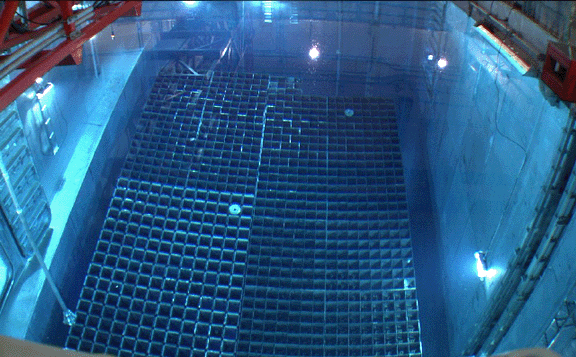
Facing South 2nd June 2017, As the United States continues to grapple with long-term storage of highly radioactive spent fuel from the nation’s nuclear power plants, science watchdogs are warning of serious flaws with the current storage method, which involves densely packing the combustible spent fuel assemblies under at least 20 feet of water in pools located at individual plants while awaiting creation of a permanent repository.
https://www.facingsouth.org/2017/06/nuclear-regulators-flawed-analysis-leaves-millions-risk-radioactive-fires
June 5, 2017
Posted by Christina Macpherson |
safety, USA, wastes |
Leave a comment
Nuclear Insider 31st May 2017 Holtec’s two-phase licensing approach for its $280 million consolidated interim storage facility (CISF) project in New Mexico allows the company to use recent learnings in U.S. and Ukraine to accelerate approval for all
storage canisters.
In April, Holtec started the second phase of a CISF licensing program which would make it the first company to store all
canisters types currently used at U.S. plants. Holtec and Waste Control Services (WCS) are competing to build the U.S.’ first CISF facility, ahead of a proposed state-owned permanent repository at Yucca Mountain,
Nevada.
There is currently around 78,620 metric tons (MT) of used nuclear fuel stored at decommissioned and active reactor sites across 35 states. The U.S. Department of Energy (DOE) has proposed a pilot facility for consolidated storage be in place by 2021, followed by a larger storage facility by 2025 and a permanent repository by 2048.
Holtec plans to build a $280 million CISF to host 10,000 storage canisters, representing 120,000 MT of spent fuel, between the cities of Carlsbad and Hobbs. The company has launched a two-phased licensing approach, initially seeking to store Areva-supplied 24PT1-DSC canisters using Holtec’s HI-STORM UMAX dry spent fuel storage system. In a second phase, the company will file a series of license amendment requests to include all canisters currently in use at
U.S. plants– supplied by Areva, Pacific Nuclear, Vectra, NAC, Sierra Nuclear and BNFL Solutions & Westinghouse.
http://analysis.nuclearenergyinsider.com/holtec-builds-first-kind-learnings-race-license-us-storage-facility
June 3, 2017
Posted by Christina Macpherson |
USA, wastes |
Leave a comment
Q&A session on Fort Calhoun nuclear plant focuses on cost of decommissioning, security, By Cole Epley / Omaha World-Herald staff writer, Jun 1, 2017
OPPD’s plan to fund dismantling and cleanup of its Fort Calhoun nuclear plant is expected to be sufficient to cover the cost, and the now-closed plant will retain its 24-hour armed security force even after the last building is no longer needed.
That was the message from federal regulators to Omaha Public Power District ratepayers and members of the public Wednesday night at a meeting on decommissioning the reactor. The plant, which closed in October, is 20 miles north of Omaha.
Questions about security — both in terms of armed guards and spent nuclear fuel left on site — and the cost of tearing down and cleaning up the plant were among issues addressed during a question-and-answer session at the Doubletree Hotel in downtown Omaha.
Representatives from the Nuclear Regulatory Commission and OPPD fielded questions for about an hour following a general overview of the decommissioning process……
Decommissioning the plant is expected to cost about $1.5 billion in 2016 dollars. By the time the work is completed in some 60 years, the inflation-adjusted cost is expected to be roughly $3 billion…….
Within five years, OPPD will be pulling spent fuel from the storage pool inside one of the buildings and putting it in concrete casks on site. Because the U.S. has no functioning long-term storage site for spent nuclear fuel, the Fort Calhoun site will hold spent fuel in the above-ground casks indefinitely. At least as long as the fuel is there, security guards will be there, the public was told Wednesday.
Significant demolition isn’t expected until the 2050s, once much of the radioactivity at the site has decayed.
Doug Broaddus, head of the NRC branch that oversees plants like Fort Calhoun that are transitioning from operating to decommissioning, said utilities that fall short of the money needed to close their plants generally look to the same place.
June 2, 2017
Posted by Christina Macpherson |
decommission reactor, USA |
Leave a comment
http://www.wxyz.com/news/canadian-company-still-wants-to-bury-nuclear-waste-near-lake-huron
May 30, 2017 Canadian company is standing by its proposal to store waste from nuclear power plants underground less than a mile from Lake Huron.
Ontario Power Generation has submitted a 145-page document with answers to questions raised by the Canadian Environmental Assessment Agency.
Most of them involved whether there’s a better place to put the low- and intermediate-level radioactive waste. The company wants to bury it 2,230 feet deep at the Bruce Power complex near Kincardine, Ontario.
More than 200 communities object to putting it so close to Lake Huron, fearing water pollution.
The company says the waste would be encased in rock and would pose no threat to the lake. It says other sites would delay the project 15 years or more without improving safety.
Canada’s environment minister is expected to decide this year whether to approve the plan.
May 31, 2017
Posted by Christina Macpherson |
Canada, wastes |
Leave a comment

 Nuclear storage crisis grows as reactor restarts continue http://www.japantimes.co.jp/news/2017/05/28/national/nuclear-storage-crisis-grows-reactor-restarts-continue/#.WStAvpKGPGg BY ERIC JOHNSTON, TOYAMA – More than six years after the March 11, 2011, Tohoku quake, tsunami, and triple meltdown at the Fukushima No. 1 nuclear power plant, Japan is accelerating efforts to restart as many reactors as it possibly can. Four have been revived so far, and Kansai Electric Power Co. plans to restart the Takahama No. 3 unit soon.
But the rush to restart them has only highlighted the fact that Japan still has no final repository for its high-level radioactive waste. Original plans to first reprocess spent fuel at the Rokkasho facility in Aomori Prefecture before final disposal somewhere else have long been stalled. After 17 years asking prefectures and municipalities around the country to host such a site, no takers have been found.
So the government has changed its approach, saying it will draw up a map by this summer of “scientifically appropriate” candidate sites around the country.
To explain what that means, a series of town hall meetings are taking place at select locations this month and next month.
On May 20, officials from the Agency for Natural Resources and the Nuclear Waste Management Organization of Japan (NUMO) were in Toyama, which is less than 50 km from the Shika nuclear power plant in neighboring Ishikawa Prefecture.
At present, there are about 18,000 tons of spent nuclear fuel stored in about 40,000 canisters at Japan’s nuclear power plants, said NUMO Executive Director Shinichi Ito. A final disposal site for high-level waste produced when, or if, the fuel is reprocessed would need to be quite large. Most of it would be underground, with an elaborate tunnel system of transport vehicles to deliver and store the waste.
“In terms of scale, above-ground facilities at a final depository would be between 1 to 2 sq. km, and the underground portion would be 6 to 10 sq. km in area, located at a depth of more than 300 meters from the surface. There would be some 200 km of tunnels in total for the storage facilities,” Ito said.
Waste would be stored at the site for around a half century. The basic cost for building a final depository is ¥3.7 trillion.
In drawing up the map of what constitutes a scientifically appropriate site, the government has a list of conditions and standards based on what it does not want.
A site should not be built within a 15-km radius of a volcano, and not near active fault lines at least 10 km long. In addition, it should not be situated in area where there is a lot of geothermal activity.
The government is also seeking a site that is within 20 km of a port where ships carrying the waste could dock, since transporting waste by ship, the government says, is the most appropriate method.
Iwao Miyamoto, director of the public relations office of the Agency for Natural Resources’ Radioactive Waste Management Office, said that, after the map is publicized and dialogue takes place with authorities deemed to have appropriate sites, a three-stage survey process would be carried out.
“The first stage would be to research the seismological and geological history of a potential site, checking to see how frequently earthquakes and volcanoes in and around the area have occurred,” Miyamoto said. “The second stage would be on-site drilling to determine how porous the rock bed is, and the third step is a precision survey to determine if the site can handle an underground storage facility.
“The first survey stage is expected to take two years, the second stage four years, and the final stage around 14 years,” he added.
In an attempt to entice the authorities at a chosen site, the central government will offer funding and economic incentives that the municipalities hosting nuclear power plants have long enjoyed.
“NUMO will work with a government that accepts a final storage facility to renovate and expand its roads, ports, and information systems,” Ito said. “There will also be donations for revitalizing the local economy via support for locally produced goods and for local culture.”
However, overcoming local political resistance in an area judged appropriate for a final depository is likely to be a long, difficult road. Nobody wants to be known as the town or village with a nuclear waste dump, and questions remain about the safety of transporting toxic waste by land or by sea.
Some governors in prefectures with many reactors have made it clear they will oppose any effort by the central government or utilities to bury nuclear waste on site or beside the plant that generated it.
“Fukui has accepted nuclear power plants. But it has no obligation to accept final disposal of nuclear waste,” Fukui Gov. Issei Nishikawa said in 2015. Fukui is home to 13 commercial reactors.
“We have our hands full just dealing with the nuclear reactors we have now,” Saga Gov. Yoshinori Yamaguchi said last year, indicating his prefecture would not accept being the site of a final repository. Saga hosts the four reactors at the Genkai plant run by Kyushu Electric. Yamaguchi approved the restart of Genkai units 3 and 4 in April.
Once the map is published, it is sure to galvanize opinion in those places judged appropriate and become a politically delicate topic. Yet with Agency for Natural Resources estimates showing the spent fuel pools of 17 power plants will run out of space within the next 15 years, if run continuously, the problem of final disposal grows more acute with each passing day. Pressure on those areas that fit the requirements for final disposal is likely to be intense.
At this point, though, the central government says that if a local government with a site deemed appropriate by the map still refuses once the survey begins, that will be the end of it.
“If there is official opposition at the local level at any stage of a survey, there would be no advancement to the next stage,” Miyamoto said.
However, given all of the problems Japan has had trying to make its reprocessing program work, critics say that attempting to draw up a plan for a final repository is a pipe dream.
” The Japanese government knows the current final nuclear waste repository program will never materialize. The whole project depends upon the creation of high-level waste canisters, i.e. the reprocessing of spent nuclear fuel. But t he program also depends on Japan recovering and consuming tons and tons of plutonium
” The Rokkasho reprocessing plant’s commercial operation has been delayed 23 times, and the fast reactor program to consume the plutonium is at square one de spite over a half century of effort,” said Aileen Mioko Smith of Kyoto-based Green Action.
May 29, 2017
Posted by Christina Macpherson |
Japan, wastes |
Leave a comment
Decommissioning continues as normal at Dounreay under heightened response rate, John O’Groat Journal, 26 May 17, DOUNREAY said decommissioning work is continuing as normal as the UK terror threat level has been raised to critical.
Prime Minister Theresa May announced on Tuesday night the threat level was raised from severe to critical, the highest possible level after the Manchester Arena bombing on Monday night.
Critical level means an attack is expected imminently in the UK.
A spokeswoman at Dounreay has announced the site is operating at a heightened response rate but work continues as normal.
She said: “Security at Dounreay and other sites owned by the Nuclear Decommissioning Authority is kept under continuous review.
“The site is continuing to operate at a “heightened” response state and decommissioning work is continuing as normal….http://www.johnogroat-journal.co.uk/News/Decommissioning-continues-as-normal-at-Dounreay-under-heightened-response-rate-24052017.htm
May 27, 2017
Posted by Christina Macpherson |
decommission reactor, safety, UK |
Leave a comment









 nuclear-news