Argument on the classification of nuclear waste
Reclassify waste to shift the nuclear landscape, The US Department of Energy should classify and dispose of nuclear rubbish according to risk.Nature, 24 October 2017 The United States has a single deep geological repository for nuclear waste. Since 1999, the Waste Isolation Pilot Plant (WIPP), 655 metres down in a massive salt formation near Carlsbad, New Mexico, has received 12,000-odd shipments of what it calls transuranic waste. This is clothing, tools and other detritus from the nuclear-weapons programme that are contaminated by elements heavier than uranium. It’s more hazardous than low-level waste, which can be buried closer to the surface, but not as dangerous as high-level waste, for which a disposal site has yet to be found.
WIPP was closed for three years after radiation escaped from a ruptured drum in 2014. It was given the all-clear to reopen only in January; an enquiry determined that the drum had been packed improperly before shipment from the Los Alamos National Laboratory in northern New Mexico. Concerns remain about safety, as well as the long-term risk of human intrusion into a facility that will remain dangerous for thousands of years after its eventual closure. But by and large, WIPP has functioned as designed, and it could do even more to help the US Department of Energy (DOE) address the fallout from the country’s nuclear-weapons programme.
Much high-level waste — produced during the reprocessing of spent nuclear fuel into plutonium — is highly radioactive and dangerous. But the evidence suggests that some of the waste that is labelled ‘high level’ technically qualifies as transuranic. This material is still barred from direct disposal at WIPP, purely because of how it was produced. But labels can be changed. If wastes that meet the transuranic criteria could be shipped to WIPP, it would save considerable time and effort as the DOE continues to struggle with the country’s radioactive legacy. ………
After spending some $11 billion on the as-yet-unfinished vitrification plant over the past two decades at Hanford, some may hesitate to change course. But as former DOE secretary Steven Chu said, the worst thing you can do in a multi-decade project such as nuclear-waste clean-up is to close the door to alternatives. In this case, the solution is simple enough: nuclear waste should be managed on the basis of the risk it poses and not the process that produced it. http://www.nature.com/news/reclassify-waste-to-shift-the-nuclear-landscape-1.22880
Call to get rid of radioactive redundant nuclear submarines from Scottish dockyard
Dundee Courier 24th Oct 2017,Radiation levels around Rosyth dockyard increased last year according to
the latest monitoring report. Levels across the UK were well within dose
limits, said the Scottish Environment Protection Agency (SEPA) following
the publication of its Radioactivity in Food and the Environment (RIFE 22)
Report.
However, local SNP MSP Douglas Chapman has made a renewed call for
the “excruciatingly slow” timescale for dismantling Rosyth’s seven
redundant nuclear submarines to be hastened. Mr Chapman, said: “It’s
encouraging that SEPA’s latest report shows radioactivity doses are well
within limits.
“However, Rosyth should not be a sanctuary for toxic
submarines and this is something I have raised in Parliament as
constituents are fed-up with the subs rotting in their own backyard. Yes,
they are to be dismantled and removed, but the timescale is excruciatingly
slow. “‘I’m encouraging SEPA to progress its work with the MoD to
manage the area effectively and help rid Rosyth of the subs so that the
space in the dockyard basin can be used for more economically productive
uses.”
America’s troubled Nuclear Waste Isolation Pilot Plant to be expanded
US nuke waste repository in New Mexico will get more space, abc news, By SUSAN MONTOYA BRYAN, ASSOCIATED PRESS, Workers are expected to begin mining operations at the U.S. nuclear waste dump in New Mexico for the first time in three years following a radiation release that contaminated part of the underground repository, the Energy Department said Tuesday.
The work to carve out more disposal space from the ancient salt formation where the repository is located will begin later this fall and should be completed by 2020, the department said in a statement.
Workers will remove more than 112,000 tons (101,605 metric tons) of salt, making way for seven disposal rooms. Each will have space for more than 10,000 drums containing up to 55 gallons (208 liters) of waste.
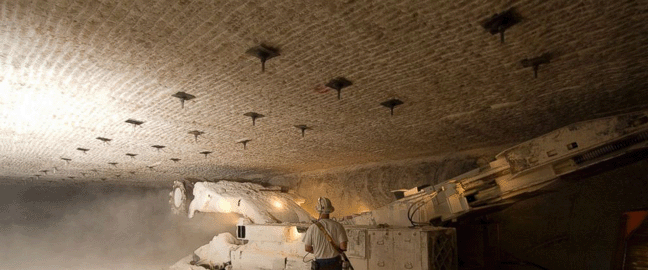
The repository, named the Waste Isolation Pilot Plant, began accepting shipments of radioactive waste from defense sites and national laboratories earlier this year after being closed for nearly three years.
It’s working to catch up with the nation’s multibillion-dollar program for cleaning up tons of waste left behind by decades of bomb-making and nuclear research. The waste includes radioactive tools, gloves, clothing and other debris.
The pace of shipments is increasing slowly, but federal auditors recently raised concerns that the repository could run out of space. The U.S. Government Accountability Office also found that the Energy Department has no plans for securing regulatory approvals and expanding the Waste Isolation Pilot Plant before it reaches capacity in less than a decade…… http://abcnews.go.com/Technology/wireStory/us-nuke-waste-repository-mexico-space-50541795
Nuclear wastes – a divisive problem for the French, that could mean the end of the industry
“if we manage to stop it, it will mean the end of the industry. Regardless of how you look at it, nuclear power is an industry with no future.”

 What to do with nuclear waste? The question dividing France,https://www.equaltimes.org/what-to-do-with-nuclear-waste-the#.Wea2VY-CzGg , 17 Oct 17, On 15 August, an anti-nuclear campaigner almost lost his foot during a demonstration in Bure, in the east of France. One month later, on 20 September, police conducted several raids on premises housing activists in the village, including the emblematic “Maison de la résistance”, (House of Resistance), the nerve centre of the fight against the nuclear dump.
The small village of Bure, in the Meuse department, has crystallised the anti-nuclear campaign in France in recent months. In 1998, it was selected as the site for an Industrial Geological Storage Centre (Cigéo), where the plan is to progressively bury 85,000 cubic metres of highly radioactive long-lived waste in a bed of clay, 500 metres below ground, by means of operations expected to last 150 years.
The ANDRA (National Agency for Radioactive Waste Management), which is managing the project, is expected to apply to the IRSN (French Institute for Radioprotection and Nuclear Safety) for authorisation to build in 2019. Its application has been deferred on several occasions due to legal and technical setbacks, which could explain the growing hostility towards the anti-Cigéo activists.
In an open letter, the residents of Bure and the surrounding area recently denounced the “systematic strategy of tension and asphyxiation” launched by the state several months ago, a strategy “aimed at wearing us down and isolating us, like hunted beasts”.
The closer the project comes to the completion phase, the stronger the opposition, and the more the noose of repression is tightened around the anti-nuclear campaigners.
A far from satisfactory solution
The 54 nuclear reactors in France, the second largest producer of nuclear energy in the world, behind the United States, produce 12,000 to 15,000 cubic metres of radioactive waste every year. This includes both low level short-lived radioactive waste and much more toxic long-lived waste.
“The uranium industry, presented as a “virtuous cycle” by the nuclear lobby, actually conceals a chain of dirty, polluting and unmanageable fuel, from the mine to the waste disposal phase,” denounces the French anti-nuclear network Sortir du Nucléaire.
Whereas before, France used to dispose of its nuclear waste in repositories in the Atlantic Ocean, underground disposal now seems to be “the only management option”, says Matthieu Denis-Vienot, who is in charge of institutional dialogue at ANDRA, in an interview with Equal Times.
This agency was given the task, in 1979, of answering the insoluble question of how to manage this waste, which can be destroyed by no known chemical or mechanical means, and is extremely toxic.
“We have the technical capacity to store this waste in such a way that it is harmful neither to man nor to the environment, nor the object of malicious acts,” ensures Matthieu Denis-Vienot. “Our priority is therefore focused on confining this waste, because we want to act responsibly and not to leave this burden with future generations.”
This option, although it has been written into French law since 1991 and is in line with the advice of the International Atomic Energy Agency (IAEA), is far from satisfactory, according to some researchers.
“Whether the waste is thrown into the sea or buried in the ground, the principle behind it is the same: get rid of it, so we can forget about it, because we don’t know what to do with it,” argues Jean-Marie Brom, a physicist and researcher with the CNRS (National Centre for Scientific Research). “What I can tell you as a scientist, is that burying it is the only solution, but it is far from being a good one.”
At ANDRA, the response to this is: “It’s all well and good to say it’s a heresy, but now that it’s there, what can we do about it?”
And that is the final argument put forward to the anti-Cigéo movement by ANDRA. The waste to be buried in Bure is all that generated by 43 years of nuclear energy production.
For the time being, it is being kept at the storage and reprocessing plant in La Hague, in the Manche department of France, where it is vitrified and placed in containers. It is a valid precaution, given that although this waste only represents four per cent of the total, it accounts for 99 per cent of the radioactivity emitted. Moreover, it is the waste with the longest lifespan. It takes 24,440 years for plutonium, for example, to lose half of its radioactivity.
The other 96 per cent of the waste, which accounts for one per cent of radioactivity, is stored on the surface, in the main, at two other storage centres, a few dozen kilometres from Bure.
Anti-nuclear campaigners are outraged by the situation. “It is far too dangerous. Firstly, it means that for 100 years, two radioactive convoys will cross France every day to come to Bure. And secondly, the safety of the site cannot be guaranteed when such long lifespans are involved. What will happen if, one day, these 200,000 “parcels” resurface, whilst they are still radioactive?” asks Jean-Marc Fleury, president of Eodra, a group of elected officials from the Grand Est region who are opposed to the Cigéo project.
The response from ANDRA is that geologists have conducted research and have established that the clay subsoil in the Meuse department of France is a stable geological formation over time.
The IRSN (French Institute for Radiological Protection and Reactor Safety), in its report from July, pointed to a number of risks, such as fire, and whilst acknowledging that the project had reached “satisfactory technical maturity”, it concluded that ANDRA’s current waste disposal concept “did not provide sufficient safety guarantees”.
The anti-nuclear campaigners highlight the example of the United States’ WIPP facility, in New Mexico, where a fire led to the release of radioactive gas, or that of Asse, in Lower Saxony, Germany, where 126,000 barrels of radioactive waste have to be evacuated from an old salt mine being eroded by seepage.
All these countries, confronted with the same problem, are far from having found long-term solutions, and face the same criticisms from the anti-nuclear movement.
Future of nuclear industry at issue
For those opposed to the Cigéo project, it is an ethical issue. “Since we know that collective memory is relatively short, it is possible that in a thousand years, it might be forgotten that it there is radioactive waste in Bure and people will go through these areas, with all the risks that entails,” explains researcher Jean-Marie Brom. “How can we warn future generations that there is extremely dangerous waste here?”
A whole new dimension is added when taking into account the waste to come from the nine reactors due to be decommissioned. And all the more so given that this number is expected to rise, with the Energy Transition Law, which envisages reducing the share of nuclear power in the country’s energy mix from 72 to 50 per cent by 2025.
The waste resulting from this decommissioning will have to be stored somewhere.
Beyond the unresolvable waste issue, the fight against the Cigéo project is part of a wider case against the nuclear industry in general. In a context where Germany has announced plans to close all of its nuclear power plants by 2022 and where Italy no longer has nuclear power, France stands out as an exception in the eyes of the activists.
“What is at stake in Bure, is the future of nuclear power,” says Jean-Marc Fleury. “If the Cigéo is not built here, the nuclear industry will come to an end in the next ten years, because a project like this could never be implemented anywhere else, everyone is conscious of that. That’s why we are fighting: if we manage to stop it, it will mean the end of the industry. Regardless of how you look at it, nuclear power is an industry with no future.”
Matthieu Denis-Viennot of ANDRA is not convinced by this line of reasoning. “The Cigéo has to be left out of the debate for or against nuclear power. We may not have chosen to launch the nuclear industry in France, but the fact is that, today, electricity comes mainly from this resource. Given the staggering lifespan of this radioactive waste, we can always question whether such or such a decision is legitimate, but that should not, nevertheless, reinforce indecision.”
So far, Nicolas Hulot, France’s new minister for the ecological transition, has not taken a stand.
The anti-Cigéo groups have, however, repeatedly reminded him of the positions he has taken in the past, including this photo from October 2016 of him posing, and smiling, with a placard against the Cigéo project.
But it seems that the new minister, who has taken off his environmental activist’s hat, has a short memory and is in no hurry to stop the project.
Kansai Electric Power Co. to permanently close 2 nuclear reactors in Fukui Prefecture

 Oi nuclear reactors set to be decommissioned , Japan News , October 17, 2017 Kansai Electric Power Co. intends to decommission the No. 1 and No. 2 reactors at the Oi nuclear power plant in Fukui Prefecture when the plant reaches 40 years of service in 2019, it has been learned.
KEPCO made the decision because the distinctive structure of the reactors’ containment vessels would require massive spending to apply safety measures that would meet the new standards set after the crisis at Tokyo Electric Power Company Holdings Inc.’s Fukushima No. 1 nuclear power plant.
The power company is expected to make an official decision by the end of this year and submit an application to the Nuclear Regulation Authority.
Since the 2011 Great East Japan Earthquake, decisions have been made to decommission six nuclear reactors, not counting those at the Fukushima No. 1 plant. The Oi reactors will be the first large-scale reactors, with a maximum output of over 1 million kilowatts, to be decommissioned……..
The deadline for the Nos. 1 and 2 Oi reactors to apply for an operating period extension is approaching in 2018. With work to improve safety likely being a difficult challenge, KEPCO has no prospect of cutting back on the cost, which is expected to be over ¥100 billion. The company therefore gave up on restarting the reactors.
Tens of billions of yen are expected to be spent over 30 years to complete the decommissioning of the reactors, but that is still much cheaper than restarting them. ….. http://the-japan-news.com/news/article/0004008184
Britain’s Nuclear Decommissioning Authority (NDA) likely to create a new agency, after cancelling Cavendish Fluor Partnership
FT 15th Oct 2017, Decommissioning Britain’s first generation of atomic reactors is likely
to be brought back “in-house” by the UK nuclear clean-up agency after
the collapse of a £6.2bn outsourcing contract that exposed “fundamental
failures” at the organisation.
Ministers have been considering whether
the work, involving 12 Magnox nuclear plants and research sites, should be
offered to another private contractor or run directly by the Nuclear
Decommissioning Authority. A final decision has not yet been made but
industry figures with knowledge of the process said the most likely outcome
was for the NDA to create a new subsidiary to take control of the Magnox
clean-up programme.
Such an outcome would bring an end to an embarrassing
episode in which Greg Clark, business secretary, in March cancelled a deal
with Cavendish Fluor Partnership, a joint venture between UK-based Babcock
International and Fluor of the US, at a cost of £122m to British
taxpayers. https://www.ft.com/content/b83c5ada-b014-11e7-beba-5521c713abf4
Hinkley nuclear site radioactive mud to be dumped near Cardiff
 Critics say dredging of sediment could increase risks of contamination on Welsh side of Severn estuary, Guardian, Jamie Doward, 15 Oct 17, More than 300,000 tonnes of “radioactive” mud, some of it the toxic byproduct of Britain’s atomic weapons programme, will be dredged to make way for England’s newest nuclear power station and dumped in the Severn estuary just over a mile from Cardiff.
The mud to be dredged contains 50-year-old deposits from Hinkley Point A, where radioactive material for Britain’s atomic weapons was produced. Nuclear historian Dr David Lowry said some of the plutonium produced at the plant was sent to the US in a controversial and confidential exchange. “That deal is coming back to haunt today’s nuclear industry as plans for the third generation of nuclear plants at Hinkley are literally running into the sparkling radioactive mud,” Lowry said………. https://www.theguardian.com/uk-news/2017/oct/14/hinkley-point-radioactive-mud-dumped-cardiff-severn-estuary
Britain’s nuclear watchdog slams nuclear cleanup contract that cost public £122m
Watchdog slams nuclear cleanup contract that cost public £122m https://www.theguardian.com/politics/2017/oct/11/watchdog-slams-nuclear-cleanup-contract-that-cost-public-122m
Contract to dispose of material from 12 sites went ‘wrong on a fundamental level’ and led to multimillion pound payouts, Guardian, Rajeev Syal, 11 Oct 17, The government agency responsible for mishandling a major nuclear cleanup contract – costing the state more than £122m – has been severely criticised by Whitehall’s spending watchdog.
A National Audit Office inquiry into a bungled £6.2bn contract to dispose of material from 12 different nuclear sites has questioned whether the Nuclear Decommissioning Authority (NDA) is capable of understanding procurement rules.
The head of the NDA has apologised for “past mistakes” after the contract collapsed, leading to multimillion pound payouts to firms cut out of deal.
The NAO report published on Wednesday also criticised the Department for Business, Energy and Industrial Strategy’s oversight of the contract.
MP Meg Hillier, chair of the public accounts committee, said: “The NDA was badly mistaken about the work it needed to do on its sites when it let this contract, and has had to cancel it nine years early. It now has to start again from scratch.
“This was one of government’s biggest ever contracts and it has gone wrong on a fundamental level. Its failure raises serious questions about the NDA’s capability.”
Between 2012 and 2014, the NDA ran a competitive procurement exercise for 10 nuclear outlets and two research facilities resulting in the award of a 14-year contract for up to £6.2bn to Cavendish Fluor Partnership.
The deal collapsed after the high court found there was “a significant mismatch between the work specified … and the work that actually needs to be done”.
The NDA was forced to settle claims to the losing bidders in March of this year, when the government launched an inquiry into the contract.
Auditors found that the NDA: breached its obligation under public contracting regulations; settled legal claims with the rival bidders at a cost of £97.3m; and spent £13.8m on legal and external advisers, while in-house staff time cost £10.8m.
Civil servants from the business department and UK Government Investments were aware of the delays but did not raise concerns with ministers until last year, the report said.
Responding to the report, NDA’s chief executive officer David Peattie said: “I would like to apologise for these past mistakes.
“Since taking over earlier this year, I have made a number of improvements to the way the NDA operates to provide greater focus, discipline, standardisation and simplification to our work.”
A department spokesperson said the business secretary, Greg Clark, would scrutinise the auditors’ findings.
“The secretary of state has been clear that the reasons for the failure of the Magnox procurement should be exposed and understood, which is why he commissioned the independent Magnox Inquiry earlier this year,” he said.
“The government will carefully scrutinise the NAO report.”
The environmental cost of an iPhone
 This is a timely and important article. As an antinuclear campaigner, I also must deplore the lack of insight shown by most environmentalists on this issue. We rightly oppose the nuclear industry, with its focus on endless growth in energy use. However, the growth in renewable energy and in modern technology should not mean endless energy use and endless mining of rare earths.
The environmental cost of an iPhone http://www.wildcat.arizona.edu/article/2017/10/the-environmental-cost-of-an-iphone Thanks to advances in metallurgy and integrated circuit design, computers are working themselves into every aspect of our lives. From appliances to smart phones, it seems like everything these days has a microprocessor buried somewhere inside it. But remember, all of these pieces come from somewhere, and the metals they’re made from aren’t easy to come by. They are called “precious metals,” after all.
From the earth to your smart fridge, rare earth metal mining consists of three stages: mining, refining and disposal, all of which create waste byproducts. In the case of electronics, a lot of these waste products are r (http://www.electronicstakeback.com/toxics-in-electronics/wheres-the-harm-extraction/)adioactive because rare earth elements are usually mixed in with thorium or iridium, two radioactive substances.
To separate the minerals from their radioactive neighbors, large amounts of sulfates, ammonia and hydrochloric acid are used. With today’s refinement technology, producing one ton of refined rare earth metals produces 2,000 tons of toxic waste. And the waste doesn’t stop after the electronics are produced.
Another large threat to the environment is the disposal of electronics after they’ve completed their life cycle. Throwing a smart phone in the trash leads to a plethora of environmental toxins. From the chemicals in the battery to the plastics in the case, these materials eventually make their way into soil or waterways, damaging these natural resources in the process.
A study from the Massachusetts Institute of Technology showed that out of the 120 million mobile phones purchased in the U.S. in 2011, only 12 million mobile phones were collected for recycling. That’s 10 percent.
According to the United Nations Environmental Program, 90 percent of electronic waste ends up being illegally dumped. This occurs via a black market for exporting e-waste to countries with more lax environmental regulations. Countries such as Ghana and Vietnam take on the environmental burden of other countries’ e-waste at a monetary and human cost.
Once the waste has been dumped, the metals are extracted to be re-sold and reused. However, this isn’t clean recycling. A simple way to extract metals from electronics is to burn the surrounding plastic, and it shouldn’t come as news to you that burning plastic is bad on many levels, from the air pollution it causes to the respiratory and neurological damage that occurs when humans breathe these fumes.
In the countries where such recycling practices take place, not much is done in the way of worker safety. Studies have found alarming levels of toxic compounds linked to cancer, developmental damage and other health problems present in both these workers and those that live near these plants.
To combat this growing trend, many companies and countries are pushing legislation and practices in order to minimize these impacts.
Apple has made the claim on its website that it wants to move toward using 100 percent recycled parts in the coming years, and the UN is continuing to create policy that will apply harsher punishments to those who illegally dump electronic waste.
In the meantime, the need for the latest gadgets continues to propel this problem forward. One of the biggest surges in electronic waste is around Christmas, when people are getting their newest tech-toys and getting rid of the old ones.
Maybe the next time you want the newest iPhone, take a moment first to stop and think about what consequences for both people and the planet stem from this decision. While just being conscious of the impact won’t solve the problem, by realizing the weight of this decision, we can maybe slow it down some. What’s your new tech-toy really worth?
Controversial plan to ship nuclear waste down the Hudson River
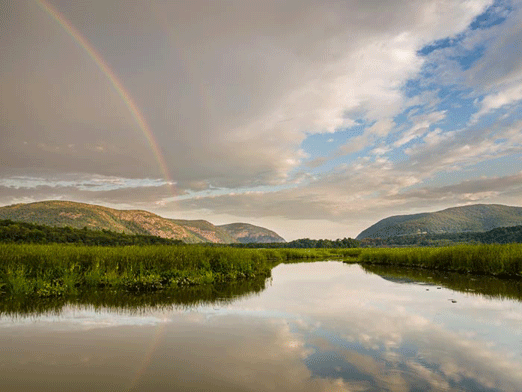
PLAN TO SHIP NUCLEAR WASTE DOWN HUDSON CAUSES DEBATE, Rockland County Times, on In recent months, routes to dispose of 76,000 metric tons of used fuel have been discussed in Congress.
In a 2002 report, the Department of Energy laid out a plan to get rid of the nation’s spent nuclear power plants’ waste, which has been piling up for several decades.
The report envisioned shipped the county’s nuclear waste from various locations via barge, rail and truck routes to the Yucca Mountain in the Mojave Desert, 100 miles northwest of Las Vegas.
Among the report’s more controversial proposals is a plan to move spent fuel out of Indian Point in Buchanan along with 16 other power plants without direct access to railroad lines, by barge, down the Hudson River.
Over the course of decades 58 shipments of nuclear waste would be loaded on barges at Indian Point for the 42 miles trip down the River, passing under the new Mario Cuomo Bridge and past New York City on the way to the seaport in New Jersey.
At the NJ seaport, cement and steel casks of spent nuclear matter weighing up to 100 tons, would be placed on rail cars for a 2,600-mile trip west to the Yucca Mountains.
The plan has caused much debate among politicians in New York. Former New Jersey Sen. Robert Torricelli stated the New Jersey ports should not be used “as rest stops for nuclear material.” http://www.rocklandtimes.com/2017/10/12/49179/
Muddled maths on the supposed costs of storing nuclear waste at Yucca Mt
UK taxpayers forked out £122million for failed nuclear decommissioning deal
Nuclear Authority’s failure to carry out decommissioning deal cost taxpayer £122million
Energy Voice by Reporter – 12/10/2017 Fundamental failures in awarding a £6.2 billion deal to decommission the UK’s ageing fleet of Magnox nuclear power stations cost the taxpayer £122 million, an official report has found.
The National Audit Office said the saga raised “serious questions” about the Nuclear Decommissioning Authority’s (NDA) understanding of procurement regulations.
The NDA ran a competitive procurement exercise for decommissioning services at 12 nuclear sites, resulting in the award of a 14-year contract for up to £6.2 billion, but the High Court found it had wrongly decided the outcome of the process.
The NDA agreed to settle claims in March 2017, the same month as the Government set up an inquiry into the Magnox contract.
Energy Solutions unsuccessfully bid for the contract, and later issued legal claims against the NDA for damages.
The High Court found that, had the NDA applied its evaluation criteria correctly, the winning bidder, Cavendish Fluor Partnership (CFP), would have been excluded from the competition.
The NDA agreed to settle legal claims with Energy Solutions and its consortium partner at the time of the bid, Bechtel, at a cost of £97.3 million.
It also spent £13.8 million on legal and external advisers, while in-house staff time cost £10.8 million.
Amyas Morse, head of the National Audit Office, said: “The NDA’s fundamental failures in the Magnox contract procurement raise serious questions about its understanding of procurement regulations; its ability to manage large, complex procurements; and why the errors detected by the High Court judgement were not identified earlier…….https://www.energyvoice.com/otherenergy/nuclear/153035/nuclear-authoritys-failure-carry-decommissioning-deal-cost-taxpayer-122million/
Scotland’s Dounreay nuclear site: health experts to be appointed by the operator
Scottish nuclear site looks to hire ‘health boffins’, Energy Voice, by Reporter , 12 Oct 17, A nuclear site criticised over its safety is seeking a team of health boffins – with starting salaries of £46,000 “upwards.”
Dounreay near Thurso in Caithness is being decommissioned at a cost of £2.32bn.
Safety concerns were raised in August about the handling of radioactive waste at the plant. The Nuclear Decommissioning Authority said safety has “deteriorated” at Dounreay and warned improvements made after a fire in 2014 had not been kept up.
Environmental protection agency Sepa rated the handling of waste last year as ‘at risk’ and called the management of vaults used to store it ‘poor’.
There were three serious incidents at the 60-year-old plant, where decommissioning work has been under way since the 1990s……
The Scottish Government has called for urgent action to address the problems at Dounreay, which were revealed in the NDA’s latest annual report. Gail Ross, SNP MSP for Caithness, Sutherland and Ross, has also said she was “seriously concerned” about Dounreay’s safety record.
But now its operators wants to recruit “a number” of senior health physicists…….
The boffins must be an appointed Radiation Protection Adviser, provide radiation protection advice, give advice and support to emergency arrangements at Dounreay and develop and provide specialist radiation protection training as well as contributing to the development of a safety culture……. https://www.energyvoice.com/otherenergy/nuclear/153131/scottish-nuclear-site-looks-hire-health-boffins/ –
Radioactive waste is to be removed from a contaminated section of Ridgewood
EPA targets radioactive site in Ridgewood, Times Ledger, 13 Oct 17, Radioactive waste is to be removed from a contaminated section of Ridgewood which was once the location of a chemical plant that harvested raw materials from sand and dumped the refuse into the sewer.
The parcel of land — which became contaminated while under use by the Wolff-Alport Chemical Company from 1920 to 1954 — will see all business tenants relocated, buildings demolished, soil removed and sewers replaced, according to the EPA. The three-quarter-acre patch of contaminated land is located at 1125 to 1139 Irving Ave. and 1514 Cooper Ave. It used to be home to Jarabacoa Deli Grocery, as well as office space, residential apartments, several auto repair shops and warehousing space…….https://www.timesledger.com/stories/2017/41/radioactive_2017_10_13_q.html
South Wales petition calls for reviewing the dumping of radioactive mud off coast of Cardiff
More than 5,500 sign anti-dumping petition, Ian Craig, -South Wales, Argus, 9 Oct 17, MORE than 5,000 people have signed a petition calling for a stop to plans to dump waste from the nuclear power station off the coast of Cardiff.
The petition was launched after it was revealed EDF Energy had applied to be allowed to dredge 300,000 tonnes of mud from near Hinkley Point in Somerset and dump it off Cardiff Bay.
Although some have claimed the mud could be radioactive, both EDF and the Welsh Government have denied this is the case.
A petition launched by South Wales Central AM Neil McEvoy calling for the plans to be reviewed has been signed by more than 5,500 people, meaning it must be debated in the Assembly.
Mr McEvoy, who was suspended from Plaid Cymru for the second time this year last month and is currently sitting as an Independent AM, said: “This isn’t just about radioactive mud, even though that’s bad enough.
“This is about Wales’ future.
“We’re not here to have the things other people don’t want being dumped on us, whether that’s potentially radioactive mud from a nuclear reactor or mass numbers of prisoners.”
To view the petition visit tinyurl.com/ybqnvaax.
1 This Month
23-25 October – on Zoom – World BEYOND War’s annual global conferenc


Shut down the radiation-damaged Heysham nuclear reactors now
To see nuclear-related stories in greater depth and intensity – go to https://nuclearinformation.wordpress.com

Say No to NASA’s Reckless Nuclear Reactor on the Moon
Say No to NASA’s Reckless Nuclear Reactor on the Moon

-
Archives
- October 2026 (199)
- September 2026 (339)
- August 2026 (330)
- July 2026 (355)
- June 2026 (287)
- May 2026 (306)
- April 2026 (356)
- March 2026 (251)
- February 2026 (267)
- January 2026 (308)
- December 2025 (358)
- November 2025 (359)
-
Categories
- 1
- 1 NUCLEAR ISSUES
- business and costs
- climate change
- culture and arts
- ENERGY
- environment
- health
- history
- indigenous issues
- Legal
- marketing of nuclear
- media
- opposition to nuclear
- PERSONAL STORIES
- politics
- politics international
- Religion and ethics
- safety
- secrets,lies and civil liberties
- spinbuster
- technology
- Uranium
- wastes
- weapons and war
- Women
- 2 WORLD
- ACTION
- AFRICA
- Atrocities
- AUSTRALIA
- Christina's notes
- Christina's themes
- culture and arts
- Events
- Fuk 2022
- Fuk 2023
- Fukushima 2017
- Fukushima 2018
- fukushima 2019
- Fukushima 2020
- Fukushima 2021
- general
- global warming
- Humour (God we need it)
- Nuclear
- RARE EARTHS
- Reference
- resources – print
- Resources -audiovicual
- Weekly Newsletter
- World
- World Nuclear
- YouTube
-
RSS
Entries RSS
Comments RSS

