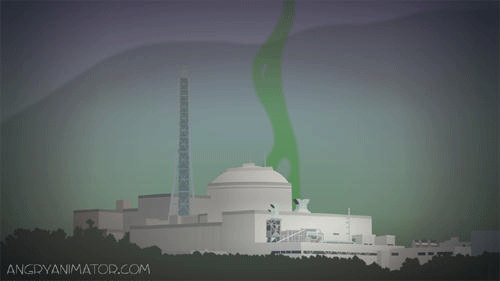
Le Monde 1st April 2018, [Machine Translation]By validating, on Wednesday 28 March, the project to
dismantle the Monju breeder reactor, the Nuclear Regulatory Authority (ARN)
thwarting Japan’s ambition to control the fuel cycle and adds a new nuclear
bill in the archipelago. The project involves a dismantling over thirty
years of the facility built in Tsuruga in the department of Fukui (center).
It should cost 375 billion yen (2.86 billion euros). The operation will
start as soon as July by the removal of the fuel. Then the sodium –
liquid delicate cooling to handle because flammable on contact with air –
will be removed. Disassembly will follow, with an end scheduled for 2048. http://www.lemonde.fr/energies/article/2018/04/01/nucleaire-les-ambitions-contrariees-du-japon_5279295_1653054.html
After repeated attempts to find a site to bury the UK’s nuclear waste, the last of which ended in 2013 when Cumbria County Council voted to halt the process, the Government are about to restart the search process. Ahead of this launch, the Department for Business, Energy and Industrial Strategy (BEIS) have released a consultation document, Working With Communities.Cumbria Trust has examined the proposal in detail and we have some very serious concerns about this consultation and its implications for areas which volunteer.
BEIS are proposing to open the search process to allow anyone to volunteer, even a member of the public, a farmer or a business. They can do this behind closed doors, with no requirement to make public their expression of interest during the first few months. A process being presented as ‘open and transparent’ appears to fall a long way short.
In stark contrast to the flexible approach by which areas can enter the process, if they later wish to withdraw, they are obliged to follow a much more complex and convoluted procedure in order to be allowed to leave.
However the most alarming aspect of the proposal is that the first and only test of public support does not happen until some 20 years after the process starts. During this time the community will have to endure a programme of borehole drilling and other intrusive investigations lasting a decade or more. The last time this borehole programme happened was in the 1990s with Nirex, and that led Jamie Reed, MP at the time and prominent nuclear advocate, to declare in 2006
“The experience of Nirex endured by my community in the mid-1990s was so wretched that I was minded to entitle this debate fear and loathing”.
He continued
“As long as I have anything to do with it Nirex will never dig another sod of turf in West Cumbria”.
What BEIS are proposing will again potentially expose a community to this experience, and with no mechanism for the public to halt the process. Instead any right of withdrawal rests with a defined Community Partnership. Without regular tests of public support, the Community Partnership appears not to be answerable to the public.
For all the talk of an ‘open and transparent’ process, what BEIS are actually proposing is nothing of the sort, and seems likely to create an early breakdown of public trust. Cumbria Trust has responded to the consultation and would urge our members to read this and consider making their own submissions. The deadline is 19th April and we hope to publish some guidance notes to assist with this within the next few days.
France Info 26th March 2018, [Machine Translation] Nuclear: Bure, a colossal project at phenomenal cost.
Burying waste nuclear power plants 500 meters underground in Bure (Meuse) is a pharaonic site that will last a hundred years. EDF, which has to paythe bill, estimates the cost at 20 billion euros.
For Andra, the agency that will build the storage, the cost would be 34 billion euros. ” The Agency has an interest in the fact that the costing includes the safest security options possible while EDF has an interest in the fact that this storage costs the least possible, ” says Yves Marignac, independent expert
Wise Paris.
Waste Control Specialists (WCS) and Orano USA intend to revive licensing of a consolidated interim storage facility (CISF) in Andrews County, Texas, where spent nuclear fuel (SNF) from reactors across the country can be stored until a permanent repository is developed.
The companies said on March 13, 2018, they intend to form a joint venture that will ask the Nuclear Regulatory Commission (NRC) to resume its review of the CISF license application, which WCS originally submitted in April 2016. In that application, WCS requested NRC authorization to store up to 5,000 metric tons of uranium for a period of 40 years at its Texas Compact Waste facility.
In April 2017, however, the company requested that the NRC temporarily suspend all safety and environmental review activities as well as public participation activities associated with the license application. The company cited “a magnitude of financial burdens” that made pursuit of licensing unsupportable.
One issue was that the NRC’s estimate of the cost of the application review—$7.5 million—was “significantly higher” than WCS originally estimated. Costs associated with a public participation process and a potential adjudicatory hearing were also estimated to be “considerable.” WCS also said a cost-sharing agreement it had in place with one of its partners was “depleted” and it could not be “extended.” At the same time, WCS has faced significant operating losses in each of its operating years, and the cost of actively pursuing the project only serves to increase those losses, it said.
WCS said on its website in March that a joint venture with Orano USA—formerly AREVA Nuclear Materials—would leverage the French company’s decades of expertise in used fuel packaging, storage, and transportation. Scott State, CEO of WCS, noted that WCS’s proposed solution was an “industry-driven near-term solution” that will use “proven storage technology and procedures to expand the capabilities and operations at the WCS site to include consolidated interim storage of commercial used nuclear fuel.” Sam Shakir, CEO of Orano USA, in a statement said the WCS-Orano USA joint venture “will provide safety, flexibility and value for used nuclear fuel titleholders and reduce U.S. taxpayer liabilities for ongoing storage, while plans for a permanent federal repository continue.”
WCS’s Texas Compact Waste Facility in western Andrews County has been operational since early 2012. Owned and licensed by the State of Texas, it is the only commercial facility in the U.S. licensed in the past 40 years to dispose of Class A, B, and C low-level radioactive waste. It primarily serves Texas and Vermont, which are member states of the Texas Compact Commission, but it is also available to 34 other U.S. states that have no access to a compact disposal facility. However, irradiated SNF discharged from commercial nuclear reactors is classified as high-level radioactive waste.
A Boost for Consolidated Interim Storage
As POWER reported, the nation lacks a long-term nuclear waste strategy, and nearly a third of the nation’s SNF is in dry storage in about 2,080 cask or canister systems at 75 reactor sites scattered across 33 states. U.S. SNF pools have reached capacity limits, forcing nuclear generators to load about 160 new dry storage canisters each year.
Nuclear generators currently recover costs for SNF storage and management by suing the Department of Energy (DOE), which, under the Nuclear Waste Policy Act (NWPA), was contractually obligated to dispose of SNF by January 1998. The DOE, however, cannot fulfill its obligation because no permanent repository exists—or is even in sight. (For an in-depth look at the current state of nuclear waste management, see “A Break in the Nuclear Waste Impasse?” in POWER’s March 2018 issue.)
Beyond Yucca Mountain—the long-stonewalled Nevada repository identified by amendments to the NWPA in 1987—the law allows for only two other nuclear waste options: to build one or more interim storage facilities to temporarily consolidate SNF across the nation until a permanent repository is completed; or use federally monitored retrievable storage (MRS) facilities, in which the DOE could store nuclear waste from commercial nuclear plants pending permanent disposal or reprocessing.
While no MRS facilities have been proposed to date, only two private companies have filed NRC applications for an interim spent facility: WCS and Holtec, a Camden, New Jersey–based supplier of SNF management equipment.
On March 26, Holtec International reported that its HI-STAR 100MB cask, which could serve to transport hundreds of multipurpose canisters in storage across the U.S. to its proposed HI-STORE CIS facility in New Mexico, won an international competition for deployment in China.
Holtec’s vice president of Business Development, Joy Russell, said in a statement on March 12 that Holtec’s HI-STAR transportation systems have been used for 12 years now. In 2006, the 1976-closed Humboldt Bay Power Plant south of Eureka, California, became the first plant to feature subterranean storage. Ameren’s Callaway plant deployed the first canister based on Holtec’s HI-STORM UMAX storage system, which it plans to use at the New Mexico CISF. In January 2018, a seismically hardened version of the HI-STORM UMAX canister was lowered into a fortified cavity at the San Onofre nuclear plant.
“The successful deployment of under-ground-storage technology and Holtec’s actions licensing the HI-STORE CIS facility are true demonstrations that consolidated interim storage is achievable,” Russell said.
—Sonal Patel is a POWER associate editor (@sonalcpatel, @POWERmagazine)
In 1989, Russia Left a Nuclear Submarine Dead in the Ocean (Armed with Nuclear Weapons) National Interest , Kyle Mizokami , 27 Mar 18
Komsomolets sank in 5,250 feet of water, complete with its nuclear reactor and two nuclear-armed Shkval torpedoes. Between 1989 and 1998 seven expeditions were carried out to secure the reactor against radioactive release and seal the torpedo tubes. Russian sources allege that during these visits, evidence of “unauthorized visits to the sunken submarine by foreign agents” were discovered.
In the mid-1980s, the Soviet Union constructed a super submarine unlike any other. Fast and capable of astounding depths for a combat submersible, the submarine Komsomolets was introduced in 1984, heralded as a new direction for the Soviet Navy.
Five years later, Komsomolets and its nuclear weapons were on the bottom of the ocean, two-thirds of its crew killed by what was considered yet another example of Soviet incompetence.
The history of the Komsomolets goes as far back as 1966. A team at the Rubin Design Bureau under N. A. Klimov and head designer Y. N. Kormilitsin was instructed to begin research into a Project 685, a deep-diving submarine. The research effort dragged on for eight years, likely due to a lack of a suitable metal that could withstand the immense pressures of the deep. In 1974, however, the double-hulled design was completed, with a titanium alloy chosen for the inner hull.
Project 685, also known as K-278, was to be a prototype boat to test future deep-diving Soviet submarines. The Sevmash shipyard began construction on April 22, 1978 and the ship was officially completed on May 30, 1983. The difficulty in machining titanium contributed to the unusually long construction period.
K-278 was 360 feet long and forty feet wide, with the inner hull approximately twenty-four feet wide. It had a submerged displacement of 6,500 tons, and the use of titanium instead of steel made it notably lighter. It had a unique double hull, with the inner hull made of titanium, that gave it its deep-diving capability. The inner hull was further divided into seven compartments, two of which were reinforced to create a safe zone for the crew, and an escape capsule was built into the sail to allow the crew to abandon ship while submerged at depths of up to 1,500 meters.
……….On April 7, 1989, while operating a depth of 1266 feet, Komsomolets ran into trouble in the middle of the Norwegian Sea. According to Norman Polmar and Kenneth Moore, it was the submarine’s second crew, newly trained in operating the ship. Furthermore, its origins as a test ship meant it lacked a damage-control party.
A fire broke out in the seventh aft chamber, and the flames burned out an air supply valve, which fed pressurized air into the fire. Fire suppression measures failed. The reactor was scrammed and the ballast tanks were blown to surface the submarine. The fire continued to spread, and the crew fought the fire for six hours before the order to abandon ship was given.
………. Only four men had been killed in the incident so far, but after the submarine sank many men succumbed to the thirty-six-degree (Fahrenheit) water temperatures. After an hour the fishing boats Alexi Khlobystov and Oma arrived and rescued thirty men, some of whom later succumbed to their injuries. Of the original sixty-nine men on board the submarine when disaster struck, forty-two died, including Captain First Rank Vanin.
Komsomolets sank in 5,250 feet of water, complete with its nuclear reactor and two nuclear-armed Shkval torpedoes. Between 1989 and 1998 seven expeditions were carried out to secure the reactor against radioactive release and seal the torpedo tubes. Russian sources allege that during these visits, evidence of “unauthorized visits to the sunken submarine by foreign agents” were discovered.
Kyle Mizokami is a defense and national security writer based in San Francisco who has appeared in the Diplomat, Foreign Policy, War is Boring and the Daily Beast. In 2009 he cofounded the defense and security blog Japan Security Watch. You can follow him on Twitter: @KyleMizokami.
This second article on the unsuitability of nuclear power discusses radioactive waste. Waste disposal assumes there is a place ‘away’, where unwanted things can be discarded. This is a dualistic assumption. Holism recognizes that everything is connected: there is no ‘away’. In nature, everything is recycled, but humans have yet to learn this. Since 1945, more than 80K chemicals have been created and dispersed into our air, water, and soil, 90 percent of them untested for biological toxicity. Bacteria and fungus can break these chemicals into component parts, rendering them non-toxic and available for reintroduction into living systems.
However, radioactive waste is toxic by processes of nuclear physics (not chemistry), and only becomes safe over long periods of time. The life span of radioactive isotopes is measured by the time needed for 50 percent decay, a half-life, which can be tens of thousands of years.
The Nuclear Regulatory Commission (NRC) legislates that nuclear waste be categorized and treated based on level of radioactivity. Very Low Level Waste, twice as radioactive as natural granite, will decay to natural levels within 30 years. This material is disposed of in monitored landfills. Low Level Waste, about 20 times more radioactive than granite, contains isotopes with long half-lives. In the US, this material must be buried in one of four NRC regulated sites.
Intermediate Level Waste, generated from reprocessing spent fuel rods, is 100K to 100M times more radioactive than granite and can take more than 100 thousand years to return to natural levels. High Level Waste, spent fuel rods, is a billion times more radioactive than granite (an exposure of less than 20 seconds is lethal), and remains radioactive for millions of years. The 99 reactors currently operating in the US, have already produced 80,000 tons of High Level Waste. This will double by the time the reactors are decommissioned. These rods are stored in cooling pools, or dry cask storage, within the reactor facilities, but space is limited.
The only safe disposal of Intermediate and High Level waste requires geologic and social stability for hundreds of thousands of years. Globally, there are six research facilities studying the problem but, after 60 years of commercial nuclear power, there are no repositories that accept this type of radioactive waste. Geologic sites might exist with this kind of longevity, but human structures, social and physical, are relatively short lived. The Pandyan Empire in southern India, lasted 2,000 years, and the oldest culture, the Australian Aborigines, dates only 50,000 years. Warning signs about enduring danger are problematic, since language originated about 10,000 years ago.
Yucca Mountain, designated as the High Level depository in the US, was shut down in 2011, after decades of construction and billions in cost, because of unexpected ground water intrusion and political resistance from the State of Nevada. In any event, it is too small to store the waste now in storage, let alone future production, and would require air conditioning for a century. There are no plans for alternative sites, although the Trump administration wants to reopen Yucca for consideration.
“Spent fuel rods” contain 90 percent of the original enriched uranium and fissionable plutonium is produced within the rods, as a result of nuclear reactions. Advocates of nuclear technology and weapons, see this as a potential resource, and want consideration for future access. High Level waste must not be allowed to migrate into the environment for health reasons, and national security demands that this material be kept out of the hands of terrorists. Constructing geologic depositories with possible future access complicates an already difficult design problem.
A nuclear power plant boils water for less than half a century, and leaves a legacy lethal to life for a million years, with the added risk of it falling into the hands of terrorists to produce weapons of mass destruction. Such short-sighted thinking is typical of the dualistic mindset, which seems comfortable sacrificing future generations for the immediate gain of a few. We must be better than that.
Crispin B. Hollinshead is a retired mechanical engineer, a lifelong model maker, woodworker, and philosopher, residing in Mendocino County for over half his adult life, currently living in Ukiah.
Nucnet 16th March 2018, US-based Westinghouse Electric Company has completed a decommissioning
project at the Barseback nuclear power station in Sweden that included the
underwater segmentation and packaging of the reactor vessel internals.
Westinghouse said it had also carried out upfront engineering studies, and
equipment manufacturing and qualification for the project, which was part
of the first dismantling and decommissioning of a commercial nuclear power
plant in Sweden.
Barseback-2, a 600-MW boiling water reactor unit, began
commercial operation in July 1977 and was permanently shut down in May
2005, with decommissioning work beginning in August 2016. The closure
decision, announced in October 2004, followed what the government described
as failure to reach an agreement with the power industry on the details and
timetable for a voluntary phaseout of Sweden’s nuclear facilities Its
sister unit, Barseback-1, was permanently shut down in November 1999.
Westinghouse said it is now due to begin decommissioning work on
Barseback-1, with an estimated completion date of April 2019.
This Father-Daughter Team Says It Has a Cheaper, Safer Way to Bury Nuclear Waste, Startup Deep Isolation wants to use fracking tech to drill horizontal disposal tunnels a mile below the Earth’s surface. Bloomberg By Ashlee Vance, 20 March 18Richard and Elizabeth Muller have come up with one of the more unusual father-daughter businesses in recent memory. On March 20 they announced a startup called Deep Isolation that aims to store nuclear waste much more safely and cheaply than existing methods. The key to the technology, according to the Mullers, is to take advantage of fracking techniques to place nuclear waste in 2-mile-long tunnels, much deeper than they’ve been before—a mile below the Earth’s surface, where they’ll be surrounded by shale. “We’re using a technique that’s been made cheap over the last 20 years,” says Richard, a famed physicist and climate change expert. “We could begin putting this waste underground right away.”
…….. The U.S. has about 80,000 tons of nuclear waste, mostly sitting at about 70 sites, in aboveground water pools.
……….With each passing year, the U.S. produces an additional 2,000 tons of nuclear waste, and the total is already more than Yucca Mountain was meant to hold. While President Trump has sought a modest $120 million to restart the program, Congress has made clear it’s not going to broach the subject in an election year. “It’s quite a serious problem,” says Rodney Ewing, a Stanford professor of geological sciences who specializes in nuclear security. “As a country, we seem to not be paying attention to the obvious difficulties we have with the waste.”
Nuclear waste experts have contemplated deep-drilling for half a century, mostly by proposing to bore straight down into granite and crystalline rock. But tests of these techniques haven’t gotten very far, being blocked, on occasion, by the public. These approaches have been deemed costly and possibly unsafe, because stacking containers on top of one another puts so much weight on the bottom drums. The Mullers say it’s much cheaper and safer to drill horizontal tunnels, and to do so in shale. They can fit the typical waste canisters (each 1 foot in diameter and 14 feet long) quickly and safely into shale tunnels, they say, given advances in fracking equipment. “Drilling the holes takes a couple weeks at most,” says Elizabeth.
…….. It’d be best to keep the tunnels close to existing nuclear waste sites, the Mullers say. The U.S. is so shale-rich that the waste disposal tunnels could be placed near nuclear production sites, so no hauling of waste would be required. The boreholes would also be much deeper than something like Yucca, vastly reducing the chance of radioactive waste leaking into the water supply. “The goal is to get this stuff out of the biosphere, and the farther down you go, the less things change,” Elizabeth says. “The waste will have 1 billion tons of rock on top of it and be in shale that has held methane gas and other volatiles for tens to hundreds of millions of years. Things don’t leak out.” Also, unlike at Yucca, machines could handle all the tunnel work, says Richard: “We’re cheaper because we remove a lot less dirt and don’t put people underground.”
The elder Muller first made his name dealing with radiation much farther away. As a professor at the University of California at Berkeley and senior scientist at the Lawrence Berkeley National Laboratory, Richard did that pioneering research on dark energy and cosmic radiation, including work on projects that eventually earned Nobel Prizes. After he and Elizabeth co-founded Berkeley Earth, a nonprofit that measures global temperature and climate change, he went from being one of the most prominent global warming doubters to one of the loudest voices confirming that climate change is real and caused by humans.
…….. Before the Mullers can drill any holes in shale, they have massive challenges to overcome. Stanford’s Ewing says Deep Isolation will likely struggle to persuade dozens of communities to accept having a long-term nuclear waste site nearby and to persuade the government to let commercial companies tackle the problem. The two have drafted federal legislation that could lead to private nuclear waste disposal. “The government might allow this,” says Allison Macfarlane, former chair of the U.S. Nuclear Regulatory Commission. “The real question is whether such a small startup company would have the resources to go through the licensing over such a long time period.”……..https://www.bloomberg.com/news/articles/2018-03-20/this-father-daughter-team-says-it-has-a-cheaper-safer-way-to-bury-nuclear-waste
Pipe-crawling robot will help decommission DOE nuclear facility, Radiation-measuring robots go where humans cannot Science Daily
Date:
March 20, 2018
Source:
Carnegie Mellon University
Summary:
A pair of autonomous robots will soon be driving through miles of pipes at the US Department of Energy’s former uranium enrichment plant in Piketon, Ohio, to identify uranium deposits on pipe walls.
A pair of autonomous robots developed by Carnegie Mellon University’s Robotics Institute will soon be driving through miles of pipes at the U.S. Department of Energy’s former uranium enrichment plant in Piketon, Ohio, to identify uranium deposits on pipe walls.
The CMU robot has demonstrated it can measure radiation levels more accurately from inside the pipe than is possible with external techniques. In addition to savings in labor costs, its use significantly reduces hazards to workers who otherwise must perform external measurements by hand, garbed in protective gear and using lifts or scaffolding to reach elevated pipes.
DOE officials estimate the robots could save tens of millions of dollars in completing the characterization of uranium deposits at the Portsmouth Gaseous Diffusion Plant in Piketon, and save perhaps $50 million at a similar uranium enrichment plant in Paducah, Kentucky.
…….. Shuttered since 2000, the plant began operations in 1954 and produced enriched uranium, including weapons-grade uranium. With 10.6 million square feet of floor space, it is DOE’s largest facility under roof, with three large buildings containing enrichment process equipment that span the size of 158 football fields. The process buildings contain more than 75 miles of process pipe.Finding the uranium deposits, necessary before DOE decontaminates, decommissions and demolishes the facility, is a herculean task. In the first process building, human crews over the past three years have performed more than 1.4 million measurements of process piping and components manually and are close to declaring the building “cold and dark.”
“With more than 15 miles of piping to be characterized in the next process building, there is a need to seek a smarter method,” said Rodrigo V. Rimando, Jr., director of technology development for DOE’s Office of Environmental Management……….https://www.sciencedaily.com/releases/2018/03/180320084315.htm
Cortez Masto seeks details on Yucca spending since Trump’s election, The Nevada Independent, Humberto Sanchez , March 19th, 2018 , Sen. Catherine Cortez Masto has called on Energy Secretary Rick Perry to provide details on how the White House would spend funds requested for the Yucca Mountain nuclear waste repository, as well as how money has been spent since President Donald Trump was elected.
In a letter to Perry dated Monday, Cortez Masto, an opponent of the controversial project, noted that while the president has requested $120 million in both of his fiscal year (FY) 2018 and 2019 budget blueprints, with regard to the Department of Energy (DOE), neither of the budget documents provides a detailed account of how funding will be, or has been, spent.
“The FY 2019 Budget Justification, like the FY 2018 Budget Justification, provides little meaningful information on how DOE would actually spend these funds to participate in U.S. Nuclear Regulatory Commission licensing activities for the Yucca Mountain nuclear waste repository,” the letter said. “Moreover, neither of these budget documents provide any information on DOE expenditures from the Nuclear Waste Fund for Yucca Mountain activities during FY 2017 and FY2018.”
Cortez Masto wants Perry to disclose what the unobligated balances were in DOE’s Defense Nuclear Waste Disposal and Nuclear Waste Disposal accounts at the beginning of FY 2017, which started on Oct. 1, 2016, as well as for FY 2018.
She also wants to know how much was spent from these accounts during FY 2017 and 2018 for Yucca licensing activities; pension fund and related obligations for retired Yucca Mountain workers; administration of the Nuclear Waste Fund, financial audits; investment guidance; maintenance of records and technical and scientific information, including preservation and security of geologic samples. ……..https://thenevadaindependent.com/article/cortez-masto-seeks-details-on-yucca-spending-since-trumps-election
Thousands of containers with radioactive waste were dumped in the Kara Sea during Soviet times. Now, Russia’s Federal Agency for Fishing believes it’s a good idea to start fishing. By Thomas Nilsen March 15, 2018
“We shall present soon a program on development of promising fishing in the Kara Sea,” said Sergey Golovanov at the 5th international conference of fishing in the Arctic, organized in Murmansk this week. He is quoted by news agency TASS.
Golovanov is head of the Science and Education Department with the Federal Agency for Fisheries and has a background from PINDRO, the Marine research institute in Murmansk.
According to Gulovanov, the Kara Sea’s advantage for the fishing industry is that it is a shelf sea, it does not border any territorial waters of other nations. “This is why Russia can have own fishing regulations there,” he said according to TASS.
In 2013, a Norwegian-Russian joint study expedition to the dump-site of K-27 concluded that it is feasible to lift the ill-fated submarine from the seabed. Although dumped 30 years ago, the hull of the submarine is intact.
Several other areas of the Kara Sea were also visited by the science expedition.
Nuclear weapons testing
Additional to the nuclear waste dumped across the Kara Sea, the waters are also next to the Soviet Union’s largest testing area for nuclear weapons. At Novaya Zemlya, 79 nuclear- and hydrogen bombs where detonated in the atmosphere between 1955 and 1962. In the period from 1963 to 1990 another 35 warheads were tested in tunnels under ground. Today, most of Novaya Zemlya is closed off miitary area.
At the conference in Murmansk, nothing was said about the Kara Sea being the main dumping ground for nuclear waste during Soviet times. No other oceans worldwide have more dumped radioactive waste than Russia’s Arctic Kara Sea.
Here, there, everywhere
17 ships and barges loaded with radioactive waste are dumped here. So are 17,000 containers with radioactive waste. Even worse, along the east coast of Novaya Zemlya is 16 nuclear reactors dumped, six of them with spent uranium fuel still on board.
With the breakup of the Soviet Union, both the military Northern Fleet and the civilian icebreakers stopped dumping waste at sea.
Entire nuclear sub dumped in 1982
On shallow waters in the Stepovogo Bay on the southeast coast of Novaya Zemlya, an entire nuclear-powered submarine, the K-27, was dumped in 1982.
The submarine had then been laid-up for more than 15 years after one of the two troublesome reactors suffered a severe leakage of radioactive gasses and inadequate cooling causing extensive fuel element failures.
Dumping the entire submarine at sea was done in what the Soviet reactor engineers and scientists believed would be a safe way to avoid leakages of radionuclides into the marine environment.
The two on board reactors are liquid-metal cooled and contain spent nuclear fuel, 800 kilograms of uranium to be precise.
Both Russian and Norwegian radiation experts have repeatedly warned that failing to lift the submarine eventually one day will cause leakages of radioactivity into the Kara Sea. A worst-case scenario has even pointed to the danger of an uncontrolled chain reaction that could be triggered inside the reactor in case sea water one day starts to leak in through the protecting cover that today isolates the compartment holding the two reactors.
In 2013, a Norwegian-Russian joint study expedition to the dump-site of K-27 concluded that it is feasible to lift the ill-fated submarine from the seabed. Although dumped 30 years ago, the hull of the submarine is intact.
Several other areas of the Kara Sea were also visited by the science expedition.
Nuclear weapons testing
Additional to the nuclear waste dumped across the Kara Sea, the waters are also next to the Soviet Union’s largest testing area for nuclear weapons. At Novaya Zemlya, 79 nuclear- and hydrogen bombs where detonated in the atmosphere between 1955 and 1962. In the period from 1963 to 1990 another 35 warheads were tested in tunnels under ground. Today, most of Novaya Zemlya is closed off miitary area.
First samples of Fukushima plant nuclear fuel debris to be collected in FY 2019 https://mainichi.jp/english/articles/20180316/p2a/00m/0na/018000c (Mainichi Japan) The government and Tokyo Electric Power Co. (TEPCO) are set to extract a small sample of melted nuclear fuel from the bottom of the No. 2 reactor’s containment vessel at the disaster-stricken Fukushima No. 1 nuclear plant as early as fiscal 2019.
The operation will be a test before starting full-scale collection of the fuel, targeted for 2021 or earlier. If development of technologies for debris retrieval shows promise, the operation may be moved up to the end of fiscal 2018. The government and TEPCO hope to ascertain the properties of the melted fuel and use the information for developing collection devices and debris containers.
This will be the first attempt to sample nuclear fuel debris from a reactor. Other materials, including those floating in contaminated water and substances stuck to robot probes, have been extracted from the plant’s reactors before. The No. 1, 2 and 3 reactors at the Fukushima No. 1 plant melted down in the March 2011 nuclear disaster.
The road map for collecting the melted fuel, last revised in September 2017, states that TEPCO would choose a first reactor to tackle by the end of fiscal 2019 and decide on a collection method. The utility would then start the retrieval process in 2021. As deciding on this process requires finalizing ways to contain, transfer and store the debris, the government and utility concluded that they would need to grasp the fuel’s current condition by extracting samples beforehand.
In January this year, a camera and dosimeter were sent into the containment vessel of the No. 2 reactor through an existing passage to find pebble- and clay-like masses at its bottom believed to be melted fuel. A source close to the government says the plan is to remotely guide a robot arm equipped with a camera and dosimeter into the containment vessel through the same passage, and extract a small amount of the suspected fuel debris.
The January probe of the containment vessel revealed radiation around the pebble-like masses measured 8 sieverts per hour — a level potentially lethal to humans after just one hour of exposure. Due to the ultrahigh radiation, the sampled material will be placed in a special radiation-shielded container before being removed from the reactor. After that, the sample will be brought to a Japan Atomic Energy Agency facility in Ibaraki Prefecture for analysis.
A government source told the Mainichi Shimbun that sampling the suspected fuel debris is different from the debris collection specified in the road map, and stressed that extracting samples should be beneficial to determine a method for retrieving the fuel.
The federal government is demanding that the company building a giant nuclear waste treatment plant in Washington state provide records proving that the steel used in the nearly $17 billion project meets safety standards.
The U.S. Department of Energy says in a letter obtained by the Associated Press that records needed to ensure that the structural steel used in the project is safe are either missing or of “indeterminate quality.”
“This condition is a potentially unrecoverable quality issue,” said the letter sent March 6 from the agency’s Office of River Protection in Richland to Bechtel National Inc., which is building the long-delayed plant to dispose of wastes created in the production of plutonium for nuclear weapons.
The agency gave Bechtel National 14 days to provide proof that work on the project should continue.
The plant is located on the Hanford Nuclear Reservation near Richland, which for decades made most of the plutonium for the nation’s nuclear weapons arsenal. The resulting 56 million gallons of radioactive and hazardous wastes are stored in 177 underground tanks, many of which are leaking.
The waste treatment plant is designed to turn much of that waste into glass-like logs for burial, a technically demanding process.
But construction of the giant plant, which began in 2002, has long been slowed by safety and technical issues.
Bechtel National is working on providing the records, spokeswoman Stasi West said. “We have documentation that demonstrates the nuclear-grade structural steel meets project requirements,” West said. “The safety and quality of the structural steel was never in question.”
The letter from the Office of River Protection, which is named for the Columbia River that flows through the Hanford site, did not contend that the structural steel in the Hanford Tank Waste Treatment and Immobilization Plant was defective. Rather it says that records proving the steel can perform its safety function were missing or of poor quality.
The agency directed Bechtel “to promptly investigate the facts and circumstances surrounding the procurement, receipt and acceptance of materials installed … to justify the continuation of work,” the letter said.
In a statement, the Department of Energy said it was committed to the safety of workers, the public and the environment.
“The department directed Bechtel National Inc. to gather the necessary documentation and provide it to the department,” the DOE said Friday. “When received, DOE will determine whether the documentation meets applicable quality assurance standards for the steel being used in the (plant).”
The watchdog group Hanford Challenge contended the issue was potentially a “showstopper.”
“If the structural steel and other components cannot meet rigorous safety standards for nuclear operations, the plant cannot be allowed to operate,” said Tom Carpenter, executive director of Hanford Challenge. “The contractor failed and needs to be held accountable.”
About 40,000 tons of structural steel is needed for the plant, to help prevent the release of radioactive and hazardous wastes into the environment.
“Structural steel, in conjunction with reinforced concrete structures, is integral to performing functions relied on in safety basis accident analyses,” the letter said.
The plant will use state-of-the-art vitrification technology, which involves blending the nuclear waste with glass-forming materials and heating it to 2,100 degrees Fahrenheit. The molten mixture is poured into stainless steel canisters to cool and solidify. In the glass form, the waste is stable and its radioactivity will safely dissipate over hundreds to thousands of years.
The construction site spans 65 acres and plant buildings are up to 12 stories tall. The plant is expected to be completed early in the next decade.
A team of six experts in the nuclear energy sector has been assembled to find a way to move the 3.55 million pounds of nuclear waste at the San Onofre Nuclear Generating Station.
The group includes a former chairman of the Nuclear Regulatory Commission, the independent agency in charge of all safety-related matters surrounding nuclear energy in the U.S., and a former director of policy at the U.S. Department of Energy.
The panel was put together as part of an out-of-court settlement negotiated last summer between Southern California Edison — the utility that operates SONGS — and attorneys for two San Diego-area plaintiffs who opposed a permit granted by the California Coastal Commission allowing waste to be stored on the plant’s premises.
One of the terms in the settlement called for creating a team of authorities in engineering, radiation detection and nuclear waste siting and transportation to learn if any alternative sites exist to store SONGS’ spent fuel.
“This is a very significant step; this hasn’t been done before,” Aguirre said. “There hasn’t been an owner of nuclear waste that has brought together a panel working with the community that’s focused on figuring out how to move (the waste) to a safer location.”
SONGS sits between the Pacific Ocean and one of the busiest freeways in the country — Interstate 5. About 8.4 million people live in a 50-mile radius of the plant in an area with a history of seismic activity.
Among the members of the panel is Allison Macfarlane, who chaired the Nuclear Regulatory Commission from 2012 to 2014, and Thomas Issacs, whose time at the Department of Energy included policymaking regarding waste management and security.
Speaking in general terms about nuclear waste, Macfarlane told the audience, “It is our ethical responsibility to deal with this material and not leave it for future generations.”
The other members of the panel are:
Kristopher W. Cummings, a fuel storage expert and engineer with Curtis-Wright Nuclear Division.
Gary Lanthrum, the former director of the National Transportation Program for Yucca Mountain.
Richard C. Moore, a consultant specializing in transportation of radiological materials who works for the Western Interstate Energy Board.
Josephine Piccone, a health physics and radiation control expert with regulatory compliance experience
“We believe this distinguished panel of experts will make significant contributions to a growing industry-wide effort to achieve off-site storage of nuclear fuel,” Tom Palmisano, vice president of decommissioning and chief nuclear officer at SONGS said in a letter to members of the facility’s Community Engagement Panel.
“We have a long road ahead as we undertake this difficult task but selection of these experts is an important step,” Palmisano said, adding that the panel will begin its work “in the coming weeks.”
The team of experts was assembled with input from the attorneys involved in the settlement and from Edison officials.
About 80,000 metric tons of spent fuel has accumulated at nuclear reactor sites across the country.
The Yucca Mountain repository in Nevada was supposed to accept large amounts of waste, but Nevada lawmakers, especially then-Senate Majority Leader Harry Reid, were firmly against opening the site. The Obama administration cut off funding for Yucca Mountain in 2010.
KIEV, March 15 (Xinhua) — The Ukrainian government has included the facility for nuclear waste near the destroyed Chernobyl nuclear power plant into a list of heavily guarded objects, local media reported Thursday, citing a government decree.
The decree, which was adopted by the cabinet earlier this week, envisages that the central spent fuel storage facility (CSFSF) will be guarded by the officers of the National Guard of Ukraine.
The building of the CSFSF, which will store spent nuclear fuel from three Ukrainian nuclear power plants, is currently underway at the 30-km-radius exclusion zone around the plant.
The construction of the facility has started in November 2017 and its first stage is due to be completed in 2019.
The building of the CSFSF is aimed at boosting Ukraine’s capabilities in managing and storing its nuclear waste. Currently, the East European country relies heavily on Russia for storing spent fuel from its power plants.
Ukraine generates over half of its electricity from nuclear energy. Currently, 15 reactors in four nuclear power plants are operating in the East European country.
The Chernobyl plant, located some 130 km from Kiev, witnessed one of the worst nuclear accidents in human history on April 26, 1986.
The blasts at the No. 4 reactor spread radiation across Ukraine, Belarus, Russia and other European countries.