On a concrete pad about 25 feet above Plymouth Bay, eight massive steel-reinforced concrete cylinders hold the remains of the radioactive fuel that has kept the Pilgrim Nuclear Power Station running since the 1970s.
“Radioactive Waste and Canada’s First Nations” – perilously close to ruining this Earth

Mother Earth and the “too late” time https://beyondnuclearinternational.org/2018/04/24/radioactive-waste-first_nations/ We are getting perilously close, warn First Nations, By Linda Pentz Gunter
How the diabolically dangerous plutonium cores killed two nuclear scientists
The Nuclear ‘Demon Core’ That Killed Two Scientists https://www.atlasobscura.com/articles/demon-core-that-killed-two-scientistsAfter World War II ended, physicists kept pushing a plutonium core to its edge. BY SARAH LASKOW
APRIL 23, 2018
Since the United States dropped two atomic bombs on Japan, the world has been in a state of readiness for nuclear combat. In this secretive domain, mistakes and mishaps are often hidden: This week we’re telling the stories of five nuclear accidents that burst into public view.
THE WAR WAS OVER—JAPAN HAD surrendered. The third plutonium core created by the United States, which scientists at Los Alamos National Lab had been preparing for another attack, was no longer needed as a weapon. For the moment, the lab’s nuclear scientists were allowed to keep the sphere, an alloy of plutonium and gallium that would become known as the demon core.
In a nuclear explosion, a bomb’s radioactive core goes critical: A nuclear chain reaction starts and continues with no additional intervention. When nuclear material goes supercritical, that reaction speeds up. American scientists knew enough about the radioactive materials they were working with to be able to set off these reactions in a bomb, but they wanted a better understanding of the edge where subcritical material tipped into the dangerous, intensely radioactive critical state.
One way to push the core towards criticality involved turning the neutrons it shedback onto the core, to destabilize it further. The “Critical Assembly Group” at Los Alamos was working on a series of experiments in which they surrounded the core with materials that reflected neutrons and monitored the core’s state.
The first time someone died performing one of these experiments, Japan had yet to formally sign the terms of surrender. On the evening of August 21, 1945, the physicist Harry Daghlian was alone in the lab, building a shield of tungsten carbide bricks around the core. Ping-ponging neutrons back the core, the bricks had brought the plutonium close to the threshold of criticality, when Daghlian dropped a brick on top. Instantly, the core reacted, going supercritical and Daghlian was doused in a lethal dose of radiation. He died 25 days later.
His death did not dissuade his colleagues, though. Nine months later, they had developed another way to bring the core close to that critical edge, by lowering a dome of beryllium over the core. Louis Slotin, another physicist, had performed this move in many previous experiments: He would hold the dome with one hand, and with the other use a screwdriver to keep a small gap open, just barely limiting the flow of neutrons back to the bomb. On a May day in 1946, his hand slipped, and the gap closed. Again, the core went supercritical and dosed Slotin, along with seven other scientists in the room, with gamma radiation.
In each instance, when the core slipped over that threshold and started spewing radiation, a bright blue light flashed in the room—the result of highly energized particles hitting air molecules, which released that bolt of energy as streams of light.
The other scientists survived their radiation bath, but Slotin, closest to the core, died of radiation sickness nine days later. The experiments stopped. After a cooling-off period, the demon core was recast into a different weapon, eventually destroyed in a nuclear test.
Design flaws in Holtec’s canisters for nuclear waste burial (-teleconference and comments)

 Holtec Proposal To Bury High Level Nuclear Waste – Teleconference Sign-up Deadline Monday-Written Comments Due End Mayhttps://wordpress.com/read/feeds/4410547/posts/1834518669 22 Apr 2018
by miningawareness
Deadline Monday to Register for teleconference re burial of high level nuclear waste (including spent Mox fuel) in New Mexico by Holtec. Privately owned Holtec’s plan would involve cross country transport and burial of first 500 and then ultimately 10,000 high level nuclear waste cans (Chernobyls in a can). Read more here:https://adamswebsearch2.nrc.gov/webSearch2/view?AccessionNumber=ML18107A144
Written Comment deadline end of May:https://www.federalregister.gov/documents/2018/03/19/2018-05438/holtec-internationals-hi-store-consolidated-interim-storage-facility-for-interim-storage-of-spent
An earlier US DOE funded site study of the site states that: “Mineral extraction in the area consists of underground potash mining and oil/gas extraction. Both industries support major facilities on the surface, although mining surface facilities are confined to a fairly small area…. Intrepid has rights to potash beneath the Site as shown in Appendix 2A, Map 9 and Figure 2.1.2-3. Mining has not progressed as far as Site….” https://www.nrc.gov/docs/ML1024/ML102440738.pdfWhile the dry salt lakes and potash mines suggest higher than normal corrosion rate for the 1/2 inch thick Holtec canisters, the location suggests sinkhole risk. The limited DOE funded study, which Holtec uses, denies the existence of karst, but this is hard to believe. Risk is exacerbated by the oil and gas wells and potash mining. The original DOE funded study states that “A producing gas and distillate well with associated tank battery is located near the communications tower…”
If “the requested CIS Facility license is issued by the NRC, Holtec subsequently anticipates requesting an amendment to the license to request authorization to possess and store an additional 500 canisters for each of 19 subsequent expansion phases to be completed over the course of years. Ultimately, Holtec anticipates that approximately 10,000 SNF canisters would be stored at the CIS Facility upon completion of all 20 phases…Phase 1 of the CIS Facility will include two HI-STORM UMAX pads that will allow storage of 500 canisters of SNF and GTCC waste from commercial nuclear reactors as well as a small quantity of spent mixed-oxide fuel..” https://www.federalregister.gov/documents/2018/03/19/2018-05438/holtec-internationals-hi-store-consolidated-interim-storage-facility-for-interim-storage-of-spent
As explained by Donna Gilmore of San Onofre Safety:
“Holtec HI-STORM UMAX canister storage systems and all other thin-wall nuclear waste canister storage systems are vulnerable to short-term radioactive leaks and potential explosions and criticalities. Each canister has roughly as much highly radioactive Cesium-137 as was released from the 1986 Chernobyl nuclear disaster.
These thin-wall “Chernobyl” cans have the following design flaws:
* Vulnerable to short-term cracking and major radioactive leaks
* Cannot be inspected inside or out
* Cannot be repaired
* Cannot be monitored or maintained to PREVENT radioactive leaks
* No plan for failing canisters.
Holtec proposes to transport thousands of US aging nuclear waste cans across the country to New Mexico and store them in an unproven HI-STORE CIS “Consolidated Interim Storage” facility,…“. See Handout: Holtec Storage System Designed to Leak.
https://sanonofresafety.files.wordpress.com/2015/10/designedtoleakholtec-cis-2017-06-24.pdf Read the rest here: https://sanonofresafety.org/holtec-hi-storm-umax-nuclear-waste-dry-storage-system/
Holtec actually admits in a recent presentation that these huge canisters which may be up to 75 ¾ inches in diameter, and up to 213 inches tall are only 1/2 inch thick and the vented protective shell only 1 inch thick: https://www.nrc.gov/public-involve/conference-symposia/dsfm/2015/dsfm-2015-stefan-anton.pdf…..
HOLTEC IS PRIVATELY OWNED, APPARENTLY BY KRIS PAL SINGH, THOUGH REALLY NO ONE KNOWS. IN THE US THIS MEANS THAT IT IS ALMOST IMPOSSIBLE TO GET INFORMATION ON THE COMPANY. IN THE PAST, SINGH HAS REFUSED TO GIVE INFORMATION ABOUT THE SPENT FUEL CASK SYSTEMS TO THE US GOVERNMENT WHEN IT WAS NEEDED BY THEM TO ESTIMATE COSTS DURING A LAWSUIT. HOLTEC HAS BEEN FINED FOR BRIBING THE TVA. HOLTEC HAS REQUESTED AND GOTTEN WHAT SEEMS LIKE ENDLESS REQUESTS FOR EXEMPTIONS TO THE AGREED STANDARDS FOR PRODUCTION AND PACKING THE SPENT FUEL CASK SYSTEMS. AN UNKNOWN NUMBER OF THE SPENT FUEL CASKS ARE NOT EVEN CORRECTLY PACKED AND RECEIVED “EXEMPTIONS”. ON AT LEAST ONE NUCLEAR REACTOR SITE ALMOST ALL ARE IMPROPERLY PACKED. NOTE THAT HOLTEC EVEN TRIES TO CLAIM COPYRIGHT ON INFORMATION WHICH HOLTEC TOOK FROM AN EARLIER US GOVERNMENT FUNDED DOCUMENT. THIS GIVES A TINY IDEA OF WHAT JERKS THEY ARE.
Danger of rising sea levels to nuclear waste canisters at Pilgrim Nuclear Power Station
Special vehicles are required to move the casks, as are specially built roads that can handle the immense weight.
“We don’t know if this highly dangerous material will be there for another 100 years or a thousand years.
if the casks are not moved in the coming decades, or even centuries, they worry about who would ultimately be responsible for protecting the nuclear waste. It’s unlikely, for example, that Entergy will still own the property, they say.
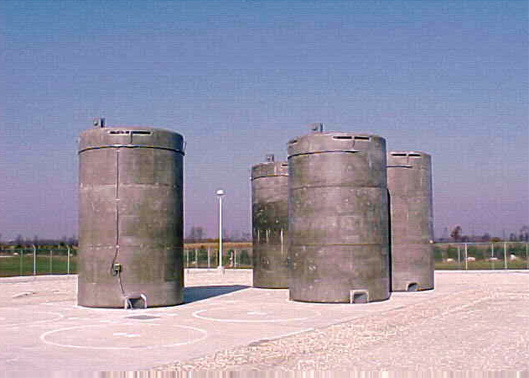
Pilgrim officials consider moving nuclear waste to higher ground more https://www.bostonglobe.com/metro/2018/04/20/seas-rise-pilgrim-mulls-moving-its-nuclear-waste-higher-ground/rcrkilSqo4cGpfledFyrJJ/story.html?,
The problem is where to store the nuclear waste — especially since its current location won’t stay 25 feet above Plymouth Bay for long.
As sea levels rise at an accelerating rate, increasing the threat that an extreme storm surge could flood the coastal facility, Pilgrim officials are considering whether to move the spent fuel to higher ground.
Plant officials and federal regulators maintain that the current location is safe, at least for the foreseeable future, noting that the containers are designed to withstand flooding. But local activists are urging Pilgrim to take action, worried that the daunting political obstacles to moving the casks to a federal repository could force them to remain in Plymouth permanently.
“Not moving them would be irresponsible,” said Pine duBois, executive director of the Jones River Watershed Association in Kingston, which is about 8 miles from Pilgrim. “We don’t know if this highly dangerous material will be there for another 100 years or a thousand years. It has to be moved.”
Environmental advocates are calling on the state to require Entergy Corp., the Louisiana-based conglomerate that owns Pilgrim, to move the casks to its helipad or parking lot, which are three times higher than the existing storage site and set further back from the water.
Plant officials and federal regulators maintain that the current location is safe, at least for the foreseeable future, noting that the containers are designed to withstand flooding. But local activists are urging Pilgrim to take action, worried that the daunting political obstacles to moving the casks to a federal repository could force them to remain in Plymouth permanently.
“Not moving them would be irresponsible,” said Pine duBois, executive director of the Jones River Watershed Association in Kingston, which is about 8 miles from Pilgrim. “We don’t know if this highly dangerous material will be there for another 100 years or a thousand years. It has to be moved.”
Environmental advocates are calling on the state to require Entergy Corp., the Louisiana-based conglomerate that owns Pilgrim, to move the casks to its helipad or parking lot, which are three times higher than the existing storage site and set further back from the water.
Despite the concerns, plant officials say the casks are secure……….
Under recent worst-case projections, tides could rise as much as 10 feet by the end of the century and as much as 37 feet by 2200. That’s not accounting for storm surges, such as the 15-foot high tides that battered the Massachusetts coast during two nor’easters this winter, causing widespread flooding. …….
Under recent worst-case projections, tides could rise as much as 10 feet by the end of the century and as much as 37 feet by 2200. That’s not accounting for storm surges, such as the 15-foot high tides that battered the Massachusetts coast during two nor’easters this winter, causing widespread flooding………
The decision about where to store the casks comes as the 46-year-old plant faces a host of maintenance challenges. Entergy announced three years ago that it would close Pilgrim in June 2019, after a litany of economic woes and safety issues. In 2015, the NRC designated Pilgrim as one of the nation’s three least-safe reactors.
Those problems have persisted. Until Thursday, the plant had been offline for 43 days — one of its longest unplanned outages — after crews discovered a significant issue with a transformer that provides power for Pilgrim to operate. It was the second unplanned shutdown this year.
Plant officials must also weigh a range of other issues in deciding whether to move the waste, including security, radiation, and the impact on decommissioning the plant.
Cost is another factor.
Special vehicles are required to move the casks, as are specially built roads that can handle the immense weight. For example, at Vermont Yankee, which began the decommissioning process several years ago, it cost $143 million to fill and move their remaining casks to a new storage site.
Moving the casks uphill would add to the expense, and plant officials have not ruled out building a new storage pad adjacent to the existing one, which is only about 100 feet from the reactor building.
Storing nuclear waste has long been a thorny political issue, one that has become increasingly urgent as more aging plants are shuttered………
For local activists who have long raised concerns about the dangers of nuclear power, the assurances of Pilgrim and the NRC provide little comfort.
While the casks may not leak from being submerged for a brief period, they could be subject to corrosion from exposure to saltwater, which could create cracks and eventually lead to leaks, they said.
And if the casks are not moved in the coming decades, or even centuries, they worry about who would ultimately be responsible for protecting the nuclear waste. It’s unlikely, for example, that Entergy will still own the property, they say.
“We need a plan for the next 100 to 300 years,” said Mary Lampert, director of Pilgrim Watch, a civic watchdog group. “I don’t see that happening.”
America’s mounting piles of plutonium cores – to be removed, perilously, by contract workers
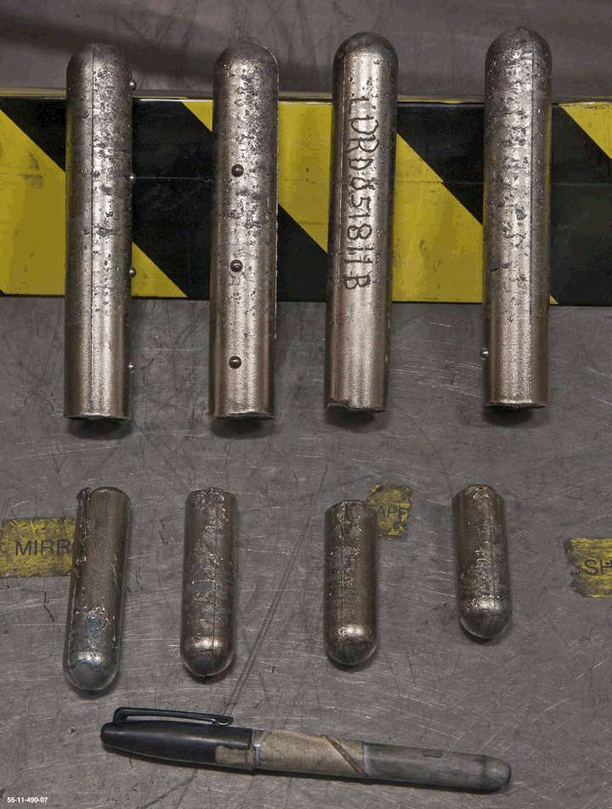 Reuters 20th April 2018 , In a sprawling plant near Amarillo, Texas, rows of workers perform by hand
one of the most dangerous jobs in American industry. Contract workers at
the U.S. Department of Energy’s Pantex facility gingerly remove the
plutonium cores from retired nuclear warheads. Although many safety rules
are in place, a slip of the hand could mean disaster.
In Energy Department facilities around the country, there are 54 metric tons of surplus
plutonium. Pantex, the plant near Amarillo, holds so much plutonium that it
has exceeded the 20,000 cores, called “pits,” regulations allow it to
hold in its temporary storage facility. There are enough cores there to
cause thousands of megatons of nuclear explosions. More are added each day.
https://www.reuters.com/article/us-usa-nukes-plutonium-specialreport/americas-nuclear-headache-old-plutonium-with-nowhere-to-go-idUSKBN1HR1KC
America’s dangerous stockpile of old plutonium cores
America’s nuclear headache: old plutonium with nowhere to go https://www.reuters.com/article/us-usa-nukes-plutonium-specialreport/americas-nuclear-headache-old-plutonium-with-nowhere-to-go-idUSKBN1HR1KC, Scot J. Paltrow
AMARILLO, Texas (Reuters) – In a sprawling plant near Amarillo, Texas, rows of workers perform by hand one of the most dangerous jobs in American industry. Contract workers at the U.S. Department of Energy’s Pantex facility gingerly remove the plutonium cores from retired nuclear warheads.
Although many safety rules are in place, a slip of the hand could mean disaster.
In Energy Department facilities around the country, there are 54 metric tons of surplus plutonium. Pantex, the plant near Amarillo, holds so much plutonium that it has exceeded the 20,000 cores, called “pits,” regulations allow it to hold in its temporary storage facility. There are enough cores there to cause thousands of megatons of nuclear explosions. More are added each day.
The delicate, potentially deadly dismantling of nuclear warheads at Pantex, while little noticed, has grown increasingly urgent to keep the United States from exceeding a limit of 1,550 warheads permitted under a 2010 treaty with Russia. The United States wants to dismantle older warheads so that it can substitute some of them with newer, more lethal weapons. Russia, too, is building new, dangerous weapons.
The United States has a vast amount of deadly plutonium, which terrorists would love to get their hands on. Under another agreement, Washington and Moscow each are required to render unusable for weapons 34 metric tons of plutonium. The purpose is twofold: keep the material out of the hands of bad guys, and eliminate the possibility of the two countries themselves using it again for weapons. An Energy Department website says the two countries combined have 68 metric tons designated for destruction – enough to make 17,000 nuclear weapons. But the United States has no permanent plan for what to do with its share.
Plutonium must be made permanently inaccessible because it has a radioactive half-life of 24,000 years.
“A MUCH MORE DANGEROUS SITUATION”
Edwin Lyman, a physicist at the Union of Concerned Scientists, a science advocacy group based in Washington, says solving the problem of plutonium storage is urgent. In an increasingly unstable world, with terrorism, heightened international tensions and non-nuclear countries coveting the bomb, he says, the risk is that this metal of mass annihilation will be used again. William Potter, director of the James Martin Center for Nonproliferation Studies at the Middlebury Institute of International Studies, told Reuters: “We are in a much more dangerous situation today than we were in the Cold War.”
Washington has not even begun to take the steps needed to acquire additional space for burying plutonium more than 2,000 feet below ground – the depth considered safe. Much of America’s plutonium currently is stored in a building at the Savannah River Site in South Carolina – like Pantex, an Energy Department site. Savannah River used to house a reactor. Local opponents of the storage, such as Tom Clements, director of SRS Watch, contend the facility was never built for holding plutonium and say there is a risk of leakage and accidents in which large amounts of radioactivity are released.
The Energy Department has a small experimental storage site underground in New Mexico. The department controls the radioactive materials – plutonium, uranium and tritium – used in America’s nuclear weapons and in the reactors of nuclear-powered aircraft carriers and submarines. In a Senate hearing in June 2017, Energy Secretary Rick Perry said the Energy Department has been in talks with New Mexico officials to enlarge the site. Environmental groups there have strongly opposed expansion.
Under an agreement with Russia, the United States was to convert 34 metric tons of plutonium into fuel for civilian reactors that generate electricity. The fuel is known as MOX, for “mixed oxide fuel.” Plutonium and uranium are converted into chemical compounds called oxides, and mixed together in fuel rods for civilian nuclear power plants. The two metals are converted into oxides because these can’t cause nuclear explosions. But the U.S. effort has run into severe delays and cost overruns.
The alternative method is known as dilute-and-dispose. It involves blending plutonium with an inert material and storing it in casks. The casks, however, are projected to last only 50 years before beginning to leak, and so would need to be buried permanently deep underground.
Plutonium contamination forces shutdown of demolition process for Hanford nuclear site
 Contamination from a nuclear cleanup forced a shutdown. Investigators want to know who is responsible http://www.latimes.com/nation/la-na-hanford-plutonium-exposure-20180330-story.htmlBy RALPH VARTABEDIAN, APR 16, 2018
Releases of radiation from Hanford plutonium processing plan: demolition process is halted
 Plutonium plant removal halted after radiation releases https://cen.acs.org/safety/Plutonium-plant-removal-halted-radiation/96/i17 Corrective measures include better control measures, communication with workers by Jeff Johnson APRIL 18, 2018
The Department of Energy (DOE) has called for 42 actions to correct safety deficits that led to a series of radioactive releases during demolition of the now-closed plutonium processing facility at the former Hanford nuclear weapons production site in Washington state.
The actions include better application of coatings and use of other technologies to control spread of radioactive contamination, broader radiation boundaries, improve air dispersion measurement and modeling, greater involvement of employees as demolition moves ahead, and better training of and communication with site workers to solicit their input.
Following the releases, site remediation halted last December. Several hundred workers were tested for radiation exposure. Test results showed that several dozen workers had inhaled or ingested detectable radiation but at levels acceptable to the department.
The shutdown only affects demolition of the plutonium facility, but that is a significant part of the $2 billion a year Hanford cleanup. Hanford, in turn, is the largest component in what is the world’s more expensive remediation program. During World War II and the Cold War, the Hanford site was one of more than 100 U.S. plants that made nuclear weapons components. All the plant sites are undergoing some level of remediation.
The radiation exposure incidents at Hanford occurred last year and DOE’s analysis of what happened was released publicly in March. Additionally, DOE recently announced an additional internal but independent review of the plutonium demolition project. That analysis will be “ongoing,” according to DOE’s Office of Enterprise Assessments, which will conduct the review. An official with the office would not predict when oversight will end.
The demolition and remediation will not restart until the Washington State Department of Ecology and the U.S. Environmental Protection Agency, which regulate Hanford cleanup activities, are satisfied the operation is safe, according to DOE and Washington state officials.
The plutonium finishing facility turned plutonium nitrate solutions into solid, hockey-puck-sized plutonium “buttons” that could be shipped to other facilities. It once was a complex of some 90 building and was shut down in the 1980s. Cleanup began in 1989; demolition began in 2016.
Last June and again in December, demolition activities contaminated workers and vehicles at the site. Small levels of radiation were found away from the plutonium facility but still within the Hanford site. No detectable amounts were found in workers’ homes, DOE says.
In the March report, DOE says 281 workers requested bioassays and were tested following the December release. The results found two doses less than 1 millirem, eight doses between 1 to 10 mrem, and one dose between 10 to 20 mrem. DOE sets the acceptable level at 100 mrem/year for nonradiological workers and members of the public and 500 mrem/year for radiological workers.
Following the June release, some 300 workers requested testing and bioassays found elevated radiation exposure for 31 workers, DOE says.
Communities that hosted nuclear reactors now stuck with stranded radioactive trash
 The township will be stuck with 753 metric tons of nuclear waste because the U.S. has no plan for its disposal. Oyster Creek’s used nuclear fuel now goes to the plant’s spent fuel pool, a specially designed area where the fuel cools for five years. After that, it’s moved to dry cask storage in metal canisters safely contained within a massive concrete structure.
Gary Quinn, Lacey’s former mayor and a current committeeman, said the town never anticipated having to deal with the spent fuel, which stays radioactive for hundreds of thousands of years.
With nuke plant shutting down, N.J. community inherits 1.7M pounds of waste WHYY By Catalina Jaramillo April 16, 2018
UK government will need to lift the bribes for communities to accept nuclear wastes
Derby Telegraph 16th April 2018 , Why fears have been raised that Derbyshire might end up hosting a nuclear
waste facility. “It was an area suggested for such a facility around 25
years ago.” A geological formation in Derbyshire could be considered for a
nuclear waste facility, it is feared.
The Government is scouring the UK for
a suitable location for a new £12 billion geological disposal facility
(GDF). Cumbria was being lined up to to store an estimated 750,000 cubic
metres of radioactive material produced by 50 years of nuclear power and
defence activity – but its county council rejected the idea in 2013,
forcing the Government to search for a new location.
Now a neighbouring council has discussed hosting the nuclear waste dumping facility in a
sedimentary basin known as the Widmerpool Gulf – which extends across
Derbyshire, Nottinghamshire and Leicestershire. A response to a Government
package of incentives designed to get communities to agree to ‘host’ a
storage complex has been discussed by Leicestershire County Council,
reports the Leicester Mercury.
Any facility would look to bury waste at least 200 metres below ground somewhere in a geological area which
stretches from the eastern fringes of Derby across the countryside to the
south of Nottingham and on to the west of Melton Mowbray in north
Leicestershire. Leicestershire County Council has said there are no
specific proposals for a GDF in Leicestershire at this stage but it has
asked for further information on the issue from the Department of Business,
Energy and Industrial Strategy.
The council’s head of planning LonekWojtulewicz said: “The underlying principle is these sort of facilities
will only come forward if communities are prepared to accept them.” The
Government has said £1 million a year could be offered to a community
willing to host a GDF rising to £2.5 million as a scheme progresses.
https://www.derbytelegraph.co.uk/news/local-news/fears-been-raised-derbyshire-might-1461024
UK Dept. for Business, Energy and Industrial Strategy (BEIS) dodges the hard questions about community support for nuclear waste dumping
Too many questions left unanswered. https://cumbriatrust.wordpress.com/2018/04/12/too-many-questions-left-unanswered/ April 12, 2018
Saudi Arabia’s disturbing plans for dumping nuclear waste on the Qatari border

 SAUDI ARABIA WANTS TO DUMP NUCLEAR WASTE ON THE QATARI BORDER TO MAKE ITS ARCH ENEMY AN ISLAND, NewsWeek , BY
Demolition of plutonium processing plant stalled due to radiation risks to workers
Danger from radiation shuts down nuclear plant demolition in Washington state, WLWT5,
NICHOLAS K. GERANIOS, 8 Apr 18, SPOKANE, Wash. — Seven decades after making key portions of the atomic bomb dropped on Nagasaki, Japan, workers at the Hanford Nuclear Reservation are being exposed to radiation as they tear down buildings that helped create the nation’s nuclear arsenal.
Dozens of workers demolishing a plutonium processing plant from the 1940s have inhaled or ingested radioactive particles in the past year, and even carried some of that radiation into their vehicles, according to the U.S. Department of Energy.
The incidents have prompted the federal government, along with state regulators, to halt the demolition of the sprawling Plutonium Finishing Plant until a safe plan can be developed.
The contamination has also shaken confidence in a massive cleanup of Hanford, the nation’s most polluted nuclear weapons production site. The work costs the federal Treasury around $2 billion a year. Hanford is near the city of Richland, about 200 miles southeast of Seattle.
“This is a very disturbing set of incidents,” said Tom Carpenter, head of the Seattle-based watchdog group Hanford Challenge.
The Energy Department, which owns Hanford, has launched an independent investigation into the spread of radiation at the plant. The investigation will be conducted by an agency office that is not connected to work at Hanford.
Radioactive particles are known to have contaminated 42 workers, which led to the shutdown of demolition, the agency has said.
Carpenter said widespread worker contamination has been rare at Hanford in recent decades. Plutonium production ended in the 1980s and the site in 1989 switched its focus to cleanup of nuclear wastes.
“It’s one of the more serious events to happen in the age of cleanup at Hanford,” Carpenter said. “There have been other incidents, but none rose to the level of plutonium contamination of this many people and private vehicles and being found miles and miles away.”
A union representing some Hanford workers said it was closely monitoring the situation…..http://www.wlwt.com/article/danger-from-radiation-shuts-down-nuclear-plant-demolition-in-washington-state/19712632
Cumbria Trust gives advice on UK’s Community Consultation regarding nuclear waste dumping
Communities should have access to a truly independent scientific body such as MKG in Sweden
what is described as an open and transparent process, could be a long way from that.
there needs to be more honesty and openness about the negative aspects.
“Working With Communities” – Guidance notes for your own response to the consultation. April 8, 2018
Global nuclear decommissioning services to be valued at USD 8.90 billion by 2025
 The global nuclear decommissioning services market size is expected to be valued at USD 8.90 billion by 2025
Nuclear Decommissioning Services Market Size, Share & Trends Analysis Report By Reactor Type (PWR, BWR, PHWR, GCR), By Strategy (Immediate and Deferred Dismantling, Entombment), And Segment Forecasts, 2018 – 2025 BY Sarah Smith Research Advisor at Reportbuyer.com Email: sarah@reportbuyer.com ReportBuyer LONDON, April 3, 2018 /PRNewswire/ –According to a new report by Grand View Research, Inc., exhibiting a 6.8% CAGR during the forecast period. Global nuclear phase out and rising support from governments post nuclear accidents are among major factors expected to fuel market growth over the years to come.
Rise in public safety concerns due to hazardous consequences of nuclear accidents is set to actuate market demand over the coming years.In addition, increasing sustainability concerns are likely to positively impact market growth.
The transitioning trend toward renewable energy thanks to various government initiatives and regulations is also projected to promote nuclear decommissioning services over the forecast period.
With extensive research and development underway, various novel decommissioning technologies to enable efficient dismantling of nuclear facilities have been developed. Furthermore, in order to enable sustainable development, government authorities are providing various incentives and support schemes for efficient dismantling of nuclear plants. …….
The global nuclear decommissioning services market size is expected to be valued at USD 8.90 billion by 2025, according to a new report by Grand View Research, Inc., exhibiting a 6.8% CAGR during the forecast period. Global nuclear phase out and rising support from governments post nuclear accidents are among major factors expected to fuel market growth over the years to come.
Rise in public safety concerns due to hazardous consequences of nuclear accidents is set to actuate market demand over the coming years.In addition, increasing sustainability concerns are likely to positively impact market growth.
The transitioning trend toward renewable energy thanks to various government initiatives and regulations is also projected to promote nuclear decommissioning services over the forecast period.
With extensive research and development underway, various novel decommissioning technologies to enable efficient dismantling of nuclear facilities have been developed. Furthermore, in order to enable sustainable development, government authorities are providing various incentives and support schemes for efficient dismantling of nuclear plants.
Key market players include Orano Group; Babcock International Group PLC; Westinghouse Electric Company LLC; AECOM Group; Studsvik AB; Bechtel Group Inc.; GE Hitachi Nuclear Energy; and Magnox Ltd. These companies mainly focus on innovation to improve service quality and meet global demand.
Download the full report: https://www.reportbuyer.com/product/5360564 https://www.prnewswire.com/news-releases/the-global-nuclear-decommissioning-services-market-size-is-expected-to-be-valued-at-usd-890-billion-by-2025-300623629.html
1 This Month
26 September – International Day for the Total Elimination of Nuclear Weapons





PLEASE OPPOSE HR 8255 AND S.3639 – bills would accelerate satellite deployment, with no environmental review or safeguards – https://ncstd5li.quorum.us/campaign/169331/
To see nuclear-related stories in greater depth and intensity – go to https://nuclearinformation.wordpress.com
-
Archives
- September 2026 (323)
- August 2026 (330)
- July 2026 (355)
- June 2026 (287)
- May 2026 (306)
- April 2026 (356)
- March 2026 (251)
- February 2026 (267)
- January 2026 (308)
- December 2025 (358)
- November 2025 (359)
- October 2025 (375)
-
Categories
- 1
- 1 NUCLEAR ISSUES
- business and costs
- climate change
- culture and arts
- ENERGY
- environment
- health
- history
- indigenous issues
- Legal
- marketing of nuclear
- media
- opposition to nuclear
- PERSONAL STORIES
- politics
- politics international
- Religion and ethics
- safety
- secrets,lies and civil liberties
- spinbuster
- technology
- Uranium
- wastes
- weapons and war
- Women
- 2 WORLD
- ACTION
- AFRICA
- Atrocities
- AUSTRALIA
- Christina's notes
- Christina's themes
- culture and arts
- Events
- Fuk 2022
- Fuk 2023
- Fukushima 2017
- Fukushima 2018
- fukushima 2019
- Fukushima 2020
- Fukushima 2021
- general
- global warming
- Humour (God we need it)
- Nuclear
- RARE EARTHS
- Reference
- resources – print
- Resources -audiovicual
- Weekly Newsletter
- World
- World Nuclear
- YouTube
-
RSS
Entries RSS
Comments RSS

