

 Communities offered £1m a year to host nuclear waste dump https://www.theguardian.com/environment/2018/jan/25/communities-offered-1m-a-year-to-host-nuclear-waste-dump
New search for communities willing to host underground site for thousands of years, Guardian, Adam Vaughan, 25 Jan 18, Local communities around England, Wales and Northern Ireland will be offered £1m a year to volunteer to host an underground nuclear waste disposal facility for thousands of years, as part of a rebooted government programme.
The financial incentive is one way the government hopes to encourage communities to host the £12bn facility, after previous efforts failed in 2013 when Cumbria county council rejected the project.
Under new plans published on Thursday, a test of public support will be required for the scheme to go ahead, which could include a local referendum.
The only areas to explore the idea last time round were Copeland and Allerdale borough councils in Cumbria, and Shepway District Council in Kent.
This time, interested communities that explore hosting the facility will also receive £1m a year, which officials say could be spent on developing skills locally or apprenticeships. The payments, which could rise to £2.5m annually as a community considers whether to proceed, are expected to last for around five years.
The geological disposal facility (GDF) is seen by experts as the best long-term solution to storing the estimated 750,000 cubic metres of waste generated by half a century of nuclear power and defence, which would fill three quarters of Wembley Stadium.
It also includes the radioactive material created by potentially five new plants that the government expects to be built, including Hinkley Point C, which EDF Energy is constructing in Somerset.
The Institute of Directors said storing waste deep underground would be cheaper than storing it above ground, as it is at present at around 30 sites.Business, unions and local authority groups welcomed the renewed bid to site a GDF.
“Running costs for a geological disposal facility storing the waste 1,000 metres below the surface would be significantly lower,” the business group said.
Richard Harrington, energy minister, said: “We owe it to future generations to take action now to find a suitable permanent site for the safe disposal of our radioactive waste. And it is right that local communities have a say.”
But Greenpeace criticised the payments, calling them bribes, and said new nuclear power plants should not go ahead without a long-term solution in place for their waste.
Doug Parr, the group’s chief scientist, said: “Having failed to find a council willing to have nuclear waste stored under their land, ministers are resorting to the tactics from the fracking playbook – bribing communities and bypassing local authorities.
“With six new nuclear plants being planned, the waste problem is just going to get much worse. Since there is no permanent solution for the disposal of spent nuclear fuel, the responsible thing to do would be to stop producing more of it instead of just passing the radioactive buck to future generations.”
Nuclear waste is currently stored at about 30 sites, but predominantly at ground level at Sellafield in Cumbria. The GDF project is expected to cost £12bn, spread over a century.
January 26, 2018
Posted by Christina Macpherson |
politics, UK, wastes |
Leave a comment
 NFLA 24th Jan 2018, As the UK Government plans yet another attempt to deliver a deep
underground radioactive waste repository, NFLA urges them and the
regulators to look carefully at a Swedish court ruling rejecting a
repository licence around real safety concerns.
The Nuclear Free Local Authorities (NFLA) has been made aware that the UK Government imminently
plans its latest attempt, which is the sixth attempt in the past 42 years,
to start a process to find a willing community to host a deep underground
radioactive waste repository.
This process now could be, and should be, completely reconsidered after a Swedish court ruling rejecting a licence
application on the waste capsules for a similar development, after many
years of planning.
For over 4 decades, several UK bodies – UKAEA, Nirex,
RWMD and now Radioactive Waste Management Ltd (RWM) – have been
established by the UK Government to deliver a deep underground radioactive
waste repository, often referred to in the industry as a geological
disposal facility (GDF).
Three consultations are expected to be issued
imminently – one on the definition of the community that would decide on
such a repository and how engaging with the public would take place, a
second on a National Policy Statement for a deep waste repository, and the
third the publication by RWM of a national geological screening of England,
Wales and Northern Ireland (Scotland is pursuing a separate policy of
‘near site, near surface’ storage of its highly active radioactive
waste).
Throughout its 38 years of operation, NFLA has been heavily engaged
in this debate. It remains sceptical that a deep underground repository is
the most environmentally sound solution for managing the UK’s huge burden
of radioactive waste.
It notes that the Nuclear Waste Advisory Associates
have outlined over 100 key technical and scientific concerns around such
developments, and NFLA has seen no resolution to these issues from the
government or RWM.
http://www.nuclearpolicy.info/news/uk-government-plans-deep-underground-radioactive-waste-repository-nfla-urges-regulators-look-swedish-court-ruling/
January 26, 2018
Posted by Christina Macpherson |
UK, wastes |
Leave a comment
Exposing UK government folly of investment in new nuclear https://www.theguardian.com/environment/2018/jan/24/exposing-uk-government-folly-of-investment-in-new-nuclear
A new-build programme would create an intolerable burden on communities into the far future, writes Andrew Blowers; while Rose Heaney wonders why our abundant renewable energy sources are being overlooked
In 1976, Lord Flowers pronounced that there should be no further commitment to nuclear energy unless it could be demonstrated that long-lived highly radioactive wastes could be safely contained for the indefinite future. Ever since, efforts to find a suitable site for a geological disposal facility have been rejected by communities (Wanted: community willing to host a highly radioactive waste dump in their district, 22 January).
There is, therefore, little evidence to support the government’s claim that “it is satisfied that effective arrangements will exist to manage and dispose of the waste that will be produced from new nuclear power stations”. Deep disposal may be the eventual long-term solution but demonstrating a safety case, finding suitable geology and a willing community are tough challenges and likely to take a long time. The search for a disposal site diverts attention from the real solution for the foreseeable future, which is to ensure the safe and secure management of the unavoidable legacy wastes that have to be managed. It is perverse to compound the problem by a new-build programme that will result in vastly increased radioactivity from spent fuel and other highly radioactive wastes which will have to be stored indefinitely at vulnerable sites scattered around our coasts.
The fact that the UK government is still going ahead with plans to construct new power stations, generating even more toxic radioactive waste, troubles and puzzles me immensely. Here, on the beautiful isle of Anglesey, where tidal, solar and wind energy production are all highly feasible alternatives and could also provide opportunities for well-paid employment, politicians appear to be happy for an area of outstanding natural beauty to be contaminated for further than the foreseeable future, not to mention the immense eyesore that will occupy acres of fertile land. It is an eye-wateringly costly venture that many fear will expose taxpayers to huge financial risk and will also leave future generations guarding the threat to their environment and health long after it ceases to function.
Future generations will doubtless wonder, when most of Europe is shutting down its nuclear power stations and not planning any more, why in the world the local population didn’t protest harder.
Rose Heaney
Holyhead, Gwynedd
A new-build programme would create an unmanageable and intolerable burden on communities into the far future. To suggest that a repository is the solution is in the realm of fantasy.
Prof Andrew Blowers
Member of the first Committee onRadioactive Waste Management
January 26, 2018
Posted by Christina Macpherson |
UK, wastes |
Leave a comment
 Guardian 21st Jan 2018, The government is expected this week to begin a nationwide search for a community willing to host an underground nuclear waste dump to store highly
radioactive material for thousands of years.
Britain has been trying for years to secure a site with the right geology and local communities which would volunteer to host a £12bn geological disposal facility (GDF), as a
long-term solution for the most dangerous waste from nuclear power
stations.
The last effort hit a brick wall in 2013 when Cumbria county
council, the only local authority still in the running as a host for the
dump, rejected it.
Now, ministers are to relaunch their mission to win over
a community to host the GDF. The task has taken on heightened importance
now that a nuclear power plant is under construction in Somerset, with
plans to build four others.
Radioactive Waste Management, the government
body tasked with building the facility hundreds of metres underground, said
it had made significant progress since 2014 in “developing the offer” to
interested communities. Consultations on the planning process and how the
government will work with communities will be launched this week, said two
sources close to the process. “I hope to God they get it right this time,”
said one. “The mess they made in the past can’t be repeated. It’s
outrageous it became a victim of local politics last time.”
https://www.theguardian.com/environment/2018/jan/21/search-area-willing-host-highly-radioactive-waste-uk-geology
January 24, 2018
Posted by Christina Macpherson |
UK, wastes |
Leave a comment
 Swedish regulators disagree on safety of nuclear waste plan https://www.reuters.com/article/us-sweden-nuclear-regulator/swedish-regulators-disagree-on-safety-of-nuclear-waste-plan-idUSKBN1FC21P, JANUARY 24, 2018 , Lefteris Karagiannopoulos, OSLO (Reuters) JANUARY 24, 2018 – Sweden’s radiation safety authority (SSM) and an environmental court issued diverging recommendations to the government on Tuesday on whether to allow the construction of a nuclear waste repository.
While the SSM said the nuclear fuel and waste management company SKB should be allowed to go ahead with the plan, which may take 10 years to complete, the Land and Environmental court said it was not certain of the proposed repository’s safety.
“There is still uncertainty about the ability of the capsule to contain the nuclear waste in the long term,” the court said, adding that further documentation was required.
The final decision to approve or reject the facility, designed to store up to 12,000 tonnes of spent fuel from Sweden’s nuclear plants, will be in the government’s hands.
In a statement to Reuters, Environment and Energy Minister Karolina Skog said no decision would be made this year.
SKB, controlled by Sweden’s nuclear plant operators, applied in March 2011 to build the repository at Forsmark in southwest Sweden.
Eva Hallden, SKB’s director, said the firm would produce additional documentation, which it was confident would allay the safety concerns of the environmental court.
Sweden currently stores its spent nuclear fuel in an interim facility near the Oskarshamn nuclear plant. Editing by Kevin Liffey
January 24, 2018
Posted by Christina Macpherson |
politics, Sweden, wastes |
Leave a comment
Guano, Nuclear Testing, Chemical Weapons Another guano claim converted for U.S. military use is Johnston Atoll (Kamala), located about 800 miles southwest of Honolulu.
One phase of expansion on Johnston Island involved construction of a launch pad for high-altitude missile tests for Operation Dominic in the 1960s. Two of the tests were aborted, with radioactive contamination falling on the runway. Forty years later, in 2002, the Air Force “finished burying thousands of cubic meters of plutonium-contaminated waste in a 25-acre landfill on the atoll.”
The question, then, is not when will islands be submerged, but when will sea-level rise make life on low-lying islands impossible.
The answer to that question is close at hand for a number of Pacific islands.
Perhaps the biggest legal stride in New Zealand is Prime Minister Jacinda Ardern’s recent announcement of plans for a special refugee visa for Pacific Islanders, starting with 100 places annually. “We are anchored in the Pacific,” Ardern told reporters. “Surrounding us are a number of nations, not least ourselves, who will be dramatically impacted by the effects of climate change. I see it as a personal and national responsibility to do our part.”

American Polynesia, Rising Seas and Relocation, By Laray Polk, Global Research, January 06, 2018 The Asia-Pacific Journal: Japan Focus 22 December 2017 In the next 30 to 50 years, rising sea levels caused by global warming will subsume low-lying islands in the Pacific Ocean. Inhabitants will have to relocate, but there are few choices. Among nations (with the exception of Fiji and New Zealand) there is little preparation for the inevitable migration of Pacific Islanders. Which nations should commit to the processes of equitable relocation?
The following article will address this question through historical context and colonial occupation; current legal debates surrounding climate change and maritime migration; and the potential rights of “deterritorialized” states, such as retention of exclusive economic zones. Historical context includes an examination of U.S. insular territories in the Pacific and the continued exercise of presidential authority over island possessions.
There are strong arguments to be made that the United States has ethical obligations to assist Pacific Islanders as sea levels continue to rise, with assistance taking many forms. The U.S. is obligated namely because it is the second largest emitter of greenhouse gases, and the largest carbon emitter historically; it has extensively tested atomic and hydrogen bombs and biochemical agents in the Pacific Ocean (Marshall Islands, Christmas Island, Johnston Atoll); has commercially profited from the Pacific ecosystem since the early days of whaling; and in addition to American Samoa, Guam, and the Commonwealth of the Northern Mariana Islands, possesses eight insular territories referred to as “United States Minor Outlying Islands.”1
The U.S. Minor Outlying Islands are Baker Island, Howland Island, Jarvis Island, Johnston Atoll, Kingman Reef, Midway Islands, Palmyra Atoll, and Wake Island. (A ninth minor outlying island, Navassa Island, is located in the Caribbean Ocean, near Haiti.) Around these insular territories is an exclusive economic zone (EEZ) of 200 nautical miles. The National Oceanic and Atmospheric Administration defines the EEZ as “the zone where the U.S. and other coastal nations have jurisdiction over natural resources,” such as fisheries, energy, and other mineral resources.
When the zones of the eight minor outlying islands are combined with those of American Samoa, Guam, Hawaii and the Northern Mariana Islands, it forms a U.S. EEZ in the Pacific Ocean of 2.2 million square miles.2 The United States, seen in this light, is not a distant observer to the Pacific Islanders’ plight but an invested neighbor with shared history; a history defined in large part by commercial exploitation and continuing military entanglements……….
Guano to Nuclear Testing
The early annexation of guano islands by commercial interests explains why access to Christmas Island (Kiritimati) for testing nuclear weapons, first by the U.K., then the U.S., was easily facilitated. How economic rivalry in the 19th century turned to military alliance in the 20th century involves a more complex telling……….
Guano, Nuclear Testing, Chemical Weapons
Another guano claim converted for U.S. military use is Johnston Atoll (Kamala), located about 800 miles southwest of Honolulu. The atoll, claimed by the Pacific Guano Company in 1857, consists of four islands on a coral reef platform, all of which have been artificially expanded by blasting, dredging, and reconstruction programs. According to NOAA, the U.S. Navy began preparing the atoll for military operations in 1939 by enlarging the main island (also named Johnston). Construction lasted until 1942, followed by a second phase in 1963. That year, Johnston and Sand Islands were further enlarged and two artificial islands created, called Akau and Hikina. Johnston, by far the largest of the four, is 16 times its original size and resembles an aircraft carrier.18
One phase of expansion on Johnston Island involved construction of a launch pad for high-altitude missile tests for Operation Dominic in the 1960s. Two of the tests were aborted, with radioactive contamination falling on the runway. Forty years later, in 2002, the Air Force “finished burying thousands of cubic meters of plutonium-contaminated waste in a 25-acre landfill on the atoll.”19
Other uses of the atoll include open-air biochemical testing; chemical weapons storage; and destruction of nerve agents VX and Sarin, sulfur mustard gas, and Agent Orange. Stockpiles of chemical weaponry were transported from Okinawa, Germany, and the Solomon Islands and incinerated on site using the Johnston Atoll Chemical Agent Disposal System (JACADS).20………..
Rate of Rising Seas
Pacific island nations and territories are at different stages of addressing the pressing issues of sea-level rise. Discussions involving retention of EEZs—and the rights and financial security maritime zones confer—represent the long game, and enters into a conceptual realm of “What is nationhood, if a nation no longer exists?” Legitimate answers to questions of this magnitude would require changes in international law, a notoriously slow process. As scientific data on climate change feedbacks demonstrate, island nations and territories need answers now.
The Intergovernmental Panel on Climate Change predicts the oceans will rise by between 11 and 38 inches by the end of the century, with the potential to submerge low-lying islands. A report from 2016, written by former NASA scientist James Hansen and 16 co-authors, predicts that without serious mitigation of greenhouse gas emissions, global sea level is likely to increase “several meters over a timescale of 50 to 150 years.”34 If less than one meter of sea-level rise has the potential to cause an island to disappear by 2100, then Hansen’s numbers portend something more urgent. The question, then, is not when will islands be submerged, but when will sea-level rise make life on low-lying islands impossible.
The answer to that question is close at hand for a number of Pacific islands. Sea-level rise increases both the frequency and magnitude of flooding caused by high tides and storms; saltwater intrusion destroys freshwater sources and the prospect of productive agriculture. Writer and filmmaker Jack Niedenthal, who lives in the Marshall Islands, says that on the island of Kili, “there have been huge changes since about 2011.” That was the first year the island was heavily flooded, and he says it’s happened every year since. Kili, which averages an elevation of 6 feet, is home to many displaced families originally from Bikini Atoll.35
The population there, he says, is trying to raise awareness of climate change with the rest of the world, but it’s challenging. “I find it stunning that there are still so many climate change deniers out there. In the Marshall Islands, we are building numerous seawalls, some very large, others are just building them with old tires and broken down cars.”……..
Freedom and Fear in the High Seas
At a climate change symposium in 2015, Fiji’s Foreign Affairs secretary Esala Nayasi explained the dilemma of Islanders succinctly: “These are people who are on the verge of losing their land that they call home, losing their critical basic necessities and infrastructure, culture, identity and traditional knowledge. This is no longer a news story, it is happening now.”
Nayasi’s sense of urgency is reflected in policy. Among nations, the Republic of Fiji is in the vanguard of relocation efforts……. Because Fiji is a combination of high and low islands, it’s geographically advantaged (though not immune to climate disruption). For other nations such as Tuvalu, comprised of nine coral atolls with a mean elevation of 2 meters, all choices look the same.
Options for relocation are limited in other ways, such as the exclusion of “climate change refugees” from the 1951 Refugee Convention. Under the convention, there are five grounds to qualify for refugee status and fleeing the catastrophic conditions caused by climate change is not one of them. It hasn’t stopped legal challenge in several recent cases in New Zealand. Asylum-seeker Ioane Teitiota from Kiribati lost his case, and was deported in 2015. Sigeo Alesana from Tuvalu had his asylum application declined, but he won his immigration case based partially on the “vulnerability of the couple’s children to illnesses as a result of poor water quality.” According to Radio New Zealand, it’s the first time climate change has been successfully used in an immigration case.40
Perhaps the biggest legal stride in New Zealand is Prime Minister Jacinda Ardern’s recent announcement of plans for a special refugee visa for Pacific Islanders, starting with 100 places annually. “We are anchored in the Pacific,” Ardern told reporters. “Surrounding us are a number of nations, not least ourselves, who will be dramatically impacted by the effects of climate change. I see it as a personal and national responsibility to do our part.”41……….
The U.S. government, with the exception of the Pentagon, is in official denial concerning a major cause of climate disruption: the unabated burning of fossil fuels.44 The current administration has no interest in reducing CO2 emissions or admitting the country’s hand in environmental catastrophe. What will be of interest to U.S. policymakers when the low-lying islands and atolls in the Pacific Ocean begin to disappear is likely to center on the retention of EEZs and other maritime entitlements associated with U.S. insular possessions. If there is to be any U.S. involvement in “adaptation” in this part of the world, preserving these zones is high on the list; Pacific island nations and territories should be included in those efforts. Subsequent to resource depletion, war, nuclear testing and contamination, engagement with the Pacific Ocean ultimately means taking care of the people who live there. https://www.globalresearch.ca/american-polynesia-rising-seas-and-relocation/5624927
January 20, 2018
Posted by Christina Macpherson |
climate change, OCEANIA, wastes |
Leave a comment
‘Insanity’ to allow nuclear waste disposal near Ottawa River, Indigenous groups say http://www.cbc.ca/news/canada/ottawa/chalk-river-nuclear-waste-indigenous-1.4492937
Canadian Nuclear Laboratories facility in Chalk River, Ont., could be up and running in 2020, CBC News Jan 18, 2018 Indigenous groups say a plan to dispose of nuclear waste near the Ottawa River in eastern Ontario is “insanity” and want the federal government to intervene.
Canadian Nuclear Laboratories, a private company, wants a 10-year licence to keep running the Chalk River nuclear labs in eastern Ontario.
In 2014, the federal government gave Canadian Nuclear Laboratories (CNL) control over nuclear operations at Chalk River. The government continues to own the nuclear assets.
CNL has plans for a permanent nuclear waste disposal site at Chalk River, plans that have been criticized by a concerned citizen’s group as being “cheap, dirty, unsafe and out of alignment with International Atomic Energy Agency guidance.”
Nuclear waste in Chalk River will cost billions to deal with and leave a legacy that will last centuries, opponents say.
“Trying to build this giant mound of radioactive waste … is insanity,” said Patrick Madahbee, grand council chief of the Anishinabek Nation, which advocates for around 40 communities representing around 65,000 people across Ontario.
He said CNL has an obligation under the United Nations Declaration on the Rights of Indigenous Peoples to consult Indigenous people about storing hazardous materials in their territory, but CNL hasn’t talked to them about it.
The waste facility could be operational by 2020.
“We understand this is a complex file, but clearly the risks here are to people’s drinking waters and traditional territories,” said Patrick Nadeau, executive director of the Ottawa Riverkeeper.
CNL’s licence to run the Chalk River labs expires on March 31 and the consortium has asked the regulator, Canadian Nuclear Safety Commission, for a 10-year licence agreement, rather than the usual five-year term.
The Canadian Nuclear Safety Commission will hold public hearings in Pembroke, Ont., from Jan. 23 to 25 to consider CNL’s licence.
Dozens of delegations have registered to comment at the hearings. But Mark Lesinski, president of Canadian Nuclear Laboratories said among those posed to present submissions at the hearings, there are a number of “misunderstandings.”
January 19, 2018
Posted by Christina Macpherson |
Canada, indigenous issues, opposition to nuclear, wastes |
Leave a comment
 NFLA 15th Jan 2018, NFLA submission on radioactive waste elements of the reactor design for the
Wylfa B site – it could increase the UK inventory of radioactive waste by as much as 80%. The Nuclear Free Local Authorities (NFLA) Welsh Forum has submitted its views to Natural Resources Wales (NRW) on the radioactive
waste elements of the Advanced Boiling Water Reactor (ABWR) design proposed for the Wylfa site in Anglesey.
The NFLA Welsh Forum has taken a very close eye with the proposed development of Wylfa B and has raised a number oftimes that a new nuclear reactor in Anglesey is not required. In March 2017it raised in detail concerns over the design of the Advanced Boiling Water Reactor in reference to issues arising from the Fukushima disaster.
NRW is consulting on whether it will issue an environmental permit to Horizon Nuclear, wholly owned by Hitachi, for Wylfa B. This is concentrating now on issues around the radioactive waste that would be generated from such a
reactor, how it will be managed and stored and for how long it will remain on site.
NFLA Vice-Chair Councillor David Blackburn said: “This NFLA submission on Wylfa B’s radioactive waste programme has gone into much detail about the radioactive high burn-up fuel that would be produced from such a reactor, should it ever be built. Such waste would have to remain on site for as much as 160 years and Wylfa B alone could increase the current UK radioactive waste inventory by as much as 80%.
NFLA does not see such a waste burden being beneficial to the people of Anglesey or of Wales. There are far safer, less expensive alternatives that do not produce such hazardous materials as what Wylfa will generate. Wales would be far better off then to build solar, tidal, wind, hydroelectric and geothermal energy facilities instead, with energy efficiency and energy storage solutionsadequate to deal with intermittency issues.”
http://www.nuclearpolicy.info/news/nfla-submission-radioactive-waste-elements-reactor-design-wylfa-b-increase-uk-inventory-radioactive-waste/
January 16, 2018
Posted by Christina Macpherson |
UK, wastes |
Leave a comment
Cumbria Trust 15th Jan 2018, Tim Knowles, who chaired the last search process, known as Managing Radioactive Waste Safely (MRWS) has changed his view since 2013 and no longer supports the idea of geological disposal of nuclear waste in Cumbria. He appears to share Cumbria Trust’s view that Cumbria does not have suitable geology, and that there are much better sites elsewhere in the country.
It is interesting that we have now had 2 search processes in Cumbria and both the Lead Inspector of the first Nirex process, and now the Chair of the second MRWS process have reached the same conclusion – that the search should move to an area of simple geology in the east or south of the country. Both of them want Cumbria to not volunteer again.
In a few months the national geological screening report will be published before councils are asked to volunteer for the third search process. We know that the GDF developer, Radioactive Waste Management, has decided to take
control of this report by producing the narrative itself, and our concern is that they may manipulate the output to suit their intention to return to Cumbria for a third time.
https://cumbriatrust.wordpress.com/2018/01/15/a-change-of-view-for-tim-knowles/
January 16, 2018
Posted by Christina Macpherson |
UK, wastes |
Leave a comment
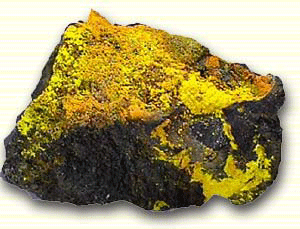 Ken commented on Navajo town remembers water pollution due to uranium mining – fears of new mines Uranium Miners Pushed Hard for a Comeback. They Got Their Wish. NYT, By HIROKO TABUCHIJAN. 13, 2018 “………The Navajo …
There are 10 or eleven towns in Colorado, Wyoming, Utah, Arizona, and New Mexicothat had Uranium mills, right in the middle of town. That means that Uranium dust, polonium, thorium, radium, and radon blew freely, thoughout thewe towns, 24 hours a day for years. Most of the water, drained into the Colorado ariver. Many of these towns were downwinder towns, from open air blasting of nucler bombs in Nevada from 1949 to 1962. Many, of the towns had the misfortune of having underground nuclear bombs detonated close to them as well, to try to track natural gas. Especially in New Mexico and Colorado. In the 60s Hilibutron was also tracking nuclear waste into areas in Nevada, and Wyoming. More recently there has been fracking for oil and gas in UtAh, Wyoming, Colorado, New Mexico, Arizona. This means the radioactive burden to their water tables has been increased again substantially , along with 60 years of radioactive burden on the Colorado River. There are also the 1000 or so uranium mines draining into the Colorado River and Green driver from Utah, the western slope, Shiprock New Mexico, Wyoming, The Grand Canyon Area.
I think Helen Caldicotts and Christina Macphersons estimates of a few million tons of radioactive sediment in Lake Mead and even lake Powell is wrong. https://nuclear-news.net/2017/12/22/uranium-tailings-pollution-in-lake-mead-and-lake-powell-colorado/
Consider underground nuclear destinations in Rangely Colorado and Northen New Mexico. I think it is more like a half billion or billions of ons of nuclear waste sediment in Lake Powell and lake mead..
There were Uranium Mills on the Navajo nation by Ship Rock and Halchita which is by the Colorado river. There were Uranium Mills right in the middle of town in Canyon City.Colorado, Moab.Utah, Uravan.Colorado, White Mesa.Utah, Monticello.Utah, by Grand Junction.Colorado. Many in Wyoming.
Uranium mining in Wyoming – Wikipedia
https://en.m.wikipedia.org/wiki/Uranium_mining_in_Wyoming.
There are dense cancer clusters in these little towns on the Navajo Nation, in Utah, in Nevada, in Colorado, in Wyoming, in New Mexico. There are Genetic mutations that should not exist. Some people, like those in St George or Monticello Utah got the mere pittance of 50,000 dollars, after having lived in downwinder areas and surviving cancer. Generations of families wiped-out in many instances. Clarke county Nevada, by Las Vegas has one of the highest incidences of cancer in the US. Is it any wonder, with all the radiation in their primary drinking water supplies?
Many little Colorado Plateau towns, in the west are hit with quintuple curses: bomb blasts above ground, bomb blasts below ground-poisoning their head waters, uranium mills and waste in town, their river water radioacively poisoned from inderground nuclear blasts, from uranium mines, from cold war nuclear bomb detonations.
There has recently, been a great deal of cracking in these areas, releasing radioactivity into their desert rivers and water tables.
Americans live in a grand delusion, thinking how clean the western United States, and the rest of the USA is, with a hundred rickety old nuclear plants belching tritium, into the environment. The United State is the most radioactive shithole in the world. How Trump has the gall to call other countries shitholes, is beyond me.
January 15, 2018
Posted by Christina Macpherson |
environment, Reference, Uranium, wastes |
Leave a comment

 Romandie 12th Jan 2018 [Machine Translation] Dismantling: in France, nuclear country, the task remains immense. EDF may well show international ambitions in terms of nuclear dismantling, the industry still has to prove itself in France, the world’s second largest producer of nuclear electricity, where the task remains immense and the delays numerous.
“We dismantle nine reactors in France We consider that our know-how can put us in a very good position to win real market share internationally,” assured AFP on Wednesday Sylvain Granger director of deconstruction projects at EDF. An ambition
“staggering” for Barbara Romagnan, former PS MP, author of a parliamentary report that highlighted in early 2017 the “underrated” costs and growing delays of these projects.
“None of these French reactors has yet been totally dismantled, even though they were closed between 1985 and 1997,”
she argues. Elsewhere in the world, seventeen reactor vessels (more than 100 MW) have been dismantled in the United States, Germany and Spain, according to the Institute for Radiation Protection and Safety (IRSN).
In Chooz, EDF’s most advanced site, located in the Ardennes, the dismantling of the tank, the ultimate and most delicate stage, began in 2017. But the cutting of the internal components of the tank was suspended after the contamination. in June, a Swedish employee from Westinghouse, to whom EDF subcontracted this operation, according to the French company. EDF
estimates at 79 billion euros the cost of dismantling all its reactors in France (including 18.5 billion spent fuel management), said Thursday the company that spoke in 2000 of 16 billion euros.
https://www.romandie.com/news/880085.rom
January 15, 2018
Posted by Christina Macpherson |
decommission reactor, France |
1 Comment

Plymouth Herald 14th Jan 2018, 13 former Royal Navy subs are awaiting disposal in Plymouth – with a further seven in
Rosyth. The MoD says the submarines are “safely stored” and subject to
rigorous checks. It adds that there has been “no measurable increase in
exposure for local people”.
But the cost of storing and maintaining the laid-up vessels is vast. Over five years – between 2010 and 2015- the total
bill for storing the vessels at the two sites, both owned by Plymouth-based engineering firm Babcock, reached more than £16million.
The estimated cost of the MoD’s submarine dismantling programme, which started in December 2016 and is due to take more than 25 years to complete, have not been released. The MoD says this is due to ongoing commercial negotiations withBabcock – it’s main contractor for the programme – and other key suppliers.
http://www.plymouthherald.co.uk/news/plymouth-news/nuclear-submarines-left-rot-devonport-1043977
January 15, 2018
Posted by Christina Macpherson |
politics, UK, wastes, weapons and war |
Leave a comment

Regulators to DOE: No more Hanford demolition until we say it’s safe http://www.tri-cityherald.com/news/local/hanford/article194318189.html, BY ANNETTE CARY, acary@tricityherald.com, January 11, 2018, Hanford regulators have ordered the Department of Energy not to restart demolition of the nuclear reservation’s highly radioactively contaminated Plutonium Finishing Plant until regulators agree the work can be done safely.
Demolition was stopped at the plant in mid December, after specks of radioactive contamination were discovered to have spread outside of a containment zone established around demolition work.
There is no estimate of when demolition of the plant may restart.The Washington State Department of Ecology and the Environmental Protection Agency notified DOE this week that they would use their authority under the legally binding Tri-Party Agreement to prevent a restart of work if they have concerns about the safety of the public or workers.
The Department of Ecology’s concerns have been growing as more is learned about the extent of the spread of radioactive contamination, said Alex Smith, manager of Ecology’s Nuclear Waste Program.
As recently as Jan. 3, more contamination was detected inside the radiological control area of the plant, indicating that the spread of contamination has not yet been controlled, EPA and Ecology officials said in a letter to DOE this week.
The contamination was found even though a pile of demolition rubble at the plant’s Plutonium Reclamation Facility was covered with fixative and soil multiple times, Ecology officials said.
Although the investigation of the contamination spread is continuing, the suspected source is the pile of rubble left from demolition of the Plutonium Reclamation Facility. The spread of contamination was found just hours after its demolition using heavy equipment was completed.
The facility was expected to be the most hazardous demolition work to be done at the Plutonium Finishing Plant. The facility, added to one end of the plant, was contaminated with plutonium that easily becomes airborne.
The halt to work covers both loading out rubble for disposal and the demolition of the remainder of the finishing plant.
Part of the plant that had the main plutonium processing lines remains standing. Plutonium came into the plant in a liquid solution and was formed into pucks and powder for shipment to the nation’s nuclear weapons production plants during the Cold War.
“We’re not going to go ahead until we are sure we can do it without another release,” Tom Teynor, DOE project director for the plant, said at a Hanford Advisory Board committee meeting Tuesday.
This week, in an abundance of caution, the control zone around the demolition project was expanded to include roughly eight times more area.
t includes not only the Plutonium Finishing Plant campus, but the U, TX and TY tank farms storing radioactive waste in underground tanks, and U Plant, one of five large processing facilities built at the Hanford nuclear reservation.
The access control area now includes several streets, including parts of 18th Street, Camden Avenue and Bridgeport Avenue, which are closed to traffic. Many specks of contamination had been found across Camden Street from the plant campus.
Access to other projects in the area must be approved by finishing plant officials, and no private vehicles are allowed. Instead, workers are driving government vehicles into work sites or are parking a mile away at the 200 West Pump and Treat facility and being shuttled to the plant in government vehicles.
By the latest figures, 16 government or contractor vehicles were found with specks of contamination, along with seven private vehicles. Surveying of government vehicles continues.
The private vehicle contamination was found in December — all on the exterior of the vehicles. No contamination was found at the homes of the seven workers.
The number of Hanford workers requesting checks to determine if they may have inhaled or ingested airborne specks of radioactive material had climbed to 269 by the end of the work week.
CH2M Plateau Remediation Co., the DOE contractor demolishing the plant, is bringing in corporate expertise as it studies the cause of the contamination spread to develop a plan to correct shortcomings before work resumes.
Doug Shoop, the manager of the DOE Hanford Richland Operations Office, is putting together a panel of independent experts to review the findings of the investigation and evaluate proposed actions to prevent another spread when demolition and load out work resumes.
The remaining demolition work is not expected to be as hazardous as the plant’s reclamation facility, but still includes some highly contaminated areas.
The Department of Ecology has asked to sit in on the expert panel discussions.
“We take this very seriously,” Teynor said. “The release was inexcusable. We are doing everything in our power to prevent it from happening again.”
Work this week has included adding soil to areas where specks of contamination were spread and applying fixative to contain any possible contamination, including to the roofs of buildings that support the demolition project.
With the plant taking longer to demolish than anticipated, more money will have to be found in the current fiscal year budget for the project.
That should not be a problem because the project is a priority, Teynor said.Annette Cary: 509-582-1533, @HanfordNews
January 13, 2018
Posted by Christina Macpherson |
decommission reactor, incidents, USA |
Leave a comment
 Cumbria Trust 9th Jan 2018, Former Leader of Cumbria County Council, and current Director of Cumbria Trust, Eddie Martin was interviewed by BBC Radio Cumbria, to discuss the latest plans to find a site to bury the UK’s nuclear waste. Our members will recall that it was Eddie Martin who along with his cabinet, halted the last search process. During the interview Eddie is challenged to respond to a point from Professor Francis Livens of Manchester University, who claimed that it would be possible to engineer a Geological Disposal Facility (GDF) in West Cumbria, although he admitted that it would be quicker, easier and cheaper elsewhere.
What Professor Livens omitted to say was that it would also be safer elsewhere as well since geology forms the final barrier. That was the conclusion of the £400m Nirex investigation in the 1980s and 90s, and the government-funded geologist during the last process backed the view that the prospects of finding the right geology were so poor in Cumbria that no commercial organisation would continue.
Perhaps Professor Livens,who is a radio-chemist rather than a geologist, is unaware of the history of this project, and particularly the conclusions reached by geologists on both sides of the debate. The entire purpose of the National Geological
screening exercise is to seek volunteers from geologically suitable areas and his intervention appears to preempt the report which is due to be released in the next few months.
As Eddie Martin points out there are potentially far safer and more suitable GDF sites in the UK, including a
site under the North Sea and the job of the government should be to encourage those areas to volunteer.
https://cumbriatrust.wordpress.com/2018/01/09/2018-and-the-gdf-is-back-in-the-news/
January 11, 2018
Posted by Christina Macpherson |
UK, wastes |
Leave a comment
 Aiken Standard 7th Jan 2018, South Carolina’s $1million daily penalty tally against the Department of
Energy started over Jan. 1, and state leaders said they will pursue payment of the daily penalty as well as claims for penalties accrued in 2016 and 2017.
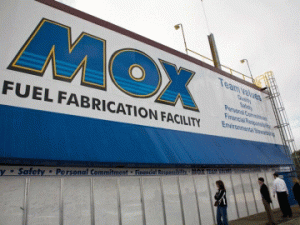
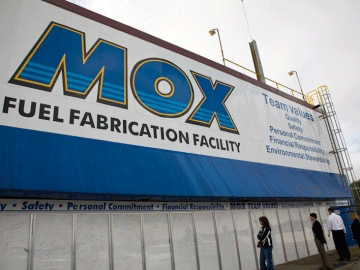
According to federal law, the DOE was required to finish the Mixed Oxide Fuel Fabrication Facility at the Savannah River Site in Aiken County by 2014, or remove at least one metric ton of plutonium from the state by Jan. 1, 2016. When the Energy Department failed to meet those deadlines, a $1 million daily penalty was instated. The penalties add up to a maximum of
$100 million annually for each of the first 100 days of the year. When the fees reach the maximum mark, state leaders said residents can expect to see a claim follow quickly thereafter.
https://www.aikenstandard.com/news/clock-resets-for-m-a-day-fine-against-doe-for/article_160b5366-f258-11e7-acdd-9b750ce012c1.html
January 10, 2018
Posted by Christina Macpherson |
Legal, USA, wastes |
Leave a comment












 nuclear-news