Nuclear Waste Management Organization (NWMO) of Canada bribing struggling towns to have nuclear waste dump
 Morrison cited several fears some of the townsfolk have about the project, such as negative impact on tourism, water contamination from the DGR boring project and the risk of accident while transporting high level waste along the highway.
Morrison said money has already come into Hornepayne because of its progression into the project. NWMO’s Learn More Project provides funding to cover travel expenses for individuals who represent the community to meet with the NWMO at its office in Toronto. It also funds the hiring independent experts to advise the community ($15,000 or less) and pays to support authorities to engage citizens in the community to learn about the project ($20,000 or less).
“Businesses that are for the project get some of that money from council and businesses that aren’t don’t get any.”
Nuclear waste debate divides Northern town Ben Cohen Special To The Sault Star, August 3,  2018 Hornepayne, Ont., a community of 980 people about 400 kilometres northwest of Sault Ste. Marie, is one of the five finalists to see who becomes home to a nuclear waste facility.
Wolf Creek, Kansas, to be stuck with stranded nuclear wastes for 60 years or more
 New plan would leave spent nuclear fuel at Wolf Creek until
  2105 http://www.wibw.com/content/news/Kansas-Corporation-Commission-approves-new-plan-for-Wolf-Creek-decommissioning-489928701.html TOPEKA, Kan. (WIBW) — The Kansas Corporation Commission revised the decommission plans for the Wolf Creek Generating Station. The KCC approved a different method than before on Thursday.
Previously the commission had approved what is called the DECON method which assumes that the U.S. Department of Energy will take the spent fuel at the decommissioning time and costs $814 million.
The nuclear plan in Burlington has been operating since 1985 and will decommission in 2045.
The plan approved Thursday, SAFSTOR, keeps the spent fuel at the facility until the unit is removed 60 years later in 2105. It will cost $1.09 billion.
Westar is part of the Wolf Creek Nuclear Operation Corporation (WCNOC) and rates for their customers will increase with the plan.
Spokesperson for Westar and KCP&L Jeremy McNeive said SAFTSOR is actually the better option for Westar customers.
“The change to the decommission plan would be about $800,000 annually which is less than 1 percent for Westar customers,” McNeive said. “Without the change, the decommission cost would have been $1.2 million annually. This is a positive thing, obviously, for Westar customers.”
The WCNOC also includes Kansas City Power & Light, Kansas Gas and Electric and Kansas Electric Power Cooperative.
The decommission order goes under review every three years to make adjustments for inflation and any other factors.
U.S. Navy’s $1 Billion Plan for Breaking Down Old Nuclear-Powered Carrier
US Navy Considered $1 Billion Plan for Breaking Down Old Nuclear-Powered Carrier https://sputniknews.com/military/201808031066935225-US-Navy-Considered-1-Billion-Plan-Breaking-Down-Nuclear-Powered-Carrier/
MILITARY & INTELLIGENCE 03.08.2018
The US Navy has yet to choose a way forward for dismantling the USS Enterprise aircraft carrier. The delay has been motivated in part by the fact that disposing of the nuclear-powered craft could cost more than $1 billion ‒ a pill the Navy is loathe to swallow.
The Government Accountability Office published a report Thursday indicating that in 2013 “the Navy’s cost estimate for the shipyard” in Puget Sound, Washington, “to perform all [USS Enterprise] dismantlement and disposal activities increased — from a range of $500 million to $750 million — to well over $1 billion.”
As a result of this rather significant expense — about 25 percent of what it cost to build the ship in 1958 in inflation-adjusted terms — the Navy decided to ditch the plans. As the ship, built between 1958 and 1961, was the world’s first nuclear-powered aircraft carrier, the government wants to take special care in dismantling it and must comply with stringent guidelines set in place by nuclear regulation bodies separate from the Navy.
There is also a policy precedent to be set by how the carrier is deconstructed, in terms of “the processes, costs and oversight that may be used to dismantle and dispose of nuclear-powered aircraft carriers in the future.” Specifically, the manner in which the Enterprise is disposed of will set an example for how to do the same thing with the US Navy’s aging fleet of Nimitz-class carriers.
One of the thornier issues when it comes to disposal of the carrier is what to do with the nuclear waste produced by its propulsion generators. In 2016, the Navy thought it would have commercial contractors bid for contracts to break down the non-nuclear parts of the ship — everything except what’s referred to as the propulsion space section.
As GAO conducted its study, the Navy decided to ditch this plan. Instead, the Navy is now considering two options for the USS Enterprise, the watchdog noted. One route would be to do most of the deconstruction in Puget Sound, and then dump the nuclear waste at the US Department of Energy’s Hanford Site in southeastern Washington state. The other route is for commercial contractors to do all the dismantling. There is no estimate provided in GAO’s report for how much each of these routes would cost the US Navy, and by extension US taxpayers.
Under the 100 percent commercial dismantling route, the US Navy needs to coordinate with the Nuclear Regulatory Commission (NRC), which has regulatory jurisdiction over the private nuclear industry, the GAO said. The Pentagon agreed with this recommendation, Stars and Stripes reported Friday.
Japan’s NRA plans nuclear wastes burial at least 70 meters deep for about 100,000 years

Mainichi 2nd Aug 2018 , The Nuclear Regulation Authority (NRA) plans to require that highly
radioactive waste generated when nuclear reactors are decommissioned be
buried underground at least 70 meters deep for about 100,000 years until
the waste becomes no longer hazardous.
Moreover, disposal sites for such waste should not be built in areas that could be affected by active faults
or volcanoes. The plan is part of the proposed regulatory standards on
disposal sites for radioactive waste from dismantled nuclear reactors,
which the NRA approved on Aug. 1. The NRA will hear opinions from power
companies operating nuclear plants and other entities before finalizing the
regulatory standards.
https://mainichi.jp/english/articles/20180802/p2a/00m/0na/008000c
Hanford Plutonium Finishing Plant clean-up to be restarted
 Daily Mail 27th July 2018 , Work to demolish a former nuclear weapons production factory in Washington
state may resume in September, about six months after it was halted when
workers were exposed to radioactive particles, the U.S. Department oEnergy said Thursday.
workers demolishing the Plutonium Finishing Plant on the Hanford Nuclear
Reservation, which is near Richland. The plant was involved in producing
much of the plutonium for the nation’s nuclear arsenal.
issued a report in late March that said a total of 42 Hanford workers
inhaled or ingested radioactive particles when they were exposed during
contamination events in June and December of last year. Radioactive
contamination was also found outside plant offices and inside two dozen
vehicles, the report said.
http://www.dailymail.co.uk/wires/ap/article-5997239/Work-demolish-nuke-weapons-plant-resume-September.html
Japan has amassed enough plutonium to make 6,000 nuclear bombs

 Economist 25th July 2018 Japan has now amassed 47 tonnes of plutonium, enough to make 6,000 bombs.
What is Japan doing with so much plutonium? Plutonium is at the heart of
Japan’s tarnished dream of energy independence. Spent fuel from nuclear
reactors can be reprocessed to extract plutonium, which is then recycled
into mixed oxide, or MOX, fuel. This was intended for use in Japan’s
reactors but most of its nuclear power plants have been offline since the
2011 Fukushima disaster.
Tougher safety checks have failed to reassure the
nuclear-phobic public that the reactors can be restarted. And Japan’s
nuclear-energy fleet is ageing. Taro Kono, Japan’s foreign minister, has
admitted that this situation is “extremely unstable”.
Japan’s status as a plutonium superpower is increasingly under scrutiny. The government
says it has no intention of building a bomb. But China and other countries
question how long it can be allowed to stockpile plutonium. Analysts worry
about a competitive build-up of plutonium in Asia.
Moreover Japan’s stock, which is weapons-grade, is reprocessed and stored in France and
Britain. It is moved across the world in heavily armed convoys. America
says those shipments and the storage of plutonium in civilian sites present
a potential threat to non-proliferation goals: they could be redirected to
make weapons, or targeted by terrorists. It is nudging its ally to start
reducing the hoard.
https://www.economist.com/the-economist-explains/2018/07/25/why-does-japan-have-so-much-plutonium
Bradwell Nuclear Power Station closed 16 years ago, now ready for decades of “interim” wastes
 Maldon & Burnham Standard 23rd July 2018 , BRADWELL Power Station has finished treating radioactive waste as it makes another big step towards being decommissioned. Site operator Magnox is now
preparing the site for the 80 year care and maintenance process. The power
station stopped generating electricity in March 2002, after running for 40
years. In a programme spanning seven years, hundreds of thousands of litres
of radioactive resin and sludge has been made ready for interim storage.
The radioactive sludge was collected from the ponds which stored the
site’s spent nuclear fuel during operation. The resins helped with
removing the radioactive content from site’s discharges – making sure
they were kept within safe and permitted levels. Once it had been
retrieved, the waste was treated and packaged in self-shielding ductile
cast iron containers known as yellow boxes, making it suitable for interim
storage in the site’s purpose-built facility.
http://www.maldonandburnhamstandard.co.uk/news/16371458.bradwell-power-station-finishes-treating-radioactive-waste/
Australia’s beautiful Flinders Ranges to become bonanza nuclear waste site – or nuclear sacrifice zone?

Coalition’s Kimba nuclear dump exploits local area and puts nation at risk https://independentaustralia.net/politics/politics-display/coalitions-kimba-nuclear-dump-exploits-local-area-and-puts-nation-at-risk,11717 Noel Wauchope 23 July 2018,
How is a small rural town to cope with a proposition that may transform the community by providing an economic boon or be a long-term curse?
This is the dilemma facing the towns of Kimba and Hawker, both in the Eyre Peninsula, South Australia.
Individual landowners offered their land to the Turnbull Government for a radioactive waste storage site and the Government’s National RadioactiveWaste Management Facility (NRWMF) team swung into action.
There’s quite a hurry on, about this. Resources Minister Matt Canavan announced that, on 20 August, there will be a local ballot to gauge community support for a nuclear waste dump.
Following that, said Canavan:
“The decision will be made in the second half of this year … We do not want this overlapping with a Federal election.”
Much can be said about this plan, not least that it contravenes South Australian law. One might ask, too, why the inquiry stipulates South Australia when the waste to be stored would have to travel 1,700 km from the Lucas Heights nuclear reactor in Sydney? However, the most notable immediate ramifications concern its impact on Eyre Peninsula rural communities.
As one local resident put it:
‘Stress levels are through the roof for a lot of people within our communities. People are getting sick, and some are just sick and tired of hearing about it, with many wanting the dump to just go away!’
And in the words of another resident:
‘Before a nuclear waste dump came into our lives, people enjoyed cultural activities together … Today it isn’t like that, a once close family ruined and torn apart all because of a proposed nuclear waste dump that could be put on Adnyamathanha traditional lands, which will destroy our culture and … cause cultural genocide.’
Community division is obvious when one reads the submissions that local and Eyre Peninsula residents have sent to a Senate Committee of Inquiry. The Inquiry called for submissions, stipulating fairly narrow Terms of Reference (TOR), about the ‘Selection process for a national radioactive waste management facility in South Australia’.
Among the 40 supporters of the plan, most are local residents, enthusiastic about hosting the waste dump.
Repeatedly, their submissions include phrases like ‘no negative impacts’ and ‘comfortable and satisfied with the prospect of hosting the proposed nuclear waste facility’
Numbers below in brackets refer to the submission numbers listed on the Senate website.
John Hennessy( No 7), is “bubbling with enthusiasm” for nuclear waste dump in Hawker. “Hawker has “ a once in a lifetime opportunity”
Jessica Morgan, (no.37) ” I have stood [at ANSTO] next to and touched the canister containing the intermediate level waste with my 9 month old baby in a carrier on my chest, feeling totally confident of my own safety and that of my child.”
Annie Clements, (No 35) – happy to see nuclear waste dump “powering Kimba community into the future”.
And here we come to another aspect of their support for the waste dump plan. It’s not just that Kimba might be “powered into the future”. It’s the thought that Kimba might not have a future unless it hosts the dump.
Again and again this argument appears in the pro nuclear submissions:
This repository would ensure our towns survival – Ian Carpenter.( No 3 )
Kimba is struggling, population is declining,… we are in need of a life line …. The possibilities this facility could provide a small failing community is endless – Jodie Joyce (No 33)
this project will ensure the long term viability of this small country town – Janice McInnis, ( No 4 )
it will save Kimba ” for many more generations to come– Melanie Orman (No 77)
A third, much repeated, theme in these submissions is that this matter concerns only the local community.
This is frequently expressed with the dismissal of the opinions of people outside the immediate area and also, at times, with downright hostility to those who oppose the dump:
‘People outside our area could be influenced by anti-nuclear scare campaigns and wild allegations that have no relevance to this facility.’ ~ Annie Clements (35)
‘Activists and politicians who have been using [this] project as a vehicle for their anti-nuclear stance should not be entitled to any say …’ ~ Heather Baldock (64)
Outsiders do not care if Hawker dies a slow death due to lack of employment etc – Chelsea Haywood (No. 2)
‘We disagree that we need “broader community views” and the need to stretch the boundaries outside of our District Council. What is happening in our Community is exactly that: our community.’ As residents of Kimba for the last 43 years, plus ++ We see no reason that the rest of SA has a right to tell us what we can and can’t have. It is our back yard, not theirs. ….. . It’s a shame we have to have this inquiry. ~ Margaret and Charlie Milton (34)
These three themes – enthusiasm for the project, distrust of critics, and resistance to the involvement of outsiders, merge into a kind of strong local patriotism allied to trusting loyalty to the federal government, which has run a huge informational campaign in the towns.
As to the 58 submissions opposing the plan, at least half come from residents of the Eyre Peninsula. As with the rest of the opponents, they do express a variety of arguments, but local submissions are most often concerned with the local area.
Above all, they are dissatisfied with the community consultation process, and the lack of clarity about what is meant by “broad community support”. They want the wider community, Eyre Peninsula, South Australia, to be consulted, and, indeed they see the federal nuclear waste facility as a national issue. They also do not believe that the project has Indigenous support.
Readers of all 98 submissions can’t fail to notice that, on the whole, these 55 opposing ones have more comprehensive, detailed, and referenced writing, as compared with the pro nuclear ones. And this is certainly true of the very thoughtful and measured arguments of the farmers from the local areas concerned.
These raise some issues which are rarely mentioned on the pro-nuclear side:
- concern about co-location of low and intermediate level wastes, especially the prospect of stranded “temporary” wastes, with no plan for final disposal;
- transport dangers;
- seismic and flood dangers;
- impacts on agricultural markets and tourism; and
- the fear that this waste dump would lead to a full-scale commercial importation of nuclear waste.
Kay Fels, a Flinders Ranges farmer.(No 63) ‘s submission is representative of the concerns of many others:
our stock (sheep and cattle) may also be stigmatised by the proximity of the waste dump and our organic status compromised Agriculture and tourist industries will be jeopardised as the clean, green image of the Flinders Ranges is tarnished . The sites are located in an area where the underground water table is almost at surface level. This could lead to contamination of the underground water source, so vital to the region. The location is also on a piedmont plain and prone to flooding
Given that the proposal is to store low level waste in an above ground facility, and temporarily store intermediate waste in that same facility, it seems ludicrous that this is even considered given the geological and environmental features and risks involved.
The consultation phase was a tokenism with ANSTO telling us what will be happening, how safe it is and pushing the affirmative – not a true reflection of the community’s views and concerns. The consultative committee is a rubber stamp
Many are strongly sceptical of the consultations held by the Department of Industry Innovation and Science (DIIS), and of the information campaign by Australian Nuclear Science and Technology Organisation (ANSTO) . There is strong criticism of the nomination of Wallerberdina property by non-resident former Liberal Senator Grant Chapman, with close links to the nuclear industry. They also claim hypocrisy of DIIS in biased and misleading information, and dismissal and indeed, exclusion of critics.
‘
I am not against having a LLW facility in Australia. I am against the way in which DIIS have gone about finding a quick fix for something that will affect all South Australians for centuries to come. It should not be up to a small council area to overrule our Prohibition Act 2000, if we are to vote for something of such national importance.” My problem is a complete lack of trust with DIIS in the way in which they have treated ordinary people from Quorn, Hawker and Kimba – Leon Ashton (No 73)
there are far too many discrepancies in the information, consultation process and long term impacts to have such a facility based at Kimba (or Hawker). the consultation process has been an insult to the intelligence of rural people. – Leanne Lienert (No. 50)
Sue Tulloch (no 32) makes a scathing criticism of the federal nuclear waste dump process and “shambolic “Barndioota Consultative Committee.
Aboriginal voices are passionate, at the same time as providing factual information and references:
The Senate took a long time to publish this one – perhaps because they recognised it as the most important one? Regina McKenzie (No 107) , a very well informed traditional indigenous owner of the selected are at Barndioota, focuses on the cultural heritage rights and interests of identified traditional owners and the State/Federal obligations regarding those rights. The Department of Industry, Innovation and Science (DIIS) has ignored Australia’s commitment to United Nations Declaration on the Rights of Indigenous Peoples. DIIS has poorly assessed Aboriginal cultural heritage, and engaged inappropriate consultants. –
In this article, I have avoided the wider arguments expressed in the submissions, including the ones from organisations on both sides of the argument. Through studying 98 submissions, I have tried to get to the feelings of the communities involved – to what it must be like, to be part of a community caught in this dilemma.
Our biggest worry of this process is the detrimental effect it will have and is already having on the local community as a whole. Along with my family we have never seen an event in this area cause so much angst and division in a once very proud close knit community which was the envy of many other communities. – Philip Fels (No 84)
The mental health and well-being of communities is completely ignored in this process and this is a serious issue that needs to be addressed in future frameworks and guidelines. This process makes communities feel powerless – no support is given to those with opposing views, it is a process that is heavily favoured towards those pro-nuclear and when the rules keep changing to suit those in favour it really gives people a sense of hopelessness. Chloe Hannan, Kimba : (No. 61)
As an outsider, I can’t really gauge this social situation. But, whatever the outcome of the federal government’s plan, Kimba and Hawker communities will never be quite the same again
It’s a worry that USA’s Dept of Energy aims for cheaper commercial treatment of Hanford nuclear waste
Feds push for low-cost commercial treatment of Hanford waste. State has concerns, BY ANNETTE CARY, acary@tricityherald.com, RICHLAND, WA
The Department of Energy is making plans to encase 2,000 gallons of waste now held in Hanford’s underground tanks in concrete-like grout, part of a continuing demonstration project.
DOE recently released a fact sheet that indicated its interest in continuing the demonstration project and listing what it sees as the benefits of the project, called the test bed initiative.
The project is a departure from plans to turn radioactive and hazardous chemical waste into a stable glass form at the $17 billion vitrification plant under construction at the nuclear reservation.
But DOE still needs to get other parties on board.
The Washington Department of Ecology, a Hanford regulator, has sent DOE a list of questions about the project. The state would need to issue permits and approvals for some aspects of the demonstration project.
“Current core work at the Hanford Site is already being deferred and delayed due to a lack of funds,” said Maia Bellon, Ecology director, in the letter to DOE. “We are concerned about (Department of) Energy pursuing a new initiative that could divert even more funding away from existing priorities that are tied to consent decree deadlines.”
The project also faces a congressional hurdle.
Language included in the Senate’s fiscal 2019 Hanford budget recommends no money be spent on the test bed initiative.
The Senate budget language must be reconciled with the House budget language for the same year, which was bullish on the project. It directed $15 million be spent on the next phase of the demonstration.
The first phase of the demonstration project, grouting three gallons of the 56 million gallons of waste held in Hanford’s underground tanks, was successfully completed in December.
………The state of Washington and the Hanford Advisory Board have advocated for more double-shell tanks to be built to provide more space for waste to be emptied from single-shell tanks. DOE has been opposed to building more storage tanks, saying it would rather spend money on treating waste………https://www.tri-cityherald.com/latest-news/article215368935.html
Hardened On-Site Storage (HOSS) of nuclear wastes is the safest method
 (Transport dangers) Any mainline rail can be used. The condition of the rails in the U.S. is not good.
 Think of recent train derailments – as NIRS has often asked, “What if nuclear waste had been aboard?” The irradiated nuclear fuel casks aboard trains bound for Holtec/ELEA, NM, combined with the rail cars, would weigh around 180 tons. These would be among the heaviest loads on the rails, and would risk further damaging them.
 (Waste container contamination) sometimes the exterior of shipping casks are contaminated, sometimes severely so. Above, 49 such incidents of external contamination were documented in the U.S. from 1949-1996. As revealed by Mycle Schneider of WISE-Paris in the mid- to late 1990s, Areva (now called Orano in the U.S., as at the WCS, TX CISF) experienced a very large number of externally contaminated HLRW shipments.
Decommissioning Nuclear Power Plants: What Congress, Federal Agencies and Communites Need to Know Highly Radioactive Irradiated Nuclear Fuel: Need for Hardened On-Site Storage; Risks of Off-Site Transport Kevin Kamps, Radioactive Waste Specialist, Beyond Nuclear , July 16, 2018 https://static1.1.sqspcdn.com/static/f/356082/27949948/1532014874603/7+16+18+Capitol+Hill+Decommissioning+and+HLRW+congressional+briefing+EESI+with+further+note+slides+added.pdf?token=p2q8spOdyd5eCfAnSiIAvb%2FMi2g%3D
Captiol Hill briefing paper on the need for autopsies at decommissioning reactors
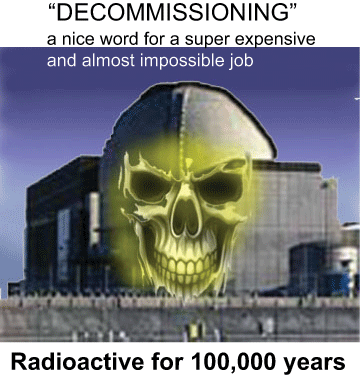 Decommissioning nuclear power stations need an “autopsy” to verify and validate safety margins projected for operating reactor license extensions
Summary
The Issue
The Nuclear Energy Institute (NEI), the lead organization for the U.S. commercial nuclear power industry, envisions the industry’s “Bridge to the Future” through a series of reactor license renewals from the original 40-year operating license; first by a 40 to 60-year extension and then a subsequent 60 to 80-year extension. Most U.S. reactors are already operating in their first 20-year license extension and the first application for the second 20-year extension (known as the “Subsequent License Renewal”) is before the U.S. Nuclear Regulatory Commission (NRC) for review and approval. NEI claims that there are no technical “show stoppers” to these license extensions. However, as aging nuclear power stations seek to extend their operations longer and longer, there are still many identified knowledge gaps for at least 16 known age-related material degradation mechanisms (embrittlement, cracking, corrosion, fatigue, etc.) attacking irreplaceable safety-related systems including miles of electrical cable, structures such as the concrete containment and components like the reactor pressure vessel. For example, the national labs have identified that it is not known how radiation damage will interact with thermal aging. Material deterioration has already been responsible for near miss nuclear accidents. As such, permanently closed and decommissioning nuclear power stations have a unique and increasingly vital role to play in providing access to still missing data on the impacts and potential hazards of aging for the future safety of dramatic operating license extensions.
The NRC and national laboratories document that a post-shutdown autopsy of sorts to harvest, archive and test actual aged material samples (metal, concrete, electrical insulation and jacketing, etc.) during decommissioning provides unique and critical access to obtain the scientific data for safety reviews of the requested license extensions. A Pacific Northwest National Laboratory (PNNL) 2017 report concludes, post-shutdown autopsies are necessary for “reasonable assurance that systems, structures, and components (SSCs) are able to meet their safety functions. Many of the remaining questions regarding degradation of materials will likely require[emphasis added]a combination of laboratory studies as well as other research conducted on materials sampled from plants (decommissioned or operating).” PNNL reiterates, “Where available, benchmarking can be performed using surveillance specimens. In most cases, however, benchmarking of laboratory tests will require(emphasis added)harvesting materials from reactors.” In the absence of “reasonable assurance,” it is premature for licensees to complete applications without adequate verification and validation of projected safety margins for the 60 to 80-year extension period.
Decommissioning is not just the process for dismantling nuclear reactors and remediating radioactive contamination for site restoration. Decommissioning has an increasingly important role at the end-of-reactor-life-cycle for the scientific scrutiny of projected safety margins and potential hazards at operating reactors seeking longer and longer license extensions.
The Problem
After decades of commercial power operation,the nuclear industry and the NRC have done surprisingly little to strategically harvest, archive and scientifically analyze actual aged materials. Relatively few samples of real time aged materials have been shared with the NRC. The NRC attributes the present dearth of real time aged samples to “harvesting opportunities have been limited due to few decommissioning plants.” However, ten U.S. reactors have completed decommissioning operations to date and 20 units are in the decommissioning process. More closures are scheduled to begin in Fall 2018. A closer look raises significant concern that the nuclear industry is reluctant to provide access to decommissioning units for sampling or collectively share this cost of doing business to extend their operating licenses. Key components including severely embrittled reactor pressure vessels were promptly dismantled by utilities and buried whole without autopsy. Many permanently closed reactors have been placed in “SAFSTOR,” defueled and mothballed “cold and dark” for up to 50 years without the material sampling to determine their extent of condition and the impacts of aging. Moreover, the NRC is shying away from taking reasonable regulatory and enforcement action to acquire the requested samples for laboratory analysis after prioritizing the need for a viable license extension safety review prior to approval. Meanwhile, the nuclear industry license extension process is pressing forward.
David Lochbaum, a recognized nuclear safety engineer in the public interest with the Union of Concerned Scientists, identifies that nuclear research on the impacts and hazards of age degradation in nuclear power stations presently relies heavily on laboratory accelerated aging—often of fresh materials—and computer simulation to predict future aging performance and potential consequences during license extension. Lochbaum explains that “Nuclear autopsies yield insights that cannot be obtained by other means.” Researchers need to compare the results from their time-compression studies with results from tests on materials actually aged for various time periods to calibrate their analytical models.According to Lochbaum, “Predicting aging effects is like a connect-the-dots drawing. Insights from materials harvested during reactor decommissioning provide many additional dots to the dots provided from accelerated aging studies. As the number of dots increases, the clearer the true picture can be seen. The fewer the dots, the harder it is to see the true picture.”
The Path Forward
1) Congress, the Department of Energy (DOE) and the NRC need to determine the nuclear industry’s fair share of autopsy costs levied through collective licensing fees for strategic harvesting during decommissioning and laboratory analysis of real time aged material samples as intended to benefit the material performance and safety margins of operating reactors seeking license extensions, and;
2) As NRC and the national laboratories define the autopsy’s stated goal as providing “reasonable assurance that systems, structures, and components (SSCs) are able to meet their safety functions” for the relicensing of other reactors, the NRC approval process for Subsequent License Renewal extensions should be held in abeyance pending completion of comprehensive strategic harvesting and conclusive analysis as requested by the agency and national laboratories, and;
3) Civil society can play a more active role in the independent oversight and public transparency of autopsies at decommissioning reactor sites such as through state legislated and authorized nuclear decommissioning citizen advisory panels.
Japan, U.S. extend nuclear pact amid concern about plutonium stockpile
KYODO NEWS 17 July 18 Japan and the United States extended on Tuesday a bilateral nuclear agreement that has served as the basis for Tokyo’s push for a nuclear fuel recycle policy.
The pact, which entered into force in July 1988, has authorized Japan to reprocess spent fuel, extract plutonium and enrich uranium for 30 years. As neither side sought to review it before the end of the term, it will remain effective, leaving Japan the only country without nuclear arms that is allowed to reprocess spent nuclear fuel.
But the passing of the initial 30-year period raises uncertainty over the future of the pact, now that it can be terminated anytime six months after either party notifies the other.
The United States is seen as concerned about Japan’s stockpiles of plutonium
………Japan has around 47 tons of plutonium, which is enough to produce about 6,000 nuclear warheads.
Of the 47 tons, around 10 tons were stored in Japan and the reminder in Britain and France as of the end of 2016, according to government data.
In early July, Japan clearly stated for the first time in its basic energy plan that it will trim the amount.
Spent fuel from nuclear reactors is reprocessed to extract uranium and plutonium, which is then recycled into fuel called mixed oxide, or MOX, for use in fast-breeder reactors or conventional nuclear reactors.
But following the 2011 Fukushima nuclear disaster, most of Japan’s nuclear power plants remain offline as they are required to pass newly established safety regulations……..
The Rokkasho plant, a key pillar of the country’s nuclear fuel recycling policy, will be able to produce around 8 tons of plutonium a year when fully operational. https://english.kyodonews.net/news/2018/07/d0e37985dc1c-japan-us-extend-nuclear-pact-amid-concern-about-plutonium-stockpile.html
Questions: why does USA allow only Japan to reprocess plutonium?
Japan’s ‘plutonium exception’ under fire as nuclear pact extended https://asia.nikkei.com/Politics/International-Relations/Japan-s-plutonium-exception-under-fire-as-nuclear-pact-extended Beijing and Seoul question why US allows only Tokyo to reprocess, TOKYO — Japan’s nuclear cooperation agreement with the U.S. — the pillar of Tokyo’s nuclear energy policy — renews automatically on Monday after the current pact, which took effect in 1988, expires.
The agreement allows Japan to be the sole non-nuclear-weapons state to use plutonium for peaceful purposes and underlies the country’s policy of recycling spent nuclear fuel.
But the renewal comes at a time when Japan’s “plutonium exception” is increasingly under scrutiny. Instead of negotiating a new pact that could last several decades, Washington and Tokyo chose an automatic extension of the current agreement.
The agreement signed three decades ago stated that after the 30-year period expired, the terms would remain in force but could be terminated by either side with a six months’ notice. Japan worries that without a new long-term agreement, the country enters an “extremely unstable situation,” Foreign Minister Taro Kono has said.
Japan’s neighbors have cried foul over Japan’s plutonium exception. China has said it creates a path for Japan to obtain nuclear weapons. South Korea, which also has a nuclear cooperation agreement with the U.S., has pressed Washington hard to be granted similar freedom on fuel reprocessing.
Countries such as Saudi Arabia that are looking to develop their own nuclear programs have also protested.
Under President Barack Obama, Japan’s plutonium stockpiles — much of which is stored in the U.K. — drew uncomfortable attention in Washington. In March 2016, Thomas Countryman, the then-assistant secretary of state for nonproliferation, told a Senate hearing that he “would be very happy to see all countries get out of the plutonium reprocessing business.”
President Donald Trump has shown less interest in preventing nuclear proliferation, but is committed to dismantling North Korea’s nuclear facilities and materials. Resolving the inconsistent treatment afforded Japan’s plutonium stockpile would make it easier to convince Pyongyang to give up reprocessing capabilities as part of its denuclearization, Countryman told Nikkei recently.
The Trump administration appears aware of these arguments. The National Security Council and State Department have requested that Japan reduce its stockpile and otherwise ensure its plutonium is used and managed appropriately. On July 3, Japan’s cabinet approved a new basic energy plan that includes reducing plutonium holdings, aiming to assuage American concerns.
But Japan’s mostly idled nuclear power industry makes working through the stockpile a challenge.At one point after the 2011 Fukushima nuclear disaster, all of the country’s reactors were offline. Nine have managed to restart under stricter safety standards adopted in the wake of the meltdowns, but only a few Japanese reactors can run on so-called mixed-oxide fuel containing plutonium.
Regulators have asked utilities such as Shikoku Electric Power and Kyushu Electric Power that are working to restart nuclear reactors to look into consuming plutonium fuel held by other power companies. But this would require potentially difficult negotiations with local governments.
One other option is to pay overseas countries that store plutonium on Japan’s behalf to dispose of them, but that would involve discussion on the international level.
“The only viable option is to explain to the world the steady efforts we are making toward reduction,” said an official at the Ministry of Economy, Trade and Industry, which is responsible for Japan’s energy policy.
So far, the U.S. has not called on Japan to abandon its plutonium entirely, or to speed up its reduction. And there is little chance the U.S. will end the cooperation agreement, as “Japan’s nuclear technology is indispensable to the American nuclear industry,” according to a Japanese government source.
But Tokyo worries that the Trump administration may apply the same transactional approach it has to other foreign policy issues to the question of Japan’s plutonium.
USA Navy ‘s history of dumping nuclear wastes in the sea
When the Navy sank nuclear waste with machine guns, https://www.wearethemighty.com/history/navy-nuclear-waste-dumping?r Logan Nye, Jul. 12, 2018
1 This Month
23-25 October – on Zoom – World BEYOND War’s annual global conferenc


Shut down the radiation-damaged Heysham nuclear reactors now
To see nuclear-related stories in greater depth and intensity – go to https://nuclearinformation.wordpress.com

Say No to NASA’s Reckless Nuclear Reactor on the Moon
Say No to NASA’s Reckless Nuclear Reactor on the Moon

Please sign the petition here: https://www.change.org/p/stop-japan-s…
-
Archives
- October 2026 (190)
- September 2026 (339)
- August 2026 (330)
- July 2026 (355)
- June 2026 (287)
- May 2026 (306)
- April 2026 (356)
- March 2026 (251)
- February 2026 (267)
- January 2026 (308)
- December 2025 (358)
- November 2025 (359)
-
Categories
- 1
- 1 NUCLEAR ISSUES
- business and costs
- climate change
- culture and arts
- ENERGY
- environment
- health
- history
- indigenous issues
- Legal
- marketing of nuclear
- media
- opposition to nuclear
- PERSONAL STORIES
- politics
- politics international
- Religion and ethics
- safety
- secrets,lies and civil liberties
- spinbuster
- technology
- Uranium
- wastes
- weapons and war
- Women
- 2 WORLD
- ACTION
- AFRICA
- Atrocities
- AUSTRALIA
- Christina's notes
- Christina's themes
- culture and arts
- Events
- Fuk 2022
- Fuk 2023
- Fukushima 2017
- Fukushima 2018
- fukushima 2019
- Fukushima 2020
- Fukushima 2021
- general
- global warming
- Humour (God we need it)
- Nuclear
- RARE EARTHS
- Reference
- resources – print
- Resources -audiovicual
- Weekly Newsletter
- World
- World Nuclear
- YouTube
-
RSS
Entries RSS
Comments RSS

