A conversation with Dr. Gordon Edwards: contemporary issues in the Canadian nuclear industry, and a look back at the achievements of the Canadian Coalition for Nuclear Responsibility (CCNR), http://www.ccnr.org/ Montreal, August 25, 2018, Nuclear waste management: an exercise in cynical thinking. DiaNuke.org, 24 Sept 2018 “……..Proliferation of thousands of non-naturally occurring radioactive isotopes
Our organization has come to the conclusion that these wastes did not exist seventy-five years ago. It’s only in the last 70 some years that these wastes have been produced, and there are thousands of human-made radioactive materials, in addition to the couple of dozen radioactive materials that exist in nature. There are naturally occurring radioactive materials, but the difference is most of the existing radioactive materials are different chemical species from the non-radioactive materials. You can separate them chemically. Uranium, thorium, radium and so on are different chemical species than normal non-radioactive atoms.
In a nuclear power plant what you’re-creating is hundreds and hundreds of radioactive varieties of otherwise non-radioactive materials. Non-radioactive iodine is now contaminated with radioactive iodine. Non-radioactive cesium is contaminated with radioactive cesium—non-radioactive strontium and so on. And the result is that once these things are blended together, the radioactive and the non-radioactive, you can’t separate them anymore. It is an impossible task to separate out the radioactive from the non-radioactive once you have created duplicates of virtually every element in the periodic table of a radioactive variety.
15. Rolling stewardship
So we feel that for the foreseeable future, and that means for however long it takes, 100 years 200 years or more, we should not fool ourselves into thinking we have a solution. We should adopt a policy of rolling stewardship which means that we have to keep these things under constant surveillance, constant monitoring and they must be retrievable, and they must be guarded, and they must also have a built-in mechanism, a social mechanism, for ensuring that there is funding and knowledge and resources and tools available to future generations so that they can, in fact, know what these wastes are, that they can monitor them, and that they can take corrective measures when things start going wrong, and that they can improve the containment so that this is not just a status quo.
This is not an idea of just leaving it where it is and ignoring it. On the contrary, it’s an active involvement, an active engagement to continually improve the storage of these materials because we know how to do this. We know how to store the materials in such a way that they do not get out into the environment, and we can do this for periods of decades or even centuries, depending on the circumstances.
We feel that this is the policy that we should be following, not that this is an acceptable long-term solution, either, but it is something that can be managed over an intergenerational period of time indefinitely. The point here is that rather than abandoning the waste, which is what the industry now wants to do…
And by the way, it’s not only industry that wants to abandon the waste. It’s also the regulatory agency because the regulatory agency wants to also cut its liability. They don’t want to have to look after or be responsible for these wastes beyond a certain point in time. So they have a conflict of interest. Institutionally, they have an interest in abandoning the waste and saying it’s not our problem anymore. Any problems that are caused are your problem, not ours. Unfortunately, the people who are more likely to suffer the consequences of major leakage or major failure of containment will not have the resources or the knowledge. So abandonment actually presupposes amnesia. It means that you’re saying that we’re just going to forget it, and that means that when these things do come back to the surface, if they do, and do contaminate surface waters and food paths and so on, nobody knows anymore. It’s a question of rediscovering what these materials are, how we contain them, and so on.
So we feel that rolling stewardship is a more responsible approach and that entails really admitting that we don’t have a solution, and admitting that we should stop producing the waste. One of the reasons why we continue to produce this waste is because we are continually being presented with a dangled carrot, with the idea that the solution is just around the corner, and that we’re working on the solution. As long as we’re working on the solution, how can you possibly object to us just continuing?
A conversation with Dr. Gordon Edwards: contemporary issues in the Canadian nuclear industry, and a look back at the achievements of the Canadian Coalition for Nuclear Responsibility (CCNR), http://www.ccnr.org/ Montreal, August 25, 2018, Nuclear waste management: an exercise in cynical thinking. DiaNuke.org, 24 Sept 2018. “…….. The elusive “willing host community”DR: I know too there have been a lot of targeted “willing host communities” that have rejected it. Do you think they’ll succeed in finding one?
GE: Here in Canada they have gone through this process of looking for a “willing host community,” which is kind of foolish because these communities are very small. For example, I just visited two of them within the last few weeks way up above Lake Superior. In the two communities that I visited, Hornepayne and Manitouwadge, I gave presentations. These communities have less than a thousand residents in each one of them and they get $300,000 a year as basically bribe money in order to keep them on the hook, to keep them interested in learning more. It’s called the “learn more” program, and as long as they’re “learning more,” they can get $300,000 a year. Well, they are both interested in getting the money, and consequently they’re still in the running, but do they really want to be a nuclear-waste community? If this is such a good deal for them, then why aren’t other communities bidding for this—larger communities? Of course, one of the points that comes to mind immediately is that if you had a city of a million people or so, then you’d have to shell out $300 million instead of $300,000 every year, so this idea of a “willing host community” exists only because of the bribes that are given by the industry in order to keep these communities supposedly interested in receiving the waste. And in some of them, of course, there are people who see dollar signs and who see an opportunity for them to make a lot of money. In a small community, a certain small number of people can make a lot of money by capitalizing on an opportunity like that without being concerned very much about the long-term wisdom of it.
DR: Yeah, and the seventh future generation doesn’t get a voice.
I did speak to two other communities a couple of years ago in that same general area north of Lake Superior. One of them was the town of Schreiber, and one of them was White River, and both of those communities are now off the list. They’re no longer candidates, so we now have only three communities up north of Lake Superior which are still actively pursuing this program of taking money and “learning more.” I have spoken now to two of them and I haven’t yet been invited to go to the third one.
10. The great unknowable: long term care for nuclear waste. Who pays? Who cares?When I go there I try and point out to them not only the fact that this whole exercise is questionable, but also the fact that once the nuclear waste is moved up to a small remote area like this, what guarantee is there that it’s really going to be looked after properly? Because these small communities do not have a powerful voice.
They don’t have economic clout, and so they can’t really control this. If a person like Donald Trump, for example in the United States, or Doug Ford in Ontario, who many people think is a kind of a mini Donald Trump, thinks, “Why are we going to spend money on that? Forget it we’re not going to spend money on that,” then it’s going to not be pursued as originally planned. And it could become just a surface parking lot for high-level nuclear waste. Who is going to guarantee that it is actually going to be carried out? Now the nuclear plants are in danger of closing down. We’re having fewer nuclear plants every year than we had the year before now in North America, and consequently there’s not the revenue generation that there used to be. The money that’s been set aside is nowhere near adequate to carry out the grandiose project they’re talking about, which here in Canada is estimated to cost at least twenty-two billion dollars. They have maybe five or six billion, but that’s not nearly enough.
So there’s also another problem lurking in the wings, and that is that if you do want to carry out this actual full-scale program of geological excavation with all the care that was originally planned, how do you generate revenue? What company is willing to spend twenty-two billion dollars on a project which generates absolutely no revenue?
There are only two ways you can generate revenue from that, and one way is to take waste of other countries and charge a fee for storing the waste. The other thing is to sell the plutonium. If you extract the plutonium, then you could have a marketable product, but both of these ideas are extremely far from what these communities are being told. In other words, the plan that’s being presented to them does not include either one of these possibilities, and it changes the game considerably. As we all know, getting the plutonium out of the spent fuel involves huge volumes of liquid radioactive waste. It involves very great emissions, atmospheric emissions, and liquid emissions. The most radioactively polluted sites on the face of the earth are the places where they’ve done extensive reprocessing, such as Hanford in Washington, Sellafield in northern England, La Hague in France, Mayak in Russia, and so on.
DR: And Rokkasho in Japan.
GE: That’s right, and so this is a completely different picture than what they’re being presented with. Now whether or not that would actually happen is anybody’s guess, but it’s written right in their documents that this is an option, and they’ve never excluded that option. They’ve always included the option. In fact, the first sentence of the environmental impact statement written by Atomic Energy of Canada Limited many years ago says that when we say high-level nuclear waste we mean either irradiated nuclear fuel or solidified post-reprocessing waste. They have always kept that door open for reprocessing.
11. A disturbed “undisturbed” geological formation is no longer undisturbed But even under the best of circumstances we know that you can’t get waste into an undisturbed geological formation without disturbing it. As soon as you disturb it, it’s no longer the same ballgame. The other thing that people are unaware of, generally, is the nature of this waste. They really don’t realize that this waste is not inert material, that it’s active. It’s chemically active. It’s thermally active. It generates heat for fifty thousand years. They have a fifty thousand-year time period they call the thermal pulse, and the degree of radio-toxicity staggers the mind. Most people have no ability to wrap their mind around that. Take a simple example like Polonium 210 which was used to murder Alexander Litvinenko, and which will breed into the irradiated fuel as time goes on… According to the Los Alamos nuclear laboratories (it’s on their website), this material is 250 billion times more toxic than cyanide. That’s a staggering concept. In fact, nobody can wrap their mind around that, really. 250 billion times more toxic?! Theoretically that means that if you had a lethal dose of cyanide, and you had the same amount of Polonium 210, the cyanide could kill one person. The Polonium 210 could kill 250 billion persons. That’s amazing. How do you possibly wrap your mind around that?………https://www.dianuke.org/a-conversation-with-dr-gordon-edwards-contemporary-issues-in-the-canadian-nuclear-industry-and-a-look-b
Japan vows to cut its nuclear hoard but neighbours fear the opposite, Japan has amassed a large stockpile of plutonium and neighbours fear that the country may decide to build more nuclear weapons. By Motoko Rich, 25 Sept 2018 New York Times, More than 30 years ago, when its economy seemed invincible and the Sony Walkman was ubiquitous, Japan decided to build a recycling plant to turn nuclear waste into nuclear fuel.
It was supposed to open in 1997, a feat of advanced engineering that would burnish its reputation for high-tech excellence and make the nation even less dependent on others for energy.
Then came a series of blown deadlines as the project hit technical snags and struggled with a Sisyphean list of government-mandated safety upgrades. Seventeen prime ministers came and went, the Japanese economy slipped into a funk and the initial $6.8 billion budget ballooned into $27 billion of spending.
Now, Japan Nuclear Fuel Ltd, the private consortium building the recycling plant, says it really is almost done. But there is a problem: Japan does not use much nuclear power anymore.
The country turned away from nuclear energy after the 2011 Fukushima disaster, and only nine of its 35 reactors are operational.
It is a predicament with global ramifications. While waiting for the plant to be built, Japan has amassed a stockpile of 47 metric tons of plutonium, raising concerns about nuclear proliferation and Tokyo’s commitment to refrain from building nuclear arms even as it joins the United States in pressing North Korea to give up its arsenal.
In August, North Korea’s state-run Rodong Sinmun newspaper accused Japan of accumulating plutonium “for its nuclear armament.”
Japan pledged for the first time this past summer to reduce the stockpile, saying the recycling plant would convert the plutonium into fuel for use in Japanese reactors.
But if the plant opens as scheduled in four years, the nation’s hoard of plutonium could grow rather than shrink.
That is because only four of Japan’s working reactors are technically capable of using the new fuel, and at least a dozen more would need to be upgraded and operating to consume the plutonium that the recycling plant would extract each year from nuclear waste.
“At the end of the day, Japan is really in a vice of its own making,” said James M. Acton, a researcher at the Carnegie Endowment for International Peace in Washington.
“There is no easy way forward, and all those ways forward have significant costs associated with it.”
A handful of countries reprocess nuclear fuel, including France, India, Russia and the United Kingdom.
But the Japanese plan faces a daunting set of practical and political challenges, and if it does not work, the nation will be left with another problem: about 18,000 metric tons of nuclear waste in the form of spent fuel rods that it has accumulated and stored all these years.
Japan’s neighbours, most notably China, have long objected to the stockpile of plutonium, which was extracted from the waste during tests of the recycling plant and at a government research facility, as well as by commercial recycling plants abroad.
Most of this plutonium is now stored overseas, in France and Britain, but 10 metric tons remain in Japan, more than a third of it in Rokkasho, the northeastern fishing town where the recycling plant is being built.
Japan says it stores its plutonium in a form that would be difficult to convert into weapons, and that it takes measures to ensure it never falls into the wrong hands.
But experts are worried the sheer size of the stockpile — the largest of any country without nuclear weapons, and in theory enough to make 6,000 bombs — could be used to justify a nuclear buildup by North Korea and others in the region.
Any recycling plan that adds to the stockpile looks like “a route to weaponise down the road,” said Alicia Dressman, a nuclear policy specialist. “This is what really concerns Japan’s neighbours and allies.”
Japan maintains that its plutonium is for peaceful energy purposes and that it will produce only as much as it needs for its reactors. “We are committed to nonproliferation,” said Hideo Kawabuchi, an official at the Japan Atomic Energy Commission.
But the launch of the Rokkasho plant has been delayed so long — and popular opposition to restarting additional nuclear reactors remains so strong — that scepticism abounds over the plan to recycle the stockpile.
Critics say Japan should concede the plant will not solve the problem and start looking for a place to bury its nuclear waste.
“You kind of look at it and say, ‘My God, it’s 30 years later, and that future didn’t happen,’” said Sharon Squassoni, a nonproliferation specialist at George Washington University.
“It’s just wishful thinking about how this is going to solve their myriad problems.”
Engineers have repeatedly revised the design of the plant to address water leaks and earthquake safety, and it took years to develop a safe way to dispose of hazardous byproducts.
After the Fukushima disaster, government regulators demanded even more safety measures.
A conversation with Dr. Gordon Edwards: contemporary issues in the Canadian nuclear industry, and a look back at the achievements of the Canadian Coalition for Nuclear Responsibility (CCNR), http://www.ccnr.org/ Montreal, August 25, 2018, Nuclear waste management: an exercise in cynical thinking. DiaNuke.org, 24 Sept 18,Dennis Riches (DR): Instead of a question I thought we would ask you to comment on something that has been published by an organization called Waste Management Symposia (Waste Management Symposia Inc. http://www.wmsym.org/wm2019 ). They are a non-profit organization, but they seem to be something that was set up by the nuclear industry so that different players in the field could get together and talk about waste management issues. They have a symposium coming up in March of 2019
Gordon Edwards (GE): Well it’s an exercise in cynical thinking……….Of course, the problem is that there’s no way of destroying this stuff. There’s no way of getting rid of it that is technically or economically feasible, so all we’re really doing is repackaging. We’re not getting rid of it, and of course the packages do not last forever, so you can’t eliminate this liability by simply repackaging it and moving it from one place to another. It may be justified on the basis of environmental protection—for example, moving it away from waterways and so on so as to have less opportunity for the material to be dispersed, but once again you really can’t get rid of it. So the with language itself, they talk about “disposal.” Disposal implies that you somehow magically eliminate or get rid of this waste when in fact all you’re doing is reconstituting it in a different form, a different physical form, a different chemical form, but generally not changing the nature of the problem fundamentally.
2. Private solutions for public problemsSo when the last government approached this problem they decided, being Conservative, that it’s better to get private enterprises to look after these things, so they hired a consortium of multinational corporations to solve the problem for us, and in the absence of any policy—the trouble is that Canada has absolutely no policy regarding any nuclear waste except for the irradiated nuclear fuel itself………..
3. Early days: ignorance about nuclear wasteBut if we just back off on all this, the way my organization sees the picture, my organization being the Canadian Coalition for Nuclear Responsibility, which formed in the early 1970s—Well, basically in 1974 we formed, and from our view, the first thirty years of the nuclear age were characterized by a total ignorance about nuclear waste. That is, the public was not informed that there was such a thing as nuclear waste and the decision-makers who authorized the spending of billions of dollars in building a nuclear infrastructure and nuclear reactors were also not informed that this was a major unsolved problem. So it was basically a lie
Nuclear energy was presented as an absolutely clean energy source and people interpreted that to mean, “Hey, no problem. There is no waste.” When it became clear that it is, in fact, the most dangerous industrial waste ever produced on the face of the earth, in the form of the irradiated nuclear fuel, the industry then embarked upon a second lie which was, “Yes, we do have this waste product, the irradiated fuel, and it is very dangerous, and it is essentially indestructible, but we know exactly what to do with it. We know how to solve the problem, and the solution is simply to stick it underground in an undisturbed geological formation and then it’s all safe. We just walk away from it, and no problem.”
4. Belated realization of the problemWell, of course, that was then and this is now, and in the light of experience in the intervening years… In the mid-1970s there was a series of reports in Canada, the United Kingdom, the USA and other countries calling attention to this nuclear waste problem and basically saying quite plainly that unless this problem could be adequately solved that there should be no more nuclear power plants built. So I call this the nuclear ultimatum. It was really an ultimatum to the nuclear industry: You do not have a future if you don’t solve this problem. And because the industry said that they knew what to do with it, the expectation was that they could solve it in ten or twenty years. It would only take ten or twenty years……….
DR: But it seems like they want to keep up the impression that the solution is being worked on. It’s underway. As long as they can keep doing that, the nuclear plants can keep running.
GE: That’s correct, and people have been bamboozled by this empty promise really, and of course it’s become increasingly clear. There have been eight attempts in the United States to locate a high-level waste repository, all of which have failed. There have been two underground repositories in Germany which have failed, for low-level and intermediate-level waste. There’s no facility anywhere in the world which is operational for high-level waste, although there are some that have been built like the one in Finland, for example, near Olkiluoto.
5. Barbaric plans for nuclear wasteAnd now we have this consortium of private companies that has come into Canada to deal with not the irradiated nuclear fuel, but the decommissioning waste and the other post-fission waste, and they have come up with what we consider to be barbaric suggestions.One of them is to, just less than one kilometer from a major river—the Ottawa River which flows into the St. Lawrence River and which comes right down here to Montreal flowing through the nation’s capital—they wanted to build a gigantic mound, basically a surface facility, which is simply a landfill, nothing more than a glorified landfill, and put all the low-level and intermediate-level waste into this one facility which would be five to seven stories high and cover an area which would be equivalent to 70 major-league hockey rinks, and this would basically have no solidity to it. It would be just a mound, an earthen mound of radioactive waste, about million cubic meters.
There has been a massive outcry over this. For example, the twenty-eight communities which make up the municipality of Montreal, as an agglomeration of municipalities, have all come out unanimously against this project. And there are over a hundred municipalities up and down the Ottawa River.
DR: How about Ottawa itself?
GE: No, not Ottawa itself, unfortunately. Most of the opposition has come from the Quebec side of the border. There has been far, far less opposition on the Ontario side. Of course, Ontario is also largely dependent upon nuclear power and so that may be the reason why.
We do not find that Canada has produced any enviable plans for nuclear waste disposal. On the contrary, we feel that they’re setting a terrible example for the rest of the world, and we are fighting to stop it cold in its tracks. We actually had a press conference just last week in Ottawa, just the last few days, in fact, and a march and a demonstration and so on, calling upon the federal government to stop these plans which are underway right now.
6. In situ abandonment of nuclear facilitiesIn addition to piling up the waste on the surface, as I was mentioning, in a huge mound, they’re also planning to take four prototype nuclear reactors, or at least two of those four (they haven’t talked about the other two), and use a process of entombment whereby they will simply dump all the radioactive waste from the reactor itself into the sub-basement and then flood the interior of the building with concrete and turn it into a concrete mausoleum, very close to various rivers, including the Ottawa River, and the Winnipeg River in Manitoba. This they call in situ decommissioning. What it means is that you are taking a facility which was originally licensed to house a nuclear reactor, and you’re turning it into a permanent nuclear waste repository, even though it was never chosen with that in mind. It never went through the examination, the scrutiny, and the qualification that would be associated with a permanent waste repository. And yet that’s what they’re planning to do: just wave their magic wand and turn it from a reactor into a waste repository. We are totally opposed to this, and we’re mobilizing citizen opposition to it……….
7. Wrong people in charge, telling rather than consultingThe nuclear industry wants to abandon these wastes because they cannot possibly look after them for the period of time we’re talking about. Who can really? But we feel that they’re the wrong people to be in charge of this because they have a clear conflict of interest, and this conflict of interest manifests itself in many different ways.
There has been no consultation with Canadians to arrive at these plans. These plans have been announced, and then there have been meetings to inform the public of what they’re planning to do, with no opportunity to change those plans other than to criticize them. Basically it is regarded as a fait accompli.
DR: Yeah, in Japan they call those setsumeikai—explanatory meetings, which means it goes in one direction—we’re explaining to you what’s going to happen.
GE: Yeah. This is by no means a consultation. And we’re calling upon the Canadian government to actually stop these plans and to launch true consultations with Canadians and with First Nations, and to follow up on the recommendations that have been made by several independent bodies in Canada, all of which have recommended that there should be a nuclear waste agency completely independent from the nuclear industry and which has on its board of directors major stakeholders, including First Nations people, in order to ensure that the sole efforts of this organization should be the protection of the public and the environment, and not the furtherance of the nuclear industry, the promotion of expansion of the nuclear industry, which is what the consortium is interested in……….https://www.dianuke.org/a-conversation-with-dr-gordon-edwards-contemporary-issues-in-the-canadian-nuclear-industry-and-a-look-back-at-the-achievements-of-the-canadian-coalition-for-nuclear-responsibility-ccnr-http-ww/
A conversation with Dr. Gordon Edwards: contemporary issues in the Canadian nuclear industry, and a look back at the achievements of the Canadian Coalition for Nuclear Responsibility (CCNR), http://www.ccnr.org/ Montreal, August 25, 2018, Nuclear waste management: an exercise in cynical thinking. DiaNuke.org, 24 Sept 18, 2. “……. Six hundred Lake Superiors needed to dilute nuclear waste to a safe levelThe Ontario government had a Royal Commission on electric power planning back in the 70s, and they made this comparison. They said, “Look, just to try and get an idea or try to communicate the toxicity of this material, let’s ask this question: If you took one year’s worth of spent fuel from one CANDU reactor only, and if you wanted to dissolve this in water to the point where the water was contaminated to the maximum legal degree permitted, the maximum degree of contamination for drinking water, how much water would you need for one year’s worth from one reactor?” And the answer is approximately the volume of Lake Superior. So now you multiply that by 600 because we have 20 reactors operating each for 30 years, so it’s 600 times. 600 Lake Superiors! Well, nobody has that much fresh water, so the only purpose of that calculation is simply to highlight the disparity between what we normally think of as toxic and what we must acknowledge as toxic in this setting.
13. No solution assumedSo in my organization, the Canadian Coalition for Nuclear Responsibility, we feel that it is wrong to assume that there is a solution. We do not know that there is a solution. These proposed solutions are really untested ideas, and in fact, there is not even a scientific definition of the word disposal. If you look at the IAEA, at the nuclear industry’s definition of disposal, all it says is they have no intention of retrieving it. That’s a political definition, not a scientific definition. There is no scientific criterion which allows you to say, if you check the boxes, “Yes, disposal has been achieved.” In other words, that we have achieved this goal of disposal. We’re really conducting experiments on the planet on the assumption that we can achieve a goal which has never been achieved by the human race ever before. We’ve never actually disposed of anything in the whole history, and now we think that we can dispose of the most toxic material we’ve ever created. So how come we can do it now when we never could before, to truly dispose of this material?………..https://www.dianuke.org/a-conversation-with-dr-gordon-edwards-contemporary-issues-in-the-canadian-nuclear-industry-and-a-look-back-at-the-achievements-of-the-canadian-coalition-for-nuclear-responsibility-ccnr-http-ww/
Activists rally against nuclear waste transport, By JOSHUA SOLOMON Staff Writer,Greenfield Recorder September 21, 2018 GREENFIELD— In a lot of ways it was like a party, celebrating the accomplishments of the past few years: The closures of the Vermont and Rowe nuclear plants. ……..The theme of the night? The high-level nuclear power plant waste being stored in Rowe and Vernon, Vt., must go — but only once the right and final safe place for it is decided.
“I haven’t bothered you for three or four years at this point,” leader of CAN and Rowe resident Deb Katz said. “But we’ve come back to our community to say: We need to be involved again. And I wish it wasn’t so.”
Katz and CAN just begun a tour of New England, and after spending their first two nights in Vermont, they came to Greenfield Thursday. On Friday, they will take the tour to the Statehouse on Beacon Hill.
Currently, the anti-nuclear activists are rallying against a bill that could allow for the high-level nuclear waste in Rowe and Vernon, Vt., to be shipped in canisters across the country to Texas or New Mexico. It would place the waste in what CAN is calling “parking lots” that are seen as more temporary holdings than anything else, but could be pitched as helping tthe economy in these regions in the Southwest of the country.
“Why shouldn’t we just say ‘yes, wow. Thank you so much’? The trouble is this is a really bad idea,” Katz said. “We all want the waste off the site, but we want it done right. And we want it done once.” ………
At the moment there isn’t a distinct solution on where to move the high-level nuclear waste, but Katz and fellow lead organizer Chris Williams of Vermont advovated for more science to figure out the best solution to storing waste that remains toxic for thousands of years.
“It took a lot of hard science to create this mess,” Williams said. “To get rid of this stuff properly, we’re going to have to apply real science and not just political expediency.”
The goal is to look to scientists to find the place for “deep geological storage,” Williams said.
Preaching to find a better, scientific solution was organizer and activist Kerstin Rudek from the Peoples Initiative, based out of Germany, where her neighbors have faced similar issues.
“It’s an international thing,” Rudek said, pointing to the lack of answers of what to do with the nuclear waste and the need for answers. “It’s not just a local thing.”
The meeting, which Williams described as a “little more lively than your usual nuclear waste meeting,” also included the speaker Leona Morgan, from the Navajo Nation and an Albuquerque, N.M. resident.
“It’s great news when we hear a nuclear power plant has been shut down, but it makes me nervous because it makes the push for these false solutions even harder,” Morgan said.
She described the political climate in New Mexico as pitching to residents that moving the nuclear waste there would be good for their economy, creating jobs, but ignoring the will of the residents who might be affected by it most.
“I’m here tonight to tell you we don’t want it,” Morgan said. “We don’t want this waste.”………
Whitehaven News 20th Sept 2018, The Nuclear Decommissioning Authority has joined forces with the Japan
Atomic Energy Agency to share expertise in nuclear decommissioning and
radioactive waste management. The NDA – which is responsible for cleaning
up and decommissioning 17 sites in the UK including Sellafield in Cumbria
– has signed an agreement that will see skills, knowledge, research,
information and technology exchanged with the JAEA, Japan’s research and
development institute for nuclear energy.
Independent 21st Sept 2018 Government delayed scrapping potentially unsafe nuclear submarines in bid
to cut costs, MPs told. Influential Commons committee tells Ministry of
Defence to put a stop to postponements after expert admits possible ‘safety
issue’. The government has delayed scrapping potentially unsafe nuclear
submarines because of concerns over costs, a new report from an influential
committee of MPs has revealed. 20 disused submarines are currently awaiting
disposal, according to the Ministry of Defence (MoD), including nine that
still contain nuclear fuel. But despite admitting to potential safety
risks, the government will only begin dismantling the next vessel in the
mid-2020s, while the total work needed to scrap the entire 20 submarines
will not be completed until at least 2045. https://www.independent.co.uk/news/uk/politics/trident-uk-nuclear-submarines-government-cuts-pac-ministry-defence-a8547856.html
REAL PLUTONIUM, Paul Richards shared a link. Nuclear Fuel Cycle Watch South Australia, 21 Sept 18
Global nuclear brotherhood driving weapons proliferation, they still haven’t anywhere to store;
* unspent & spent nuclear fuel,
* excess radionuclides,
* redundant weapons arming material
* contaminated material and their
* respective short &
* long-term containment systems as canisters, or
* short-term storage, 200-litre drums.
Containers at worst need repacking in
* five years in case of the 200-litre drums, with best practice, every
Even if the optimism of the scientists and engineers is well-founded, it will still take almost two more decades for the vitrification plant to run at full bore. So it may be 2047—or later—before the ghosts of plutonium are finally laid to rest.
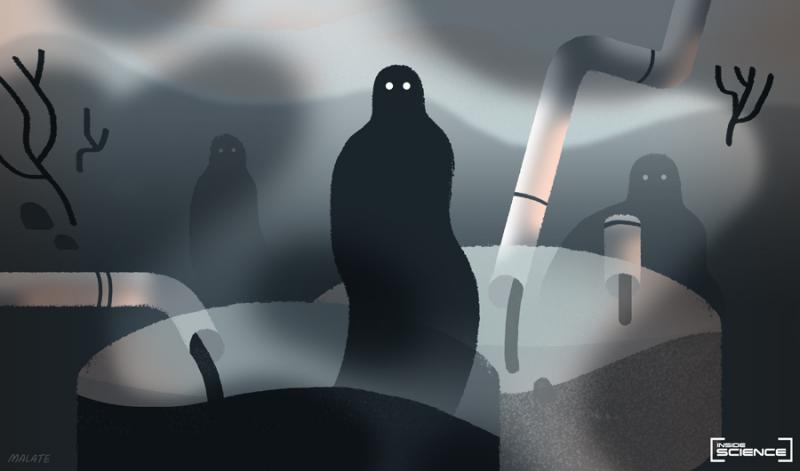
illustration by Abigail Malate, Staff Illustrator, American Institute of Physics
Plutonium Waste Continues to Haunt Nuclear Site https://www.laboratoryequipment.com/news/2018/09/plutonium-waste-continues-haunt-nuclear-site 09/20/2018 – by Valerie Brown, Inside ScienceNearly 30 years ago, the state of Washington and two federal agencies agreed to clean up the Hanford Nuclear Reservation, a 586-square-mile chunk of sagebrush desert where the U.S. produced plutonium for nuclear weapons starting 75 years ago. In the process, half a trillion gallons of chemically toxic and radioactive waste was dumped on the ground or injected into groundwater. Some of it has reached the Columbia River. Another 56 million gallons of concentrated, radioactive sludge and crystallized salts sit corroding within 177 steel-and-concrete underground tanks.Although the tank waste is only a fraction of the total, its safe disposal is one of the site’s most urgent priorities, especially to the policymakers and residents of Washington and Oregon. Eighteen years ago, workers began constructing a plant for “immobilizing” the remaining waste by vitrifying it—a process whereby it is mixed with molten glass, cooled and encased in stainless steel canisters for long-term storage underground in an as yet undesignated location.
Today the task remains unfinished. Prominent among the reasons for this is that designing, building and operating the infrastructure to treat the waste may be the most complicated project of its kind ever attempted. And that’s because the waste itself is, well, complicated. Although plutonium is no longer being created at Hanford this most peculiar element continues to loom ghostlike over the government’s efforts to mitigate the damage its creation caused and prevent any further environmental and human risk for centuries to come. Continue reading →
Nuclear plant mud dumping worries raised by Labour AMs , BBC News, 19 September 2018
Two senior Labour AMs have raised concerns in the Senedd about the dumping of mud from a nuclear plant site into the sea near Cardiff.
Julie Morgan and Jane Hutt – both close to leadership frontrunner Mark Drakeford – said constituents had safety worries about dredging 300,000 tonnes of mud from Hinkley Point.
Dumping began last week. AMs were told the mud poses no risk to human health.
Ms Morgan and Ms Hutt quizzed Rural Affairs Secretary Lesley Griffiths following a topical question raised by independent AM Neil McEvoy.
The project to build the new Hinkley Point C nuclear power station in Somerset includes dredging mud and sediment from Bristol Channel near the sites of the decommissioned Hinkley Point A and B nuclear plants, and disposing of it just over a mile out to sea from Cardiff Bay.
Protestors want the licence from Natural Resources Wales (NRW) which permitted the dredging to be scrapped, amid worries the mud could be contaminated from discharges from Hinkley. In the assembly on Wednesday, Cardiff North AM Julie Morgan asked why the dumping site was chosen “when it’s only two kilometres from the shore”, and what the benefits to south Wales were. ……..
·EnergySolutions is requesting exemption from a law that prohibits the amount of depleted uranium (DU) that can come into Utah. When laws governing the disposal of nuclear waste were developed in the 1980s, byproducts like DU weren’t yet considered. So how can EnergySolutions ensure the safety of future generations from hazards like DU?
Currently, there are limits on DU concentrations and masses allowed in Utah, and any shipments above the limit require safety evaluations. EnergySolutions hopes to exceed these limits by bringing in DU munitions. While EnergySolutions insists that DU is less of a hazard in this form, advocacy groups like HEAL Utah and Utah Sierra Club have raised legitimate concerns.
Most concerning is that DU becomes “hotter” over time. While it begins as a low-level waste, its radioactivity increases for thousands of years. EnergySolutions’ Clive disposal site, just off Interstate 80, is in a particularly vulnerable area, is subject to flooding and will look vastly different in even 100 years. It’s unsettling that EnergySolutions thinks it has the power, and knowledge, to evade the law for something this capricious and uncertain.
There is a public comment period Sept. 6-Oct. 6 regarding EnergySolutions’ exemption request.
Congress looking for money for cities hit by nuclear plant closures — including Diablo Canyon,The Tribune BY KAYTLYN LESLIE, kleslie@thetribunenews.com, September 17, 2018
Congress wants to find money to support communities where nuclear power plants are being decommissioned — which could mean some funding for San Luis Obispo County once Diablo Canyon starts the process itself in the coming years.
Congressman Salud Carbajal announced Monday that Congress directed the U.S. Department of Energy to study public and private funding sources available to help those communities, as part of its Fiscal Year 2019 Energy and Water, Legislative Branch and Military Construction and Veterans Affairs Appropriations Act (HR 5895).
“With the impending Diablo Canyon Power Plant closure, I am working to secure all available federal resources to help offset the economic impact of this decommissioning,” Carbajal said in a news release. Carbajal, a Democrat, represents California’s 24th Congressional District, which spans between San Luis Obispo and Ventura counties.
The Department of Energy study will focus on identifying public and private funds to support municipalities where a nuclear power plant is decommissioned, in the process of decommissioning or plans to shut down within three years of the act’s enactment, and contains nuclear waste within its boundaries, according to the news release.
More than 1.5 million pounds of radioactive waste have been safely removed from the USS Sturgis’ nuclear reactor. Additionally, more than 600,000 pounds of lead from the vessel have been recycled.
The removal process has taken three years and the Corps said decommissioning the Army’s first and only floating nuclear reactor prototype is now complete.
The World War II vessel was converted into a barge-mounted nuclear reactor in the 1960s.
The Galveston Daily News reported the ship will be towed to Brownsville later this month, where it will be scrapped.
With closure and dismantling of the Yankee Atomic plant in Rowe and now Vermont Yankee and other New England nuclear sites pretty much a fait accompli, watchdog groups like Citizens Awareness Network are focused on the one tremendous remaining issue: the high-level nuclear waste remaining on the reactor sites.
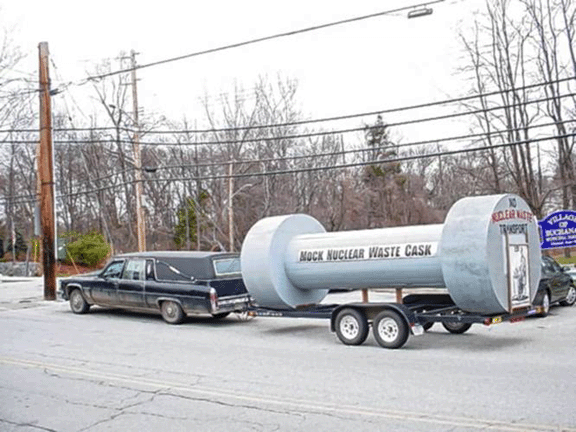
CAN is planning a tour with a giant can — a 32-foot-long wooden mock-up of a radioactive waste cask — and an array of speakers to speak about what the organization calls “the abdication by the federal government and the nuclear industry” to deal with high-level nuclear waste “stranded” at nuclear sites around. Continue reading →











 nuclear-news