
Reports: San Onofre nuclear site ‘fatally flawed’, https://www.thecoastnews.com/reports-san-onofre-nuclear-site-fatally-flawed/Samantha Taylor January 17, 2019,
REGION — Nuclear waste storage facilities at the decommissioning San Onofre Nuclear Generating Station are “fatally flawed” and could cost Southern California nearly $13.4 trillion over a 50-year period if a major release of radiation occurs, according to two reports recently published by the Samuel Lawrence Foundation.
The reports were published during an ongoing Nuclear Regulatory Commission investigation into electric supply company Southern California Edison and its contractor, Holtec International, which designed and built the storage facility.
The investigation stems from an incident on Aug. 3, 2018, when a full canister of spent nuclear fuel came within a quarter-inch of falling 18 feet.
Edison’s plan is to move 73 canisters into the oceanfront storage vault, having already moved 29 by the reports’ publication.
After the August incident, regulators stopped any more canisters from being loaded into the vault, built to hold 3.6 million pounds of nuclear waste at the San Onofre site, located on Marine Corps Base Camp Pendleton on the coastal side of I-5.
The report notes how storage tanks at gas stations in California must be double-walled after experiencing how single-walled containers can leak gasoline into groundwater.
“With a double-walled fuel tank, if a leak occurs it can be detected and the storage container can be repaired or replaced before any gasoline is released,” the report states. “At San Onofre, we certainly should expect that some kind of leak prevention system would be in place to contain extremely toxic high-level radioactive waste.”
At an Aug. 9, 2018, community engagement panel discussing the decommissioning of San Onofre, Occupational Safety and Health Administration inspector David Fritch told attendees about a near-accident at the storage facility.
When workers using a crane were moving a canister containing spent nuclear fuel, it became lodged at the top of the cavity enclosure container into which it was being stored.
Investigations revealed the operators and managers could not see the canister as it was being lowered and became stuck for nearly an hour, hanging 18 feet in the air from the guide ring along the top of the container.
The San Onofre Nuclear Generating Station (SONGS) began operating in 1968 and closed in 2012 after continuous leaks were discovered in the plant’s steam generator tubes.
The first report, titled “San Onofre Nuclear Waste Problems,” examines damage caused to the “thin-walled, steel” canisters as they are lowered into the dry storage vaults. The report refers to this damage as “gouging” and considers it the most serious of the issues facing the storage facility.,
The Del Mar-based nonprofit Samuel Lawrence Foundation’s research determined that had the canister fallen, it could have hit the steel-lined concrete floor of the facility with “explosive energy greater than that of several large sticks of dynamite.” The damage could have caused a large radiation release, according to the report, and could have ruined the facility’s cooling system.
According to the report, each nuclear storage canister contains 37 spent fuel assemblies, which generate “enormous amounts of heat” and are cooled by an air duct system, which could have been blocked by the damage from a canister falling.
If that had happened, great quantities of water would be needed to cool the reaction and prevent or control a meltdown. That water would instantly become radioactive steam, similar to what happened during the 2011 Fukushima Daiichi nuclear disaster in Japan.
In the report, retired U.S. Navy Rear Adm. Len Hering, Sr., who previously served as a nuclear weapons safety officer, provided a scathing assessment of the storage facility’s management practices.
“I find that virtually none of the protocols that should be expected for the safe handling of this dangerous material are present,” he states in the report. “I find that personnel and companies are being hired virtually off the street, no specific qualification standards are present or for that matter even required, training is not specific to the risks of the material involved, and there is no fully-qualified and certified team assembled for this highly-critical operation.”
The report also addresses the risk of storing them so close to the Pacific Ocean, where rising sea levels, frequent high humidity and coastal fog make metal susceptible to short-term corrosion and stress-induced corrosion cracking.
According to the report, the mean high tide level is about 18 inches below the base of the oceanfront storage facility, which means sea level frequently exceeds that height.
It states it’s likely that the present groundwater table will leach into the vault and result in damp storage, which the vault is not designed for.
Rising sea levels due to climate change could make things worse, potentially causing the bottom seven feet of the storage canisters to be submerged and possibility create a similar crisis to Fukushima, where spent fuel was exposed to moisture.
In the second report, titled “Potential Economic Consequences from an Event at the San Onofre Nuclear Generation Station Interim Spent Fuel Storage Installation,” uses economic impact modeling software to estimate economic losses from diminished activities within evacuation zones of one, 10 or 50 miles over one year to 50 years.
In a scenario looking at contamination across a one-mile radius, the report states the most significant loss is likely the disruption of regional transportation for up to a year costing $266 million.
The 1-mile radius, which would only represent a minor event, would still affect I-5 and the rail line.
Looking at evacuation zones of 10 to 50 miles over a one- to 50-year period, residential property losses could amount to $11 billion to $500 billion depending on the evacuation scenario. In the 50-mile impact scenario, about $13.4 trillion in gross regional product could be at risk over a 50-year period.
The first report concludes that the nuclear waste at San Onofre requires “much better storage configuration” and needs to be moved to a “technically defensible storage facility” further away from major transportation corridors like I-5.
“If an accident, natural disaster, negligence, or an act of terrorism were to cause a large-scale release of radiation, the health and safety of 8.4 million people within a 50-mile radius would be put at risk,” the report states.
It also demands that a “complete analysis of canister loading procedure and comprehensive risk assessment” be conducted transparently by an independent party, and recommends a permanent stop to the loading of nuclear storage canisters into the seaside vault, to begin placing spent fuel into “reliable canisters that can be monitored, inspected and repaired” and to move them to a facility at a much higher elevation.
January 19, 2019
Posted by Christina Macpherson |
decommission reactor, USA |
3 Comments

After the Shutdown: Oyster Creek Nuclear Generating Station Oyster Creek is done producing nuclear energy. Now comes the hard part: cleaning up five decades of radioactive waste. New Jersey Monthly, By Ian T. Shearn | | January 14, 2019 “……..At noon this past September 17, operators shut down the Oyster Creek turbine. Three minutes later, two “scram” buttons were simultaneously pushed, inserting 122 control rods into the reactor core and aborting the nuclear reaction inside the vessel. After nearly a half-century of operation, the nation’s oldest active nuclear power plant went offline for good.
That began the onerous task of decontaminating and dismantling the plant—a process known as decommissioning. The shutdown also created severe financial angst among local officials, who had grown dependent on Oyster Creek’s tax revenue. And it offered the latest painful reminder that the United States lacks a plan to deal with a growing stockpile of radioactive nuclear waste.
The shutdown left New Jersey with three operating nuclear reactors, which produce 37 percent of the state’s electricity. With the emergence in recent years of cheap and abundant natural gas, along with a growing appetite for renewable energy, plants like Oyster Creek have lost their competitive edge. The nuclear age is on the wane in the United States, at least in the commercial energy sector. Today, there are 60 active U.S. nuclear plants with 98 reactors, down from a high of 112 operational plants in 1991. Only two reactor plants are under construction.
Oyster Creek’s license was to expire in 2029. But in 2010, the state Department of Environmental Protection ordered the plant to build cooling towers to protect Barnegat Bay from its warm-water discharges. After estimating the cost at more than $800 million, Exelon Corp., the current owner/operator, reached an agreement to close the plant in 2019. That was advanced to 2018 in part to manage costs.
A CHANGE IN PLANS
Shortly after the shutdown, plant employees began the process of cooling down the reactor and removing all nuclear fuel for storage in the plant’s used-fuel pool, a bath of highly purified, chemically balanced, fresh water. The 40-foot-deep pool—with reinforced concrete walls 2-feet thick—contains 2,430 fuel assemblies, more than half of the spent fuel that has accumulated over five decades.
Exelon estimated decommissioning would take 60 years. Its method, a process known as SAFSTOR, includes waiting for the radiation—both in the fuel pool and the reactor—to diminish naturally over decades, reducing the contamination risk for workers dismantling the facility. That plan changed dramatically last summer when Exelon reached an agreement to sell the plant to Holtec International, which has a technology campus in Camden, and proposes to complete the task in less than eight years by expediting the transfer of the spent fuel from the pool to dry storage casks before its radiation has appreciably decayed. Holtec and Exelon have asked the U.S. Nuclear Regulatory Commission for an expedited approval of the sale by May 1, prompting concern among environmentalists.
“What’s the big hurry?” asks Janet Tauro, board chair of Clean Water Action NJ. “Holtec may be the best thing in the world, but we’re talking about 1.7 million pounds of nuclear waste.” Lacey Township, the Sierra Club and Concerned Citizens of Lacey have asked the NRC to hold a public hearing. Tauro and Clean Water Action New Jersey have asked the state attorney general for a review of the Exelon/Holtec deal.
“The NRC will try to complete a review of the application by May 1,” says NRC spokesman Neil Sheehan. “But we have made it clear to Exelon and Holtec that achieving that will be contingent upon us receiving the information we need.” That could include information about technical aspects of the decommissioning and adequacy of funding for the project.
Exelon and Holtec officials are nonetheless optimistic the deal will be approved on their timetable. Soon, the nuclear license and the 700-acre property would be transferred to Holtec—along with control of a nearly $1 billion decommissioning trust fund generated by utility ratepayers over decades. Holtec would assume all liability for the spent nuclear fuel—and any potential accidents.
Jeff Tittel, director of the New Jersey Sierra Club, says he’s fine with the expedited decommissioning schedule. “It’s very doable and it’s been done many times throughout the country,” he notes. But he would like to see the storage site for the nuclear waste elevated and upgraded to withstand potential flooding or a terrorist attack. According to an AP report, the Sierra Club and several community groups also say the $1 billion fund is insufficient for cleanup and storage.
Tittel is “most concerned,” however, about the transfer of Oyster Creek’s ownership from Exelon, an industry behemoth with deep pockets, to Holtec, a relatively small limited-liability company, which will subcontract the work to an even smaller subsidiary. “If there is some kind of accident, there will be no one to hold accountable,” he says.
Kris Singh, who holds more than 90 patents, mostly related to nuclear energy, founded Holtec in 1986. His company has emerged as an industry leader in the management of spent nuclear fuel. Its dry-cask technology is used at 116 nuclear power plants around the world, including 65 in the United States. Those casks would be used to store Oyster Creek’s spent fuel.
But Singh’s company lacks experience in cleaning up closed nuclear plants. That’s why it teamed with a Canadian engineering firm, SNC-Lavalin, to form Comprehensive Decommissioning International (CDI). Holtec has also reached agreements to purchase nuclear plants in Massachusetts and Michigan and perform expedited decommissioning there. The Massachusetts deal is awaiting NRC approval, and the Michigan deal will be submitted at a later date.
“CDI, headquartered in Camden, has been established to bring the expertise of both companies together to ensure safe, rapid, and economic nuclear plant decommisioning,” says Holtec marketing and communications specialist Caitlin Marmion.
What’s in it for Holtec? The company would, in effect, hire itself and its subsidiary to clean up the site by drawing fees from the decommissioning fund. Holtec also would purchase its own storage casks for the cleanup. And once the cleanup is done, it can profit from the sale of the 700-acre Oyster Creek site.
SOUNDING THE ALARM
Paul Gunter, a longtime environmental activist, policy analyst and nuclear-reactor watchdog for the advocacy group Beyond Nuclear, has been following activities at Oyster Creek for decades. He is calling for a thorough inspection of the plant’s GE Mark 1 reactor before it’s disposed of, citing its well-documented design flaws and a long history of modifications and retrofits. The reactor came under intense international scrutiny in 2011, after three of the same reactors melted down at the Fukushima Daiichi Nuclear Power Plant in Japan.
Holtec’s decommissioning plan “is like burying a body without an autopsy,” says Gunter. He notes that 21 GE Mark 1 reactors remain operational in the United States. (Holtec’s Marmion points out that the company’s plans to dismantle and dispose of the reactor are “in accordance with regulatory requirements.”)
Gunter is also alarmed by Holtec’s partnership for the decommissioning work. SNC-Lavalin, Gunter says, currently faces federal corruption charges in Canada. Equally disturbing, he says, the company is “barred from doing any contractual work with the World Bank until 2023—again because of global corruption.”
SNC-Lavalin has had a legal cloud over its head since 2015 (the same year it began collaborating with Holtec) when allegations surfaced that former employees paid $150 million in bribes to officials in Libya to influence government policy and win contracts. In one case, a former SNC-Lavalin vice president is awaiting trial on charges he made bribes to the Gaddafi regime. In a separate case, a former SNC-Lavalin vice president of construction pleaded guilty in July to using a forged document following a widespread corruption investigation involving the construction of a super-hospital in Canada. And in May, Canadian authorities filed charges against SNC-Lavalin after a multiyear probe related to illegal political contributions.
“Is this the company we want to be handling a $1 billion trust fund?” asks Gunter……..
The decommissioning project is not the only joint venture between Holtec and SNC-Lavalin. The two companies are also collaborating on the design and production of a small, nuclear and modular reactor, called SMR-160, at Holtec’s Technology Campus in Camden. The reactor is planned for operation by 2026.
Last February, Holtec signed an agreement in Camden that calls for the state-run nuclear operator in Ukraine to adopt the SMR-160 technology to meet its energy needs. Shortly after, Holtec announced that Ukraine may also become a manufacturing hub for SMR-160 components.
“Holtec is poised to….reinvigorate nuclear power for a world in dire need of a weather-independent and carbon-free source of energy,” CEO Singh told World Nuclear News at the time…………. https://njmonthly.com/articles/politics-public-affairs/after-the-shutdown-oyster-creek-nuclear-generating-station-forked-river/
January 15, 2019
Posted by Christina Macpherson |
USA, wastes |
Leave a comment
Japan News 14th Jan 2019 The total cost for scrapping the nation’s nuclear power facilities —
excluding Fukushima No. 1 nuclear power plants and other facilities under construction — is estimated to be about ¥6.72 trillion, according to a tally by The Yomiuri Shimbun.
The assessment only includes dismantlements of nuclear power facilities for which the cost can currently be estimated. Among these estimates, the cost for closing a spent nuclear fuel reprocessing plant now being built by Japan Nuclear Fuel Ltd. (JNFL) in Rokkasho, Aomori Prefecture, accounts for the largest amount at ¥1.6 trillion.
The cost for decommissioning 53 commercial nuclear reactors is estimated to total about ¥3.58 trillion, for an average at ¥57.7 billion per reactor. Of the 53 reactors, 19 reactors are scheduled or are likely to be scrapped.
http://the-japan-news.com/news/article/0005476533
January 15, 2019
Posted by Christina Macpherson |
decommission reactor, Japan |
Leave a comment
After the Shutdown: Oyster Creek Nuclear Generating Station Oyster Creek is done producing nuclear energy. Now comes the hard part: cleaning up five decades of radioactive waste. New Jersey Monthly, By Ian T. Shearn | | January 14, 2019
“………WASTE PILES UP
The closing of Oyster Creek is more than a local story. It occurs amid the glaring absence of a national strategy for the permanent storage of our growing stockpile of nuclear waste. That stockpile stands at 80,000 metric tons—its radiation lasting thousands of years—and is expected to increase to about 140,000 metric tons over the next several decades as more plants close.
In 1982, Congress directed the Department of Energy to develop a permanent geological repository for used nuclear fuel. In 2002, President George W. Bush signed a law designating Yucca Mountain in Nevada as that site. In 2010, however, the DOE, after investing $12 billion in the project, shut it down with little explanation. Nevada’s Harry Reid, then the Senate majority leader, is widely credited with scuttling the plan in his home state.
For now, U.S. nuclear power plants are resorting to on-site storage. Most of their spent fuel is stored in cooling pools and steel-and-concrete casks at 125 sites in 35 states. The NRC claims fuel can be stored safely in this manner for more than 100 years.
But the U.S. Government Accountability Office informed Congress in April 2017 that “spent nuclear fuel can pose serious risks to humans and the environment….and is a source of billions of dollars of financial liabilities for the U.S. government. According to the National Research Council and others, if not handled and stored properly, this material can spread contamination and cause long-term health concerns in humans or even death.”
Holtec, which made a name for itself in on-site storage, raised eyebrows last year when it announced its plans to jump into the potentially lucrative decommissioning business. Now, it is looking to take an even bigger leap: It has applied to build and operate a mammoth interim spent-fuel repository on 1,000 acres in New Mexico.
Holtec initially wants to store 500 canisters of spent nuclear fuel containing up to 8,680 metric tons of uranium from commercial nuclear reactors. If the NRC issues that initial license, Holtec would seek to expand the facility in 9 subsequent phases, each for an additional 500 canisters, to be completed over the course of 20 years. (If the license is approved, Oyster Creek’s spent fuel would be shipped to the site—creating yet another revenue opportunity for Holtec.) If that were to occur, the New Mexico site would swell to 163,700 metric tons—more than double the capacity assigned to Yucca Mountain.
Opposing Holtec’s interim storage proposal last year became the singular mission of Kevin Kamps, a radioactive-waste specialist at Beyond Nuclear. His reasons are many, but mostly he is concerned that it would establish a “de facto permanent, surface storage dump” without approval by Congress.
In addition, the interim site, he says, “would expose low-income people of color, communities already heavily polluted by fossil-fuel and nuclear industries, to yet another, major assault to their health, safety, security and environment. And it would launch tens of thousands or more high-risk mobile Chernobyls…down the roads, rails and/or waterways in shipping containers…of questionable structural integrity.”
For decades, the plant has provided as many as 700 jobs. That number has shrunk to 400 and will be reduced by another 100 during the decommissioning. Local government has become reliant on the $2.7 million in annual corporate taxes it collects from the plant. Lacey also receives $11 million annually in state Energy Tax Receipts. That covers about one-third of Lacey’s annual budget.
Quinn says state officials have assured him the township will continue to benefit from the energy tax for a couple of years, but its share could be reduced drastically, maybe by half, after that. And when it comes time to demolish the buildings, the corporate property tax revenue will decline as well. It’s a troubling picture for Lacey’s financial future.
With nuclear waste being stored on-site indefinitely, the prospects for residential or commercial projects are virtually non-existent, Quinn says. Township officials have begun discussions with natural gas companies to see if there is interest for a plant there, given that the hookup to the state’s power grid is basically ready to go. Quinn believes it is the best scenario for the township’s financial future.
A bill coauthored last year by then U.S. representative Tom MacArthur would tap into a $40 billion federal nuclear storage fund to provide economic relief for towns affected by a nuclear-plant closure. The bill breezed through the House but died in the Senate. (In November, MacArthur, a Republican, lost his bid to keep his House seat to Democratic challenger Andy Kim.)
As it stands, there is no plan for the town to get anything other than 1.7 million pounds of radioactive nuclear waste. There it will sit—in steel and concrete canisters in a concrete structure next to a parking lot just off Route 9 and a few miles from the beach—until America comes up with plan. https://njmonthly.com/articles/politics-public-affairs/after-the-shutdown-oyster-creek-nuclear-generating-station-forked-river/
January 15, 2019
Posted by Christina Macpherson |
USA, wastes |
2 Comments
 First step to a solution on nuclear waste: End Yucca Mountain https://lasvegassun.com/news/2019/jan/14/first-step-to-a-solution-on-nuclear-waste-end-yucc/ By Judy Treichel, Jan. 14, 2019 There is an interesting phenomenon at the Department of Energy when it comes to the disposal of high-level nuclear waste.
When a new concept for getting rid of waste is proposed, the reaction from the department is: “Our policy is Yucca Mountain. That’s the law.” But when someone suggests abandoning Yucca Mountain, the reaction is: “We can’t do that without a viable alternative.”
This is a circular dilemma, going nowhere.
In 2010, then-Secretary of Energy Steven Chu announced that the DOE would withdraw the license application that had been submitted to the Nuclear Regulatory Commission, seeking construction authorization for a high-level nuclear waste repository at Yucca Mountain. Officials and residents in Nevada were delighted — a wake was held to commemorate the death of the project, in fact.
However, the celebration was premature because Chu’s decision was challenged in court, where it was decided that the project must continue as long as there was funding.
But after years of successfully fighting to block funding for the project, it’s time for a new strategy. It’s time to permanently shut down the project.
Bringing Yucca Mountain to an end after more than 30 years of battle and expense to national taxpayers, rate payers and the people of Nevada is the right thing to do. The site cannot isolate or contain deadly poisonous waste for the thousands of years. A restart of the program would eventually cost more than other options and result in failure.
The waste is still a problem, but the good news is that although there are increasing amounts of it needing management and disposal, the pile is growing more slowly because old commercial nuclear power plants are being shut down.
Any country using nuclear power, however, recognizes that it must enact a workable plan for the permanent disposal of its waste. The U.S. is no different.
Many nuclear nations have faced problems very similar to the dilemma we’re facing in our nation, but the countries that appear to have programs moving toward their goals have discovered that the only possibility for success is if they engage the public first.
If we were to permanently pull the plug on Yucca Mountain, we wouldn’t be alone in stopping a mistake like this. That’s exactly what happened in the United Kingdom.
The first attempt at high-level nuclear waste disposal there went down because the government attempted to force a dump into an area that didn’t want it. The next program sought the consent of the public, but fizzled amid inadequate follow-through. Now, the decision has been made to make a clean break – stop and make a new start.
We should follow that example.
We all agree that there needs to be permanent disposal for dangerous, highly radioactive waste.That can only happen if all disposal options are considered, and the public is consulted and in agreement with any new program.
There must be trust and confidence in the agency or entity that is given the job of running a program. Both a government blue ribbon commission and an academic group have issued reports on the matter recently, and each said that any facility siting must be consensual with fully adequate public involvement. Both agreed that the implementer of a new program must be an entity other than the Department of Energy.
For more than 60 years, through atomic weapons testing and nuclear waste battles, Nevada has been treated unfairly and dishonestly by government agencies. We have spent our time and money fighting to stop the damage being done by weapons tests and preventing a nuclear waste dump that we know will not be safe.
Yucca Mountain should be declared unsuitable because it cannot safely isolate the waste.
It is time for the battle to end, so a new beginning can be possible.
Judy Treichel is executive director of the Nevada Nuclear Waste Task Force.
January 15, 2019
Posted by Christina Macpherson |
USA, wastes |
Leave a comment
PG&E to close Diablo Canyon nuke plant in 10 years, East Bay Times, By GEORGE AVALOS | gavalos@bayareanewsgroup.com | Bay Area News Group, August 15, 2016
Signaling the end of nuclear power in California, PG&E on Tuesday announced plans to close the Diablo Canyon Power Plant by 2025.The proposal to shut down the state’s last nuclear power facility represents a major leap toward meeting California’s renewable energy mandate. It would mark the end of more than a half-century of nuclear power generation in the state and could serve as a blueprint for closing other U.S. nuclear facilities…….
To replace the lost nuclear power, PG&E plans to expand energy efficiency, its use of renewable energy, and energy storage that would exceed current state mandates. California’s historic 2015 energy law requires that power companies get 50 percent of their electricity from renewable sources, such as solar or wind, by 2030. PG&E aims to produce 55 percent of its power from renewable sources by 2031. At present, about 30 percent of the utility’s electricity comes from renewable sources, said Keith Stephens, a PG&E spokesman. The state requires that utilities reach 33 percent by 2020. …….https://www.eastbaytimes.com/2016/06/21/pge-to-close-diablo-canyon-nuke-plant-in-10-years/
January 15, 2019
Posted by Christina Macpherson |
decommission reactor, USA |
Leave a comment
Nuclear Fuel Cycle Watch South Australia, 13 Jan 19, Something that is never discussed about dry cask storage (before it is transferred into a repository canister) is that the fuel rods have been emitting alpha particles for 40 years in the dry cask.
The nuke enthusiasts who don’t understand physics naively think those alpha particles are impotent. They say “a piece of paper can block an alpha particle.” True but misleading.What actually happens is that alpha particles do indeed get blocked and don’t go far within a fuel rod, but they get converted to back to helium. [Remember an alpha particle is a helium nucleus anyway].So you get helium bubbles building up inside the fuel rod. Over 40 years this can fracture the fuel rod into pieces. So transferring the rods into a repository canister may not be possible. Because no one has actually opened up a bunch of old dry casks to get the rods into a repository yet, there isn’t much experience on exactly how much alpha particle damage affects the rods. I’m not sure there has even been a proper study of this. I am searching and will post it here if I find a study.
https://www.facebook.com/groups/1021186047913052/
January 14, 2019
Posted by Christina Macpherson |
2 WORLD, wastes |
1 Comment
Entergy sells Vermont Yankee nuclear plant, signaling what’s to come for Indian Point, Lohud, Thomas C. Zambito, Rockland/Westchester Journal News Jan. 11, 2019
Entergy sold its Vermont Yankee nuclear power plant to a dismantling firm, a first-of-its-kind deal that offers a blueprint for Indian Point’s future
STORY HIGHLIGHTS
- The Nuclear Regulatory Commission approved the deal in October
- Towns near Indian Point are hoping for a similar deal so Indian Point can be opened to development after it shuts down in 2021
- Deal with dismantling firm a first for dismantling of a nuclear plant
Entergy sold its Vermont Yankee nuclear power plant to a New York dismantling firm Friday, finalizing a deal that could offer the blueprint for Indian Point’s future after it shuts down in 2021.
The deal with NorthStar Group Services represents the first time a nuclear power plant has transferred its license to a company that take over the lengthy process of dismantling nuclear reactors and securing spent radioactive fuel.
It’s likely more will follow.
With nuclear power plants struggling to compete against the cheap price of natural gas, more than a dozen nuclear plants across the U.S. have, in recent years, shut down or announced plans to close…….https://www.lohud.com/story/news/local/westchester/2019/01/11/entergy-sells-its-vermont-yankee-nuclear-power-plant-ny-firm/2552170002/
January 14, 2019
Posted by Christina Macpherson |
decommission reactor, USA |
Leave a comment
Permit changes at WIPP face challenges https://www.abqjournal.com/1267913/permit-changes-at-wipp-face-challenges-ex-new-governor-urged-to-reconsider-predecessors-decision.html, BY MARK OSWALD / JOURNAL STAFF WRITER
U.S. Sen. Tom Udall is encouraging Gov. Michelle Lujan Grisham’s new administration to reconsider a state government decision made just before she took office Jan. 1 that changes how radioactive waste volume is measured at the Waste Isolation Pilot Plant, in effect allowing more waste to placed in the underground repository near Carlsbad.
Udall said last week that limits on how much waste WIPP can hold were critical to federal-state negotiations that led to WIPP’s creation “and were a major reason New Mexico agreed to this mission in the first place.”
“I am encouraging the new administration to take a hard look at this action, and hopeful that it will pause and reconsider this last-minute change that has major ramifications for our state,” the senator said in an email statement.
The controversial state permit modification for WIPP, approved by then-New Mexico Environment Department Secretary Butch Tongate on Dec. 21, changes the way waste volume is calculated to exclude empty space inside waste packaging. With the alteration, WIPP becomes only about a third full instead of 50 percent full.
And there have been indications that the federal Department of Energy – which oversees the nation’s nuclear weapons operations – wants to bring new kinds of waste to WIPP, which the additional space could accommodate. That’s one reason activists opposed the volume calculation change.
In May, DOE Secretary Rick Perry said in a letter to a key member of the U.S. Senate Armed Services Committee that 34 tons of excess weapons-grade plutonium was headed to WIPP. Perry at the time was pulling the plug on a troubled, costly and long-delayed effort at the DOE’s Savannah River Site in South Carolina turn the plutonium into fuel rods for nuclear power plants.
Perry confirmed that DOE is removing plutonium from South Carolina, adding, “We are currently processing plutonium for shipment to the Waste Isolation Pilot Plant and intend to continue to do so.”
“I certify that the Department will work with the state of New Mexico to address the capacity issues related to receipt of the full 34 metric tons at WIPP,” Perry wrote in his letter to U.S. Sen. Deb Fischer, R-Neb.
Udall said at the time he had serious questions about whether there was enough room at WIPP to store additional waste from Savannah River, given “the clear legal limits” in the 1992 federal act creating WIPP that resulted “following a lawsuit New Mexico won against DOE when I served as Attorney General.”
Udall added: “If DOE is asking New Mexico to take on additional waste missions beyond what is authorized by current law, unilateral action (by DOE) is absolutely not an option.”
WIPP now takes transuranic waste, largely contaminated items and material leftover from plutonium work, including protective clothing. Changing what kind of waste WIPP can hold would require another permit change.
Udall said last week, “If New Mexico is being asked to take on additional waste missions beyond what is authorized by current law, New Mexicans need to have a say – and we should only agree to a new agreement that is in the overall best interest of New Mexico. There needs to be ample time for public input and awareness, and we must ensure that the safety of workers and the public is protected long into the future.”
James Kenney is Lujan Grisham’s recently dubbed secretary-designate of the state environment department. He said in an interview last week that he needs more time to analyze the previous administration’s decision on WIPP volume measurements before speaking on it, but the topic remains “high on (his) list” of priorities.
The change in how the volume of waste is measured came after a request by DOE and WIPP operating and managing contractor Nuclear Waste Partnership, LLC. There was public comment period and a three-day public hearing in Carlsbad.
The plutonium that had been slated for conversion to fuel in South Carolina would likely be first diluted with an inert, cement-like material, essentially turning it into waste, an idea called “dilute and dispose” that was conceived by the Obama administration as cheaper than trying to make the excess weapons plutonium into fuel rods.
January 14, 2019
Posted by Christina Macpherson |
politics, USA, wastes |
Leave a comment
 I have long been worried that environmentalists are seen to be enthusiastic about renewable energy, seeing it as the panacea for the world’s climate woes. Solar power is a great technology for replacing polluting fossil fuel power, but it’s only a part of what needs to be done – in the urgently needed transition from our wasteful CONSUMER SOCIETY to a CONSERVER SOCIETY. It must not become a contributor to the waste disaster.
Waste crisis looms as thousands of solar panels reach end of life, https://www.theage.com.au/politics/federal/waste-crisis-looms-as-thousands-of-solar-panels-reach-end-of-life-20190112-p50qzd.html By Nicole Hasham, 13 Jan 19,Thousands of ageing rooftop solar panels represent a toxic time-bomb and major economic waste unless Australia acts swiftly to keep them out of landfill, conservationists and recyclers say.
Australia’s enthusiastic embrace of rooftop solar has brought clear environmental and economic benefits, but critics say governments have dragged their feet in addressing the looming waste crisis.
As of December more than 2 million Australian households had rooftop solar installed. The uptake continues to grow due to the technology’s falling cost and rising electricity bills.
Photovoltaic panels last about 30 years, and those installed at the turn of the millennium are nearing the end of their lives. Many have already been retired due to faults or damage during transport and installation.
The nation’s environment ministers in April last year agreed to fast-track the development of new product stewardship schemes for photovoltaic solar panels and associated batteries. Such schemes make producers and retailers take responsibility for an item across its life cycle.
However, Total Environment Centre director Jeff Angel, a former federal government adviser on product stewardship, said action was long overdue and the delay reveals a “fundamental weakness” in Australia’s waste policies.
“We’ve had a solar panel industry for years which is an important environmental initiative, and it should have been incumbent on government to act in concert with the growth of the industry so we have an environmentally responsible end-of-life strategy,” he said.
Mr Angel said photovoltaic panels contain hazardous substances and “when we are sending hundreds of thousands of e-waste items to landfill we are also creating a pollution problem”.
“It’s a systemic problem that [applies to] a whole range of products”, he said, saying schemes were badly needed for paint, batteries, floor coverings, commercial furniture and many types of electronic waste.
Photovoltaic panels are predominantly made from glass, polymer and aluminium, but may also contain potentially hazardous materials such as lead, copper and zinc.
 Australian Council of Recycling chief executive Peter Schmigel attributed delays in product stewardship schemes to both “bureaucratic malaise” and unfounded concern about cost.
The national television and computer recycling scheme, which since 2011 has required manufacturers and importers to participate in industry-funded collection and recycling, showed that regulatory measures can work, he said.
“Recovery rates have been out of sight since the beginning of the scheme, nobody has said anything at all about there being an inbuilt recycling cost. It generates jobs, it generates environmental outcomes and yet for some reason we have policymakers who are hesitant about [establishing similar schemes] for solar PVs and batteries,” he said.
Victoria will ban electronic waste in landfill from July 2019, including all parts of a photovoltaic system, mirroring schemes imposed in Europe.
Sustainability Victoria is also leading a project examining end-of-life management options for photovoltaic systems, which may progress to a national program. The issue is particularly pertinent in Victoria where a new $1.3 billion program is expected to install solar power on 700,000 homes.
Sustainability Victoria resource recovery director Matt Genever said there was strong support from industry, government and consumers for a national approach to photovoltaic product stewardship. Final options are due to be presented to environment ministers in mid-2019.
He rejected suggestions that plans were progressing too slowly.
“The analysis we’ve done in Victoria … shows that it’s in 2025 that we see a real ramp up in the waste being generated out of photovoltaic panels. I certainly don’t think we’ve missed the boat,” he said.
A report by the International Energy Agency and the International Renewable Energy Agency in 2016 found that recoverable materials from photovoltaic panel waste had a potential value of nearly $US15 billion by 2050.
Reclaim PV director Clive Fleming, whose business is believed to be the only dedicated photovoltaic recycler in Australia, said it recycles 90 per cent of materials in a panel. The company has been lobbying for state bans on solar panels entering landfill.
The NSW Environment Protection Authority said it has commissioned research to better understand how e-waste, including solar panels, was managed. The panels can be dumped in NSW landfill, however given their life span they were “not a common item in the waste stream”, it said.
The Queensland government is developing an end-of-life scheme for batteries used in solar systems and other appliances.
A federal review of the Product Stewardship Act was expected to be completed last year, but the Department of the Environment and Energy is yet to present a report to the government.
Mr Genever hoped the review would result in a broader range of products being subject to stewardship programs and take steps to ensure voluntary schemes were effective.
Both the Smart Energy Council and the Clean Energy Council, which represent solar industry operators, said a well-designed product stewardship scheme was important and should be developed through cooperation between industry, governments and recyclers.
January 14, 2019
Posted by Christina Macpherson |
AUSTRALIA, renewable, wastes |
Leave a comment
 North County Report: The Head-Spinning Complexity of Moving Nuclear Waste Out of San Diego, Voice of San Diego, 9 Jan 19
The clock is ticking on attempts to find a suitable destination for nuclear waste from the decommissioned San Onofre power station north of Oceanside, and Carlsbad is sending a new representative to SANDAG. What to do with the spent nuclear fuel at the decommissioned San Onofre power station north of Oceanside — let’s just call it “waste” — is an important question. But I hadn’t spent much time thinking about it because it seemed remote and abstract……
lots of people have lots ideas about what to do with the millions of pounds of nuclear waste in San Diego County sitting,
as the nonprofit Surfrider Foundation put it, “100 feet from the shoreline, on a receding bluff, near a fault line … next to the one of the nation’s busiest freeways, and within roughly 50 miles of the densely populated City of San Diego.”
Everyone with a stake in San Onofre seems to agree today that the waste shouldn’t be there, especially as the Pacific Ocean creeps closer. But moving the waste inland is politically difficult because it requires buy-in from outside communities and action at the federal level.
“We have maybe a year to work on this,” said David Victor, a UCSD professor international relations and chair of a San Onofre community engagement panel, “then the presidential election will shut down the conversation.”
Southern California Edison, the station’s majority owner, has long maintained that the waste is safe and being properly stored. Earlier this week, a nonprofit estimated that a major release of radiation on the site could cause upwards of $13 trillion in economic damage…..
San Onofre was closed and then decommissioned in 2013 after the detection of a small radiation leak. When the station’s owners got permission from the California Coastal Commission in 2015 to begin burying the waste in dry bunkers on the beach, they cited a lack of off-site places willing to take it. Several groups filed suit and the owners agreed in 2017 to move the canisters away from the Pacific Ocean. Eventually. And pending the development of a federally approved facility, possibly in New Mexico, Texas or Arizona.
There’s been a growing sense of urgency in recent months, and not just among activist kombucha sellers. Although no one was hurt, an incident in August has given plenty of cause for concern.
Workers at the station were loading a nuclear canister into a bunker when it got wedged near the top and remained that way for about 45 minutes, according to the Nuclear Regulatory Commission. Eventually the workers readjusted and lowered the canister the remaining 18 feet.
SoCal Edison told regulators about the incident the following business day, but the public didn’t learn of it until a contractor blew the whistle at a later community meeting. In response, an independent nuclear expert told the U-T that although the incident posed no threat to public, the station was “tempting fate.”
Even the station’s chief nuclear operator said the incident was unacceptable and suspended the transfer of nuclear fuel from cooling pools into dry bunkers on the San Onofre site. He has also acknowledged a second, previously unreported incident, in July, when workers encountered trouble lowering another canister into place. The Nuclear Regulatory Commission is expected soon to hand down a punishment.
Meanwhile, according to the U-T, former San Diego City Attorney Michael Aguirre, who sued San Onofre’s owners in 2015, is asking the FBI to investigate whether the handling of nuclear waste by a SoCal Edison contractor rises to the level of a criminal violation.
So, Where’s the Nuclear Waste Supposed to Go?
Last year, the U.S. House passed a bill intending to redevelop permanent storage at Yucca Mountain, in Nevada, which had already received billions in investment but had been stalled under the Obama administration thanks to Sen. Harry Reid. That bill had the support of then-Rep. Darrell Issa, a Republican whose district included San Onofre, and was meant to appease lawmakers who were reluctant to hold the waste before it went to the final destination.
In bureaucratic-speak, these facilities are known as “interim storage.”……….
There are dozens of sites across the country where waste is accumulating with nowhere to go……. https://www.voiceofsandiego.org/topics/news/north-county-report-the-head-spinning-complexity-of-moving-nuclear-waste-out-of-san-diego/
January 12, 2019
Posted by Christina Macpherson |
USA, wastes |
Leave a comment
Trump administration wants to reclassify leaking nuclear waste to avoid cleaning it up, say officials
‘This is unacceptable, and we will not stand by while this administration plans to abandon its responsibility to clean up their mess’, Independent UK, 10 Jan 19, Josh Gabbatiss, Science Correspondent
January 10, 2019
Posted by Christina Macpherson |
politics, USA, wastes |
8 Comments
State opposes federal plan to reclassify Hanford nuclear waste, KATU 2, by NICHOLAS K. GERANIOS , Associated Press, January 9th 2019
SPOKANE, Wash. (AP) — The state of Washington said Tuesday it opposes a federal proposal to reclassify as less dangerous some radioactive waste on a site in the state that contains the nation’s largest supply because it fears much of the waste will be left in the ground.
The state this week filed its objections to a Trump administration plan to reclassify millions of gallons of waste stored in underground tanks at Hanford Nuclear Reservation. The objections were accompanied by a letter from Gov. Jay Inslee and Attorney General Bob Ferguson.
The U.S. Department of Energy is seeking to reclassify a large percentage of the waste as lower-level waste. That would allow treatment and disposal options that would not guarantee long-term protections.
“This dangerous idea will only serve to silence the voices of tribal leaders, Hanford workers, public safety officials, and surrounding communities in these important conversations,” said Inslee, a Democrat who is considering running for president in 2020. “This is unacceptable, and we will not stand by while this administration plans to abandon its responsibility to clean up their mess.” ……https://katu.com/news/local/state-opposes-federal-plan-to-reclassify-hanford-nuclear-waste
January 10, 2019
Posted by Christina Macpherson |
opposition to nuclear, USA, wastes |
Leave a comment
Feds say some Hanford radioactive waste is not so dangerous. Oregon disagrees, Tri City Herald, BY ANNETTE CARY, JANUARY 07, 2019 RICHLAND, WA
A Department of Energy proposal that could change what is done with some high level radioactive waste at Hanford has Oregon urging its residents to take a stand.
“Waste that is no longer considered high level would be disposed in shallow burial at Hanford,” said Oregon in a news release Monday.
The state’s position is at odds with Tri-City area groups, which say the DOE proposal could save billions of dollars in environmental cleanup money across the nation, making more money available for some of the most pressing environmental cleanup at the Hanford nuclear reservation.
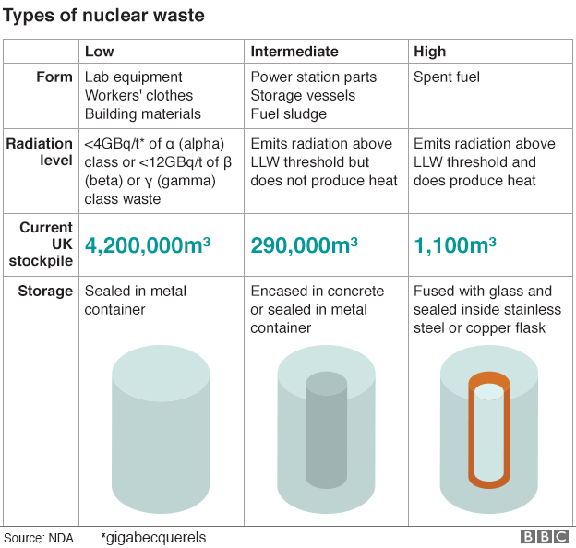
Now radioactive waste at Hanford and other DOE nuclear cleanup sites across the nation is defined as high level waste based on its origin.
Waste associated with chemically processing irradiated uranium fuel to remove plutonium for the nation’s nuclear weapons program is currently classified as high level waste.
It is required to be disposed of in a deep geological repository, such as the one that has been proposed at Yucca Mountain, Nev.
DOE wants to reinterpret the definition to look at the waste’s characteristics and risks, as other countries typically do, rather than its origin.
Oregon proposed that be done nearly 30 years ago.
But it is concerned that DOE’s current proposal would give DOE unilateral discretion to determine how to classify and dispose of waste that for decades has been managed as high level waste.
Independent regulatory oversight by states and the Nuclear Regulatory Commission would be gone, as well as the criteria for defining waste that has been approved by Congress, according to Oregon’s comments submitted to DOE.
DOE published the proposal in the Federal Register and set an extended deadline for comments on it to be received by Wednesday……….
DOE has declined to say what waste could be affected by its proposal to change its interpretation of what is high level waste.
But the state of Oregon says it could could allow more of the long-lived and highly radioactive constituents in the tank waste to remain in the treated waste expected to be disposed of at Hanford.
It also could allow more waste to remain in Hanford’s tanks as they are closed, likely through a process of filling them with grout and leaving them in the ground, according to Oregon. DOE is unable to get all of the waste out of the enclosed tanks as it empties them, but its goal is to remove 99 percent of the waste.
Soil contaminated by leaks and spills of Hanford tank waste and discharges of contaminated liquid into the ground also could be affected. The change to the definition could make it easier for DOE to leave the radioactive contamination in the soil, Oregon said.
“DOE projects confidence that it understands one of the most complicated radiochemical mixtures created by our civilization, and that this waste can be managed for thousands of years in shallow environments,” Oregon said in its comments.
“DOE’s proposed interpretation could lead to long-term risk decisions with insufficient precaution and technical rigor,” it said.
DOE faces a conflict between its responsibility to ensure long-term safety from radiation and its interest in reducing the cost of environmental cleanup in the nation’s nuclear weapons complex, Oregon said.
But the state believes that safety should always prevail over cost savings, it said.
TRIDEC, Hanford Communities and Oregon find some common ground in concerns over the way that DOE is proposing to change how it interprets the definition of high level waste……..
Washington state also is expected to weigh in against the proposed change before the comment period ends Wednesday, but had not finished its comments by Monday.
Comments from organizations and individuals may be emailed to HLWnotice.em.doe.gov. https://www.tri-cityherald.com/news/local/hanford/article224033150.html
January 10, 2019
Posted by Christina Macpherson |
politics, USA, wastes |
Leave a comment





 nuclear-news