San Onofre Task Force Questions Edison About Nuclear Waste Canisters
The Task Force was created to increase public involvement in the decommissioning of the plant, which shut down in 2012 after a small radioactive leak was discovered in the steam generators.
Levin said several Task Force members are concerned about burying spent nuclear fuel in stainless steel canisters encased in concrete, next to the beach.
“Our task force members had specific questions about those canisters,“ Levin said, “their safety, their design and the wear and tear that the coastal environment takes on them. Those questions were not answered sufficiently. Edison said, ‘We’ll have to have another meeting to discuss that,’ so we took them up on that, and we’re having another meeting.”
Levin said he has introduced legislation to put San Onofre’s nuclear waste at the top of the list to be moved if Congress decides on a location to store the nation’s spent fuel longer term.
His bill to earmark $25 million to identify and develop what’s called consolidated interim storage site recently passed the House Appropriations Committee.
Church should oppose nuclear waste in Utah
|
https://www.sltrib.com/opinion/letters/2019/05/29/letter-church-should/ By Leslie and Gail Ellison | The Public Forum, Dear Russell M. Nelson, Dallin H. Oaks and Henry B. Eyring,
On May 5, 1981, the First Presidency of The Church of Jesus Christ of Latter-day Saints issued a bold and important statement opposing the placing of the MX missile train system in Utah and Nevada. Our state is confronted with a similar situation today that simply cannot be ignored. Our legislators in the last session passedHB220 potentially allowing Class B and Class C nuclear wastes (including depleted uranium) to be transported to and stored at the Envirocare Skull Valley repository. These long-lived wastes increase in toxicity over hundreds of thousands of years. Every legislator that voted in favor of this legislation received donations from Envirocare. Imagine the thousands of trains and trucks transporting these nuclear poisons, sloshing in their holds … forever. Insane! There is so much wrong here, not only the dangers of transportation through population centers and the Envirocare site itself (open pit, shallow aquifer, etc.), but so many unknowns. This is a Utah state issue. Other states and the U.S. Department of Energy (DOE) cannot believe our state will actually welcome these toxic wastes. This should not be a political issue. It is an extremely serious health concern for our families, our children and our children’s children. We call upon the First Presidency and the Quorum of the Twelve Apostles to take a stand in reversing this bill, similar to the brave and righteous position they took against the MX missile system in 1981. |
|
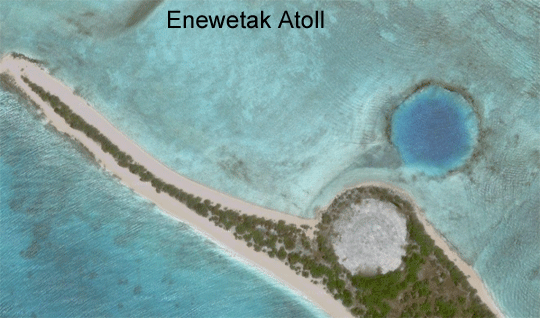
Temporary dome over radioactive trash on Runit Island – now leaking waste to the Pacific

|
Fears Grow That ‘Nuclear Coffin’ Is Leaking Waste Into The Pacific https://www.forbes.com/sites/trevornace/2019/05/27/fears-grow-that-nuclear-coffin-is-leaking-waste-into-the-pacific/#653322537073, Trevor Nace The tropical blue skies over the southern Pacific Ocean were enveloped by towering mushroom clouds lingering over the Marshall Islands in 1954 as the United States continued its testing of nuclear weapons. The United States conducted 67 nuclear weapon tests from 1946 to 1958 on the pristine Marshall Islands. The most powerful test was the “Bravo” hydrogen bomb in 1954, which was about 1,000 times more powerful than the bomb dropped on Hiroshima, Japan. The extensive nuclear bomb testing blanketed the islands in radioactive ash, covering it in the fine, white, powder-like substance. Children, unaware of what the radioactive ash was, played in the “snow” and ate it according to the Atomic Heritage Foundation. Today, there are growing concerns that the temporary containment of the nuclear waste resulting from those tests is leaking into the Pacific Ocean and could be cracked wide open from the next storm that rolls by. Specifically, the site is believed to be leaking one of the most toxic substances in the world, the radioactive isotope plutonium-239, a byproduct of nuclear bombs that decays with a half-life of 24,100 years. In 1977 the United States worked to clean up the radioactive waste left strewn across the Marshall Islands. In total, an estimated 73,000 cubic meters of radioactive soil was collected across the Marshall Islands. The US used a crater from an especially large nuclear bomb test on Runit Island to stash away the radioactive soil. The 328-foot crater from a May 1958 test was designated the dumping ground. As this was considered a temporary solution, the crater bottom was not lined with impervious material, which would have prevented radioactive waste from entering the below aquifers and Pacific Ocean. After the material was piled into the crater, an 18-inch thick concrete dome was positioned on top of it as a temporary containment. Plans for permanent radioactive waste storage were never finalized and thus the temporary solution has sat as-is for nearly 40 years. Shortly afterward, in 1983 the Marshall Islands agreed on their severity from the United States and with it, the islands released the United States of any responsibility for past nuclear testing. Rising sea level, soil shifting, and storms have all caused new concern over the integrity of the “nuclear coffin” and its ability to contain radioactive waste. The dome is reportedly cracking and the local government fears the next big storm may split the concrete dome apart. In addition, groundwater models suggest that seawater is almost certainly accessing the crater. However, it is unclear how much nuclear waste is seeping from the unlined crater bottom into the Pacific Ocean and groundwater aquifers. Despite recent awareness around the issue, the Marshallese government does not have the money or expertise to properly clean up and isolate the nuclear waste. Thus, the Marshallese are left helpless as their tropical islands continue to leak deadly radioactive waste across its coral reefs. Trevor Nace is a PhD geologist, founder of Science Trends, Forbes contributor, and explorer. Follow his journey @trevornace. |
|
Serious doubts about Holtec’s lucrative fast decommissioning of nuclear reactors

|
Nuclear waste: A hot business? https://thebulletin.org/2019/05/nuclear-waste-a-hot-business/, By Thomas Gaulkin, May 24, 2019 It usually takes decades for defunct nuclear plants in the United States to be taken apart and cleaned up so the land can be developed for other purposes. Long after the main facilities are dismantled and their sites remediated, spent fuel remains radioactive and takes years to cool off in pools before it can be safely placed in concrete cylinders—dry casks, in industry lingo—for interim storage that could last years or even decades. Utility companies stuck with these useless sites often delay the costly cleanups as long as they possibly can.
But Bob Salsberg reports for the Associated Press that a profit-hungry industry is emerging to rescue electric utilities that have little enthusiasm for dismantling their own aging nuclear power plants. Behind a promise of dramatically reduced decommissioning times, in some cases by as much as 50 years, a group of companies wants to buy the retired plants, take on the work of demolishing them, and manage storage of the spent fuel rods that will likely be stuck on the plants’ grounds for a very long time. Companies like Holtec International (which Salsberg reports has deals for several plants that are being retired up and down the east coast and in Michigan) will take on the nuclear facilities, their multibillion-dollar funds set aside for the decommissioning process, and the prospect of lucrative government compensation. (Since there’s no national long-term disposal site for high-level civilian nuclear waste, the concrete cylinders have to stay where they are until a long-term repository is created.) Holtec claims it can safely store spent fuel in its specialized cylinders after only two years of cooling, instead of the five to 10 years of cooling now required. But opponents and some officials worry that encouraging commercialization of nuclear waste storage will jeopardize safety, and that the speedier decommissioning projects will hit more snags than they already do. Salsberg notes that Holtec International has “never managed a decommissioning start to finish.” It’s also not clear that moving spent fuel from cooling pools into storage canisters a few years more quickly than it otherwise might be moved will make the former sites of nuclear power plants—still burdened with dry casks full of nuclear waste—all that attractive as developments sites. |
|
USA’s radioactive dump in the Marshall Islands is leaking
|
Under the dome: Fears Pacific nuclear ‘coffin’ is leaking, https://phys.org/news/2019-05-dome-pacific-nuclear-coffin-leaking.html As nuclear explosions go, the US “Cactus” bomb test in May 1958 was relatively small—but it has left a lasting legacy for the Marshall Islands in a dome-shaped radioactive dump.
The dome—described by a UN chief Antonio Guterres as “a kind of coffin”—was built two decades after the blast in the Pacific ocean region. The US military filled the bomb crater on Runit island with radioactive waste, capped it with concrete, and told displaced residents of the Pacific’s remote Enewetak atoll they could safely return home. But Runit’s 45-centimetre (18-inch) thick concrete dome has now developed cracks. And because the 115-metre wide crater was never lined, there are fears radioactive contaminants are leaching through the island’s porous coral rock into the ocean. The concerns have intensified amid climate change. Rising seas, encroaching on the low-lying nation, are threatening to undermine the dome’s structural integrity. Jack Ading, who represents the area in the Marshalls’ parliament, calls the dome a “monstrosity”. “It is stuffed with radioactive contaminants that include plutonium-239, one of the most toxic substances known to man,” he told AFP. “The coffin is leaking its poison into the surrounding environment. And to make matters even worse, we’re told not to worry about this leakage because the radioactivity outside of the dome is at least as bad as the radioactivity inside of it.” Staggering’ challenges The dome has become a symbol of the mess left by the US nuclear test programme in the Marshall islands when 67 bombs were detonated between 1947-58 at Enewetak and Bikini atolls. Numerous islanders were forcibly evacuated from ancestral lands and resettled, including Enewetak’s residents. Thousands more islanders were exposed to radioactive fallout and suffered health problems. The people of Enewetak were allowed home in 1980, and about 800 islanders now live in the southern part of the atoll, 20 kilometres (12 miles) from Runit. After the US military withdrew, the Marshall Islands government officially accepted a “full and final” settlement to cover the impact of the nuclear tests. But there have long been complaints that the compensation paid by Washington was inadequate, and the United Nations has described “a legacy of distrust” towards the United States. UN Secretary General Guterres raised the issue earlier this month after meeting Marshall Islands President Hilda Heine in Fiji, when they discussed the nuclear legacy and the prospect of radioactive leakage from Runit dome. “The Pacific was victimised in the past as we all know… the consequences of these have been quite dramatic, in relation to health, in relation to the poisoning of waters in some areas,” he said. Marshalls Foreign Minister John Silk said he appreciated Guterres bringing the Runit dome to world attention with this comments.. “We are pleased that the Secretary General made these statements, since so often it seems that these ongoing legacy issues that continue to impact our people are forgotten by the international community,” he said. Uncertain future Rhea Moss-Christian, who chairs the Marshall Islands National Nuclear Commission, said the country “needs the support of the international community to address the staggering health and environmental challenges across the Pacific.” The consequences of the dome failing are unclear. A 2013 inspection commissioned by the US government suggested radioactive fallout in the Enewetak lagoon sediment was already so high a catastrophic failure would not necessarily result in locals receiving increased dosages of radiation. Silk, noting that the US government had committed to ongoing monitoring of the dome, said an independent assessment of the structure’s status “would be helpful”. But Ading said the situation was “a constant source of anxiety for the people of Enewetak”. “We pray that the Runit dome does not eventually become our coffin,” he said. |
|
At June G20 meeting, Japan to push for international conference on nuclear waste disposal (but no talk on stopping making radioactive trash)
 Japan to push for int’l conference on nuclear waste disposal at June G-20 meet https://mainichi.jp/english/articles/20190525/p2a/00m/0in/006000c TOKYO — The Japanese government announced May 24 that it plans to arrange an international meeting to consider how to dispose of highly radioactive nuclear waste.
Tokyo is set to get approval for the plan at the Group of 20 Ministerial Meeting on Energy Transitions and Global Environment for Sustainable Growth scheduled for mid-June in Karuizawa, Nagano Prefecture, and aims to launch the first roundtable this autumn.
High-level nuclear refuse is usually “vitrified” — mixed with melted glass and solidified — before being deposited in an underground storage facility. Japan’s own disposal plans call for holding the waste for 30 to 50 years to cool it before burying it in stable rock formations at least 300 meters below ground. Finland is already building a major underground disposal site, while its neighbor Sweden is conducting a safety evaluation at the location of its own planned facility. However, there is no precedent for actually operating such an installation, and Japan has not yet even begun the survey process to choose a site.
The Japanese government will thus use the June 15-16 G-20 environment and energy summit meeting to urge member nations to cooperate on realistic solutions. Specifically, Japan will press nations with advanced nuclear disposal technology including those in Europe to share their know-how, and also promote international collaboration among research facilities and staff exchanges. The international roundtable will put together a collection of proposals on a basic nuclear waste disposal cooperation strategy and how to explain the issue to the citizens of member nations.
In UK Councillors to get briefing from nuclear panel – anyone can offer their land for nuclear waste dump!

Councillors to get briefing from nuclear panel https://www.newsandstar.co.uk/news/17663707.councillors-to-get-briefing-from-nuclear-panel/
By John Connell @JConnell35 Reporter 24 May 19, NEW councillors appointed to Copeland council’s nuclear panel will receive their first briefing early next month.The Strategic Nuclear Energy team is one of the authority’s most important committees, working with the Government and companies including Sellafield.
The first meeting since borough council elections will be held on Tuesday June 4 and will see members given an overview of the roles and responsibilities of the committee.
Members will be discussing some huge issues in the coming months including the Government’s search for a host community for a nuclear waste store.
Anyone with a reasonably-sized patch of land can volunteer it as a contender for the multi-million Geological Disposal Facility (GDF), effectively kick-starting the process.
West Cumbria has also been rocked in recent months by the collapse of the Moorside nuclear investment deal, while Sellafield is moving into the decommissioning phase.
Coun David Moore, Portfolio holder for Nuclear and Corporate Services, said the briefing would be an opportunity for councillors who have not worked on the panel before or were completely new to local politics to get to grip with the scope of the committee’s important work.
He added: “Some of the councillors who will be there are first-time councillors, just about to dip a toe in the water. This meeting them will give them an overview and it will be a learning curve for them.
“We are key players in nuclear consultations. Not many councils have an equivalent of our committee. I have no equivalent to my role as nuclear portfolio-holder.”
A ‘doomsday button’ for Native Americans if Yucca Mountain were to be poisoned by nuclear trash
 It will poison everything.’ Native Americans protest Yucca Mountain Nuclear Waste site It will poison everything.’ Native Americans protest Yucca Mountain Nuclear Waste site
TO THE WESTERN SHOSHONE NATION, THIS LAND IS SACRED. TO STORE NUCLEAR WASTE HERE IS TO PRESS A DOOMSDAY BUTTON. Ed Komenda, Reno Gazette Journal 24 May 19, “……….. “This is our church,” says Bobb, the 67-year-old chief of the Western Shoshone National Council. “All we have to do is pray.” Seven tents and travelers from as far as South Dakota and Washington dot this camp less than a mile from armed men in camouflage guarding the Nevada National Security Site – a 1,360-square-mile desert patch 65 miles north of Las Vegas where scientists decades ago detonated more than 900 nuclear bombs, assaulting the horizon with mushroom clouds. Off the Mercury exit of U.S. Highway 95 is a yellow road sign topped with flashing lights: “DEMONSTRATORS ON ROADWAY.” Another 35 miles northwest is the reason those demonstrators are here: The Yucca Mountain Nuclear Waste Repository. The Trump administration and a bipartisan collective of congressmen contend the Nye County mountain on federal land adjacent to the test site is the solution to the country’s nuclear waste problem – but the people who roamed the west long before there was a federal government see the peaks a different way. To the Western Shoshone Nation, this land is sacred. To store nuclear waste here is to press a doomsday button. “It will poison everything,” the elder says. “It’s people’s life, our Mother Earth’s life, all the living things here, all the creatures; whatever’s crawling around, it’s their life too.”…… The fight to prevent federal dollars from flowing into the Yucca Mountain project runs tandem to the push to license the land as a dumping ground. In January, Gov. Steve Sisolak promised “not one ounce” of nuclear waste would enter Yucca Mountain under his administration. Last week, it appeared another hurdle had been cleared to help him keep that promise. A Department of Energy funding bill released on May 14 showed no money set aside to bankroll nuclear waste storage at Yucca Mountain. The absent dollars marked a small victory for Nevada House Democrats – including Rep. Dina Titus, who met with Speaker Nancy Pelosi last week to talk about halting funding. “This has been a long, protracted battle,” Titus told the USA TODAY Network. “Some people say it’s a marathon and not a dash – but I’d say right now we’re in a pivotal moment.”….. The Trump administration now favors storing the nuclear waste in Yucca Mountain – and Trump has support from members of Congress looking to rid their own waste from nuclear facilities in their home districts. “It’s get it out of my backyard and into somebody else’s,” Titus said. In 2018, the House voted 340-72 to advance a bill directing the Department of Energy to resume the licensing process for a nuclear waste facility in Yucca Mountain. The bill died, never making it to the Senate floor – but it made its return to the House last week. Illinois Republican John Shimkus co-sponsored the reintroduction of the bill, pegging nuclear power as an essential component to addressing climate change….. n an interview with the USA Today Network, Shimkus characterized Yucca Mountain as a “pretty good” and “secure” location for nuclear waste. “If Yucca Mountain was where the capital is – yeah,” Shimkus said, “I could understand some concerns and some frustration.”…… “We’re trying to get money for that final scientific debate and argument. My friends, the Nevadans, continue to say it’s unsafe… but let’s have the science debated.” That effort to get that money died in Washington Tuesday, when the House Appropriations Committee voted 27-25 to kill an amendment from Rep. Mike Simpson, R-Idaho, to inject $74 million for Yucca Mountain into a bill funding the Energy Department. The outcome, Shimkus said in a statement, left him “disappointed.” https://www.rgj.com/story/news/2019/05/22/yucca-mountain-nuclear-waste-nevada-test-site/3694806002/ |
|
A high risk operation removing spent nuclear fuel from Russian ship “Lepse”
 Work on removing nuclear waste from 85-years old ship has started in Russia’s north https://thebarentsobserver.com/en/ecology/2019/05/work-removing-nuclear-waste-85-years-old-ship-has-started-russias-north
|
May 23, 2019
It is a milestone for nuclear safety clean-up on the Kola Peninsula. Though, the removal of the spent nuclear fuel elements from the storage compartment from «Lepse» will take time. The work is, to say it mildly, a high risk operation involving uranium fuel so radioactive it could cause lethal dose to workers if something goes wrong. «Preparatory work for this stage of the disposal of «Lepse» has been underway for the last two years,» Chief Engineer Georgy Neyman of the Nerpa shipyard told Komsomolskaya Pravda. «A protective shelter is built,» Neyman said. Phase one of the work, which started last week, is removing the 620 fuel elements believed not to be damaged. The elements will be loaded over to special casks for shipping to Atomflot service base in Murmansk. From there, a special train will take the casks to Mayak reprocessing plant in the Chelyabinsk region in the South-Urals. The work ahead is the most demanding. Cutting out the radioactive elements is done by using robotics. Inside the shelter, humans should spend as little times as possible. «The time intervals during which a person can be in the presence of ionizing radiation are strictly observed,» Oleg Khalimullin, deputy chief engineer at Nerpa shipyard said in an interview with the news portal of Bellona. The environmental group in Murmansk has for 25 years worked on promoting a safe disposal of «Lepse». In the early 1990s, the plan was simply to tow the aging storage ship to Novaya Zemlya in the Russian Arctic and dispose it in the permafrost near the shore. With radionuclides onboard estimated to be some 28,000 TBq (750,000 Curie), or nearly half the release of the Cesium-137 isotope that contaminated half of northern Europe following the 1986 Chernobyl disaster, the “Lepse” was a ticking threat to people and nature around Murmansk. «Lepse» was built in 1936, sunken during World War II, lifted afterwards and used as a radiological support vessel for the Soviet Union’s first nuclear powered icebreaker, «Lenin» from 1962. After a coolant accident with one of the three reactors on «Lenin» in 1966 some few hundreds of the spent fuel roads were lifted over to the storage compartment to «Lepse» . Radiation levels were high and “sarcophagus” was built over by filling cement. Both neighbouring Norway and the European Union have finacially and technically assisted Russia with securing the nuclear waste ship and preparing for the work now started. Expenses for the shelter and robotics are co-financed by the European Bank of Reconstruction and Development. If all go in accordance with schedule, removing the nuclear fuel from the compartment should be ended next year. |
|
Companies like Holtec planning to make $billions by a quick fix for nuclear wastes

Companies are buying defunct nuclear reactors, planning to demolish them quickly https://www.latimes.com/business/la-fi-nuclear-reactors-fast-decommission-radioactive-20190522-story.html BOB SALSBERG, 22 May 19 Companies specializing in the handling of radioactive material are buying retired U.S. nuclear reactors from utilities and promising to clean them up and demolish them in dramatically less time than usual — eight years instead of 60, in some cases.
Turning nuclear plants over to outside companies and decommissioning them on such a fast track represents a completely new approach in the United States, never before carried to completion in this country, and involves new technology as well.
Supporters say the accelerated method can get rid of a hazard more quickly and return the land to productive use sooner. But regulators, activists and others question whether the rapid timetables are safe and whether the companies have the expertise and the financial means to do the job.
“We were up in arms that it was 60 years,” Janet Tauro, head of the environmental group New Jersey Clean Water Action, said of the initial plans for decommissioning the Oyster Creek plant in Forked River, N.J. “And then we hear it’s going to be expedited to eight years. It’s great to get it over with, but are there corners that are going to be cut?”
Once a reactor is shut down, the radioactive mess must be cleaned up, spent nuclear fuel packed for long-term storage and the plant itself dismantled. The most common approach can last decades, with the plant placed in a long period of dormancy while radioactive elements slowly decay.
Spent fuel rods that can no longer sustain a nuclear reaction remain radioactive and still generate substantial heat. They are typically placed in pools of water to cool, staying there at least five years, with 10 years the industry norm, according to the Nuclear Regulatory Commission. After that, they are removed and placed in giant cylindrical casks, typically made of steel and encased in concrete.
But Holtec International, which in the last year has been buying up several retired or soon-to-be-retired nuclear plants in the United States, has designed a cask it says can accept spent fuel after only two years of cooling.
Holtec, a corporation with more than 30 years of experience in handling radioactive waste, struck a deal last year to buy the Oyster Creek plant.
It also has deals in place to buy several plants owned by Entergy Corp., including Pilgrim, in historic Plymouth, Mass., closing May 31; Palisades, in Covert, Mich., set to shut down in 2022; and two reactors expected to close within two years in Buchanan, N.Y.
“Our commitment to the nuclear industry includes taking ownership of shut-down nuclear plants so that we can safely and efficiently decommission the plants so that the land can be returned to productive use,” Holtec spokeswoman Joy Russell said in an email.
The proposed sales await NRC approval, with decisions expected in the coming weeks and months.
Similarly, in January, NorthStar Group Services, a specialist in nuclear demolition, completed the purchase of Vermont Yankee from Entergy with plans for its accelerated decommissioning.
The full financial details of the pending deals have not been disclosed. But if the agreements are approved, Holtec will inherit the multibillion-dollar decommissioning trust funds set up by the utilities for the plants’ eventual retirement.
The company could keep anything left over in each fund after the plant’s cleanup. Holtec and Northstar are also banking on the prospect of recouping money from the federal government for storing spent fuel during and after the decommissioning, because there is no national disposal site for high-level nuclear waste.
The companies jumping into the business believe they can make a profit. For the utilities, such deals free them from having to oversee long, complex projects involving decades of work and round-the-clock guarding of the dangerous waste.
While there are risks in transferring spent fuel too quickly, experts also note there are dangers while the fuel rods are sitting in the pools, including the chances of a catastrophic fire or leak resulting from a natural disaster, terrorist attack or other event.
There’s a natural tendency to say, ‘Oh, they’re doing it fast, they’re going to make mistakes, it’s not going to be safe,’” said Rod McCullum, senior director of decommissioning and used fuel at the Nuclear Energy Institute, a Washington-based advocacy group for nuclear power. “You’re actually getting safer by getting faster.”
In legal briefs filed with the NRC, however, Massachusetts state officials have expressed skepticism about Holtec’s plan to decommission Pilgrim on an expedited schedule “never before achieved.” Holtec has never managed a decommissioning start to finish.
Holtec has come under scrutiny over its role in a mishap last August during the somewhat less aggressive decommissioning of the San Onofre Nuclear Generating Station on the northwestern edge of San Diego County, where two reactors were retired in 2013 and the estimated completion date is 2030.
Holtec contractors were lowering a 45-ton spent fuel cask into an underground storage vault at San Onofre when it became misaligned and nearly plunged 18 feet, investigators said. No radiation was released.
Federal regulators fined Southern California Edison, the plant’s owner, $116,000, and an investigation found that some Holtec procedures had been inadequate or not properly followed.
Massachusetts officials have stopped short of asking the NRC to block Pilgrim’s sale but have cited the San Onofre incident while questioning whether the money in Pilgrim’s decommissioning trust fund is sufficient to cover unexpected delays or overruns.
By Holtec’s accounting, the Pilgrim decommissioning will cost an estimated $1.13 billion, leaving $3.6 million in the fund. State officials have described that cushion as “meager” and have warned of “significant health, safety, environmental, financial and economic risks.”
Holtec said its equipment has never been involved in a major accident and stands by its cost estimates.
Pilgrim, which is along scenic, environmentally sensitive Cape Cod Bay and is being retired after 47 years, has a history of unscheduled shutdowns and was only recently removed from an NRC list of the nation’s least safe reactors.
The citizen group Pilgrim Watch, which has long pushed for the closing of the plant, is leery of what lies ahead during the decommissioning.
“The story isn’t over. There’s a sequel,” said Mary Lampert, the organization’s director. “And sometimes the sequel, like in the movies, is worse than the main show.”
Funding for Yucca nuclear waste dump rejected in U.S. Congress House committee
|
Funding fight to make Yucca Mountain nuclear waste site stalls in Washington
|
|
New research into plutonium workers’ internal radiation exposure.
  Job-exposure matrix sheds light on plutonium workers’ radiation exposure https://physicsworld.com/a/job-exposure-matrix-sheds-light-on-plutonium-workers-radiation-exposure/ Job-exposure matrix sheds light on plutonium workers’ radiation exposure https://physicsworld.com/a/job-exposure-matrix-sheds-light-on-plutonium-workers-radiation-exposure/
Internal exposure to plutonium, which decays via alpha particle emission, is a recognised health hazard. But with little specific information available, potential risks from plutonium exposure have largely been assessed through knowledge of radiation exposure risks in general, much of which comes from external exposure to photon radiation such as gamma and X-rays. However, due to its high linear energy transfer rate, alpha particle radiation exhibits significantly enhanced biological effects at the cellular level, creating a specific need to investigate the associated exposure risks. To obtain more direct estimates of potential internal exposure risks, epidemiological studies of plutonium workers need to be conducted,” explains lead author Tony Riddell, from Public Health England’s Centre for Radiation, Chemical and Environmental Hazards. “These studies require individual plutonium exposure estimates that are as accurate and unbiased as possible.” The Sellafield workforce includes one of the world’s largest cohorts of plutonium workers. Through the support of the workforce, this group has been comprehensively monitored for internal exposure to plutonium, primarily through inhalation. However, for 630 workers employed there at the start of plutonium operations, from 1952 to 1963, the historical urinalysis results available do not provide sufficiently accurate and unbiased exposure assessments. These results were based on a threshold level of urinary plutonium excretion, which was suitable for operational protection purposes at the time, but tended to overestimate exposure, leading to underestimation of any risks if used in epidemiological analyses. “This means these early workers are excluded from epidemiological studies of exposure risks, which significantly reduces the power of these studies,” says Riddell. “Early workers are important for assessing potential exposure risks because they usually received some of the highest plutonium exposures and, due to the passage of time, health outcomes for these workers will now be largely known.” To solve this problem, Riddell and colleagues employed an approach called a job-exposure matrix (JEM). The JEM approach uses exposure data from other sources to estimate the average exposure that a typical worker (in the same work group) would have received in a given period. Substituting the missing data with these JEM estimates allowed the researchers to build a more reliable picture of the early workers’ radiation exposure. “To overcome the problem of missing or deficient exposure data, we used more reliable data from other relevant workers (‘exposure analogues’) along with statistical, mathematical and empirical analyses to estimate the average exposures for a typical worker at Windscale/Sellafield for all combinations of specific occupation and year required to build the JEM,” explains principal investigator Frank De Vocht from the University of Bristol. The authors note that the exposure analogues approach developed in this study provides a generic methodological advance that is potentially transferable to other internally exposed workers, and which may permit other epidemiological cohorts to include significant groups of workers who otherwise might have been excluded due to the lack of reliable exposure information. “It’s likely that replacing the missing or unreliable exposure data with JEM-derived values in future epidemiological studies could have considerable impact on the risk estimates which can be produced,” adds De Vocht. |
|
Chernobyl’s spent nuclear fuel to be stored (Holtec’s in on this one, too)
 Final trials begin on a facility to store Chernobyl’s spent nuclear fuel The Chemical Engineer Amanda Jasi 2 May 19, ON 6 May the final system-wide trials of a new dry storage facility at Chernobyl began. ISF2, located at the site of the Chernobyl nuclear power plant, will process and store spent nuclear fuel to allow for decommissioning of the plant…….. Final trials begin on a facility to store Chernobyl’s spent nuclear fuel The Chemical Engineer Amanda Jasi 2 May 19, ON 6 May the final system-wide trials of a new dry storage facility at Chernobyl began. ISF2, located at the site of the Chernobyl nuclear power plant, will process and store spent nuclear fuel to allow for decommissioning of the plant……..
Holtec said it would complete “stem-to-stern” functional demonstrations of spent fuel handling and storage processes over the next two months. Following the demonstrations, the facility will be handed over to Ukraine’s state-owned enterprise Chernobyl Nuclear Power Plant (ChNPP), which will initiate commissioning. WNN reported that the Chenobyl nuclear power plant entered decommissioning last year after gaining approval from Ukraine’s State Nuclear Regulatory Inspectorate. According to the news service, the first stage of decommissioning – the so-called final shutdown and preservation stage – is expected to take ten years. The ISF2 project began in the 1990s but stalled for nearly a decade when the previous contractors’ technology proved to be “inadequate to meet the facility’s functional and regulatory requirements”. Holtec was awarded the project contract in 2011. Principal contactors on the ISF2 project are UTEM, BNG, and Maloni, reports WNN. It is funded by a group of Western countries and Japan, and administered by the European Bank for Reconstruction and Development (EBRD). ….. In partnership with Energoatom, Holtec is also constructing the Central Spent Fuel Storage Facility (CSFSF), which will receive and store spent nuclear fuel assemblies from Ukraine’s pressurised water reactors (VVERs). The facility will mean Ukraine will no longer have to spend US$200m/y to store nuclear fuel in Russia, says WNN. Full operation is expected in 2020. https://www.thechemicalengineer.com/news/final-trials-begin-on-a-facility-to-store-chernobyl-s-spent-nuclear-fuel/ |
|
|
USA’s nuclear waste dome ‘leaking’ radioactive sludge into the Pacific
|
US ‘nuclear coffin’ on island in the Pacific could be ‘leaking’ radioactive sludge into the sea, By Christopher Carbone https://www.foxnews.com/science/us-nuclear-coffin-leaking-radioactive-sludge Radioactive waste from Cold War nuclear weapons tests could be leaking into the Pacific Ocean.
According to United Nations Secretary-General Antonio Guterres, a concrete dome that was built on Runit Island in the late 1970s to contain waste from massive atomic bomb tests conducted after World War II could be leaking toxic sludge into the sea. The island nation was where 67 American nuclear weapons tests were conducted, which included the 1954 “Bravo” hydrogen bomb, the most powerful ever detonated by the U.S. and about 1,000 times bigger than the A-bomb dropped on Hiroshima, Japan. In the Marshall Islands, many residents were forced to leave their land and thousands of others were exposed to radioactive fallout. “I’ve just been with the president of the Marshall Islands [Hilda Heine], who is very worried because there is a risk of leaking of radioactive materials that are contained in a kind of coffin in the area,” Guterres, who is touring the South Pacific to raise awareness about climate change, told AFP. Radioactive soil and ash from the blasts were put into the crater and capped with an 18-inch thick concrete dome that was seen as a temporary fix at the time. Now, cracks have developed in the concrete and there are fears that it could break apart in the event of a tropical cyclone. “A lot needs to be done in relation to the explosions that took place in French Polynesia and the Marshall Islands,” the U.N. chief said. “This is in relation to the health consequences, the impact on communities and other aspects. Of course, there are questions of compensation and mechanisms to allow these impacts to be minimized.” |
|
US Congress ‘s continued search for nuclear trash dump – but they still let ’em keep making it!
 Congress continues search for nuclear waste dump, https://www.graydc.com/content/news/Congress-continues-search-for-nuclear-waste-dump-510161521.html By Kyle Midura | WASHINGTON (Gray DC) 20 May 19, – More than 70,000 tons of nuclear waste has no place to go. Congress agreed to take care of it decades ago, but lawmakers can’t agree on where to send it. Waste from 42 years of operation at Yankee Nuclear in Vermont remains on-site years after the shuttered plant stopped generating power. For now, it’s being held in large, thick cannisters known as dry casks.Rep. Peter Welch (D-VT) said that’s a direct result of Congress failing to fulfill its promise to create a national dump for used fuel. “Every place where we have a nuclear plant including Vermont has in effect become a long-term storage plant,” he said, “that’s not viable.” Congress continues search for nuclear waste dump, https://www.graydc.com/content/news/Congress-continues-search-for-nuclear-waste-dump-510161521.html By Kyle Midura | WASHINGTON (Gray DC) 20 May 19, – More than 70,000 tons of nuclear waste has no place to go. Congress agreed to take care of it decades ago, but lawmakers can’t agree on where to send it. Waste from 42 years of operation at Yankee Nuclear in Vermont remains on-site years after the shuttered plant stopped generating power. For now, it’s being held in large, thick cannisters known as dry casks.Rep. Peter Welch (D-VT) said that’s a direct result of Congress failing to fulfill its promise to create a national dump for used fuel. “Every place where we have a nuclear plant including Vermont has in effect become a long-term storage plant,” he said, “that’s not viable.”
The government developed Nevada’s Yucca Mountain to be the repository for the country’s spent fuel, planning to bury it deep underground and within thick barriers designed to be impenetrable. President Donald Trump is trying to revive that plan. Welch would like to see Yucca Mountain used as a permanent site – though he said political opposition in the state may make that impossible — and is working on a bill to move forward with a temporary site in Texas. “Bottom line: after spending 15 billion dollars on Yucca, I think that is a bad place to be permanently storing the nuclear waste in this country,” said Sen. Bernie Sanders (I-VT). Sanders said he’s concerned by the potential for earthquakes at the site given geological fault lines in the area. He opposes further expansion of nuclear – especially while the search for a permanent repository continues. Like many of his fellow Senators seeking the democratic nomination – Sanders signed onto a bill allowing a state like Nevada to say ‘no’ to storing nuclear waste in its backyard. “We need to find a permanent solution which is not going to be Yucca,” Sanders said. “The science says it’s safe, but we’ve got to make sure it’s correct and let Nevada have its day in court,” said Baker Elmore, Senior Director of Federal Programs for the Nuclear Energy Institute. He argues the best path forward is to create temporary storage sites, and finalize plans for a permanent repository as soon as possible. After decades of waiting, Elmore says the country appears to be getting closer to signing-off on a plan. “I’m excited because we’re finally getting around to having a meaningful conversation on this issue,” he said. |
|
1 This Month



Website of the Week
Now until to February 10, 2026 Radioactive waste storage in France: the debate is finally open! How to participate?
-
Archives
- January 2026 (183)
- December 2025 (358)
- November 2025 (359)
- October 2025 (377)
- September 2025 (258)
- August 2025 (319)
- July 2025 (230)
- June 2025 (348)
- May 2025 (261)
- April 2025 (305)
- March 2025 (319)
- February 2025 (234)
-
Categories
- 1
- 1 NUCLEAR ISSUES
- business and costs
- climate change
- culture and arts
- ENERGY
- environment
- health
- history
- indigenous issues
- Legal
- marketing of nuclear
- media
- opposition to nuclear
- PERSONAL STORIES
- politics
- politics international
- Religion and ethics
- safety
- secrets,lies and civil liberties
- spinbuster
- technology
- Uranium
- wastes
- weapons and war
- Women
- 2 WORLD
- ACTION
- AFRICA
- Atrocities
- AUSTRALIA
- Christina's notes
- Christina's themes
- culture and arts
- Events
- Fuk 2022
- Fuk 2023
- Fukushima 2017
- Fukushima 2018
- fukushima 2019
- Fukushima 2020
- Fukushima 2021
- general
- global warming
- Humour (God we need it)
- Nuclear
- RARE EARTHS
- Reference
- resources – print
- Resources -audiovicual
- Weekly Newsletter
- World
- World Nuclear
- YouTube
-
RSS
Entries RSS
Comments RSS
 nuclear-news