Nuclear waste, rising seas and Trump: Marshall Islands struggles to stay above water, Yahoo News, Marshall Islands President Heine speaks with Reuters in Geneva By Tom Miles, 21 June 19, GENEVA (Reuters) – The Marshall Islands is literally struggling to stay above water but its President Hilda Heine told Reuters she had saved her breath rather than try to persuade U.S. President Donald Trump to hear its climate change message.
Heine met Trump at the White House last month, along with the presidents of Palau and the Federated States of Micronesia, both of which are also under threat from rising sea levels.
But they did not talk about climate change.
“We made a conscious decision to discuss those things that we think we could accomplish, rather than spend time talking about something that we know is not going to happen,” she said.
“We know that we’re not going to be able to change his mind in 30 minutes about climate change.”
The Marshall Islands, comprising 31 tropical atolls between Australia and Hawaii, risks being underwater in 10-20 years.
“If that’s not scary enough, I don’t know what is. For us, it’s of course an existential issue,” said Heine, who was in Geneva to open a diplomatic mission, address the International Labour Organization and press her country’s case for a seat on the U.N. Human Rights Council.
The scene of massive U.S. nuclear tests in the 1950s, it is also at risk of disaster from radioactive debris the U.S. military left behind.
Her government has put a line item in its budget to cope with environmental costs, with about 5% of spending set aside to fund sea walls to save at least its two most populated areas.
On climate change, Heine said she had a simple message for the world: “Get real. Climate change is here. It’s not anything to just talk about and think, that is going to happen. It’s happening.”
The official statement from the White House meeting cited “the region’s most pressing issues, including responding to natural disasters”, but not climate change or rising sea levels.
The main topic was renewal of U.S. financial grants and the rollover of a Cold War-era defence and security agreement.
The Marshall Islands was occupied by Allied forces in 1944 and placed under U.S. administration in 1947. Between 1946 and 1958, the United States detonated 23 atomic and hydrogen bombs on Bikini and Enewetak atolls, debris from which was left buried under a shallow concrete dome on Enewetak.
“We’re told it’s seeping into the lagoon,” Heine said, adding that the government wanted help to assess the damage and impact on marine life and potential costs of making it safe.
Asked if it was potentially a nuclear disaster on top of a climate emergency, she said: “It could be.”
NUCLEAR JUSTICE
The Marshall Islands gained independence in 1986 and later tried in vain to sue nuclear powers in a David-and-Goliath case at the International Court of Justice.
It now has a “nuclear justice strategy” to cope with displacement and higher cancer rates, but cannot back a treaty banning nuclear weapons because of one provision that would force it to take care of its own clean-up, Heine said.
The Nuclear Regulatory Commission approved the transfer of the reactor’s license from Exelon Generation Co. to a subsidiary of Holtec International Inc., a nuclear services provider with headquarters in Camden. Holtec has developed a specialty in handling spent nuclear fuel and dismantling retired reactors.
The decommissioning will largely be concentrated in 2019 through 2025, but completed by 2035, according to a schedule submitted to the NRC. Under law, the owner could have taken up to 60 years to dismantle the plant and restore the site. ……
Holtec is hiring 200 of 600 Oyster Creek employees to work on the decommissioning. In addition, the other experts will be hired to assist in the project at various stages, Pierre Oneid, Holtec senior vice president and chief nuclear officer, said in a statement.
The company will pay the decommissioning costs from a $848 million trust fund that built up from payments collected from customers during 49 years of operations. The owner anticipates the fund, conservatively invested, will generate $46 million in interest income in the coming years that will also go toward decommissioning.
Exelon secured a license renewal through to 2029, but announced in 2010 that it planned to shut down the reactor by 2019 rather than install a costly cooling tower required under new environmental standards to reduce the temperature of the water it discharges into Barnegat Bay.
Chernobyl Episode 4 Scene | HBO | Graphite Clearing
This man knows what it’s really like shovelling radioactive debris on top of Chernobyl’s reactor ABC News
By Katri Uibu “Sometimes it happens in life that someone, somewhere, has to do something. Whether they want to or not.”
Key points:
At age 32, Jaan Krinal was forced to go to Chernobyl and clean the roof of the reactor
He says men were initially enthusiastic to help eliminate the radiation
One-third of the men of his town he served with in Chernobyl have died
When he left his wife and two children on May 7, 1986 and went to work, Jaan Krinal didn’t know he would be one of those people.
The 32-year-old was working on a state-owned farm in Soviet-occupied Estonia.
Because he’d been forced to complete the Soviet military’s retraining a year before, he was confused when officers surprised him at work and said he’d been called up again — immediately.
Jaan and 200 other men were taken to a nearby school. Once they’d walked through the door, no-one was allowed to leave.
The men’s passports were seized before they were loaded onto buses and taken to a forest, where they were told to slip into brand new army uniforms.
“That’s when I first questioned what’s really going on here,” Jaan recalls………
Workers told radiation could have health benefits
It all happened fast.
Hundreds of men boarded a Ukraine-bound train on May 8. By the next evening, they were setting up camp on the edge of Chernobyl’s exclusion zone.
They were just 30 kilometres away from the site of the world’s worst nuclear disaster — the still-smouldering wreckage of a reactor torn apart by a series of explosions and spewing radiation in a plume across Europe.
Jaan was among the first group sent to clean up in the aftermath of the catastrophe.
Tasked with hosing down radiation on the houses in nearby villages, he was thrown into the thick of it……
Despite the apparent uselessness of the job, they continued to work 11-hour days without a day off until the end of June. After that, they had two days of downtime a month.
As the weeks rolled on, suspicions grew.
“We started to have doubts. But all the officers said, ‘Why are you fretting, the radiation levels aren’t that high.”
In a cruel irony, the commanders told the men that being exposed to radiation would actually have health benefits.
“They joked that whoever has cancer can now get rid of it — because the radiation helps,” Jaan says.
Men unaware of deadly reason behind roof time limit
By the end of September, whatever enthusiasm the men initially felt had faded.
As many developed a cough, concerns grew about whether they were being lied to about the radiation being harmless. The respirators the men were given wouldn’t stay on because of the heat and were used until they got holes in them.
Later they found they should have been replaced every day…….
A rumour had it that the very last leg of the assignment was going on the roof of the reactor to clean up as much debris as possible.
Humans were going to be given a task that remote-control robots had previously attempted, but failed. The machines simply stopped working due to the unprecedented levels of radiation.
“When they told us, ‘You have to go to the roof’, we thought, ‘Oh, this means we can go home soon’,” he says.
On the day, he changed his army uniform for a protective suit, glasses and a gas mask, and a metal groin guard.
“We were all lined up and told, ‘who doesn’t want to go on the roof, step forward’. But only a couple of us did,” he says.
“There was no mass rejection. Most people went up there.
“It had to be done. We couldn’t just leave it. I think everyone realised the longer the reactor would have stayed open, the more dangerous it would have become.”
Jaan was shown on a small screen exactly which piece of debris he had to pick up with a shovel and throw off the roof of the reactor, but strictly warned against going too close to the edge.
He had two minutes to complete the assignment — a bell would ring to tell him when to run back.
The two-minute timeframe was to limit exposure to radiation, which could kill a man.
But this wasn’t communicated to the men at the time.
Jaan says the roof-cleaning scene depicted in HBO’s mini-series Chernobyl mirrored real life events…….
A staggering one-third of the men of his town who went to Chernobyl have died.
The average age of death has been 52.
“Over the past couple of years, just a couple of us have died. But not too long ago it was around 10 men a year,” he says.
“There have been cancers. There have been suicides too, but thankfully not too many.”……
he hopes tourists won’t start flocking to the ghost city.
“I hope they’ll never start sending large groups of tourists there. It’s still a dangerous zone,” he says.
AS THE NATION’S NUCLEAR PLANTS CLOSE, A NEW INDUSTRY HAS SPROUTED. WORTH BILLIONS TO SOME, THE DECOMMISSIONING PROCESS WORRIES OTHERS.
Thomas C. Zambito, Rockland/Westchester Journal News June 19, 2019 Shutting down nuclear plants is set to become a multi-billion dollar business. If that business fails, critics say, your tax dollars – and possibly your safety – could be on the line. Learn more in our USA TODAY NETWORK Northeast project, The Nuclear Option.
The nuclear power industry is shrinking by the day.
Some 20 reactors at 15 power plants across the U.S. have plans to shut down or are in the midst of being decommissioned, a process that traditionally takes decades.
Now, a new crop of companies — fed by Wall Street speculators — are claiming they can cut that time to at least eight years, as they eye the $60 billion set aside in trust funds to handle the messy work of shutting down nuclear reactors.
Two firms, Holtec International of Camden, New Jersey, and its rival, New York-based NorthStar Group Services, together with their partners, have been on a buying spree in recent years, snatching up power plants across the nation with the promise of quicker teardowns.
A quicker-to-finish timeline appeals to folks who live near power plants in communities that for decades could count on balancing their budgets with the tax revenue they generated.
Safety sacrificed for speed?
But watchdog groups, politicians, scientists and experts on decommissioning nuclear plants are questioning whether safety will be sacrificed for speed, as profit-seeking companies rush to finish one job so they can move on to the next.
There are also worries that the trust funds will be bled dry before the job is completed, leaving taxpayers — and anyone who pays for electricity — footing the bill.
“If the decommissioning fund goes bankrupt and the job isn’t completed, they walk away and leave the cleanup to the states,” said Tim Judson, the executive director of the Nuclear Information and Resource Service.
In February, Massachusetts Attorney General Maura Healey voiced her concerns in a petition to intervene in the Nuclear Regulatory Commission’s review of the pending sale of Pilgrim Nuclear Power Station in Plymouth to Holtec.
The proposed deal puts the health and safety of our residents at risk,” Healey said. “We’re intervening to protect the public and ensure that the transaction does not leave our state’s taxpayers on the hook for any of the costs of safely decommissioning the plant, and managing spent nuclear fuel.”
On May 31, Pilgrim shut down. A day earlier, Duke Energy announced it had a contract with Accelerated Decommissioning Partners (ADP), a joint venture between NorthStar and Orano USA, to dismantle its Crystal River plant in Florida. ADP says the job will be finished by 2027.
Holtec has pending deals to buy Indian Point in New York’s Hudson Valley and Oyster Creek on Barnegat Bay, with plans to tear them down. Oyster Creek shut down in the fall and Indian Point will shut down in 2021. Indian Point’s trust fund totals $1.85 billion and Oyster Creek’s is nearly $1 billion.
Holtec and its partners also have a pending deal to buy Palisades Nuclear Generating Station in Michigan. If the deal goes through, Holtec will own six reactors in four states.
Northstar, meanwhile, purchased Vermont Yankee from Louisiana-based Entergy in January and is already moving ahead with demolition following a lengthy state and federal approval process.
It’s the largest number of shutdowns since the 1990s, when some of the industry’s earliest reactors powered down.
Lessons learned
In recent years, Entergy and Exelon, the owners of Indian Point and Oyster Creek, have faced economic challenges that forced them to reconsider their investment.
The cheap price of abundant natural gas has made it difficult to compete in the energy market.
And fears of a mishap like the partial meltdown that occurred at Pennsylvania’s Three Mile Island in 1979, coupled with disasters at Fukushima and Chernobyl — the focus of a recent series on HBO — have contributed to the chorus of political opposition.
Several other struggling nuclear power plants might have shut down if they hadn’t secured state bailouts to keep them operating. In upstate New York, the state agreed to divert billions of dollars in ratepayer money to subsidize three power plants — Nine Mile Point and James A. FitzPatrick in Oswego County and R.E. Ginna near Rochester.
And in April, New Jersey regulators approved $300 million a year in subsidies so Newark-based Public Service Enterprise Group can keep operating three nuclear reactors at the Salem and Hope Creek Nuclear Generating Stations in Lower Alloways Creek. The money will come out of ratepayers’ electricity bills.
Industry proponents view the latest downturn as part of the natural business cycle.
Rod McCullum, who specializes in decommissioning issues for the Nuclear Energy Institute, a trade group for power plant owners, says last year the nation’s 98 nuclear reactors had one of their best years ever.
Over each of the past three years, energy generated by nuclear power in the U.S. has been around 805 million megawatt hours, up from about 790 million megawatt hours in 2013.
McCullum noted, however, that several older plants are being phased out as more efficient, less costly reactor designs become available.
Georgia Power is building two nuclear reactors in Augusta, a rare event in the nuclear power industry over the past 20 years.
“The nuclear industry in the future will be very different,” McCullum said. “There are a lot of advanced nuclear designs on the table and over time we will be shutting down and decommissioning the older plants. You’re starting to see a wave of that now.”
New players in the decommissioning industry
Decommissioning is not new. Several plants were decommissioned in the 1990s at places like Rancho Seco in Sacramento County, California, and Maine Yankee in Wiscasset.
What’s new are two key changes.
First, companies are forming consortiums dedicated to dismantling. Holtec has partnered with SNC-Lavalin, a Canadian company that specializes in demolitions, to create a subsidiary called Comprehensive Decommissioning International. And NorthStar, which has experience knocking down large hotels and casinos, is teaming with a company whose experience is in the nuclear industry.
Second, and perhaps more importantly, the lessons learned in Maine and other sites provide a road map for how to do the job more efficiently, McCullum said. In prior years, the prevailing thought was to remove the fuel from the reactor, place it in either a cooling pool or canisters and leave the plant intact while radiation decayed. Such a process could take up to 60 years.
Not so today.
“The idea now is it’s a better use of the trust fund to get the plants down as fast as possible,” McCullum says. “That’s why you’re seeing these business deals.”
These newly formed companies use a “rip and ship,” which saves time and limits worker exposure to dangerous levels of radiation.
“They used to decontaminate the floor drains and it was hard to do,” said Bruce Watson, who heads the NRC’s decommissioning branch and has overseen shutdowns at Maine Yankee and Rancho Seco. “Now you go up, you hit it with a hammer, break the concrete, yank the pipe out and put it in a low level waste bin. You don’t waste your time cleaning it. You just measure it and put it in the bin.”
Holtec has yet to do a decommissioning but is no stranger to the nuclear industry. It manufactured a wet storage system used to store spent fuel once it’s removed from the reactor.
The company began manufacturing dry storage canisters in 1994. The canisters are built from stainless and carbon steel and more than two feet of cement is added to the interior once they arrive at the power plant.
Its decommissioning plan calls for moving spent fuel out of cooling pools as soon as possible so workers can get to work tearing down contaminated buildings without unnecessary exposure to radiation. And it has applied to the NRC for permission to use a cask that will allow workers to move hotter fuel into canisters after less than three years in a cooling pool.
By taking the spent fuel out of the pool faster it gives you the added benefit of making it almost a fully industrial decommissioning process,” said Joy Russell, Holtec’s senior vice president for business development.
Holtec has plans for an underground repository in southeastern New Mexico to hold some of the 80,000 metric tons of spent nuclear fuel that’s been building up at the nation’s nuclear power plants over the past six decades. Federal officials say it’s enough to fill a football field 20 meters deep.
If successful, the plan could help resolve the nation’s nuclear fuel problem while making Holtec a lot of money.
“Holtec engineers have come up with a solution that puts that used fuel below the ground, away from the reach of terrorists, away from risks to humankind in any form,” Holtec’s owner, Krishna Singh said at a 2017 event in Camden.
The occasion was the grand opening of a state-of-the-art factory built on the shores of the Delaware River, where Holtec manufactures the mammoth steel canisters that will entomb spent nuclear fuel for hundreds of years.
“If it (the New Mexico repository) becomes a reality then we will need to build 10,000 canisters,” Singh said. “That will employ thousands of people for many, many, many years.”
Like Holtec, NorthStar’s partners, Waste Control Specialists, have plans to build a storage site out West. Theirs will be in Texas, not far from the site where Holtec has decided to build.
The sites would, in theory, serve as interim storage facilities until the U.S. Department of Energy secures a permanent repository for the nation’s nuclear waste. Efforts to create a final resting ground at Yucca Mountain north of Las Vegas have stalled.
Stranded nuclear waste
As a result, nuclear power plants have sued the federal government for leaving nuclear waste stranded at their facilities.
At the end of 2016, the Department of Energy said the federal government had already paid out $6.1 billion to the owners of spent nuclear fuel and owes another $25 billion. The amount of waste is growing by 2,200 metric tons a year and is expected to hit 140,000 metric tons over the next 50 years, the Government Accountability Office says.
The NRC will have to sign off on the repository proposals, a process that could take several years.
“The companies specializing in decommissioning don’t share their strategies with us, including whether they are interested in managing the near- and long-term storage of spent nuclear fuel, including at interim repositories they hope to build,” said Watson. “But we will be closely reviewing all of those plans both at plant-specific and holistic levels.”
In May, Holtec cleared a significant hurdle in its effort to build its New Mexico facility when the NRC’s Atomic Safety Licensing Board rejected a challenge from environmental groups.
And Holtec will have to raise the money for the project. Russell said the company has already spent about $8 million on its efforts to secure an NRC license but will need much more to build.
“We haven’t made that jump yet to say we will build the facility,” Russell said during a May interview at Holtec headquarters in Camden. “As far as the construction goes, Holtec looks for funding from either the Department of Energy or utilities or some other source to begin the construction. That still has to be figured out and we’re actively working on it.”
If the funding comes through, construction would begin in 2021 and the first shipment of spent fuel would arrive in 2023.
The weight of power
Reactors in the U.S. have generated approximately 80,000 metric tons of nuclear waste.
That’s about about eight times as heavy as the Eiffel Tower.
About 14,700 metric tons of used nuclear fuel sits in storage in New York, Pennsylvania and New Jersey.
That’s roughly three-fifths the weight of the Statue of Liberty.
On June 7, the Concerned Citizens of Lacey sent a letter to the NRC asking the federal agency to hold off on any decisions regarding Oyster Creek’s license transfer to Holtec until New Jersey state officials resolve questions raised by the award.
Earlier this month, ProPublica reported that New Jersey had put a hold on tax credits to Holtec.
“Holtec continues to have interactions with the EDA,” the company said in a statement. “No notice has been received by Holtec indicating that the tax credits are frozen.”
Singh immigrated to the U.S. from India in the late 1960s and received degrees from the University of Pennsylvania. In 2007, he donated $20 million to his alma mater to help fund a nanotechnology center that bears his name.
Singh’s expertise is in heat transfer, put simply the process of turning hot things cold and hot things hotter. In the lobby of Holtec’s Camden corporate offices plaques recognize some of his 60 patents.
Focused on the work ahead
Russell says the company remains focused on the work ahead.
“We’re going to show the world that we can safely decommission and safely manage spent fuel storage at these sites and instill confidence in the rest of the country that nuclear is a viable option,” Russell said.
“At a time when other companies in our industry and in the U.S. in general are rolling up their carpet and closing their shops and heading overseas, we’re not,” Russell added. “We’re investing in nuclear.”
The Camden factory is the size of eight football fields and resides on a site that was home to New York Shipbuilding Corp., which shut down in 1967 after building warships for the Navy with a workforce that at its peak numbered 30,000.
The factory will eventually be used to build Holtec’s modular nuclear reactors, smaller than the type currently used at power plants and less reliant on water sources. That has led some to speculate whether Holtec is looking to put the reactors into use at the nuclear power plants it plans to purchase.
For now, though, the reactors are being marketed overseas.
“That’s why we built this factory here because we fully intend to bring that small modular reactor to market,” Russell said. “Unfortunately, we don’t see a market in the United States but we have signed a memorandum of understanding with a Ukraine nuclear utility and so we’ll likely build our first small modular reactor in Ukraine.”
It houses machines capable of bending steel plates seven inches thick, giant spinning lathes and an X-ray machine that insures every weld is leak free. On the factory floor are canisters destined for power plants across the county and overseas to Slovenia. This report is brought to you by USA TODAY Network Northeast, a group of network news organizations based throughout New Jersey, New York, Delaware, Pennsylvania, Vermont and Virginia.
The Crushing Cost Of Nuclear Waste Is Weighing On Taxpayers https://oilprice.com/Alternative-Energy/Nuclear-Power/The-Crushing-Cost-Of-Nuclear-Waste-Is-Weighing-On-Taxpayers.html# By Haley Zaremba – Jun 19, 2019, The Maine Yankee nuclear power plant hasn’t produced a single watt of energy in more than two decades, but it cost U.S. taxpayers about $35 million this year.” So begins a powerful report this week about the crushing cost of nuclear waste storage by the Los Angeles Times.Nuclear waste has always been a contentious topic in the United States, and the issue has a particularly long history of litigation and protest in the country, from the anti-nuclear movement of the 1960s to the major outcry over the Yucca Mountain nuclear waste repository approved for construction in 2002 under George W. Bush and later de-funded in 2011 under the Obama administration. Even though nuclear power remains controversial, the United States is nevertheless the largest nuclear power generator in the world, producing a whopping 30 percent of global nuclear energy supplies.
“About 80,000 metric tons of nuclear waste have been stored at 72 private locations across the nation, enough to cover a football field to a depth of about 66 feet, according to the Government Accountability Office. Most are at operating plants, incorporated into the plant’s daily activities, but 17 are at closed facilities, with seven at sites — including Maine — where the plant itself has been demolished,” says the LA Times. “In those cases, only the storage casks remain, and keeping them monitored and protected as they get older can be an expensive operation.”
For the first 40 years of nuclear power production in the United States, there were no federal regulations on how the industry should operate or dispose of its dangerously radioactive byproducts. Before the Nuclear Waste Policy Act of 1982, private companies in the U.S. were responsible for their own clean-up and storage of spent nuclear fuel, quickly running out of storage space. However, those private companies were not sufficiently equipped to store their waste long-term, as some kinds of nuclear waste have a half-life (meaning the amount of time they remain radioactive) of up to 17 million years. Congress decided that going forward the burden of responsibility would lie with the United States government, putting the massive cost of cleanup on the shoulders of U.S. taxpayers.
Now, that price tag has reached a whopping $7.5 billion, and that number is only going to keep growing.
As the United States has scrapped the Yucca Mountain nuclear waste repository for the time being, there is still no simple solution for ongoing nuclear waste management. “With no place of its own to keep the waste, the government now says it expects to pay $35.5 billion to private companies as more and more nuclear plants shut down, unable to compete with cheaper natural gas and renewable energy sources,” reports the LA Times. “Storing spent fuel at an operating plant with staff and technology on hand can cost $300,000 a year. The price for a closed facility: more than $8 million.”
In the United States, where the nuclear industry is ailing, this is particularly bad news. More plants are shutting down than are going online, and many of the nuclear plants that are continuing to function are able to do so in large part thanks to government subsidies at the state level, which is to say, even more taxpayer dollars.
The Trump administration, for its part, has made efforts to combat the rising prices of nuclear waste storage–albeit extremely controversial ones. Just this month, “in a move that will roll back safety standards that have been observed for decades” says not-for-profit news organization Truthout, “the Trump administration reportedly has plans to reclassify nuclear waste previously listed as “high-level” radioactive to a lower level, in the interest of saving money and time when disposing of the material.”
While this may be a quick fix for the massive amounts of money flowing out of taxpayer pockets and into the nuclear energy industry, it’s certainly not a sustainable solution for what could easily become a national health crisis if mismanaged. What’s more, the United States nuclear industry may not stay struggling forever–it could easily make a comeback as national attitudes change about the benefits of nuclear and the downsides of fossil fuels. In fact, the United States has enough Uranium domestically to power the country for hundreds of years into the future.
AT A COST OF $10 MILLION A YEAR, THE OWNERS OF THE CLOSED PLANT PAY ARMED GUARDS TO WATCH 60 CEMENT AND STEEL CASKS FULL OF SPENT NUCLEAR FUEL.
Thomas C. Zambito, Rockland/Westchester Journal News June 19, 2019 The 11-acre site on a peninsula off the coast of Wiscasset, Maine, is home to what may be the nation’s most expensive storage facility.
At a cost of $10 million a year, the owners of the shuttered Maine Yankee nuclear power plant pay armed guards to watch 60 cement and steel canisters loaded with decades’ worth of spent nuclear fuel, each weighing 150 tons.
When Maine Yankee stopped producing power in 1996, folks in Wiscasset figured it would be a few years before that spent fuel would be shipped to Yucca Mountain in the Nevada desert, where the federal government was preparing an underground repository for the nation’s nuclear waste.
That never happened. Twenty-three years later, Wiscasset is still waiting.
“For 20 years we’ve heard, ‘Oh, it’s all going to Yucca Mountain, don’t worry about it,'” said Benjamin Rines Jr., a longtime Wiscasset selectman who was around when Maine Yankee was built in 1972. “Well, you know what happened to all of that, and here we are.”
Maine Yankee wrapped up its decommissioning in 2005, one of the first at a nuclear power plant in the U.S.
Early on, the company faced major hurdles. Maine Yankee was forced to take on the job of removing fuel from the reactor and dismantling buildings itself after the contractor it hired could not finish the $250 million job.
But the effort is still considered an achievement in a nuclear power industry that once saw decommissioning as a 60-year job.
Maine Yankee leads the way
Techniques used at Maine Yankee are now being applied by a new generation of decommissioning companies that have promised to match the eight years it took Maine Yankee to tear down its plant.
A hot-spot removal program used radiation detection equipment to identify for removal any pipes and valves with high levels of radiation, so workers would be spared exposure to dangerous doses of radiation.
And in 2004, explosives were used to demolish the plant’s 150-foot containment dome, the first time that was done at a nuclear power plant, according to Maine Yankee. It created 25 million pounds of rubble.
Three miles of pine forest separate Paul Berkowicz’s ranch-style home from a cluster of towering canisters on a concrete pad containing one of mankind’s most dangerous substances.
For decades, the 68-year-old retired educator has lived and worked near the Oyster Creek Generating Station, the nation’s oldest operating commercial nuclear power plant until it stopped energy production in September.
But while the plant’s decommissioning was labeled a success, efforts to redevelop portions of the 800-acre site on which it stood have fizzled. And many don’t see any prospects ahead until the spent fuel is gone.
The spent fuel installation sits behind a chain-link fence on the 180-acre Bailey Point Peninsula, where the plant’s reactor was located. The canisters there are said to be warm enough in winter to melt snow.
“The surrounding communities are stuck with a spent fuel installation, which is safe and secure, and I don’t think anybody doubts that, but it’s an impediment to any future use of this property,” said Don Hudson, the chairman of Maine Yankee’s Community Advisory Panel. “Once it’s out of there, then you can imagine a number of things happening.”
Maine Yankee donated 200 acres to the Chewonki Foundation for use as a nature preserve and walking trails as part of a 1999 settlement agreement, which allowed Maine Yankee to increase charges to ratepayers so it could move ahead with the decommissioning. And some 430 acres were eventually sold to a developer who specializes in “challenging” properties.
So far, though, there has been no development.
$472M in payouts
A 2007 referendum proposal to build an energy plant that turned coal into gas was shot down by voters.
In the interim, the owners of Maine Yankee and two other Yankee plants decommissioned in Connecticut and Massachusetts have won some $472 million after suing the federal government for failing to create an underground repository for the nation’s nuclear waste, as it had promised.
Yucca Mountain was supposed to be ready by 1998, but those efforts stalled amid political opposition from Nevada lawmakers and environmentalists.
As part of the 1999 agreement, Maine Yankee sued the U.S. Department of Energy (DOE) to recover the money ratepayers had, through the years, kicked in for the plant’s decommissioning.
“Had they [the DOE] met their obligation, all of the fuel would have been gone by 2004 and Maine Yankee as a single-asset company would have been out of business by 2008,” said Eric Howes, the director of public and government affairs for Maine Yankee.
Public pension funds invested with J.F. Lehman
J.F. Lehman’s $883 million fund received at least $126.5 million from variouspublic employee retirement funds that may have invested in nuclear decommissioning projects through J.F. Lehman & Co.
Economic challenges
With Maine Yankee no longer making electricity, Wiscasset was left with a gaping hole in its budget.
The town took in nearly $12 million a year in taxes from Maine Yankee, more than 90 percent of its tax base. In 2005, the year the decommissioning was finished, the total was $1 million and last year it was closer to $700,000, according to town figures.
Taxes had to be raised. Municipal jobs went unfilled. And the village started charging for sewer service.
Wiscasset was helped by long-term investing ahead of the shutdown that left some $12 million in reserve, money used years later to keep taxes down, said Rines, the selectman.
“It was always the thought of the town that we would put it away for a rainy day when we needed it, and the rainy day showed up a lot quicker than we thought,” said Rines, 66.
Wiscasset remains a busy pass-through for travelers using Route 1 on the way to Boothbay and Bar Harbor. Some will stop in at Sarah’s, where “The First Ingredient is Love,” or Red’s Eats across the street for a lobster roll.
Maine Yankee’s spent fuel is located some 5 miles away, past car dealerships, Big Al’s Fireworks and a welcome sign that announces Wiscasset as “The Prettiest Village in Maine.”
After the plant shut down, Hudson, then the director of the Chewonki Foundation, was asked to lead Maine Yankee’s community advisory panel. The company arranged for Hudson and others to visit Yucca Mountain to see the underground rail tunnels where Maine Yankee’s spent fuel would be sent to cool down.
“It’s out in the middle of a vast desert about as far away as you can be from anywhere,” Hudson said. “If we can’t put it there, I don’t know where we’re going to put it.”
These days, the panel meets just once a year. Its primary business is drafting a letter to federal lawmakers urging them to back legislation written to aid towns stuck with nuclear waste.
“We write the delegation, we reference the bills, we encourage them,” Hudson said. “We’re basically the cheerleaders for moving this stuff along, and we’re trying to give them the moral courage and public support that says, ‘We’re with you. We know this is really difficult. We encourage you to tackle it.’ ”
INVESTORS ARE SCRAMBLING TO BUY OLD NUCLEAR PLANTS. THEY SAY THEY CAN CLEAN THEM FOR PROFIT. IF THEY FAIL, EXPERTS WORRY TAXPAYERS MAY BE ON THE HOOK.
Christopher Maag, North Jersey Record, June 19, 2019 Shutting down nuclear plants is set to become a multi-billion dollar business. If that business fails, critics say, your tax dollars – and possibly your safety – could be on the line. Learn more in our USA TODAY NETWORK Northeast project, The Nuclear Option.
Among them is one of the most recognized names from the Reagan Administration, former Secretary of the Navy John Lehman.
Lehman’s plans are shrouded in secrecy. The hedge fund that bears his name does not disclose basic information about its finances.
But an examination of deals made by the hedge fund since 2017 to raise money and acquire firms, makes it clear the company sees a pot of gold for the taking — some $60 billion accumulating in trust funds owned by nuclear power plants — all of it bankrolled by ratepayers.
“We believe that the profitability potential remains high,” said Daryl Walcroft, a lead adviser at the accounting firm PwC, which recently released a 20-page report titled “Ready, set…shut down!” to lure new investors.
If they succeed, investors will control a brand-new industry. If they fail, as some independent experts predict, those investors — including public employee pension funds for teachers, police and firefighters — could lose hundreds of millions of dollars.
Past projects blew their budgets by up to half a billion dollars, forcing ratepayers to cover the costs. Current projects may be even riskier, as companies saddle the trust funds with new cleanup costs that federal rules never envisioned, and do not allow.
Such deals may enable big investors like Lehman to take their profit and walk away, leaving “taxpayers to bear the financial burden and responsibility for finishing the work,” Massachusetts Attorney General Maura Healey said in a petition to federal regulators.
For years, power companies supervised reactor cleanup themselves. Nearly every project was a financial failure. In some cases the cost approached $1 billion, double the original estimate.
“I would say all of the early projects went over budget,” said Scott State, CEO of NorthStar Group, a company that deconstructs buildings.
Industry leaders like State believe they can decommission a nuclear plant faster and cheaper, and share the savings with their investors as profit.
“They’re taking on a big risk that they can do a big job,” said Tom LaGuardia, an engineer widely regarded as the world’s top expert on decommissioning costs.
The New Model
TO INVESTORS, EACH REACTOR IS A POT OF GOLD
To some people, a closed nuclear plant is a dangerous place contaminated with radioactive waste.
To investors, each reactor is a pot of gold.
Federal law requires electricity companies to save money in trust funds for the eventual closure and cleanup of nuclear reactors. Fund totals ranged from $286.6 million for Beaver Valley reactor 1 in Pennsylvania to $1.5 billion for Diablo Canyon reactor 2 in California, according to 2016 tallies from the Nuclear Regulatory Commission, the latest available.
Nationwide, trust fund balances topped $60 billion in 2016, the NRC found. They grew to $70 billion by 2018, according to The Callan Institute, which advises fund managers. And the total may soon rise to $90 billion, according to PwC, a major accounting firm formerly known as PriceWaterhouseCoopers.
And unlike virtually every other big construction project, companies decommissioning nuclear plants get paid upfront, before work even starts.
“Having pre-funded work is very good,” said State, of NorthStar.
Powerhouses including the PwC accounting firm also see profit opportunity in teardown deals.
“(T)he growth of this market is accelerating more quickly than predicted,” according to the company’s recent report. “Already, we are seeing qualified decommissioning specialists and institutional investors clamoring through various deals to own” decommissioning companies.
Here’s what that clamor looks like. After serving as President Ronald Reagan’s Secretary of the Navy, John Lehman founded J.F. Lehman & Co., a hedge fund that invested $1.9 billion primarily in defense and aerospace industries, according to the company’s website.
In 2016, J.F. Lehman & Co. sought to raise $700 million. It attracted more than 48 investors, including “leading public and private pension funds” who together invested $883 million, more than 25 percent above Lehman’s original plan, according to a Lehman press release.
Investments included $40 million from the Teachers’ Retirement System of Oklahoma. Another $36.5 million came from three public employee retirement funds in Connecticut. The public employee retirement fund in Montgomery County, Maryland invested $23 million, the Arkansas Teacher Retirement System invested $14.6 million, and the retirement system for municipal police in Louisiana invested $12.5 million, according to the funds’ annual reports, for a total of at least $126.6 million. Together, these funds own $75.9 billion in assets.
Three months after Lehman announced it had beaten its fundraising goal, in June 2017, it gained a foothold in the decommissioning industry by acquiring NorthStar. The following month, it announced a partnership with a company now called Orano, which specializes in nuclear teardowns. In January 2018 Lehman bought Waste Control Specialists, which owns radioactive waste disposal sites in Texas.
The deals allow Lehman’s companies to save money at every step of decommissioning, said State, who is CEO of both NorthStar and Waste Control Specialists.
“We own and control everything we need to do this work,” State said.
Important details about Lehman’s companies remain unknown, including how much cash each keeps for emergencies. Even less is known about Holtec’s decommissioning venture Comprehensive Decommissioning International, which is co-owned with SNC-Lavalin, a large Canadian engineering firm.
The company is secretive about its finances, refusing to disclose basic information about its revenue, assets or ability to handle contingencies. “Both Holtec and SNC-Lavalin supplied the capital for establishing CDI,” Joe Delmar, a Holtec spokesman, said by email.
Potential pitfalls
HOLTEC AND NORTHSTAR HAVE REQUESTED EXEMPTIONS FROM THE NRC’S TRUST FUND FORMULA
The financial success or failure of decommissioning a nuclear reactor hinges on one thing: the size of its trust fund.
“The most unique risk in this market has to do with the health of the trust fund,” said Walcroft, lead adviser on American infrastructure projects for PwC.
In Holtec’s application to buy Pilgrim nuclear power plant in Massachusetts, and in NorthStar’s application to buy the Vermont Yankee plant, both companies said they expect each reactor’s trust fund to pay for the entire project.
“I am telling you they will get it done with the trust fund because they’re really good,” said Rod McCullum, senior director of used fuel and decommissioning at the Nuclear Energy Institute, the industry’s powerful trade group.
Consultants, financial experts and three federal agencies are not so confident. Plant owners must prove their trust funds meet the Nuclear Regulatory Commission’s minimum formula, which the commission estimates will generate enough money to clean up a nuclear plant’s radioactive contamination.
But the commission’s own Office of Inspector General, as well as the Government Accountability Office and Pacific Northwest National Laboratory, together published four reports since 2011 finding the formula — created in the early 1980s — is so old that it consistently underestimates the amount of money needed.
“The NRC estimate is still low,” said LaGuardia, who said he has completed cost estimates on 90 percent of all decommissioning projects in North America.
Moreover, Holtec and NorthStar plan to use trust funds in ways the NRC never envisioned. According to federal rules, trust money may be used only to clean up nuclear contamination. Other jobs, like managing spent reactor fuel and removing asbestos or lead, must use other money.
“It comes from their own money, their own profits,” said Richard Turtil, a senior financial analyst for the NRC.
That’s not what NorthStar and Holtec have in mind. At Pilgrim, Holtec requested an exemption allowing the trust fund to cover $541 million in spent fuel management and site restoration costs. NorthStar requested a similar exemption at Vermont Yankee for $425 million. Both companies stated the funds will have sufficient money to cover the additional work, and provide them with profits.
“This very substantial amount — over a billion dollars — in Pilgrim’s [trust fund] will be sufficient to cover the estimated cost of decommissioning and spent fuel management, as well as site restoration,” Holtec said in a filing to the NRC.
Some current and former regulators disagree. If granted, the exemption “poses a significant risk that insufficient funds will exist” to clean the site, Massachusetts Attorney General Maura Healey told the NRC.
“Certainly, I think the funds are sufficient to cover the cost of the cleanup,” Gregory Jaczko, former chairman of the Nuclear Regulatory Commission, said in May at a Congressional briefing. “But I’m not sure that they’re sufficient to cover the costs of the cleanup and a very nice level of leftover benefit for the company.”
Blowing budgets?
THE BIGGEST DRIVER OF COST INCREASES IS FINDING POCKETS OF PREVIOUSLY UNKNOWN CONTAMINATION
Finally, there’s the question of cost overruns. The cost to decommission Yankee Rowe nuclear plant in Massachusetts was estimated at $370 million in 1994. By the time it was finished in 2003, costs rose by an extra $266 million, according to book co-authored by LaGuardia. At Connecticut Yankee the final bill was $931 million, more than double original estimates.
“Almost invariably in the work I’ve done, the costs were greater than expected,” said Julia Moriarty, senior vice president of The , which advises nuclear fund managers.
Work accidents and changing government rules caused many projects to run over-budget, LaGuardia said, but the biggest driver of cost increases is finding pockets of previously unknown contamination.
Companies learned from these mistakes, State and Delmar said. Teardown experts now perform more intensive site studies; avoid cutting apart reactors with tools like grit sanders that spread contamination around a site; and often control the final disposition of nuclear waste. This means they can simply “rip and pitch” waste into trucks or trains bound for disposal sites, State said, rather than spend valuable workers’ time decontaminating materials on-site.
“They’re getting smarter now, and they’re doing site characterization first,” LaGuardia said. “They know the risks. If they’re not comfortable with their cost estimating method, they’re not going to be in this business.”
Site studies remain imperfect, however.
“Site conditions are never known with absolute precision,” Warren K. Brewer, a decommissioning expert, told the Vermont Public Utilities Commission.
All construction companies build cushions into their plans to cover unexpected costs. At Vermont Yankee, NorthStar set aside 10 percent of the trust fund’s $500 million for contingency and profits, far below standard industry practice, according to Brewer and Gregory Maret, another expert hired by the state.
Even small changes in site conditions or state regulations could increase costs by up to $200 million, Brewer found, enough to overwhelm the contingency fund.
“That’s a very risky business play,” LaGuardia said of NorthStar’s plan.
Eventually NorthStar and its partners committed $200 million in additional financial assurances, said Dan Dane, a financial expert involved in the negotiations.
Holtec’s contingency at Pilgrim is even smaller. The company will set aside 17 percent of Pilgrim’s projected $1.3 billion trust fund for surprises, it told the NRC.
But as Healey found, Holtec plans to spend all but $3.6 million of the $1.3 billion in its trust fund on basic decommissioning work.
“In other words, its contingency allowance covers costs it expects to incur,” Healey wrote in her petition. “Holtec’s attempt to account for contingencies and uncertainty risk is woefully deficient.”
The buck stops where?
IF EVEN A HANDFUL OF PROJECTS GO BROKE, RETIREES IN AT LEAST FIVE STATES STAND TO LOSE $126.6 MILLION
Leaders of decommissioning companies are confident they can avoid the failures of the past.
“Does that mean every project will go perfectly? No,” State said. “But I don’t lose any sleep thinking we aren’t going to be able to do these projects in precisely the way we say we expect we can.”
Consultants think failure is an option, however.
“I think the vast majority will do just fine,” said Moriarty, who has monitored nuclear funds for 20 years. “I think there will be cases where they run into problems.”
If even a handful of decommissioning projects goes broke, current and future public employees in at least five states stand to lose $126.6 million in investments. In its report, PwC advised investors to consider, “Do I have the financial capability to manage the nuclear decommissioning trust fund as required by the NRC — or to make up the difference if it falls short?”
If investors can’t step up, some worry it will fall to “taxpayers to bear the financial burden and responsibility for finishing the work,” Healey told the NRC.
“If they go bankrupt,” Moriarty said, “I assume the taxpayers are on the hook.”
Is It Safe To Store Nuclear Waste At San Onofre? The Science Behind It, kpbs, June 19, 2019
By Shalina Chatlani Southern California Edison will soon resume storing spent nuclear fuel at San Onofre Nuclear Generating Station. The move comes almost a year after a near-miss accident, when one of the canisters that contained the spent nuclear fuel nearly fell 18 feet.
Resuming storing the fuel has also reignited concerns from residents who live around San Onofre on whether storing 1,700 tons of nuclear waste next to the beach is safe.
“Nobody has talked about the half-life of the nuclear waste that’s there,” he said at a June meeting. “Some of (the nuclear waste) goes quickly. But some of it goes 24,000 years. We’re talking about canisters … that are going to hold it for 10 to 60 years. It’s ridiculous.”
McBride and others at the meeting said the canisters are too thin, and with the salt air, they will corrode and break open. Some also said rising ocean levels could smother the canisters in water and cause them to breach.
“I’m worried about the fact that not only this area but other areas of the country face the same kind of irresponsibility with this potentially disastrous material,” McBride said. “I’m worried about our children, my grandson.”
San Onofre’s senior nuclear engineer Randall Granaas said residents shouldn’t be concerned. He recently led KPBS on a tour of the station and said any danger would come from heat and radiation.
Right after being removed from the reactor, fuel rods are extremely hot. They are then put in cooling ponds for five to seven years.
“After five years then we can transfer it into this dry storage system,” he said. “And that’s adequate, using the natural convection to cool the fuel.”
Granaas said vents on the canisters allow cold air to come in, so the heat can circulate out.
There is, however, still the issue of radiation. Even spent nuclear fuel is highly radioactive. Part of that radiation can go through some materials, like aluminum, but not through steel or concrete. The radiation, known as gamma, can take years to dissipate.
“So if you had no shielding between our fuel and yourself, it could be fatal in a relatively short amount of time. So it is important to maintain that shielding,” Granaas said. “But if you fast-forward several hundred years from now you can walk up to one of those fuel assemblies for a short period of time and you’ll be fine.”
But we can’t fast forward — that has residents such as McBride worried. What would happen if the shielding suddenly went away?
Storage is structurally sound, officials say
At San Onofre’s spent fuel site, a thick concrete slab acts as a 35,000-pound lid. It sits on top of a 20-foot crevice, where the fuel canisters are stored. Officials say this system can withstand massive amounts of stress.
Still, some scientists are skeptical.
Physicist Tom English told KPBS he thinks there are a number of ways this operation could go wrong.
“They’re basically going to put the stuff in a thin storage container, which probably will have some problems with corrosion given this ocean environment here,” he said. “The second idea is they’re going to store it such that it will be about 100 feet from the water and a few inches above the groundwater table, which is totally ridiculous. As the sea level rises, what will happen is the bottom of the containers will corrode.”……. https://www.kpbs.org/news/2019/jun/19/nuclear-waste-beach-science-and-safety-explained/
Three Mile Island, an icon of the industry and the site of America’s worst nuclear disaster, was once a popular tourist destination as travelers made their way through central Pennsylvania.
But the visitor center at TMI has been closed for years now, and the billowing steam from the iconic towers will soon fade to nothing as the plant awaits its doomed fate.
Exelon Generation plans to shut down the Three Mile Island reactor by the end of September after a $500 million proposal to rescue Pennsylvania’s nuclear power industry failed to gain support.
When it closes, TMI’s Unit 1 reactor will be as stagnant as its parallel, Unit 2, which has been sitting inactive since its partial meltdown in 1979. But even as operations cease, the towers could loom large for decades — it could take nearly 60 years and $1.2 billion to decommission the Dauphin County plant, with nuclear waste sitting in storage between the two units’ cooling towers.
Exelon Generation filed a report with the federal Nuclear Regulatory Commission in April, outlining a tentative schedule for the decommissioning activities and expanding on what a future without the Three Mile Island nuclear power plant would look like.
Here are some highlights from the original proposal along with updates from the Nuclear Regulatory Commission:
Will TMI really take 60 years to decommission?
It could. Federal regulations give plant operators up to 60 years to clean up a site after the plant closes.
According to Exelon’s Post-Shutdown Decommissioning Activities Report, the company has chosen the SAFSTOR method for decommissioning the plant. It’s one of the three federally allowed options for decommissioning a nuclear power plant in the United States and is also known as the “deferred dismantling” method.
“Radioactive decay occurs during the SAFSTOR period, thereby lowering the level of contamination and radioactivity that must be disposed of during decontamination and dismantlement,” Exelon said.
It also leaves time for the trust fund to pay for the dismantling to grow.
How can TMI’s owners accelerate the decommissioning process?
Companies such as Holtec International and Westinghouse Electric Co. are interested in buying up closing plants so they can disassemble them promptly and keep what is left in the decommissioning trust fund when the process is complete.
These specialist companies typically plan to decommission and restore the plant site more quickly than the industry-standard plan that could span more than six decades. In some cases, Holtec has said it can decommission a plant in eight years.
But Exelon said it has no plans to sell the plant, meaning it plans to handle the decommissioning itself using the SAFSTOR method.
Neil Sheehan, a spokesman for the Nuclear Regulatory Commission, said most U.S. nuclear plants now on a fast-track decommissioning schedule originally opted for the SAFSTOR method before reaching deals with specialist companies.
What happens to the fuel and other radioactive materials?
Unit 1’s nuclear fuel would immediately be removed from the reactor after shutdown. Exelon plans to build an independent spent fuel storage installation (ISFSI) to hold spent fuel in the middle of the current plant, between the two units’ cooling towers. The uranium fuel rods would cool in spent fuel pools until being moved to dry storage canisters that will be installed on site in 2022.
But if Exelon sticks to its SAFSTOR approach, the reactor’s cooling towers and other major components would remain standing until 2074. And by 2078, all radioactive material would be safely stored or removed from the site.
So really, $1.2 billion?
That’s what Exelon expects the cost of the total decommissioning and restoration of Unit 1 to be. And if you thought that was a lot, the damaged Unit 2, owned by FirstEnergy Corp., is expected to cost an additional $1.27 billion to fully decommission.
Where does that money come from?
The decommissioning’s $1.2 billion cost would be financed from a trust fund the power plant’s customers have paid into since the plant became operational in 1974.
Unit 1’s fund has almost $670 million in it currently. Exelon spokeswoman Liz Williamson said the trust fund should fully cover the expected cost of $1.2 billion for decommissioning.
If there were a shortfall in the fund, Exelon would be responsible for the rest.
The decommissioning of the damaged Unit 2 reactor, TMI Unit 2, would be paid from a separate trust fund, which has accumulated to about $834 million.
How many people will lose their jobs because of this?
Once the plant is shutdown, employment at TMI will plummet from the current staff of about 650 to 300 employees by the end of year as the plant becomes a storage site.
And when the on-site dry storage building is completed in 2022, employment will drop again to about 56, with most of the remaining jobs being focused on security.
At this rate, the final cleanup and restoration of the site may not be complete until 2079— a century after its infamous disaster.
FOR THE FORESEEABLE FUTURE, THIS JERSEY SHORE TOWN WILL BE LEFT WITH THEIR NUCLEAR PLANT’S DANGEROUS LEGACY — CANISTERS CONTAINING RADIOACTIVE WASTE.
Amanda Oglesby, Asbury Park Press, June 19, 2019 Three miles of pine forest separate Paul Berkowicz’s ranch-style home from a cluster of towering canisters on a concrete pad containing one of mankind’s most dangerous substances.
For decades, the 68-year-old retired educator has lived and worked near the Oyster Creek Generating Station, the nation’s oldest operating commercial nuclear power plant until it stopped energy production in September.
Since the plant’s opening a half-century ago, residents of Lacey Township relished the high-paying jobs and the low taxes the plant helped provide.
With decommissioning, nuclear jobs will dry up. Property taxes are expected to spike. And, for the foreseeable future, the town’s 30,000 residents will be left with the plant’s dangerous legacy — the stored canisters, or casks, containing radioactive waste.
It’s not what Berkowicz expected when he purchased his home here in the 1970s. He believed the plant’s radioactive waste, which can sicken and kill, would be removed from Lacey. In reality, towns across the United States, Lacey included, will likely be stuck with the waste for decades to come.
“I’m not anti-power plant or anti-nuclear power,” said Berkowicz as he sat as his dining room table. “I’m anti- having hundreds of places where you’re storing this thing that will be poisonous for 1,000 years.
“Nobody would have agreed to have a power plant anywhere, in any community, if they were going to have the next generations live with the waste,” he added.
A national problem
Across the nation, residents of communities where nuclear plants are closing face similar concerns. At least 15 nuclear power plants are scheduled to close, or are being taken apart, across the United States.
The company looking to dismantle Oyster Creek, Holtec International, is also applying to purchase and decommission Indian Point Energy Center in Buchanan, New York, the Pilgrim Nuclear Power Station in Plymouth, Massachusetts, and the Palisades Power Plant in Covert, Michigan.
As the nuclear industry shrinks, its spent radioactive fuel — waste totaling more than 80,000 metric tons, or enough to fill a football field about 20 meters deep — will be left behind in towns like Lacey.
Just how big is nuclear power?
The United States currently has 98 commercial nuclear reactors operating at 60 plants in 30 states.
Those 98 reactors feed approximately 20% of the nation’s electricity consumption.
How the material will be stored and for how long are questions vexing plant neighbors, public officials and environmentalists in communities even hundreds of miles from the closing plants.
High stakes are attached to the answers.
More than 138,000 people live within 10 miles of Oyster Creek. Lacey Township is a middle class, suburban community in central New Jersey, about 35 miles north of Atlantic City.
Situated in an environmentally sensitive region, the plant lies along the eastern edge of the Pinelands National Reserve, a 1.1 million-acre expanse of unique pine forest that spreads across 22 percent of New Jersey.
Oyster Creek also sits on the western shores of Barnegat Bay, a 660-square-mile body of brackish water that is one of the region’s top tourist attractions, behind its miles of sandy ocean beaches.
Underneath Oyster Creek runs another integral natural asset, the Kirkwood-Cohansey aquifer. This 3,000-square-mile, 17 trillion-gallon aquifer provides drinking water and agricultural irrigation for most of south New Jersey.
These sensitive environmental jewels have not deterred Holtec, based in Camden, New Jersey, from seeking to buy the power plant from owner Exelon Generation. Holtec has applied to dismantle the facility — and to do so decades sooner than first envisioned by Exelon .
Holtec’s work — and profits — would be funded by the plant’s $1 billion trust fund, a decades-old pot of money reserved for the tedious process of decommissioning.
Some environmentalists warn the company will be challenged to both quickly and efficiently demolish Oyster Creek, while at once protecting the environment and the health and safety of workers and the public.
“Decommissioning… has been pretty limited to date,” said Paul Gunter, director of the Reactor Oversight Project at Beyond Nuclear, a group that advocates abandoning nuclear power in favor of other power sources. “It’s not like we have experience in this.”
From decades to years
Holtec proposes taking down Oyster Creek, and other plants it’s preparing to purchase, in a mere eight years, thanks to new technology and streamlined processes.
Exelon first proposed a 60-year decommissioning.
Gunter worries that a push for quick profits could eclipse caution and safety concerns.
“With an accelerated number of plants that are being decommissioned, we could possibly see broader risks,” he said.
Key to Holtec’s speedier plan is an expedited process for removing spent nuclear fuel from the plant and putting the material into storage casks.
The Holtec design allows hot fuel to be loaded into the casks in under 3 years of storage in cooling pools, instead of the minimum 5 years.
But are they safe?
Holtec says its casks are designed to last 300 years, although the Nuclear Regulatory Commission only licenses casks for 40 years, with the expectation companies will apply for renewals periodically.
The casks “are very safe. They do require that people continue to monitor,” said Robert S. Bean, associate director of the Center for Radiological and Nuclear Security at Purdue University. “These facilities will not be allowed to put the stuff in casks and walk away.”
Edwin Lyman, acting director of the Nuclear Safety Project at the Union of Concerned Scientists, a nuclear safety watchdog, isn’t as confident the casks will hold up.
“As materials and facilities age, unexpected things crop up,” said Lyman. He added that Holtec’s claims that its casks are designed to last 300 years are “totally unproven.”
Yet, Lyman said cask storage is the safest place for spent fuel.
Are the casks safe?
Casks are a technology Holtec has worked to perfect since it began manufacturing them in 1992. They are designed not only to contain radiation, but to withstand disasters like missile strikes and explosions, said Joy Russell, senior vice president of business development for Holtec.
Not everyone is sold on the technology.
Putting nuclear fuel into casks before it has properly cooled is “dangerously premature,” said Robert Alvarez, a senior scholar of nuclear, environmental and energy policies at the Institute for Policy Studies, a progressive think tank based in Washington.
“It’s called faith-based safety,” said Alvarez, who previously served as a staff expert to the U.S. Senate on the United States’ nuclear weapons program. “It’s basically taking a gamble on the basis of no technical support.”
James Conca, an environmental scientist and expert in nuclear waste disposal, said missteps involving nuclear energy garner outsize attention.
“It’s kind of frustrating,” he said. “Nuclear has the worst rep, and there’s reasons for that, but it’s actually quite safe.”
Casks are hardly new to communities built up around nuclear plants.
Across the United States, more than 90,000 metric tons of spent nuclear fuel is awaiting disposal, according to the U.S. Government Accountability Office. Of that, more than 80,000 metric tons are from the nation’s fleet of commercial reactors.
In New Jersey, more than 3,117 metric tons of nuclear fuel have been left from more than 60 years of energy generation, according to the Nuclear Energy Institute. New York has more than 4,314 metric tons. Pennsylvania, home of the notorious Three Mile Island nuclear plant, has more than 7,000 metric tons.
With no permanent repository established, casks are the only long-term solution for storage.
Radiation, asbestos among concerns
Forty-five miles north of Midtown Manhattan, on the north side of Indian Point nuclear plant, 45 stone-gray casks hold the leftovers of decades of nuclear power generation, on a cliff overlooking the Hudson River.
The canisters, standing 11 feet wide by 22 feet high, serve an integral function in the afterlife of a nuclear plant, entombing dangerous radioactive elements like Cesium-137, Strontium-90 and Plutonium-239, fuel bi-products created inside the reactor vessel.
Inside the cask
Casks hold dangerous radioactive elements like Cesium-137, Strontium-90 and Plutonium-239, fuel bi-products created inside reactors, which remain dangerous for generations.
Here’s what they do to people.
Cesium 137
Can burn skin, cause radiation sickness and damage tissue. In high doses, it can cause cancer.
Strontium-90
Is absorbed like calcium within the body and can lead to bone cancer, bone marrow cancer, and cancer in the tissues near bones.
Plutonium 239 and 240
Both remain dangerously radioactive for thousands of years. If inhaled, plutonium particles can scar the lungs, damage bones, liver and spleen and cause cancer. Source: CDC and EPA reports
Nuclear safety experts say these thick concrete and steel vessels are safer than holding spent fuel within the reactor core or cooling pool, where the risk of accident or fire is a slim, but real, possibility.
Cesium-137 can burn skin, damage tissue and cause radiation sickness for generations. Strontium-90 is absorbed by human bones and can cause cancer. Plutonium-239 can scar lungs, damage bones and organs and cause cancer. It remains dangerous for hundreds of thousands of years.
The fuel gives off heat for years after it is removed from the reactor core.
The casks at Oyster Creek were nearly 20-degrees hotter than the air around them when measured in 2002, according to a monitoring report filed with the NRC.
Some radiation does escape the thick walls of the casks — about 1.5 millirems per hour of gamma radiation or less, and about 1 millirem per hour of neutron radiation, according to the report.
These are small doses. For comparison, a chest X-ray emits about 10 millirems and a full body CT scan about 1,000 millirems, according to the NRC. The average person receives a radiation dose of about 620 millirem a year, half of which is from cosmic rays and the Earth’s natural radiation.
“From a cask, the risk is not that great, compared to the things we worry about, (like) the reactor core itself,” said Bean.
But nobody sees storage casks as a lasting solution to the nation’s nuclear waste dilemma.
The federal government had originally promised to dispose of the material in a repository to be built at Yucca Mountain, Nevada. The plan fell apart due to geological concerns and political pressure.
Instead, fuel has been accumulating at plants across the nation.
Berkowicz, the Lacy resident, wants to see action.
“All of these states (with nuclear waste) should get together,” he said. “What are you going to do with this virtually eternal poison?.. You’ve got to do something with it.”
Lacey Mayor Timothy McDonald wants more help from Washington in charting the long-range future of Oyster Creek, such a staple of this community that an atom is incorporated into the municipal seal.
And radioactive waste is not what most worries McDonald.
“I’m more concerned with the tearing down of the buildings,” he said. Filled with decades worth of radioactive materials, Oyster Creek is also contaminated with asbestos, according to decommissioning documents.
Without the proper precautions — special containment systems, worker gear and sawing equipment, for example — the worry is dangerous dust and debris could sicken workers or contaminate the environment.
Some say faster is preferred
Yet McDonald and municipal officials support the plant being razed sooner rather than later.
A speedier decommissioning would give town officials hope for the eventual re-purposing of the sprawling property.
“The faster we can get this thing down, and get to redoing the property down there, the better off Lacey Township is, but we have to do it safely,” he said.
If the sale of Oyster Creek to Holtec goes through, Holtec spokeswoman Caitlin Marmion said the company would take every precaution to protect workers, public health and the environment.
“Stringent environmental standards will continue throughout the decommissioning process,” she said in an email.
“All radiation is completely removed from materials prior to any open-air demolition. Managing fugitive dust and debris during deconstruction is a key part of the planning and mandatory for the protection of workers, the community and the environment,” Marmion said.
Berkowicz isn’t convinced that residents near the plant have nothing to fear. He worries less about decommissioning than what will be left behind after the plant is gone: Holtec says 63 towering casks of radioactive spent fuel will remain.
by Staff Report • June 19, 2019 The Trump administration announced a change in the interpretation of current regulations that would allow some of that radioactive waste to be disposed of under less stringent conditions.
Trump administation officials want to reclassify ‘high-level radioactive waste’ without a oversight to make it cheaper to get rid of spent fuel at several nuclear weapons facilities.DOE is asserting the power to unilaterally reclassify high-level radioactive waste from Cold War-era reprocessing of spent fuel for nuclear weapons.
The U.S. Department of Energy (DOE) published a notice on June 5, saying that it now interprets the statutory term “high-level radioactive waste” as set forth in the Atomic Energy Act of 1954 and the Nuclear Waste Policy Act of 1982 in a way so that some substances may be reclassified and may be disposed of in accordance with weaker radiological standards.
DOE currently needs to submit re-classification determinations to the U.S. Nuclear Regulatory Commission for review.
The agency proposed the new interpretation in October 2018, and has received a total of 5,555 comments from members of the public, environmental groups, Native American tribes, government officials, and the Nuclear Regulatory Commission.
The agency also published a notice stating that it will be drafting a plan to dispose up to 10,000 gallons of stabilized recycle wastewater from the Savannah River Defense Waste Processing Facility at a commercial low-level radioactive waste disposal facility located outside South Carolina.
It was not clear where that radioactive waste would go, but officials indicated that is would head to a facility located in Texas or Utah.
DOE currently holds approximately 90 million gallons of such radioactive waste in underground storage tanks at three facilities (Hanford Site in Washington State; Savannah River Site in South Carolina; and the Idaho National Laboratory) and is in the process of cleaning up those sites.
Those efforts have been plagued by ballooning costs and significant delays driven in large part by the stringent controls for high-level radioactive waste and Trump officials believe the weaker standards will save money.
Critics are alarmed that radioactive waste is a threat to health and environmental, but the Republican administration appears unconcerned about matters of public safety.
The move drew condemnation from Washington Gov. Jay Inslee and Attorney General Bob Ferguson, who called it “reckless and dangerous” in a joint statement.
Critics argue the policy will allow federal regulators to abandon cleanup obligations at the state’s Hanford Site, which currently cost an estimated $2.5 billion a year.
The federal government reprocessed spent nuclear fuel from the 1940s through the Cold War to develop bombs.
Most of that development happened in Washington State — which was one of multiple facilities involved in the process of building the atomic bomb dropped on Nagasaki, Japan — and the South Carolina site.
The Idaho National Laboratory was tapped for nuclear research and development and is reported to have 9 million gallons of high-level radioactive waste on site.
The new policy has also proven controversial among.
“The Trump administration is moving to fundamentally alter more than 50 years of national consensus on how the most toxic and radioactive waste in the world is managed and ultimately disposed of,” said Geoff Fettus, an attorney at the Natural Resources Defense Council. “No matter what they call it, this waste needs a permanent, well-protected disposal option to guard it for generations to come.”
High-level radioactive waste requires disposal in a deep geological repository, such as Yucca Mountain. The nation’s sole operational deep geological repository, the Waste Isolation Pilot Plant in New Mexico closed in 2014 after a radiation leak. It has since reopened.
Gabbard Seeks Report On Pacific Nuclear Waste Dome, Runit Dome in the Marshall Islands is reportedly leaking nuclear waste. https://www.civilbeat.org/beat/gabbard-seeks-report-on-pacific-nuclear-waste-dome/ByAnita Hofschneider 16 June 19, U.S. Rep. Tulsi Gabbard from Hawaii wants the federal government to provide more information on a dome holding radioactive nuclear waste leftover from U.S. nuclear testing in the Marshall Islands.Gabbard proposed an amendment that has been added to the 2020 National Defense Authorization Act, according to a press release from her office.
It would “require the Department of Energy, the Environmental Protection Agency, and the Department of Defense to provide an unclassified public report on the current state of the Runit Dome nuclear waste facility,” the press release said.
The dome was created to hold 111,000 cubic yards of nuclear waste and was supposed to be a temporary structure, the Guardian reported in 2015. Leaders of the Republic of the Marshall Islands have expressed concerns about leaks.
If Gabbard’s amendment becomes law, the report would describe the condition of the dome and its potential environmental and public health impacts.
“The U.S. government is responsible for this storage site and must ensure the protection of the people and our environment from the toxic waste stored there,” Gabbard said in the press release.
G20: Japan proposes framework for nuclear waste, https://www3.nhk.or.jp/nhkworld/en/news/20190616_14/ Japan has used the G20 meeting to propose setting up an international framework for cooperative research into how to dispose of high-level radioactive waste from nuclear power plants.
The Group of 20 energy and environment ministers are in the town of Karuizawa, Nagano Prefecture, for the second and final day of their meeting.
Japan’s industry minister, Hiroshige Seko, chaired a session on energy in the morning. He brought up the idea of the international framework.
He said it is important to share experience and knowhow to accelerate efforts to solve a common issue for countries that use nuclear energy.
Many countries have found it difficult to draw up concrete plans for final waste disposal. Only Sweden and Finland have decided on disposal sites.
Many nations, including Japan, have not even begun studying potential sites.
The proposal calls for countries to share what they are doing regarding the selection of disposal sites and to promote cooperation and the exchange of human resources.
The first meeting on the framework is planned for October in France.
Ministers are expected to issue a joint statement on Sunday after the conclusion of the G20 meeting.
DECCAN CHRONICLE.Jun 16, 2019 Chennai: VCK chief Thol Thirumavalavan has opposed the construction of Away From Reactor (AFR) Spent Fuel Storage facility within the Kudankulam Nuclear Power Plant in Tirunelveli saying it is totally against the rules and regulations.
“Away from reactor means away from the campus. They have to choose a proper place which does not affect the people. They have to choose a place which is not affected by any natural calamity. But that is not possible now. So they are trying to construct Away From Reactor (AFR) Spent Fuel Storage facility within the campus which is dangerous,” he said.
He said the opposition parties including the DMK are opposed to the construction of Nuclear waste plant within the campus as it is totally against the rules and regulations. “So we will hold a demonstration on June 25 against it,” he told reporters here on Saturday. Leaders of other parties including CPI and Muslim League were present on the occasion.
If possible, he would meet Prime Minister Narendra Modi and prevail upon him to halt the construction of the AFR.
Director of Kudankulam Nuclear Power Plant (KKNPP) Sanjay Kumar has said that all nuclear power stations in operation in India and other countries had facilities to store new as well as spent (used) fuel on the premises of the plant. The scheme for the storage of spent fuel in a nuclear power plant was two-fold — one facility is located within the reactor building/service building, generally known as the spent fuel storage pool / bay, and the other is located away from the reactor, called the Away From Reactor (AFR) Spent Fuel Storage Facility, but within the plant’s premises, he had said.
Meanwhile, ahead of a scheduled public hearing on July 10, anti-nuclear groups have opposed the proposal to set up an ‘AFR’ facility on the premises of the KKNPP.
“My position and that of the state of Nevada remains identical to the position of Nevada’s past five governments,” the letter says. “I am totally opposed to any legislative effort to restart the Yucca Mountain project.”
He said this latest piece of legislation, “would seriously weaken Nevada’s current due process rights to challenge documented safety concerns and adverse environmental impacts in the legally-mandated licensing proceeding.”
The result, he said, will be to waste billions of additional ratepayer and taxpayer dollars in an attempt to, “force an unsafe site on an unwilling state.”
“The proposed legislation only exacerbates the erosion of trust and confidence caused by the federal government’s recent secret shipments of weapons-grade plutonium into our state,” Sisolak wrote.
He said he intends to keep his promise to Nevadans not one ounce of nuclear waste will be delivered to Yucca Mountain while he’s governor.
The letter was sent to committee Chairman Frank Pallone, D-New Jersey, and Ranking member Greg Walden, R-
In written testimony prepared for that hearing, Bob Halstead, director of Nevada’s Agency for Nuclear Projects, reiterated Nevada’s long standing conclusion Yucca Mountain is unsuitable because of its geology and hydrology, its proximity to military aircraft training and testing (Nellis Air Force Base) and its distance from existing railroads.
“The proposed repository emplacement drifts would be located in fractured rock above the water table and would inevitably leak dangerous radionuclides into the groundwater where they would be transported to an aquifer,” Halstead wrote.
He said that aquifer provides water for drinking, agriculture, food processing and Native American religious ceremonies.
Halstead also charged the proposed legislation, “fails to honestly address the cost of Yucca Mountain.” He said Nevada’s estimate for future costs of the dump are “at least $100 billion in 2019 dollars.”
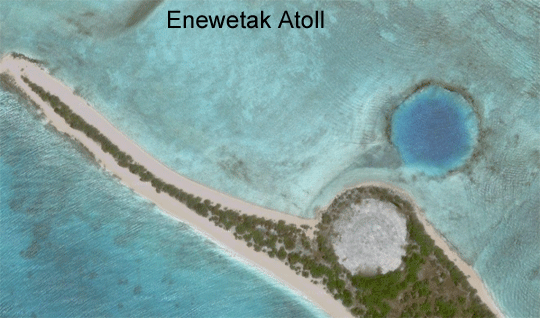









 nuclear-news