China grapples with problem of its growing nuclear wastes

China earmarks site to store nuclear waste deep underground
Researchers will conduct tests at the location in Gansu to see whether it will make a viable facility to store highly radioactive waste safely
Scientists say China has the chance to become a world leader in this field but has to find a way to ensure it does not leak, SCMP, Echo Xie September 06, 2019 China has chosen a site for an underground laboratory to research the disposal of highly radioactive waste, the country’s nuclear safety watchdog said on Wednesday.
Officials said work would soon begin on building the Beishan Underground Research Laboratory 400 metres (1,312 feet) underground in the northwestern province of Gansu.
Liu Hua, head of the National Nuclear Safety Administration, said work would be carried out to determine whether it was possible to build a repository for high-level nuclear waste deep underground. …….. [China] needs to find a safe and reliable way of dealing with its growing stockpiles of nuclear waste. …..
Despite broad scientific support for underground disposal, some analysts and many members of the public remain sceptical about whether it is really safe.
China is also building more facilities to dispose of low and intermediate-level waste. Officials said new plants were being built in Zhejiang, Fujian and Shandong, three coastal provinces that lack disposal facilities.
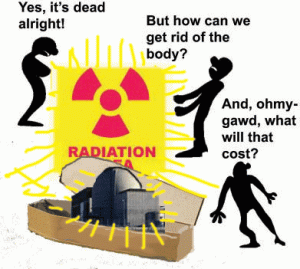
A very small nuclear reactor still results in expensive and risky decommissioning
 Environmental groups concerned about demolition plan for Saskatoon’s SLOWPOKE-2 nuclear reactor, https://www.cbc.ca/news/canada/saskatoon/saskatoon-nuclear-reactor-demolition-concerns-1.5264231
Groups worried about transportation of nuclear waste, pouring treated water into sewer,
· CBC News ·Aug 30, 2019 Environmental groups from across the country are expressing concerns about the decommissioning of a small nuclear reactor near the University of Saskatchewan campus.
The Saskatchewan Research Council is applying to dismantle its SLOWPOKE-2 reactor. The demolition would likely happen next year, but before that happens the Canadian Nuclear Safety Commission (CNSC) will hold a hearing in Ottawa next month to look at approving the plan.
Environmental groups’ concerns about the plan include the intentions to release treated water from the reactor pool into the City of Saskatoon’s sewer system and to send the non-radioactive building materials to a private landfill.
“We don’t know what the cumulative effect or the additive effect of the radioactive burden is going to be of either of those practices,” said Brennain Lloyd, project manager of Northwatch, an environmental group in northern Ontario.
Other concerns include the fate of the reactor pool itself. The proposed plan includes filling the empty pool with concrete, rather than removing the contaminated site completely, as long as the site meets radioactivity guidelines.
Michael Poellet of Saskatchewan’s Inter-Church Uranium Committee Educational Co-operative (ICUCEC) questioned leaving the pool site in the ground.
“The issue there is that the cement in the pool has absorbed radioactivity,” said Poellet. “It’s not assured that the cement will be able to keep that radioactivity within that cement.”
Northwatch, along with the ICUCEC and Nuclear Waste Watch, have all applied to provide comment at the hearing.
The groups said they have important questions, including concerns about eight cubic meters of nuclear waste being transported hundreds of kilometres to a holding facility in South Carolina and parts of the reactor being sent to long-term storage in Chalk River Laboratories in Ontario.
“It’s a big deal project,” said Lloyd. “It seems to have been flying under the radar but it needs to come out out front.” Continue reading
Residents skeptical of plans to dismantle Oyster Creek nuclear plant
Residents skeptical of plans to dismantle Oyster Creek nuclear plant, WHYY, Nicholas Pugliese,
Watchdogs ask court to stop Edison from dumping San Onofre plant’s nuclear waste at beach
|
Watchdogs ask court to stop Edison from dumping San Onofre plant’s nuclear waste at beach https://www.desertsun.com/story/news/environment/energy-water-summit/2019/08/30/watchdogs-ask-judge-stop-edison-burying-nuclear-waste-san-onofre-beach/2163119001/
The complaint, filed by Public Watchdogs with U.S. District Court in the Southern District of California, also named Sempra Energy and its subsidiary San Diego Gas & Electric; Holtec International, the contractor storing the nuclear waste underground; and the U.S. Nuclear Regulatory Commission, which allowed the waste transfers. The nuclear power plant first became operational in 1972. Decommissioning of the last operational reactors began in 2013. Unable to find off-site storage, Edison began to transfer cooled, spent nuclear fuel rods to underground storage on site at the beachfront facility, wedged between San Onofre State Beach and Interstate 5. Edison eventually hopes to transfer the waste to a federal facility. Nearly 3.6 million pounds of nuclear waste is stored at the plant, which has a spotty safety track record. Earlier this year, the NRC fined Edison $116,000 for violating safety requirements relating to fuel transfers. My immediate concern is for the health and safety of the millions of people who could be impacted by a toxic cloud being released,” Chuck La Bella, lawyer of Public Watchdog, said in a press release. “It isn’t really a question of ‘if’ but rather ‘when’ we’re going to be dealing with a nuclear accident here.” An estimated 8 million people live within a 50 mile radius of the facility, what the NRC calls a “plume zone,” where people could be exposed to toxic nuclear waste in the event of a storage equipment failure. Edison resumed burying rods last month after operations were suspended for nearly a year following an incident during which a canister containing nearly 50 tons of spent fuel rods was negligently handled while being transferred to the underground storage unit. The U.S. Nuclear Regulatory Commission found in its investigation that Edison had fallen short on a number of safety procedures, including a failure to publicly report a “near-miss” regarding nuclear waste within 24 hours. In particular, the canisters in which cooled, spent nuclear fuel rods are being packed are defective and too thin-walled at just five-eighths of an inch thick, according to Public Watchdogs. Furthermore, the canisters are being stored underground, 108 feet from the water in a known tsunami inundation zone near the San Andreas fault. The court papers identify broken bolts in the storage canisters that get scratched and gouged during transfer, among other engineering failures, as well as alleging cavalier safety attitudes at Edison. Edison spokesperson John Dobken told The Desert Sun that stopping the fuel transfers from wet to dry storage could potentially strand spent fuel on site, even when options for transport or disposal become available. “Placing spent nuclear fuel into approved canisters that meet all technical, safety and regulatory requirements for on-site storage is the first step to relocating the fuel to an off-site federally licensed facility.” Dobken said, adding that by 2021, more than 80 percent of the spent fuel stored at San Onofre will be eligible for transport. In the last month, three more canisters were transferred, leaving another 41 remaining canisters above ground. A spokesperson for the NRC said the agency does not comment on ongoing litigation, but that they stand by their earlier statement that it is safe for Edison to transfer fuels at the San Onofre facility. Impact on the beachThe California Department of Parks and Recreation says visits to San Onofre’s surfing spots have steadily declined since 2006. In August of that year, the station’s third reactor, which had been shut down for 14 years, was discovered to have been leaking radioactive cancer-causing tritium, contaminating the groundwater. During the peak month of July 2006, there were over 526,000 visitors to the beach area. This year, there were fewer than 200,000 visitors during the same month. The court filing is part of Public Watchdogs’ larger legal action against Edison. Last week, the California Public Utilities Commissions awarded the group $57,924 for making substantial contributions to their decision that Edison was unfairly making ratepayers foot the bill for the decommissioning of the facility at San Onofre State Beach. |
|
“Chernobyl on the Seine” – Marie curie’s radioactive legacy
France Is Still Cleaning Up Marie Curie’s Nuclear Waste, Her lab outside Paris, dubbed Chernobyl on the Seine, is still radioactive nearly a century after her death. Bloomberg Business Week , By Tara Patel, 28 Aug 19,
In 1933 nuclear physicist Marie Curie had outgrown her lab in the Latin Quarter in central Paris. To give her the space needed for the messy task of extracting radioactive elements such as radium from truckloads of ore, the University of Paris built a research center in Arcueil, a village south of the city. Today it’s grown into a crowded working-class suburb. And the dilapidated lab, set in an overgrown garden near a 17th century aqueduct, is sometimes called Chernobyl on the Seine. No major accidents occurred at the lab, which closed in 1978. But it’s brimming with radioactivity that will be a health threat for millennia, and France’s nuclear watchdog has barred access to anyone not wearing protective clothing. The lab is surrounded by a concrete wall topped by barbed wire and surveillance cameras. Monitors constantly assess radiation, and local officials regularly test the river. “We’re proof that France has a serious nuclear waste problem,” says Arcueil Mayor Christian Métairie. “Our situation raises questions about whether the country is really equipped to handle it……. (subscribers only) https://www.bloomberg.com/news/articles/2019-08-28/france-is-still-cleaning-up-marie-curie-s-nuclear-wastePublic Should Comment on New “WIPP Forever” Strategic Plan
 Public Should Comment on New “WIPP Forever” Strategic Plan, http://nuclearactive.org/ August 22nd, 2019 The Waste Isolation Pilot Plant (WIPP) is the nation’s first geologic disposal site for radioactive and hazardous waste. https://wipp.energy.gov/ But WIPP should not be the only repository. For decades, federal laws and state agreements and permits have established a limited mission for both the amount of waste allowed and how long the site can operate. Other repositories are necessary since the nation has no plans to stop production of nuclear weapons that generate the plutonium waste. Other repositories also are required for commercial spent fuel and military high-level wastes.
In recent years, officials with the Department of Energy (DOE) have discussed various ideas to keep WIPP open for at least 50 years – twice as long as the original schedule – and to expand the types and amounts of waste. One reason for the “WIPP Forever” plan is to avoid telling Congress and the public that it is time to develop other repositories – since no state is asking for those dump sites.
DOE announced the upcoming release of a Draft Five-Year Strategic Plan and public comment meetings in Santa Fe on Monday, August 26th from 3 to 5 pm at the Hotel Santa Fe, and in Carlsbad on Wednesday, August 28th from 10:30 am to 12:30 pm at the Skeen-Whitlock Building. While WIPP officials acknowledge that more informed public comment happens if the draft plan is released several days in advance, the document may not be available until just before the Santa Fe meeting.
Thus, what exactly is in the five-year plan is uncertain. But it likely will presume that WIPP continues to operate until at least 2050 and the amount of waste totals at least thirty percent more than the legal limit of 175,564 cubic meters. It will certainly include adding at least one new shaft and numerous underground disposal rooms beyond those ever included in past designs. That additional space is for plutonium-contaminated waste previously designated for WIPP that doesn’t fit because of the underground contamination that makes some areas of the underground unusable. The Plan also could include tons of weapons-grade plutonium and high-level waste that has always been prohibited by federal law and the state permit.
Don Hancock, of Southwest Research and Information Center, said, “Whatever the specifics of the WIPP Strategic Plan, the public can tell DOE that we do not agree with operating WIPP forever. People can also tell State officials to enforce the legal limits on the amount and types of waste and set a closing date so that DOE and Congress know that it’s time to plan for either long-term storage at generator sites or new repositories in other states.” http://www.sric.org/
Germany shows how it can lead the world in neatly shutting down nuclear power
Spectacular Video Shows Nuclear Power Plant Demolition in Germany
Tower of German nuclear station demolished. The plant was on line for only 13 months
Short-lived German nuclear plant’s cooling tower demolished https://www.citynews1130.com/2019/08/09/short-lived-german-nuclear-plants-cooling-tower-demolished/, BY THE ASSOCIATED PRESS, Aug 9, 2019
Remote-controlled excavators on Friday removed pillars that supported the tower at the Muelheim-Kaerlich plant, near Koblenz. The tower, whose top half had already been removed by a specially designed robot, collapsed under its own weight in a cloud of dust a couple of hours later.
Muelheim-Kaerlich was switched off in September 1988 after 13 months in service when a federal court ruled the risk of earthquakes in the area hadn’t been taken into account sufficiently. After a lengthy legal battle, demolition started in 2004. Operator RWE says nearly all radioactive material had already been removed by then.
Removal of one metric ton of plutonium from Savannah River Site South Carolina
One metric ton of plutonium removed from massive nuclear facility in SC, https://www.wspa.com/news/one-metric-ton-of-plutonium-removed-from-massive-nuclear-facility-in-sc/ by: Georgiaree Godfrey
Posted: Aug 8, 2019 / 09:06 PM EDT Updated: Aug 9, 2019 / 0JACKSON, SC (WSPA)- The South Carolina Attorney General announced earlier this week the successful completion of the removal of a portion of the plutonium being stored at the Savannah River Site in Aiken.
The Savannah River Site has been in the state since the late 1950’s and was originally home to a nuclear bomb making facility, but over the years the site has taken on the role of several different operations, including the storage of plutonium.
Savannah River Site is now home to a nuclear laboratory and facility to reuse the nuclear material left behind from the Cold War. Over the years the storage of that plutonium has become a concern.
“A lot of pollution left over from that so the main mission of the Savannah River Site for a long time has been the cleaning up of the contamination that exists,” explained Tonya Bonitatibus, the Executive Director of Savannah Riverkeeper. Savannah Riverkeeper monitors the quality of the Savannah River, which is used for drinking water for more than 1 million residents.
The United States Department of Energy notified the state’s attorney general of the removal of one metric ton of plutonium from the Savannah River Site.
In 2016, Congress passed a law to remove the plutonium if production goals to reuse the material were not met.
The plutonium removed so far is the first step in a wider cleanup after the state won a lawsuit against the DOE.
Bonitatibus continued, “The Savannah River Site has been the dumping ground for nuclear waste. It just has because nobody wants it. So it ends up being stored here leaking into the coastal plain and groundwater.”
The National Nuclear Security Administration says, “The material removed from the Savannah River Site (SRS) in Aiken, South Carolina, will be used for national security missions and is not waste.”
NNSA also released a removal plan that designated Texas and New Mexico as the destinations for the removed plutonium.
The ruling outlined that one metric ton of the plutonium would be removed each year. The process could take another 5 to 7 years to remove the plutonium being stored.
The removal was supposed to be completed by January 1, 2020. The process is 6 months ahead of schedule, according to NNSA.
Savannah River Site is located on land in Aiken, Allendale and Barnwell counties.
China buried nuclear waste in Sudan desert
According to the former director of the Sudan Atomic Energy Commission in Sudan, Mohamed Siddig, 60 containers have been brought to Sudan together with construction materials and machinery for the building of the Merowe Dam (Hamdab Dam) in the Northern part of Sudan. He did not mention the exact year of the import and the date the nuclear waste was disposed. China worked on the dam between 2004 and 2009.
During a conference held by the Sudanese Standards and Metrology Organisation (SSMO) in Khartoum on Tuesday, he disclosed how the Sudanese authorities allowed the import of the waste ‘without inspection’. He told the audience that 40 containers were buried in the desert not far from the Merowe Dam construction site. Another 20 containers were also disposed in the desert, though not buried…..
Mohamed Siddig was responsible for the Sudan Radioactive Waste Management programme that started in 1995, a central radioactive waste management facility was established in Soba near Khartoum. The Atomic Energy Committee is responsible for overseeing the safety in activities that involve the use of atomic energy in Sudan, and promoting the use of nuclear techniques.
Gold miners complain
In 2010, the government was already confronted by complaints of local gold diggers, according to the Sudanese newspaper El Tariq. Several gold workers approached the government complaining about many of the worker suffering from cancer and skin diseases. The Sudan authorities downplayed the questions saying the waste they dug up were remnants from earlier times. However witnesses told El Tariq that 500 sealed barrels were discovered in the El Atmur desert area in River Nile State…….https://www.dabangasudan.org/en/all-news/article/official-china-buried-nuclear-waste-in-sudan-s-desert
The Deep Isolation Texas nuclear waste plan
 An excellent article, explaining Deep Isolation, and thoroughly outlining the global problem of radioactive trash.
What a pity, then, that this article, and its title, mindlessly accept the current dogma about nuclear power being the solution to climate change!. To believe this is to ignore nuclear’s serious problems, and especially the fact that the thousands of nuclear reactors required would never be built in time to have any effect on global warming – even if that claim were true – which it isn’t.
WHAT TO DO WITH THE DEADLY RADIOACTIVE WASTE? ensia, 31 July 19
The Deep Isolation Texas demonstration
Skip forward to Cameron, Texas, on January 16, 2019. This was a nerve-wracking day for Liz Muller, co-founder of California startup technology company Deep Isolation and her father, Richard Muller, professor emeritus of physics at the University of California, Berkeley, and now chief technology officer at Deep Isolation.
The father-daughter team had invited 40 nuclear scientists, U.S. Department of Energy officials, oil and gas professionals, and environmentalists to witness the first-ever attempt to test whether the latest oil-fracking technology could be used to permanently dispose of the most dangerous nuclear waste.
At 11:30 a.m., the crew of oil workers used a wire cable to lower a 30-inch (80-centimeter)-long, 8-inch (20-centimeter)-wide 140-pound (64-kilogram) canister — filled with steel rather than radioactive waste — down a previously drilled borehole. Then, using a tool called a “tractor” invented by the industry to reach horizontally into mile-deep oil reservoirs, they pushed it 400 feet (120 meters) farther away from the borehole through the rock.
Five hours later, the crew used the tractor to relocate and collect the canister, attach it to the cable and pull it back to the surface — to the cheers of the workers. Until then, few people in the nuclear industry believed this could be done.
By avoiding the need to excavate large, expensive tunnels to store waste below ground, the Deep Isolation team believes it has found a solution to one of the world’s most intractable environmental problems — how to permanently dispose of and potentially retrieve the hundreds of thousands of tons of nuclear waste presently being stored at nuclear power plants and research and military stations around the world.
“We showed it could be done,” Elizabeth Muller says. “Horizontal, directional drilling has come a long way recently. This is now an off-the-shelf technology. Using larger canisters, we think about 300 boreholes with tunnels up to 2 miles (3 kilometers) long would be able to take much of the U.S.’s high-level nuclear waste. We think we can reduce by two-thirds the cost of permanent storage.” ……In 80-odd years of nuclear power, in which more than 450 commercial reactors, many experimental stations and tens of thousands of nuclear warheads have been built, great stockpiles of different levels of waste have accumulated.
Depending on how countries classify waste, only about 0.2–3% by volume is high-level waste, according to the World Nuclear Association, a London-based industry group that promotes nuclear power. Mostly derived from civil reactor fuel, this is some of the most dangerous material known on Earth, remaining radioactive for tens of thousands of years. It requires cooling and shielding indefinitely and contains 95% of the radioactivity related to nuclear power generation.
A further 7% or so by volume, known as intermediate waste, is made up of things like reactor components and graphite from reactor cores. This is also highly dangerous, but it can be stored in special canisters because it does not generate much heat.
The rest is made up of vast quantities of what is called low-level and very low level waste. This comprises scrap metal, paper, plastics, building materials and everything else radioactive involved in the operation and dismantling of nuclear facilities.
The consensus is that around 22,000 cubic meters (29,000 cubic yards) of solid high-level waste has accumulated in temporary storage but not been disposed of (moved to permanent storage) in 14 western countries, along with unknown amounts in China, Russia and at military stations. A further 460,000 cubic meters (600,000 cubic yards) of intermediate waste is being stored, and about 3.5 million cubic meters (4.6 million cubic yards) of low-level waste. Some 34,000 cubic meters (44,000 cubic yards) of new high-level and intermediate waste is generated each year by operating civil reactors, says another nuclear industry group, the World Nuclear Association (WNA).
The U.S., with 59 nuclear power plants comprising 97 working civil reactors each generating at least several tons of high-level waste per year, has around 90,000 metric tons (99,000 tons) of high-level waste awaiting permanent disposal, according to the U.S. Government Accountability Office. Although it’s impossible to come up with a global total because of differences in how quantities are measured and reported, and with some inventories kept secret, other countries harbor significant amounts of waste as well.
Many Ideas
In the early days of nuclear power, waste of any sort was barely considered. British, U.S. and Russian authorities, among others, dumped nuclear waste, including more than 150,000 metric tons (160,000 tons) of low-level waste at sea or in rivers. Since then, billions of dollars have been spent trying to identify how best to reduce the amount produced and then store it for what may be eternity.
Many ideas have been investigated, but most have been rejected as impractical, too expensive or ecologically unacceptable. They include shooting it into space; isolating it in synthetic rock; burying it in ice sheets; dumping it on the world’s most isolated islands; and dropping it to the bottom of the world’s deepest oceanic trenches.
Vertical boreholes up to 5,000 meters (16,000 feet) deep have also been proposed, and this option is said by some scientists to be promising. But there have been doubts because it is likely to be near impossible to retrieve waste from vertical boreholes…….
Only Finland is close to completing a deep repository for high-level waste. In May, work started on an “encapsulation” plant where waste will be packed inside copper canisters that will be transferred into 400- to 450-meter (1,300- to 1,500-foot)-deep underground tunnels. But doubt has been cast on the long-term safety of the canisters.
“The problem is intractable,” says Paul Dorfman, founder of the Nuclear Consulting Group, a group of around 120 international academics and independent experts in the fields of radiation waste, nuclear policy and environmental risk. “The bitter reality is that there is no scientifically proven way of disposing of the existential problem of high- and intermediate-level waste. Some countries have built repositories, some plan them. But given the huge technical uncertainties, if disposal does go ahead and anything goes wrong underground in the next millennia, then future generations risk profound widespread pollution.”
Many people now doubt that a satisfactory final repository will ever be found. ….. https://ensia.com/features/radioactive-nuclear-waste-disposal/#comment-344362
San Onofre’s nuclear waste: an intractable problem
 But is interim storage really interim?……. the communities that give the OK to build an interim storage facility may end up having the waste stuck in their backyards for decades to come.
Nuclear reactors at Fukushima No 2 plant to be decommissioned
 Tepco says it will decommission nuclear reactors at Fukushima No. 2 plant https://www.japantimes.co.jp/news/2019/07/24/national/tepco-says-will-decommission-nuclear-reactors-fukushima-no-2-plant/#.XTjRFugzbIU, 24 July 19,
Tokyo Electric Power Company Holdings Inc. will decommission the Fukushima No. 2 nuclear plant, its president, Tomoaki Kobayakawa, told Fukushima Gov. Masao Ochibori at a meeting Wednesday.
The facility is the second nuclear plant that the utility company has decided to decommission after accepting it would need to shutter the nearby Fukushima No. 1 plant, which was crippled by the March 2011 earthquake and tsunami disaster in the world’s worst nuclear crisis since Chernobyl.
Tepco’s decision to scrap Fukushima No. 2, which is expected to cost some ¥280 billion ($2.6 billion), will be formally approved at the company’s board meeting later this month if local municipalities accept the plan.
The prefecture has demanded the utility scrap the reactors at Fukushima No. 2, saying their existence would hamper its reconstruction efforts. The plant has been offline since its operations were suspended due to the 2011 disaster.
If the plan goes ahead, all 10 nuclear reactors in the prefecture — four at the No. 2 plant and six at the No. 1 facility — will be scrapped.
It will also leave the utility company with only the Kashiwazaki-Kariwa nuclear plant in Niigata Prefecture and the planned Higashidori nuclear plant in Aomori Prefecture.
Kobayakawa said at the meeting, also attended by the mayors of the two towns — Naraha and Tomioka — that host the plant, that Tepco plans to build a new on-site storage facility for spent nuclear fuel from the reactors at the Fukushima No. 2 plant.
The fuel will be placed in metallic containers and cooled using a dry storage approach, according to the operator.
No decision has been made regarding final disposal of the spent fuel, raising concerns that the radioactive waste may remain on-site for a long time.
The Fukushima No.2 plant currently has around 10,000 assemblies of spent fuel cooling in pools.
Danger in Using Commercial Satellites To Control Nuclear Weapons
Using Commercial Satellites To Control Nuclear Weapons Is A Bad Idea — But
It’s Being Discussed Forbes, Loren Thompson 24 July 19, “……. With the collapse of the Soviet Union and the appearance of new
threats, though, the sense of urgency about nuclear security has waned. The
infrastructure supporting nuclear deterrence has decayed to a point where all three
legs of the strategic “triad”—land-based missiles, sea-based missiles and long-range
bombers—need to be replaced. Meanwhile, the architecture used to command and
control nuclear forces has changed little since the Reagan era.
Against this backdrop, the Chief of Staff of the U.S. Air Force said something curious at a meeting of
the Mitchell Institute on June 26. The institute recently produced a report focused on the need to
modernize technology for nuclear command and control. General David Goldfein opined that ongoing
efforts to network the Air Force were as relevant to control of nuclear forces as conventional forces.
In particular, he mentioned the “rapid and exciting expansion of commercial space”
as a trend that might facilitate the creation of resilient links for communicating with
nuclear forces. I was unaware of the chief’s comments until I saw a story by Mandy
Mayfield of National Defense Magazine entitled, “Air Force Wants To Utilize
Commercial Satellites For Nuclear Command, Control.” The Air Force is responsible
for most of the 200 systems comprising the nuclear command and control system, so
General Goldfein’s thoughts have to be taken seriously even if they are just random
musings.
This particular idea is dangerous.
Commercial satellites lack virtually all of the security features that would be
necessary to assure control of the nuclear arsenal in a crisis. First of all, they are not
survivable against a wide array of threats that China and Russia have begun posing
to U.S. orbital assets, ranging from kinetic attacks to electronic jamming to
electromagnetic pulse. Second, they are susceptible to cyber intrusion via their
ground stations that could impede their performance. Third, they frequently contain
foreign components, including in-orbit propulsion technology made in Russia, which
might be manipulated in a crisis or simply become unavailable during wartime.
Air Force planners presumably know all this, so why would General Goldfein suggest
relying on commercial satellites to execute the military’s most fateful decisions?
Perhaps for the same reason that the Army is backing into reliance on commercial
satellites for its next-generation battlefield networks. There are so many commercial
constellations in operation that it seems unlikely America’s enemies could shut them
all down in wartime, and they are a lot cheaper to use than orbiting dedicated military
satcoms with the requisite capacity and redundancy.
“Resilience” has become the watchword for modernizing military space activities, and
one way of creating resilience is to proliferate the pathways available for vital
communications to a point where adversaries can’t keep up with all the possible
options available to U.S. commanders. The same logic is leading technologists to
propose large numbers of cheap satellites in low-earth orbit as an adjunct to existing
military satcoms.
These “cheapsats” wouldn’t be anywhere near as capable as the secure
communications assets that Washington has placed in geostationary orbits, but there
would be so many that links could be sustained even in highly stressed
circumstances, such as the “trans-attack” phase of a nuclear war.
Or at least, so the reasoning goes.
……But the idea of relying on commercial satellites for command and control of
nuclear forces takes this reasoning a step too far, because market forces preclude
any of the hardening and other protective features that might be required in dedicated
military birds
……… think of all the ways an adversary like China might seek to interfere with
commercial satellites through their ground stations and uplinks, such as insertion of
malware via hacking and jamming of signals. ……..
https://www.forbes.com/sites/lorenthompson/2019/07/23/using-commercial-satellites-to-control-nuclear-
weapons-is-a-bad-idea-but-its-being-discussed/#2da6f0751dfa
In Texas oil town Andrews , there’s support for hosting nuclear waste dump
 This Texas Oil Town Actually Wants the Nation’s Nuclear Waste, Bloomberg
By Ari Natter and Will Wade July 24, 2019, This Texas Oil Town Actually Wants the Nation’s Nuclear Waste, Bloomberg
By Ari Natter and Will Wade July 24, 2019,
But Roberts, 29, has his eye on what he hopes will be the next big thing for the area: nuclear waste. As president of the local chamber of commerce, knows that oil booms are inevitably followed by busts. He is supporting a plan to establish a repository in the desert about 30 miles outside of town for as much as 40,000 metric tons of highly radioactive spent nuclear fuel and waste from power plants……. Local support for the project is strong, said County Judge Charlie Falcon, who presides over the four-member Andrews County Commissioners’ Court, which functions as the county’s board of commissioners. The panel approved a resolution in 2015 backing the idea to accept high-level nuclear waste at the designated site, and is likely to reiterate its support with a letter in the near future, Falcon said during an interview in his chambers in the brick courthouse on Main Street. …….. The plan by Interim Storage Partners LLC, a joint venture between Orano CIS LLC and Waste Control Specialists LLC, calls for waste to be shipped by rail from around the country. Then it would be sealed in giant concrete casks and stored above ground for as long as 100 years, or at least until a permanent repository is built. Opponents say that could be never……. In the meantime, the U.S. has no permanent place of its own to store radioactive material that will remain deadly for several thousand years. … Not everyone in Andrews is on board with the idea of storing waste that can remain radioactive for thousands or even hundreds of thousands of years. “We don’t need to put it right in the middle of the biggest oil field in the world,” said Tommy Taylor, director of oil and gas development for Fasken Oil and Ranch Ltd. of Midland, Texas, which is part of a coalition of oil and gas producers and landowners opposed to the nuclear dump. More than 4 million barrels of crude are produced every day in the Permian Basin and drillers say a leak or terrorist attack could put the oil boom at risk. “It would shut the whole Permian down. The result would be catastrophic for us,” he said. Said Andrews resident Elizabeth Padilla: “It only takes one accident and we would become the Chernobyl of West Texas.” Some surrounding counties and cities have adopted resolutions against the plan. It’s also drawn opposition from national environmental groups………. A panel of administrative judges from the Nuclear Regulatory Commission recently convened a hearing at the neighboring Midland County Courthouse and heard arguments from environmentalists, oil industry representatives and other groups. Outside, protesters gathered around an eight-foot-tall, green-and-black inflatable replica of a storage cask bearing a sign reading “Say No To Radioactive Waste.” Kevin Kamps, an official with Takoma Park, Maryland-based group Beyond Nuclear, who drove to Midland for the hearing, said in an interview that high-level nuclear waste bound for Andrews would travel through major cities. “The transport risks are for the entire country and they haven’t even been alerted,” Kamps said. Other opponents expressed worry about the site’s proximity to the Ogallala Aquifer, a underground reservoir that spans eight states that supplies water for drinking and irrigation to millions of people. ….. The project has powerful backers. As Texas Governor, Rick Perry encouraged storing high level nuclear waste in the state and, as U.S. Energysecretary, he has been supportive of interim nuclear waste storage. The current governor, Greg Abbott, is opposed. Scott State, the chief executive officer of Waste Control Specialists, which is owned by J.F. Lehman & Co., said he was optimistic the Nuclear Regulatory Commission would approve the license for the project, though additional approvals, such as plans for transporting waste, need to be approved before storage can begin, he said. Rose Gardner, a 61-year-old grandmother who owns a floral shop in Eunice, N.M., about five miles away from the proposed nuclear dump, said she will do everything in her power to stop that from happening. “We will appeal and appeal and appeal,” she said in an interview. “We will do whatever we have to throw a monkey wrench inside their plans to open a deadly dump.” https://www.bloomberg.com/news/articles/2019-07-24/one-texas-oil-town-actually-wants-the-nation-s-nuclear-waste |
|
1 This Month

of the week – Shut Down Drone Warfare!


Tell the Ukrainian Government to Drop Prosecution of Peace Activist Yurii Sheliazhenko

Petition to revoke the licensing of the Near Surface Nuclear Disposal Facility (NSDF) at Chalk River. https://www.ourcommons.ca/petitions/en/Petition/Details?Petition=e-7247
To see nuclear-related stories in greater depth and intensity – go to https://nuclearinformation.wordpress.com
-
Archives
- April 2026 (114)
- March 2026 (251)
- February 2026 (268)
- January 2026 (308)
- December 2025 (358)
- November 2025 (359)
- October 2025 (376)
- September 2025 (257)
- August 2025 (319)
- July 2025 (230)
- June 2025 (348)
- May 2025 (261)
-
Categories
- 1
- 1 NUCLEAR ISSUES
- business and costs
- climate change
- culture and arts
- ENERGY
- environment
- health
- history
- indigenous issues
- Legal
- marketing of nuclear
- media
- opposition to nuclear
- PERSONAL STORIES
- politics
- politics international
- Religion and ethics
- safety
- secrets,lies and civil liberties
- spinbuster
- technology
- Uranium
- wastes
- weapons and war
- Women
- 2 WORLD
- ACTION
- AFRICA
- Atrocities
- AUSTRALIA
- Christina's notes
- Christina's themes
- culture and arts
- Events
- Fuk 2022
- Fuk 2023
- Fukushima 2017
- Fukushima 2018
- fukushima 2019
- Fukushima 2020
- Fukushima 2021
- general
- global warming
- Humour (God we need it)
- Nuclear
- RARE EARTHS
- Reference
- resources – print
- Resources -audiovicual
- Weekly Newsletter
- World
- World Nuclear
- YouTube
-
RSS
Entries RSS
Comments RSS
 nuclear-news