Canada’s Nuclear Waste Management Organization (NWMO) courts indigenous communities

More specifically, the NWMO, which is a consortium of Canadian nuclear industry players created by an act of parliament, is looking for a community willing to allow used nuclear fuel to be placed in what’s called a deep geological repository – or DGR.
Currently the NWMO is engaging with Ignace, Ontario a small community 250 km northwest of Thunder Bay, as well as the municipality of South Bruce, on Lake Huron northwest of Toronto.
Indigenous communities in both those areas are being courted and having the DGR concept pitched to them by the NWMO.
Indigenous engagement is a major focus at the NWMO.
It has put out an eight-part video series on reconciliation, and it also employs Bob Watts as their vice president of Indigenous Relations.
Watts is a long time major player in Indigenous politics who has held high-level positions with the Assembly of First Nations and the federal government………
Fundamentally, a DGR needs to protect radioactive waste from water, because water could potentially bring the deadly radioactive material back into contact with our environment. …….
not everyone is sold on the safety case made by the NWMO.
Gordon Edwards is president of the Canadian Coalition for Nuclear Responsibility and is likely the nuclear industry’s best known critic in Canada.
Edwards isn’t impressed with the NWMO’s multiple barrier system.
“You can put barrier after barrier after barrier, that doesn’t mean that you have a safe system,” he said. ”The same multiple barrier philosophy is used in nuclear reactors. They say the fuel is inside metal tubes, which are called zirconium, that’s another barrier, it’s called the sheath. And those are inside pressure tubes, which is another barrier. And then that’s inside a calandria, which is another barrier. And that’s inside the reactor building, which is another barrier. Consequently, there cannot be a nuclear accident.
“Well, we’ve seen what happened with that philosophy. Chernobyl exploded and the whole area around Chernobyl is still uninhabitable and will be for at least another hundred years. Fukushima, we’ve had three reactors melting down on the same weekend and those multiple barriers were all in place.”
Edwards said the notion that we can build something to last hundreds of thousands of years, the length of time used nuclear fuel will potentially remain dangerously radioactive – is folly.
“You have to realize that the pyramids of Egypt are only 5,000 years old,” said Edwards. “Go and look at them there. They’re really deteriorated a great deal. So the half-life of plutonium is 24,000 years. The Great Lakes didn’t even exist 24,000 years ago. So we’re talking about periods of time that dwarf the span of human history.”
Edwards said he believes taking a wait-and-see approach is better than putting the used fuel in a DGR.
“We can afford to wait another century or two and see if we can come up with a genuine solution,” he said. “If we can’t come up with a genuine solution, we can continue to look after it. We can continue to transmit the information. We can continue to repackage it periodically into better and better packages, which is going to make sure. And if there is leakage that occurs, failure of containment – we can spring into action right away and fix it and not let it get out of hand. That’s a much better approach.
“This is called rolling stewardship.”………
The NWMO said it hopes to have identified a willing host community for a deep geological repository by 2023.
Nuclear Courtship, Part 2 airs next week, and will be accompanied with a web story which will examine the mood of some of the communities engaging with the nuclear industry.cread@aptn.ca https://aptnnews.ca/2020/02/07/indigenous-communities-courted-as-nuclear-industry-looks-for-place-to-put-used-fuel/
Corpses of UK’s nuclear submarines still unburied after 25 years

|
Nuclear vessels still languish at Fife dockyard 25 years after pledge against submarine graveyard, by Cheryl Peebles The Courier.co.uk
February 7 2020,Seven of the vessels, which contain radioactive material, have languished for decades at the Fife dock awaiting dismantling by the Ministry of Defence.
They include HMS Dreadnought, the UK’s first nuclear-powered submarine which was retired from service in 1980. It was during a visit to Rosyth in January 1995 that the then defence procurement minister Roger Freeman made the statement. The milestone prompted a repeated demand from Dunfermline and West Fife MP Douglas Chapman for action to deal with the vessels. Mr Chapman said: “It is astonishing that 25 years after Roger Freeman made that statement we are still waiting for the UK government to clear up these submarines that were decommissioned in the 1980s. “I have pressured the government for years to have some sort of joined-up thinking to remove these. “It is not only costing the taxpayer millions every year to keep them but also taking up valuable dock space that Babcock could be utilising for more economically productive activities.”…… https://www.thecourier.co.uk/fp/news/local/fife/1123498/nuclear-vessels-still-languish-at-fife-dockyard-25-years-after-pledge-against-submarine-graveyard/ |
|
Natural Resources Defense Council: It’s Time to Pursue a Genuine Solution for Nuclear Waste
 NRDC: It’s Time to Pursue a Genuine Solution for Nuclear Waste NRDC: It’s Time to Pursue a Genuine Solution for Nuclear Waste
February 07, 2020 WASHINGTON — President Donald Trump bowed to reality as he said his administration would end its attempts to force nuclear waste into the unsafe Yucca Mountain site in Nevada.
Following is a statement by Geoff Fettus, senior attorney in the Nuclear Program at the Natural Resources Defense Council: “With this change of direction by the Trump administration, decades of unfortunate attempts to shove nuclear waste down Yucca Mountain officially come to an end. Congress must now move in a new direction, one based on sound science, the consent of the state and local citizens, and compliance with all environmental laws.” Please see this analysis for more information on this issue: https://www.nrdc.org/experts/geoffrey-h-fettus/final-resting-place-nuclear-waste The National Resources Defense Council (NRDC) is an international nonprofit environmental organization with more than 3 million members and online activists. Since 1970, our lawyers, scientists, and other environmental specialists have worked to protect the world’s natural resources, public health, and the environment. NRDC has offices in New York City, Washington, D.C., Los Angeles, San Francisco, Chicago, Bozeman, MT, and Beijing. Visit us at NRDC.org and follow us on Twitter @NRDC. |
|
Saugeen Ojibway Nation vote ends company’s plans to store nuclear waste near Lake Huron
The decision came following years of Michigan lawmakers asking Ontario Power Generation to reconsider. It took the vote of the Saugeen Ojibway Nation of Ontario Friday to shift the discussions away from the lake. Of 1,232 ballots cast, 1,058 were against the site and 170 in favor.
We were not consulted when the nuclear industry was established in our Territory,” said a news release on the vote. “Over the past forty years, nuclear power generation in Anishnaabekiing has had many impacts on our Communities, and our Land and Waters, including the production and accumulation of nuclear waste.”
The release said that SON leaders will work with Ontario Power Generation “to find an acceptable solution for the waste.
“We will continue to work with OPG and others in the nuclear industry on developing new solutions for nuclear waste in our Territory,” said Chief Greg Nadjiwon of the Chippewas of Nawash Unceded First Nation. “We know that the waste currently held in above-ground storage at the Bruce site will not go away. SON is committed to developing these solutions with our communities and ensuring Mother Earth is protected for future generations. We will continue to ensure that our People will lead these processes and discussions.” ……….
Site had been sought since 2010
On Jan. 24, the Nuclear Waste Management Organization announced it had signed agreements with landowners east of Lake Huron in South Bruce, Ontario, which would allow land access for studies for the site. …….
In January, southeast Michigan state representatives Gary Howell, R-Lapeer, and Shane Hernandez, R-Port Huron, issued statements against locations near Kincardine and Lake Huron. They said the Kincardine locations are too close to Lake Huron, and expressed concerns about drinking water and public health if something went wrong at the site.
They called on the United States Congress to do everything in its power to stop the development. https://www.thetimesherald.com/story/news/2020/02/03/plans-store-nuclear-waster-near-lake-huron-halted/4587366002/
Indigenous community votes down proposed nuclear waste bunker near Lake Huron,
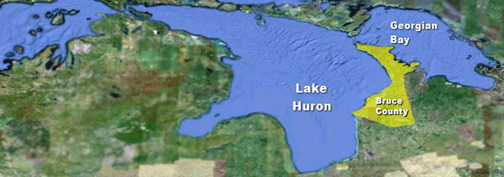
‘We were not consulted when the nuclear industry was established in our territory’,https://nationalpost.com/news/canada/indigenous-community-votes-down-proposed-nuclear-waste-bunker-near-lake-huron The Canadian Press, Colin Perkel. February 1, 2020
TORONTO — An Indigenous community has overwhelmingly rejected a proposed underground storage facility for nuclear waste near Lake Huron, likely spelling the end for a multibillion-dollar, politically fraught project years in the making.
After a year of consultations and days of voting, the 4,500-member Saugeen Ojibway Nation announced late Friday that 85 per cent of those casting ballots had said no to accepting a deep geologic repository at the Bruce nuclear power plant near Kincardine, Ont.
“We were not consulted when the nuclear industry was established in our territory,” SON said in a statement. “Over the past 40 years, nuclear power generation in Anishnaabekiing has had many impacts on our communities, and our land and waters.”
The province’s giant utility, Ontario Power Generation, had wanted to build the repository 680 metres underground about 1.2 kilometres from Lake Huron as permanent storage for low and intermediate-level radioactive waste. The project was tentatively approved in May 2015.
In August 2017, then-environment minister Catherine McKenna paused the process to ensure buy-in from Indigenous people in the area
While Kincardine was a “willing host,” the relative proximity of the proposed bunker to the lake sparked a backlash elsewhere in Canada and the United States. Politicians, environmentalists and scores of communities expressed opposition.
Successive federal governments have withheld final approval. In August 2017, then-environment minister Catherine McKenna paused the process — the last in a string of delays for the project — to ensure buy-in from Indigenous people in the area.
The generating company, which insisted the stable bedrock would safely contain the waste, items such as contaminated reactor components and mops, said it respected SON’s decision.
“OPG will explore other options and will engage with key stakeholders to develop an alternate site-selection process,” Ken Hartwick, head of OPG, said in a statement shortly after the vote was announced. “Any new process would include engagement with Indigenous peoples as well as interested municipalities.”
The apparent end of the road for the project comes shortly after the federally-mandated Nuclear Waste Management Organization said it was making progress toward choosing a site for storing millions of far more toxic spent nuclear fuel bundles.
The organization, comprising several nuclear plant operators, said it had struck deals with landowners in South Bruce — about 30 minutes east of Kincardine — that will allow it to begin site tests. The only other site under consideration for high-level waste storage is in Ignace in northern Ontario.
Despite the rejection of OPG’s proposal, the utility said it planned to continue a relationship “based on mutual respect, collaboration and trust” with the Saugeen Ojibway Nation, which comprises the Chippewas of Saugeen First Nation and the Chippewas of Nawash Unceded First Nation.
Chippewas of Saugeen Chief Lester Anoquot called the vote — 170 for and 1,058 against — a “historic milestone and momentous victory” for the community.
“We worked for many years for our right to exercise jurisdiction in our territory and the free, prior and informed consent of our people to be recognized,” Anoquot said. “We didn’t ask for this waste to be created and stored in our territory.”
At the same time, Anoquot said, the vote showed the need for a new solution for the hazardous waste, a process he said could take many years.
Ontario depends heavily on nuclear power for its electricity but a permanent storage solution for the increasing amounts of waste now stored above ground has proven elusive. The radioactive material, particular from used fuel, remains highly toxic for centuries.
The utility insists exhaustive science shows a repository in stable and impermeable rock offers the best solution.
“Permanent and safe disposal is the right thing to do for future generations,” Hartwick said.
Ignoring Aboriginal opposition, Australian government chooses nuclear waste dump site
|
Federal Government chooses Kimba farm Napandee on the Eyre Peninsula for nuclear dump, ABC, 1 Feb 2020 The Federal Government has selected a farm on South Australia’s Eyre Peninsula as the site of a controversial nuclear waste dump. Key points:
Jeff Baldock’s Napandee property 20 kilometres west of Kimba will be used to permanently store low-level waste and temporarily store intermediate-level waste. The decision to use the 160-hectare area for what the Government calls a “disposal and storage facility” was made after four years of consultation. Nearly 62 per cent of people voted in favour of the site being used in November, while a site near Hawker in the Flinders Ranges was opposed by Aboriginal traditional owners and residents……. Dump to consolidate nuclear wasteLocal federal Liberal MP Rowan Ramsey said waste would come in from more than 100 sites around Australia, such as hospitals and universities, and the Lucas Heights nuclear reactor in Sydney. Processed medium-level nuclear fuel rods from Lucas Heights will be temporarily stored at Kimba while a permanent site is found for them, he said. Mr Ramsey, who tried to nominate his own property near Kimba for the dump but was barred as a federal MP, said there would be no fly-in, fly-out workers at the facility……. Aboriginal group opposed the voteThe Barngarla Determination Aboriginal Corporation launched legal action in 2018 against the District Council of Kimba, arguing it contravened the Racial Discrimination Act by excluding native title holders from a ballot due to be held that year. The Federal Court dismissed the claim last year because it said no contraventions of the Racial Discrimination Act had been established…….. The Howard government proposed a similar dump in South Australia in 1998 but withdrew its plans after losing a fight with the South Australian Labor government in the Federal Court. In 2007, a property called Mukaty Station in the Northern Territory was put forward to host the nuclear waste facility. The plan was abandoned in 2014, again because of legal action, this time by the area’s traditional owners. A group called No Radioactive Waste Facility for Kimba District held a rally against the decision in the town on Sunday.Friends of the Earth national nuclear campaigner Jim Green said the Federal Government promised the facility would not be approved unless it received at least 65 per cent of community support. “They’ve ignored the traditional owners, ignored South Australians. South Australia’s got legislation banning the imposition of nuclear waste dumps and that’s been ignored and it’s just disrespectful from start to finish,” he said. “South Australians have got greater ambitions for our state than to be someone else’s nuclear waste dump.”https://mobile.abc.net.au/news/2020-02-01/kimba-farm-eyre-peninsula-chosen-for-nuclear-dump/11920514 |
|
Indigenous tribe, Saugeen Ojibway Nation, has voted down plans for nuclear waste dump near Lake Huron
Hervé Courtois to C.A.N. Coalition Against Nukes, 1 Feb 2020, Members of  the Saugeen Ojibway Nation (SON) have voted down plans to bury Ontario’s low- and intermediate-level nuclear waste within 1.2 kilometres of Lake Huron….On Friday, 1,232 members of the First Nation band voted. The vote results saw 1,058 ‘no’ votes, with 170 ‘yes’ and 4 spoiled ballots…It means Canada’s first permanent nuclear waste facility will need to be built somewhere else in Ontario…OPG will now have to start searching for a new host community to house over 200,000 cubic metres of low- and intermediate- level nuclear waste…OPG says finding a new site may set the project back 20 to 30 years….https://www.facebook.com/groups/C.A.N.CoalitionAgainstNukes
Opposition to Nuclear Waste Storage Plan Near Lake Huron
|
Canada Nuclear Waste Storage Plan Near Lake Huron Faces Vote, Bloomberg, Jan. 31, 2020,
U.S. lawmakers from the Great Lakes region are weighing in on the fate of two major Canadian nuclear waste facilities, which could hinge on a vote in a First Nation community in western Ontario on Friday. The 4,500-member Saugeen Ojibway Nation, based on Lake Huron’s Bruce Peninsula, is voting on whether to support construction of Ontario Power Generation Inc.’s C$2.4 billion ($1.8 billion) deep geological repository for low- and intermediate-level nuclear waste near the shore of Lake Huron. But several U.S. members of Congress oppose it, claiming it could endanger drinking water for millions. Ontario Power Generation pledged not to move ahead if the First Nation community votes against the repository. The Nuclear Waste Management Organization, which could build a much larger C$23 billion repository for more radioactive spent nuclear fuel in the same region, won’t proceed in the area if it doesn’t have a partnership with the nation. The vote on Friday doesn’t deal with its proposal directly. The two projects together represent the bulk of Canada’s long-term plan to store nuclear waste. Canada has 2.9 million bundles of highly radioactive used nuclear fuel, according to 2015 data, and around 100,000 cubic meters of low and intermediate nuclear waste, according to 2016 figures, the most recent available. U.S. Lawmakers Oppose Both SitesU.S. lawmakers from across Lake Huron in Michigan have long opposed both projects, and environmental groups say storing radioactive materials deep underground near large bodies of water isn’t safe. “Storing high-level nuclear waste could threaten the well-being of the Great Lakes for generations to come and undo progress made to preserve them,” Sen. Gary Peters (D-Mich.) said in a statement Thursday. “This makes no sense,” said Sen. Debbie Stabenow (D-Mich.). “Canada has as much at stake as we do in protecting our Great Lakes. There is no justification for a nuclear waste site so close to Lake Huron to even be under consideration.” At its closest point, the low- and intermediate-level nuclear waste could be stored underground within a mile of the lake’s shoreline. Peters and seven other senators from the Great Lakes region introduced a resolution in the Senate on Jan. 15 calling on Canada’s federal government to stop both projects and for the Trump administration to help find a solution. An identical resolution was introduced in the House of Representatives Jan. 17. The U.S. Environmental Protection Agency has shared concerns about the project’s potential impact on the U.S. and the Great Lakes, the agency said in a statement Thursday. Highly Radioactive Waste SiteThe Nuclear Waste Management Organization repository would be built to store 5.2 million bundles of used nuclear fuel Canada is projected to produce. It could be built in South Bruce, Ontario, or farther north in Ignace, the organization said Jan. 24. The waste is currently stored outside nuclear facilities across four provinces, with 90% of it in Ontario. “We’re working to identify a single, preferred location for a deep geological repository to be located in an area with informed and willing hosts,” spokesperson Bradley Hammond wrote in an email Wednesday. Landowners in South Bruce gave the organization the go-ahead to dig bore holes to test the area’s suitability this month. The joint private-federal agency wants to pick its site by 2023. The U.S. has long wrestled with its own plan to store nuclear waste. First Nation VoteThe vote by the Saugeen Ojibway Nation on the site for low- and intermediate-level nuclear waste is a monumental accomplishment for First Nations having a say over major decisions, the nation’s environment office said in a statement in December. “Never before has a First Nation secured this level of consent on a project of this magnitude,” the nation said. It declined to comment further. Ontario Power Generation has proposed a financial benefit for the nation, but details aren’t public. A Canadian federal review panel approved the Ontario Power Generation project in May 2015, but the then environment minister asked the company to get more information on impacts to the Saugeen Ojibway Nation’s cultural heritage and wait for the results of the community vote. After receiving the new information, the Impact Assessment Agency will write a draft report on the project’s community impacts, Alison Reilander, agency spokeswoman, wrote in an email Jan. 21. Underground StorageCanada’s existing low- and intermediate-level nuclear waste is currently stored at the surface of where the repository will be located, which is also home to the eight-reactor Bruce Power plant……… https://news.bloombergenvironment.com/environment-and-energy/canada-nuclear-waste-storage-plan-near-lake-huron-faces-vote |
|
Historic vote on nuclear waste underway in Bruce County, Ontario
|
Historic vote on nuclear waste underway in Bruce County, Ont.London CTV News, Scott MillerVideographer @ScottMillerCTV Contact, January 31, 2020 SOUTHAMPTON, ONT. — Plans to build Canada’s first permanent home to nuclear waste are being decided by a local First Nations band Friday. Over 4,500 members of the Saugeen Ojibway Nation (SON) were eligible to vote on whether to approve the plan to bury Ontario’s low- and intermediate-level nuclear waste along the shores of Lake Huron. Ontario Power Generation (OPG) plans to bury 200,000 cubic metres of nuclear waste in a facility, 680 metres under the Bruce Power site, north of Kincardine, Ont. The Deep Geological Repository or DGR falls within the traditional territory of the SON, so OPG has committed to not moving forward without the band’s support. Whatever SON members decide, it will have far-reaching impacts. There are over 230 resolutions by various levels of government around the Great Lakes, including London, Sarnia and Toronto, opposing the plan. In Michigan, Congressman Dan Kildee has been leading the charge against the DGR. “Permanently storing nuclear waste less than a mile from Lake Huron just doesn’t make sense. Surely in the vast land mass that comprises Canada, there is a better place to permanently store nuclear waste than on the shores of the world’s largest supply of fresh water,” he says…….. https://london.ctvnews.ca/historic-vote-on-nuclear-waste-underway-in-bruce-county-ont-1.4792113 |
|
Waste Isolation Pilot Plant to cease accepting nuclear wastes from Feb. 14 to March 15
|
New Mexico nuclear waste facility to pause operations, https://www.kob.com/new-mexico-news/new-mexico-nuclear-waste-facility-to-pause-operations/5629204/ The Associated Press, January 30, 2020
CARLSBAD, N.M. (AP) – A New Mexico nuclear waste plant will temporarily stop its waste acceptance and other operations to complete multiple maintenance projects. The Carlsbad Current-Argus reported that the Waste Isolation Pilot Plant is expected to cease its primary operations of receiving and disposing nuclear waste from Feb. 14 to March 15. Federal energy officials say the maintenance projects are expected to take multiple days or be conducted in critical areas of the facility. Officials say waste shipments would also be put on hold until the projects are completed. |
|
In Cumbria, concern over nuclear waste canisters, and inadequacy of Radioactive Waste Management (RWM)

Current model for storing nuclear waste is  incomplete, https://cumbriatrust.wordpress.com/2020/01/30/current-model-for-storing-nuclear-waste-is-incomplete/ 30 Jan
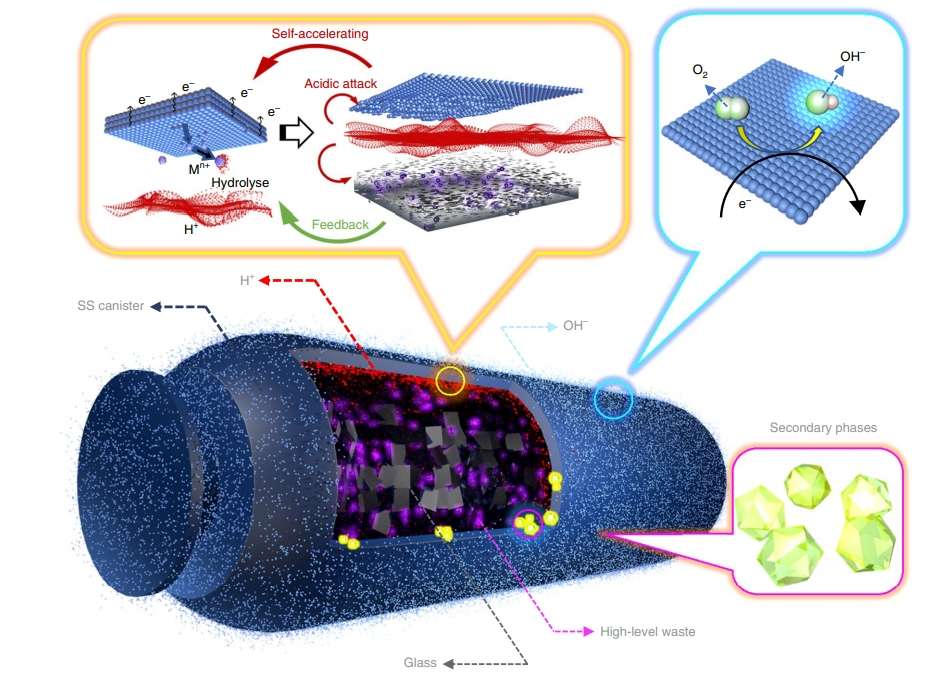
  , New research carried out by Ohio State University has revealed significant problems with one of the key containment methods for high level nuclear waste to be used in the UK. It had previously been assumed that forming high level waste into glass or ceramics within a stainless steel canister would ensure that the waste would be isolated from its surroundings while it underwent radioactive decay. It now appears that the iron within stainless steel canister is reacting with the silicon, a fundamental constituent of glass. This leads to severe localised corrosion at a far higher rate than previously assumed. The full article can be found here.
Followers of Cumbria Trust will be aware that this is not the only example of a canister intended for the UK’s geological disposal programme which has failed to perform as expected. Another is the KBS-3 concept which used copper canisters, where some experiments have shown accelerated corrosion via a pitting process.
 During the previous search for a site to bury the UK’s nuclear waste, the Nuclear Decommissioning Authority (NDA) attempted to deny the existence of these problems. Recently, Radioactive Waste Management (RWM), a subsidiary of the NDA, has become more open in its admission of the difficulties they face. Cumbria Trust welcomes this approach, and has had a constructive dialogue with some senior RWM figures over recent years.
Our recent experience with RWM hasn’t been entirely positive though – they have failed to exclude designated areas (such as national parks and AONBs) in the latest search process, despite overwhelming public opposition to their inclusion, and have refused to discuss this with Cumbria Trust when asked. Cumbrians might ask themselves why RWM are taking this stance.
A new serious problem with stainless steel canisters for nuclear wastes
|
By David Szondy January 28, 2020 A new study by researchers at Ohio State University suggests that stainless steel may not be the best choice for containing high-level nuclear waste. By simulating long-term storage conditions, the team found that the storage materials interact with each other more than previously thought, causing them to degrade faster.
The storage of nuclear waste is more than a perennial political football, it is an existential problem. Whatever one’s opinions about nuclear power or weapons, there are thousands of tons of nuclear waste temporarily stored around the world, meaning that a way must be found to store it all
safely in the long term.
The most important type of nuclear waste is the high-level waste left over from reprocessing nuclear fuel or from nuclear weapon production. Such waste is made up of a complex mixture of radioactive isotopes with half-lives ranging from years to millennia. Though reactors have been operating all over the world for over 75 years, only Finland has started to build a permanent storage facility for such very dangerous waste.
That may show a remarkable lack of political will or even courage, but perhaps this reluctance will turn out to be serendipitous. That’s because the favored way of storing high-level waste is to vitrify it. That is, to mix the isotopes with molten glass or ceramics to form a chemically inert mass that can be sealed in stainless steel canisters before being sealed in an underground storage facility.
That plan may now have to change if the Ohio study is correct. Led by Xiaolei Guo, the team took glasses and ceramics and put them in close contact with stainless steel in various wet solutions for 30 days in conditions similar to those that would be found in the proposed US Yucca Mountain nuclear waste repository.
In the real-life scenario, the glass or ceramic waste forms would be in close contact with stainless steel canisters,” says Xiaolei. “Under specific conditions, the corrosion of stainless steel will go crazy. It creates a super-aggressive environment that can corrode surrounding materials.”
They found that the steel interacted with the glass or ceramic to produce severe and localized corrosion that both damaged the steel and corroded and cracked the glass and ceramics. According to the team, this is because the iron in stainless steel has a chemical affinity with the silicon in glass, accelerating corrosion. This indicates that the current models may not be sufficient to keep this waste safely stored,” says Xiaolei. “And it shows that we need to develop a new model for storing nuclear waste.” The research was published in Nature Materials. Source: Ohio State University |
|
World’s first public database of mine tailings dams aims to prevent deadly disasters
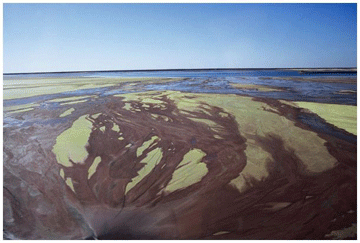
World’s first public database of mine tailings dams aims to prevent deadly disasters https://www.eurekalert.org/pub_releases/2020-01/g-wfp012320.php
Previously unreleased data offer unprecedented view into mining industry’s waste storage practices
GRID-ARENDAL 24 JAN 2020 ENVIRONMENTAL ORGANIZATION GRID-ARENDAL HAS LAUNCHED THE WORLD’S FIRST PUBLICLY ACCESSIBLE GLOBAL DATABASE OF MINE TAILINGS STORAGE FACILITIES. THE DATABASE, THE GLOBAL TAILINGS PORTAL, WAS BUILT BY NORWAY-BASED GRID-ARENDAL AS PART OF THE INVESTOR MINING AND TAILINGS SAFETY INITIATIVE, WHICH IS LED BY THE CHURCH OF ENGLAND PENSIONS BOARD AND THE SWEDISH NATIONAL PENSION FUNDS’ COUNCIL ON ETHICS, WITH SUPPORT FROM THE UN ENVIRONMENT PROGRAMME. THE INITIATIVE IS BACKED BY FUNDS WITH MORE THAN US$13 TRILLION UNDER MANAGEMENT.
Until now, there has been no central database detailing the location and quantity of the mining industry’s liquid and solid waste, known as tailings. The waste is typically stored in embankments called tailings dams, which have periodically failed with devastating consequences for communities, wildlife and ecosystems.
“This portal could save lives”, says Elaine Baker, senior expert at GRID-Arendal and a geosciences professor with the University of Sydney in Australia. “Dams are getting bigger and bigger. Mining companies have found most of the highest-grade ores and are now mining lower-grade ones, which create more waste. With this information, the entire industry can work towards reducing dam failures in the future.”
The database allows users to view detailed information on more than 1,700 tailings dams around the world, categorized by location, company, dam type, height, volume, and risk, among other factors.
“Most of this information has never before been publicly available”, says Kristina Thygesen, GRID-Arendal’s programme leader for geological resources and a member of the team that worked on the portal. When GRID-Arendal began in-depth research on mine tailings dams in 2016, very little data was accessible. In a 2017 report on tailings dams, co-published by GRID and the UN Environment Programme, one of the key recommendations was to establish an accessible public-interest database of tailings storage facilities.
“This database brings a new level of transparency to the mining industry, which will benefit regulators, institutional investors, scientific researchers, local communities, the media, and the industry itself”, says Thygesen.
The release of the Global Tailings Portal coincides with the one-year anniversary of the tailings dam collapse in Brumadinho, Brazil, that killed 270 people. After that disaster, a group of institutional investors led by the Church of England Pensions Board asked 726 of the world’s largest mining companies to disclose details about their tailings dams. Many of the companies complied, and the information they released has been incorporated into the database.
For more information on tailings dams, see the 2017 report “Mine Tailings Storage: Safety Is No Accident” and the related collection of graphics, which are available for media use.
About GRID-Arendal
GRID-Arendal supports environmentally sustainable development by working with the UN Environment Programme and other partners. We communicate environmental knowledge that motivates decision-makers and strengthens management capacity. We transform environmental data into credible, science-based information products, delivered through innovative communication tools and capacity-building services.
Japan could decide on fate of radioactive waste water before the Olympics in July

|
Fukushima Water Waste Decision Could Come Before Tokyo Olympics, VOA, 26 Jan 2020, Japanese officials say a decision on how to deal with radioactive water from the Fukushima nuclear plant could come before the Tokyo Olympics begin in July……
TEPCO officials recently guided a Reuters reporter around the plant, which covers about 3.5 million square meters in northeast Japan. The reporter described large cranes being used to break up major parts of the plant’s structure. The reporter also described operations aimed at removing spent fuel from a reactor. Overall, about 4,000 people are taking part in the cleanup effort, Reuters reported. Some Olympic events are set to take place within 60 kilometers of the destroyed plant, Reuters said. One major part of the cleanup has involved treating and storing contaminated water from the area. TEPCO has predicted that Fukushima will run out of all its storage space for water by 2022. A government group studying future storage solutions said last month that it had decided on two main possible solutions. One solution is to treat the water and then control its release into the Pacific Ocean. The other would be to let the water evaporate. Japanese experts say the government may decide on a solution within the next few months. Either process is expected to take years to complete. Joji Hara is a Tokyo-based spokesman for the power company. He told Reuters that TEPCO has already been making preparations to inform the public about any developments related to Fukushima. “The Olympics are coming, so we have to prepare for that, and TEPCO has to disclose all the information – not only to local communities but also to foreign countries and especially to those people coming from abroad,” Hara said….. oji Hara is a Tokyo-based spokesman for the power company. He told Reuters that TEPCO has already been making preparations to inform the public about any developments related to Fukushima. “The Olympics are coming, so we have to prepare for that, and TEPCO has to disclose all the information – not only to local communities but also to foreign countries and especially to those people coming from abroad,” Hara said. The Olympic torch will be carried through a sports center called J-Village. The center served as an operations base for the Fukushima nuclear plant during the first years after the disaster. The torch will then pass through areas near the destroyed power station on its way to Tokyo. Last month, the environmental group Greenpeace said it found radiation “hotspots” at J-Village, about 18 kilometers south of the plant. When Tokyo was chosen for the 2020 Summer Olympics, Prime Minister Shinzo Abe declared that Fukushima was “under control” and would not affect activities related to the Games. https://learningenglish.voanews.com/a/fukushima-water-waste-decision-could-come-before-tokyo-olympics/5254594.html |
|
Lawmakers seek safeguards on decommissioning of Pilgrim Nuclear Power Station
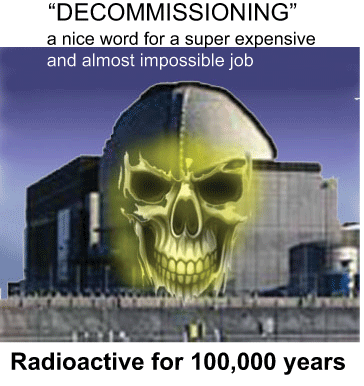 Lawmakers seek safeguards on nuclear plant decommissioning, 22 WWLP.com by: Chris Lisinski: Jan 25, 2020 BOSTON (SHNS) – Lawmakers are seeking additional influence over the decommissioning of the recently shuttered Pilgrim Nuclear Power Station, but a representative for the company conducting the work argued Wednesday that those attempts may be unconstitutional. Lawmakers seek safeguards on nuclear plant decommissioning, 22 WWLP.com by: Chris Lisinski: Jan 25, 2020 BOSTON (SHNS) – Lawmakers are seeking additional influence over the decommissioning of the recently shuttered Pilgrim Nuclear Power Station, but a representative for the company conducting the work argued Wednesday that those attempts may be unconstitutional.
Tom Joyce, a lobbyist for Holtec Decommissioning International, said that bills imposing higher clean-up standards (H 2904 / S 1949) or reforming how decommissioning is funded (S 1948, S 1992) would exceed the state’s authority and infringe on the jurisdiction of the federal Nuclear Regulatory Commission. Joyce told the Joint Committee on Telecommunications, Utilities and Energy that passage of the bills would likely prompt a lawsuit from Holtec, delaying the decommissioning process that the company has said will take seven years…….. Backers of the legislation, though, see the proposals as important steps to protect local stakeholders amid a process that has drawn criticism and a lawsuit from the attorney general. Plymouth Republican Rep. Mathew Muratore, who filed one of the bills that would require decommissioning to meet stricter environmental standards, said his goal is to ensure the land is clean enough to appeal to potential businesses and avoid remaining vacant…… The Pilgrim facility officially ended operations on May 31 after decades of generating power. In August, the NRC approved the transfer of Pilgrim’s license from Entergy to Holtec International to handle its decommissioning. Attorney General Maura Healey, with the backing of the Baker administration, filed a lawsuit seeking to block the transfer until the NRC holds a hearing on concerns about Holtec’s ability to decommission the plant safely, its financial stability and the company’s alleged involvement in a kickback scheme. Speakers at Wednesday’s committee hearing said the case, which also features the Pilgrim Watch group as a party, is still pending. Other bills before the committee (S 1948, S 1992) would charge the owners of any nuclear power station in the state $25 million per year and stash the money into a fund managed by the state treasurer only to be used for postclosure activities. Pilgrim Watch chair Mary Lampert said that money would serve as an “insurance policy” – if decommissioning concluded using the existing trust fund set aside for those purposes, the owners would get back the additional funding plus interest, she said. If not, the state would have a reserve ready to cover any shortfall. Without a safety net backing up the more than $1 billion trust fund, Lampert said taxpayers would be on the hook. “Who’s going to pay the difference? We’re going to pay the difference,” she told the committee. “Holtec cannot be required to do so. Why can it not be required to do so? Because it is a limited liability company and you cannot get blood out of this stone.” Rep. Sarah Peake, a cosponsor of the bill, said Connecticut found itself footing a $480 million bill to complete decommissioning of the former Connecticut Yankee Nuclear Power Plant. Like the legislation concerning cleanup standards, Joyce argued the funding proposals would unconstitutionally circumvent NRC authority…. Muratore and Lampert said they did not agree with that argument, with the latter arguing that the bills in question are all “money bills” and therefore grant the state authority to take additional action. “States have the authority to enact a more conservative (environmental) standard if it applies after NRC has released the site because once the NRC has released the site, it no longer has authority, so there is not a question of preemption,” Lampert said. In his fiscal year 2021 budget unveiled Wednesday, Gov. Charlie Baker proposed language that would allow the Department of Public Health to assess operators of nuclear reactors in the process of being decommissioned — such as Holtec — for the costs of radiation monitoring and emergency planning associated with the project. https://www.wwlp.com/news/state-politics/lawmakers-seek-safeguards-on-nuclear-plant-decommissioning/ |
|
1 This Month
26 September – International Day for the Total Elimination of Nuclear Weapons





PLEASE OPPOSE HR 8255 AND S.3639 – bills would accelerate satellite deployment, with no environmental review or safeguards – https://ncstd5li.quorum.us/campaign/169331/
To see nuclear-related stories in greater depth and intensity – go to https://nuclearinformation.wordpress.com
-
Archives
- September 2026 (305)
- August 2026 (330)
- July 2026 (355)
- June 2026 (287)
- May 2026 (306)
- April 2026 (356)
- March 2026 (251)
- February 2026 (267)
- January 2026 (308)
- December 2025 (358)
- November 2025 (359)
- October 2025 (375)
-
Categories
- 1
- 1 NUCLEAR ISSUES
- business and costs
- climate change
- culture and arts
- ENERGY
- environment
- health
- history
- indigenous issues
- Legal
- marketing of nuclear
- media
- opposition to nuclear
- PERSONAL STORIES
- politics
- politics international
- Religion and ethics
- safety
- secrets,lies and civil liberties
- spinbuster
- technology
- Uranium
- wastes
- weapons and war
- Women
- 2 WORLD
- ACTION
- AFRICA
- Atrocities
- AUSTRALIA
- Christina's notes
- Christina's themes
- culture and arts
- Events
- Fuk 2022
- Fuk 2023
- Fukushima 2017
- Fukushima 2018
- fukushima 2019
- Fukushima 2020
- Fukushima 2021
- general
- global warming
- Humour (God we need it)
- Nuclear
- RARE EARTHS
- Reference
- resources – print
- Resources -audiovicual
- Weekly Newsletter
- World
- World Nuclear
- YouTube
-
RSS
Entries RSS
Comments RSS

