Angst in Nevada over law designating Yucca Mt for a national repository.
 CORTEZ MASTO PRESSES DOE SECRETARY ON PLAN TO SEEK YUCCA ALTERNATIVES Lincoln County Central | Mar 13, 2020 By Humberto Sanchez, The Nevada Independent
Energy Secretary Dan Brouillette sought to reassure Sen. Catherine Cortez Masto on Tuesday that the Department of Energy plans to seek alternatives to storing nuclear waste at Yucca Mountain, but he stopped short of backing an effort to change the law designating the site for a national repository.
At a Senate Energy and Natural Resources Committee hearing Tuesday on the DOE budget, Cortez Masto, who opposes the project, asked Brouillette what DOE would do if Congress provided funds for the Yucca project in the current fiscal year.
‘We will follow the law, obviously, but it’s our intent to look for alternatives to Yucca Mountain,” Brouillette said. “It’s our intent to begin a process, and that’s why we’ve requested $27.5 million in the budget, to do a few things.” ……
Cortez Masto also pressed Brouillette about whether he would support a repeal of the 1987 law that designated the Yucca the spot for the nation to bury its nuclear waste. …..
At a House hearing last week, Brouillette said the administration currently has no plans to change the law even though it would be needed to implement storing waste at temporary sites, which is something DOE has said it could explore……
After seeking funds for the project in his first three budgets, President Donald Trump reversed course in the fiscal 2021 budget blueprint and in a tweet last month said he heard Nevadans on the issue of Yucca. Most Nevada lawmakers and business interest groups oppose the project’s proposed site, which is located about 90 miles from Las Vegas.
Following the release of the budget, Gov. Steve Sisolak, who was in Washington for the annual National Governors Association winter meeting, hand-delivered a letter to the White House calling on Trump to pledge to veto legislation that would advance the Yucca project and “undermine the State’s legal standing or consent requirements.”
The White House has not yet responded according to Sisolak’s office……..
Trump’s decision on Yucca also comes as he looks to win Nevada in his 2020 re-election bid. He lost the state to Hillary Clinton in 2016 by two points.
After the hearing, Murkowski said she welcomed the president’s budget request dropping funds for Yucca because it would allow Congress to focus on advancing legislation to authorize temporary nuclear waste storage rather than expending energy on the Gordian knot that is Yucca.
“We think we have an opportunity to move on our interim waste bill,” Murkowski said. “I always thought that was a path that we needed to pursue as well. And so I think this gives us an opportunity and an opening.”
The energy secretary also said that DOE remains on track for removing the half metric-ton of weapons-grade plutonium the agency secretly shipped to the Nevada National Security Site (NNSS) from the Savannah River site in South Carolina.
In April, Cortez Masto struck a deal with then-Energy Secretary Rick Perry to remove the plutonium beginning in 2021 and getting all of it out by 2026. The DOE disclosed in January 2019 as part of a lawsuit filed by the state to prevent any plutonium shipment—after talks with DOE yielded no resolution—that it had already shipped the plutonium. ……. https://lccentral.com/2020/03/13/cortez-masto-presses-doe-secretary-on-plan-to-seek-yucca-alternatives/
Fukushima, and the ocean’s history of nuclear waste dumping

|
Fukushima: How the ocean became a dumping ground for radioactive waste, DW, 11 Mar 20, The nuclear disaster at Fukushima sent an unprecedented amount of radiation into the Pacific. But, before then, atomic bomb tests and radioactive waste were contaminating the sea — the effects are still being felt today.
Almost 1.2 million liters (320,000 gallons) of radioactive water from the Fukushima nuclear power plant is to be released into the ocean. That’s on the recommendation of the government’s advisory panel some nine years after the nuclear disaster on Japan’s east coast. The contaminated water has since been used to cool the destroyed reactor blocks to prevent further nuclear meltdowns. It is currently being stored in large tanks, but those are expected to be full by 2022. Exactly how the water should be dealt with has become highly controversial in Japan, not least because the nuclear disaster caused extreme contamination off the coast of Fukushima. At the time, radioactive water flowed “directly into the sea, in quantities we have never seen before in the marine world,” Sabine Charmasson from the French Institute for Radiological Protection and Nuclear Safety (IRSN) tells DW. Radiation levels in the sea off Fukushima were millions of times higher than the government’s limit of 100 becquerels. And still today, radioactive substances can be detected off the coast of Japan and in other parts of the Pacific. They’ve even been measured in very small quantities off the US west coast in concentrations “well below the harmful levels set by the World Health Organization,” according to Vincent Rossi, an oceanographer at France’s Mediterranean Institute of Oceanography (MIO). But that doesn’t mean there’s no risk, says Horst Hamm of the Nuclear Free Future Foundation. “A single becquerel that gets into our body is enough to damage a cell that will eventually become a cancer cell,” he says. A study from the European Parliament reached a similar conclusion. The research found that “even the smallest possible dose, a photon passing through a cell nucleus, carries a cancer risk. Although this risk is extremely small, it is still a risk.” And that risk is growing. Radioactive pollution in the ocean has been increasing globally — and not just since the disaster at Fukushima. Atomic bomb tests In 1946, the US became the first country to test an atomic bomb in a marine area, in the Pacific Bikini Atoll. Over the next few decades, more than 250 further nuclear weapons tests were carried out on the high seas. Most of them (193) were conducted by France in French Polynesia, and by the US (42), primarily in the Marshall Islands and the Central Pacific. But the ocean wasn’t just being used as a training ground for nuclear war. Until the early 1990s, it was also a gigantic dump for radioactive waste from nuclear power plants. From 1946 to 1993, more than 200,000 tons of waste, some of it highly radioactive, was dumped in the world’s oceans, mainly in metal drums, according to the International Atomic Energy Agency (IAEA). Several nuclear submarines, including nuclear ammunition, were also sunk during this time. Is the ocean a perfect storage site? The lion’s share of dumped nuclear waste came from Britain and the Soviet Union, figures from the IAEA show. By 1991, the US had dropped more than 90,000 barrels and at least 190,000 cubic meters of radioactive waste in the North Atlantic and Pacific. Other countries including Belgium, France, Switzerland and the Netherlands also disposed of tons of radioactive waste in the North Atlantic in the 1960s, 70s and 80s. “Under the motto, ‘out of sight, out of mind,’ the dumping of nuclear waste was the easiest way to get rid of it,” says Horst Hamm. To this day, around 90% of the radiation in the ocean comes from barrels discarded in the North Atlantic, most of which lie north of Russia or off the coast of Western Europe. “The barrels are everywhere,” says ecologist Yannick Rousselet of Greenpeace France. He was present in 2000 when the environmental organization used submarines to dive for dumped drums a few hundred meters off the coast of northern France, at a depth of 60 meters (196 feet). “We were surprised how close they were to the coast,” Rousselet says. “They are rusty and leaking, with the radiation clearly elevated.” Germany also implicated In 1967, Germany also dumped 480 barrels off the coast of Portugal, according to the IAEA. Responding to a 2012 request for information from the Greens about the condition of those barrels, the German government wrote: “The barrels were not designed to ensure the permanent containment of radionuclides on the sea floor. Therefore, it must be assumed that they are at least partially no longer intact.” Germany and France don’t want to salvage the barrels. And even Greenpeace activist Yannick Rousselet says he sees “no safe way to lift the rusted barrels” to the surface. That means nuclear waste will likely continue to contaminate the ocean floor for decades to come. For Horst Hamm, the long-term consequences are clear. The radiation will be “absorbed by the marine animals surrounding it. They will eventually end up caught in fishing nets, and come back to our plates,” he says. In its 2012 response to the Greens, however, the German government described the risk to humans from contaminated fish as “negligible.” Rousselet sees things differently: “The entire area along the coast is contaminated by radiation — not just in the sea, in the grass, in the sand, you can measure it everywhere.” Radioactive dumping ground The main reason behind the radiation along the northern French coastline isn’t the underwater barrels, but rather the nuclear fuel reprocessing plant at La Hague. It is located directly on the coast and “legally discharges 33 million liters of radioactive liquid into the sea each year,” says Rousselet. He thinks it’s scandalous. In recent years, La Hague has also been the scene of several incidents involving increased radioactivity levels. The dumping of nuclear waste in drums was banned in 1993 by the London Convention on the Prevention of Marine Pollution. But discharging liquid contaminated with radiation into the ocean is still permitted internationally. Spike in cancer rates According to a study by the European Parliament, statistics show cancer rates are significantly higher in the region surrounding La Hague. Cancer rates are also high near the nuclear processing plant in Sellafield in northern England. A study from 2014 concluded that the total amount of radioactivity discharged into the sea from the Sellafield plant over the years is equivalent to the amount released by the nuclear meltdown at Fukushima. The report say a link to health effects “cannot be ruled out” even if there is no clear evidence to date of a link between illness and radioactive discharges from nuclear facilities. “The exact effects of radioactive radiation are extremely difficult to measure and prove. We only know that it has an impact,” says Rousselet, adding that it’s crucial to walk away from everything that causes radioactive waste. https://www.dw.com/en/fukushima-how-the-ocean-became-a-dumping-ground-for-radioactive-waste/a-52710277 Dumping more waste at Fukushima In Fukushima, the operating company of the Tokyo Electric Power Company nuclear plant claims that before the cooling water is discharged into the sea as planned, all 62 radioactive elements will be filtered down to safe levels — except for the isotope tritium. The advisory panel in Tokyo considers discharging the cooling water into the sea to be “safer” than other alternatives, such as evaporating the water. Just how harmful tritium is to humans is a source of controversy. According to the plant operator, the concentration of tritium in the collection tanks is sometimes much higher than that of conventional cooling water from nuclear power stations. “The local fishermen and residents cannot accept the discharge of water,” Takami Morita of the National Research Institute of Fisheries Science said in a press release. While fish pollution levels are below the harmful limit, demand for fish from the region has dropped to one-fifth of what it was before the disaster. Releasing the cooling water into the sea “is a good method because of the diluting properties of the water,” Sabine Charmasson of the IRSN says. “There aren’t any real problems on the security side, but it’s difficult, because there are also social implications. It might be an appropriate method, but it’s never easy to release radioactive substances into the environment.” In a press release, Greenpeace said: “There is no justification for additional, deliberate radioactive pollution of the marine environment or atmosphere.” https://www.dw.com/en/fukushima-how-the-ocean-became-a-dumping-ground-for-radioactive-waste/a-52710277 |
|
The lies about nuclear waste dumping in Scotland – from U.S. nuclear submarines
We were lied to in the past about dumping of nuclear waste https://www.thenational.scot/politics/18295704.lied-past-dumping-nuclear-waste/
By Iain Ramsay, Greenock & Inverclyde 11 Mar 20, QUITE a few years back, when I was a local SNP candidate here in Inverclyde, the local small boat owners and fishermen’s association approached me with their worries and problems, which resulted in me taking up the cudgels on their behalf.One of their spokesmen, who had a prawn fishing boat, was the late Brian Penny, who explained the problem and gave me the astounding fact that all the sea life had died in the Holy Loch.
The obvious cause of this was the USA nuclear submarine base of Polaris submarines, which must be discharging or dumping nuclear waste into the loch. With the help of the Greenock Telegraph we made a complaint to the far-off powers in Westminster who (according to them) sent a naval investigation team and took samples of sand, and water from the Loch, and assuring all concerned, that there was no need for any worry, as their tests had shown that the Loch was clean and no contamination was found.
 So who was to be believed, our local men who worked the river, or the boffins from the Anglo/Brit Navy? It was their expert word against our on-the-spot working fishermen. The result was that, as usual, nothing happened, until long after the USA navy left, the commander of the Holy Loch base retired and confessed to dumping tons of radio active waste into the loch.
Along with this admission was his statement that the base would have been illegal in America, as such nuclear bases have got to be more than 20 miles from the nearest town.This Holy Loch base was bang in the middle of the river Clyde, and only two miles from Greenock, the second-largest town in Scotland.
This confession by this former USA commander made the Royal Navy tests a total lie. No such tests were made. Proof of the pudding resulted in a permanently based dredger, working for well over a year on the very spot where the American commander’s mother ship was moored. I hope since that panic clean-up, sea life may have made a comeback, although some types of nuclear waste are a danger for a hundred years or more. I hope the USA were back charged for this long and hazardous clean-up, or did we taxpayers foot that bill also?
This doesn’t end the story of contamination, and if anything is only the beginning of a long line of attacks on our fragile environment. The English-flag-flying Royal Navy have taken over where the Yankees left off. Just across the river we have a nuclear submarine base, which not only admits to discharging radioactive waste from Faslane into the Gairloch but announces that this will increase by 50% when the new nuclear subs arrive.
The fact is, the only enemy attack we have to thole right now is from this highly dangerous Cobalt-60 and Tritium cocktail, a GIFT from the Royal Navy. However if you look up GIFT in a German dictionary, it means poison or venom. There are no contingency plans for our children’s health, when only less than two miles away we have a unique seawater swimming pool in Gourock which will eventually filter this contamination through, to be shared by all.
No, to Mr Donald Doull, the base commander, don’t install that new pipeline which will spew out this dangerous filth into our beloved Clyde. Rather fill your navy tankers with the effluent, and sail it down to the River Thames, when opposite the Westminster Parliament discharge this contaminated water into the river. Let’s see how long the Londoners would tolerate such muck spreading on their patch. You will find the English are not as gullible as to accept your stupid comment that this waste is of an acceptable radioactive level. Acceptable by whom, may I ask?
U.S. Department of Energy’s plans could mean delay in Hanford nuclear waste clean-up
|
Nuclear waste cleanup efforts in Washington could be delayed https://triblive.com/news/world/nuclear-waste-cleanup-efforts-in-washington-could-be-delayed/, ASSOCIATED PRESS | Wednesday, March 11, 2020 RICHLAND, Wash. — The Department of Energy has announced priority plans for environmental cleanup nationwide and indicates a slower process for the decommissioned nuclear site in Washington state, a report said.
The focus at the Hanford Site will be to start treating waste at the $17 billion vitrification plant, but the report does not detail other work at the 580-square-mile site, the Tri-City Herald reported Tuesday. The report does not mention moving radioactive capsules to safer storage and cleaning up a radioactive spill under one of the buildings a mile north of Richland. “It is shocking that DOE would propose to delay projects like the cesium-strontium capsules and the 324 Building contamination, which pose such great risks to the workers and public,” said Tom Carpenter, executive director for Hanford Challenge, a watchdog and worker advocacy group. The “Environmental Management Vision 2020-2030: A Time of Transition and Transformation” report may also signal delays and decreased commitment to current plans for up to 10 years, including cleanup of contaminated groundwater flowing toward the Columbia River, the newspaper said. “Proactively addressing these hazards before they pose an imminent risk is critically important, and frankly, they can’t wait until sometime in the 2030s,” said David Reeploeg, the Tri-City Development Council vice president for federal program. A budget request for upcoming year by President Donald Trump’s administration proposes cleaning up 56 gallons of radioactive waste held in underground tanks at the site. Reeploeg added that he was pleased there is some commitment to treat tank waste. Hanford produced plutonium for nuclear weapons during the Cold War and World War II. |
|
Nuclear reactors on the sea floor – Russia’s costly problem

Lifting Russia’s accident reactors from the Arctic seafloor will cost nearly €300 million, https://thebarentsobserver.com/en/ecology/2020/03/lifting-russias-accident-reactors-arctic-seafloor-will-cost-nearly-eu300-millionExperts are discussing the framework for safe lifting of dumped reactors from four submarines and uranium fuel from one icebreaker reactor in the Kara Sea, in addition to one sunken nuclear submarine in the Barents Sea. By Thomas Nilsen 8 Mar, 20,
Russian and European experts agree that the dumped Soviet-era nuclear reactors in the Kara Sea can’t stay on the seafloor forever.
The Soviet Union used the waters east of Novaya Zemlya to dump accidental reactors, spent nuclear fuel and solid radioactive waste from both the navy and the fleet of nuclear-powered civilian icebreakers.
About 17,000 objects were dumped in the period from the late 1960s to the late 1980s.
Most of the objects are metal containers with low- and medium level radioactive waste. The challenge today, though, are the reactors with high-level waste and spent uranium fuel, objects that will pose a serious threat to the marine environment for tens of thousands of years if nothing is done to secure them.
According to the Institute for Safe Development of Nuclear Energy, part of Russia’s Academy of Science, the most urgent measures should be taken to secure six objects that contain more than 90% of all the radioactivity.
It is the information site for Russia’s submarine decommissioning program that informs about the plans.
The reactors from the submarines K-11, K-19 and K-140, plus the entire submarine K-27 and spent uranium fuel from one of the old reactors of the Lenin-icebreakers have to be lifted and secured.
Also, the submarine K-159 that sank north of Murmansk while being towed for decommissioning in 2003 have to be lifted from the seafloor, the experts conclude.
Special priority should be given to the two submarines K-27 in the Kara Sea and K-159 in the Barents Sea.
The study report made for Rosatom and the European Commission has evaluated the costs of lifting all six objects, bringing them safely to a yard for decommissioning and securing the reactors for long-term storage.
The estimated price-tag for all six will €278 millions, of which the K-159 is the most expensive with a cost of €57,5 millions. Unlike the submarines and reactors that are dumped in relatively shallow waters in the Kara Sea, the K-159 is at about 200 meters depth, and thus will be more difficult to lift.
Lifting the K-27, transporting to a shipyard for decommissioning and long-term storage in Saida Bay will come at a price of €47,7 millions the report reads.
The work can be done over an eight years period, according to the expert.
But, as the expert-group underlines, the €278 millions funding does not exist in any Russian Federal budgets today.
Nuclear and other toxic wastes dumped in Beaufort’s Dyke, which lies between Scotland and Northern Ireland
The National 4th March 2020, FOR decades, Scotland has been used by the Ministry of Defence to dump
everything from nuclear waste to unwanted munitions. For example,
Beaufort’s Dyke, which lies between Scotland and Northern Ireland, is
packed with laboratory waste, chemical munitions and artillery rockets. The
decision by the MoD to use it as a dumping ground has effectively ruled out
any possibilty of using that crossing for a Scotland to Northern Ireland
bridge (if ever such a thing was viable in the first place).
https://www.thenational.scot/news/18280377.uk-used-scotland-nuclear-dumping-ground-decades/
Kazakhstan local residents may be stuck with costs of decommissioning nuclear reactor
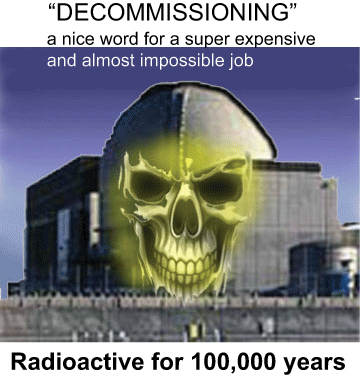 Local residents pay for decommissioning of Kazakhstan’s BN-350 reactor https://www.neimagazine.com/news/newslocal-residents-pay-for-decommissioning-of-kazakhstans-bn-350-reactor-7796914 27 February 2020 During a public hearing of the feasibility study on the environmental impact of decommissioning of the BN-350 fast reactor in Kazakhstan, Bulat Zhumakanov, representative of regional utility MAEK-Kazatomprom, said residents Aktau in Mangystau province, where the reactor is sited, will continue to pay for its maintenance.The BN-350, a sodium-cooled industrial fast neutron reactor, was physically launched in 1972, and was connected to the Mangystau power system in 1973. In 1998, it was closed down and formally began decommissioning the following year. Local residents pay for decommissioning of Kazakhstan’s BN-350 reactor https://www.neimagazine.com/news/newslocal-residents-pay-for-decommissioning-of-kazakhstans-bn-350-reactor-7796914 27 February 2020 During a public hearing of the feasibility study on the environmental impact of decommissioning of the BN-350 fast reactor in Kazakhstan, Bulat Zhumakanov, representative of regional utility MAEK-Kazatomprom, said residents Aktau in Mangystau province, where the reactor is sited, will continue to pay for its maintenance.The BN-350, a sodium-cooled industrial fast neutron reactor, was physically launched in 1972, and was connected to the Mangystau power system in 1973. In 1998, it was closed down and formally began decommissioning the following year.
MAEK-Kazatomprom has supplied Mangystau region of Kazakhstan with electricity, heat and water since 1967. It is responsible for three gas and oil power plants with total installed capacity 1330MWe, a desalination plant and for decommissioning the BN-350 reactor. According to representatives of the development company, METR, preliminary information, puts the total cost of decommissioning the BN-350 at KZT125 billion ($330m) excluding inflation. Zhumakanov said this year Kazakhstani Wealth Fund Samruk-Kazyna has allocated KZT1.2 billion for the maintenance of the reactor. However, funds will still be taken from local residents through the electricity tariff for repair work. An application has been made to the federal budget, but whether money will be allocated from the republican budget in future “remains open”, he said. The tariff has been in place for 20 years and residents have been pressing the government to provide the necessary funding. Decommissioning of the BN-350 reactor is planned in three stages:
From 1999 to 2016, with the financial support of the US government, nuclear fuel was removed, primary circuit sodium was treated to remove from caesium radionuclides, a project was implemented to process the used fuel, to passivate sodium residues in the first circuit, and other work. The decommissioning process must be continued and cannot be delayed, said representatives of MAEK-Kazatomprom. The tanks in which radioactive waste is stored have been in operation since 1972, and need upgrading. Some 3000 cubic metres of liquid radioactive waste, mainly sodium and caesium-137, which has a half-life of 30 years, are stored at MAEK-Kazatomprom. |
|
Sweden now faces years of nuclear reactor shutdowns and waste disposal problems
Sweden prepares for a decade of nuclear decommissioning, NS Energy, By Kristina Gillin 27 Feb 2020 ,
Sweden is preparing to dismantle and demolish six large power reactors on three sites over the coming years.
By the end of 2020, half of Sweden’s nuclear reactors will have been permanently shut down for decommissioning. The six large reactors are expected to undergo nuclear decommissioning in Sweden over the next decade.
Besides these, the Ågesta prototype reactor, a combined heat and power plant is about to commence dismantling.
Nuclear decommissioning at Sweden’s Barsebäck nuclear power plant
The twin units at Barsebäck, a few miles across the straight from Denmark, ceased to generate power in 1999 and 2005, respectively.
After shutdown, all spent fuel was removed and shipped to Sweden’s central interim storage facility (Clab) in Oskarshamn. Major decontamination of systems was also done early. However, dismantling had to wait, due to a lack of facilities for storage or disposal of decommissioning waste………
Funding and nuclear waste disposal in Sweden
Owners of nuclear power plants in Sweden have a statutory duty to dispose of their wastes. They are also required to set aside funding for waste management and nuclear decommissioning in Sweden. The funding is held in the Nuclear Waste Fund, a segregated Swedish government fund.
To fulfil the obligations, they jointly own the Swedish Nuclear Fuel and Waste Management Co (SKB). SKB’s scope covers disposal of most radioactive waste streams, interim storage of spent fuel and transportation between the various sites.
SKB is also responsible for compiling cost estimates for decommissioning and waste management every three years.
This to ensure that payments into the Nuclear Waste Fund are sufficient to cover future costs.
According to the 2019 estimates, the total cost of waste disposal, spent fuel storage and decommissioning is approximately SEK 147 billion (around €14 billion). Of this, about SEK 53 billion (around €5 billion) has been spent to date.
These figures include most of SKB’s scope but exclude the costs of near-surface disposal facilities for very low-level waste at Oskarshamn, Ringhals and Forsmark.
The majority of low- and intermediate-level waste from all Swedish reactors will be disposed of in SFR, a shallow geological repository for short-lived waste on the Forsmark nuclear site.
SFR has been in operation since 1988 but is currently licensed for operational waste only. To accommodate decommissioning waste, SKB plans to expand SFR’s capacity from 63,000 to 180,000 m3. An application for the expansion was submitted in 2014.
Pending regulatory approvals, construction of the new rock vaults will take place from 2023 to 2029. https://www.nsenergybusiness.com/news/nuclear-decommissioning-sweden/?fbclid=IwAR1me9D6hKLIPYP8Hp9tRS7Fgt6ksTbZ9t0Gvpo8IHCHgjIkeBqRnDgO79
Radioactive wastes into River Clyde could have devastating effects on community and wildlife
 Row over MoD River Clyde nuclear waste dump plans Row over MoD River Clyde nuclear waste dump plans
By Herald Scotland Online 1 Mar 20, Scotland’s national environment watchdog has denied claims the Ministry of Defence (MoD) is planning to increase discharges of radioactive waste into the River Clyde.Under the plans, liquid waste from reactors which power Royal Navy submarines at the Faslane and Coulport nuclear bases would be drained into the Gare Loch via a new pipeline.
Campaigners warned the rising discharges could have a devastating effect on surrounding wildlife and communities after a report by investigative journalism platform The Ferret stated emissions of one byproduct, cobalt-60, could rise by more than 50 times. …….. The Ferret reported the discharge of cobalt-60 would rise to 23.4 million units of radioactivity annually – around 52 times the current level. It added emissions of a second substance, known as tritium, would increase by 30 times to around 175,000 units, or ‘megabecquerels’, every year…….. SEPA’s public consultation is open until 13th Match and we welcome all responses. All responses will be reviewed in detail to ensure we continue to safeguard the environment and human health.” The bases are due to receive at least five more submarines in the coming years, including an ageing Trafalgar vessel and three new Astute submersible. The Ferret said a 50-strong group of Nuclear-Free Local Authorities (NFLA) had objected to the discharges. NFLA Scotland convener, Glasgow SNP councillor Feargal Dalton told The Ferret: “NFLA is particularly concerned about the considerable uncertainties in modelling doses and an under-appreciation of the effects of tritium”. “There are effective alternatives to nuclear powered submarines, as pioneered by the likes of Japan, and the Ministry of Defence should make a serious attempt to look at them.” https://www.heraldscotland.com/news/18272691.mod-planning-dump-50-times-nuclear-waste-river-clyde/ |
|
New Mexico’s elected leaders waver on Holtec’s nuclear waste plan
|
Congresswoman: Science Should Guide Nuclear Storage Decision, By The Associated Press, Feb. 25, 2020, ALBUQUERQUE, N.M. — A member of New Mexico’s congressional delegation wants to ensure a “sound and robust” scientific review is done before federal regulators decide whether to sign off on plans for a multibillion-dollar temporary storage facility for spent nuclear fuel. U.S. Rep. Xochitl Torres Small in an interview with The Associated Press acknowledged that the growing stockpile of used fuel at commercial reactors around the U.S. is a national problem and that elected leaders need to ensure New Mexico does not pay an unfair price as part of the solution. “My concern is making sure that we’re looking at the science and that we are doing our best to evaluate based on that, not based on economic considerations or based on fear or bias, but based on how do we solve a challenge that is a national challenge,” the Democrat said. While elected leaders in Eddy and Lea counties support the project, it has garnered fierce opposition from nuclear watchdog groups, New Mexico Gov. Michelle Lujan Grisham and other members of the state’s congressional delegation. They are concerned about the state becoming a permanent dump since the federal government is far from having any long-term plan for dealing with the tons of spent fuel building up at nuclear power plants around the nation……. New Jersey-based Holtec International is seeking a 40-year license from federal regulators to build what it has described as a state-of-the-art complex near Carlsbad. The site in southeastern New Mexico is remote and geologically stable, the company has said. Holtec executives also have said the four-layer casks that would hold the spent fuel would be made of thick steel and lead and transported on a designated train with guards and guns. The Nuclear Regulatory Commission is in the process of considering Holtec’s application. It could be next year before a decision is made. Torres Small said the clock is ticking for elected leaders to find a permanent solution as spent fuel is now stored at a variety of dangerous locations scattered across the U.S., including near important waterways. New Mexico already is home to the U.S. government’s only underground repository for Cold War-era waste generated over decades by nuclear research and bomb-making. Some watchdogs are concerned the Waste Isolation Pilot Plant could become the final destination for other types of waste as the government prepares to ramp up production of the plutonium cores that serve as triggers for weapons in the nation’s nuclear arsenal. Torres Small couched her support for production of the plutonium coresby saying New Mexico has a long history of bearing a burden when it comes to nuclear development and waste. She said the focus should be on making sure the state and its residents are kept “whole and strong” as national security obligations are met. https://www.nytimes.com/aponline/2020/02/25/business/ap-us-nuclear-waste-new-mexico.html  |
|
Is Cumbria about to become the world’s plutonium dump?

 February 24, 2020During the last search process for a burial site for the UK’s nuclear waste, which ended in January 2013, the Nuclear Decommissioning Authority (NDA) offered repeated assurances that only the UK’s nuclear waste would be buried in a UK Geological Disposal Facility (GDF). Many questioned at the time whether the NDA could be trusted to keep its word, and it became apparent in mid-2012 that it could not be trusted. The NDA had accepted 4 tonnes of plutonium from Germany in a ‘commercially advantageous arrangement’ according to Charles Hendry, the UK’s Energy Minister at the time. In other words the NDA had been paid to take ownership of the German plutonium.
Poor quality nuclear spent fuel casks at Pilgrim Nuclear Power Station
 Push for better storage of spent Pilgrim Nuclear Power Station fuel, Cape Cod Times, Christine Legere Feb 23, 2020
Citizen activists in Barnstable County communities will ask voters at spring town meetings, or via local election ballots, to support an advisory question that would direct Gov. Charlie Baker and state legislators to require that the radioactive waste is stored in “better quality” dry casks than those planned for use, and that the casks are protected by earthen berms or within enclosures with heightened security.,
The Cape Downwinders wrote the advisory question.
“Fifty percent of Americans live within 50 miles of a nuclear power plant,” Turco said. “Safety is a right. Our petition is to raise consciousness: educate the public about ongoing issues at Pilgrim.”
The selectmen in Orleans and Brewster voted to put the advisory question on their respective spring election ballots, Turco said. In Bourne, the question will go on the town meeting warrant.
Other Barnstable County communities will be presented with the advisory in the coming weeks.
Entergy Corp., Pilgrim’s longtime owner, sold the plant to Holtec International, a New Jersey-based company that will handle decommissioning, spent fuel management and site cleanup.
Turco and other Pilgrim critics have complained that Holtec has a conflict of interest since the company uses dry casks that it manufactures. The Holtec Hi-Storm 100s the company uses are concrete-encased stainless steel canisters that are a little over a half-inch thick.
“That’s just three-eighths of an inch thicker than a Yeti cup,” Turco said.
There is no way to monitor the steel canisters once they are sealed, critics say, and there is no aging management plan.
Concern also has been expressed over Holtec’s plan to store spent fuel on a concrete pad just a short distance from a well-traveled road. A vanity fence, rather than earth berms or enclosures, will block the view from the street.
“In this day and age, Pilgrim is an open door for any bad actors who want to cause serious damage to our country,” Turco said. “Nuclear waste is a predeployed nuclear weapon. Its safe storage is being ignored.”………
tate Attorney General Maura Healey filed a motion to intervene in the license transfer several months ago, but the motion remains under review by the Nuclear Regulatory Commission.
Frustrated by the lack of action, Healey sued the NRC last fall in U.S. District Court for approving the transfer of Pilgrim’s license from Entergy Corp. to Holtec International without first listening to what state officials and the public had to say about it. The case is pending.
Healey contends that Holtec is inexperienced in decommissioning and will likely run out of money before the job is done. Holtec will use the plant’s decommissioning trust fund, which contains $1.1 billion in ratepayer money.
The Nuclear Decommissioning Citizens Advisory Panel, which is made up of local officials, representatives from state agencies and members of the public, has been frustrated by Holtec’s lack of response during monthly meetings regarding decommissioning and spent fuel.
Holtec’s continuing refusal to answer the advisory panel and the public’s questions about the safety and expected longevity of the company’s dry cask storage technology is not only disturbing, it’s outrageous,” Sean Mullin, chairman of the advisory panel, wrote in an email. “The citizens of the Commonwealth have a right to know how, for example, Holtec can accurately monitor the sealed casks for problems and, if detected, how these can be repaired.”
The NRC director of the Division of Nuclear Materials Safety, a senior health physicist, senior materials engineer and chief of the NRC’s Storage and Transportation Licensing Branch will attend an advisory panel meeting set for 6:30 p.m. Monday in Plymouth Town Hall to discuss the region’s concerns.
Follow Christine Legere on Twitter: @ChrisLegereCCT. https://www.capecodtimes.com/news/20200223/push-for-better-storage-of-spent-pilgrim-nuclear-power-station-fuel
President Trump, eyeing the election campaign contradicts his administration on Nevada nuclear waste dump
 One Side of a Nuclear Waste Fight: Trump. The Other: His Administration.
The president, eyeing the battleground state of Nevada, has made clear he opposes a nuclear waste site at Yucca Mountain, reversing a policy that was made in his name.
-
Mr. Trump, who in recent weeks seemed to end his administration’s support for moving nuclear waste to Yucca Mountain, a proposal that had been embraced by his appointees for three years despite his own lack of interest
- “Why should you have nuclear waste in your backyard?” Mr. Trump asked the crowd at a rally in Las Vegas on Friday, to applause, noting that his recently released budget proposal did not include funding to license the site, as previous ones had. applause, noting that his recently released budget proposal did not include funding to license the site, as previous ones had.
|
The story of the muddled and shifting position on Yucca Mountain is partly one of an administration focused on Mr. Trump’s re-election chances in a battleground state that he lost to Hillary Clinton by two percentage points in 2016. But it is also emblematic of a White House where the president has strong impulses on only a narrow set of issues, and policy is sometimes made in his name regardless of whether he approves of it. ………..
The president made his latest move after a monthslong policy debate inside the White House over finally breaking with support for Yucca, officials said…….
Nationally, Republicans have long favored the proposal, which was developed in the late 1980s and signed into law by President George W. Bush in 2002. But Nevada politicians of both parties have remained steadfastly opposed to the policy, which is deeply unpopular in the state…….
most Republican leaders outside of the state remained supportive. While the plans for Yucca remain law as set under Mr. Bush, Congress has never moved to fund it since…..
previous energy secretary, Rick Perry, supported the measure, and as the Office of Management and Budget listed $120 million in the president’s budget to restart the licensing process of the site. It was listed as one of the administration’s priorities. ……..
At a House energy subcommittee hearing two weeks ago, Mark W. Menezes, the president’s nominee for deputy energy secretary, prompted alarm at the White House when he said, “What we’re trying to do is to put together a process that will give us a path to permanent storage at Yucca.” After White House officials expressed concern, Mr. Menezes put out a statement saying that he fully supported Mr. Trump’s decision.
Whether that will be enough to reassure Nevadans about Mr. Trump’s intentions remains to be seen. “Nevadans aren’t going to just forget that Trump spent the first three years of his administration trying to treat the state as a dumping site,” said Rebecca Kirszner Katz, a former adviser to Mr. Reid. “Donald Trump had an opportunity to be on the right side of a major issue in a huge battleground state, and he bungled it.” https://www.nytimes.com/2020/02/23/us/politics/trump-yucca-mountain-nevada.html
AT THE BEGINNING Before the 2018 midterm elections, Senator Dean Heller stood with President Trump in the glittering Trump International Hotel near the Las Vegas Strip, looking out from the top floor, and pointed.
“I said, ‘See those railroad tracks?’” Mr. Heller, a Nevada Republican who lost his seat later that year, recalled in an interview. Nuclear waste to be carted to Yucca Mountain for permanent storage would have to travel along the tracks, within a half-mile of the hotel, Mr. Heller said.
I think he calculated pretty quickly what that meant,” Mr. Heller said. “I think it all made sense. There was a moment of reflection, of, ‘Oh, OK.’” Whether the waste would have traveled along those particular tracks is a subject of debate. But the conversation appears to have helped focus Mr. Trump, who in recent weeks seemed to end his administration’s support for moving nuclear waste to Yucca Mountain, a proposal that had been embraced by his appointees for three years despite his own lack of interest. bungled it.” https://www.nytimes.com/2020/02/23/us/politics/trump-yucca-mountain-nevada.html
|
|
No vote on high level nuclear waste storage in New Mexico, despite Memorial opposing the dump
 New Mexico lawmakers unopposed to high-level nuclear waste storage as House kills memorial. Adrian Hedden, Carlsbad Current-Argus Feb. 24, 2020 A measure that would have called on the New Mexico Legislature to formally oppose the transportation and storage of high-level nuclear waste, as a project was ongoing to do so the southeast corner of the state, died while in committee as the 2020 session closed without a vote.
House Memorial 21 did pass the House Energy and Natural Resources Committee on a 8-5 vote during a Feb. 1 hearing, but was never brought to a vote on the House floor and thus did not proceed to be signed into law.
HM 21, sponsored by Matthew McQueen (D-50) cited an “unacceptable risk” created by the storage of high-level waste from the eastern United States, which the memorial cited as holding “90 percent” of nuclear reactors.
The memorial also said the risk would be spread to “40 other state” through the transportation of spent nuclear fuel by rail.
The facility that the memorial blamed for creating such as risk was proposed by Holtec International, which applied for a license to build a consolidated interim storage facility (CISF) for spent nuclear fuel rods in a remote location between Carlsbad and Hobbs.
New Mexico Gov. Michelle Lujan Grisham and State Land Commissioner Stephanie Garcia Richard both voiced opposition to the project last year, with the Lujan Grisham calling it “economic malpractice” as it could disrupt nearby oil and gas agriculture industries.
“The creation of a high-level radioactive waste storage facility in New Mexico jeopardizes the state’s existing industrial, agricultural and ranching businesses, runs counter to the promotion of tourism and the diversification of New Mexico’s economy and threatens the health and safety of New Mexico residents,” read the memorial….
McQueen worried the facility, although it was proposed as a temporary or “interim” facility could become permanent as a permanent repository was unlikely to be opened during the 40-year term of Holtec’s license application.
“I also believe this is a temporary benefit for really long-term or permanent liability for Mew Mexico. The facility threatens our existing economic activity, not only in the area but statewide,” he said during the Committee hearing.
“It’s amazing how something that temporary pretty much becomes permanent. I believe New Mexico should not be the nation’s nuclear waste dumping ground.”
A New Mexico Senate bill aimed at expanding the State’s oversight to include privately-owned storage for high-level waste also died after it was voted down last week on the Senate floor…… . https://www.currentargus.com/story/news/local/2020/02/24/new-mexico-lawmakers-unopposed-high-level-nuclear-waste-storage/4856468002/
Plans to remove Lewiston nuclear waste
Corps of Engineers seeks design planners for removal of Lewiston nuclear waste, https://buffalonews.com/2020/02/24/corps-of-engineers-seeks-design-planners-for-removal-of-lewiston-nuclear-waste/By Thomas J. ProhaskaFebruary 25, 2020 The Army Corps of Engineers announced Friday that it will compile a list of companies qualified to design the removal of 278,000 cubic yards of nuclear and chemical waste stored in Lewiston. The actual bidding for the design plan is anticipated later this year.
The Niagara Falls Storage Site at 1397 Pletcher Road features a 10-acre containment structure that holds waste from the World War II atomic bomb project and postwar nuclear work by Niagara Falls-area industries. The structure is 990 feet long, 450 feet wide and a maximum of 34 feet high.
The Corps of Engineers decided in 2018 that everything in it will be removed, treated and shipped elsewhere for disposal. The Corps’ notice to potential bidders said a decision is expected in 2023 on what remediation the rest of the 191-acre storage site may need after the waste is removed.
Engineering firms have until March 18 to submit their qualifications to join the bidding list.
1 This Month
23-25 October – on Zoom – World BEYOND War’s annual global conferenc


Shut down the radiation-damaged Heysham nuclear reactors now
To see nuclear-related stories in greater depth and intensity – go to https://nuclearinformation.wordpress.com

Say No to NASA’s Reckless Nuclear Reactor on the Moon
Say No to NASA’s Reckless Nuclear Reactor on the Moon
-
Archives
- October 2026 (169)
- September 2026 (339)
- August 2026 (330)
- July 2026 (355)
- June 2026 (287)
- May 2026 (306)
- April 2026 (356)
- March 2026 (251)
- February 2026 (267)
- January 2026 (308)
- December 2025 (358)
- November 2025 (359)
-
Categories
- 1
- 1 NUCLEAR ISSUES
- business and costs
- climate change
- culture and arts
- ENERGY
- environment
- health
- history
- indigenous issues
- Legal
- marketing of nuclear
- media
- opposition to nuclear
- PERSONAL STORIES
- politics
- politics international
- Religion and ethics
- safety
- secrets,lies and civil liberties
- spinbuster
- technology
- Uranium
- wastes
- weapons and war
- Women
- 2 WORLD
- ACTION
- AFRICA
- Atrocities
- AUSTRALIA
- Christina's notes
- Christina's themes
- culture and arts
- Events
- Fuk 2022
- Fuk 2023
- Fukushima 2017
- Fukushima 2018
- fukushima 2019
- Fukushima 2020
- Fukushima 2021
- general
- global warming
- Humour (God we need it)
- Nuclear
- RARE EARTHS
- Reference
- resources – print
- Resources -audiovicual
- Weekly Newsletter
- World
- World Nuclear
- YouTube
-
RSS
Entries RSS
Comments RSS

