A warning to Idaho residents on the danger of Hanford’s nuclear wastes

A study released by the National Cancer Institute in 1997 showed that 25 states had citizens exposed to high levels of radiation due to nuclear testing.
“When there is an earthquake in that area, the radiation fallout will be equal to Chernobyl,” Brodesser said in her lecture. “When, not if.”
They know what they’ve done’: America’s nuclear past threatens Idaho’s future https://www.idahopress.com/news/local/they-know-what-theyve-done-americas-nuclear-past-threatens-idahos-future/article_a02826ba-b62f-5964-9b08-09dbe300d596.html, By ASHLEY MILLER amiller@idahopress.com MERIDIAN — In a time before social distancing, the lecture hall of the Idaho College of Osteopathic Medicine was packed. Students, staff, politicians and community members sat intermixed in the seats, elbow to elbow.
But Kaaren Brodesser stood alone.
Before she started her lecture on March 10, she was introduced simply as an advocate. More than that, she is a witness, part of a small group of people fighting for the rights of Idahoans whose lives changed on July 16, 1945, when the U.S. conducted the first-ever nuclear test, setting off a series of events the world is still struggling to fully understand.
These are downwinders, and they are dying.
‘THEY KNOW WHAT THEY’VE DONE’
In the 1950s and ’60s, the bulk of America’s nuclear testing was done in a 680-square-mile piece of desert about 65 miles outside of Las Vegas. The Nevada Test Site was ground zero for America’s Cold War preparations, testing the effects and power of the nuclear bombs designed by the military. From 1951 to 1958, around 100 aboveground nuclear tests were conducted on the site. The site was chosen for its relative isolation from any densely populated cities; however, in the end, distance was not the solution it first seemed.
The term “downwinders” refers to anyone who lived in communities exposed to nuclear radiation during the end of World War II and the peak of the Cold War (roughly the late 1940s to 1980). During the construction and testing of nuclear weapons, wind patterns directed the fallout far beyond the safety perimeters of the sites, spreading radiation hundreds and even thousands of miles away.
In the book “Atomic Farmgirl,” author Teri Hein details her life growing up downwind of Hanford, Washington, where the bulk of America’s plutonium was produced for many decades. She explains the fallout like this: When Mount Saint Helens erupted in 1980, ash drifted far past the state lines of Washington. The wind carried and then settled the debris into neighboring states. Nuclear radiation fallout can be thought of in the same way. The testing locations in Nevada and the production plants in Hanford are the eruption. The radiation then drifted into Idaho, Montana, Wyoming and beyond.
The radiation was in the air and, more importantly, in the crops and livestock of these communities. According to the National Cancer Institute, a significant portion of the Intermountain West was exposed to high doses of radiation from the tests, specifically the radioisotope Iodine-131. Iodine-131 is processed in the thyroid, the gland in your neck that regulates hormones. This is why children seemed to be the hardest hit from the fallout: their thyroid is still developing and isn’t strong enough to process the high dosage of Iodine.
NCI’s list of medical issues tied to downwinders is long, ranging from multiple sclerosis to various forms of cancer that slowly eat away at your life. That’s something that Emmett resident Tona Henderson knows only too much about. Continue reading
UK’s plutonium problem as it shuts down its last nuclear reprocessing facility

burial. https://thebulletin.org/2020/04/britain-has-139-tons-of-plutonium-thats-a-real-problem/
Opening the lid on Russia’s super-secretive nuclear industry

“Our country will receive waste from foreign nuclear power plants built by Rosatom from time to time” https://realnoevremya.com/articles/4406-vladimir-slivyak-on-import-of-radioactive-waste-to-russia By  Matvey Antropov, 14.04.2020
Environmentalist Vladimir Slivyak on the industry that “always kept its affairs secret”
On March 19 and April 6 of this year, German eco-activists protested against the export of new shipments of radioactive waste to Russia, “cynically undertaken in the midst of the pandemic to safely avoid protests.” Realnoe Vremya spoke with Vladimir Slivyak, co-chairman of the Russian environmental group Ecozaschita!, author of the book From Hiroshima to Fukushima, about how nuclear waste is imported to Russia, how open information is about Rosatom’s activities, and whether a nuclear power plant will be built in Tatarstan.
“We will know that certain wastes are imported to Russia after their transportation or arrival”
Vladimir, let’s first determine what is considered to be radioactive waste.
There are different points of view on this issue. There is a view of the nuclear industry, which is the position of the state, and there is a view of environmentalists, which, of course, is fundamentally different. The first is that if you plan to use radioactive waste (RW) further, then they are not considered waste. Environmentalists believe that any action with radioactive materials leaves waste (by-products). This can be work at nuclear power plants, in places where uranium is extracted and enriched — there are a lot of such places. In general, the discussion about what is considered waste in Russia has been going on for many years.
It should also be noted that when it comes to importing nuclear waste to Russia, it is most often waste from uranium enrichment — depleted uranium hexafluoride UF6 or spent fuel from nuclear power plants.
How many tonnes of radioactive waste are imported to Russia and who is their main exporter?
There is a contract, under which from 2019 to 2022, 12,000 tonnes of depleted uranium hexafluoride should be imported to our country from the plant in Gronau (North Rhine —Westphalia), owned by Urenco. Approximately 6,000 tonnes have already been imported. Of course, we don’t know about all the contracts. From 2016 to at least 2019, Russia received depleted uranium hexafluoride from the British plant in Capenhurst of the same company Urenco. It is unknown exactly how much it was imported.
The nuclear industry has always kept its business secret and still does. All the words that they want to be open and engage with the public are conversations in favour of the poor. Of course, all the information in Rosatom is classified. We will know that certain wastes are imported to Russia after their transportation or arrival to Russia. We have colleagues abroad who monitor the movement of nuclear waste. So we will only find out about this through our own channels of civil cooperation of activists. Reports from representatives of the nuclear industry are very rare in the media, so it is quite difficult for us to navigate. But the data on the movement of uranium hexafluoride from the plant in Gronau are accurate — they were obtained by a member of the Bundestag from the official response of the German government.
It should also be noted that Rosatom builds nuclear power plants in different countries of the world. Last year, we conducted the first independent study in Russia to find out where Rosatom operates, where nuclear power plants are actually being built, and where only the appearance of construction is being created. We have a corresponding report on our website. Usually, the priority option when signing an agreement on the construction of a nuclear power plant involves the return of spent nuclear fuel to Russia, of course, for a lot of money. In other words, our country will receive waste from foreign nuclear power plants built by Rosatom from time to time. Ecologists consider them to be one of the most dangerous among the nuclear waste.
“They say that this is not waste but valuable raw materials. At the same time, a million tonnes of ‘raw materials’ lie idle for decades”
As far as I know, the import of nuclear waste in Russia was not always allowed, right?
Yes, in the ’90s, spent nuclear fuel from nuclear power plants could not be transported. And then it was considered waste. There was also a complete ban on the import of other raw materials. The nuclear industry (then ministry of atomic energy) came out of the situation in the following way: referring to long-concluded agreements that need to be fulfilled, the ministry for atomic energy asked to make an exception for them. And the government agreed with these arguments.
And in 2001, a bill was passed allowing the import of spent fuel from foreign nuclear power plants and removing it from the category of waste (because it can be used further). Although the essence of the question on this topic is as follows: during the production of electricity at nuclear power plants, nuclear waste occurs. Whether you use them in the future or not -it’s still waste. Besides, not all spent fuel is used in any way in industry.
Our legislation has done everything for Rosatom’s comfortable operation. If the latter has indicated somewhere that it plans to use the waste in some way in the future, this means that it ceases to be radioactive waste. But this is absurd.
Rosatom is committed to disposing of all depleted uranium hexafluoride available in Russia by 2080. Here is a quote on this topic from Novaya Gazeta: “But against the background of the international outcry, Rosatom announced the launch of a programme for the management of DUHF, in which uranium “tails” are called raw materials for nuclear power of the future, a source of hydrogen fluoride and fluorine. One of the goals of the programme is the complete elimination of DUHF reserves at all Russian landfills by 2080. “Our activities can be designated with the Recycling sign,” said the acting CEO of Techsnabexport (Rosatom’s subsidiary) Yury Ulyanin.”
Does anyone believe that Rosatom will be able to recycle millions of tonnes of UF6 by 2080? In Russia, any documents that speak of such a distant time are perceived as absurd. At the moment, more than one million tonnes of depleted uranium hexafluoride are stored at enterprises and in places where radioactive waste is stored in Russia. A very small part has been converted to a different form that is more convenient for storage, but this is not even disposal or recycling.
Now, when the issue of importing UF6 from Germany has been raised, Rosatom insists that it is not waste but insanely valuable and necessary raw materials. But at the same time, they have a million tonnes of this raw material without any use for decades
“We were brought and showed absolutely nothing”
Under what conditions are nuclear waste stored? How safe is it?
For example, waste from Germany is being transported to a landfill in the closed city of Novouralsk in Sverdlovsk Oblast. No one is allowed in this city to see what kind of radioactive waste is stored there. There are satellite photos that show that the containers are under the open sky. In some photos in Google Maps or Google Earth, one can see that some containers are subject to corrosion.
This information is also available from government agencies, but it is from the second half of the 2000s. Since then, publication of information on nuclear waste had been restricted. In the 2000s, Rostekhnadzor made reports on dangerous types of industry in Russia, in which the risks were described in detail. It said that a significant number of containers are subject to corrosion and there is a threat of their depressurization.
Now Rosatom says that everything is fine, take our word for it. Word — because an ordinary person can not get to the places where any radioactive waste is transported. For the most part, these are closed cities with access control. Even if someone is allowed on them as an exception, they only show a small piece of territory. You can’t freely study containers, you don’t decide what they show you.
I had a single experience of visiting a closed city in the 2000s. Then there was a fire at one of the enterprises of the uranium industry in the city of Lesnoy, Sverdlovsk Oblast. We distributed information about the fire through our channels, and a representative of Rosatom told us something like this: “Let’s take you to that company, and you will see for yourself that the information about the fire is not true.” My colleague and I were brought and showed absolutely nothing. We were taken to the house of culture, where the employees of this enterprise were sitting, and they began to express something to us. We asked: “Will you show us anything?” They told us they wouldn’t show us anything, and sent us back.
Apart from satellite images, there is no other open information on radioactive waste in closed cities.
Where and how are other types of radioactive waste stored in Russia? Are there any radiation leak?
If we take spent nuclear fuel from a nuclear power plant, then after removing it from the reactor, it is stored in pools, where it lies in the water for several years and cools down. Spent fuel can be stored dry for a long time in containers on special sites.
By default, we should assume that in theory, radiation leakage is always possible, and therefore we need to achieve the most reliable barrier between RW and the environment. Once radiation enters the environment, you can no longer control it. The rain or wind blows, and the radioactive trace spreads further and further. The only chance to contain radiation is to organize very well the places where radioactive substances are stored.
A person cannot imagine all the combinations of extreme circumstances that can lead to the depressurization of a container with radioactive substances or to the destruction of a storage facility. Accidents happen because people can’t calculate everything. Each accident is an example of some new combination of circumstances that we could not have predicted.
The nuclear industry remains the most classified in Russia. They try never to talk about any problems or accidents, and this is contrary to the interests of public safety. From the latest news, we can recall how last year the media reported about a suspected radiation leak in Novouralsk. We haven’t really found out what happened there.
America’s eternal nuclear waste problem
After burning at 550 degrees Fahrenheit for several years, the fuel in the cores of nuclear reactors (uranium, in most cases) will experience diminishing returns of energy output. The 700-pound, 14.5’-tall uranium fuel assemblies must be replaced, but what to do with the street lamp-sized chunk of (very) heavy metal that will leak radiation for the next 100,000 years?
For nearly 40 years, federal officials have grappled with the question of nuclear waste disposal. There’s no easy answer.
All the uranium ever burned and extracted from reactors at Exelon’s Nine Mile Point and James A. FitzPatrick nuclear facilities remains at the sites, within sight of the Lake Ontario shoreline in Scriba. After several years in a cooling pool adjacent to the reactor itself, the depleted uranium is entombed in steel and concrete silos (known as dry cask storage) at a separate part of the plants’ campuses.
Dry cask storage is “designed to contain radiation, manage heat and prevent nuclear fission. They must resist earthquakes, projectiles, tornadoes, floods, temperature extremes and other scenarios,” according to the Nuclear Regulatory Commission (NRC), which oversees all nuclear plants in the United States. While licensed on a 20-year basis and in most cases built to be effective for more than 100 years, dry cask installations are nevertheless not designed to last forever — unlike the radiation emanating from the uranium.
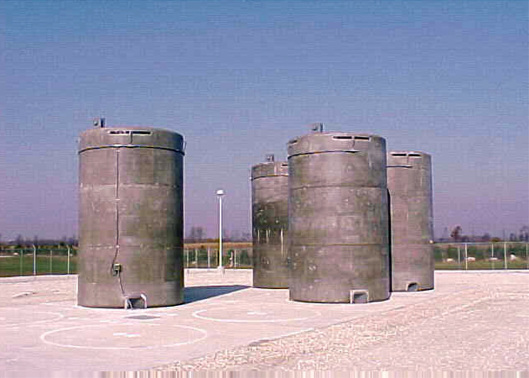
There’s a lot of science involved in using uranium to power our homes and businesses, but the solution to its waste problem is undeniably a political one.
The federal Nuclear Waste Policy Act of 1982 mandated the Department of Energy to find a solution to the problem of how to collect, transport and store American nuclear waste in a central location. Four decades later, the spent uranium from FitzPatrick and Nine Mile Point’s reactors still sits in Scriba, enjoying its lakeside view.
In 1987, Yucca Mountain, Nevada, was selected from a pool of eight potential sites to host the nation’s geological repository for high-level nuclear waste.

According to the NRC, the Yucca Mountain facility would look basically as follows:
1. Canisters of waste, sealed in special casks, are shipped to the site by truck or train.
2. Shipping casks are removed, and the inner tubes with the waste are placed in steel, multilayered storage containers.
3. An automated system sends storage containers underground to the tunnels.
4. Containers are stored along the tunnels, on their sides.
Unsurprisingly, this was not a universally popular decision with the people of Nye County, Nevada, where Yucca Mountain is located.
NRC documents describe the scenes at the first public hearings in Nye County about the project in 1999 and 2000, after more than a decade of geological studies and environmental impact research.
“The citizens expressed concern about why they felt they couldn’t trust the government and were afraid of being lied to,” read one section of a report prepared by the Center for Nuclear Waste Regulatory Analyses.
In addition to the scientific challenges of building a facility capable of withstanding one million years of natural disasters (an actual court-ordered requirement), the NRC found they had to deal with unexpected human hurdles
“At one of the meetings a local politician attended the meeting with his own television reporter and used the meeting as a venue for grandstanding,” the report said. “His comments off camera to the NRC staff were very complimentary, but on camera he took a much harsher stance.”
U.S. Sen. Kirsten Gillibrand, D-NY, has indicated that while she believes a federal repository is the best solution to spent uranium storage, she would not demand the construction of one without the consent of its local communities.
“Senator Gillibrand believes we must find a permanent solution for spent fuel storage and the Department of Energy should work with the states and with Congress to find an acceptable site,” said Gillibrand spokesperson Miriam Cash. “There should be a federal repository for permanently storing civilian nuclear waste and communities in New York should not have to be required to store it on-site for decades.”
Funds for the Yucca Mountain licensing review process finally ran out in 2011 and no meaningful progress has been made since that point, according to federal nuclear officials.
Secretary of Energy Stephen Chu, a member of President Barack Obama’s administration, dubbed Yucca Mountain “off the table” in 2009, but clearly, the table still has room to accommodate its return.
Yucca Mountain sits in the middle of the Nevada desert roughly 100 miles northwest of Las Vegas. Since the site’s selection in 1987 as the national spent fuel repository from a pool of eight other locations, the Department of Energy has run into roadblocks from local and environmental interests and, perhaps most importantly, opposition from Nevada Democrat Harry Reid. Reid represented Nevada in the U.S. Senate for 30 years beginning in 1987 and deftly wielded his influence, including as Senate majority leader, to stifle Yucca Mountain progress until his 2017 retirement. That was the same year President Donald Trump’s first executive budget contained funds to restart the research into a feasible transition from individual reactor site dry cask storage to a national repository system.
Executive budgets are not law, however, and while Trump’s public support for more than $100 million in funding symbolized yet another component in his industry-friendly administration’s larger platform, Congress has yet to approve any of the dollars.
“The political debate rages on,” Rod McCullum of the Nuclear Energy Institute, an industry advocacy group based in Washington, D.C., told The Palladium-Times in a recent interview. “The scientific and technical basis is as strong as ever, but the political will to move forward is as weak as ever.”
Any meaningful change in funding for the Yucca Mountain licensing review would would need to come from Congress, but in a legislative body where in the best of times progress is measured in subatomic increments, the current health crisis has brought all non-COVID-19 discussion to an indefinate halt.
In a statement on the topic of dry cask storage versus a federal repository, U.S. Rep. Anthony Brindisi, D-Utica, expressed support for a “bipartisan solution that identifies and funds a permanent storage solution” and removing the spent uranium from its sites. Brindisi is also a co-sponsor on H.R. 2314, the Nuclear Powers America Act, which provides investment tax credits for nuclear power plants.
The course reversal (and back again) by the federal government isn’t helping matters. As recently as 2018, legislation was proposed funding Yucca Mountain’s review process. For many, the term “nuclear waste” evokes images of leaking barrels of glowing, toxic goo; the boring truth is that spent fuel’s true danger lies more in the quantity than its lack-of-quality. As long as nuclear plants continue to operate in the United States, they will continue to produce waste uranium that must be carefully stored on site in dry cask facilities.
Yucca Mountain’s license application is for a term of 10,000 years. It is unclear if that is a long enough span of time for officials to come to a final decision.
Seth Wallace is the managing editor of The Palladium-Times and a nuclear energy policy enthusiast.
Microbes in nuclear fuel ponds slow down the decommissioning process
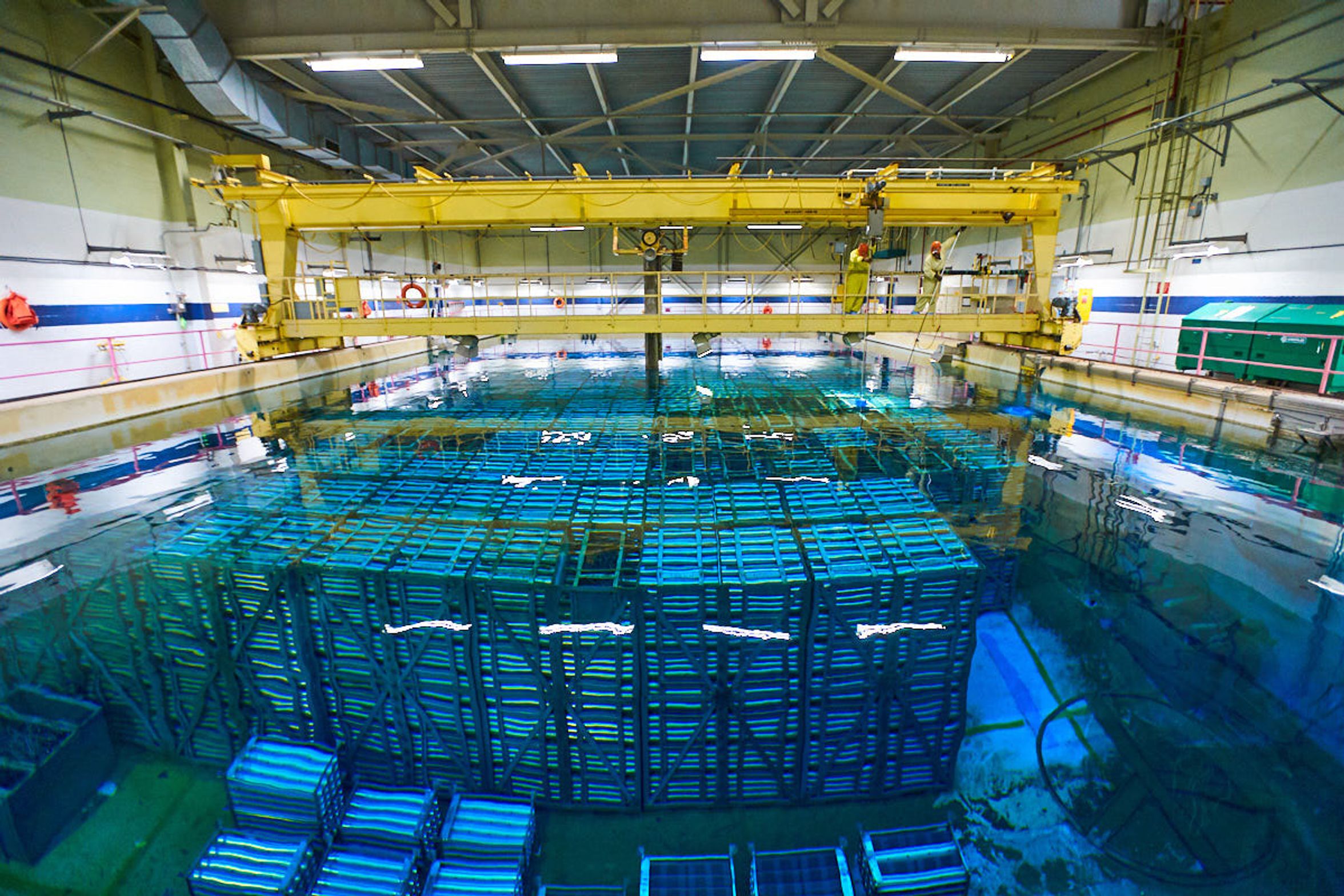 Manchester University 8th April 2020,Two new research papers from The University of Manchester, working with colleagues at Sellafield Limited and the National Nuclear Laboratory show that microbes can actively colonise some of the most intensively radioactive waste storage sites in Europe. When nuclear facilities such as
Sellafield were designed and built more than 50 years ago, it was sensible to assume that the conditions in the pond would prevent microbial life from taking hold, but now new research shows that this is not the case. The growth of microbial life in nuclear facilities can cause uncertainty or problems. Understanding how microbial life can inhabit environments such as
fuel storage ponds is vital to progress nuclear decommissioning work such as at Sellafield. Microbes are a group of organisms that, including bacteria and algae, are known to inhabit a wide range of habitats on Earth. Improvements in detection technology in recent years has allowed microorganisms to be detected in environments previously thought to be inhospitable to life. It is now becoming clear that some microorganisms are capable of withstanding surprisingly high doses of radiation, at levels significantly greater than seen in natural environments. Power Technology 8th April 2020, University of Manchester researchers have discovered microbial life can
Geomicromicrobiologists studied microbes that can cause summer blooms in
nuclear fuel storage ponds, slowing down the decommissioning process of retired nuclear plants. Summer blooms reduce visibility and disrupt fuel retrieval. University of Manchester microbiology professor Jonathan Lloyd
said: “Our research focused on Sellafield’s First Generation Magnox Storage Pond (FGMSP), which is a legacy pond that has both significant levels of radioactivity in conjunction with a highly alkaline pH (11.4), equivalent to domestic bleach. “The ultimate aim of this work was to identify the microbes that can tolerate such an inhospitable environment, understand how they tolerate high radiation levels, and help site operators control their growth. “The growth of the microorganisms in the FGMSP inhibits the operations in the pond, which is currently a priority for decommissioning. “ |
|
|
Idaho lawmakers want nuclear waste ready to get trucked away
Idaho lawmakers want nuclear waste ready to get trucked away
 by KEITH RIDLER Associated Press, Saturday, April 11th 2020 BOISE, Idaho (AP)
– Idaho’s congressional delegation wants the U.S. Department of Energy to prepare spent nuclear fuel for trucking out of eastern Idaho ahead of a 2035 deadline.
The two Republican senators and two Republican representatives in the letter sent Wednesday said the department could be readying the spent fuel for placement in protective trucking containers.
A 1995 agreement following a series of federal lawsuits requires the Energy Department to remove most of the spent fuel and other nuclear waste from the site that includes the Idaho National Laboratory……..
The Idaho lawmakers acknowledge the lack of a permanent repository in their letter, but they say preparing the waste for removal from Idaho should start anyway. …….
The U.S. Government Accountability Office reports that the U.S. has more than 99,000 tons (90,000 metric tons) of spent nuclear fuel stored at 80 sites in 35 states. Most of the spent fuel is from nuclear power generation at commercial plants, with about 15% coming from the U.S. government’s nuclear weapons program.
Some of that nuclear waste was being sent to Idaho for years until former Democratic Gov. Cecil Andrus and former Republican Gov. Phil Batt engaged in a series of federal court battles with the Energy Department resulting in the 1995 Settlement Agreement during Batt’s term that is generally seen as preventing Idaho from becoming a high-level nuclear waste dump.
That agreement, with some exceptions, requires the Energy Department by 2035 to remove spent fuel and nuclear waste from its 890-square-mile (2,300-square-kilometer) eastern Idaho site in sagebrush steppe. The area is about 50 miles (80 kilometers) west of Idaho Falls and sits atop a giant aquifer supplying farms and cities in the region with water.
The 1995 agreement has been altered several times over the years, including twice recently…….
The U.S. Navy also stores spent fuel from its fleet of nuclear-powered warships at the site. That spent fuel is also covered in the 1995 agreement. https://idahonews.com/news/local/idaho-lawmakers-want-nuclear-waste-ready-to-get-trucked-away
Trump uses the pandemic, to decimate environmental restrictions. Nuclear waste to landfill decision is just one example.
|
https://americanindependent.com/donald-trump-administration-nuclear-waste-cleanup-coronavirus-new-mexico-covid-19/ By Josh Israel,April 8, 2020 The coronavirus pandemic is making the problem even worse.
The Trump administration has been under fire for not doing enough to clean up nuclear waste. And now, with the COVID-19 pandemic and social distancing measures, the efforts are effectively on hold. At the Waste Isolation Pilot Plant in New Mexico, an underground nuclear waste facility operated by the Department of Energy, new shipments of hazardous material from nuclear sites across the country have reportedly been stopped to protect workers from the coronavirus. According to an Associated Press report, the small number of essential employees working at nuclear facilities around the country, including Los Alamos National Laboratory in New Mexico and the Hanford Nuclear Reservation in Washington, are focusing on safety, security, and information technology. Cleanup efforts have been frozen. Sen. Maria Cantwell (D-WA) told the wire service this week that worker safety is a priority, but more effort is needed to speed nuclear cleanup. “We are fighting to make sure workers and their families are taken care of during this crisis and that workers have the resources they need to meet cleanup goals when they are able to safely return to their jobs,” she said. Cantwell, Washington Sen. Ron Wyden (D), and New Mexico Democratic Sens. Martin Heinrich and Tom Udall raised concerns in early March that the Trump administration was not planning to spend enough money to do needed nuclear waste cleanup. Funding for those efforts, they warned, was being cut in favor of spending more money on modernization of the nation’s nuclear arsenal. The landfill decision is the latest in a line of moves by the Trump administration that flout environmental concerns. It also comes as the administration is under fire for using the coronavirus pandemic as an excuse to decimate environmental protections. The Environmental Protection Agency announced last week that it was temporarily suspending enforcement of civil environmental regulations, allowing the fossil fuel industry to ignore monitoring and compliance obligations. The agency additionally rolled back automobile pollution standards enacted during the Obama administration. Donald Trump has repeatedly promised America “crystal clear clean water and clean air” but has significantly changed environmental regulations, often going beyond the loosening of rules that industry asks for. Last year, Trump told reporters at a NATO summit in London that climate change was “very important” to him, saying he thought about it “all the time.” However, months later, his administration curbed a series of methane regulations that even some energy companies opposed. And despite claiming he wants “crystal clear” water, Trump has signed a series of orders allowing construction on highly controversial oil pipelines to move forward. “Nobody in the world can do what you folks do,” he told a group of pipeline engineers in April last year before signing an order making it difficult for states to intervene and stop such projects. “And we’re going to make it easier for you.” |
|
Bosnia might need international arbitration over Croatia’s nuclear waste dump plan near the border
|
Bosnia May Seek Arbitration on Croatia Nuclear Waste Dispute
https://balkaninsight.com/2020/04/08/bosnia-may-seek-arbitration-on-croatia-nuclear-waste-dispute/ Nedim Dervisbegovic, Sarajevo, BIRN
April 8, 2020, Minister says Bosnia will ramp up its protests after Croatia gives go-ahead for nuclear waste store to be built near Bosnian border. Bosnia may request international arbitration if Croatia proceeds with a plan to create a nuclear waste disposal site just across the border from Novi Grad in north-west Bosnia, Foreign Trade and Economic Relations Minister Stasa Kosarac was reported as saying. Kosarac’s ministry said dumping waste from the Croatian-Slovenian jointly-owned Krsko nuclear power plant at a former military storage facility near the Croatian town of Dvor would endanger the health and lives of some 250,000 people living in 13 Bosnian municipalities along the Una River. He made the statement after speaking with a group of ministers from Bosnia’s two entities, state parliamentarians and Novi Grad’s mayor via video link on Tuesday. Kosarac reportedly informed them about his telephone conversations with the Croatian ambassador to Bosnia, Ivan Sabolic, and Croatia’s Environment and Energy Minister, Tomislav Coric, after the fund for financing the decommissioning of the Krsko power plant and the disposal of its radioactive waste said last week that it had received approval from Coric’s environment ministry to use the former Čerkezovac military barracks at Trgovska Gora near Dvor. The statement said the video conference had concluded that Bosnia’s Ministry of Foreign Trade and Economic Relations would now ask the Council of Ministers – Bosnia’s state government – to help set up legal teams “to deal with this open bilateral issue with Croatia, and that budget funds be allocated for this”. “It was also concluded that it was necessary for all relevant institutions to strengthen diplomatic activities with the goal of preventing Croatia from designating this location as the final solution for the disposal of the nuclear waste,” it added. Croatia needs to take over half of the nuclear waste from the Krsko power plant, which lies inside Slovenia, by 2023. The plant was a joint venture of the two republics when both were part of former Yugoslavia. |
Idaho lawmakers want DOE to remove spent nuclear fuel from the Idaho National Laboratory.
|
Idaho lawmakers urge Department of Energy to remove spent nuclear fuel from INL https://idahonews.com/news/local/idaho-lawmakers-urge-department-of-energy-to-remove-spent-nuclear-fuel-from-inl– Idaho representatives and senators are urging the Department of Energy to take additional steps to remove spent nuclear fuel from the Idaho National Laboratory.CBS2 News Staff Thursday, April 9th 2020 BOISE, Idaho (CBS2) Representative Mike Simpson and Representative Russ Fulcher sent a letter to the U.S. Department of Energy Wednesday encouraging further action by DOE. The letter asks the DOE to remove spent nuclear fuel from the Idaho National Lab (INL) consistent with the 1995 Idaho Settlement Agreement.
Idaho’s congressional delegation, including U.S. Senator Mike Crapo, U.S. Senator James Risch, Representative Mike Simpson and Representative Russ Fulcher sent a letter to the U.S. Department of Energy Wednesday encouraging further action by DOE. The letter asks the DOE to remove spent nuclear fuel from the Idaho National Lab (INL) consistent with the 1995 Idaho Settlement Agreement. The delegation wrote, “We encourage the Department to initiate activities needed to begin loading of spent nuclear fuel into a multi-purpose canister (MPC) at the Idaho National Laboratory using existing facilities.” The letter urges DOE to take additional action to prove it will meet the 2035 deadline for removal of spent nuclear fuel. Read the full letter HERE, or the text below. [on original] |
University boffins discuss the eternal problem of nuclear wastes
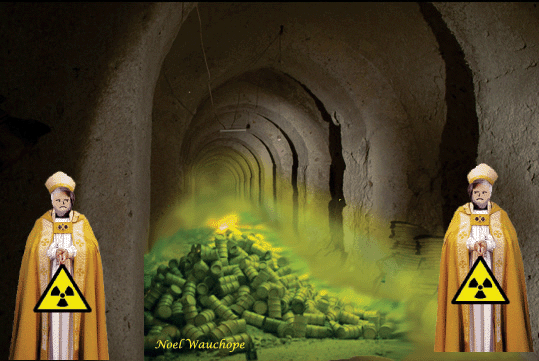
 Amazing – still none of these scientists suggests stopping making this radioactive trash!
The problem of nuclear waste, The Naked Scientists, 07 April 2020 Interview with Claire Corkhill, University of Sheffield
Part of the show The Rise of Radioactivity
Chris – So what you’re saying is, if we’ve got say something that looks like glass, because it’s spitting out all these energetic particles of radiation all the time, it’s slowly going to shatter the glass. It’s almost like shaking the glass very, very hard for hundreds of thousands of years; it’s eventually going to fall to pieces and it will no longer be any good at retaining and constraining the radioactive products inside.
Adam – How do we design something in the future so that this stuff stays where it is, and isn’t archeologist bait, and they suddenly dig up a radioactive cube of glass?
U.S. Nuclear Regulatory Commission proposing dumping some nuclear wastes in landfills – a huge public health danger
|
NRC Proposes Allowing Nuclear Waste at Dumps, Recycling Sites https://www.publicnewsservice.org/2020-04-06/nuclear-waste/nrc-proposes-allowing-nuclear-waste-at-dumps-recycling-sites/a69794-1 April 6, 2020. BOISE, Idaho — The Nuclear Regulatory Commission may change its rules to allow the nuclear industry to dump some of its waste in landfills. Opponents say the change poses a public health risk and would allow waste to go unmonitored. The proposal would enable the NRC to reinterpret the meaning of low-level radioactive waste so that it could be accepted at dumps and hazardous waste sites, rather than regulated storage facilities. Daniel Hirsch is president of Committee to Bridge the Gap, an organization that focuses on nuclear safety. He says a dump site in Idaho would benefit from this change. “In addition to the waste potentially going to everyone’s municipal landfill, the real focus of this is to allow the U.S. Ecology facility in Idaho to — without a license — start taking the material that up until today you’re required to have a license for,” he points out. On Friday, the public comment period was extended from April 20 to July 20. But Hirsch and other opponents say the COVID-19 pandemic isn’t allowing for proper scrutiny of the rule. They want it picked back up six months after the coronavirus crisis is over. Diane D’Arrigo, radioactive waste project director for the Nuclear Information and Resource Service, says the change would allow the industry to dispose of any waste other than irradiated fuel at landfills. That includes concrete, soil, clothing or any material where radiation still exists. The limit would be 25 millirem per year, a unit of absorbed radiation. D’Arrigo says the change poses a big public health risk. “There’s some so-called low-level waste that could give a lethal dose in 15 minutes if you’re exposed unshielded,” Terry Lodge, an attorney who works on nuclear safety issues, says the industry has been working for this change for decades because of the cost of disposing waste at radioactive-storage facilities. “The utilities build the expense of disposing of the waste into their electrical charges to us customers,” he points out. “So it’s not as though they don’t have the money. But there is a relentless search for quick and dirty solutions.” |
|
Bosnia and Herzegovina oppose Croatia’s nuclear waste plan
 BiH warns Croatia against storing nuclear waste from Krško at borderhttps://balkangreenenergynews.com/bih-warns-croatia-against-storing-nuclear-waste-from-krsko-at-border/ Bosnia and Herzegovina Croatia April 3, 2020 An environmental impact study is underway after Croatia gave the green light to a special fund to use a former barracks near the border with Bosnia and Herzegovina for the disposal of nuclear waste from the Krško nuclear power plant. Both the government in Sarajevo and the Republic of Srpska entity protested against the decision. BiH warns Croatia against storing nuclear waste from Krško at borderhttps://balkangreenenergynews.com/bih-warns-croatia-against-storing-nuclear-waste-from-krsko-at-border/ Bosnia and Herzegovina Croatia April 3, 2020 An environmental impact study is underway after Croatia gave the green light to a special fund to use a former barracks near the border with Bosnia and Herzegovina for the disposal of nuclear waste from the Krško nuclear power plant. Both the government in Sarajevo and the Republic of Srpska entity protested against the decision.
Bosnia and Herzegovina’s Minister of Foreign Trade and Economic Relations Staša Košarac told Croatia’s Ambassador Ivan Sabolić that the neighboring country’s intention to build a storage site for radioactive and nuclear waste from Krško less than a kilometer from the border is unacceptable. The Čerkezovac location at Trgovska gora is a former army barracks near the town of Dvor. Croatia’s Fund for Financing the Decommissioning of the Krško Nuclear Power Plant and the Disposal of Krško NPP Radioactive Waste and Spent Nuclear Fuel just got the approval to use the facility. It revealed an environmental impact study would be conducted before it seeks permits. The Una river, separating the two states, is a protected area. Following earlier announcements about the project, BiH threatened to sue the other country and pursue arbitration and its officials have cited risk from seismic activity. Protests have been held as well.
Košarac claimed more than 250,000 people living near the river would be endangered if the plan is implemented and that it would be bad for the environment. BiH will continue to prove the damaging effect and mobilize its institutions, his ministry said. Čerkezovac is near the country’s northwestern tip. The fund based in Zagreb vowed to cooperate with the local community, the general public and stakeholders on the other side. It claimed that if the project goes through, it would manage the radioactive waste from Krško in a safe, systematic and standardized way. The nuclear power plant is in Slovenia, just 10 kilometers from the border with Croatia and just over 30 kilometers from the center of Zagreb. It was built jointly by the two republics, then part of Yugoslavia, in 1981. Slovenia plans to store waste in Krško’s vicinity, in Vrbina, but there is no consensus with Croatia.
Croatian authorities have filed the domestic national strategy with the European Atomic Energy Community (Euratom) for evaluation. The said study is planned to include geological work and the determination of the so-called zero radiation conditions. The fund said it would perform security analysis as well. Košarac informed Johann Sattler, Head of the Delegation of the European Union and the EU’s Special Representative in BiH, of the country’s stance. |
|
Action on pandemic means that Hanford nuclear waste clean-up is stalled
 US nuclear waste cleanup takes back seat to coronavirus, New York Post, By Associated Press, April 3, 2020 ALBUQUERQUE, NM —The US government’s efforts to clean up Cold War-era waste from nuclear research and bomb making at federal sites around the country has lumbered along for decades, often at a pace that watchdogs and other critics say threatens public health and the environment.Now, fallout from the global coronavirus pandemic is resulting in more challenges as the nation’s only underground repository for nuclear waste finished ramping down operations Wednesday to keep workers safe.Over more than 20 years, tons of waste have been stashed deep in the salt caverns that make up the southern New Mexico site. Until recently, several shipments a week of special boxes and barrels packed with lab coats, rubber gloves, tools and debris contaminated with plutonium and other radioactive elements were being trucked to the remote facility from South Carolina, Idaho and other spots.
That’s all but grinding to a halt.
Shipments to the desert outpost will be limited for the foreseeable future while work at the country’s national laboratories and defense sites shift to only those operations considered “mission critical.”
Officials at the Waste Isolation Pilot Plant warned state regulators in a letter Tuesday that more time would be needed for inspections and audits and that work would be curtailed or shifts would be staggered to ensure workers keep their distance from one another.
“This action is being taken out of an abundance of caution for the safety of employees and the community,” said Donavan Mager, a spokesman for Nuclear Waste Partnership, the contractor that runs the repository.
Some critical duties still must be done — like placing bolts in the repository’s ceilings to ensure the shifting salt doesn’t collapse.
It’s the same at Los Alamos National Laboratory, the once-secret city in northern New Mexico that gained famed for being the birthplace of the atomic bomb. Most employees there are working remotely and the summer intern program is on pause.
Some work related to cleanup is ongoing, such as radiological surveys, inspections of hazardous waste storage facilities and maintenance of an early notification system designed to protect drinking water supplies.
In Washington state, tours of one of the most significant nuclear reactors in atomic history are on hold. Public meetings at the Hanford Nuclear Reservation have been canceled and those who want to review documents in person are out of luck as officials there downsized to mission critical operations nearly two weeks ago.
The number of employees on site has dwindled to the “absolute minimum” needed to run safety and security programs and keep IT systems humming for those working at home.
The circumstances are unlike anything ever faced by managers at Hanford, Los Alamos and elsewhere……
Democratic senators had voiced concerns just weeks ago that the Trump administration’s proposed budget for the US Energy Department calls for less money to clean up the Cold War-era waste while funneling significantly more to fund modernization of the nation’s nuclear arsenal.
The proposal provides nearly $27 billion, most of which would go toward nuclear security work that includes restarting production of the plutonium cores that are used as triggers inside nuclear weapons. Less than one-quarter of that would be used for cleanup of 16 sites in 11 states.
“The coronavirus pandemic demonstrates why we should get cleanup done once and for all,” said Jay Coghlan, executive director of Nuclear Watch New Mexico. “What we do as humans ebbs and flows with history, but the radioactive and toxic wastes that we leave behind last longer than our recorded history. We should be acting now.”
Watchdogs also pointed to permit renewals and other regulatory actions related to cleanup that could get pushed back.
The federal government has agreements with several states to reach certain cleanup milestones. Officials were reticent to say what deadlines might be missed, noting only that the Energy Department’s environmental managers are evaluating the potential effects on projects across the complex as the virus spreads.
US Sens. Tom Udall and Martin Heinrich said worker health should remain the priority but noted that as lawmakers consider more economic stimulus legislation, increased funding for environmental management could help support jobs and accelerate cleanup in the future. https://nypost.com/2020/04/03/cleanup-of-us-nuclear-waste-takes-back-seat-as-virus-spreads/
Anxieties over proposal to allow some nuclear waste to be disposed in landfills
 Advocates raise questions about proposal to allow some nuclear waste to be disposed in landfills The Hill, BY RACHEL FRAZIN – 04/03/20 Scientists and advocates are raising concerns about a proposed relaxation on regulations for disposing of nuclear waste, saying that the government should halt the proposal as the scientific community focuses on the coronavirus.
A March 6 Nuclear Regulatory Commission (NRC) proposal would allow for the disposal of some nuclear waste in municipal landfills, rather than a licensed facility.
Advocates say the proposal could put public health at risk, pushing the NRC to give the public more time to weigh in.
“What they’re trying to do is prop up a failing industry so that the cost of decommissioning these [nuclear] reactors is reduced so you don’t have to send it to a place that is expensive because it’s designed to safely handle it,” said Dan Hirsch, the former director of the University of California, Santa Cruz’s Program on Environmental and Nuclear Policy.
“I find it just astonishing that they would do that in the midst of the coronavirus pandemic,” he added. “How the NRC can look themselves in the mirror to propose massive deregulation and do it in the midst of the pandemic, I find it just ethically shocking.”……..
“If they’re going to consider it at all, it should only be considered once the pandemic is behind us,” he said.
Currently, the nuclear waste in question is typically disposed of at licensed waste disposal facilities, which have adequate training and equipment to protect public health.
The proposal would grant some exceptions to this regulation for waste with a cumulative radiation dose level of up to 25 millirem…….
n a statement on Thursday, Public Employees for Environmental Responsibility Pacific Director Jeff Ruch also criticized the proposal.
“NRC’s action could transform most municipal dumps into radioactive repositories, with essentially no safeguards for workers, nearby residents, or adjoining water tables,” he said. https://thehill.com/policy/energy-environment/490988-advocates-raise-questions-about-proposal-to-allow-some-nuclear
Danger in transporting spent nuclear fuel to New Mexico
Why should NM store nation’s nuclear waste? https://www.abqjournal.com/1439716/why-should-nm-store-nations-nuclear-waste.html BY LAURA WATCHEMPINO / MULTICULTURAL ALLIANCE FOR A SAFE ENVIRONMENT, PUEBLO OF ACOMA
Friday, April 3rd, 2020 If the Nuclear Regulatory Commission’s conclusion that it’s safe to move spent nuclear fuel from nuclear power plants across the country to a proposed storage facility in Lea County sounds vanilla-coated, it’s because the draft environmental impact statement for a Consolidated Interim Storage Facility submitted by Holtec International did not address how the casks containing the spent fuel would be transported to New Mexico.
It’s likely the casks would be transported primarily by rail using aging infrastructure in need of constant repair. But our rail systems were not built to support the great weight of these transport casks containing thin-wall fuel storage canisters.
Nor was the potential for cracked or corroded canisters to leak radiation studied because an earlier NRC Generic EIS for the Continued Storage of Spent Nuclear Fuel assumed damaged fuel storage canisters would be detected during an intermediary dry transfer system or a pool. But Holtec’s proposal only addresses a new destination for the high-level nuclear waste – not the removal and transport of the fuel storage canisters from nuclear power plants to New Mexico.
Even transport casks with canisters that are not damaged will release radiation as they are transported from nuclear power plants to the storage facility, exposing populations along the transport routes in a majority of states and tribal communities in New Mexico to repeated doses of radiation.
Other issues not considered in the draft EIS were the design life of the thin-wall canisters encasing the nuclear fuel rods and faulty installation at reactor sites like San Onofre, or the self-interest of the Eddy-Lea Energy Alliance in using the land it acquired for a consolidated interim storage site.
Thin-wall canisters cannot be inspected for cracks and the fuel rods inside are not retrievable for inspection or monitoring without destroying the canister. NRC does not require continuous monitoring of the storage canisters for pressure changes or radiation leaks. The fuel rods inside the canisters could go critical, or result in an uncontrolled nuclear chain reaction, if water enters the canisters through cracks, admits both Holtec and the NRC. None of us are safe if any canister goes critical.
Yet a site-specific storage application like Holtec’s should have addressed NRC license requirements for leak testing and monitoring, as well as the quantity and type of material that will be stored at the site, such as low burnup nuclear fuel and high burnup fuel.
With so many deficiencies in the draft EIS, a reasonable alternative is to leave this dangerous radioactive nuclear waste at the nuclear plants that produced it in dry cask storage rather than multiply the risk by transporting thousands of containers that could be damaged across many thousands of miles and decades to southeastern New Mexico, then again to a permanent repository.
Interim storage of spent nuclear fuel at existing nuclear plant sites is already happening – there are 65 sites with operating reactors in the United States and dry cask storage is licensed at 35 of these sites in 24 states. But since the thin-wall canisters storing the fuel rods are at risk for major radioactive releases, they should be replaced with thick-walled containers that can be monitored and maintained. The storage containers should be stored away from coastal waters and flood plains in hardened buildings.
Attempting to remove this stabilized nuclear waste from where it is securely stored across hundreds or thousands of miles through our homelands and backyards to a private storage facility also raises some thorny liability issues, since the United States will then be relieved of overseeing the spent nuclear fuel in perpetuity. The states and nuclear plants that want to send us their long-lived radioactive waste will also be off the hook, leaving New Mexico holding a dangerously toxic bag without any resources to address the gradual deterioration of man-made materials or worse, a catastrophic event. It’s a win/win, however, for Holtec International and the Eddy-Lea Energy Alliance.
Environmental justice footnote: When removal of uranium mine waste on the Navajo Nation was being discussed a few years ago, communities got this response from EPA: Digging up the waste and tr+ansporting it to a licensed repository in different states outside the Navajo Nation – which has always been the Nation’s preferred alternative – is the most expensive option. “Off-site disposal, because of the amount of waste in and around these areas, means possibly multiple years of hundreds and hundreds and hundreds of trucks going in and out of the community and driving for miles.”
1 This Month
26 September – International Day for the Total Elimination of Nuclear Weapons





PLEASE OPPOSE HR 8255 AND S.3639 – bills would accelerate satellite deployment, with no environmental review or safeguards – https://ncstd5li.quorum.us/campaign/169331/
To see nuclear-related stories in greater depth and intensity – go to https://nuclearinformation.wordpress.com
-
Archives
- September 2026 (305)
- August 2026 (330)
- July 2026 (355)
- June 2026 (287)
- May 2026 (306)
- April 2026 (356)
- March 2026 (251)
- February 2026 (267)
- January 2026 (308)
- December 2025 (358)
- November 2025 (359)
- October 2025 (375)
-
Categories
- 1
- 1 NUCLEAR ISSUES
- business and costs
- climate change
- culture and arts
- ENERGY
- environment
- health
- history
- indigenous issues
- Legal
- marketing of nuclear
- media
- opposition to nuclear
- PERSONAL STORIES
- politics
- politics international
- Religion and ethics
- safety
- secrets,lies and civil liberties
- spinbuster
- technology
- Uranium
- wastes
- weapons and war
- Women
- 2 WORLD
- ACTION
- AFRICA
- Atrocities
- AUSTRALIA
- Christina's notes
- Christina's themes
- culture and arts
- Events
- Fuk 2022
- Fuk 2023
- Fukushima 2017
- Fukushima 2018
- fukushima 2019
- Fukushima 2020
- Fukushima 2021
- general
- global warming
- Humour (God we need it)
- Nuclear
- RARE EARTHS
- Reference
- resources – print
- Resources -audiovicual
- Weekly Newsletter
- World
- World Nuclear
- YouTube
-
RSS
Entries RSS
Comments RSS

