Ontario’s Unfunded Nuclear Decommissioning Liability is in the $18-$27 Billion CAD Range
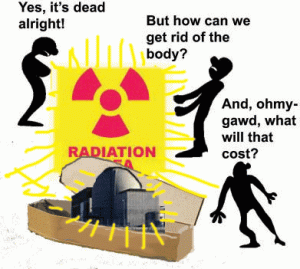
Ontario’s Unfunded Nuclear Decommissioning Liability is in the $18-$27 Billion CAD Range
https://tinyurl.com/5a9du4mz Editorial Team, August 6 2021 Late last year I worked up the likely amount of public money that would have to be thrown at the nuclear industry in order to successfully and safely decommission the 100 operational reactors and the now shut down ones. Unsurprisingly, the nuclear industry had been very optimistic in its estimates of decommissioning costs and timeframes, when the global empirical averages were trending to a billion USD and 100 years per reactor.
Recently I was asked by an Ontario journalist what I thought the likely situation in Ontario would be, and whether the decommissioning trusts were equally underfunded. I was unsurprised to find that Canada is in the same boat as the US, with highly optimistic schedule and cost projections which belie Canadian empirical experience with the CANDU reactor, and that the fund had nowhere near the money necessary for the job. Let’s run the numbers. [diagram on original]
Ontario Power Generation (OPG) is the chunk of the provincial utility that was carved apart in the late 1990s by the Mike Harris Conservatives to handle generation alone. It operates 18 aging CANDU reactors across three sites: Bruce, Pickering, and Darlington.
Table of operational nuclear generation reactors in Ontario
OPG has a nuclear decommissioning fund of about $5 billion CAD or US$4 billion right now. If the experience of other countries on the actual cost of a billion USD per reactor and an actual timeline of decommissioning of a century holds true, and I see no reason why it doesn’t, that means that there is currently a $17.5 billion CAD gap in Ontario, in addition to the existing $19.3 billion CAD in debt still being serviced from their construction. When the government of the era split up the utility, it moved all of the debt off of the components and into general debt. One of the many appropriate and sensible things that the McGuinty Administration did in the 2000s, in addition to shutting down coal generation entirely, was to move the debt back into the utility and set about servicing it from utility bills.
Most of the reactors at Bruce Nuclear are aging out, with several over 40 years old and the remainder approaching 40. Darlington’s are around 30, so they have a bit of runway. Pickering’s reactors are going to be shut down in 2024 and 2025 and start decommissioning in 2028. While refurbishment could bridge Ontario’s for another 20 years in many cases, that’s expensive and typically won’t pass any economic viability assessment compared to alternatives.
The likelihood is that all reactors in Ontario will reach end of life by 2035, and be replaced by some combination of renewable energy and HVDC transmission from neighboring jurisdictions, with both Manitoba and Quebec having excellent, low-carbon hydroelectric to spare.
Does the empirical experience of shutting down CANDU reactors track to the roughly billion USD that’s seen for other reactors? According to the World Nuclear Association, no.
The fourth unit is Gentilly 2, a more modern Candu 6 type, which was shut down at the end of 2012 after 30 years operation. It is being defuelled and the heavy water was to be treated over 18 months to mid-2014. A decommissioning licence was issued for 2016 to 2026 and the main part of the reactor will be closed up and left for 40 years to allow radioactivity to decay before demolition. All 27,000 fuel bundles are expected to be in dry storage (Macstor) by 2020. The decommissioning cost is put at C$ 1.8 billion over 50 years.”
That translates to US$1.44 billion, so it would appear as if CANDUs are on the expensive side to decommission. If that holds true, Ontario’s gap is actually in the range of $27 billion CAD.
Nuclear decommissioning funding comes from reactors operating revenue. In the US, it’s 0.01 to 0.02 cents per kWh as a set aside. I wasn’t able to find the required set aside for Ontario’s fleet, but obviously they aren’t setting aside sufficient funds now, or have absurdly optimistic fund growth expectations. They only have a decade to set aside more money from operating reactors, and have only set aside $5 billion CAD after 50 years, so the most generous assumption is that they will set aside perhaps $7 billion CAD in the OPG fund by end of life of the reactors, and have a liability for decommissioning of $15.5 to $27 billion CAD. For the next step, let’s assume $20 billion CAD for the sake of round numbers.
Given the likelihood of all of Ontario’s reactors being off of the grid by 2035, with major decommissioning occurring every few years until then, the kWh generated by Ontario’s nuclear fleet from now through 2060 will be in the range of about 1000 TWh assuming there are no lengthy outages at any of the plants, which to be clear is an awful lot of low carbon electricity.
However, $20 billion is a big number too. It turns into about 19 cents per kWh if you only count electricity generated from today through end of life for the reactors. It’s obviously a lot lower if you calculated from beginning of the lifetime of the reactors. However you count it though, that’s only the unfunded Ontario liability, and it’s on top of subsidized security costs Canada and Ontario and municipalities bear, and it’s on top of the outstanding $19.3 billion in debt that has only been receiving servicing on the interest since the McGuinty government brought it back into the utility. It’s likely that the majority of that debt will be outstanding in 2035 still, as it has gone from $20 billion to $19.3 billion in the last 11 years, so expecting it to be gone by 2035 is not realistic.
So yes, Ontario’s nuclear program will be a fiscal burden on Ontarians to the tune of around $40 billion CAD which will be spent through roughly 2135, finally being paid off by the great-grandchildren of babies born in 2021.
Nuclear, the gift that keeps on giving.
This article was originally published by Cleantechnica.com.
Read the original article here.
Samuel Lawrence Foundation loses court case to keep spent fuel pools as safety backup at San Onofre nuclear station
Judge tosses out lawsuit that sought to stop San Onofre nuclear plant dismantlement, Ruling says Coastal Commission properly granted permit, San Diego Tribune, BY ROB NIKOLEWSKI , . 20, 2021
Deconstruction work at the now-shuttered San Onofe Nuclear Generating Station — known as SONGS for short — will continue after a judge in Los Angeles County turned back a lawsuit filed by an advocacy group that looked to put a halt to it.
Deconstruction work at the now-shuttered San Onofe Nuclear Generating Station — known as SONGS for short — will continue after a judge in Los Angeles County turned back a lawsuit filed by an advocacy group that looked to put a halt to it.
In a 19-page decision, Los Angeles County Superior Court Judge Mitchell Beckloff ruled last week the California Coastal Commission acted properly when it granted a permit in 2019 to Southern California Edison — the operators of the plant — to proceed with dismantlement efforts.
The Samuel Lawrence Foundation filed the suit, arguing the commission violated its own regulations and provisions by issuing the permit………….
Samuel Lawrence Foundation president Bart Ziegler said in an email that his group “will continue to push for strict monitoring, protocols and handling facilities at Edison’s nuclear waste dump.”
The heart of the lawsuit centered on two spent fuel pools that are scheduled to be torn down.
At commercial nuclear power plants, when the highly radioactive fuel rods used to generate electricity lose their effectiveness, operators place the assemblies in a metal rack that is lowered about 40 feet into a “wet storage” pool, typically for about five years, to cool.
Edison has since taken the assemblies out of the pools, placed them into stainless steel canisters and moved them into two “dry storage” facilities on the north end of the plant. One facility holds 50 canisters and another, more recently constructed site, holds 73 canisters.
Edison says now that the spent fuel has been transferred to dry storage, the pools are unnecessary and should be dismantled.
The Samuel Lawrence Foundation argued Edison should keep the pools in case the canisters ever get damaged or degrade over time………..
Despite issuing the permit and related measures, the commission has complained about being put in a tough position.
Edison says now that the spent fuel has been transferred to dry storage, the pools are unnecessary and should be dismantled.
Schwartz said until the federal government comes up with a long-term storage site, “we are forced to live with the increased risks of storing (waste) on our coast. Commissioners and staff have communicated to the (Nuclear Regulatory Commission) the urgency of moving these spent fuel facilities out of the coastal hazard zone, and we will continue to press the NRC on this issue.”
There are 3.55 million pounds of used-up fuel in the canisters at SONGS, which is located between the Pacific and Interstate 5.
But keeping the waste on-site is not unique to San Onofre. About 80,000 metric tons of spent fuel has stacked up at 121 commercial nuclear sites in 35 states………..
Under a “special condition” agreed to in 2015, the commission is allowed by 2035 to revisit whether the storage site should be moved to another location in case of rising sea levels, earthquake risks, potential canister damage or other scenarios……
SONGS’ dismantlement began in March 2020 and is expected to take about eight years to complete. Roughly 2 billion pounds of equipment, components, concrete and steel will be removed from the plant.
The two distinctive containment domes, each nearly 200 feet high, are scheduled to come down around 2027.
About 450,000 tons of material labeled low-level nuclear waste will be shipped — mostly by rail — to a disposal facility in Clive, Utah. Another 35 tons of low-level waste will get shipped by truck to a facility in the West Texas town of Andrews.
According to Edison’s plans, all that will remain at SONGS will be two dry storage facilities, a security building with personnel to look over the waste, a seawall, a walkway connecting two beaches north and south of the plant, and a switchyard with power lines. The rest of the property will revert to the U.S. Navy and Marine Corps Base Camp Pendleton. https://www.sandiegouniontribune.com/business/energy-green/story/2021-09-20/judge-tosses-out-lawsuit-that-sought-to-stop-san-onofre-nuclear-plant-dismantlement
Small nuclear reactors, uranium mining, nuclear fuel chain, reprocessing, dismantling reactors – extract from Expert Response to pro nuclear JRC Report
.

………… If SMRs are used, this not least raises questions about proliferation, i.e. the possible spread of nuclear weapons as well as the necessary nuclear technologies or fissionable materials for their production. ………..
By way of summary, it is important to state that many questions are still unresolved with regard to any widespread use of SMRs – and this would be necessary to make a significant contribution to climate protection – and they are not addressed in the JRC Report. These issues are not just technical matters that have not yet been clarified, but primarily questions of safety, proliferation and liability, which require international coordination and regulations.
The volume of waste arising from decommissioning a power plant would therefore be significantly higher than specified in the JRC Report in Part B 2.1, depending on the time required to dismantle it
Measures to reduce the environmental impact The JRC Report is contradictory when it comes to the environmental impact of uranium mining: it certainly mentions the environmental risks of uranium mining (particularly in JRC Report, Part A 3.3.1.2, p. 67ff), but finally states that they can be contained by suitable measures (particularly JRC Report, Part A 3.3.1.5, p. 77ff). However, suitable measures are not discussed in the depth required ……..…
Expert response to the report by the Joint Research Centre entitled “Technical assessment of nuclear energy with respect to the ‛Do No Significant Harm’ criteria in Regulation (EU) 2020/852, the ‛Taxonomy Regulation’” 2021
”…………………3.2 Analysing the contribution made by small modular reactors (SMRs) to climate change mitigation in the JRC Report
The statement about many countries’ growing interest in SMRs is mentioned in the JRC Report (Part A 3.2.1, p. 38) without any further classification. In particular, there is no information about the current state of development and the lack of marketability of SMRs.
Reactors with an electric power output of up to 300 MWe are normally classified as SMRs. Most of the extremely varied SMR concepts found around the world have not yet got past the conceptual level. Many unresolved questions still need to be clarified before SMRs can be technically constructed in a country within the EU and put into operation. They range from issues about safety, transportation and dismantling to matters related to interim storage and final disposal and even new problems for the responsible licensing and supervisory authorities
The many theories frequently postulated for SMRs – their contribution to combating the risks of climate change and their lower costs and shorter construction periods – must be attributed to particular economic interests, especially those of manufacturers, and therefore viewed in a very critical light.
Today`s new new nuclear power plants have electrical output in the range of 1000-1600 MWe. SMR concepts, in contrast, envisage planned electrical outputs of 1.5 – 300 MWe. In order to provide the same electrical power capacity, the number of units would need to be increased by a factor of 3-1000. Instead of having about 400 reactors with large capacity today, it would be necessary to construct many thousands or even tens of thousands of SMRs (BASE, 2021; BMK, 2020). A current production cost calculation, which consider scale, mass and learning effects from the nuclear industry, concludes that more than 1,000 SMRs would need to be produced before SMR production was cost-effective. It cannot therefore be expected that the structural cost disadvantages of reactors with low capacity can be compensated for by learning or mass effects in the foreseeable future (BASE, 2021).
There is no classification in the JRC Report (Part A 3.2.1, p. 38) regarding the frequently asserted statement that SMRs are safer than traditional nuclear power plants with a large capacity, as they have a lower radioactive inventory and make greater use of passive safety systems. In the light of this, various SMR concepts suggest the need for reduced safety requirements, e.g. regarding the degree of redundancy or diversity. Some SMR concepts even consider refraining from normal provisions for accident management both internal and external – for example, smaller planning zones for emergency protection and even the complete disappearance of any off-site emergency zones.
The theory that an SMR automatically has an increased safety level is not proven. The safety of a specific reactor unit depends on the safety related properties of the individual reactor and its functional effectiveness and must be carefully analysed – taking into account the possible range of events or incidents. This kind of analysis will raise additional questions, particularly about the external events if SMRs are located in remote regions if SMRs are used to supply industrial plants or if they are sea-based SMRs (BASE, 2021).
Continue readingThe final costly burden of Ontaria’s nuclear decommissioning will fall to the great-grandchildren of babies born in 2021
So yes, Ontario’s nuclear program will be a fiscal burden on Ontarians to the tune of around $40 billion CAD which will be spent through roughly 2135, finally being paid off by the great-grandchildren of babies born in 2021.
Ontario’s Unfunded Nuclear Decommissioning Liability Is In The $18-$27 Billion CAD Range eTransport News, 12 Aug 21, Late last year I worked up the likely amount of public money that would have to be thrown at the nuclear industry in order to successfully and safely decommission the 100 operational reactors and the now shut down ones. Unsurprisingly, the nuclear industry had been very optimistic in its estimates of decommissioning costs and timeframes, when the global empirical averages were trending to a billion USD and 100 years per reactor.
Recently I was asked by an Ontario journalist what I thought the likely situation in Ontario would be, and whether the decommissioning trusts were equally underfunded. I was unsurprised to find that Canada is in the same boat as the US, with highly optimistic schedule and cost projections which belie Canadian empirical experience with the CANDU reactor, and that the fund had nowhere near the money necessary for the job. Let’s run the numbers.
Ontario Power Generation (OPG) is the chunk of the provincial utility that was carved apart in the late 1990s by the Mike Harris Conservatives to handle generation alone. It operates 18 aging CANDU reactors across three sites: Bruce, Pickering, and Darlington.
OPG has a nuclear decommissioning fund of about $5 billion CAD or US$4 billion right now. If the experience of other countries on the actual cost of a billion USD per reactor and an actual timeline of decommissioning of a century holds true, and I see no reason why it doesn’t, that means that there is currently a $17.5 billion CAD gap in Ontario, in addition to the existing $19.3 billion CAD in debt still being serviced from their construction. When the government of the era split up the utility, it moved all of the debt off of the components and into general debt. One of the many appropriate and sensible things that the McGuinty Administration did in the 2000s, in addition to shutting down coal generation entirely, was to move the debt back into the utility and set about servicing it from utility bills.
Most of the reactors at Bruce Nuclear are aging out, with several over 40 years old and the remainder approaching 40. Darlington’s are around 30, so they have a bit of runway. Pickering’s reactors are going to be shut down in 2024 and 2025 and start decommissioning in 2028. While refurbishment could bridge Ontario’s for another 20 years in many cases, that’s expensive and typically won’t pass any economic viability assessment compared to alternatives.
The likelihood is that all reactors in Ontario will reach end of life by 2035, and be replaced by some combination of renewable energy and HVDC transmission from neighboring jurisdictions, with both Manitoba and Quebec having excellent, low-carbon hydroelectric to spare……………….
Nuclear decommissioning funding comes from reactors operating revenue. In the US, it’s 0.01 to 0.02 cents per kWh as a set aside. I wasn’t able to find the required set aside for Ontario’s fleet, but obviously they aren’t setting aside sufficient funds now, or have absurdly optimistic fund growth expectations. They only have a decade to set aside more money from operating reactors, and have only set aside $5 billion CAD after 50 years, so the most generous assumption is that they will set aside perhaps $7 billion CAD in the OPG fund by end of life of the reactors, and have a liability for decommissioning of $15.5 to $27 billion CAD. For the next step, let’s assume $20 billion CAD for the sake of round numbers.
Given the likelihood of all of Ontario’s reactors being off of the grid by 2035, with major decommissioning occurring every few years until then, the kWh generated by Ontario’s nuclear fleet from now through 2060 will be in the range of about 1000 TWh assuming there are no lengthy outages at any of the plants, which to be clear is an awful lot of low carbon electricity.
However, $20 billion is a big number too. It turns into about 19 cents per kWh if you only count electricity generated from today through end of life for the reactors. It’s obviously a lot lower if you calculated from beginning of the lifetime of the reactors. However you count it though, that’s only the unfunded Ontario liability, and it’s on top of subsidized security costs Canada and Ontario and municipalities bear, and it’s on top of the outstanding $19.3 billion in debt that has only been receiving servicing on the interest since the McGuinty government brought it back into the utility. It’s likely that the majority of that debt will be outstanding in 2035 still, as it has gone from $20 billion to $19.3 billion in the last 11 years, so expecting it to be gone by 2035 is not realistic.
So yes, Ontario’s nuclear program will be a fiscal burden on Ontarians to the tune of around $40 billion CAD which will be spent through roughly 2135, finally being paid off by the great-grandchildren of babies born in 2021.
Nuclear, the gift that keeps on giving. https://etransportnews.com/2021/08/06/ontarios-unfunded-nuclear-decommissioning-liability-is-in-the-18-27-billion-cad-range/
Stockton Professor: Nuclear Power is “Terrible Neighbor
Stockton Professor: Nuclear Power is “Terrible Neighbor” https://ocnjdaily.com/stockton-professor-nuclear-power-terrible-neighbor/ By MediaWize – August 8, 2021 By DR. JOHN AITKEN Ph.D., Adjunct Professor of Physics, Stockton University
Opponents of the Ocean Wind turbine project spoke in favor of using nuclear power as an alternative to the wind power at the July 27 Michael Shellenberger presentation sponsored by Save Our Shores in Ocean City.
The speaker stated that that while climate change is indeed real, the only solution to reducing carbon emissions is nuclear power, contrary to the position of many environmental organizations.
His proposals to pursue solely nuclear power did not mention its disadvantages and costs. Nuclear power operates carbon free as do solar and wind power, but unlike them, nuclear generates large quantities of dangerous waste that are difficult to dispose of and costly to manage.
Nuclear power can supply an unlimited amount of power but creates an unlimited amount of hazardous nuclear waste requiring storage for at least 300 years. Nuclear power may be a useful servant but it is a terrible neighbor.
Take the example of the Oyster Creek nuclear plant 35 miles north of Atlantic City. After approximately 50 years of service it is being decommissioned due to its inability to compete with cheaper natural gas.
In the 1960s, Lacey Township signed up to host the plant. What they did not realize at the time was that they had signed a deal with devil. The town had traded its own long-term safety for the benefits of good paying jobs and reduced property taxes.
Due to environmental and transportation concerns, nuclear waste storage sites in Nevada or Washington state promised by the federal government never materialized, leaving local plants on their own to store their nuclear waste on site for decades if not centuries.
The costs associated with decommissioning the nuclear site, estimated between $800 million and $1.4 billion, are another legacy left by the plant. The original owner/operator of the plant, Exelon, sold the plant to another company who will execute the decommissioning plan. For the rest of this article I will refer to this decommissioning company as DC.
While the project is supported by a decommissioning fund, likely cost overruns will be paid by future generations through their utility bills. The costs cover the removal and deactivation of spent nuclear fuel, control rods, the reactor and associated buildings, which themselves have become radioactive from exposure to radiation.
But now, with decommissioning approaching, the township is paying the piper dearly for the good years. Oyster Creek Nuclear Plant has been shut down. The spent nuclear fuel and radioactive debris from the reactor and the associated buildings will be stored in 68 cylindrical casks, each 22 feet high and 11 feet in diameter, emitting low levels of radiation on the now-defunct site. The casks must remain intact for at least 300 years to allow the radioactivity of the waste inside to decay to handleable levels.
DC is now in charge of the decommissioning project. DC makes no commitment as to how long, decades or even centuries, these casks will have to remain on the Lacey Township site in close proximity to homes and schools.
Nor is there a guarantee that the casks, manufactured by DC, will remain intact during the 300-year storage period. Lacey Township at first sued DC to prevent the storage of these casks on the site. After a long legal battle, Lacey settled the lawsuit with them, acquiescing to the onsite storage on the condition that DC would build and assign another cask for emergency use by the township.
The Lacey Township decision shows it is a virtual prisoner of DC, which now owns the nuclear waste but is also the town’s only hope of restoring the site to radiation-free conditions.
Operating nuclear plants are also a continual hazard to the communities where they are sited. Nuclear plants do not pose a threat of nuclear explosion. Their Achilles heel is the plumbing, which brings water in and out of the reactor vessels.
The water pipes, degraded by the nuclear reactions, develop cracks and eventually leak water with radioactive contaminants. This water can leak into the local water supply and cause cancer or DNA damage to people who drink it.
As shown by the Oyster Creek experience, nuclear power is costly, dangerous and unmanageable. Those in favor of nuclear power should be ready to accept nuclear power stations in their own backyards and relive the Lacey Township experience. Nuclear power makes a terrible neighbor.
Delay in demolition of Three Mile Island Nuclear Station
Three Mile Island Nuclear Plant Demolition Delayed
WKOK Staff | August 8, 2021 MIDDLETOWN – Stateimpact Pennsylvania is reporting…The company responsible for decommissioning the Unit 2 reactor at the Three Mile Island nuclear plant is delaying demolition of the reactor’s two cooling towers, the project director said Wednesday. Frank Helin told the TMI-2 Community Advisory Panel that the towers will come down in 2022 instead of this fall.The decommissioner, TMI-2 Solutions, is a subsidiary of EnergySolutions, a Utah-based company that tries to turn a profit by dismantling inactive nuclear sites under budget. TMI-2 Solutions acquired the reactor’s license from FirstEnergy in December. The company plans to start removing what remains of TMI-2’s damaged core by mid-2022. It expects to complete the entire clean-up process by 2037. EnergySolutions spokesman Mark Walker said the delay in taking down the cooling towers does not affect the rest of the process…………
Eric Epstein, chair of the watchdog group Three Mile Island Alert, said that while he is not concerned about the cooling towers, he believes the reactor building may have more radioactive material than the company is prepared to deal with.
“Our concern is making sure that the plant is finally cleaned up 42 years later,” he said. “We don’t believe the company that owns TMI-2 has the technology, the expertise, or the resources to clean the plant up.” On its website, TMI-2 Solutions says it anticipates the project will cost $1.06 billion. It says the trust fund dedicated to the reactor’s decommissioning contains about $877 million, but that fund growth over time will provide enough money to cover the costs. https://www.wkok.com/three-mile-island-nuclear-plant-demolition-delayed/
Costly dismantling of France’s Brennilis nuclear power plant continues, 35 years after shutdown.
The dismantling of the Brennilis nuclear power plant, in the Monts
d’Arrée (Finistère) will be completed by 2040 and will have cost 850
million euros, the departmental council of Finistère said on Thursday.
These operations began over 35 years ago.
France Bleu 15th July 2021
The 44 year process for demolishing TEPCO’s Fukushima No. 2 nuclear station, – with nowhere to put the radioactive trash.
TEPCO grants 1st peek at work to scrap Fukushima No. 2 plant, http://www.asahi.com/ajw/articles/14389389 THE ASAHI SHIMBUN, July 7, 2021
Work to prepare for the decommissioning of Tokyo Electric Power Co.’s Fukushima No. 2 nuclear plant is under way in Fukushima Prefecture, a mammoth project the operator plans to complete in about 44 years.
However, TEPCO has not yet secured a location to dispose of a large amount of radioactive waste, a difficult task that it plans to tackle in the years to come.
The project is expected to prove an enormous challenge to TEPCO as the utility needs to proceed with it while simultaneously taking on the even more formidable task of cleaning up the crippled Fukushima No. 1 nuclear plant.
Together, 10 reactors are housed at the two plants: four at the No. 2 plant and six at the No. 1 plant.
The company will need to train workers for the decommissioning, secure a workforce for the lengthy project that will span decades, and put measures in place to ensure the safety of the facilities when hit by natural disasters such as torrential rain, earthquakes and tsunami.
On July 6, reporters were granted access to the decommissioning work at the Fukushima No. 2 plant so they could show the work to the public for the first time since the process began on June 23.
The No. 2 plant is located on the coastal side of the towns of Tomioka and Naraha, and the work on July 6 revolved around decontamination at its No. 1 reactor building.
Donning protective gear, 12 workers from TEPCO and contractors cleaned up pipes around water tanks with a high-pressure washer in a room for inspecting the equipment that inserts and removes control rods from the reactor core.
The work to decommission the No. 2 plant will be divided into four stages, with each stage spanning a decade or so, according to TEPCO.
In the first stage, operators will focus on decontaminating the facility to prepare for the following stages.
After that, TEPCO expects to move on to the second stage, which involves the demolition and removal of equipment surrounding the nuclear reactors. The reactors will be dismantled and cleared in the third stage, and then finally the reactor buildings in the fourth stage.
“We are determined to steadily and safely proceed with the decommissioning work while gaining support and understanding from local residents,” said Takaki Mishima, the head of the plant.
Perhaps the most crucial question that must be resolved will be where high-level and low-level waste that will be produced from the decommissioning process should be temporarily stored before a permanent disposal site is found.
A total of 9,532 spent nuclear fuel rods–highly radioactive materials–are stored at the plant.
Fukushima officials are demanding they be removed from the prefecture by the time the decommissioning wraps up in fiscal 2064.
But no municipalities in Japan want to accept and house such dangerous materials in their backyards.
TEPCO estimates the amount of low-level radioactive waste will total 52,000 tons.
To dispose of the waste, it needs to be buried underground at a depth from several meters to more than 70 meters from the surface, depending on the levels of radioactivity.
But as of now, no potential sites in Japan for temporary storage have been determined, not to mention a final disposal site.
“That is a question we will address later,” an official from the utility said.
Although the Fukushima No. 2 plant was damaged by the Great East Japan Earthquake and tsunami of 2011, it was spared from a meltdown and has been idle since.
TEPCO’s decision to pull the plug on the plant came at the insistence of the prefectural government and local residents.
(This article was compiled from reports by Shigetaka Kodama, Tetsuya Kasai, Yu Fujinami and Tsuyoshi Kawamura.)
Taiwan Shuts Another Reactor as Part of Nuclear-Free Goal,
Taiwan Shuts Another Reactor as Part of Nuclear-Free Goal, Jul 7, 2021, Power, by Darrell Proctor
Taiwan’s move to end the country’s use of nuclear power continues, with Unit 1 of the Kuosheng Nuclear Power Plant being shut down. The reactor was taken offline at the end of June, six months ahead of its scheduled Dec. 27 retirement, with officials saying spent fuel-storage capacity constraints meant the unit could not be refueled…..
Taiwanese President Tsai Ing-wen has made closing the country’s nuclear power plants a goal of her administration, saying the three remaining reactors will go offline by mid-2025. The 985-MW Kuosheng unit, which officials said generated about 3% of the nation’s total electricity, is the third of what were six operating reactors to be shuttered……
Decommissioning Plan
Taipower first proposed its decommissioning plan for Kuosheng Unit 1 in 2018, and it was approved by the Atomic Energy Commission (AEC) in October 2020. The plan included construction of a dry storage facility for used fuel, but a dispute between the city of New Taipei and Taipower has delayed the project.
Officials in New Taipei have yet to issue a permit for the storage facility, which would house the used fuel rods from Unit 1. The New Taipeil government has said it does not want a permanent spent nuclear fuel storage facility within the city……..
Tsai, who took over as Taiwan’s first female president in 2016, is the leader of the Democratic Progressive Party (DPP). The DPP has championed a “nuclear-free homeland.” The president in her opening remarks at the renewable energy-focused EnergyTaiwan event in October 2020 called on Taiwan to be “a leading center of green energy in the Asia-Pacific region.”
New policy initiatives have supported that goal, including amendments to the country’s Electricity Act that mandated nuclear power generation be ended no later than 2025. The government has said it expects moving away from coal-fired and nuclear power, and support of gas-fired generation and renewable energy, will generate about $36 billion in investment in the country’s energy sector by 2025, along with creating 20,000 jobs………..
Voters also on Aug. 28 will be asked about a plan to restart construction of the Lungmen Nuclear Power Plant 4. That plant, designed with two General Electric advanced BWR reactors and generation capacity of 2,700 MW, was expected to be completed in 2004 after construction began in 1999. Numerous delays, cost overruns, and government opposition put the project on hold in 2014. Even if voters approve a restart, analysts have said it’s unlikely the project would resume under the current administration. https://www.powermag.com/taiwan-shuts-another-reactor-as-part-of-nuclear-free-goal/
Taiwan on its path toward denuclearization
Taiwan on its path toward denuclearization. The Taiwanese government shut
down the No. 1 generator at its Kuosheng Nuclear Power Plant in Wanli
District, New Taipei City, on Thursday (July 1) to prepare for the unit’s
full closure.
The nuclear generator went online on Dec. 28, 1981. A General
Electric Boiling Water Reactors Type-6 model, the unit was licensed to run
for 40 years, which will expire on Dec. 27, 2021. It has produced more than
270 billion kilowatt-hours (kWh) of electricity for the past 40 years as
well as 800 tons of radioactive waste, according to the Environment
Information Center.
The generator is being decommissioned early because the
spent fuel pool is nearly at capacity. If the generator keeps operating,
there will be not be enough space to store nuclear waste, the Taiwan Power
Company (TPC) explained.
Taiwan News 4th July 2021
French corporation EDF will close down all 7 of its advanced gas-cooled reactor nuclear power stations in Britain within the next decade.
French-based global power developer EDF Energy vowed to put all seven of its advanced gas-cooled reactor nuclear power stations in the United Kingdom into the defueling and decommissioning stages within the next decade.
The company’s agreement with the UK government calls for shutting down the AGR stations by 2030. At that point EDF’s generating capacitywill consist of Sizewell B, HPC, potentially Sizewell C (currently under construction) and renewables including solar, onshore and offshore wind.
Power Engineering 25th June 2021
Senator Markey urges the NRC to improve safety and security of nuclear decommissioning process.
SENATOR MARKEY URGES THE NRC TO IMPROVE SAFETY AND SECURITY OF NUCLEAR DECOMMISSIONING PROCESS, https://www.markey.senate.gov/news/press-releases/senator-markey-urges-the-nrc-to-improve-safety-and-security-of-nuclear-decommissioning-process In a letter, Markey requests stricter safeguards as 23 nuclear power plants, including the Pilgrim Nuclear Power Station, undergo decommissioning in the U.S.
Washington (June 25, 2021) – Senator Edward J. Markey (D-Mass.), Chair of the Subcommittee on Clean Air, Climate, and Nuclear Safety in the Senate Committee on Environment and Public Works, today sent a letter to the Nuclear Regulatory Commission (NRC), urging the agency to address safety and security concerns before approving the draft rule, “Regulatory Improvements for Production and Utilization Facilities Transitioning to Decommissioning,” and putting out a proposed rule for public comment. “The Nuclear Regulatory Commission must prioritize the safety and security of the nuclear plants it oversees,” said Senator Markey. “As currently written, the proposed rule would allow the NRC and plant operators to cut corners on safety and limit public participation, which is critical to the decommissioning process. The communities around our nuclear plants deserve better than this.”
A copy of the letter can be found HERE.In his letter, Senator Markey requests that the NRC:
- propose a defined and exact set of rules on how plants should navigate the decommissioning process;
- improve public participation during the NRC’s consideration of any license transfers requested in connection with a nuclear plant’s decommissioning process;
- acknowledge and address the fact that spent fuel could remain onsite for long periods of time, perhaps indefinitely; and
- reevaluate its proposal to reduce financial protections for offsite and onsite liability claims for plants that are in the process of decommissioning.
Senator Markey also requests that the NRC ensure that the twenty-three nuclear reactors, such as Pilgrim Nuclear Power Station, that have already begun the decommissioning process adapt their operations to reflect stronger standards. The NRC should also establish the proper checks to ensure the safety and security of the eight additional nuclear power plants that have already declared their intent to decommission. Senator Markey has consistently urged the NRC to prioritize safety and public participation in the nuclear decommissioning process. Last Congress, Senator Markey reintroduced the Dry Cask Storage Act, which was aimed at improving the storage of spent nuclear fuel at nuclear plants across the nation.
As the Pilgrim Power Station commenced its decommissioning process, Senator Markey continued to fight to ensure that the NRC prioritized safety and public participation. In August 2019, Senators Markey and Elizabeth Warren (D-Mass.), and Representative William Keating (MA-09) wrote to the NRC to urge it to delay ruling on the proposed license transfer for Pilgrim from Entergy Nuclear Operations, Inc. to Holtec International until after the Commission considered and ruled on extant petitions and motions. In October 2018, Senator Markey and Rep. William demanded clear details from Holtec and Entergy about the safety and security issues involved in the ownership, transfer, and eventual decommissioning of the power plant.
Britain facing a massive series of nuclear decommissioning
Britain prepares for new wave of nuclear decommissioning
Sceptics of the fuel argue the plans demonstrate why no new plants should be built, Ft.com Nathalie Thomas in Edinburgh 23 June, 21, At Dungeness B nuclear power station on a remote stretch of the Kent coast in south-east England, workers are making preparations to carefully remove thousands of radioactive fuel elements from its reactors and transfer them to a purpose-built pond for at least 90 days for cooling. The spent fuel will later be packed into 53-tonne “flasks” fortified with 39cm-thick steel walls before being transported across country by train to Sellafield in Cumbria.
The nuclear facility in north-west England is host to most of the radioactive remnants of Britain’s civil nuclear programme that dates back to the 1950s. These include highly toxic waste that will remain there until a suitable site is found for an underground repository where it will have to be stored for more than 100,000 years to make it safe.
Preparations for the “defuelling” of Dungeness B started with “immediate effect” on June 7 when its majority owner, French state-controlled utility EDF, announced it would close the plant seven years early. It had not been operational since September 2018 as engineers tried to fix problems, including corrosion and cracks in its pipework.
The 1.1GW plant is the first of seven built in the UK between the mid-1960s and late-1980s using advanced gas-cooled reactor (AGR) technology to come out of service. It will kickstart a decommissioning process spanning generations, which sceptics argue strikes at the heart of why no new nuclear plants should be built.
The remaining six AGR plants are due to be retired by the end of this decade at the latest, leaving the more modern Sizewell B plant in Suffolk, which uses pressurised water reactor technology, as the only one operational out of the existing fleet
. “[Decommissioning of] many of these facilities will continue well into the 22nd century,” said Paul Dorfman of University College London’s Energy Institute. “The problem with decommissioning is it always turns out to be more complex than one had imagined.”
Critics also point out that the decommissioning of Britain’s 17 earliest atomic power sites has been extremely costly. The latest clean-up bill for those sites, which include a generation of nuclear plants known as the “Magnox” stations, is estimated at more than £130bn over 120 years. ……
Climate activists, such as E3G and Greenpeace, have long argued that the debate over building costly, complex new nuclear plants detracts from investment in cheaper, climate-friendly technologies……….
The exact arrangements for the decommissioning of Dungeness and the six other AGR plants are subject to negotiation between EDF and the government. It will be financed via a £14.5bn fund set up in 2005.
The French utility is expected to take at least three years to remove all fuel from each site and potentially carry out some early demolition work before handing them over to the UK state-owned Nuclear Decommissioning Authority. EDF declined to comment. The next stage will probably involve the treatment and removal of waste and demolition of facilities that are no longer needed. Some facilities will be left untouched for 85 years — to allow residual radioactive materials to decay — before demolition. …….. https://www.ft.com/content/0381e567-d088-4802-a2e4-e125c8099605
Euphoria about nuclear costs, especially about decommissioning – Institute for Energy Economics and Financial Analysis (IEEFA) warns Indonesia.

IEEFA: Nuclear power euphoria in Indonesia is all smoke and mirrors with no current technical, financial or market viability,
Renewables should be the focus of Indonesia’s net-zero pledge. (IEEFA Indonesia): In growing energy markets like Indonesia, decision makers are facing a barrage of pro-nuclear media coverage as the nuclear industry floods the market with panels and webinars focused on the potential of nuclear power.
A new report from the Institute for Energy Economics and Financial Analysis (IEEFA) highlights that while nuclear is promising as a baseload substitute for coal power, it currently has no technical, financial, or market viability in the Indonesian context. Author of IEEFA’s report Elrika Hamdi says that Indonesian nuclear power supporters often promise that nuclear will be an affordable, safe and sustainable solution for the problem of over-reliance on fossil fuel.
Yet, 70 years after the first nuclear power developments were announced, the technology is quickly losing market share as global power markets pivot toward more cost-competitive renewables and storage solutions.
“Despite the steady erosion of nuclear power’s competitive potential, key Southeast Asian energy ministries continue to be lobbied by nuclear advocates. Many of these lobbyists are international backers of new small modular reactor (SMR) technologies, who are actively engaging with governments and utilities around the region,” says Hamdi.

As old generation large-scale nuclear units face decommissioning, there is little consensus about how long it will take for newer small-scale nuclear technologies to be economically viable or how long-standing safety and waste disposal risks will be addressed.
“Determining the suitability of nuclear for the Indonesian power market will be a challenging task that will require honest and deep engagement by senior policymakers to ensure there is a high degree of accountability as Indonesians need to know the real cost of having nuclear in the power system as well as how the government will handle the problem of nuclear waste.”
Hamdi says that the short-list of nuclear power issues includes technology reliability, safety and safeguards, the geographic conditions of Southeast Asia, the prospects for decommissioning, waste treatment and permanent disposal, fuel availability, affordability, and the risk of persistent cost overruns and frequently overlooked shut-down costs.
Research has shown that an estimated 97% (175 out of 180 projects examined) of nuclear power projects exceed their initial budgets. The average cost overrun for a nuclear power plant was US$1.3 billion per project with construction delays adding 64% more time than initially projected.
Nuclear waste disposal costs also complicate the cost estimation process—typically raising project costs as political risk factors crystallize. The inability of leading nuclear nations to find safe and affordable solutions for permanent high-level nuclear waste disposal leaves expensive back-end cost issues on the table.
The economics of nuclear power in Indonesia is also blurred by the fact that under existing regulations, nuclear accident liabilities for nuclear owners/operators are capped at a maximum of IDR 4 trillion (US$276 million) for power plants with a capacity of more than 2000MWe. It is cut in half as the capacity decreases. This means smaller nuclear reactors would be liable for only a fraction of potential accident costs.
“These open-ended cost issues make it hard to evaluate claims about the market viability of nuclear power in Indonesia’s cost-sensitive market. This is particularly true when most established nuclear nations are pivoting away from commitments to new nuclear power facilities as more flexible renewable plus storage options reshape power sector economics,” says Hamdi.
“If a decision is reached to move ahead with pilot stage nuclear projects, policymakers and the government will need to do a lot of policy work including the technical evaluation, the regulatory preparation and the financial support, including preparation of the currently non-existent third-party liability insurance framework.
“This will place a serious burden on a government already taxed by the response to the COVID-19 pandemic and efforts to revitalize the financially constrained PT Perusahaan Listrik Negara (PLN), Indonesia’s national power company.”
PLN also recently pledged to become carbon neutral by 2060. However, the plan released shows nuclear only entering the energy mix in 2040. This demonstrates that PLN is realistic about the technical, financial, and market challenges that need to be overcome if nuclear power is to successfully integrate into Indonesia’s future energy mix.
Hamdi says that until these issues have been acknowledged and fully addressed, the safe path for Indonesia, for now, would be to pause and set realistic goals for its power development strategy.
This includes taking advantage of Indonesia’s abundance of renewable energy resources and market viability.
“Currently only 2.5% of Indonesia’s 400GW renewable energy potential has been utilized. That means that new technology options such as nuclear must compete with the deflationary cost curve in evidence with increasingly low-cost and low-risk renewable power solutions.
“New innovations to support grid flexibility such as demand response and storage are providing a cost-effective alternative to baseload-heavy planning disciplines. This trend raises questions about how small-scale nuclear reactors will fit into a more diverse power market where more cost-competitive renewable options could under-cut untested technologies that are years away from realizing economies of scale.
“The smaller, easily dispatchable, and walk-away safe promise of the new Gen-IV SMR technology offer is promising, IF and when the technology reaches commercial stage. But until such technology is proven to be technically and financially feasible, Indonesia’s safest option is to pause and set a more realistic net-zero scenario with resources and technologies that are already readily available with less cost, less risk, and less future liabilities.”
Read the report: Tackling Indonesia’s Nuclear Power Euphoria
Chernobyl nuclear tomb will eventually collapse. Sellafield, too, will need £132 billion, at least, to decommission.

LADBible 15th May 2021, A scientist has warned that Chernobyl nuclear power plant must be dismantled in the next 100 years or else it will collapse.
Professor Neil Hyatt is the Royal Academy of Engineering and Nuclear Decommissioning Authority’s research chair in radioactive waste management. Speaking to LADbible about recent developments that nuclear reactions had been detected from deep within the mummified plant – 35 years after its core exploded in what is widely viewed as history’s worst nuclear disaster – he says it’s time to act.
“If we don’t take it down, it’s going to fall down,” says Professor Hyatt, who teaches at Sheffield University. “The original shelter was built as a temporary facility to stabilise a situation and the New Safe Confinement is essentially the same thing – to buy us time. [But] it only buys us around 100 years or so.
“If you think about nuclear decommissioning, which I do all the time, look at the projects that are going on around the world. “There’s the Sellafield site in the UK – that’s one hundred years to decommission the Sellafield site at a cost of £132 billion, at least. “That probably tells you it’s going to take at least 50 years, if we started today, probably at a cost of about £900 million, to decommission Chernobyl.
“These are orders of magnitude, and the reason is because we still don’t know everything we need to know to decommission it, about the material inside.” He adds: “If we don’t take it down, it’s gonna collapse eventually. If you’ve bought yourself 100 years, you really need to start cracking on with the dismantling – probably in the next 20 years.
1 This Month
23-25 October – on Zoom – World BEYOND War’s annual global conferenc


Shut down the radiation-damaged Heysham nuclear reactors now
To see nuclear-related stories in greater depth and intensity – go to https://nuclearinformation.wordpress.com

Say No to NASA’s Reckless Nuclear Reactor on the Moon
Say No to NASA’s Reckless Nuclear Reactor on the Moon

-
Archives
- October 2026 (247)
- September 2026 (339)
- August 2026 (330)
- July 2026 (355)
- June 2026 (287)
- May 2026 (306)
- April 2026 (356)
- March 2026 (251)
- February 2026 (267)
- January 2026 (308)
- December 2025 (358)
- November 2025 (359)
-
Categories
- 1
- 1 NUCLEAR ISSUES
- business and costs
- climate change
- culture and arts
- ENERGY
- environment
- health
- history
- indigenous issues
- Legal
- marketing of nuclear
- media
- opposition to nuclear
- PERSONAL STORIES
- politics
- politics international
- Religion and ethics
- safety
- secrets,lies and civil liberties
- spinbuster
- technology
- Uranium
- wastes
- weapons and war
- Women
- 2 WORLD
- ACTION
- AFRICA
- Atrocities
- AUSTRALIA
- Christina's notes
- Christina's themes
- culture and arts
- Events
- Fuk 2022
- Fuk 2023
- Fukushima 2017
- Fukushima 2018
- fukushima 2019
- Fukushima 2020
- Fukushima 2021
- general
- global warming
- Humour (God we need it)
- Nuclear
- RARE EARTHS
- Reference
- resources – print
- Resources -audiovicual
- Weekly Newsletter
- World
- World Nuclear
- YouTube
-
RSS
Entries RSS
Comments RSS

