Unsafe plan for abandoning nuclear reactors onsite, and developing Small Nuclear Reactors
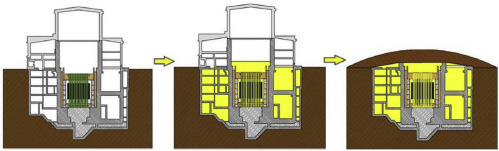
“IAEA guidance that entombment is not considered an acceptable strategy for planned decommissioning of existing [nuclear power plants] and future nuclear facilities.”
|
Groups oppose plans to abandon defunct nuclear reactors and radioactive waste, https://rabble.ca/columnists/2021/02/groups-oppose-plans-abandon-defunct-nuclear-reactors-and-radioactive-wasteThe Canadian Nuclear Safety Commission (CNSC) has just given a green light to the preferred industry solution for disposal of nuclear reactors — entomb and abandon them in place, also known as “in-situ decommissioning.” This paves the way for the introduction of a new generation of “small modular” nuclear reactors or SMRs. Over 100 Indigenous and civil society groups have signed a public statement opposing SMR funding, noting that the federal government currently has no detailed policy or strategy for what to do with radioactive waste. Many of these groups are also participating in a federal radioactive waste policy review launched in November 2020. The Assembly of First Nations passed resolution 62/2018 demanding that the nuclear industry abandon plans for SMRs and that the federal government cease funding them. It calls for free, prior and informed consent “to ensure that no storage or disposal of hazardous materials shall take place in First Nations lands and territories.”
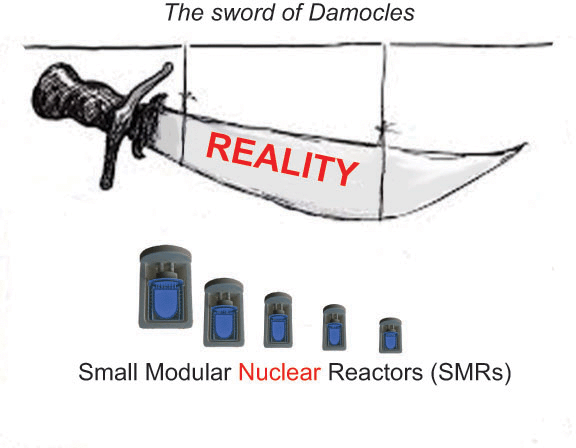
An SMR emits no radiation before start-up (other than from uranium fuel) and could easily be transported at that stage. But during reactor operation, metal and concrete components absorb neutrons from the splitting of uranium atoms — and in the process, transform into radioactive waste. Removing an SMR after shut-down would be difficult and costly, and comes with the need to shield workers and the public from its radioactivity. Abandoning nuclear reactors on site has been in the works for some time. CNSC helped draft a 2014 nuclear industry standard with in-situ decommissioning as an option and then included it in a July 2019 draft regulatory document. However, when the International Atomic Energy Agency (IAEA) released a peer-reviewed report on Canada’s nuclear safety framework last February, it said in-situ decommissioning is “not consistent” with IAEA safety standards. The IAEA suggested that CNSC “consider revising its current and planned requirements in the area of decommissioning to align with the IAEA guidance that entombment is not considered an acceptable strategy for planned decommissioning of existing [nuclear power plants] and future nuclear facilities.” It also noted that CNSC is reviewing license applications for in-situ decommissioning of shut-down federal reactors in Ontario and Manitoba, and encouraged Canada “to request an international peer review of the proposed strategy” for legacy reactors. But CNSC continued to pursue this strategy. Clever language in a June 2020 document appeared to rule out on-site reactor disposal, but left the door open where removal is not “practicable”:
At public meeting last June, CNSC Commissioner Sandor Demeter asked: “why are future facilities in this sentence when in fact we should be designing them so that in-situ decommissioning is not the option?” Former CNSC staff member Karine Glenn replied that “leaving some small parts of a structure behind…especially if you are in a very, very remote area, may be something that could be considered.” Glenn is now with the industry-run Nuclear Waste Management Organization, tasked with leading the development of a radioactive waste management strategy for Canada. Commissioners decided to approve the regulatory document, but with added text to clarify where in-situ decommissioning would be acceptable. They asked for additional text on “legacy sites” and “research reactors,” stating that “[t]he Commission need not see this added text if it aligns with the oral submissions staff made in the public meeting.” But no new clarifying text was added to the final version of the document published on January 29, 2021. It enables abandonment of SMRs — by retaining the reference to future nuclear facilities — and of “research and demonstration facilities, locations or sites dating back to the birth of nuclear technologies in Canada for which decommissioning was not planned as part of the design.” The CNSC seems willing to ignore international safety standards — and a decision of its own commission — to accommodate nuclear industry proponents of SMRs and allow radioactive waste to be abandoned in place. Meanwhile, the federal government has assigned the nuclear industry itself — via the Nuclear Waste Management Organization — the task of developing a radioactive waste strategy for Canada. Barring public outcry, that strategy will be abandonment. Ole Hendrickson is a retired forest ecologist and a founding member of the Ottawa River Institute, a non-profit charitable organization based in the Ottawa Valley. |
|
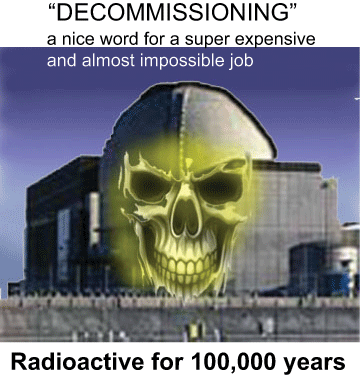
Increasing business and jobs in closing down Europe’s nuclear reactors, as renewable energy grows
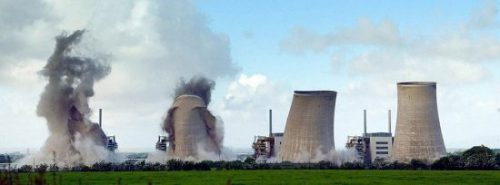
Europe Nuclear Decommissioning Service Market Forecast to 2027: COVID-19 Impact and Analysis by Reactor Type; Strategy; Application; Capacity and Country – ResearchAndMarkets.com Yahoo Finance, 3 Feb 21, The “Europe Nuclear Decommissioning Service Market Forecast to 2027- COVID-19 Impact and Analysis by Reactor Type; Strategy; Application; Capacity and Country” report has been added to ResearchAndMarkets.com’s offering.The nuclear decommissioning service market in Europe was valued US$ 2.68 billion in 2019 and is projected to reach US$ 4.29 billion by 2027; it is expected to grow at a CAGR of 6.2% from 2020 to 2027.
The growing health concerns due to radioactive emissions from aging infrastructures have compelled the European countries to decommission nuclear power plants that are nearing the end of their operational lives. France and Germany are among the leading countries in the nuclear decommissioning services market in this region.
In Germany, the nuclear energy generation sector contributes 12% to the total electricity generation. The country has no plans to construct newer nuclear power plants in the coming years. Germany decommissioned 11 nuclear power plants in the past decade, including Philippsburg nuclear facility that retired in 2019.
The German government has laid down its plans to decommission the remaining 6 nuclear power plants by 2022; these plants are Gundremmingen nuclear plant (2021), Grohnde nuclear power plant (2021), Brokdorf nuclear power plant (2021), Neckarwestheim nuclear power plant (2022), Isar nuclear plant (2022), and Emsland nuclear power plant (2022). The decommissioning strategies laid down by the government have been creating business growth opportunities for decommissioning service providers.
With the growth in the demand for electricity generated via renewable sources, rise in thermal power plants, and aging of long-established nuclear power plants, the governments are undertaking significant steps to decommission several power plants that are nearing the end of operational life. This is boosting the demand for services offered by the nuclear decommission services market players. The average lifespan of a commercial power reactor is 35-40 years.
A large number of commercial reactors operating today are soon likely to reach the end of operational life, and the governments of respective countries have approved the plans for their decommissioning. The cost of dismantling and decommissioning a commercial nuclear power plant is high and requires huge workforce.
The Italian nuclear power generation and transmission sector contributes to only 8% of the country’s overall electricity generation and transmission. The country had 4 reactors in the past, but it has been decommissioning the reactors following the Chernobyl disaster in 1986. Italy relies heavily on import of electric power and is the world’s second-largest net importer of electricity. Sogin S.p.A., a government-owned nuclear decommissioning service provider, has been engaged in dismantling and decommissioning several nuclear power plants in the country. ……….https://finance.yahoo.com/news/europe-nuclear-decommissioning-market-forecast-124000767.html
Creating jobs and community opportunities -Pickering City Council wants immediate dismantling of nuclear station
Clean Air Alliance (accessed) 8th Jan 2021, Ontario’s new Minister of Finance, Peter Bethlenfalvy, can create 16,000 person-years of employment in Pickering by directing Ontario Power Generation (OPG) to immediately dismantle the Pickering Nuclear Station after its operating licence expires in December 2024.
According to the International Atomic Energy Agency, immediate dismantling is “the
preferred decommissioning strategy” for nuclear plants. In fact, dismantling is the one area of employment growth in the nuclear industry.
Immediate dismantling will permit most of the 600-acre site to be returned to the local community by 2034 for parkland, recreational facilities, dining, entertainment, housing and other employment uses. That is among the reasons why Pickering City Council unanimously supports having the plant dismantled as “expeditiously as possible” after it is shut down.
Unfortunately, OPG wants to delay dismantling until 2054 to put off its
dismantling costs for 30 years despite the fact that it already has more
than $7.5 billion in its decommissioning and dismantling fund.
Decommissioning of Oyster Creek nuclear station – a nasty precedent for closing down of other USA reactors.
|
The decommissioning at Oyster Creek was funded by ratepayers and amounted to almost $1 billion when it was sold, presumably for significantly less than its billion-dollar-fund balance. Authoritative sources had previously estimated the cost to decommission Oyster Creek at over $1.4 billion. The original decommissioning schedule was to occur over a 60-year period, but the new owners are betting they can decommission the plant faster, and for significantly less than their investment, pocketing the difference. The quicker they can do this, the more they earn. Of course, if they find they bit off more than they can chew and look like they are on a pathway to failure, they can pack up their wrenches and backhoes and abandon the project, leaving New Jersey ratepayers to fund whatever actions remain to safely complete decommissioning. Seems like a win-win for both buyer and seller. For the new owner, if the challenges exceed their abilities, they can simply cut and run before depleting their newly acquired billion-dollar decommissioning fund. For the seller, they have unloaded an unpleasant responsibility in a way that’s sadly reminiscent of the actions of a deadbeat dad. Current questions on nuclear subsidiesThe current question before the BPU on subsidies presents a rare opportunity for regulators to exert some leverage considering tangential, but critical, questions on nuclear energy. Are safety practices sufficient to deter today’s technology-savvy terrorists? How reliable are their storage processes for spent fuel and what are the long-term plans for its disposal or relocation? What are the plans for the eventual decommissioning of remaining New Jersey nuclear reactors that combined are almost five times the size of Oyster Creek? Are we comfortable following the path blazed by Oyster Creek with the potential of a pre-emptive sale if the new owners make their way out of Dodge before the sheriff shows up …. |
|
Holtec wants to build new nuclear reactor at site of USA’s oldest, most dangerous nuclear station
 New Jersey nuclear plant proposed at site of old reactor PBS, Jan 5, 2021
LACEY, N.J. (AP) — The company that’s in the process of mothballing one of the nation’s oldest nuclear power plants says it is interested in building a new next-generation nuclear reactor at the same site in New Jersey.
Holtec International last month received $147.5 million — $116 million of which will come from the U.S. Department of Energy — to complete research and development work on a modern nuclear reactor that could be built at the site of the former Oyster Creek Nuclear Generating Station in the Forked River section of Lacey Township, New Jersey.
Holtec owns that facility and oversaw its shutdown in 2018……
company spokesperson Joe Delmar said Holtec is “actively engaged with the Nuclear Regulatory Commission” about the project, but has not yet formally applied to build the reactor…..
Jeff Tittel, director of the New Jersey Sierra Club and a longtime opponent of the Oyster Creek plant, called the proposal “a threat to health and safety.”
“Things are going from bad to worse,” he said. “What was supposed to be the cleanup and ending of the Oyster Creek nuclear plant is now being looked at for another nuclear power plant. The whole point of closing and decommissioning this site was to get rid of the oldest and probably most dangerous nuclear plant. Putting all of that nuclear material in one area that is vulnerable to climate impacts like sea-level rise is a disaster waiting to happen.”……. https://www.pbs.org/newshour/economy/new-nuclear-plant-could-rise-at-site-of-former-one-in-nj
Fukushima nuclear clean-up hugely affected by discovery of lethal radiation levels

|
Lethal Levels of Radiation Found in Damaged Fukushima Reactor Will Have ‘Huge Impact’ on Shutdown, Regulators Warn https://www.commondreams.org/news/2020/12/30/lethal-levels-radiation-found-damaged-fukushima-reactor-will-have-huge-impact The radiation levels reported around shield plugs at two reactors are high enough to kill a worker exposed for even an hour. Brett Wilkins, staff writer
In what Japanese regulators on Wednesday called an “extremely serious” development, lethal levels of radiation have been recorded inside the damaged reactor building at the Fukushima No. 1 nuclear power plant, threatening the shutdown and decommissioning of the site of the second-worst peacetime nuclear disaster in history.”This will have a huge impact on the whole process of decommissioning work.” —Toyoshi Fuketa, Nuclear Regulation Authority According to The Asahi Shimbun, Japan’s Nuclear Regulation Authority (NRA) reported that massive amounts of radioactive materials have been found around shield plugs of the containment vessels in the No. 2 and No. 3 reactors. NRA officials estimated radiation levels at 10 sieverts per hour—enough to kill a worker who spends just one hour there. Decommission of the reactor requires workers to remove the shield plugs, which block radiation from the reactor core during normal plant operation. This discovery has forced officials to reconsider their shutdown plans. NRA chair Toyoshi Fuketa said that removing the highly irradiated shield plugs made safe retrieval of nuclear fuel debris—an already dangerously daunting task—all the more difficult.. “It appears that nuclear debris lies at an elevated place,” Fuketa said at a news conference earlier this month. “This will have a huge impact on the whole process of decommissioning work.” The latest alarming find is the result of an investigation that resumed in September after a five-year pause in which the NRA took new measurements of radiation levels around the shield plugs at the No. 2 and No. 3 reactors. Tokyo Electric Power Co., the operator of the plant, announced December 24 that nuclear fuel debris removal would be postponed until 2022 or later due to the coronavirus pandemic. As Common Dreams reported in October, Greenpeace and other environmental and anti-nuclear advocates expressed shock and outrage after the Japanese government announced a plan to release stored water from the ill-fated plant into the Pacific Ocean. Greenpeace subsequently released a report claiming that radioactive carbon-14 released into the ocean “has the potential to damage human DNA.” The Fukushima Daiichi disaster—the result of a 2011 earthquake and tsunami that killed more than 15,000 people in northeastern Japan—was the worst nuclear incident since the 1986 Chernobyl meltdown in the former Soviet Union, and the worst in Japan since the United States waged a nuclear war against the country in 1945 that killed hundreds of thousands of people. |
Dismantling Duke Energy’s Crystal River nuclear plant
|
Work begins soon on dismantling Duke Energy’s Crystal River nuclear plant
The utility’s contractor began the decommissioning process this fall, which will ramp up in 2021. By Malena Carollo Nov. 27
CRYSTAL RIVER — Decommissioning of Duke Energy Florida’s nuclear plant is finally underway.Accelerated Decommissioning Partners — Duke Energy’s decommissioning contractor — began its work this fall to dismantle the shuttered nuclear portion of the Crystal River Energy Complex…… The nuclear portion of the plant was shut down in 2009 after Duke Energy’s predecessor, Progress Energy Florida, failed at a do-it-yourself repair to the building housing the reactor, cracking its 42-inch-thick concrete walls in the process…… https://www.tampabay.com/news/business/2020/11/27/what-does-it-take-to-decommission-duke-energys-nuclear-plant/ |
|
£132billion and counting – Britain’s nuclear decommissioning mess could take 120 years

UK taxpayers foot huge bill for the incompetence of The Nuclear Decommissioning Authority (NDA)
 UK’s nuclear sites costing taxpayers ‘astronomical sums’, say MPs
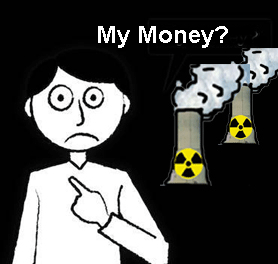
Public accounts committee says ignorance, incompetence and weak oversight to blame, Guardian, Damian Carrington Environment editor @dpcarrington Fri 27 Nov 2020 The Nuclear Decommissioning Authority (NDA) has a perpetual lack of knowledge about the state and location of waste on the 17 sites it is responsible for making safe, a powerful committee of MPs has found.
This results from decades of poor record keeping and weak government oversight, the MPs said. Combined with a “sorry saga” of incompetence and failure, this has left taxpayers footing the bill for “astronomical sums”, they said.
The NDA acknowledges that it still does not have full understanding of the condition of its sites, including 10 closed Magnox stations from Dungeness in Kent to Hunterston in Ayrshire, the MPs report said.
The NDA’s most recent estimate is that it will cost current and future generations of UK taxpayers £132bn to decommission the civil nuclear sites, with the work not being completed for another 120 years.
Since 2017, the NDA’s upper estimate of the cost of the 12-15-year programme just to get the sites to the ”‘care and maintenance” stage of the decommissioning process has increased by £3.1bn to £8.7bn. “Our past experience suggests these costs may increase further,” said the MPs’ report.
The lack of knowledge of the sites was a significant factor in the failure of a 2014 contract the NDA signed with a private sector company to decommission the Magnox sites. The government was forced to take back the contract in 2018 and the botched tender has now cost taxpayers £140m, the MPs found.
Sir Geoffrey Clifton-Brown, deputy chair of the public accounts committee (PAC), said: “Although progress has been made since our [2018] report, incredibly, the NDA still doesn’t know even where we’re currently at, in terms of the state and safety of the UK’s disused nuclear sites. Without that, and after the Magnox contracting disaster, it is hard to have confidence in future plans or estimates.” ……….
The UK has eight operating nuclear power plants, with all but one due to retire in the next decade. Only one new plant is being built, at Hinkley Point in Somerset, and it is years behind schedule and billions over budget.
Despite recent speculation over another new plant being given the go-ahead at Sizewell in Suffolk, Boris Johnson failed to announce this in his green industrial revolution plan last week. The government’s new national infrastructure strategy, published on Wednesday, said: “The government is pursuing large-scale nuclear projects, subject to clear value for money for both consumers and taxpayers.”
In 2015, the government stripped another private consortium of a £9bn contract to clean up the nuclear waste site at Sellafield. The company had been heavily criticised for its executives’ expense claims which included a £714 bill for a “cat in a taxi”. https://www.theguardian.com/environment/2020/nov/27/uks-nuclear-sites-costing-taxpayers-astronomical-sums-say-mps#_=_
NRC approves financially dodgy sale of Indian Point Nuclear Station to Holtec
Sale of NYC-Area Nuclear Power Plant Gets Federal Approval, https://www.nbcnewyork.com/news/local/sale-of-nyc-area-nuclear-power-plant-gets-federal-approval/2742312/, 23 Nov 20, After the plant shuts down in the spring, the current operator plans to transfer its license to another company to dismantle the reactors and clean up the site along the Hudson River by 2033.
The Nuclear Regulatory Commission has approved sale of the Indian Point nuclear power plant to a dismantling company without granting requests by lawmakers and environmental groups for public hearings.
The NRC announced Monday that it has signed off on its staff’s recommendation last week to approve Entergy Corp.’s sale of the plant north of New York City to New Jersey-based Holtec International. After the plant shuts down in the spring, Entergy plans to transfer its license to Holtec to dismantle the reactors and clean up the site along the Hudson River by 2033.
The NRC agreed to rescind or modify the transfer after it decides whether to grant New York state and the environmental group Riverkeeper’s requests for hearings about their concerns regarding the sale. New York Attorney General Letitia James has called the Holtec deal “very risky,” questioning Holtec’s financing and experience.
During a Zoom conference Friday organized by the Hudson River Sloop Clearwater environmental group, Assistant New York Attorney General Joshua Tallent said he would like to see money for spent radioactive fuel management set aside in a supplemental fund until the decommissioning is done to reduce the chance that taxpayers are stuck with the tab for cost overruns.
Hinkley Point B nuclear power station to be closed down by July 2022
Nuclear power station to close down by 2022, BBC, A nuclear power station in Somerset will be closed down within the next two years.
EDF said Hinkley Point B power station will be decommissioned no later than July 2022……… Once Hinkley Point B stops generating power, EDF will begin defueling the station – the first stage of nuclear decommissioning.,,, https://www.bbc.com/news/uk-england-somerset-55008752
Hinkley Point B nuclear reactor offline now, and will be shut down earlier than planned
 EDF confirms Hinkley Point B to be shut down earlier than planned
Cracks in reactor’s graphite core leads to decision to begin process no later than July 2022, Jillian Ambrose Energy correspondent, Fri 20 Nov 2020 . EDF Energy has confirmed it will begin shutting down the 45-year-old reactors at Hinkley Point B nuclear power plant in Somerset within the next two years, earlier than scheduled.
The “defuelling” will begin no later than July 2022, according to the French energy group.
The shutdown was scheduled for 2023, but cracks were discovered in the graphite core of the reactor.
…….. The power plant, which has been Britain’s most productive and whose operational life was extended, is offline for further inspections and is scheduled to return to service next year, pending approval from Britain’s nuclear safety watchdog…….
However, the scheduled start date has been delayed to between 2025 and 2026 owing to slow progress in agreeing with the government a guaranteed price for the electricity produced……
Boris Johnson’s 10-point climate plan, which was revealed on Tuesday, promised to advance large-scale nuclear projects and the developments of so-called “mini nuclear reactors” with a £525m support package.
But the plan failed to give the greenlight to EDF Energy’s planned followup to the Hinkley Point C project at the Sizewell site, which the firm hopes to build alongside a Chinese nuclear company.
The NIA said it hoped the government provided a clear path towards new nuclear capacity in an energy white paper, which is expected before Christmas. https://www.theguardian.com/uk-news/2020/nov/19/edf-confirms-hinkley-point-b-to-be-shutdown-earlier-than-planned
UK: Both Hinkley Point B and Hunterston B nuclear power stations will close early due to cracks in graphite cores
 Times 20th Nov 2020, The Hinkley Point B nuclear power station will close by July 2022 at the
latest, EDF has announced, triggering renewed calls to invest in
replacement reactors. The Somerset plant started generating in 1976 and was
due to close in 2016 but in 2012 EDF secured an extension until March 2023.
However, the reactor developed cracks in its graphite core, which has
limited its operation. EDF said this summer that the Hunterston B plant in
Scotland, which also has cracks in the core, would close earlier than
planned, in January 2022. Tom Greatrex of the Nuclear Industry Association,
said it was “a reminder of the urgency of investing in new nuclear
capacity to hit net zero”.
Hazardous plan for Peel Ports to take over the decommissioning of Britain’s dead nuclear submarines
|
Ferret 17th Nov 2020. The company that runs the port at Hunterston in North Ayrshire wants to useit to break up the radioactive hulks of defunct nuclear submarines, The Ferret can reveal. A plan by Peel Ports, released under freedom of information law, discloses that the firm sees “opportunities” for military submarine decommissioning at Hunterston.
But the idea has brought condemnation from politicians, environmental and community groups. They warn that the transport and dismantling of submarines would be “potentially hazardous” and could cause “significant environmental damage”. The 50-strong group of nuclear free-local authorities (NFLA) in the UK pointed out that prolonged public consultations had resulted in
agreement that decommissioning should only take place at Rosyth and Devonport. “If Peel Ports is lobbying for a change in that policy to undertake this work at Hunterston port, we would be concerned,” said NFLA Scotland’s convenor, SNP Glasgow councillor, Feargal Dalton. There were “complicated and potentially hazardous transport issues of moving
submarines from the east to the west coast of Scotland, and the required level of expertise to do this,” he argued. “It would also require a new consultation process at a time when the last one took years to deliver. I doubt the Ministry of Defence would like to reopen that process – and if they do, we and others will robustly challenge any significant change that increases the hazards to this operation.” https://theferret.scot/hunterston-peel-ports-nuclear-submarines/ |
Russia shuts down West Russian nuclear reactor
Russia retires Leningrad 2 RBMK, 10 November 2020
The Leningrad 2 nuclear power unit in in Sosnovy Bor in Western Russia was shut down permanently today. The RBMK, which has been in operation for 45 years, is to be replaced by Leningrad II-2, a VVER-1200, which on 6 November received regulatory approval to start pilot operation…… https://www.world-nuclear-news.org/Articles/Russia-retires-Leningrad-2-RBMK
1 This Month

22,000+ miles voyaging for nuclear disarmament
and a radiation-free environment https://vfpgoldenruleproject.org/




Cuba Is Not a Failed State – It Is a Besieged State
PETITION: “Global Appeal to Endorse Palestinian Right of Return of Refugees”
To see nuclear-related stories in greater depth and intensity – go to https://nuclearinformation.wordpress.com
-
Archives
- July 2026 (38)
- June 2026 (287)
- May 2026 (306)
- April 2026 (356)
- March 2026 (251)
- February 2026 (268)
- January 2026 (308)
- December 2025 (358)
- November 2025 (359)
- October 2025 (376)
- September 2025 (257)
- August 2025 (319)
-
Categories
- 1
- 1 NUCLEAR ISSUES
- business and costs
- climate change
- culture and arts
- ENERGY
- environment
- health
- history
- indigenous issues
- Legal
- marketing of nuclear
- media
- opposition to nuclear
- PERSONAL STORIES
- politics
- politics international
- Religion and ethics
- safety
- secrets,lies and civil liberties
- spinbuster
- technology
- Uranium
- wastes
- weapons and war
- Women
- 2 WORLD
- ACTION
- AFRICA
- Atrocities
- AUSTRALIA
- Christina's notes
- Christina's themes
- culture and arts
- Events
- Fuk 2022
- Fuk 2023
- Fukushima 2017
- Fukushima 2018
- fukushima 2019
- Fukushima 2020
- Fukushima 2021
- general
- global warming
- Humour (God we need it)
- Nuclear
- RARE EARTHS
- Reference
- resources – print
- Resources -audiovicual
- Weekly Newsletter
- World
- World Nuclear
- YouTube
-
RSS
Entries RSS
Comments RSS
 nuclear-news