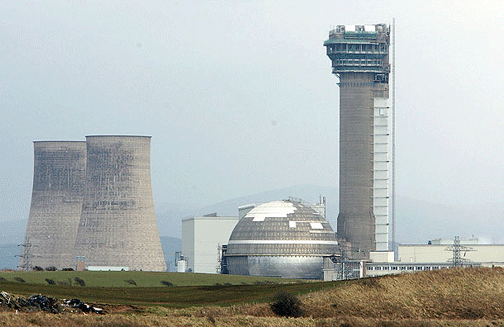
Germany’s atomic phase-out: How to dismantle a nuclear power plant https://www.dw.com/en/germanys-atomic-phase-out-how-to-dismantle-a-nuclear-power-plant/a-47823766– 11 Mar 19, Germany now has just seven nuclear plants left in operation, but what becomes of those that are already decommissioned? Bits of them are recycled, and could ultimately end up in our kitchens.
When Egbert Bialk looks at the giant demolition robot perched on top of the cooling tower at the Mülheim-Kärlich nuclear power plant, it makes him happy.
“Happy that the eyesore is finally being dismantled,” he told DW. “Some said we should leave it standing as a memorial or piece of art. But for me the tower is like a symbol of humanity’s arrogance, of us playing with fire.”
Bialk began campaigning against the reactor when it was built near his home in the 1970s, and has since joined the local chapter of environmental group BUND to observe the 1 billion euros ($1.2 billion) decommissioning of the facility.
The dismantling of the western German plant, which will take two decades to complete, started in 2004, seven years before the Fukushima disaster that prompted Angela Merkel’s government to announce the nation’s complete withdrawal from nuclear power by 2022.
With just a couple of years to go before that deadline, seven plants are still in operation, and even after they’ve shut down for good, it will take many more years before all the country’s reactors have been safely dismantled, and contaminated sites cleared and deemed free of radiation
One of the most pressing questions during this lengthy process, is what to do with the radioactive waste?
Buried in mines
The first things to be removed are the heavily contaminated spent fuel rods, which contain the nuclear fuel that is converted into electrical power.
Because Germany doesn’t yet have a long-term depository for highly radioactive waste, the rods are currently stored in so-called Castor containers in several locations across the country.
By the time all the nation’s reactors have been decomissioned, there will be around 1,900 such containers in interim storage. And there they will remain until a suitable location for their permanent resting place has been found
Read more: Nuclear waste in disused German mine leaves a bitter legacy
“We expect the storage phase to take 50 years,” Monika Hotopp, spokeswoman of BGE told DW.
Exactly what it will all cost, is unknown. Much depends on the ultimate location, but the 4.2 billion euro preparations of a former iron ore mine known as pit Konrad to be used as the final depository for low- and intermediate-level radioactive waste could serve as some kind of indicator.
Once things like technical equipment and parts of buildings exposed to nuclear fission reaction for years, have been buried in the mine, it will be filled up with concrete and sealed.
“When sealed, it’s safe and there should be no danger of nuclear radiation for the environment,” Hotopp told DW.
Environmental groups however, warn that nuclear waste remains a threat even when buried deep under the ground.
“The depositories have to be able to contain radiation for up to 500,000 years,” local environmentalist Bialk told DW. “We are giving a time bomb to future generations.”
Building materials recycled into roads and pots
And what happens to the rest of the waste? The hundred of thousands of tons of metal, concrete, pipes and other building materials that accumulate during the dismantling process?
Because under German law, the entire plant, including offices and the canteen, are considered radioactive, no single item can be removed before operators can prove it is no longer contaminated. Once considered free of radiation or at least to be below the safety limit, the waste can be disposed of at regular landfills and recycling sites.
Environmental groups and locals criticize this practice, on the grounds that once materials have been recycled, nobody knows where they end up. Concrete from nuclear power plants could be used to pave our roads, while metals could be melted and turned into pots and pans.
“Melted metals could even be turned into braces for kids; they could be contaminated by radiation and no one would know,” he told DW. “I think it would be useful to track where the materials from nuclear sites end up.”
But experts don’t regard post-decommissioning monitoring as necessary.
“The risks are minimal,” Christian Küppers, who specializes in nuclear facility safety at the environmental research center Oeko-Institut, told DW. “The safety limits for radiation correspond to what we are naturally exposed to in the environment,”
All the material from nuclear power plants that expose radiation below 0.01 millisieverts per year can be recycled, Küppers continued.
By way of comparison, the Oeko- Institut says people are exposed to natural radiation of 2.1 millisieverts per year in Germany, and a one-way transatlantic flight exposes those on board to between 0.04 and 0.11 millisieverts of radiation.
From nuclear site to “greenfield”
Once the nuclear power plants have been completely dismantled, all the waste removed and when there is no longer any measurable trace of radiation, the premises can be returned to greenfield status.
At this point, the premises are considered to be regular industrial sites, and can be sold as such.
Likewise pit Konrad. Once the mine has been closed and sealed, which is expected to happens around the year 2100, the land on top of it will also be returned to greenfield space. Theoretically, houses could then be built on it.
Whether anybody would want to live there, is another question, says Monika Hotopp from BGE, the federal company in charge of the long-term storage sites.
Because ultimately, nuclear power has become synonymous with danger. And as Bialk puts it, even when all the plants have been dismantled and the waste stored, the problem won’t have gone away.
“First, the radioactive waste remains dangerous for hundreds of thousands of years. Second, other countries still rely on nuclear power,” he said. “There are more than 50 nuclear power plants in France alone, and if an accident were to happen there, it would affect us, too.”
March 12, 2019
Posted by Christina Macpherson |
decommission reactor, Germany |
Leave a comment
Kerr: Army planning to demolish Fort Belvoir’s nuclear plant Inside Nova, BY DAVID KERR 3 Mar 19″……
The Army built another working nuclear plant at Fort Greely in Alaska that at the time was serving as an interceptor missile launch site. They also built one on a Liberty Ship called the U.S.S. Sturgis. That plant, built at Fort Belvoir, in Gunston Cove, was used as a floating power source for facilities in the Panama Canal Zone.
There was also one at the South Pole’s McMurdo Station. It ran for almost 12 years. Alas, all of these sites ran up against two problems. First, they turned out to be more expensive to operate than expected. Secondly, by the early 1970s anxiety was growing over nuclear power. Was it such a good idea to have small nuclear plants? It didn’t sound safe.
The Army built another working nuclear plant at Fort Greely in Alaska that at the time was serving as an interceptor missile launch site. They also built one on a Liberty Ship called the U.S.S. Sturgis. That plant, built at Fort Belvoir, in Gunston Cove, was used as a floating power source for facilities in the Panama Canal Zone.
There was also one at the South Pole’s McMurdo Station. It ran for almost 12 years. Alas, all of these sites ran up against two problems. First, they turned out to be more expensive to operate than expected. Secondly, by the early 1970s anxiety was growing over nuclear power. Was it such a good idea to have small nuclear plants? It didn’t sound safe.
As for the South Pole nuclear facility, unlike its counterparts in the U.S., that was demolished almost immediately. Roughly 12,000 pounds of radioactive material were shipped to a secure nuclear waste site in the United States.
Just how safe this procedure was, given the site’s remoteness and the absence of guidelines for handling radioactive debris at the time, remains an open question.
As for the SM-1, when the core was removed, Army engineers decontaminated the underground liquid radioactive waste tanks and filled them with concrete. They then sealed the reactor dome, removed the underground piping, tore down some uncontaminated structures and began a decades-long effort to monitor and continually assess the site.
They did the same at Fort Greely.
Now, the facilities are getting old and since they’re still radioactive, the Army wants to go ahead and demolish these facilities. But this is not your average construction contract or your average hazardous waste management project. These are nuclear facilities; everything about them has special requirements. …….
The SM-1 and its sister facilities were a part of our country’s early commitment to nuclear power and all that it might accomplish. Our nuclear industry learned a lot from their operations. However, while they were relatively easy to build, it’s turned out to be a lot more difficult to get rid of them than anyone ever would have imagined in the 1950s. https://www.insidenova.com/opinion/columnists/kerr-army-planning-to-demolish-fort-belvoir-s-nuclear-plant/article_f8b43228-3d4d-11e9-8098-eb75c50b06d9.html
March 4, 2019
Posted by Christina Macpherson |
decommission reactor, USA |
Leave a comment
L’Express 22nd Feb 2019 , Sooner or later, EDF will have to close power plants. Facing the corporation is a vast building project with many unknowns. And in the middle flows the Meuse.
Nestled in one of its loops, a few kilometers from the Belgian border, the two cooling towers of the Chooz nuclear power  plant spew their plumes of white smoke. On the other side of the river, under the wooded hillside that has taken the colors of autumn, EDF is leading the dismantling of Chooz A.
Shut down since 1991 this reactor, installed in an\ artificial cavern, saw its installations gradually dismantled and
evacuated. Still to settle the fate of the tank. Perched on a metal bridge over a deep pool where she was dipped, a handful of Swedish engineers from the American company Westinghouse remotely maneuver the articulated arms of a robot that cut it. A long work, which must last until 2022. After which, the cave Chooz A will be filled with sand, for eternity.
https://lexpansion.lexpress.fr/actualite-economique/les-travaux-d-hercule-du-demantelement-nucleaire_2040298.html
February 25, 2019
Posted by Christina Macpherson |
decommission reactor, France |
Leave a comment
Whitehaven News 5th Feb 2019 , CALLS are growing to make Calder Hall the first nuclear reactor in the UK
to be decommissioned. Nuclear officials say that if decommissioning is
delayed, the asbestos in the reactor will pose a risk to workers, while
maintenance costs will become ‘unsupportable’.
Council bosses are ramping up the pressure on the Government to fast-track the dismantling of the world’s oldest industrial-scale nuclear power station based at
Sellafield. The authority’s nuclear board will be asked today to delegate
authority to council chief executive Pat Graham and the nuclear
portfolio-holder councillor David Moore to develop a detailed case for
accelerated decommissioning.
Councillors agreed at the end of last year
that the UK’s first industrial-scale power station to be built should
also be the first to be cleaned up. Calder Hall is one of 11 reactor sites
around the country and the Nuclear Decommissioning Authority is now
reviewing the “timing and sequence” of its nationwide clean-up
operation.
At present the defuelling of Calder Hall is due to be finished
in 2019/20, and would not enter a care and maintenance (C&M) status until
2034. The argument for tackling the Sellafield-based reactor first includes
the continuing risk it poses to workers and the public. The report said:
“As the oldest Magnox reactor, the deterioration of the building fabric
and the potential for significant quantities of asbestos to be present pose
risk to workers. The cost borne by the taxpayer associated with maintaining
the building in a safe state for a long period of care and maintenance
could be significant and could increase over time to meet future regulatory
requirement.”
The report concludes that the reactor could deteriorate to
the point that the cost of keeping it compliant with environmental
regulations becomes “unsupportable”. The accelerated clean-up of Calder
Hall could also create jobs to offset some of the 3,000 “surplus roles”
expected at Sellafield over the next four to five years.
https://www.whitehavennews.co.uk/news/17410498.calls-to-make-calder-hall-first-nuclear-reactor-in-uk-to-be-decommissioned/
February 7, 2019
Posted by Christina Macpherson |
decommission reactor, UK |
Leave a comment
How do you dismantle a nuclear power plant? Very, very carefully. Before they can break apart this historic Army facility, they have to make sure it’s not radioactive, WP, By Michael E. Ruane, February 1 2010 Behind the locked gates of Building 372 at Fort Belvoir in Virginia, past the door to the huge containment vessel where a sign warns of radiation, a large button on the control panel is covered in red plastic and reads: “manual scram.”
This is the emergency shutdown button, which nuclear legend says was pushed when it was time to scram.
But these days, the dark interior of the Army’s historic nuclear reactor, once called an “atomic-age miracle machine,” is a maze of rusted pipes, peeling paint and pressure gauges reading zero.
Keys in the control panel haven’t been turned in years, and switches are set to “off.”
The world’s first nuclear plant to supply energy to a power grid has been defunct for years. But the Army is preparing to break it up, check it for lingering radiation and haul it away piece by piece.
Dedicated in 1957, as the government was promoting “Atoms for Peace,” the facility was a training site and a prototype for small reactors that could produce power for bases in remote places around the world, the Army said. Built on the Potomac River’s Gunston Cove, it was called the SM-1, for stationary medium power plant No. 1.
“First nuclear power plant ever to put power on a grid, ever in the world,” said Hans B. Honerlah, a senior health physicist with the Army Corps of Engineers’ hazardous, toxic and radioactive waste branch.
The SM-1 trained hundreds of nuclear plant specialists before it was shut down in 1973. By then, the military’s need for such expensive plants had dwindled, said Charles Harmon, a former shift supervisor at the facility and an unofficial historian of the site. “The cost of the Vietnam War was making funds scarce,” Harmon said.
The plant’s uranium-235 fuel and reactor waste were removed in 1973 and ’74 and taken to a storage site in South Carolina. The 64-foot-high concrete-and-steel containment vessel that housed the smaller reactor vessel and other equipment was sealed.
But all these years later, there still is likely residual nuclear contamination of some of the internal structures, Army experts said.
[An atomic town revels in its plutonium past as tunnel collapse raises contamination concerns]
Before the site is torn down, experts will check everything for radiation and look for any impacts to the environment and historical record.
Honerlah said at Fort Belvoir earlier this month: “It’d be great to make it a museum, but it’s always going to be radioactive.
“It has to go away. It’s never going to not be radioactive. The goal . . . is to take the remaining radioactive components, remove them from the . . . facility here and take them” to a nuclear waste site, probably in western Texas………
Corps of Engineer officials said they hope to start the process next year. They said it would probably take five years to finish. “These facilities were really not built to be taken apart,” Barber said.
‘Atoms for Peace’
In 1954, the SM-1 was described by The Washington Post as a miracle machine that could provide power anywhere in the world……
Years before the nuclear plant disasters at Three Mile Island in 1979, Chernobyl in the Ukraine in 1986, and Fukushima in Japan in 2011, hopes were that nuclear power could be clean and safe. ……https://www.washingtonpost.com/history/2019/02/01/how-do-you-dismantle-nuclear-power-plant-very-very-carefully/?utm_term=.5704ad3cf0b4
February 2, 2019
Posted by Christina Macpherson |
decommission reactor, USA |
Leave a comment
 Ecologist 29th Jan 2019 Decommissioning** The nuclear energy industry faces severe problems in 2019 – and beyond. Chief among them is the ageing of the global reactor fleet. The average age of the fleet reached 30 years in mid-2018 and continues to rise. The average lifespan of the current reactor fleet will be about 40 years, according to reasonable estimates. There will likely be an average of 8‒11 permanent reactor shutdowns annually over the next few decades.
This will add up to about 200 reactor shutdowns between 2014 and 2040. Indeed, the International Energy Agency expects a “wave of retirements of ageing nuclear reactors” and an “unprecedented rate of decommissioning”. The International Atomic Energy Agency (IAEA) anticipates 320 gigawatts (GW) of retirements from 2017 to 2050 (that’s about 80 percent of the current worldwide reactor fleet). Another IAEA report estimates up to 139 GW of permanent shutdowns from 2018‒2030 and up to 186 GW of further shutdowns
from 2030-2050. The reference scenario in the 2017 edition of the WNA’sNuclear Fuel Report has 140 reactors closing by 2035. A 2017 Nuclear Energy Insider article estimates up to 200 permanent shutdowns over the next two decades.
https://theecologist.org/2019/jan/29/nuclear-decommissioning-era-approaches
January 31, 2019
Posted by Christina Macpherson |
2 WORLD, decommission reactor |
Leave a comment
By: fox5dc.com staff , Anjali Hemphill, FOX 5 DC, 29 Jan 19, AN 29 2019 FORT BELVOIR, Va. (FOX 5 DC) – Tucked away on the Fort Belvoir army base, the SM-1 nuclear reactor was fully operational for many years, but now there’s a plan to take it all down and build over it.
Stepping into the former nuclear power plant is like a blast from the past. It’s been virtually untouched since the day it was deactivated back in the 1970s. The plan now is to tear it down and haul it away………http://www.fox5dc.com/news/local-news/nuclear-reactor-at-fort-belvoir-to-be-decommissioned
January 31, 2019
Posted by Christina Macpherson |
decommission reactor, USA |
Leave a comment
Decision looms on aging nuclear reactor at Genkai https://www3.nhk.or.jp/nhkworld/en/news/20190117_34/ The operator of a nuclear power plant in western Japan says it plans to decide early this year whether to scrap one of the plant’s reactors, or extend its life.
On Thursday, Kyushu Electric Power Company President Kazuhiro Ikebe revealed the plan during a meeting with the governor of Saga Prefecture that hosts the Genkai plant.
Ikebe said his firm is looking into technical aspects of the plan, including whether the aging reactor could meet the stricter regulations introduced after the March 2011 nuclear accident.
The No.2 reactor at Genkai will turn 40 years old in March 2021. It has been offline since January 2011.
Post-disaster guidelines limit the operation of reactors to 40 years in principle, but allow extensions of up to 20 years with approval of the nuclear regulation authority.
Governor Yoshinori Yamaguchi told Ikebe that he hopes society will reduce its dependence on nuclear energy and eventually be nuclear-free.
Yamaguchi said the utility must understand that the decision it takes will come under public scrutiny.
Kyushu Electric put Genkai’s No.3 and No.4 reactors back online last year, but decided to decommission the No.1 reactor.
If the utility wants to extend the operation of the No.2 reactor, it must file an application with the government by March next year and take additional safety measures.
January 21, 2019
Posted by Christina Macpherson |
decommission reactor, Japan |
Leave a comment
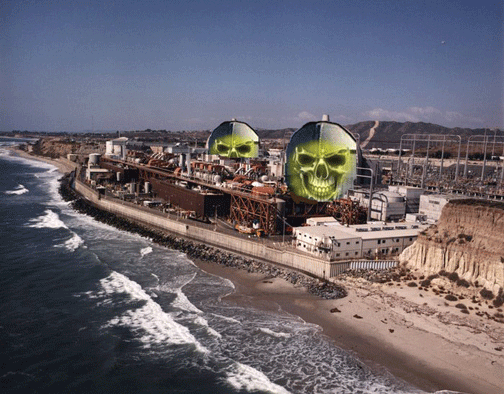
Reports: San Onofre nuclear site ‘fatally flawed’, https://www.thecoastnews.com/reports-san-onofre-nuclear-site-fatally-flawed/Samantha Taylor January 17, 2019,
REGION — Nuclear waste storage facilities at the decommissioning San Onofre Nuclear Generating Station are “fatally flawed” and could cost Southern California nearly $13.4 trillion over a 50-year period if a major release of radiation occurs, according to two reports recently published by the Samuel Lawrence Foundation.
The reports were published during an ongoing Nuclear Regulatory Commission investigation into electric supply company Southern California Edison and its contractor, Holtec International, which designed and built the storage facility.
The investigation stems from an incident on Aug. 3, 2018, when a full canister of spent nuclear fuel came within a quarter-inch of falling 18 feet.
Edison’s plan is to move 73 canisters into the oceanfront storage vault, having already moved 29 by the reports’ publication.
After the August incident, regulators stopped any more canisters from being loaded into the vault, built to hold 3.6 million pounds of nuclear waste at the San Onofre site, located on Marine Corps Base Camp Pendleton on the coastal side of I-5.
The report notes how storage tanks at gas stations in California must be double-walled after experiencing how single-walled containers can leak gasoline into groundwater.
“With a double-walled fuel tank, if a leak occurs it can be detected and the storage container can be repaired or replaced before any gasoline is released,” the report states. “At San Onofre, we certainly should expect that some kind of leak prevention system would be in place to contain extremely toxic high-level radioactive waste.”
At an Aug. 9, 2018, community engagement panel discussing the decommissioning of San Onofre, Occupational Safety and Health Administration inspector David Fritch told attendees about a near-accident at the storage facility.
When workers using a crane were moving a canister containing spent nuclear fuel, it became lodged at the top of the cavity enclosure container into which it was being stored.
Investigations revealed the operators and managers could not see the canister as it was being lowered and became stuck for nearly an hour, hanging 18 feet in the air from the guide ring along the top of the container.
The San Onofre Nuclear Generating Station (SONGS) began operating in 1968 and closed in 2012 after continuous leaks were discovered in the plant’s steam generator tubes.
The first report, titled “San Onofre Nuclear Waste Problems,” examines damage caused to the “thin-walled, steel” canisters as they are lowered into the dry storage vaults. The report refers to this damage as “gouging” and considers it the most serious of the issues facing the storage facility.,
The Del Mar-based nonprofit Samuel Lawrence Foundation’s research determined that had the canister fallen, it could have hit the steel-lined concrete floor of the facility with “explosive energy greater than that of several large sticks of dynamite.” The damage could have caused a large radiation release, according to the report, and could have ruined the facility’s cooling system.
According to the report, each nuclear storage canister contains 37 spent fuel assemblies, which generate “enormous amounts of heat” and are cooled by an air duct system, which could have been blocked by the damage from a canister falling.
If that had happened, great quantities of water would be needed to cool the reaction and prevent or control a meltdown. That water would instantly become radioactive steam, similar to what happened during the 2011 Fukushima Daiichi nuclear disaster in Japan.
In the report, retired U.S. Navy Rear Adm. Len Hering, Sr., who previously served as a nuclear weapons safety officer, provided a scathing assessment of the storage facility’s management practices.
“I find that virtually none of the protocols that should be expected for the safe handling of this dangerous material are present,” he states in the report. “I find that personnel and companies are being hired virtually off the street, no specific qualification standards are present or for that matter even required, training is not specific to the risks of the material involved, and there is no fully-qualified and certified team assembled for this highly-critical operation.”
The report also addresses the risk of storing them so close to the Pacific Ocean, where rising sea levels, frequent high humidity and coastal fog make metal susceptible to short-term corrosion and stress-induced corrosion cracking.
According to the report, the mean high tide level is about 18 inches below the base of the oceanfront storage facility, which means sea level frequently exceeds that height.
It states it’s likely that the present groundwater table will leach into the vault and result in damp storage, which the vault is not designed for.
Rising sea levels due to climate change could make things worse, potentially causing the bottom seven feet of the storage canisters to be submerged and possibility create a similar crisis to Fukushima, where spent fuel was exposed to moisture.
In the second report, titled “Potential Economic Consequences from an Event at the San Onofre Nuclear Generation Station Interim Spent Fuel Storage Installation,” uses economic impact modeling software to estimate economic losses from diminished activities within evacuation zones of one, 10 or 50 miles over one year to 50 years.
In a scenario looking at contamination across a one-mile radius, the report states the most significant loss is likely the disruption of regional transportation for up to a year costing $266 million.
The 1-mile radius, which would only represent a minor event, would still affect I-5 and the rail line.
Looking at evacuation zones of 10 to 50 miles over a one- to 50-year period, residential property losses could amount to $11 billion to $500 billion depending on the evacuation scenario. In the 50-mile impact scenario, about $13.4 trillion in gross regional product could be at risk over a 50-year period.
The first report concludes that the nuclear waste at San Onofre requires “much better storage configuration” and needs to be moved to a “technically defensible storage facility” further away from major transportation corridors like I-5.
“If an accident, natural disaster, negligence, or an act of terrorism were to cause a large-scale release of radiation, the health and safety of 8.4 million people within a 50-mile radius would be put at risk,” the report states.
It also demands that a “complete analysis of canister loading procedure and comprehensive risk assessment” be conducted transparently by an independent party, and recommends a permanent stop to the loading of nuclear storage canisters into the seaside vault, to begin placing spent fuel into “reliable canisters that can be monitored, inspected and repaired” and to move them to a facility at a much higher elevation.
January 19, 2019
Posted by Christina Macpherson |
decommission reactor, USA |
3 Comments
Japan News 14th Jan 2019 The total cost for scrapping the nation’s nuclear power facilities —
excluding Fukushima No. 1 nuclear power plants and other facilities under construction — is estimated to be about ¥6.72 trillion, according to a tally by The Yomiuri Shimbun.
The assessment only includes dismantlements of nuclear power facilities for which the cost can currently be estimated. Among these estimates, the cost for closing a spent nuclear fuel reprocessing plant now being built by Japan Nuclear Fuel Ltd. (JNFL) in Rokkasho, Aomori Prefecture, accounts for the largest amount at ¥1.6 trillion.
The cost for decommissioning 53 commercial nuclear reactors is estimated to total about ¥3.58 trillion, for an average at ¥57.7 billion per reactor. Of the 53 reactors, 19 reactors are scheduled or are likely to be scrapped.
http://the-japan-news.com/news/article/0005476533
January 15, 2019
Posted by Christina Macpherson |
decommission reactor, Japan |
Leave a comment
PG&E to close Diablo Canyon nuke plant in 10 years, East Bay Times, By GEORGE AVALOS | gavalos@bayareanewsgroup.com | Bay Area News Group, August 15, 2016
Signaling the end of nuclear power in California, PG&E on Tuesday announced plans to close the Diablo Canyon Power Plant by 2025.The proposal to shut down the state’s last nuclear power facility represents a major leap toward meeting California’s renewable energy mandate. It would mark the end of more than a half-century of nuclear power generation in the state and could serve as a blueprint for closing other U.S. nuclear facilities…….
To replace the lost nuclear power, PG&E plans to expand energy efficiency, its use of renewable energy, and energy storage that would exceed current state mandates. California’s historic 2015 energy law requires that power companies get 50 percent of their electricity from renewable sources, such as solar or wind, by 2030. PG&E aims to produce 55 percent of its power from renewable sources by 2031. At present, about 30 percent of the utility’s electricity comes from renewable sources, said Keith Stephens, a PG&E spokesman. The state requires that utilities reach 33 percent by 2020. …….https://www.eastbaytimes.com/2016/06/21/pge-to-close-diablo-canyon-nuke-plant-in-10-years/
January 15, 2019
Posted by Christina Macpherson |
decommission reactor, USA |
Leave a comment
Entergy sells Vermont Yankee nuclear plant, signaling what’s to come for Indian Point, Lohud, Thomas C. Zambito, Rockland/Westchester Journal News Jan. 11, 2019
Entergy sold its Vermont Yankee nuclear power plant to a dismantling firm, a first-of-its-kind deal that offers a blueprint for Indian Point’s future
STORY HIGHLIGHTS
- The Nuclear Regulatory Commission approved the deal in October
- Towns near Indian Point are hoping for a similar deal so Indian Point can be opened to development after it shuts down in 2021
- Deal with dismantling firm a first for dismantling of a nuclear plant
Entergy sold its Vermont Yankee nuclear power plant to a New York dismantling firm Friday, finalizing a deal that could offer the blueprint for Indian Point’s future after it shuts down in 2021.
The deal with NorthStar Group Services represents the first time a nuclear power plant has transferred its license to a company that take over the lengthy process of dismantling nuclear reactors and securing spent radioactive fuel.
It’s likely more will follow.
With nuclear power plants struggling to compete against the cheap price of natural gas, more than a dozen nuclear plants across the U.S. have, in recent years, shut down or announced plans to close…….https://www.lohud.com/story/news/local/westchester/2019/01/11/entergy-sells-its-vermont-yankee-nuclear-power-plant-ny-firm/2552170002/
January 14, 2019
Posted by Christina Macpherson |
decommission reactor, USA |
Leave a comment
 Costs for scrapping 79 nuclear facilities estimated at 1.9 tril. yen https://mainichi.jp/english/articles/20181227/p2g/00m/0na/001000c Costs for scrapping 79 nuclear facilities estimated at 1.9 tril. yen https://mainichi.jp/english/articles/20181227/p2g/00m/0na/001000c
December 27, 2018 (Mainichi Japan) TOKYO (Kyodo) — The state-backed Japan Atomic Energy Agency said Wednesday it would need to spend about 1.9 trillion yen ($17.1 billion) to close 79 facilities over 70 years, in its first such estimate.
The total costs could increase further, as the agency said the estimated figure, which would be shouldered by taxpayers, excludes expenses for maintenance and replacing aging equipment.
The JAEA plans to close more than half of the 79 facilities over the next 10 years due in part to the increased costs to operate them under stricter safety rules introduced after the 2011 Fukushima nuclear crisis. The agency, which has led nuclear energy research in Japan with its predecessors since the 1950s, owns a total of 89 facilities.
Of the estimated costs, the expense for closing the nation’s first spent-fuel reprocessing plant in the village of Tokai, Ibaraki Prefecture, northeast of Tokyo, accounts for the largest chunk of 770 billion yen. It will cost 150 billion yen to decommission the trouble-plagued Monju prototype fast-breeder nuclear reactor.
As for nuclear waste, the agency said about 100 kiloliters of high-level radioactive waste and up to 114,000 kl of low-level radioactive waste were estimated to have been produced but it has yet to decide on disposal locations.
The Japanese government aims to restart nuclear power plants after a nationwide halt following the nuclear crisis, despite persistent concern over the safety of atomic power generation.
|
|
|
December 27, 2018
Posted by Christina Macpherson |
decommission reactor, Japan, politics |
Leave a comment
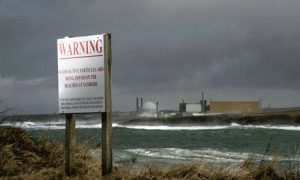 Scotland’s oldest nuclear reactor to go as demolition contract awarded, The decommissioning of Dounreay’s oldest nuclear reactor has taken a major step forward with the award of a multi-million pound contract Gov. UK 14 December 2018
December 15, 2018
Posted by Christina Macpherson |
decommission reactor, UK |
Leave a comment