UK. For thehighly radioactive Dounreay nuclear site, a mobile robot will be used to identify the toxic structures
 Press & Journal 8th Sept 2020 A mobile robot will be used for the first time in one of the most contaminated and inaccessible parts of the Dounreay nuclear plant to provide vital information on the next steps in its decommissioning. The technology will provide the first images in decades from inside the Caithness site’s Fuel Cycle Area (FCA).
The FCA consists of two reprocessing plants, waste stores and laboratory facilities where spent nuclear fuel was examined and reprocessed. As part of the site clean up, Dounreay Site Restoration Ltd (DSRL) is working with the Robotics and Artificial Intelligence in Nuclear (Rain) Hub, a consortium of universities led by the University of Manchester, to explore ways to overcome some of
the challenges.
Hinkley Point B nuclear station could close down early – EDF
 EDF Energy says UK’s Hinkley Point B nuclear plant could close earlier than planned
The 1 gigawatt (GW) plant in Somerset was due to be shut down permanently in early 2023. It began operation in 1976.
“It is possible we may need to move into defuelling within the next two years. We will review this decision in the same detailed way as we have with Hunterston B and expect to be able to confirm the outcome by the end of this year,” said a spokesman for EDF Energy, part of France’s EDF.
Last month, EDF Energy said it would start decommissioning its Hunterston B nuclear power plant in Scotland by January 2022 at the latest.
Both Hunterston B and Hinkley Point B have had issues with ageing, as cracks were found in graphite bricks which form reactor cores, prompting some industry experts to foresee their permanent closure soon.
Nearly all of Britain’s 9 GW nuclear fleet is composed of advanced gas-cooled reactors. A factor of ageing in that type of reactor is cracks in the graphite bricks.
Half of Britain’s eight operating nuclear power stations are due to move into decommissioning by March 2024, removing around 4 GW of power capacity…….. www.reuters.com/article/britain-nuclearpower/update-1-edf-energy-says-uks-hinkley-point-b-nuclear-plant-could-close-earlier-than-planned-idUSL8N2G65F8
Huge challenge to decontaminate Dounreay: ‘World’s deepest nuclear clean-up’.
|
Dounreay: ‘World’s deepest nuclear clean-up’ to begin, The first work in a clean-up of a 1950s-built shaft at a nuclear power research complex is to begin this year. BBC News, 9 Sep 20,
The shaft plunges 65.4m (214.5ft) below ground and poses one of the biggest challenges in the demolition of Dounreay in Caithness.
Radioactive waste was disposed there from 1959 until 1977 when an explosion ended the practice.
Tackling the shaft has been described as the “world’s deepest nuclear clean-up”…….
A £7.5m contract has been awarded for the first steps in this work, due to begin in late autumn, and also to carry out similar engineering work at another site at Dounreay called the silo.
It is described as being like a swimming pool with a concrete roof and was also used for the disposing of radioactive waste.
Engineering firms Nuvia and Graham Construction have been awarded the contract for work that would eventually lead to the waste being removed.
David Hubbard, of Dounreay Site Restoration Ltd, said: “The shaft and silo contain solid waste and sludge which must be retrieved and repackaged for safe above-ground storage…..
Dounreay, near Thurso, was the UK site for the development of fast reactor research from 1955 to 1994.
The facility on the north Caithness coast is in the process of being closed down, demolished and cleaned up. https://www.bbc.com/news/uk-scotland-highlands-islands-54085592
|
|
UK’s Dounreay nuclear power site, opened in 1955, closed 1994, cleaned up in 2333, if they’re lucky
Dounreay on Scottish north coast has been site of considerable radioactive leaks https://www.independent.co.uk/environment/nuclear-power-dounreay-scotland-thurso-decommissioning-radiation-a9680611.html Harry Cockburn, Thursday 20 August 2020 In 313 years’ time, 378 years after it first opened in 1955, and 339 years after it ceased operations in 1994, the 178-acre nuclear power facility site at Dounreay will be safe for other uses, a new report has stated.
Though the site on the north coast of Scotland was only home to functioning nuclear reactors for 39 years, the clean-up will take roughly ten times as long, with efforts already underway to clean up hazardous radioactive material.
The facility, near Thurso, was used by the government for research and testing of various types of nuclear reactors, including a “fast reactor” and those intended for use on nuclear submarines.
The first reactor at the site to provide power to the National Grid was the Dounreay Fast Reactor, which provided power between 1962 and 1977. A second reactor also pumped power into the grid between 1975 and 1994.
A draft report from the government’s nuclear decommissioning authority states the site will only be ready for other uses after the year 2333.
Over the next two years, Dounreay Site Restoration Limited has said it will undertake assessments of “installations, current and future disposals, areas of land contamination, sub-surface structures and other discrete site conditions” to determine “credible options for the site end state”.
A process of demolition of buildings and waste removal is already underway at the site, which has previously been used to store dangerous radioactive material.
Part of the demolition process has involved the use of a remote controlled robot nicknamed the “Reactosaurus”, a 75-tonne device with radiation-proof cameras, and robotic arms which are able to reach 12 metres into the reactors where they can operate an array of size-reduction and handling tools, including diamond wire and disks and hydraulic shears.
One of the areas targeted for waste removal is a highly contaminated area called the Shaft.
The water reacted violently with the sodium and potassium, throwing off the massive steel and concrete lids of the shaft, and littered the area with radioactive particles.
The dangerous pollution affected local beaches, the coastline and the seabed. Fishing has been banned within a two-kilometre radius of the plant since 1997.
Milled shards from the processing of irradiated plutonium and uranium, are roughly the size of grains of grains of sand. The most radioactive of the particles are believed to be potentially lethal if ingested. These small fragments are known to contain caesium-137, which has a half-life of 30 years, but they can also incorporate traces of plutonium-239, which has a half-life of over 24,000 years.
Army dismantling long dead nuclear power plant at Fort Belvoir
Army dismantling deactivated nuclear power plant at Fort Belvoir, INSIDE NOVA, Aug 28, 2020
Wow! Only the bare 313 years before the Dounreay nuclear power site could be used for anything else!
 uses in 313 years’ time, according to a new report. Dounreay, near Thurso,
was the UK site for the development of fast reactor research from 1955 to
1994. The facility on the north Caithness coast is in the process of being
closed down, demolished and cleaned up. However, the Nuclear
Decommissioning Authority said it would be 2333 before the 148-acre site is
safe for reuse. The date forms part of the authority’s newly-published
draft strategy. Waste is to be removed from the Shaft by 2029, according to
the NDA report.
https://www.bbc.co.uk/news/uk-scotland-highlands-islands-53848766
Independent 20th Aug 2020, In 313 years’ time, 378 years after it first opened in 1955, and 339
years after it ceased operations in 1994, the 178-acre nuclear power
facility site at Dounreay will be safe for other uses, a new report has
stated. Though the site on the north coast of Scotland was only home to
functioning nuclear reactors for 39 years, the clean-up will take roughly
ten times as long, with efforts already underway to clean up hazardous
radioactive material. Part of the demolition process has involved the use
of a remote controlled robot nicknamed the “Reactosaurus”, a 75-tonne
device with radiation-proof cameras, and robotic arms which are able to
reach 12 metres into the reactors where they can operate an array of
size-reduction and handling tools, including diamond wire and disks and
hydraulic shears. One of the areas targeted for waste removal is a highly
contaminated area called the Shaft. In 1977, a catastrophic leak allowed
seawater to flood a 65-metre-deep shaft which was packed full of
radioactive waste as well as more than 2kg or sodium and potassium.
Army finally tearing down Fort Belvoir’s nuclear plant
Dismantling nuclear reactors in Snowdonia; should be cleaned up by 2083, if We’re lucky
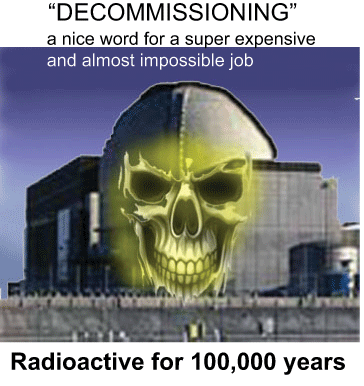 Trawsfynydd: Nuclear reactors to go under new decommissioning plan, By George Herd, BBC News, 30 July 2020
Plans have been unveiled to remove nuclear reactors and towers at a former power plant in Snowdonia.
It follows a decision to name Trawsfynydd in Gwynedd as the lead project for former Magnox stations in the UK.
The twin reactors will become the very first in the UK to be fully decommissioned.
It should safeguard hundreds of jobs at the plant for 20 years, and help drive decommissioning plans at other sites.
There are 10 former Magnox nuclear power stations in the UK, which have all now stopped generating electricity – the last being Wylfa on Anglesey in 2015.
Trawsfynydd was shut down in 1991 after operating for a quarter of a century.
Under original plans, the twin reactor buildings that tower over the landscape were due to be reduced in height by two-thirds, and then left in a care and maintenance phase, before the site is completely cleared in 2083.
The new programme will see the remaining reactor buildings demolished, while a new low-level radioactive waste store is built on the site to hold the material.
Magnox, which operates the site on behalf of the UK’s Nuclear Decommissioning Authority, said it estimated there would be 50,000 cubic metres of very low or low-level waste retained, until a new geological waste disposal site is identified by the UK government. …..
Magnox said it was still in the “early days” of planning the next phase of active decommissioning at Trawsfynydd, and would be launching consultations with stakeholders, including the community.
It said it envisaged a 20 year programme to:
- Remove the reactor building’s concrete panel outer shell down to ground level
- Remove the six 1,000 tonne boilers stored in sections and the 45 tonne overhead crane from each reactor, for off-site disposal
- Remove the reactors, their components and the reactor core
- Demolish the remaining reactor buildings
State of the art robotics and remote handling will be used to dismantle Trawsfynydd’s twin reactors and “minimise the risk of radiation dose to workers”.
Magnox said it still expected the site to be completely cleared by the 2083 target……
“There is a duty on the nuclear sector and today’s electricity users to take responsibility for the clear-up of sites, and Trawsfynydd’s twin reactors will be the first to be completely decommissioned in the United Kingdom,” said the Plaid Cymru MP for Dwyfor Meirionnydd. “In this respect, work undertaken here will lead the entire sector, and open opportunities for a whole new generation of engineers.”…. https://www.bbc.com/news/uk-wales-53595839
Dismantling of San Onofre nuclear station, but high level radioactive trash remains onsite

San Onofre Decommissioning Update https://www.kpbs.org/news/2020/jul/27/san-onofre-decommissioning-update/ Monday, July 27, 2020, By Alison St John Work continues to dismantle the San Onofre nuclear power plant, which provided San Diego with 20% of its electricity until 2012 when it shut down prematurely, due to a radiation leak. The process of decommissioning the plant is more controversial than its 44 years in operation. The question is whether the high-level nuclear waste, which remains radioactive for tens of thousands of years, can be safely disposed of?
Rob Nikolewski, energy reporter for The San Diego Union-Tribune, has been following the progress of decommissioning and storing the radioactive waste.
Nikolewski said one very large chunk classified as low-level nuclear waste has already been transported to a storage site near Clive, Utah. The 770-ton reactor vessel was shipped by rail and a convoy of eight trucks across over 400 miles to its destination. Millions more pounds of low-level waste will be broken down into smaller pieces and transported to Clive, where the private company Energy Solutions has a licensed repository.

However the high-level waste — hundreds of spent fuel rods — remains on-site, since the federal government has failed to approve a long- term storage site for the nation’s high-level nuclear waste. Southern California Edison, which owns the plant, has nearly finished transferring canisters of highly radioactive spent fuel rods into over 70 concrete bunkers next to the beach.
Earlier this month the California Coastal Commission approved Edison’s permit for the decommissioning, including removing the cooling pools which originally held the stored spent fuel rods. The Commissioners reserved the right to review the permit in 15 years and if there is evidence of cracking or other problems such as sea-level rise that threaten the integrity of the canisters, the permit holder could be required to move them.
San Diego Congressman Mike Levin is concerned about the safety of the site, which is in his district and has millions of people living within 50 miles. Levin convened a task force that met for a year and recently came out with a report. One recommendation is that since the federal government has not approved a long-term storage site for high-level nuclear waste, the state of California should take more responsibility for how the nuclear waste is disposed of.
Nikolewski said he has not seen any evidence of state officials stepping forward to hold the companies accountable. He said federal law may need to be changed to allow for that.
The distinctive twin domes that are visible from the Interstate 5 will be removed sometime between 2025 and 2027, and decommissioning the plant, including removal of the low-level nuclear waste, should be complete within 6 to 8 years. The high-level waste will remain indefinitely, in bunkers near the beach.
770-ton nuclear reactor pressure vessel completes trip to Utah
|
770-ton load from San Onofre nuclear plant finishes trip to Utah, An old nuclear reactor pressure vessel is part of the dismantlement of the plant,San Diego Tribune, By ROB NIKOLEWSKI, JULY
20, 2020 The seven-week journey of a 770-ton shipment of an old but vital piece of the San Onofre nuclear power plant has been completed.
The reactor pressure vessel that helped generate electricity at Unit 1 of the plant arrived last week at a licensed disposal site about 75 miles west of Salt Lake City after being shipped by rail and then over highways in Nevada and Utah……. The vessel left SONGS May 24 via rail before stopping at an industrial park in North Las Vegas, Nevada, where cranes helped assemble a trailer 122 feet long, with 45 axles, that slowly hauled the massive chunk about 450 miles along highways in Nevada and Utah to the Energy Solutions disposal facility in the town of Clive, Utah.
Six heavy-duty Class 8 trucks with combined 4,000-horsepower moved the the load. The convoy used 460 tires that were 18 inches wide to prevent damaging roads, bridges and public infrastructure. Contractors from Emmert International used hydraulic jacks to reinforce drainage culverts. A spokesman for the Nevada Department of Transportation said it was the heaviest load to ever traverse the Silver State’s roadways. Transportation officials in Utah said the shipment arrived July 14 without any issues. The pressure vessel once held nuclear fuel at SONGS when Unit 1 was in operation between 1968 and 1992. For 18 years, the vessel sat on the north end of the plant, covered in a shell of steel two inches thick with a top and bottom each each inches thick to shield against radiation. Encased in a carbon steel cylinder for the trip, the vessel contained pieces of radioactive metal and grout. The shipment was designated as Class A low-level waste, considered by the U.S. Nuclear Regulatory Commission as the least hazardous of radioactive waste classifications. The shipment is one of many that will head to the Clive disposal facility as part of a scheduled eight-year process to dismantle SONGS, although future shipments will not be as large. Energy Solutions and construction giant AECOM have partnered to undertake the $4.4 billion demolition project, which began earlier this year……. f all goes as planned, by the time dismantlement at SONGS is completed, all that will remain will be two dry storage facilities holding 3.55 million pounds of used-up fuel, or waste, that accumulated during the time the plant produced power; a security building with personnel to look over the waste enclosed in casks; a seawall 28 feet high at its base; a walkway connecting two beaches north and south of the plant and a switch-yard with power lines. The distinctive 200-feet-high twin domes that loom over Interstate 5 are scheduled to come down between late 2025 and 2027. https://www.sandiegouniontribune.com/business/story/2020-07-20/770-ton-load-from-san-onofre-nuclear-plant-finishes-trip-to-ut |
|
Problems and dangers face the dismantlement of damaged Three Mile Island nuclear reactor
“The smell was a combination of rotting eggs, diesel fuel and a smoldering fire pit,” he said.
The plant’s Unit 2 reactor had partially melted down about 4 a.m. March 28, 1979, and as Mohr remembers it, locals panicked, fearing for their safety. Some fled, others hid inside.
“I can remember this like it was yesterday,” said Mohr, who has been a longtime township supervisor. “There was definitely an air of uncertainty. People were confused.”
Four decades later, confusion and concern have returned near the now-inactive power plant as officials at Utah-based EnergySolutions plan to dismantle the historic reactor.
It’s a plan that has state environmental officials and local nuclear watchdogs ringing proverbial alarm bells, pointing to concerns that money set aside for the decommissioning could run out before the work is finished.
That’s in addition to fears about the potential for indefinite radioactive contamination on the island, which sits just upstream from Lancaster County on the Susquehanna River.
Old concerns resurface
To Arthur Morris, Lancaster city’s mayor from 1980 to 1990, some of those worries are familiar. They existed in the years after the 1979 accident, when Morris sat on a state advisory board that focused on radioactive decontamination of Unit 2.
Back then — and now — the Susquehanna River served as the primary source for several downstream Lancaster County drinking water systems, including in Lancaster city.
As mayor, Morris said one of his priorities on the panel was to make sure radiation wasn’t carried downstream and piped through Lancaster residents’ faucets — a priority that led to regular testing near the plant that persists today.
Last week, Morris said he isn’t surprised that some of those old concerns have resurfaced with Unit 2 coming back under scrutiny.
“Those things don’t go away until the island is cleaned up,” Morris said.
‘Worst-case scenario’
However, it’s a cleanup plan that has nuclear watchdog Eric Epstein speaking out on signs of pending danger.
“It’s the worst-case scenario,” said Epstein, a leader of the Harrisburg-based group Three Mile Island Alert.
Last fall, Unit 2’s owners at Ohio-based FirstEnergy Corp. announced that they planned to transfer all related licenses and assets to TMI-2 Solutions LLC, an EnergySolutions subsidiary.
The transfer would mean that EnergySolutions also would take over the responsibility of eventually dismantling the Unit 2 reactor.
And that eventuality had already been planned for by the time the proposed transfer was announced in October. Then, EnergySolutions revealed plans to contract decommissioning work out to New Jersey-based construction company Jingoli, which has had past success with nuclear projects in the United States and Canada.
Despite a track record, state Department of Environmental Protection officials warned that planning for and beginning decommissioning work too early could put the island and surrounding areas at risk.
After all, DEP Secretary Patrick McDonnell noted, Unit 2 is the site of the worst commercial nuclear accident in United States history — an accident that released radioactive gases and grossly contaminated the reactor and its surrounding buildings.
“Because of this, we understand there are very high radiation areas within TMI Unit 2 that present a grave risk to personnel that enter,” a letter signed by McDonnell reads.
That high radiation has prevented all but minor exploration of the Unit 2 area, meaning the radiological conditions inside large portions of the plant remain a mystery, according to the letter.
“I firmly believe TMI Unit 2 is the most radiologically contaminated facility in our nation outside of the Department of Energy’s weapons complex,” it reads.
Postponing the cleanup for “several decades” could allow for a decrease in radioactive potency, possibly lessening the chance of further environmental contamination, McDonnell wrote.
All of that is in addition to raising questions about how radioactive waste will be disposed, transported and stored. That includes concerns about whether any of that waste will be stored on the island — a site that Epstein believes could remain indefinitely radioactive.
Both McDonnell’s writings and Epstein’s concerns were submitted this spring to officials at the U.S. Nuclear Regulatory Commission, which must approve the FirstEnergy-to-EnergySolutions transfer request.
Commission officials have been reviewing the request since November, and similar reviews have been completed in a year or less, according to spokeswoman Diane Screnci.
Financial concerns
But it’s not only environmental issues that will be weighed as part of that review, with Epstein and state officials also raising serious financial concerns.
Specifically, they’ve drawn attention to a largely ratepayer-funded $901 million trust set aside to cover the cost of decommissioning, which has been estimated at upward of $1.2 billion.
Further complicating the issue, according to McDonnell’s letter, is the fact that trust fund dollars are tied to the stock market, which has seen large fluctuations due to the ongoing COVID-19 pandemic.
“Given the obvious uncertainties and complexities associated with cleaning up the remains … the demonstration of adequate funding to complete the decommissioning of TMI-2 and restoration of the site, is a significant concern of the department and the citizens of Pennsylvania,” McDonnell wrote.
Beyond sharing McDonnell’s letters, DEP officials said they could not further discuss the proposed decommissioning, citing litigation. Nondisclosure agreements stipulated by EnergySolutions also prevent DEP and Epstein from sharing some details.
EnergySolutions spokespeople did not respond to multiple requests for comment, though they indicated they are aware of concerns about their work.
Jennifer Young, a FirstEnergy spokeswoman, said company officials have faith the job will be completed on budget despite the existing disparity between the trust fund and estimated cost.
Cost estimates show there are sufficient funds given the project schedule for decommissioning,” she said. “Keep in mind that those funds will continue to accumulate value throughout the decommissioning process, which takes place over many years. Not all the money will be required or spent at one time.”
Epstein said it’s important to point out that the Unit 2 trust is full of ratepayer money, which will be under the full control of EnergySolutions’s TMI-2 Solutions LLC, a private company, with little public scrutiny.
Right company for the job
Despite those concerns, Young said FirstEnergy officials believe EnergySolutions is the right company to dismantle Unit 2. In fact, EnergySolutions decommissioning proposal was selected over offers from two other companies, she said. The unsolicited EnergySolutions proposal was made in 2018, Young said.
By Nuclear Regulatory Commission decree, the plant must be decommissioned within 60 years of halting operation, and Three Mile Island’s functioning Unit 1 was taken offline by its owner, Exelon, in 2019.
“We were faced with a decision to decommission the unit now or wait to start in the 2030s,” Young said.
“Waiting would not guarantee there would be companies available to start the dismantlement in time to comply with the 60-year requirement due to the large number of nuclear plant licenses that will expire in the 2030s,” he said.
Still, Epstein said he’d like a Nuclear Regulatory Commission decision on the transfer to remain delayed until his and DEP’s concerns can be worked through.
Like a big gravestone
Back in Conoy Township, Mohr said his full faith is in the commission to make the right decision — an opinion steeped in the immediate aftermath of the 1979 partial meltdown.
It was a commission official, Harold Denton, who shared the first details with locals, offering assurances that everything would be alright, he said.
“When he was done speaking, it was like the world calmed down,” Mohr said of the commission official. “He put it into a perspective that even we understood.”
For decades since, the plant has meant local jobs and local money, but since the 2019 shutdown, much of that has fallen by the wayside, he said. And it’s mostly for that reason that Mohr said he’s indifferent to the island’s fate.
“It’s almost to the point now that it was never there. If we drive north, we see it,” he said. “It reminds me of the biggest gravestone that I ever saw.”
France’s oldest nuclear power plant at Fessenheim finally shut down
The two reactors at Fessenheim began operation in 1977 and 1978 and were already three years beyond their projected 40-year life span.
Although there is no legal limit on the operating life of French nuclear power plants, EDF had envisaged a 40-year lifetime for all second-generation PWRs.
Fessenheim had become a focus for anti-nuclear campaigners after the 2011 Fukushima accident in Japan, prompting then President Francois Hollande to promise its closure. However, it was not until 2018 that his successor Emmanuel Macron finalised the decision.,,,….. https://www.neimagazine.com/news/newsfessenheim-closes-down-8004216
Activists, despite government oppression, campaign for decommissioning of Russia’s aging nuclear reactors
Anti–nuclear resistance in Russia: problems, protests, reprisals [Full Report 2020] Report “Anti–nuclear resistance in Russia: problems, protests, reprisals” Produced by RSEU’s program “Against nuclear and radioaсtive threats”“………..For many years, Murmansk regional environmental groups have opposed the ageing Kola NPP reactor’s lifetime extension. They have participated in public hearings, have organised many demonstrations (8-9-10), appealed to and received support from the prosecutor’s office(11), but this was all ignored by Rosatom. Activists also called on the governor to shut down the old NPP, but environmental organisations were shutdown instead. One such organisation is Kola Environmental Center (KEC) – listed as a Foreign Agent in 2017– and was subject to two trials and fined 150,000 rubles (12). KEC was forced to close down as a legal entity in2018, but has continued its environmental work as a public movement(13). Another organisation in the region –Nature and Youth – made the decision to close down in order to avoid prosecution, but continues its work as an unregistered initiative
• In 2018, after 45 years of operation, the first power unit of the Leningrad NPP was finally shut down.The second one scheduled for shutdown is in 2020, the third in 2025 and the fourth in 2026. However,decommissioning projects have not yet been clearly developed for the reactors.
• The public organisation, Green World, has worked for many years in Sosnovy Bor, Leningrad Region, a city dominated by the nuclear industry and closed to outsiders. Since 1988, activists of the organisation have opposed dangerous nuclear projects in the Baltic Sea region(17) and have provided the public with independent information on the environmental situation. (18)
In its place, another organisation was opened – the Public Council of the South Coast of the Gulf of Finland. Activists have continued their work as before under this new name…….”
Latina plant, the last of Italy’s 4 nuclear power stations to be dismantled
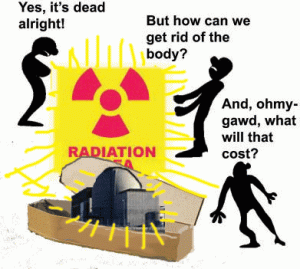 Italy approves dismantling of Latina plant https://www.world-nuclear-news.org/Articles/Dismantling-of-Italys-Latina-plant-to-begin 02 June 2020
The main activities envisaged during this initial phase of decommissioning concern the dismantling of the six boilers, with a total weight of over 3600 tonnes, and the lowering of the reactor building height from 53 to 38 metres. Buildings and auxiliary systems will also be dismantled. These operations are in addition to those already carried out or in progress at the plant.
By the end of this phase, all previous radioactive wastes generated through the operation of the plant or those produced by the dismantling of structures, systems and plant components will be stored safely at the site. These wastes will be stored both in a new temporary storage facility and in some specifically adapted reactor building premises. This initial phase of decommissioning the Latina plant is expected to be completed in 2027 and to cost EUR270 million (USD302 million).
With the availability of a planned national repository, it will be possible to start the second and final phase of the decommissioning of the plant with the dismantling of the graphite gas reactor. Once all the radioactive waste has been transferred to the repository and the temporary storage facilities demolished, the site will be released, without radiological restrictions, and returned to the community for its reuse.
“We are pleased with the issuance of this decree, the fifth after those obtained for the Bosco Marengo [fuel fabrication] plant and the Trino, Garigliano and Caorso [nuclear power] plants,” said Sogin CEO Emanuele Fontani. “This is a crucial step for the closure of the Italian nuclear cycle, which allows us to get to the heart of the decommissioning of the Latina plant. This measure confirms the fruitful collaboration between the various institutional subjects involved in the dismantling of nuclear plants.”
The Latina plant, comprising a single 210 MWe Magnox graphite gas-cooled reactor, began operating in January 1964. It was permanently shut in December 1987 as a result of the Italian referendum on nuclear power that followed the April 1986 Chernobyl disaster. Sogin took over ownership of the site in November 1999.
Dismantling of Norway’s nuclear research reactors – up to 25 years, about $billion
Norwegian reactor dismantling to cost almost USD2 billion, WNN , 18 May 2020 The decommissioning of Norway’s shut down research reactors at Halden and Kjeller will cost around NOK20 billion (USD1.96 billion) and take 20-25 years, according to a report commissioned by the Ministry of Trade and Industry. The report by Atkins and Oslo Economics mainly confirms assessments from the Institute for Energy Technology (IFE) and risk management and quality assurance consultants DNV GL that were made in 2019. It estimates that demolition of facilities and restoration of the areas will cost around NOK7 billion. There will also be costs of around NOK13 billion for the treatment of used fuel and the storage of radioactive waste. However, it notes there is “considerable uncertainty” around these costs…….
“There have been limited reactor operations in Norway, but we have complicated facilities and waste that will cost a lot,” said Minister of Industry Iselin Nybø. “The report shows how costly and lengthy that dismantling can be. The proposed measures will help to make the cleanup as efficient as possible.
“We will clean up to protect ourselves from harmful consequences for people and the environment from the radiation from this past industry,” Nybø added. “The investigation is part of the puzzle that is now being put in place to ensure a safe and effective cleanup. It will be considered thoroughly and planned to be addressed by the government in the autumn of 2020.”
Norway’s two research reactors – the nuclear fuel and materials testing reactor at Halden and the JEEP-II neutron scattering facility at Kjeller – were declared permanently shut down in June 2018 and April 2019, respectively. Their ownership and responsibility for them will move to Norwegian Nuclear Decommissioning (NND) from IFE……https://www.world-nuclear-news.org/Articles/Dismantling-of-Norwegian-reactors-to-cost-almost-U
1 This Month


Shut down the radiation-damaged Heysham nuclear reactors now
To see nuclear-related stories in greater depth and intensity – go to https://nuclearinformation.wordpress.com

Say No to NASA’s Reckless Nuclear Reactor on the Moon
Say No to NASA’s Reckless Nuclear Reactor on the Moon
-
Archives
- October 2026 (247)
- September 2026 (339)
- August 2026 (330)
- July 2026 (355)
- June 2026 (287)
- May 2026 (306)
- April 2026 (356)
- March 2026 (251)
- February 2026 (267)
- January 2026 (308)
- December 2025 (358)
- November 2025 (359)
-
Categories
- 1
- 1 NUCLEAR ISSUES
- business and costs
- climate change
- culture and arts
- ENERGY
- environment
- health
- history
- indigenous issues
- Legal
- marketing of nuclear
- media
- opposition to nuclear
- PERSONAL STORIES
- politics
- politics international
- Religion and ethics
- safety
- secrets,lies and civil liberties
- spinbuster
- technology
- Uranium
- wastes
- weapons and war
- Women
- 2 WORLD
- ACTION
- AFRICA
- Atrocities
- AUSTRALIA
- Christina's notes
- Christina's themes
- culture and arts
- Events
- Fuk 2022
- Fuk 2023
- Fukushima 2017
- Fukushima 2018
- fukushima 2019
- Fukushima 2020
- Fukushima 2021
- general
- global warming
- Humour (God we need it)
- Nuclear
- RARE EARTHS
- Reference
- resources – print
- Resources -audiovicual
- Weekly Newsletter
- World
- World Nuclear
- YouTube
-
RSS
Entries RSS
Comments RSS

