‘Significant milestone for nuclear sector’ as Hunterston B relicensed for decommissioning
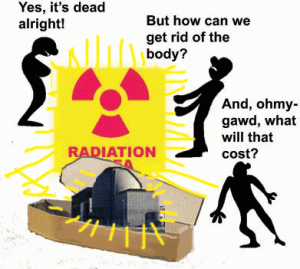
The Office for Nuclear Regulation (ONR) has approved the relicensing of
the Hunterston B nuclear power station, ushering the North Ayrshire site
into its formal decommissioning phase.
From 1 April, Nuclear Restoration
Services (NRS), a subsidiary of the Nuclear Decommissioning Authority
(NDA), will take on full responsibility as site licence holder, replacing
EDF, which operated the Advanced Gas‑Cooled Reactor (AGR) until it ceased
generation in January 2022 after 46 years in service.
This first phase of
decommissioning work at Hunterston B, on the Firth of Clyde, will involve
the removal of all buildings and plant from the site, with the exception of
the reactor buildings and some adjoining structures which will be modified
to create a Safestore structure.
This Safestore is designed to maintain the
reactor buildings in a safe state through the Quiescence phase of around 70
years. Following this, the final site clearance phase will involve the
removal of the reactors and debris vaults housed in the Safestore
structure, making the site available for future use.
New Civil Engineer 19th March 2026 https://www.newcivilengineer.com/latest/significant-milestone-for-nuclear-sector-as-hunterston-b-relicensed-for-decommissioning-19-03-2026/
Decommissioning of Gentilly 1
Ken Collier, 7 Feb 26
As in many industrial projects, many of the hazards come to be known only after the project is well under way or, very often, completed and discontinued. Gentilly 1 is one of those projects. Like others, the Gentilly 1 detritus presents grave dangers to living things as the building, equipment and supplies are taken apart. Complete public review of the decommissioning of Gentilly 1 is required, in my view. It should not be skipped or sidestepped in any way.
Notice of the project was posted on the website of the federal impact assessment agency, but it bears scant resemblance to formal and complete impact assessments, and the public is instructed to send comments to the private consortium, rather than to the federal authorities responsible for making the decision.
To cite Dr. Gordon Edwards, president of the Canadian Coalition for Nuclear Responsibility (CCNR): “Heavily contaminated radioactive concrete and steel would be trucked over public roads and bridges, through many Quebec and Ontario communities, to the Chalk River site just across the Ottawa River from Quebec.”
Impact Assessment of the Planned Dismantling of the Core of the Gentilly-1 reactor.
To: The Honourable Julie Aviva Dabrusin, Minister of Environment and Climate Change
From: The Canadian Coalition for Nuclear Responsibility (CCNR)
Re: Impact assessment of the final dismantling of the Gentilly-1 nuclear reactor
Date: July 5 2026
Reference Number 90092
Cc Impact Assessment Agency of Canada
Atomic Energy of Canada Limited
Canadian Nuclear Laboratories \
Canadian Nuclear Safety Commission
The final dismantling of the most radioactive portions of the Gentilly-1 nuclear reactor, proposed by the licensee Canadian Nuclear Laboratories (CNL), will mark the first time that a CANDU power reactor has ever been fully decommissioned – that is, demolished.
This project is not designated for a full panel review under the Impact Assessment Act (IAA) but you, Minister Dabrusin, have the power to so designate it under the terms of the Act.
The Canadian Coalition for Nuclear Responsibility urges you to do so for the reasons stated below.
(1) When it comes to post-fission radioactivity (human made), the long-lived radioactive decommissioning waste from the core area of a nuclear reactor is second only in radiotoxicity and longevity to the high-level radioactive waste (irradiated nuclear fuel) that has already been designated for a full panel review under IAA at the initiative of NWMO, the Nuclear Waste Management Organization. The deadline for initial comments on the NWMO Deep Geological Repository project (DGR) for used nuclear fuel was yesterday, February 4, 2026. [Our comments: www.ccnr.org/GE_IAAC_NWMO_comments_2026.pdf ]
(2) Fully dismantling a nuclear reactor core is a demanding and hazardous undertaking, resulting in voluminous intermediate level radioactive wastes. The highly radioactive steel and concrete structures – fuel channels, calandria tubes, tube sheet, thermal shield, calandria vessel, biological shield, reactor vault, and more – need to be carefully disassembled, using robotic equipment and perhaps underwater cutting techniques with plasma torches. Such methods are described in a 1984 article published by the Canadian Nuclear Society and linked below, on the detailed advanced methods required for dismantling Gentilly-1.
Gentilly-1 Reactor Dismantling Proposal, by Hubert S. Vogt
Reactor and Fuel Handling Engineering Department
Atomic Energy of Canada Limited – CANDU Operation
Published by the Canadian Nuclear Society in the
Proceedings of the 5th Annual Congress
(3) Dismantling the reactor core will create large amounts of radioactive dust and debris some of which will almost certainly be disseminated into the atmosphere, or flushed into the nearby St. Lawrence River, or added to the existing contamination of the soil and subsoil (including groundwater) at the Gentilly site. It is worth noting that, during the Bruce refurbishment operations in 2009, over 500 workers – local tradesmen, mainly – suffered bodily contamination by inhaling radioactive airborne dust containing plutonium and other alpha emitters (i.e. americium) for a period of more than two weeks. The workers were told that respirators were not required. The radioactivity in the air went undetected for two and a half weeks because neither Bruce managers nor CNSC officers on site took the precaution to have the air sampled and tested.
(4) Once disassembled, the bulky and highly radioactive structural components of Gentilly-1 will have to be reduced in volume by cutting, grinding or blasting. Radioactive dust control and radioactive runoff prevention may be only partially effective. Then the multitudinous radioactive fragments must be packaged, and either (a) stored on site or (b) removed and transported over public roads and bridges, probably to Chalk River. The Chalk River site is already overburdened with high-level, intermediate-level, and low-level radioactive wastes of almost all imaginable varieties. Toxic waste dumping at Chalk River is contrary to the United Nations Declaration on the Rights of Indigenous Peoples (UNDRIP) and the federal government’s “duty to consult”, since Keboawek First Nation and other Indigenous rights-holders in the area have not given their free, prior, informed consent to either the storage or disposal of these toxic wastes on their unceded territory. A panel review could weigh the options of temporary on-site storage versus immediate relocation. Since there is as yet no final destination for intermediate level wastes, moving those wastes two or three times rather than once (when a final destination exists) will be costlier and riskier. Hence on-site storage is attractive.
(5) The decommissioning waste must be isolated from the environment of living things for thousands of years. The metallic fragments contain such long-lived radioactive species as nickel-59, with a 76,000 year half-life, and niobium-94, with a 20,000 year half-life. The concrete fragments also contain long-lived radioactive species like chlorine-36, with a 301,000 year half-life. Such radioactive waste materials are created during the fission process; they were never found in nature before 1940. NWMO has recommended that such intermediate-level decommissioning waste requires a Deep Underground Repository (DGR) not unlike that proposed for used nuclear fuel. CCNR believes that it is only logical and entirely responsible to call for a panel review of this, the first full decommissioning project for a nuclear power reactor in Canada. The lessons learned will have important ramifications for all of Canada’s power reactors as they will all have to be dismantled at some time. This is not “business as usual”.
Read more: Impact Assessment of the Planned Dismantling of the Core of the Gentilly-1 reactor.(6) Demolition of buildings is often a messy business, but demolition of a nuclear reactor core is further complicated by the fact that everything is so highly radioactive, therefore posing a long-term threat to the health and safety of humans and the environment. A panel review by the Assessment Agency is surely the least we can do in the pubic interest.
(7) To the best of our understanding, Canadian Nuclear Laboratories (CNL) is a private contractor managed by an American-led consortium of multinational corporations, whose work is paid for by Canadian taxpayers through the transfer of billions of dollars to CNL from Atomic Energy of Canada Limited, a crown corporation wholly owned by the Canadian government. As CNL is a contractor, paid to do a job by AECL, CCNR does not feel assured that the best interests of Quebec or of Canada will automatically be fully served by CNL, as it is not accountable to the electorate. When the job involves demolishing, segmenting, fragmenting, packaging and transporting dangerous radioactive materials, involving persistent radiological toxins, we feel that a thorough public review by means of a comprehensive impact assessment, coupled with the involvement and oversight of accountable federal and provincial public agencies is required to ensure that the radioactive inventory is verified and documented, that no corners are cut and no presumptions go unchallenged. The International Atomic Energy Agency strongly advises that before any reactor decommissioning work is done, there has to be a very precise and accurate characterisation of the radioactive inventory –
all radionuclides accounted for, all becquerel counts recorded, and all relevant physical/chemical/biological properties carefully noted. We have seen no such documentation, but we believe it is essential to make such documentation publicly available before final decommissioning work begins, and to preserve such records for future generations so that they can inform themselves about the radioactive legacy we are leaving them. A panel review could help to ensure that we do not bequeath a radioactive legacy that is devoid of useful information, a perfect recipe for amnesia.
(8) The Canadian Coalition for Nuclear Responsibility (CCNR) is federally incorporated as a not-for-profit organization, whose official name in French is le Regroupement pour la surveillance du nucléaire (RSN). CCNR/RSN is a member of le Regroupement des organismes environnementaux en énergie (ROEÉ). The ROEÈ has also filed comments on this dossier, linked below, with 10 recommendations. We endorse the ROEÉ submission and all of its recommendations. The ROEÉ submission is en français www.ccnr.org/IAAC_ROEE_G1_2026.pdf and here is a link to an English translation
www.ccnr.org/IAAC_ROEE_G1_e_2026.pdf .
Yours very truly,
Gordon Edwards, Ph.D., President,
Canadian Coalition for Nuclear Responsibility
Nuclear power’s hidden $1 trillion problem
Jan 10, 2026 Nuclear power is having a big comeback after decades of decline. But it comes with a hidden cost: the enormous amount of time and money needed to decommission a nuclear power plant. We visit the (probably) most expensive civil decommissioning project in Europe to see why nuclear power can leave behind such a difficult legacy.
Fifth Belgian reactor is permanently shut down
World Nuclear News, 1 December 2025
Unit 2 of the Doel nuclear power plant in Belgium’s Flanders region has been taken offline for the final time after 50 years of operation and disconnected from the grid. Its closure is in line with Belgium’s nuclear phase-out policy, under which four other reactors have already been shut down.
Belgium’s Federal Agency for Nuclear Control (FANC) said the operation to shut down the 445 MWe (net) pressurised water reactor (PWR) was carried out under its supervision.
Doel 2 has now entered the decommissioning phase in preparation for its actual dismantling. Fuel will be unloaded from the reactor and cooled in the storage pool, so it can later be transported to temporary storage.
“As with the other shutdowns, the process began with the submission of a ‘notice of cessation of activities’ to the FANC,” the regulator said. “This document describes in great detail the activities that will be carried out after the shutdown to prepare for decommissioning.”
Belgium’s federal law of 31 January 2003 required the phase-out of all seven nuclear power reactors in the country. Under that policy, Doel 1 and 2 were originally set to be taken out of service on their 40th anniversaries, in 2015. However, the law was amended in 2013 and 2015 to provide for Doel 1 and 2 to remain operational for an additional 10 years. Doel 1 was retired in February this year. Duel 3 was closed in September 2022 and Tihange 2 at the end of January 2023. Tihange 1 was disconnected from the grid on 30 September this year……………………………………………….https://world-nuclear-news.org/articles/fifth-belgian-reactor-permanently-shut-down?cid=15961&utm_source=omka&utm_medium=WNN_Daily:_1_December_2025&utm_id=493&utm_map=24ecfe77-e3db-473a-be05-7c037a58ceb4
Ministry Of Defence looking at ‘various sites’ for sub dismantling project

COMMENT. Put more simply. the UK government doesn’t really know what to do with the toxic wastes from nuclear submarines.
Governments are obsessed with “defence” against each other. Meanwhile the public thinks ‘jobs, jobs, jobs” even if those jobs are toxic, and part of a useless industry.
By George Allison, November 28, 2025, https://ukdefencejournal.org.uk/mod-looking-at-various-sites-for-sub-dismantling-project/
A written answer in Parliament has confirmed that the Ministry of Defence is actively considering multiple locations for the UK’s permanent submarine dismantling and disposal capability.
Responding to Graeme Downie MP, defence minister Luke Pollard said the demonstrator vessel Swiftsure continues to be dismantled at Rosyth and remains on track to complete in 2026. He noted that “there are six further legacy submarines in Rosyth awaiting to enter the dismantling process.”
Those boats, alongside the 15 stored at Devonport, form the initial batch being processed under the Submarine Dismantling Project.
Pollard confirmed that the enduring solution will be delivered through a separate effort, the Submarine Disposal Capability Project, which is still in its concept phase. He stated that the department is “assessing options for the capability and its location with various sites under consideration within the UK,” adding that Parliament will be informed once a decision is ready.
This aligns with the practical pressures on the Defence Nuclear Enterprise. Rosyth can process only a small number of hulls at a time, while Devonport’s workload is dominated by defuelling, refit work and major safety driven upgrades. Both sites have finite regulatory and environmental headroom.
The broader SDP context helps explain the direction of travel as since 2013 the programme has been tasked with dealing with 27 retired submarines, removing radioactive and conventional waste safely and refining methods as it progresses. Swiftsure’s dismantling has already informed improved procedures, and the MoD reports that later boats will see faster and cheaper waste removal.
The Swiftsure project has proven the process, but the long term question remains open: where should the UK base a facility that will handle future decommissioned submarines on a rolling, multi decade basis. Pollard’s answer confirms that this decision is now in play.
Brian Goodall says no to next stage of submarine dismantling
“Whichever way we deal with all seven of the subs currently at the dockyard I remain completely against any further nuclear submarines being brought to Rosyth.
By Ally McRoberts, Dunfermline Press, 8th Nov 2025
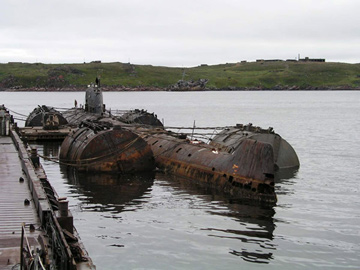
REMOVING the reactor from one of the laid-up nuclear submarines at Rosyth Dockyard is a “stage too far”.
Local SNP councillor Brian Goodall said there was “no need” to cut out the most radioactive parts left in HMS Swiftsure, which is being dismantled as part of an innovative recycling scheme.
He said there was nowhere to safely store the waste and it would also be cheaper to not go ahead – a stance that Labour MP Graeme Downie said was an “insult to the highly skilled team at Rosyth”.
Cllr Goodall said: “The next step will see Babcock cutting out the pressure vessel from the reactor compartment of the decommissioned nuclear submarine Swiftsure, in an experimental process that has never been done anywhere in the world before.
“This part of the submarine dismantling project has required Babcock to seek an increase in the limits to the levels of radioactivity they are allowed to discharge into the environment around the area.
“I believe there’s no clear justification for the cutting out of the pressure vessel, and that the removal for long term storage of the entire reactor compartment would be the more logical, proven, safer and cheaper approach to the next step in the dismantling process.”
There are currently seven old nuclear subs laid up at Rosyth and another 15 at the Devonport naval base in Plymouth.
A further five are due to come out of service.
The dismantling programme at the dockyard began in 2015 – Swiftsure is the first to be cut up – and in September yard bosses said Rosyth could become a “centre of excellence” for dealing with the UK’s old nuclear subs.
The project is doing what no-one else has attempted to do – removing the most radioactive parts left in the vessel, the reactor and steam generators, and recycling up to 90 per cent of the ship.
However, Cllr Goodall said: “The only justification ever given for cutting out the reactor pressure vessels in this way was to reduce the volume of the intermediate level radioactive waste that would be going into the UK’s deep geological radioactive waste facility.
“But such a facility does not exist and it looks like it never will, so long term, near surface storage at a nuclear licensed facility in England, like Capenhurst or Sellafield, is now the most likely outcome.
“And so there’s no need to take forward the experimental stage two part of the proposed procedure, with the increased radioactive discharges associated with it.”
He said he had made the same point at the consultation stage in 2012, before the dismantling of subs at Rosyth got the go ahead.
The councillor continued: “While I support the demonstrator project and, if it’s successful, I’d reluctantly back the on-site dismantling of the six other decommissioned submarines that are currently at Rosyth, I feel it’s not too late to rethink stage two of the process.
“Whichever way we deal with all seven of the subs currently at the dockyard I remain completely against any further nuclear submarines being brought to Rosyth.
“With homes within metres of the site and schools, shops and countless other businesses right next door, Rosyth should never have become a nuclear facility and radioactive waste store.
“We should now be doing all we can to create a long positive, clean, green future for the dockyard.”…………………https://www.dunfermlinepress.com/news/25606854.brian-goodall-says-no-next-stage-submarine-dismantling/
Hinkley Point B to begin 95-year decommissioning plan
Clara BullockSomerset, 5 Nov 25, https://www.bbc.com/news/articles/c986pvg41y2o
A former nuclear power station will begin its 95-year decommissioning process after regulators granted formal consent.
EDF’s Hinkley Point B, which lies on the Somerset coast near Stogursey, has been given the green light to be demolished by the Office for Nuclear Regulation (ONR).
In August 2022, Hinkley Point B reached the end of its operating life after nearly 46 years of generating electricity.
Dan Hasted, ONR director of regulation, said: “We will continue to proportionately regulate the Hinkley Point B site throughout the decommissioning phase to safeguard workers and the public.”
The nuclear site will transfer from EDF to the Nuclear Restoration Services next year, which will oversee the site’s dismantling.
Under the proposals, Hinkley Point B, which opened in 1976, could be decommissioned in three phases.
The first phase, which will last until 2038, includes the dismantling of all buildings and plant materials except for the site’s safestore structure. This facility will be used to store and manage the residential nuclear waste from the power station.
The second phase will see “a period of relative inactivity” of up to 70 years from 2039, to allow for the radioactive materials within the safestore to safely decay.
The final phase will see the former reactor and debris vaults being dismantled and removed.
Meanwhile, a new nuclear power station, Hinkley Point C, is being constructed near Hinkley B.
EDF’s plan to decommission Hinkley Point B approved despite regulator’s concerns
31 Oct, 2025 By Tom Pashby
The Office for Nuclear Regulation (ONR) has approved EDF’s plans for the
decommissioning of its Hinkley Point B nuclear power station, despite
wide-ranging concerns raised by organisations, including the Environment
Agency, which regulates the nuclear sector.
New Civil Engineer 31st Oct 2025, https://www.newcivilengineer.com/latest/edfs-plan-to-decommission-hinkley-point-b-approved-despite-regulators-concerns-31-10-2025/
Escalating nuclear waste disposal cost leads senior MP to demand ‘coherent’ plan.
The escalating costs of the geological disposal facility (GDF) have led the Public Accounts Committee (PAC) chair to demand that the government produce a “coherent plan” to manage the country’s nuclear waste legacy
29 Oct, 2025 By Tom Pashby
https://www.newcivilengineer.com/latest/escalating-nuclear-waste-disposal-cost-leads-senior-mp-to-demand-coherent-plan-29-10-2025/
A GDF represents a monumental undertaking, consisting of an engineered vault placed between 200m and 1km underground, covering an area of approximately 1km2 on the surface. This facility is designed to safely contain nuclear waste while allowing it to decay over thousands of years, thereby reducing its radioactivity and associated hazards.
PAC chair Geoffrey Clifton-Brown’s comments were made in reaction to the revelation that the total life cost of the GDF is up to £15bn more than the sum listed in the National Infrastructure and Service Transformation Authority’s (Nista’s) recent annual report. Nista is a government body and works with the Cabinet Office and Treasury and its August 2025 report published figures from Nuclear Waste Services (NWS), the government body responsible for the GDF, showing the GDF as having a whole life cost of from £20bn to £53.3bn.
However, Nista’s Infrastructure Pipeline dashboard lists the GDF’s CapEx (capital expenditure) range for new infrastructure in 2024/2025 prices as being from £26.2bn to £68.7bn, with the top end being slightly over £15bn higher than the figure published in the annual report.
A government source explained to NCE earlier that the discrepancy is because the figures published in Nista’s annual report was based on 2017/2018 prices, meaning the effects of long-term inflation were not accounted for.
Criticism has previously been levied at High Speed 2 (HS2) because of its use of historic pricing figures to reduce the impact of inflation on budget projects and make the total cost of the project appear to be lower than it would end up being.
Government must have coherent plan to manage nuclear waste – senior MP
The House of Commons PAC is one of the most active and powerful select committees in Parliament, able to formally request that the National Audit Office carry out investigations into government projects.
Nuclear decommissioning is a key area of focus for the Committee because of the high total costs, which will hit the public purse into the far future. Sellafield is seen as the government’s flagship project within the wider nuclear decommissioning programme.
The scale of future nuclear decommissioning is clear in the Nuclear Decommissioning Authority: Annual Report and Accounts 2024 to 2025, which says: “the discounted best estimate of the future costs of the decommissioning mission of £110.1bn”. This is a £5bn increase on the previous year.
Germany destroys two nuclear plant cooling towers as part of nuclear phaseout plan.
Euronews, 25/10/2025,https://www.euronews.com/2025/10/25/germany-destroys-two-nuclear-plant-cooling-towers-as-part-of-nuclear-phaseout-plan
The two towers, equivalent to roughly 56,000 tonnes of concrete, collapsed in a controlled demolition on Saturday. It comes as part of Germany’s nuclear phaseout.
Two cooling towers of the former nuclear power plant in Germay’s Bavarian town of Gundremmingen were brought down in a controlled demolition at noon on Saturday.
The plant had served as an important landmark in the town for nearly six decades, bringing numerous new jobs and boosting the local economy.
As part of the country’s nuclear phaseout and under Germany’s energy transition policy, the Gundremmingen, as well as the Brokdorf, and Grohnde nuclear power plants, had already been decommissioned in December 2021.
The municipality, who had prepared for a large crowd of onlookers, set up a restricted zone around the power plant.
According to energy company RWE, the demolition could be observed from various watch points in the region. Some pubs also offered public “demolition viewing parties”
How the towers will be blown up
There were three explosions in total. The first was carried out to chase away nearby animals and wildlife. The second brought down the first tower, and the third caused the second tower to collapse.
Roughly 56,000 tonnes of concrete collapsed in a matter of seconds. Following Saturday’s demolition, the dismantling of the plant will further continue, local media report, with completion expected by 2040.
The astronomic costs of decommissioning Sellafield

First Annual Report of the Chair of the Committee of Public Accounts.
(Paras 55&56) We were informed that the estimated cost of decommissioning the site was £136 billion, an increase of 18.8% since March 2019.
When the previous Committee last took evidence on Sellafield in 2018, the nine major projects that were underway then were between them delayed by 165 months and expected to cost £913 million more than originally budgeted.
However, the Committee heard that the combined costs of four of these projects are now expected to cost £1.15 billion more than when the previous Committee reported. Each of these four projects will also be delayed further by between 58 and 129 months each.
Sellafield Ltd has begun retrieving
hazardous waste from the site, and in the longer term, this waste will be
stored in an underground offsite Geological Disposal Facility (GDF) capable
of storing the waste for thousands of years. However, the Committee found
that the opening date of the GDF has slipped from 2040 to the late 2050s.
For every decade of delay, additional buildings could need to be
constructed to accommodate short-term storage of the waste at a cost of
£500–760 million.
As well as the serious implications for the value for
money of the project, this delay makes the ambition to completely
decommission the Sellafield site in the next hundred years even more
challenging.
In addition to this, in August the GDF project was rated red
in its Delivery Confidence Assessment by NISTA, meaning “successful
delivery of the project appears to be unachievable.” DESNZ has since
acknowledged that the NDA is “undertaking some replanning to mitigate
risks and support ongoing progress” across all of its programmes,
including the GDF. We will be following any further developments closely
over the coming months.
House of Commons 15th Oct 2025,
https://publications.parliament.uk/pa/cm5901/cmselect/cmpubacc/1300/report.html#heading-5
German Nuclear Operator’s Insolvency Could Shift Dismantling Costs to Taxpayers
October 6, 2025, Full Story: Clean Energy Wire, Author: Benjamin Wehrmann, https://www.theenergymix.com/german-nuclear-operators-insolvency-could-shift-dismantling-costs-to-taxpayers/
The insolvency of an operator of a decommissioned nuclear power plant in Germany raises questions about the financial responsibilities for deconstructing the reactor and disposing of its radioactive materials.
HKG, the owner of the nuclear plant Hamm-Uentrop that was opened in 1983 and taken out of service only six years later, filed for insolvency at a court in western state North Rhine-Westphalia, reports Clean Energy Wire, citing the German business weekly WirtschaftsWoche.
The operating company, owned jointly by major energy company RWE and several local utilities, initially had demanded about 350 million euros from the federal and the state government to cover the costs for deconstruction and disposal, but failed to win a lawsuit it filed in 2024. A court in the city of Düsseldorf rejected HKG’s claim in June this year, which led the company to declare itself insolvent. “HKG faces an unchanged situation with unclear financing of the remaining deconstruction work,” said the company’s CEO, Volker Dannert. According to WirtschaftsWoche, the actual costs for dismantling the plant and storing the nuclear waste initially were gauged at 750 to one billion euros.
Co-owner company RWE said the HKG shareholders bear no legal responsibility to fund deconstruction works beyond payments they made in the past. HKG manager Dannert said that talks with the federal and the state government had remained inconclusive, which meant that “it is now a task for the responsible authorities at the federal level and in North Rhine-Westphalia to organize the further dismantling.”
The prototype Thorium-Cycle-High-Temperature-Reactor (THTR) in Hamm-Uentrop was decommissioned due to technical challenges after serving for about 16,500 hours. It was sealed in 1997 and will remain so until at least 2030 to let radioactive contamination diminish before deconstruction works can begin. The process of dismantling is expected to take about one decade.
Germany is in the process of dismantling its nuclear power plants after shutting down the remaining three reactors in 2023 as part of the country’s nuclear phase-out. Dismantling nuclear power stations and safely storing radioactive waste will cost Germany dozens of billions of euros, and take many decades.
In 2017, Germany’s four major nuclear plant operators—E.ON, EnBW, RWE and Vattenfall—handed money earmarked for nuclear waste disposal over to the country’s fund for nuclear waste management, passing all responsibilities to the state. In 2025, over half of the German environment ministry’s budget is spent on managing the country’s nuclear waste, including finding a location for a final nuclear repository.
This post was originally published by Berlin-based Clean Energy Wire.
UK Government names six decommissioning sites being considered for new nuclear
30 Sep, 2025 By Tom Pashby New Civil Engineer
The government has named UK six nuclear sites currently being decommissioned where there is interest in establishing new nuclear developments.
The SMR ambitions, revealed as part of the US-UK nuclear
deal, named Hartlepool in County Durham, Cottam in Nottinghamshire and
London Gateway port in Kent as potential locations for hosting new small
reactors. The new regulation for nuclear developments, including siting –
National Policy Statement for nuclear energy generation (EN-7) – was
published in draft form in February 2025.
This new policy will open up more
potential locations for new nuclear developments beyond the eight sites
stipulated in the former statement. In April, the government said it
planned to publish the final EN-7 policy by the end of 2025.
Great British Energy – Nuclear is already assessing Wylfa on the Isle of Anglesey in
North Wales and Oldbury-on-Severn in Gloucestershire, as potential sites
for hosting three 470MW Rolls-Royce SMR reactors. Both Wylfa and Oldbury
have historic nuclear power plants, which are undergoing decommissioning.
Now the government has named four additional sites where nuclear reactors
are being decommissioned that are being considered for new nuclear
developments. It named them in response to a parliamentary question. “The
government is also aware of developer or community interest in nuclear
projects at several other sites, including those being decommissioned.
These include Pioneer Park (Moorside), Trawsfynydd (via Cwmni Egino),
Hartlepool, and Dungeness.”
Pioneer Park at Moorside in Cumbria is a
project led by Energy Coast West Cumbria (BEC) which is a joint venture
(JV) between the Nuclear Decommissioning Authority (NDA) and Cumberland
Council. BEC’s website makes reference to the government having announced
in June 2025 that part of the Moorside site was designated as suitable for
nuclear generation. The JV says Pioneer Park “will be a transformative
project designed to diversify and strengthen the local economy in West
Cumbria, reducing reliance on the Sellafield site while creating new
opportunities in the clean energy sector”.
Kent County Council pursuing
one or more SMR at Dungeness. In June 2023, a report from Kent County
Council updated cabinet members “on the opportunity to secure a nuclear
future for Dungeness and seeks support for a coordinated campaign of
action”. The report from Kent County Council cabinet member for economic
development Derek Murphy said: “We believe Dungeness is a perfect
location for one (or more) of the new breed of SMRs safely producing green,
low carbon energy and retaining high-quality jobs and skills in the area
while helping to power local growth.”
It went on to say that the council
would continue to conduct discussions about potential reactors which could
be deployed at the site with vendors, and committed to undertake “soft
market testing to develop a small number of high-level proposals for the
site”.
Cwmni Egino was set up by the Welsh Government in 2021 to explore
opportunities to develop new nuclear projects in Wales at Wylfa and
Trawsfynydd – both of which host nuclear power stations that are being
decommissioned. The organisation says it has confirmed the “viability of
small scale nuclear at Trawsfynydd”. Small scale nuclear could mean small
modular reactors (SMRs), advanced modular reactors (AMRs) or micro-modular
reactors (MMRs). The Trawsfynydd, however, also appears to be being
considered as a potential host for a medical research reactor, under the
Welsh Government’s Project Arthur, according to Cwmni Egino.
New Civil Engineer 30th Sept 2025, https://www.newcivilengineer.com/latest/government-names-six-decommissioning-sites-being-considered-for-new-nuclear-30-09-2025/
Nuclear reactor Tihange 1 to cease operations after fifty years
27 September 2025, https://www.belganewsagency.eu/nuclear-reactor-tihange-1-to-cease-operations-after-fifty-years
Next Tuesday, the plug will be pulled on the Tihange 1 nuclear reactor after 50 years of service. However, the Belgian government hopes that this will not be the end.
Tihange 1 is the fourth Belgian nuclear reactor to be shut down, following the permanent shutdown of Doel 3, Tihange 2 and Doel 1. Doel 2 will follow at the end of November. The two remaining reactors – Doel 4 and Tihange 3 – are allowed to operate for another ten years, until 2035.
Construction of the reactor on the banks of the Meuse near Huy, Liège province, began in 1969. Electricity was generated for the first time in 1975. Normally, the reactor – half owned by Engie and half by EDF Belgium – should have ceased operations already in 2015, but in the context of security of supply, it was allowed to remain open until 2025. Today, Tihange has a capacity of 962 megawatts
On Tuesday 30 September, the operators in the control room will shut down the reactor and disconnect it from the high-voltage grid. Then the decommissioning phase will begin, a preparation for the actual dismantling. The reactor will be unloaded and the fuel cooled, so that it can later be transported to temporary storage. Afterwards, the primary circuit will be chemically cleaned, amongst others. All this work will take years to complete.
The decommissioning phase is not scheduled to begin until 2028 and will continue until 2040. But if it were up to the government, all this work would be delayed. The government hopes to keep the reactor open for longer and is asking nuclear operator Engie not to carry out any irreversible work. Discussions about an extension are ongoing.
Engie itself has repeatedly made it clear that it is not keen to operate any nuclear power plants other than Doel 4 and Tihange 3. Keeping Tihange 1 open for longer would also come with a hefty price tag due to the necessary upgrades, and the reactor would also have to undergo a ten-year safety review.
1 This Month

of the week – Shut Down Drone Warfare!


Tell the Ukrainian Government to Drop Prosecution of Peace Activist Yurii Sheliazhenko

Petition to revoke the licensing of the Near Surface Nuclear Disposal Facility (NSDF) at Chalk River. https://www.ourcommons.ca/petitions/en/Petition/Details?Petition=e-7247
To see nuclear-related stories in greater depth and intensity – go to https://nuclearinformation.wordpress.com
-
Archives
- March 2026 (237)
- February 2026 (268)
- January 2026 (308)
- December 2025 (358)
- November 2025 (359)
- October 2025 (376)
- September 2025 (257)
- August 2025 (319)
- July 2025 (230)
- June 2025 (348)
- May 2025 (261)
- April 2025 (305)
-
Categories
- 1
- 1 NUCLEAR ISSUES
- business and costs
- climate change
- culture and arts
- ENERGY
- environment
- health
- history
- indigenous issues
- Legal
- marketing of nuclear
- media
- opposition to nuclear
- PERSONAL STORIES
- politics
- politics international
- Religion and ethics
- safety
- secrets,lies and civil liberties
- spinbuster
- technology
- Uranium
- wastes
- weapons and war
- Women
- 2 WORLD
- ACTION
- AFRICA
- Atrocities
- AUSTRALIA
- Christina's notes
- Christina's themes
- culture and arts
- Events
- Fuk 2022
- Fuk 2023
- Fukushima 2017
- Fukushima 2018
- fukushima 2019
- Fukushima 2020
- Fukushima 2021
- general
- global warming
- Humour (God we need it)
- Nuclear
- RARE EARTHS
- Reference
- resources – print
- Resources -audiovicual
- Weekly Newsletter
- World
- World Nuclear
- YouTube
-
RSS
Entries RSS
Comments RSS
 nuclear-news