Fifth Belgian reactor is permanently shut down
World Nuclear News, 1 December 2025
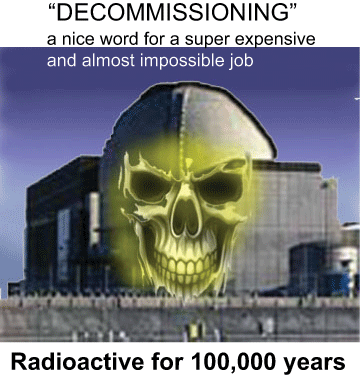
Unit 2 of the Doel nuclear power plant in Belgium’s Flanders region has been taken offline for the final time after 50 years of operation and disconnected from the grid. Its closure is in line with Belgium’s nuclear phase-out policy, under which four other reactors have already been shut down.
Belgium’s Federal Agency for Nuclear Control (FANC) said the operation to shut down the 445 MWe (net) pressurised water reactor (PWR) was carried out under its supervision.
Doel 2 has now entered the decommissioning phase in preparation for its actual dismantling. Fuel will be unloaded from the reactor and cooled in the storage pool, so it can later be transported to temporary storage.
“As with the other shutdowns, the process began with the submission of a ‘notice of cessation of activities’ to the FANC,” the regulator said. “This document describes in great detail the activities that will be carried out after the shutdown to prepare for decommissioning.”
Belgium’s federal law of 31 January 2003 required the phase-out of all seven nuclear power reactors in the country. Under that policy, Doel 1 and 2 were originally set to be taken out of service on their 40th anniversaries, in 2015. However, the law was amended in 2013 and 2015 to provide for Doel 1 and 2 to remain operational for an additional 10 years. Doel 1 was retired in February this year. Duel 3 was closed in September 2022 and Tihange 2 at the end of January 2023. Tihange 1 was disconnected from the grid on 30 September this year……………………………………………….https://world-nuclear-news.org/articles/fifth-belgian-reactor-permanently-shut-down?cid=15961&utm_source=omka&utm_medium=WNN_Daily:_1_December_2025&utm_id=493&utm_map=24ecfe77-e3db-473a-be05-7c037a58ceb4
Ministry Of Defence looking at ‘various sites’ for sub dismantling project

COMMENT. Put more simply. the UK government doesn’t really know what to do with the toxic wastes from nuclear submarines.
Governments are obsessed with “defence” against each other. Meanwhile the public thinks ‘jobs, jobs, jobs” even if those jobs are toxic, and part of a useless industry.
By George Allison, November 28, 2025, https://ukdefencejournal.org.uk/mod-looking-at-various-sites-for-sub-dismantling-project/
A written answer in Parliament has confirmed that the Ministry of Defence is actively considering multiple locations for the UK’s permanent submarine dismantling and disposal capability.
Responding to Graeme Downie MP, defence minister Luke Pollard said the demonstrator vessel Swiftsure continues to be dismantled at Rosyth and remains on track to complete in 2026. He noted that “there are six further legacy submarines in Rosyth awaiting to enter the dismantling process.”
Those boats, alongside the 15 stored at Devonport, form the initial batch being processed under the Submarine Dismantling Project.
Pollard confirmed that the enduring solution will be delivered through a separate effort, the Submarine Disposal Capability Project, which is still in its concept phase. He stated that the department is “assessing options for the capability and its location with various sites under consideration within the UK,” adding that Parliament will be informed once a decision is ready.
This aligns with the practical pressures on the Defence Nuclear Enterprise. Rosyth can process only a small number of hulls at a time, while Devonport’s workload is dominated by defuelling, refit work and major safety driven upgrades. Both sites have finite regulatory and environmental headroom.
The broader SDP context helps explain the direction of travel as since 2013 the programme has been tasked with dealing with 27 retired submarines, removing radioactive and conventional waste safely and refining methods as it progresses. Swiftsure’s dismantling has already informed improved procedures, and the MoD reports that later boats will see faster and cheaper waste removal.
The Swiftsure project has proven the process, but the long term question remains open: where should the UK base a facility that will handle future decommissioned submarines on a rolling, multi decade basis. Pollard’s answer confirms that this decision is now in play.
Brian Goodall says no to next stage of submarine dismantling
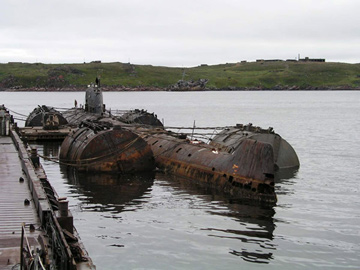
“Whichever way we deal with all seven of the subs currently at the dockyard I remain completely against any further nuclear submarines being brought to Rosyth.
By Ally McRoberts, Dunfermline Press, 8th Nov 2025
REMOVING the reactor from one of the laid-up nuclear submarines at Rosyth Dockyard is a “stage too far”.
Local SNP councillor Brian Goodall said there was “no need” to cut out the most radioactive parts left in HMS Swiftsure, which is being dismantled as part of an innovative recycling scheme.
He said there was nowhere to safely store the waste and it would also be cheaper to not go ahead – a stance that Labour MP Graeme Downie said was an “insult to the highly skilled team at Rosyth”.
Cllr Goodall said: “The next step will see Babcock cutting out the pressure vessel from the reactor compartment of the decommissioned nuclear submarine Swiftsure, in an experimental process that has never been done anywhere in the world before.
“This part of the submarine dismantling project has required Babcock to seek an increase in the limits to the levels of radioactivity they are allowed to discharge into the environment around the area.
“I believe there’s no clear justification for the cutting out of the pressure vessel, and that the removal for long term storage of the entire reactor compartment would be the more logical, proven, safer and cheaper approach to the next step in the dismantling process.”
There are currently seven old nuclear subs laid up at Rosyth and another 15 at the Devonport naval base in Plymouth.
A further five are due to come out of service.
The dismantling programme at the dockyard began in 2015 – Swiftsure is the first to be cut up – and in September yard bosses said Rosyth could become a “centre of excellence” for dealing with the UK’s old nuclear subs.
The project is doing what no-one else has attempted to do – removing the most radioactive parts left in the vessel, the reactor and steam generators, and recycling up to 90 per cent of the ship.
However, Cllr Goodall said: “The only justification ever given for cutting out the reactor pressure vessels in this way was to reduce the volume of the intermediate level radioactive waste that would be going into the UK’s deep geological radioactive waste facility.
“But such a facility does not exist and it looks like it never will, so long term, near surface storage at a nuclear licensed facility in England, like Capenhurst or Sellafield, is now the most likely outcome.
“And so there’s no need to take forward the experimental stage two part of the proposed procedure, with the increased radioactive discharges associated with it.”
He said he had made the same point at the consultation stage in 2012, before the dismantling of subs at Rosyth got the go ahead.
The councillor continued: “While I support the demonstrator project and, if it’s successful, I’d reluctantly back the on-site dismantling of the six other decommissioned submarines that are currently at Rosyth, I feel it’s not too late to rethink stage two of the process.
“Whichever way we deal with all seven of the subs currently at the dockyard I remain completely against any further nuclear submarines being brought to Rosyth.
“With homes within metres of the site and schools, shops and countless other businesses right next door, Rosyth should never have become a nuclear facility and radioactive waste store.
“We should now be doing all we can to create a long positive, clean, green future for the dockyard.”…………………https://www.dunfermlinepress.com/news/25606854.brian-goodall-says-no-next-stage-submarine-dismantling/
Hinkley Point B to begin 95-year decommissioning plan
Clara BullockSomerset, 5 Nov 25, https://www.bbc.com/news/articles/c986pvg41y2o
A former nuclear power station will begin its 95-year decommissioning process after regulators granted formal consent.
EDF’s Hinkley Point B, which lies on the Somerset coast near Stogursey, has been given the green light to be demolished by the Office for Nuclear Regulation (ONR).
In August 2022, Hinkley Point B reached the end of its operating life after nearly 46 years of generating electricity.
Dan Hasted, ONR director of regulation, said: “We will continue to proportionately regulate the Hinkley Point B site throughout the decommissioning phase to safeguard workers and the public.”
The nuclear site will transfer from EDF to the Nuclear Restoration Services next year, which will oversee the site’s dismantling.
Under the proposals, Hinkley Point B, which opened in 1976, could be decommissioned in three phases.
The first phase, which will last until 2038, includes the dismantling of all buildings and plant materials except for the site’s safestore structure. This facility will be used to store and manage the residential nuclear waste from the power station.
The second phase will see “a period of relative inactivity” of up to 70 years from 2039, to allow for the radioactive materials within the safestore to safely decay.
The final phase will see the former reactor and debris vaults being dismantled and removed.
Meanwhile, a new nuclear power station, Hinkley Point C, is being constructed near Hinkley B.
EDF’s plan to decommission Hinkley Point B approved despite regulator’s concerns
31 Oct, 2025 By Tom Pashby
The Office for Nuclear Regulation (ONR) has approved EDF’s plans for the
decommissioning of its Hinkley Point B nuclear power station, despite
wide-ranging concerns raised by organisations, including the Environment
Agency, which regulates the nuclear sector.
New Civil Engineer 31st Oct 2025, https://www.newcivilengineer.com/latest/edfs-plan-to-decommission-hinkley-point-b-approved-despite-regulators-concerns-31-10-2025/
Escalating nuclear waste disposal cost leads senior MP to demand ‘coherent’ plan.
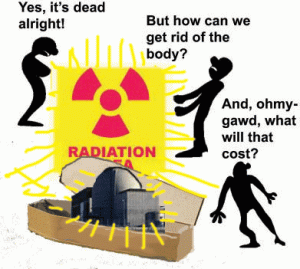
The escalating costs of the geological disposal facility (GDF) have led the Public Accounts Committee (PAC) chair to demand that the government produce a “coherent plan” to manage the country’s nuclear waste legacy
29 Oct, 2025 By Tom Pashby
https://www.newcivilengineer.com/latest/escalating-nuclear-waste-disposal-cost-leads-senior-mp-to-demand-coherent-plan-29-10-2025/
A GDF represents a monumental undertaking, consisting of an engineered vault placed between 200m and 1km underground, covering an area of approximately 1km2 on the surface. This facility is designed to safely contain nuclear waste while allowing it to decay over thousands of years, thereby reducing its radioactivity and associated hazards.
PAC chair Geoffrey Clifton-Brown’s comments were made in reaction to the revelation that the total life cost of the GDF is up to £15bn more than the sum listed in the National Infrastructure and Service Transformation Authority’s (Nista’s) recent annual report. Nista is a government body and works with the Cabinet Office and Treasury and its August 2025 report published figures from Nuclear Waste Services (NWS), the government body responsible for the GDF, showing the GDF as having a whole life cost of from £20bn to £53.3bn.
However, Nista’s Infrastructure Pipeline dashboard lists the GDF’s CapEx (capital expenditure) range for new infrastructure in 2024/2025 prices as being from £26.2bn to £68.7bn, with the top end being slightly over £15bn higher than the figure published in the annual report.
A government source explained to NCE earlier that the discrepancy is because the figures published in Nista’s annual report was based on 2017/2018 prices, meaning the effects of long-term inflation were not accounted for.
Criticism has previously been levied at High Speed 2 (HS2) because of its use of historic pricing figures to reduce the impact of inflation on budget projects and make the total cost of the project appear to be lower than it would end up being.
Government must have coherent plan to manage nuclear waste – senior MP
The House of Commons PAC is one of the most active and powerful select committees in Parliament, able to formally request that the National Audit Office carry out investigations into government projects.
Nuclear decommissioning is a key area of focus for the Committee because of the high total costs, which will hit the public purse into the far future. Sellafield is seen as the government’s flagship project within the wider nuclear decommissioning programme.
The scale of future nuclear decommissioning is clear in the Nuclear Decommissioning Authority: Annual Report and Accounts 2024 to 2025, which says: “the discounted best estimate of the future costs of the decommissioning mission of £110.1bn”. This is a £5bn increase on the previous year.
Germany destroys two nuclear plant cooling towers as part of nuclear phaseout plan.
Euronews, 25/10/2025,https://www.euronews.com/2025/10/25/germany-destroys-two-nuclear-plant-cooling-towers-as-part-of-nuclear-phaseout-plan
The two towers, equivalent to roughly 56,000 tonnes of concrete, collapsed in a controlled demolition on Saturday. It comes as part of Germany’s nuclear phaseout.
Two cooling towers of the former nuclear power plant in Germay’s Bavarian town of Gundremmingen were brought down in a controlled demolition at noon on Saturday.
The plant had served as an important landmark in the town for nearly six decades, bringing numerous new jobs and boosting the local economy.
As part of the country’s nuclear phaseout and under Germany’s energy transition policy, the Gundremmingen, as well as the Brokdorf, and Grohnde nuclear power plants, had already been decommissioned in December 2021.
The municipality, who had prepared for a large crowd of onlookers, set up a restricted zone around the power plant.
According to energy company RWE, the demolition could be observed from various watch points in the region. Some pubs also offered public “demolition viewing parties”
How the towers will be blown up
There were three explosions in total. The first was carried out to chase away nearby animals and wildlife. The second brought down the first tower, and the third caused the second tower to collapse.
Roughly 56,000 tonnes of concrete collapsed in a matter of seconds. Following Saturday’s demolition, the dismantling of the plant will further continue, local media report, with completion expected by 2040.
The astronomic costs of decommissioning Sellafield

First Annual Report of the Chair of the Committee of Public Accounts.
(Paras 55&56) We were informed that the estimated cost of decommissioning the site was £136 billion, an increase of 18.8% since March 2019.
When the previous Committee last took evidence on Sellafield in 2018, the nine major projects that were underway then were between them delayed by 165 months and expected to cost £913 million more than originally budgeted.
However, the Committee heard that the combined costs of four of these projects are now expected to cost £1.15 billion more than when the previous Committee reported. Each of these four projects will also be delayed further by between 58 and 129 months each.
Sellafield Ltd has begun retrieving
hazardous waste from the site, and in the longer term, this waste will be
stored in an underground offsite Geological Disposal Facility (GDF) capable
of storing the waste for thousands of years. However, the Committee found
that the opening date of the GDF has slipped from 2040 to the late 2050s.
For every decade of delay, additional buildings could need to be
constructed to accommodate short-term storage of the waste at a cost of
£500–760 million.
As well as the serious implications for the value for
money of the project, this delay makes the ambition to completely
decommission the Sellafield site in the next hundred years even more
challenging.
In addition to this, in August the GDF project was rated red
in its Delivery Confidence Assessment by NISTA, meaning “successful
delivery of the project appears to be unachievable.” DESNZ has since
acknowledged that the NDA is “undertaking some replanning to mitigate
risks and support ongoing progress” across all of its programmes,
including the GDF. We will be following any further developments closely
over the coming months.
House of Commons 15th Oct 2025,
https://publications.parliament.uk/pa/cm5901/cmselect/cmpubacc/1300/report.html#heading-5
German Nuclear Operator’s Insolvency Could Shift Dismantling Costs to Taxpayers
October 6, 2025, Full Story: Clean Energy Wire, Author: Benjamin Wehrmann, https://www.theenergymix.com/german-nuclear-operators-insolvency-could-shift-dismantling-costs-to-taxpayers/
The insolvency of an operator of a decommissioned nuclear power plant in Germany raises questions about the financial responsibilities for deconstructing the reactor and disposing of its radioactive materials.
HKG, the owner of the nuclear plant Hamm-Uentrop that was opened in 1983 and taken out of service only six years later, filed for insolvency at a court in western state North Rhine-Westphalia, reports Clean Energy Wire, citing the German business weekly WirtschaftsWoche.
The operating company, owned jointly by major energy company RWE and several local utilities, initially had demanded about 350 million euros from the federal and the state government to cover the costs for deconstruction and disposal, but failed to win a lawsuit it filed in 2024. A court in the city of Düsseldorf rejected HKG’s claim in June this year, which led the company to declare itself insolvent. “HKG faces an unchanged situation with unclear financing of the remaining deconstruction work,” said the company’s CEO, Volker Dannert. According to WirtschaftsWoche, the actual costs for dismantling the plant and storing the nuclear waste initially were gauged at 750 to one billion euros.
Co-owner company RWE said the HKG shareholders bear no legal responsibility to fund deconstruction works beyond payments they made in the past. HKG manager Dannert said that talks with the federal and the state government had remained inconclusive, which meant that “it is now a task for the responsible authorities at the federal level and in North Rhine-Westphalia to organize the further dismantling.”
The prototype Thorium-Cycle-High-Temperature-Reactor (THTR) in Hamm-Uentrop was decommissioned due to technical challenges after serving for about 16,500 hours. It was sealed in 1997 and will remain so until at least 2030 to let radioactive contamination diminish before deconstruction works can begin. The process of dismantling is expected to take about one decade.
Germany is in the process of dismantling its nuclear power plants after shutting down the remaining three reactors in 2023 as part of the country’s nuclear phase-out. Dismantling nuclear power stations and safely storing radioactive waste will cost Germany dozens of billions of euros, and take many decades.
In 2017, Germany’s four major nuclear plant operators—E.ON, EnBW, RWE and Vattenfall—handed money earmarked for nuclear waste disposal over to the country’s fund for nuclear waste management, passing all responsibilities to the state. In 2025, over half of the German environment ministry’s budget is spent on managing the country’s nuclear waste, including finding a location for a final nuclear repository.
This post was originally published by Berlin-based Clean Energy Wire.
UK Government names six decommissioning sites being considered for new nuclear
30 Sep, 2025 By Tom Pashby New Civil Engineer
The government has named UK six nuclear sites currently being decommissioned where there is interest in establishing new nuclear developments.
The SMR ambitions, revealed as part of the US-UK nuclear
deal, named Hartlepool in County Durham, Cottam in Nottinghamshire and
London Gateway port in Kent as potential locations for hosting new small
reactors. The new regulation for nuclear developments, including siting –
National Policy Statement for nuclear energy generation (EN-7) – was
published in draft form in February 2025.
This new policy will open up more
potential locations for new nuclear developments beyond the eight sites
stipulated in the former statement. In April, the government said it
planned to publish the final EN-7 policy by the end of 2025.
Great British Energy – Nuclear is already assessing Wylfa on the Isle of Anglesey in
North Wales and Oldbury-on-Severn in Gloucestershire, as potential sites
for hosting three 470MW Rolls-Royce SMR reactors. Both Wylfa and Oldbury
have historic nuclear power plants, which are undergoing decommissioning.
Now the government has named four additional sites where nuclear reactors
are being decommissioned that are being considered for new nuclear
developments. It named them in response to a parliamentary question. “The
government is also aware of developer or community interest in nuclear
projects at several other sites, including those being decommissioned.
These include Pioneer Park (Moorside), Trawsfynydd (via Cwmni Egino),
Hartlepool, and Dungeness.”
Pioneer Park at Moorside in Cumbria is a
project led by Energy Coast West Cumbria (BEC) which is a joint venture
(JV) between the Nuclear Decommissioning Authority (NDA) and Cumberland
Council. BEC’s website makes reference to the government having announced
in June 2025 that part of the Moorside site was designated as suitable for
nuclear generation. The JV says Pioneer Park “will be a transformative
project designed to diversify and strengthen the local economy in West
Cumbria, reducing reliance on the Sellafield site while creating new
opportunities in the clean energy sector”.
Kent County Council pursuing
one or more SMR at Dungeness. In June 2023, a report from Kent County
Council updated cabinet members “on the opportunity to secure a nuclear
future for Dungeness and seeks support for a coordinated campaign of
action”. The report from Kent County Council cabinet member for economic
development Derek Murphy said: “We believe Dungeness is a perfect
location for one (or more) of the new breed of SMRs safely producing green,
low carbon energy and retaining high-quality jobs and skills in the area
while helping to power local growth.”
It went on to say that the council
would continue to conduct discussions about potential reactors which could
be deployed at the site with vendors, and committed to undertake “soft
market testing to develop a small number of high-level proposals for the
site”.
Cwmni Egino was set up by the Welsh Government in 2021 to explore
opportunities to develop new nuclear projects in Wales at Wylfa and
Trawsfynydd – both of which host nuclear power stations that are being
decommissioned. The organisation says it has confirmed the “viability of
small scale nuclear at Trawsfynydd”. Small scale nuclear could mean small
modular reactors (SMRs), advanced modular reactors (AMRs) or micro-modular
reactors (MMRs). The Trawsfynydd, however, also appears to be being
considered as a potential host for a medical research reactor, under the
Welsh Government’s Project Arthur, according to Cwmni Egino.
New Civil Engineer 30th Sept 2025, https://www.newcivilengineer.com/latest/government-names-six-decommissioning-sites-being-considered-for-new-nuclear-30-09-2025/
Nuclear reactor Tihange 1 to cease operations after fifty years
27 September 2025, https://www.belganewsagency.eu/nuclear-reactor-tihange-1-to-cease-operations-after-fifty-years
Next Tuesday, the plug will be pulled on the Tihange 1 nuclear reactor after 50 years of service. However, the Belgian government hopes that this will not be the end.
Tihange 1 is the fourth Belgian nuclear reactor to be shut down, following the permanent shutdown of Doel 3, Tihange 2 and Doel 1. Doel 2 will follow at the end of November. The two remaining reactors – Doel 4 and Tihange 3 – are allowed to operate for another ten years, until 2035.
Construction of the reactor on the banks of the Meuse near Huy, Liège province, began in 1969. Electricity was generated for the first time in 1975. Normally, the reactor – half owned by Engie and half by EDF Belgium – should have ceased operations already in 2015, but in the context of security of supply, it was allowed to remain open until 2025. Today, Tihange has a capacity of 962 megawatts
On Tuesday 30 September, the operators in the control room will shut down the reactor and disconnect it from the high-voltage grid. Then the decommissioning phase will begin, a preparation for the actual dismantling. The reactor will be unloaded and the fuel cooled, so that it can later be transported to temporary storage. Afterwards, the primary circuit will be chemically cleaned, amongst others. All this work will take years to complete.
The decommissioning phase is not scheduled to begin until 2028 and will continue until 2040. But if it were up to the government, all this work would be delayed. The government hopes to keep the reactor open for longer and is asking nuclear operator Engie not to carry out any irreversible work. Discussions about an extension are ongoing.
Engie itself has repeatedly made it clear that it is not keen to operate any nuclear power plants other than Doel 4 and Tihange 3. Keeping Tihange 1 open for longer would also come with a hefty price tag due to the necessary upgrades, and the reactor would also have to undergo a ten-year safety review.
Sizewell C Funded Decommissioning Programme: Contingent Liability (Public on the hook)
I am pleased to have laid a departmental minute describing the contingent
liabilities arising from the signing of the funded decommissioning
programme and Government support package for Sizewell C. The funded
decommissioning programme at Sizewell C will be funded via the regulated
asset base. The regulated asset base contains a series of protections that
aim to minimise the risk that public funds will be required to meet
decommissioning costs.
However, in certain remote circumstances whereby all
the protections afforded by Sizewell C’s economic licence fall away or a
shortfall in the fund materialises, public funds could be used to
contribute towards decommissioning costs and this liability would
crystalise. Based on best estimates by the Government Actuary Department,
the maximum potential exposure from the liability is £12 billion—in 2022
terms. This has been estimated on a worse-case scenario whereby the
Government were required to meet the full costs of decommissioning the
Sizewell C power plant.
Hansard 1st Sept 2025, https://hansard.parliament.uk/commons/2025-09-01/debates/25090137000015/SizewellCFundedDecommissioningProgrammeContingentLiability
Scottish nuclear plant emptied of fuel as UK winds down ageing gas-cooled reactors.
the cost of decommissioning should be taken into
account when the government decided on new nuclear plants as “no scheme can be guaranteed to meet a cost more than a century into the future”.
The first of the UK’s seven advanced gas-cooled reactor nuclear power
stations has been emptied of fuel, kick-starting a decommissioning process
that will cost at least £27bn in total and take almost a century.
EDF said on Thursday it had defuelled Hunterston B, on the west coast of Scotland,
paving the way for the transfer of the site and 250 staff from the French
power company to the UK Nuclear Decommissioning Authority next April. The
site provided most of Scotland’s energy for more than 40 years from its
launch in 1976 until its final closure in 2022.
EDF owns seven advanced gas-cooled reactors (AGRs) plants in the UK, which were built between the 1960s and 1980s and differ from newer nuclear plants that use water for
cooling. Just four are still operating.
The uranium fuel has been packaged
into 350 large flasks, which will be stored by the NDA at the Sellafield
nuclear site in Cumbria for at least 50 years until a longer-term
underground facility has been built.
Although the process took just three
years and £400mn, it will take almost a century to eradicate the radiation
from the land and buildings, EDF has said. The decommissioning of the seven
AGRs is separate to a much wider £105bn decommissioning programme, which
will cover an additional 17 closed nuclear sites over the next 120 years,
according to the NDA.
The closures will leave the UK with just one nuclear
power plant still running by 2030 — Sizewell B in Suffolk, which is also
managed by EDF and uses a pressurised water reactor. The NDA said it was
“acutely aware of the costs associated with delivering our mission”.
The cost of decommissioning nuclear power plants is under scrutiny as the
UK presses ahead with new nuclear projects, including the £40bn Sizewell
C, which is expected to get government go-ahead this spring, and the £46bn
Hinkley Point C, which is still under construction and will open by 2030 at
the earliest.
Steve Thomas, emeritus professor of energy policy at
Greenwich university, said the cost of decommissioning should be taken into
account when the government decided on new nuclear plants as “no scheme
can be guaranteed to meet a cost more than a century into the future”.
Although EDF has owned Hunterston B and the seven other AGR nuclear plants
since 2009, the cost of decommissioning is being paid for through the
ringfenced Nuclear Liabilities Fund (NLF), which was set up in 1996 after
privatisation and is valued at £20.6bn. Decommissioning costs have soared
over the past three decades, with the fund requiring cash injections from
the Treasury, including £5bn in July 2020 and a further £5.6bn in March
2022, according to the NLF.
FT 24th April 2025, https://www.ft.com/content/c31af2d6-eeaa-4a3d-a2c0-81c63b29cb1d
Dounreay more likely to build up than knock down.

By Iain Grant, 26 March 2025
People are being warned not to expect any of Dounreay’s former fuel or
waste buildings to be levelled any time soon. NRS Dounreay managing
director Dave Wilson was responding to a query posed at the latest meeting
of Dounreay Stakeholder Group (DSG). Mr Wilson said none of the cluster of
buildings deployed in the former fast reactor complex is slated for
demolition in the next couple of years. He added: “Skyline changes in the
short term might be a building going up to store material.
John O Groat Journal 26th March 2025, https://www.johnogroat-journal.co.uk/news/dounreay-more-likely-to-build-up-than-knock-down-377882/
**Plutonium**
Sellafield decommissioning to continue for at least a century – robot dogs play a part
Robot dogs could help decommission Sellafield nuclear plant after successful trials.
Operators working from the Westlakes Science Park in Whitehaven, around
eight miles from Sellafield, remotely operated “safely and securely” a
custom Boston Dynamics Spot Quadrupedal Robot ‘dog’ that could carry
out tasks such as remote inspections, data gathering and clean-up work.
Energy generation at the plant stopped in 2003, but the painstaking
decommissioning process typically takes decades and presents radioactive
hazards to workers. Sellafield is unusual in that the decommissioning
challenge also encompasses early nuclear research and nuclear weapons
programmes that took place on the site.
The Nuclear Decommissioning Authority (NDA) is not expecting full site remediation to be completed until 2125.
Engineering & Technology 20th March 2025
1 This Month
23-25 October – on Zoom – World BEYOND War’s annual global conferenc


Shut down the radiation-damaged Heysham nuclear reactors now
To see nuclear-related stories in greater depth and intensity – go to https://nuclearinformation.wordpress.com

Say No to NASA’s Reckless Nuclear Reactor on the Moon
Say No to NASA’s Reckless Nuclear Reactor on the Moon

-
Archives
- October 2026 (209)
- September 2026 (339)
- August 2026 (330)
- July 2026 (355)
- June 2026 (287)
- May 2026 (306)
- April 2026 (356)
- March 2026 (251)
- February 2026 (267)
- January 2026 (308)
- December 2025 (358)
- November 2025 (359)
-
Categories
- 1
- 1 NUCLEAR ISSUES
- business and costs
- climate change
- culture and arts
- ENERGY
- environment
- health
- history
- indigenous issues
- Legal
- marketing of nuclear
- media
- opposition to nuclear
- PERSONAL STORIES
- politics
- politics international
- Religion and ethics
- safety
- secrets,lies and civil liberties
- spinbuster
- technology
- Uranium
- wastes
- weapons and war
- Women
- 2 WORLD
- ACTION
- AFRICA
- Atrocities
- AUSTRALIA
- Christina's notes
- Christina's themes
- culture and arts
- Events
- Fuk 2022
- Fuk 2023
- Fukushima 2017
- Fukushima 2018
- fukushima 2019
- Fukushima 2020
- Fukushima 2021
- general
- global warming
- Humour (God we need it)
- Nuclear
- RARE EARTHS
- Reference
- resources – print
- Resources -audiovicual
- Weekly Newsletter
- World
- World Nuclear
- YouTube
-
RSS
Entries RSS
Comments RSS

