Health and environmental destruction in Africa, by foreign uranium companies
Health hazards posed by uranium mining IPP MEDIA 5th July 2013“……..History has it that uranium mining companies had never solved problems associated with extraction of uranium and also never employed good practice of settling uranium radioactive waste seriously after the mining activity is complete.
Of course, these foreign companies have their eyes fixed on maximising profits against corresponding safe infrastructure investment. Some of the companies run away from implementing this social cooperative responsibility to the poor ignorant communities.
This happens in countries where local atomic energy commissions are non-existent, or if present are under- equipped with the necessary human and material resources for effective supervision, monitoring and control of 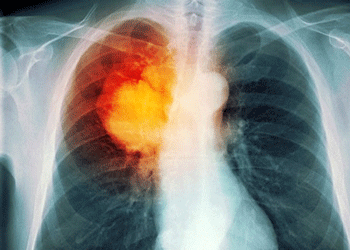 the foreign mining companies for radiation protection to the miners and the environment.
The whole population in the area surrounding the mines is endangered with the diseases mentioned above, lung cancer being the most serious for miners due to inhalation of radon gas in the pits and in the dusty atmosphere of the processing mills.
Uranium radioactive waste stored close to the mines can leach into ground water and contaminate drinking water. Other possibilities of radioactivity reaching humans and environment are a result of deficient radioactive waste management practices by the mining companies, Continue reading
Toxicity of ionising radiation from uranium mining
 Health hazards posed by uranium mining IPP MEDIA 5th July 2013 All Uranium mined end up as either nuclear weapons or highly radioactive waste from nuclear reactors. Uranium is a naturally occurring radioactive toxic element, found in the ground worldwide, including Tanzania, soon to be mined! Countries with active uranium mining are Australia, Canada, Central Africa Republic, France Namibia, Niger, South Africa and the US. The normal decay of uranium in the soil results in the production of decay radioactive products.In the process of mining uranium we liberate from the ground these natural radioactive substances like radium and radon, which are among the most harmful materials known in science.
Uranium emits ionising nuclear radiation like x-rays. Ionising radiation is energetic enough to break chemical bonds, thereby possessing the ability to damage or destroy living cells. Hence the need to keep away from nuclear radiation x-rays, uranium and its radioactive waste. Ultrasound, radio, sound and light are non-ionising nuclear radiations and are harmless
As long as the mineral remains outside the body, uranium poses little health hazards. However, if uranium is inhaled or ingested, its radioactivity and toxicity pose increased risks of lung cancer as well as cancer of bones, stomach, soft tissue and blood. It may also cause damage to internal organs notably kidneys alongside affecting the reproductive system, leading to birth defects in future generations.
Imaging swallowing or inhaling small radiation exposing x-ray machines with jammed exposure switches could result in serious health effects in the form of cancer. Similar incidence of diseases is observed in Atomic bomb survivors, refer bombing of Hiroshima and Nagasaki in Japan 1942 at end of World War II.
All the decay radioactive products of uranium remain in the crushed rock when uranium is separated from the ore. The rock left over’s waste contains 85 per cent radioactivity of the ore as well as heavy metals and toxic dissolving chemicals, which have dangerous health hazards.
Uranium mining is responsible for introducing into the human environment a tremendous large range of radioactive materials which are all very harmful to biological organisms – human beings included.
Australian uranium mining company Paladin in trouble in Namibia, as well as in Malawi
Some of the issues pertain to female worker’s miscarriages; [CEO] Duvenhage’s apparent failure to engage with the union; the company’s reluctance to give workers a “single cent” for an annual increment; unfair performance bonuses; nepotism and corruption.
Australian-based Paladin Energy Ltd. (TSE:PDN) owns 100% interest in the mine.
Protests hit second largest uranium mine in Namibia http://www.mining.com/protests-hit-second-largest-uranium-mine-in-namibia-85919/ Vladimir Basov | July 2, 2013 About 300 workers, including mine staff and contractor employees, picketed at Langer Heinrich Uranium (LHU) mine last Thursday over pay and working conditions, The Namibian reported.
Workers and media were barred from the minesite where the demonstration was supposed to take place although the protesters had organized the peaceful demonstration at the beginning of last week and had announced it to the mine’s management.
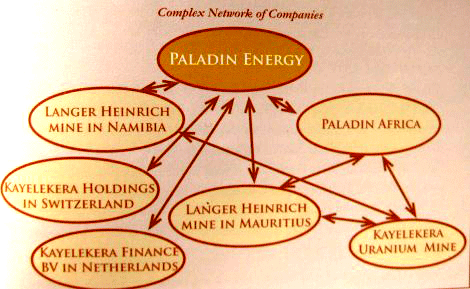
As a result, all day shift buses were forced to stop inside the concession area where workers then had to disembark – about five kilometres away from the actual site. To their dismay, the protesters were forced to picket at the concession area. The Mineworkers Union of Namibia (MUN) branch executives felt that the mine’s management snubbed what it termed a legal and democratic action. Continue reading
Legal fightback by Native Americans against uranium mining
The proposed legislation can be found at the website of Defenders of the Black Hills,
Uranium Mining and Native Resistance: The Uranium Exploration and Mining Accountability Act http://intercontinentalcry.org/uranium-mining-and-native-resistance-the-uranium-exploration-and-mining-accountability-act/ BY CURTIS KLINE • JUL 2, 2013 NATIVE AMERICANS IN THE NORTHERN GREAT PLAINS HAVE THE HIGHEST CANCER RATES IN THE UNITED STATES, PARTICULARLY LUNG CANCER. IT’S A PROBLEM THAT THE UNITED STATES GOVERNMENT HAS WOEFULLY IGNORED, MUCH THE HORROR OF THE MEN AND WOMEN WHO MUST CARRY THE PAINFUL, LIFE-THREATENING BURDEN.
The cancer rates started increasing drastically a few decades after uranium mining began on their territory.
According to a report by Earthworks, “Mining not only exposes uranium to the atmosphere, where it becomes reactive, but releases other radioactive elements such as thorium and radium and toxic heavy metals including arsenic, selenium, mercury and cadmium. Exposure to these radioactive elements can cause lung cancer, skin cancer, bone cancer, leukemia, kidney damage and birth defects.”
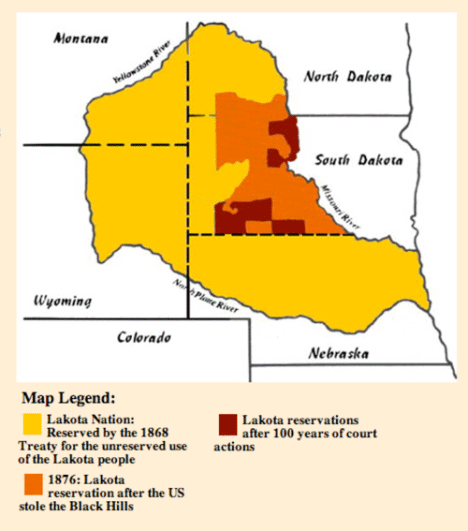
Today, in the northern great plains states of Wyoming, Montana and the Dakotas, the memory of that uranium mining exists in the form of 2,885 abandoned open pit uranium mines. All of the abandoned mines can be found on land that is supposed to be for the absolute use of the Great Sioux Nation under the 1868 Fort Laramie Treaty with the United States.
There are also 1,200 abandoned uranium mines in the Navajo Nation, where cancer rates are also significantly disproportionate. In fact, it is estimated that 60 to 80 percent of all uranium in the United States is located on tribal land, and three fourths of uranium mining worldwide is on Indigenous land.
Defenders of the Black Hills, a group whose mission is to preserve, protect, restore, and respect the area of the 1851 and 1868 Fort Laramie Treaties, is calling the health situation in their own territoryAmerica’s Chernobyl. Continue reading
Paladin uranium’s losses, but its CEO does very well financially
Paladin boss earnings increase while Kayelekera cut jobs http://www.nyasatimes.com/2013/02/14/paladin-boss-gets-massive-pay-hike-after-malawi-job-cuts/ By Nyasa Times Reporter February 14, 2013 Despite uranium miner, Paladin Energy limited claiming that its Malawi operations in the northern district of Karonga at Kayelekera are operating on massive losses and that world uranium prices are low, the company’s managing director John Borshoff elected to cash in his leave entitlementment, Nyasa Times has established.
Paladin’s annual report reveals that despite Borshoff honouring a promise to cut his salary by 25% between November 2011 and November 2012 – a promise he extended to June 2013, the CEO was able to boost his remuneration after a review of annual leave entitlements thereby pocketing a 52% rise in earnings. The review focused on annual and long-service leave in a bid to cut Paladin’s liabilities, and Borshoff responded by cashing out 220 days of leave.The transaction approaved by the remuneration Committee and the board netted Borshoff $1,717,000 and helped increase his remuneration to $3,464,000, from $2.26 million in 2012.
The uranium miner recently retrenched 110 staff from its Kayelekera mine in Malawi in an austerity drive which others commentators fault Boshoff for excercising his right to cash in the leave entitlement when local staff just had their calls for a 66 per cent pay rise rejected.
”Its total mockery to the Malawian workers at Kayelekera who were retrenched but have not had their benefits yet. These people are suffering. That’s a wake-up call to Malawi Government that Paladin is making profits despite plunge in prices” Karonga Business Community Chairperson Wavisanga Silungwe said in a statement made available to Nyasa Times.
“While production has gone up, the uranium price has not; hence Kayelekera continues to operate at a loss. We had warned government that this situation was unsustainable and would lead to job losses unless the uranium price improved, which it has not,” said Paladin’s (African) Ltd General Manager, international affairs, Greg Walker.
Walker said the staff reduction is in “response to economic pressures on the company caused by the continuing depressed uranium price” Borshoff’s contract with Paladin has one year left, and provides him with three months’ long-service leave for every five years of service. He is entitled to two years of double base salary when he retires or has his employment terminated.
Uranium mining’s threat to Grand Canyon water
Are We Really Okay With a Uranium Mine Next Door to the Grand Canyon? This move would definitely not fall under the good neighbor policy Take Part, July 3, 2013 Lawrence Karol “……Located just six miles south of Grand Canyon National Park is the site of Canyon Mine, a proposed uranium mine that could negatively impact the area’s cultural values, wildlife, and waters. The Sierra Club has stated that, “Originally approved in 1986, the Canyon Mine has long been the subject of protests by the Havasupai Tribe and others objecting to potential uranium mining impacts on regional groundwater, springs, creeks, and cultural values associated with Red Butte, a Traditional Cultural Property.”
The Obama administration has taken steps to protect one million acres around Grand Canyon from new uranium mining, but Canyon Mine has been permitted to move forward as an existing claim even though the last environmental review of the project is over two decades old.
“Mining has a history of taking precedence over other important issues due in part to the outdated Mining Law of 1872 and the significant political influence of large multinational mining corporations,” says Brune.
“The reviews for Canyon Mine are more than 27 years old, older than a number of the volunteers working on this issue,” he adds. “The mine’s permit was issued with no consideration of significant new information, including the designation of the Red Butte Traditional Cultural Property and the reintroduction of the endangered California condor.”
“Scientific studies published since 1986 demonstrate more strongly the connection between the water in this area and the seeps, springs, and creeks in Grand Canyon. If this mine pollutes the groundwater, it pollutes Grand Canyon,” says Brune………http://www.takepart.com/article/2013/07/03/uranium-mine-next-door-grand-canyon
Plummeting share price, with glut of uranium
Spot uranium price falls to lowest levels in seven years on ample supply Washington (Platts)–Jasmin Melvin, 2 July 13 An ample supply of uranium in the spot market resulting from Japan’s shutdown of all but two of its 50 operational reactors after the nuclear accident at Fukushima I in 2011 dragged the uranium spot price to its lowest levels in seven years, price publisher TradeTech said in reports released Friday and Sunday.
In its weekly report Friday, TradeTech said sellers “with near-term cash-flow concerns and anxious over the drop in the spot price” have concluded deals for “small lots at prices low enough to encourage discretionary buying.” They remain hesitant, however, to part with large quantities of material at prices below $40 a pound U3O8, the once-accepted price barrier among market participants.
Sellers last month began to ease once-firm offer prices in efforts to offload uncommitted material in small volumes, pulling the uranium spot price below $40/lb for the first time since March 2006, according to data from price publishers Ux Consulting and TradeTech……
The Platts NuclearFuel range for the week is $39.25-$40/lb.
TradeTech lowered its weekly uranium spot price by 20 cents to $39.55/lb Friday, while Ux’s weekly price dipped 15 cents to $39.50/lb Monday.
TradeTech’s daily spot price remained $39.55/lb Monday, unchanged from Friday…..http://www.platts.com/latest-news/electric-power/washington/spot-uranium-price-falls-to-lowest-levels-in-21235399
Legal case over US government’s uranium mining ban near Grand Canyon
British Uranium Firm Sues U.S. for $132 Million Over Grand Canyon Mining Ban http://www.grandcanyontrust.org/news/2013/06/british-uranium-firm-sues-u-s-for-132-million-over-grand-canyon-mining-ban/ June 25, 2013 by gctrust WASHINGTON D.C.— On June 21st, British uranium firm VANE Minerals sued the United States in Washington’s U.S. Court of Claims over the Department of the Interior’s January 2012 decision to protect 1 million acres of public lands around Grand Canyon National Park from new uranium mining. VANE’s suit, which claims that uranium mining in Grand Canyon’s watershed “would have no adverse impacts,” seeks up to $132 million from U.S. taxpayers. This is VANE’s second attempt to bring such a suit against the U.S.
Utah’s Moab uranium mine created a radioactive wasteland
TV: Western U.S. turned into “radiant wasteland” by nuclear-related facilities http://enenews.com/tv-western-u-s-turned-into-radiant-wasteland-by-nuclear-related-facilities
Title: Moab, Utah: Beauty and the Nuclear Feast
Source: KCET
Author: Char Miller
Date: June 19, 2013
[…] The [uranium] tailings made Moab [Utah] glow — and not in a good way. For nearly 30 years, the various companies that operated the facility dumped ton after ton of the radioactive sandy byproduct into an unlined impoundment area located 750 feet from the river. Over the decades, this Geiger-hot waste, which ultimately totaled 12 million cubic yards, was spread over 130 acres at a depth of more than 80 feet. According to the Department of Energy (DOE), which took over remediation of the site, the tailings “have an average radioactivity of 665 picocuries per gram of radium-226,” and because the center of the monstrous pile has a “high water content…excess water in the pile drains into underlying soils, contaminating the ground water.”
Some the deleterious consequences are revealed in “The American West at Risk,” an illuminating book whose authors pay special attention to the Moab mill. It’s hard to dispute their claim that it ranks “high in the annals of indiscriminate disposal,” for the tailings each day continue to release “an estimated 28,000 gallons of radioactive pollutants and toxic chemicals into the only major river draining the southwestern United States.” […]
The Moab mine, like Washington’s Hanford Nuclear Reservation, Rocky Flats weapons facility in Colorado, and Los Alamos National Lab in New Mexico, helped turn the west into a radiant wasteland. […]
See also: Los Angeles-area Meltdown: Cesium-137 still up to 1,000 times higher than standard — Plutonium also detected — Located between Chatsworth and Simi Valley
Trouble in Malawi, arrests at Paladin Energy’s uranium mine
the development has stunned most workers who think management’s move is aimed at eliminating workers deemed to be fighting for the employees’ welfare.Management already eliminated other employees through “unfair dismissals and retrenchment” of 25th January 2013.
Five held for ‘bomb’ threats at Paladin’s Malawi uranium mine, Nyasa Times By Nyasa Times Reporter, June 19, 2013 Malawi Police in the northern border district of Karonga are keeping in custody five Kayelekera Uranium Mine workers on allegations they threatened management to blow up the mine.
The five, arrested last Friday, are also suspected of being linked to the theft of explosives worth US$5780.76 (about K2, 150, 600) belonging to China Road and Bridge Construction Company in Chitipa.
There was no immediate comment from Karonga Police as officers said they are “still investigating”. But Nyasa Times sources said the five were arrested on orders from Paladin Energy Limited (owners of Kayelekera). The five, who are production plant operators, are reported to have threatened Kayelekera management that they would blow up the process plant if their salaries were not increased and foreign workers laid off…….. Continue reading
Cancer cluster near uranium site in Albuquerque
Residents blame cancers on uranium site
http://www.krqe.com/dpp/news/environment/residents-blame-cancers-on-uranium-site
19 Jun 2013, Elizabeth Alvarez ALBUQUERQUE (KRQE) – Residents near Milan say there’s been a cluster of cancer cases, and they’re blaming an abandoned uranium mill.
The Albuquerque Journal reports residents in the community west of Grants say action is needed immediately. They’re demanding the U.S. Environmental Protection Agency either move the waste from the abandon mill or relocate the owners of about 75 nearby homes.It’s been more than a decade since uranium ore was mined in New Mexico, but two foreign companies are looking to re-open another one this year near Grants.
Iran considers halting 20%uranium enrichment
Russian FM: Iran willing to halt 20% uranium enrichment http://www.jpost.com/Iranian-Threat/News/Russian-foreign-minister-Iran-willing-to-halt-20-percent-uranium-enrichment-316937 Lavrov: International community should react to Iran’s constructive steps by similar measures. By JPOST.COM STAFF 06/18/2013 Iran has expressed readiness to stop uranium enrichment to a fissile concentration of 20 percent in exchange for the easing of sanctions imposed by the P5+1 countries on the Islamic Republic, Russian Foreign Minister Sergei Lavrov told the Kuwait News Agency (KUNA) on Tuesday.
“The international community should react to Iran’s constructive steps by similar measures [such as the] gradual halt of sanctions and scrapping them, including the curbs of unilateral basis or those approved by the Security Council,” Lavrov said. Lavrov added that in light of Iran’s willingness to cooperate with the West, sanctions should not be tightened, but eased.
He urged both Iran and the six world powers (five permanent members of the UN Security Council and Germany) to show flexibility in nuclear talks in order to move forward.On Sunday, the International Atomic Energy Agency (IAEA) said Iran was making “steady progress” in expending its nuclear program despite international sanctions, that do not seem to be slowing it down.
“There is a steady increase of capacity and production” in Iran’s nuclear program, Yukiya Amano said in an interview with Reuters.
He spoke shortly after Iranian President-elect Hassan Rohani pledged, during a news conference in Tehran, to be more transparent about Iran’s nuclear program in order to see sanctions lifted.
But Rohani also said Tehran was not ready to suspend its enrichment of uranium, which the West fears is aimed at producing a nuclear weapons capability – something Iran denies.
Anxiety in the uranium industry
Uranium One cutting 26 staffhttp://www.mining.com/uranium-one-cutting-26-staff-43352/Michael Allan McCrae | June 15, 2013 Bowing to miserable prices for its product, Uranium One (TSE:UUU) is letting go of 26 employees.
The company’s Willow Creek Mine will see 16 people cut. The Casper operation will lose the other 10.
Donna Wicher, the company’s senior vice president of Americas, told the Wyoming Staff Tribune that the company is adjusting to the market.
“The price is so low that we have to sell our uranium at these low prices, and that’s not good,” said Wichers.
“We need higher prices in order to make a profit that we need to develop new well fields.”
Uranium One operates in situ recovery at its Willow Creek Mine in Wyoming. It also has additional exploration projects in Arizona, Colorado, and Utah.
Uranium is in the dog house after the spot price hit a seven-year low last week. In January Uranium One’s board approved a deal to be taken private by the the Russian firmJSC Atomredmetzoloto (ARMZ) for C$1.3 billion, a move that was oppos
Uranium market looking sicker than ever
 Spot uranium drops below US $40.lb 9 News Finance, 11 June 13 – Uranium spot price falls below US$40/lb – Spot market slow – Activity, but no sales in term markets.. By Andrew Nelson Stubborn uranium sellers have been holding off speculative buyers for a while now, unwilling to drop prices to get deals done. Consumers, on the other hand, have little short term requirement and many are out there cherry picking the market. That has been the way of things for quite a while now, that is until last week.
There were only four sales booked in the spot market last week, which saw 500,000 pounds of U308 change hands. More importantly, sellers finally started to buckle in their resolve and in turn, the spot price fell below what has been key psychological support at US$40/lb. This is the first time we’ve seen sub 40 price since March 2006…..with the price dropping to US$39.75/lb, one wonders whether the drop, at least in psychological terms, will turn into something much greater. US$40 has been tested time and time again, and now it’s finally been broken.
TradeTech reports that current spot demand remains thin and the only way to conclude deals at the moment is to drop prices, grin and bear it. …
no new transactions were concluded, leaving TradeTech’s Mid-Term U3O8 Price Indicator at US$44.00/lb, while the Long-Term Price Indicator was flat at US$57.00/lb.
There are still a number of analysts out there spruiking …. http://finance.ninemsn.com.au/newscolumnists/other/8672944/spot-uranium-drops-below-us40-lb
Radioactive waste from uranium mining poisons water in Jharkhand, India

 Uranium waste contaminates water in Jharkhand , Jun 8, 2013, New Delhi | Agency: DNA Reckless dumping of radioactive waste in Jharkhand is contaminating surface and ground water, putting thousands of locals at risk of developing cancer, according to a report by independent researchers.
The Uranium Corporation of India Limited (UCIL), a subsidiary of the Department of Atomic Energy, supplies uranium (yellow cake) to nuclear power plants in the country. It mines and processes uranium at seven mines in Jharkhand’s Jaduguda area. According to atomic experts, sludge and waste from uranium mines has to be scientifically disposed of as it contains around 85% radioactive substances.
Scientific disposal means creating pits that are covered, protected, cordoned off and made flood-proof. A tailing pond over an area of 30-40 acres must be created for disposal of sludge. These ponds too have to be cordoned off, made flood-proof and ensure that it prevents overflow. The waste decays to produce radium-226, which in turn produces Radon gas, a very powerful cancer-causing agent. For its three new mines i.e. Turamdih, Banduhurang and Mohuldih Uranium Mine, UCIL has one tailing pond at Talsa village, which fails to prevent sludge overflow and is not even fenced.
PT George, director of research institute Intercultural Resources, and independent writer Tarun Kanti Bose, spent six months studying the effects of uranium mining in the areas around the mines. Their report, Paradise Lost, released recently, states that UCIL’s irresponsible dumping in the vicinity of Jaduguda village (in Purbi Singhbhum district) is extremely worrisome as continued exposure to radiation will lead to increased cases of leukaemia and other blood diseases.
Heaps of uranium mining wastes have been abandoned in Dhodanga, Kerwadungri villages and those around Banduhurang open cast mine, according to the report. “The dumping has been going on for the last five years,” said Ghanshyam Birulee, a 45-year-old resident of Jaduguda village. “Despite complaints to UCIL, it has failed to take any action.”
Their report, Paradise Lost, states that UCIL’s irresponsible dumping in the vicinity of Jaduguda village (in Purbi Singhbhum district) is extremely worrisome as continued exposure to radiation will lead to increased cases of leukaemia and other blood diseases…… http://www.dnaindia.com/india/1845207/report-uranium-waste-contaminates-water-in-jharkhand
1 This Month

of the week – Shut Down Drone Warfare!


Tell the Ukrainian Government to Drop Prosecution of Peace Activist Yurii Sheliazhenko

Petition to revoke the licensing of the Near Surface Nuclear Disposal Facility (NSDF) at Chalk River. https://www.ourcommons.ca/petitions/en/Petition/Details?Petition=e-7247
To see nuclear-related stories in greater depth and intensity – go to https://nuclearinformation.wordpress.com
-
Archives
- April 2026 (103)
- March 2026 (251)
- February 2026 (268)
- January 2026 (308)
- December 2025 (358)
- November 2025 (359)
- October 2025 (376)
- September 2025 (257)
- August 2025 (319)
- July 2025 (230)
- June 2025 (348)
- May 2025 (261)
-
Categories
- 1
- 1 NUCLEAR ISSUES
- business and costs
- climate change
- culture and arts
- ENERGY
- environment
- health
- history
- indigenous issues
- Legal
- marketing of nuclear
- media
- opposition to nuclear
- PERSONAL STORIES
- politics
- politics international
- Religion and ethics
- safety
- secrets,lies and civil liberties
- spinbuster
- technology
- Uranium
- wastes
- weapons and war
- Women
- 2 WORLD
- ACTION
- AFRICA
- Atrocities
- AUSTRALIA
- Christina's notes
- Christina's themes
- culture and arts
- Events
- Fuk 2022
- Fuk 2023
- Fukushima 2017
- Fukushima 2018
- fukushima 2019
- Fukushima 2020
- Fukushima 2021
- general
- global warming
- Humour (God we need it)
- Nuclear
- RARE EARTHS
- Reference
- resources – print
- Resources -audiovicual
- Weekly Newsletter
- World
- World Nuclear
- YouTube
-
RSS
Entries RSS
Comments RSS
 nuclear-news