Massive amounts of depleted uranium created by uranium enrichment
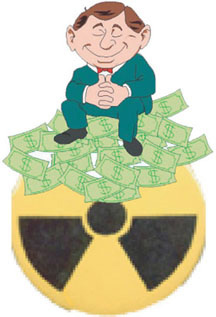
 Uranium Enrichment Creates Massive Amounts Of Depleted Uranium (DU) – Used In Weapons Of Mass Destruction
Depleted uranium, radiation, and fracking
 Wrecking the Earth: Fracking has grave radiation risks few talk about Rt.com Christopher Busby 28 Aug 13, Environmentalists point to various dangerous consequences of using fracking technology, but none can be compared to the issue of radiation exposure and radioactive contamination of the development areas it poses…….. The key to fracking
 Uranium is the key element to fracking, or hydraulic fracturing, to use its proper name. In the real-world version of Phineas Fogg’s “Eighty Days Around the World,” burning the ship’s masts and furniture to make steam, governments are now encouraging the oil and gas merchants to blast their way deep into the Earth to squeeze the last ounce of oil and gas from that poor creature. But there will be a terrible revenge. Locked up in the strata into which they pump the pressurized process water, to fracture and thus create the huge surface area sponge which will yield up its cargo of gas and oil, is a monstrous amount of natural uranium and its deadly daughter Radium-226. And vast amounts of the radioactive alpha emitting gas Radon-222, and its own daughters Bismuth 214, Lead-210 and the alpha emitter Polonium-210. Remember Polonium-210? That was the material used when a few millionths of a gram poisoned ex-Russian agent Alexander Litvinenko. Continue reading
Kazakhstan’s water imperilled by in situ leaching of uranium
Scientists studying the effects of ISL doubt how quickly mine sites can self-cleanse. This uncertainty appears to be little known to both Kazakhstan’s nuclear industry and fledgling environmentalists.
no site in the US has been entirely returned to pre-mining conditions
The cost of being the world’s No.1 uranium producer Kazakhstan’s industry has skyrocketed in the past 10 years. But what could that mean for the environment? Christian Science Monitor, By Ben Arnoldy, Staff writer / August 28, 2013 ASTANA, KAZAKHSTAN
If you make a toxic mess under one of the most isolated parts of the planet, does it matter if you don’t clean it up? Does it make a difference if that mess will be there for thousands of years? Scientists are asking those questions as Kazakhstan has steadily risen to become the world’s No. 1 uranium producer, surpassing such nations as the United States, Canada, and Australia, which require more cleanup.
Rather than employing miners to haul rock up to the surface, mine operators in Kazakhstan have embraced a newer – and generally cleaner – process by which a chemical solution is injected down a pipe to dissolve the underground uranium deposits and then is sucked back up to the surface.

This in situ leach (ISL) method avoids making a mess above ground, but leaves toxic levels of heavy metals in the ground water. In the US, companies using the method have tried for years and failed to return ground water to its pre-mining state. Continue reading
Another uranium mining company gets the financial jitters
 Bannerman waits for uranium price to turn around, The Northern Miner, 2013-08-21
A recently reported leak at the Fukushima nuclear plant in Japan has reawakened concerns over the development of new nuclear reactors in the country, with most experts agreeing that the current build-up would likely be put on hold until the situation is resolved.
The news is the latest reason being offered for why uranium prices continue to remain at low levels, but whatever the reason may be, the consequences are real for Bannerman Resources (TSX: BAN)…….
With the spot price for U3O8 still a ways off from the breakeven point outlined in its feasibility study on its flagship Etango project, Bannerman recently pushed back expected first production date for the project by two years. The mine was originally set to enter production in 2016 but now will have to wait until 2018…….
Rapid City Council votes for water security, and against uranium mining
Council passes resolution opposing uranium mining, Rapid city Journal, 21 Aug 13 The Rapid City Council passed a resolution late Monday night opposing a uranium mining operation near Edgemont, saying it “poses an unacceptable risk” to the city’s primary water supply.
The 9-1 vote came after council member Steve Laurenti sought to continue the discussion until state hearings for mining and water rights permits for Powertech concluded.
“I will tell you that this issue ranks in the top handful of issues that have generated public concern,” Mayor Sam Kooiker said. “This has really gotten peoples’ interest and there is a lot of concern in the community, and I believe that people have the right to ask questions about this issue.” Kooiker encouraged Laurenti to join the rest of the council in its decision to oppose the mine.
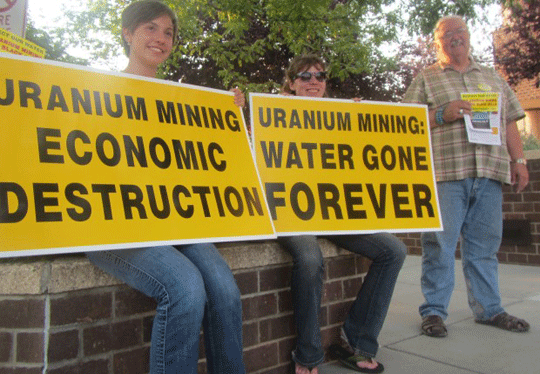
However, Laurenti stood firm with his vote against the resolution, maintaining that more information was needed before he could take a stand against the operation.
“The problem I have, from a logical standpoint, is to oppose something or even to have grave concern, grave meaning that I have a fear for my life,” Laurenti said. “I don’t fear for my life over this issue at this point.”…… The mine would draw up to 9,000 gallons of water per minute from the Inyan Kara and Madison aquifers. The Madison Aquifer supplied Rapid City with 60 percent of its water resources in 2012, according to city officials. http://rapidcityjournal.com/news/council-passes-resolution-opposing-uranium-mining/article_2253d74c-8890-58cc-9688-4bea869afbe9.html
Down, down again, goes the uranium market
 Uranium sags once more 9 news Finance. 20 Aug 13 “…..Once again the floor was pulled out from under the spot market, and prices have responded accordingly. Some 800,000lbs of U3O8 equivalent did change hands in several transactions over the course of last week, but prices trended lower with each trade now that the sellers are on the hop once more. TradeTech’s weekly spot price indicator has fallen US75c to US$35.00/lb.
These fluctuations in the spot price are having their effect on the term market. A number of utilities are looking to enter the term market for supply contracts, TradeTech reports, but none appears in a great hurry while price movements are unclear. No term transactions were reported last week….http://finance.ninemsn.com.au/newscolumnists/greg/8709269/uranium-sags-once-more
Shortage of funds holds up depleted uranium deconversion plant
Funds shortage delays uranium plant Alburquerque by Nick Pappas / Journal Ast. Business Editor 18 aug 13, International Isotopes Inc.’s construction of a first-of-its-kind depleted uranium deconversion plant just west of Hobbs will be delayed because of a shortage of funding for the $125 million project, the company acknowledged Friday…… The Idaho Falls company announced the selection of a 640-acre building site 15 miles west of Hobbs in March 2009 and submitted its license application to the U.S. Nuclear Regulatory Commission the following January. The NRC issued a 40-year construction and operating license last October.
Originally, International Isotopes officials said they hoped to complete construction of the facility in Lea County by the end of 2012.
But the need for additional funding – a mix of equity and debt financing – has extended that timeline…… http://www.abqjournal.com/248776/biz/funds-shortage-delays-uranium-plant.html
Rapid City Council swamped by opponents of uranium mining
Water is precious thing, a gift of life,” said Mark Kammerer, an area rancher who opposes the operation. “I hope you go ahead and come up with a good resolution denying Powertech the use of this water. You have that responsibility to my kids, your kids and kids not yet born. Water is the gift of life. Without it, all life dies.”

 Uranium mining opponents swarm council committee Rapid City Journal, • John Lee McLaughlin Journal staff, 15 Aug 13, After learning that the mayor and three city council members met privately with Powertech representatives, opponents of a proposed uranium mine packed Rapid City’s council chambers on Wednesday to find out where the city stands on the matter.
Despite nearly an hour of testimony, the Legal and Finance Committee declined to take a stand on a resolution opposing the project near Edgemont that needs state and federal approval. The resolution will now be considered Monday night by the Rapid City Council…… opponents to Powertech’s proposed Dewey Burdock mining project were concerned the meeting may have watered down the council’s original opposition, which was discussed at a meeting where council members say they wanted assurance the proposed project wouldn’t hurt the local water supply……
Project opponents voiced concern over the mine’s potential impacts on regional water quality and contamination from heavy metals and radioactive material that they said would pose a risk for 4.4 billion years, which is the half-life of uranium. Continue reading
British Queen has profitable investments in depleted uranium trade
UK Queen in depleted uranium trade? British anti-war campaign group the Stop the War Coalition has in a video claimed that Britain’s Queen Elizabeth is one of the richest women on earth and much of her profits are from arms trade including the notorious depleted uranium trade. http://www.presstv.ir/detail/2013/08/05/317277/uk-queen-in-depleted-uranium-trade/
The video apparently created by anti-monarchy activists and published on YouTube says the British monarch has managed to increase her wealth from £300 million early in her 60-year reign to £17 billion at present thanks to investments in arms firms that produce uranium used in depleted uranium (DU) shells, including Rio Tinto Zinc
DU shells are notorious for their ability to pierce armor and kill targets due to their deadly radioactive features.
The video cites the American nuclear radiation expert Jay M. Gould as saying in his 1996 book titled “The Enemy Within: the High Cost of Living Near Nuclear Reactors” that the British royal family, especially the Queen herself, privately own investments in uranium holding worth some £4 billion through Rio Tinto Zinc.
The mining company, originally named Rio Tinto Mines, was allegedly created for the British Royal family in the late 1950’s by Ronald Walter Rowland, the Queen’s “buccaneer”.
The video argues that the Queen and other royals have been investing in the death trade of depleted uranium globally with little ethical concerns for the consequences of their profiteering.
DU weapons were first used by the US military during the first Persian Gulf War against Iraq in 1991.
The US Defense Ministry estimated that between 315 and 350 tons of DU bombs, shells and bullets were fired during the conflict There are allegations that American and British troops used more than five times as many such weapons as the total number used in the 1991 war in Iraq.
The US has confirmed the use of depleted uranium in both wars but refuses to disclose the scale of the use.
Iraq has seen a sharp rise in the number of children with leukemia and genetic malformation in the decades after the First Persian Gulf War that are attributed to the use of DU weapons.
No sign of recovery in plummeting uranium market
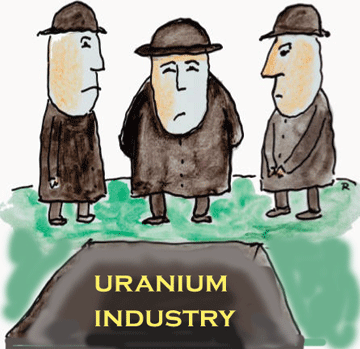 No rebound for uranium seen as Japan idle plants Prices have sunk to the lowest in more than 7 years amid a glut of the radioactive metal and speculation Japan will delay restarting its nuclear reactors. MineWeb, Ben Sharples (Bloomberg) , 02 Aug 2013 (BLOOMBERG) Uranium prices are showing little sign of recovery after sinking to the lowest in more than seven years amid a glut of the radioactive metal and speculation Japan will delay restarting its nuclear reactors.
Prices may average $42.82 a pound this year, according to Morgan Stanley, while Bank of America Corp. is predicting $43.80. BMO Capital Markets, which cut its price estimate by 10 percent in July, forecasts $43 a pound. Uranium has averaged $40.94 so far in 2013 after sliding to $34.50 last month, the lowest since November 2005.
While Japanese power producers, including Tokyo Electric Power Co., are seeking to restart reactors as soon as possible as the cost of other fuels escalates, operations may not resume until next year, according to Deutsche Bank AG. That’s threatening to delay a rebound in demand for uranium, hurting miners such as Australia’s Paladin Energy Ltd. as supplies outstrip demand. There is about 60 million pounds of surplus uranium around the world, according to Cantor Fitzgerald LP.
“The process for restarts is clearly going to take some time,” said Jonathan Hinze, a senior vice president at Roswell, Georgia-based Ux, which provides research on the nuclear industry. “Japanese utilities are unlikely to require any new fuel until 2014 at the earliest. There is a realization that the uranium demand from Japan is unlikely to dramatically change anytime soon, especially this year.”
Price Weakness
Uranium for immediate delivery has dropped as much as 21 percent this year, extending a 17 percent decline in 2012, according to data from Ux. Prices slumped 12 percent in July, the biggest monthly loss since March 2011. They climbed as high as $152 in June 2007…
Uranium glut pile rises, with doubts over Japan’s much-touted nuclear restart
.All but two of Japan’s 50 reactors remain idle due to the Fukushima disaster and must meet stricter safety standards set by the NRA before they can be restarted………The reactor review process is likely to take six months for each one, Deutsche Bank said in a July 15 note, citing NRA Chairman Shunichi Tanaka. An evaluation of all of Japan’s reactors may take more than three years
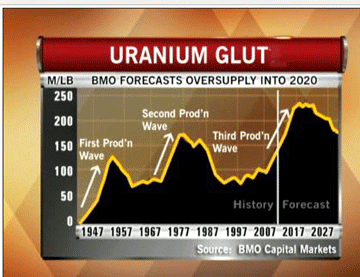
Slow reactor restart process rattles energy markets as uranium piles up, Japan Times, BLOOMBERG AUG 2, 2013 MELBOURNE – Uranium prices are showing little sign of recovery after sinking to their lowest levels in more than seven years amid a glut of the radioactive metal and speculation Japan will delay restarting its reactors……….. Uranium has averaged $40.94 so far in 2013 after sliding to $34.50 in July, the lowest price since November 2005.
While Japanese power producers including Tokyo Electric Power Co. are seeking to restart reactors as soon as possible as the cost of other fuels escalates, operations may not resume until next year, according to Deutsche Bank AG.
That’s threatening to delay a rebound in demand for uranium, hurting miners such as Australia’s Paladin Energy Ltd. as supplies outstrip demand. There is about 60 million pounds of surplus uranium around the world, according to Cantor Fitzgerald LP.
“The process for restarts is clearly going to take some time,” said Jonathan Hinze, a senior vice president at Ux, which provides research on the nuclear industry. “Japanese utilities are unlikely to require any new fuel until 2014 at the earliest. There is a realization that the uranium demand from Japan is unlikely to dramatically change anytime soon, especially this year.”
Uranium for immediate delivery has dropped as much as 21 percent this year, extending a 17 percent decline in 2012, according to data from Ux. Prices slumped 12 percent in July, the biggest monthly loss since March 2011. They climbed as high as $152 in June 2007.
“The weakness in uranium prices is partially attributable to uncertainty surrounding the timetable for reactor restarts in Japan,” John Borshoff, the chief executive officer of Australia-based Paladin Energy, said in the company’s quarterly production report July 16…..All but two of Japan’s 50 reactors remain idle due to the Fukushima disaster and must meet stricter safety standards set by the NRA before they can be restarted………The reactor review process is likely to take six months for each one, Deutsche Bank said in a July 15 note, citing NRA Chairman Shunichi Tanaka. An evaluation of all of Japan’s reactors may take more than three years…..Deutsche said.http://www.japantimes.co.jp/news/2013/08/02/business/slow-reactor-restart-process-rattles-energy-markets-as-uranium-piles-up/#.Uf2iE9Jwo6I
Sale of Namibian uranium mine cancelled, prices way too low
Paladin shares plummet after mine sale cancelled Proactive Investors, by Fiona MacDonald 2 August 13, Paladin Energy’ s (TSE:PDN) (ASX:PDN) stock lost 15 cents on the Toronto Stock Exchange Friday from prior close of 92 cents to fall more than 16 per cent on the back of the news that the uranium miner had terminated negotiations with all parties for the sale of a minority interest in the Langer Heinrich Mine.
The announcement, released after the close of North American trading Thursday night, sparked intraday trading that saw share prices dip as low as 65 cents, marking a new bottom for the Subiaco, Australia-headquartered miner’s 52 week range.
The mine, located in Malawi in southern Africa, is owned 100 per cent by Paladin and was taken off the table as a result of low uranium prices – a legacy of the disaster at Japan’s Fukushima-Daiichi atomic power plant after the 2011 earthquake and tsunami — undercutting the company’s chances of collecting the pay day it had in mind….. It is a long fall for the miner, which was trading at $1.00 per share as recently as a week ago. http://www.proactiveinvestors.com/companies/news/46789/paladin-shares-plummet-after-mine-sale-cancelled-46789.html
Australian uranium miner Paladin’s share price tumbles
Shares of uranium miner Paladin dive after cancelled sale Reuters, Aug. 02 2013, Shares of Australian uranium miner Paladin Energy Ltd. fell as much as 29 per cent in Toronto on Friday after the company cancelled plans for now to sell a minority interest in an African mine, and instead raised funds through a private placement of shares. Paladin said it ended negotiations with a potential investor on Thursday and all other parties for a stake in its Langer Heinrich mine in Namibia. The company said it was unlikely to get the price it wanted because of low uranium prices….. Trading of Paladin stock was halted in both Canada and Australia on Thursday, pending news.
Paladin’s stock was down 28 per cent, or 26 Canadian cents to 66 Canadian cents in early trading on the Toronto Stock Exchange. http://www.theglobeandmail.com/report-on-business/industry-news/energy-and-resources/shares-of-uranium-miner-paladin-dive-after-cancelled-sale/article13572589/
Cameco to sell less uranium
Cameco lowers uranium sales projections STARPHOENIX BY CHRISTOPHER DONVILLE, POSTMEDIA NEWS AUGUST 2, 2013 Cameco Corp., the world’s third-largest uranium producer, will sell less of the nuclear fuel via its German trading unit than previously planned because of the decline in the price of the commodity.
Sales volumes will be 8 million to 10 million pounds, down from an earlier projection of 9 million to 11 million, the Canadian company said Thursday in a statement. It now sees the unit’s 2013 sales at $450 million to $550 million, from $500 million to $600 million previously……..Uranium spot prices have fallen 27 per cent in the past year amid delays in resuming electricity output from nuclear power plants in Japan following the March 2011 earthquake and tsunami.http://www.thestarphoenix.com/business/Cameco+lowers+uranium+sales+projections/8740104/story.html
Unsustainable deal – Paladin’s uranium scam in Malawi
In the wake of the Kayelekera scam, Malawi needs to realise that tax is a governance issue. …. The cost of tax incentives given to Paladin is enormous. We can’t sustain it.
 Malawi gov’t and Paladin: Act on Kayelekera uranium raw deal now! Nyasa Times, By Veronica Maele-Magombe July 30, 2013 Since last week’s stinging observation by UnitedNations (UN) Special Raportuer on the Right to Food Olivier De Schutter regarding Malawi’s Kayelekera Uranium Mine deal, two elusive culprits remain pretty much intact in their hard shells. It is as if the country’s most guarded contract between government and Australian company, Paladin Africa Ltd has not been unravelled as the worst possible swindle. Continue reading
1 This Month

of the week – Shut Down Drone Warfare!


Tell the Ukrainian Government to Drop Prosecution of Peace Activist Yurii Sheliazhenko

Petition to revoke the licensing of the Near Surface Nuclear Disposal Facility (NSDF) at Chalk River. https://www.ourcommons.ca/petitions/en/Petition/Details?Petition=e-7247
To see nuclear-related stories in greater depth and intensity – go to https://nuclearinformation.wordpress.com
-
Archives
- April 2026 (103)
- March 2026 (251)
- February 2026 (268)
- January 2026 (308)
- December 2025 (358)
- November 2025 (359)
- October 2025 (376)
- September 2025 (257)
- August 2025 (319)
- July 2025 (230)
- June 2025 (348)
- May 2025 (261)
-
Categories
- 1
- 1 NUCLEAR ISSUES
- business and costs
- climate change
- culture and arts
- ENERGY
- environment
- health
- history
- indigenous issues
- Legal
- marketing of nuclear
- media
- opposition to nuclear
- PERSONAL STORIES
- politics
- politics international
- Religion and ethics
- safety
- secrets,lies and civil liberties
- spinbuster
- technology
- Uranium
- wastes
- weapons and war
- Women
- 2 WORLD
- ACTION
- AFRICA
- Atrocities
- AUSTRALIA
- Christina's notes
- Christina's themes
- culture and arts
- Events
- Fuk 2022
- Fuk 2023
- Fukushima 2017
- Fukushima 2018
- fukushima 2019
- Fukushima 2020
- Fukushima 2021
- general
- global warming
- Humour (God we need it)
- Nuclear
- RARE EARTHS
- Reference
- resources – print
- Resources -audiovicual
- Weekly Newsletter
- World
- World Nuclear
- YouTube
-
RSS
Entries RSS
Comments RSS
 nuclear-news