Iran’s nuclear materials and equipment remain a danger in an active war zone
March 17, 2026 , Matthew Bunn, The Conversation
Before launching his war on Iran, President Donald Trump said his most important goal was that Iran would “never have a nuclear weapon.” Yet it is not clear what, if anything, his administration has planned for dealing with Iran’s stock of enriched uranium that could be used to make nuclear bombs – or its remaining deeply buried nuclear facilities and the nuclear equipment that might be in them, or hidden elsewhere.
U.S. and Israeli strikes in June 2025 seriously damaged Iran’s major nuclear facilities and killed several prominent scientists associated with the country’s nuclear program. However, contrary to Trump’s claim that the Iranian nuclear program had been “completely obliterated,” it appears that Iran had stored much or all of its enriched uranium in deep tunnels that were not destroyed.
The Trump administration’s demand, just two days before the attacks began, that Iran export its enriched uranium stocks represented a tacit acknowledgment that Iran’s government still had control of this material or could get access to it.
So, as airstrikes on Iran continue, an unclear fate faces several elements of Iran’s nuclear program, including:
- Its stock of enriched uranium.
- Its centrifuges for enriching more uranium, and parts for more centrifuges.
- Any equipment it may have for turning enriched uranium into metal, shaping it into nuclear weapons components and taking other weapons-assembly steps.
- The documents and expertise from its past nuclear weapons program.
- Its as-yet-intact nuclear facilities that are deep underground.
I have been studying steps to stop the spread of nuclear weapons – including managing the dangers of Iran’s nuclear program – for decades. My conclusion is that if all these capabilities remain in place, the war will have accomplished little in reducing Iran’s nuclear capability, while likely increasing the government’s belief that it needs a nuclear weapon to defend itself.
Where could Iran’s uranium be?
The most immediate concern is roughly 970 pounds (441 kilograms) of highly enriched uranium containing 60% of the U-235 isotope that is relatively easy to split. That’s what Iran was believed to have before the summer 2025 bombings, and much of it reportedly survived those strikes.
Over 440 pounds (200 kilograms) of it is reportedly stored in deep underground tunnels near Isfahan. Other stocks of this material are thought to be in a deep underground facility near Natanz known as Pickaxe Mountain, and in Fordow, one of the sites bombed in summer 2025.
Gen. Dan Caine, chairman of the U.S. Joint Chiefs of Staff, has reportedly acknowledged that the Isfahan tunnels are too deep to destroy with bunker-buster bombs like those used on the underground Fordow facility last summer. Pickaxe Mountain, under granite, would be at least as challenging a target.
What could the uranium be used for?
With just 100 centrifuges, Iran could further enrich the 60% enriched material to be 90% or more U-235 in a few weeks. That is the concentration needed for the nuclear weapon design that Iran was working on in the secret nuclear weapons program it largely stopped in late 2003.
Even without further enrichment, the 60% enriched material could be used in a bomb, either exploding with less power or using more material and explosives.
Beyond Iran using this material itself, there are other concerns. Nobody knows who might get it if Iran’s government collapses. Some lower-level people managing it might decide to try to sell it as part of trying to save themselves from the current crisis, as happened after the 1991 collapse of the Soviet Union. Government studies have warned that even a sophisticated terrorist group might be able to make a crude nuclear bomb if it had the needed uranium.
Could it be removed peacefully?
One possibility is that the current Iranian government, or a future one, might be willing to cooperate or at least acquiesce in getting rid of the country’s nuclear material. The existing Iranian government reportedly offered to blend it down to a lower concentration in the negotiations that Trump ended by attacking Iran in February 2026.
Highly enriched uranium has been removed from many cooperative countries over the years. One early example was Project Sapphire, in 1994, in which U.S. teams worked with Kazakhstan to fly some 1,280 pounds (580 kilograms) of highly enriched uranium to safe storage in Tennessee. Similar efforts have removed tons of plutonium and highly enriched uranium from scores of sites around the world, removing the risk that terrorists could get hold of that material.
Could it be captured?
Without cooperation, and with the uranium in tunnels too deep to destroy from the air, the only other option for eliminating them could be sending in a team of either U.S. or Israeli soldiers and experts while the war continues.
U.S. special forces troops have long trained with federal scientists and experts to disable or secure adversaries’ nuclear weapons and material. But it wouldn’t be easy: Mark Esper, a defense secretary in Trump’s first term, has warned that actually doing so in Iran would take a large force and be “very perilous.”
Trump has said he would only do so if Iran was “so decimated that they wouldn’t be able to fight on the ground level.”……………………………………………………………………………………………………………………
Fundamentally, Iran’s nuclear knowledge cannot be bombed away. Ultimately, I believe, U.S. security would be best served through agreements to limit Iran’s nuclear efforts, coupled with effective international inspection, keeping watch year after year. Provisions to do that were central to the 2015 Iran nuclear deal between China, France, Germany, Russia, the United Kingdom, the United States, the European Union and Iran. Trump pulled the U.S. out of the agreement in 2018, enabling Iran to make the highly enriched uranium that now poses a danger.
In my view, only diplomacy can again provide strict limits and effective monitoring in the future. But this war may well have ruined the chances for such diplomatic options for many years to come. https://theconversation.com/irans-nuclear-materials-and-equipment-remain-a-danger-in-an-active-war-zone-278008
No to uranium mining in Greenland
February 27, 2026, by IPPNW – International Physicians fot the Prevention of Nuclear War
[Ed. note: Niels Henrik Hooge works with NOAH, the Danish branch of Friends of the Earth. He is also closely associated with Greenland’s No to Uranium Association (URANI? NAAMIK) in Nuuk. Patrick Schukalla, IPPNW Germany’s policy advisor on energy and climate, spoke with Hooge in February about the role of Greenland’s uranium resources and other subsurface wealth, and the potential threats to the territory during this period of geopolitical tension.]
PS: Although Greenland is currently on everyone’s mind, little is being learned about the island itself, its people or the Arctic ecology. Instead, the focus is on the geopolitical desires of others, both imagined and real. You have been working against large-scale mining in Greenland for a long time and have achieved significant political successes in this area. Could you tell us about that?
.NHH:………………………………………………………………….. . Denmark, which for centuries was in full control of Greenland, has made no attempts to integrate Inuit culture into the rest of Kingdom. Another striking fact is that private ownership of land does not exist and land cannot be bought or sold. You can own buildings, but not the ground. The paradox here is that you now have some of the biggest and greediest industrialists in the world trying to control property that so far has been collectively owned. This is really a clash of opposite cultures.
PS: The last time we spoke was in 2021, ahead of the COP26 Climate Summit in Glasgow. We discussed uranium mining and the false claims made by the industry and some governments under the slogan ‘Nuclear for Climate’. IPPNW is PS: committed to a world without nuclear threats. This includes calling for an end to uranium mining. What role does uranium play in Greenland and in your campaigns today?
NHH: Since 2021, when the Inuit Ataqigiit party came into power, there has been a ban on uranium mining. Inuit Ataqatigiit is mainly an ecological party and I guess to some extent you could compare it to the German Greens, because it is also a mainstream party. Until 2013, the ban had existed for a quarter of a century, but it was lifted on the request of the Australian mining company, Energy Transition Minerals (ETM, formerly known as Greenland Minerals Ltd., GML), which threatened to abandon the big Kvanefjeld uranium and rare earths mining project, if ETM could not exploit the uranium deposit.
Under GML’s ownership, the controversial project has been at the forefront of the public eye for more than a decade, and the mining project and uranium mining in general have been a major factor in the formation of at least five government coalitions since 2013. When the uranium ban was lifted, Greenlandic and Danish NGOs, including NOAH, started to cooperate to have it reinstated. Particularly, I want to emphasize our collaboration with URANI? NAAMIK, Greenland’s anti-uranium network, which played a crucial role in mobilising the public against uranium mining. Although this type of mining now is banned, the anti-uranium campaign cannot stop completely. Mining companies are lobbying the Trump administration and its associates in the private sector to intervene and changes in Greenland’s political community could fundamentally affect the status of uranium mining.
…………………………………………………………………………………….. PS: If European governments are now trying to satisfy the US without Greenland being annexed, are you worried that regulations will be weakened and the protection of the Arctic environment will be compromised?
NHH: Yes, unfortunately this is a real risk and it could start a race to the bottom. On one hand, EU’s Arctic Environment and Sustainability Strategy implies that oil, coal and gas should no longer be extracted in Arctic areas. On the other hand, EU has adopted a policy under the European Critical Raw Materials Act of fast-tracking mining projects even if they do not have support from the local population and show signs of flawed permitting or inadequate environmental impact assessments………………………………………..
PS: What are your next steps, and what would you like your friends and partners in other European countries and beyond to do?
NHH: Currently, URANI? NAAMIK and NOAH are campaigning to have mining companies which have played a role in getting the Trump administration to try to annex Greenland screened and if necessary, banned for security reasons. Furthermore, there is now a majority in the Greenlandic population to rejoin the EU as a member state, and obviously it would make sense, if EU institutions and the European NGO community started to prepare for this eventuality. In NOAH’s opinion, it would imply a conception of a European Arctic policy that includes an offer to support the Greenlandic government in protecting and preserving Greenland’s natural resources.
This could become a lighthouse project for Greenland, the Danish Kingdom and the EU, putting environmental protection on the global agenda. If mineral extraction is completely or partially abolished, the Greenlanders should of course be compensated financially. The European Parliament has supported the idea of an Arctic nature protection area in the past, using the Antarctic Treaty as a model. The idea is backed by 141 environmental organizations, including some of the largest in Europe and the world. https://peaceandhealthblog.com/2026/02/27/no-to-uranium-mining-in-greenland/
Iran suggests it could dilute highly enriched uranium for sanctions relief
Aljazeera, 9 Feb 26
Iran’s atomic energy chief makes comment as more mediated negotiations with the US expected.
Iran’s atomic energy chief says Tehran is open to diluting its highly enriched uranium if the United States ends sanctions, signalling flexibility on a key demand by the US.
Mohammad Eslami made the comments to reporters on Monday, saying the prospects of Iran diluting its 60-percent-enriched uranium, a threshold close to weapons grade, would hinge on “whether all sanctions would be lifted in return”, according to Iran’s state-run IRNA news agency.
Eslami did not specify whether Iran expected the removal of all sanctions or specifically those imposed by the US.
Diluting uranium means mixing it with blend material to reduce its enrichment level. According to the United Nations nuclear watchdog, Iran is the only state without nuclear weapons enriching uranium to 60 percent.
US President Donald Trump has repeatedly called for Iran to be subject to a total ban on enrichment, a condition unacceptable to Tehran and far less favourable than a now-defunct nuclear agreement reached with world powers in 2015.
Iran maintains it has a right to a civilian nuclear programme under the provisions of the nuclear Non-Proliferation Treaty, to which it and 190 other countries are signatories.
Eslami made his comments on uranium enrichment as the head of Iran’s Supreme National Security Council, Ali Larijani, prepares to head on Tuesday to Oman, which has been hosting mediated negotiations between the US and Iran.
Al Jazeera’s Ali Hashem, reporting from Tehran, said Larijani, one of the most senior officials in Iran’s government, is likely to convey messages related to the ongoing talks
Trump said talks with Iran would continue this week……………………………………………………………………………………………………………………………. https://www.aljazeera.com/news/2026/2/9/iran-suggests-it-could-dilute-highly-enriched-uranium-for-sanctions-relief
US DOE Awards $2.7B for Uranium Enrichment in Nuclear Power Push
Rigzone, by Jov Onsat. Tuesday, January 06, 2026
The United States Department of Energy (DOE) has awarded $2.7 billion orders to three companies for enrichment services to enable the production of low-enriched uranium (LEU) and high-assay low-enriched uranium (HALEU)…………….
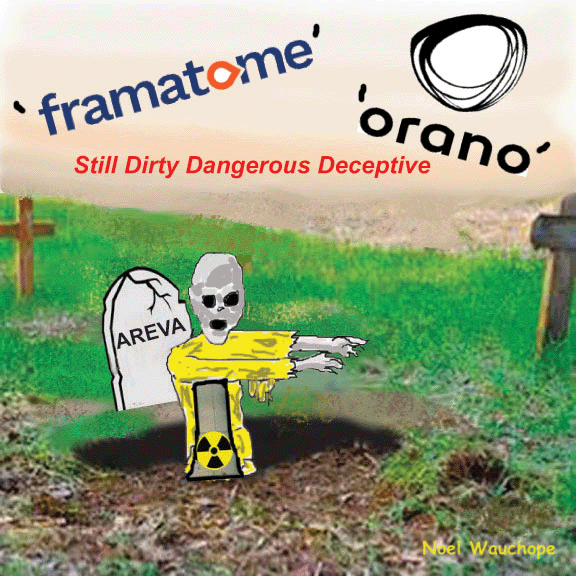
American Centrifuge Operating LLC and General Matter Inc each won $900 million to establish domestic HALEU enrichment capacity for advanced reactors. Orano Federal Services LLC also won $900 million to expand the U.S.’ LEU enrichment capacity.
……………….Currently only China and Russia can produce HALEU at a commercial scale, according to the World Nuclear Association.
Niger builds relationships with overseas uranium partners
WNN, 16 December 2025
Niger’s state-owned Timersoi National Uranium Company has signed an agreement with Russian company Uranium One Group to cooperate in uranium mining and eventually open new mines. Meanwhile, Global Atomic Corporation remains upbeat about the prospects for securing financing for the Dasa uranium project – although first uranium shipments could now be delayed.
The Memorandum of Cooperation signed on 9 December by the Timersoi National Uranium Company (TNUC) and Uranium One Group – part of the Rosatom State Corporation group of companies – is expected to make a significant contribution to strengthening the Russia-Niger partnership in the energy sector, Uranium One said.
Under the agreement, the two companies plan to “obtain the necessary permits, conduct geological exploration of prospective deposits, and ultimately establish new uranium mining operations at those sites
Niger has produced uranium commercially since 1971, in operations closely linked with French companies. But that changed following the overthrow of the government in a military coup in July 2023, which saw the revoking of mining permits held by French company Orano at Imouraren and Canadian company GoviEx Uranium at Madaouela. However, Toronto-headquartered Global Atomic has continued to develop the high-grade Dasa deposit, apparently with the support of the Niger government………………………………………………………………………………………. https://www.world-nuclear-news.org/articles/niger-builds-relationships-with-overseas-uranium-partners
France’s EDF again sends spent uranium to state-owned Russian firm for recycling
France’s EDF again sends spent uranium to state-owned Russian firm for
recycling. A shipment of reprocessed uranium from French nuclear power
plants has left the Channel port of Dunkirk to be enriched at a specialised
Russian industrial plant run by the country’s nuclear energy group Rosatom,
before being in part returned to France for further use in civil reactors.
The shipment, loaded at the weekend on a Russian-operated,
Panama-registered cargo vessel, was described by Greenpeace as a “cargo of shame”, and “immoral”, while both French utility giant EDF, which
operates the country’s nuclear power plants, and the French economy
ministry, declined to comment. Jade Lindgaard reports.
Mediapart 18th Nov 2025, https://www.mediapart.fr/en/journal/ecologie/181125/frances-edf-again-sends-spent-uranium-state-owned-russian-firm-recycling
Iran’s foreign minister says his nation is no longer enriching uranium
“All of our facilities are under the safeguards and monitoring” of the International Atomic Energy Agency, Abbas Araghchi said.
Politico, By Associated Press, 11/16/2025
TEHRAN, Iran — Iran’s foreign minister on Sunday said that Tehran is no longer enriching uranium at any site in the country, trying to signal to the West that it remains open to potential negotiations over its atomic program.
Answering a question from an Associated Press journalist visiting Iran, Foreign Minister Abbas Araghchi offered the most direct response yet from the Iranian government regarding its nuclear program following Israel and the United States’ bombing of its enrichment sites in June during its 12-day war.
“There is no undeclared nuclear enrichment in Iran. All of our facilities are under the safeguards and monitoring” of the International Atomic Energy Agency, Araghchi said. “There is no enrichment right now because our facilities — our enrichment facilities — have been attacked.”
Asked what it would take for Iran to continue negotiations with the U.S. and others, Araghchi said that Iran’s message on its nuclear program remains “clear.”
“Iran’s right for enrichment, for peaceful use of nuclear technology, including enrichment, is undeniable,” the foreign minister continued. “We have this right and we continue to exercise that and we hope that the international community, including the United States, recognize our rights and understand that this is an inalienable right of Iran and we would never give up our rights.”
Iran’s government issued a three-day visa for the AP reporter to attend a summit alongside other journalists from major British outlets and other media.
Mohammad Eslami, the head of the Atomic Energy Organization of Iran, also attended the summit and told those gathered there that Tehran had been threatened over potentially accessing the bombed enrichment sites. Satellite pictures analyzed by the AP over the months since the attack show that Iran hasn’t done any major work at the sites at Fordo, Isfahan and Natanz.
“Our security situation hasn’t yet changed. If you watch the news, you see that every day we are being threatened with another attack,” Eslami said. “Every day we are told if you touch anything you’ll be attacked.”
Iran had been enriching uranium up to 60% purity — a short, technical step from weapons-grade levels — after U.S. President Donald Trump unilaterally withdrew America from Tehran’s 2015 nuclear deal with world powers in 2018. Tehran long has maintained its atomic program is peaceful, though the West and the IAEA say Iran had an organized nuclear weapons program up until 2003.
European nations also pushed through a measure to reimpose United Nations sanctions on Iran over the nuclear program in September.
The IAEA’s Board of Governors is set to meet this week, during which there could be a vote on a new resolution targeting Iran over its failure to cooperate fully with the agency.
But Araghchi left open the possibility of further negotiations with the U.S. should Washington’s demands change.
He told journalists at the summit that the U.S. administration’s approach does not suggest they are ready for “equal, fair negotiations to reach mutual interests.”
“What we have seen from the Americans so far has actually been an effort to dictate their demands, which are maximalist and excessive. We see no chance for dialogue in the face of such demands.”………………………………………………………………………… https://www.politico.com/news/2025/11/16/irans-foreign-minister-says-his-nation-is-no-longer-enriching-uranium-00653702
Declassified cable reinforces proliferation concerns about high-assay low-enriched uranium fuel (HALEU)
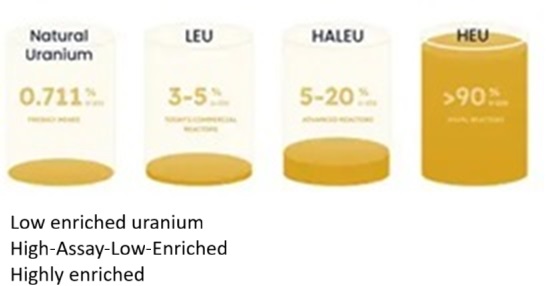
in 1977, the US government recommended to the IAEA that, contrary to its previous position, the agency should consider enriched uranium in the HALEU range to be a material “of direct utility in an … explosive device.” That is, the United States advised that HALEU should be treated similarly to HEU and be subject to stricter safeguards
Bulletin, By Edwin Lyman | November 7, 2025
A recently declassified document from nearly 50 years ago provides an important piece of the puzzle for open-source researchers seeking to understand the murky origins of the International Atomic Energy Agency (IAEA) system for safeguarding against the diversion of civil nuclear materials for weapons. The document also reinforces concerns about the proliferation potential of small modular reactors that require fuels using uranium enriched from 10 to less than 20 percent uranium 235—that is, fuels that contain the material known as high-assay low-enriched uranium (HALEU).[1]
HALEU is a subcategory of low-enriched uranium (LEU), which is uranium enriched to below 20 percent uranium 235, and the IAEA has long considered LEU, including HALEU, to be “indirect-use material.” For the agency, HALEU cannot be used to make a nuclear weapon without converting it to highly enriched uranium (HEU) by further enriching it to 20 percent or above—a significant technical barrier for all but a few countries. Consequently, HALEU is subject to far less stringent international safeguards than HEU.
But the newly uncovered document reveals that, in 1977, the US government recommended to the IAEA that, contrary to its previous position, the agency should consider enriched uranium in the HALEU range to be a material “of direct utility in an … explosive device.” That is, the United States advised that HALEU should be treated similarly to HEU and be subject to stricter safeguards—a recommendation that the IAEA apparently rejected. But given the current international push for rapid deployment of reactors that will need large quantities of HALEU fuel, it is time for the IAEA to reconsider that decision.
Proliferation risk of HALEU fuel. The Energy Department, with bipartisan support from Congress, is now vigorously promoting the global deployment of “advanced” nuclear power reactors that require HALEU-based fuels, as well as the facilities needed to enrich and fabricate those fuels. For example, nearly all of the 11 reactor designs selected by the Energy Department for its New Reactor Pilot Program will use HALEU fuel. And Russia, which has already deployed two barge-mounted small modular reactors (SMRs) using HALEU fuel, is planning to deploy others in Uzbekistan and elsewhere around the globe.
But without appropriate constraints, large-scale production and use of HALEU may greatly increase the risks of nuclear proliferation and terrorism…………………………………………………….
earlier this year, the late Richard Garwin and I—along with professors Scott Kemp of MIT, Mark Deinert of the Colorado School of Mines, and Frank von Hippel of Princeton— presented evidence in a letter to Science that HALEU may be used to make nuclear weapons without the need to enrich it further, and we called for further study of the issue by the US government. The concern is that a state or a terrorist group that illicitly obtained enough HALEU—typically, one reactor core’s worth or less, depending on the design—could have a far easier path to acquiring a bomb than if it only had access to conventional LWR fuel………………………………………………………………………………………
The document reveals that the United States apparently sought to lower the enrichment threshold that the IAEA had formerly used to define direct-use enriched uranium from 20 percent to 10 percent—thereby including the enrichment range now known as HALEU. To my knowledge, this information was not previously known to the public, and a cursory web search does not turn up any other mention of the new terms proposed in the cable………………………………………………………………………….
the cable strongly suggests that other US government agencies were concerned enough about the weapon usability of enriched uranium in the HALEU range to challenge the status quo and recommend that it be safeguarded as intensely as HEU. Such concerns should be even more salient today. An international review of HALEU’s proliferation risks is urgently needed before any more power reactors running on HALEU fuel are deployed. https://thebulletin.org/2025/11/declassified-cable-reinforces-proliferation-concerns-about-high-assay-low-enriched-uranium-fuel/?utm_source=ActiveCampaign&utm_medium=email&utm_content=Can%20Latin%20America%20find%20common%20ground%20at%20COP30%3F&utm_campaign=20251110%20Monday%20Newsletter
Don’t fuel Riyadh’s nuclear weapons cravings
By: Henry Sokolski, October 31, 2025, https://npolicy.org/dont-fuel-riyadhs-nuclear-weapons-cravings-breaking-defense/
Since 2017, US diplomats have tried unsuccessfully to devise ways to help Saudi Arabia enrich uranium — a dangerous nuclear activity that can bring a state to the very brink of making bombs. Next month, they get another chance: Crown Prince Mohammed bin Salman is coming to the White House on Nov. 18 to sign a formal US-Saudi nuclear cooperative agreement. Will this agreement finally help the Kingdom make nuclear fuel? Let’s hope not.
Tehran making nuclear fuel is scary enough. Encouraging others to do the same is scarier still.
That’s why the Pentagon bombed Iran this June. Certainly, the White House understood that nuclear fuel-making was too close to nuclear bomb-making: By the time inspectors might detect a military diversion at such plants, it would be too late to intervene to prevent a weapon from being built.
This insight prompted Trump’s termination of Obama’s 2015 nuclear deal with Iran, which allowed Iran to enrich uranium. It’s also why Trump’s nuclear emissary, Steve Witkoff, backed off trying to negotiate a new inspections regime for Iranian nuclear fuel-making, conceding that “enrichment enables weaponization.” Energy Secretary Chris Wright went further: At the International Atomic Energy Agency’s (IAEA) September general conference, he insisted that Iran’s uranium enrichment program be “completely dismantled.”
But what of the Nuclear Nonproliferation Treaty (NPT) “right” to make nuclear fuel? Iran maintains this entitlement is inalienable. As I’ve explained elsewhere, nuclear fuel-making is not mentioned anywhere in the treaty. Some NPT negotiators proposed language to assure a right to “the entire fuel cycle,” but the NPT conference rejected it. Even the Biden administration, which wanted to revive the 2015 Iran nuclear deal, only implicitly recognized such a “right” — never explicitly.
Iran, unfortunately, never bought this view. Nor has Saudi Arabia. In 2017, Prince Turki Al-Faisal, former Saudi ambassador to Washington, noted that “the NPT tells us all we can enrich.” He, bin Salman, and his lieutenants have consistently demanded that America help it exercise this “right.”
Fortunately, Congress refused. Back in 2018, Senators from the left, like Ed Markey, and the right, like Lindsey Graham, understood helping Iran enrich uranium was too dangerous. They all cited bin Salman’s warning that if Saudi Arabia thought Iran was getting a bomb, it would too, despite any NPT pledge the Saudis may have made. The Hill’s recommended fix: Get the Saudis to forswear making nuclear fuel, just as their neighbor, the UAE, had in their US nuclear agreement in 2009.
Now, it should be easier to get the Saudis to forswear as well. Why? In September, the Saudis struck a mutual defense pact with Pakistan. Pakistani Defense Minister Khawaja Mohammad Asif said that as part of this pact Pakistan would make its nuclear weapons available to Saudi Arabia if needed. So, Riyadh no longer needs its own bomb.
Meanwhile, the White House is said to be negotiating binding, NATO-like security assurances for the Saudis similar to those recently granted to Qatar. Then there is the Trump administration’s “obliteration” of Iran’s nuclear fuel-making capacity and the president’s commitment to bomb it again, if necessary.
All of this should be dispositive against Riyadh’s will to enrich and American inclinations to bend to it. But it’s not. In April, Secretary of Energy Chris Wright visited Riyadh. When asked if a deal would include “sensitive” nuclear technologies, he replied, “It certainly looks like there is a pathway to do that. … Are there solutions to that that involve enrichment here in Saudi Arabia? Yes.”
He should have said no. Keeping timely, accurate track of the powders, liquids, and gases involved in making nuclear fuel is not yet good enough to safeguard against military diversions. Nor is American ownership or operation of Saudi nuclear fuel making a fix. As America’s experience in Iran demonstrates, the United States can operate bases and own companies in foreign nations and still be thrown out. This has happened before and can happen again in Saudi Arabia.
Another headache if America helps Riyadh make nuclear fuel is the example it sets. Saudi Arabia’s neighbors, who also have US nuclear cooperative will demand the same.
They’ll all race to develop bomb options. Saying no to Riyadh’s fuel-making demands is our best chance to skirt this.
The Building of the First Atomic Bombs Impacted Workers and Residents, Too
Eighty years after the bombing of Hiroshima and Nagasaki, workers who mined the uranium and people who lived near the test sites are still dying from exposure to radiation.
by Jim Carrier, August 7, 2025, https://progressive.org/magazine/the-building-of-the-first-atomic-bombs-impacted-workers-and-residents-too-carrier-20250807/
The road to Nagasaki was littered with radiation.
Eighty years after an atomic bomb called Fat Man was dropped, killing and poisoning about 100,000 people in Nagasaki, at least a dozen sites around the world—sites that contributed to the bomb’s creation—are still dealing with its deadly legacy.
Under the pressure to win World War II, U.S. military leaders pulled out all stops to prioritize the creation and testing of an atomic bomb, indifferent to the cost on the lives and livelihood of everyday people. Landscapes were polluted, workers were exposed to radiation, and civilian neighbors to the nuclear test sites—the first “downwinders”—were ignored or lied to.
The Manhattan Project—a top-secret research and development program created by the U.S. government during World War II to develop a nuclear bomb—sourced nearly all of its much-needed uranium from the Belgian Congo’s Shinkolobwe mine. Located in the modern-day Haut-Katanga province in the Democratic Republic of Congo, the Shinkolonwe mine was the world’s richest source of high-grade uranium, radium, and other valuable minerals. First opened in 1921, the Belgian-owned mine employed artisanal miners who dug the radioactive ore with handheld tools and carried it out in sacks on their shoulders, further exposing them to the toxic substance. While the environmental impact was visible and more difficult to conceal, any known records of lasting health impacts were disappeared by the authorities or never recorded at all.
In 1939, fearing Adolf Hitler and the German discovery of nuclear fission in uranium—with its potential to create a bomb—the mine’s manager shipped more than 1,000 tons of ore from Katanga to a warehouse on Staten Island, New York. Spilled ore contaminated a portion of the site where it sat for three years. A 1980 study later determined that the site might harm trespassers beneath the Bayonne Bridge, but by that time the site had already been demolished.
President Franklin Roosevelt’s January 19, 1942, decision to build an atomic bomb touched off the $2 billion Manhattan Project with its extraordinary mix of secret research at Los Alamos, New Mexico, and massive construction projects at Oak Ridge, Tennessee, and Hanford, Washington. All of these needed hundreds of tons of uranium to make a few pounds of plutonium.
In November 1942, the U.S. Army discovered and bought the Staten Island uranium stockpile and shipped 1,823 drums by barge and railroad to the Seneca Army Depot in Romulus, New York, where it was put into large concrete igloos before being shipped to various refineries. Now part of an Environmental Protection Agency Superfund site, the depot stored all kinds of munitions and even some classified military equipment that was burned and buried. Most of the site was cleaned up in the early 2000s and opened for recreation and industrial warehousing.
The Army’s search for uranium ore also uncovered 500 tons among vanadium tailings in western Colorado, and 300 tons at Port Hope, Ontario, Canada, where the Eldorado Gold Mines refinery processed ore into more pure concentrations. Eldorado’s own mine, on Great Bear Lake in the Northwest Territories of Canada, employed First Nations Dene workers who would later suffer cancers and die from handling sacks of ore. Their community of Délı̨nę became known as a “village of widows.” Without contemporary health records, a re-created exposure study found that overall cancer rates for Délı̨nę were “not statistically significantly different from the Northwest Territories.”
Port Hope, on the northern shore of Lake Ontario, which processed all the African and North American uranium ore for the Manhattan Project, spread tailings in neighborhoods and in the lake, eventually requiring a $1.3 billion cleanup that did not begin until 2018. Residents blame the contamination for cancers, although a 2013 study found no statistical evidence of greater radiosensitive cancers.
An enduring and poetic legend links the labors of Délı̨nę villagers to the Japanese bombs, a story told in A Village of Widows, a documentary film that followed ten Dine to Hiroshima in 1998 where they paid their respects and shared mutual sorrow with hibakusha, the Japanese word for the survivors of the atomic bombs. The uranium ore from Great Bear Lake did, in fact, contribute to the Manhattan Project—a U.S. government history found that Great Bear Lake ore amounted to one-sixth of the uranium used in the Manhattan Project, Colorado ore contributed one-seventh, and the rest came from the Belgian Congo. However, a detailed 2008 analysis of the ore’s movements concluded that “the fissile material in the Nagasaki weapon was almost certainly derived from oxide processed by Eldorado which would have been mostly of Belgian Congo origin. The same is probably true for the Hiroshima weapon. It is also possible that there was some uranium of U.S. origin in both of these weapons.”
After Port Hope, the uranium was further refined at nineteen industrial sites including: Linde Air in Tonawanda, New York; Dupont’s Deepwater Works in New Jersey; Metal Hydrides Inc. in Beverly, Massachusetts; Harshaw Chemical in Cleveland, Ohio; and at Mallinckrodt Chemical Company in St. Louis, Missouri. All of these sites have undergone expensive remediation. Mallinckrodt, whose radiation contamination caused numerous cancers in children and adults, has yet to be scrubbed clean.
Uranium salts were then delivered to either Oak Ridge, Tennessee, where the Y-12 refinery produced enriched uranium for the bomb dropped on Hiroshima, or to Hanford, Washington, where refineries produced the plutonium used in both the Trinity test bomb and the Nagasaki bomb. Both reactor sites deliberately released radioactive material into the air and water. Cleaning the mess has cost much more than the original Manhattan Project. The cost to clean Hanford, considered the most radioactive spot in the world, is estimated at $640 billion. Oak Ridge’s cleanup won’t be finished until 2050. Hanford’s effort to meld radioactive sludge into glass containers and bury them in salt caves is only beginning.

The first atomic bomb blast in history, the Trinity test of the plutonium implosion “gadget” in the Alamogordo, New Mexico, desert on July 16, 1945, left permanent marks on the land and the people downwind. The airborne plume from Trinity drifted across the Tularosa Basin, landing on vegetables, cattle, and water, poisoning residents who would later report leukemia, cancers, and heart disease. Subsequent studies have found Trinity fallout reached forty-six states, Canada, and Mexico. After five years of lobbying, the Tularosa Basin Downwinders Consortium won a two-year window—until December 31, 2028—to be included in the federal Radiation Exposure Compensation Act which covers U.S. uranium workers and downwinders exposed at the Nevada Test Site during the Cold War. As of June 24, 2025, 42,575 people have received $2.7 billion dollars. Tourists can visit the test site one day a year, on the third Saturday in October. Radiation at ground zero is ten times the region’s natural radiation.
The area around Los Alamos, where brilliant physicists and world-class machinists created the bombs that fell on Japan eighty years ago, has realized that the work of those scientists also left plutonium contamination close to home. Wartime practices that dumped raw radioactive waste into Acid Canyon continued until 1951, and despite several cleanup efforts, measurable plutonium remains. The Los Alamos National Laboratory says the risks to humans walking the canyon are “tiny.” However, plutonium has a half-life of 24,000 years.
For more on the story of Nagasaki, Japan, today, see Jim Carrier’s article “The Bombs Still Ticking” from the August/September 2025 issue of The Progressive.
Russian uranium being used at Sizewell B site in Suffolk.
“It is sheer hypocrisy for energy ministers to say we need new nuclear to stop being dependent on imported Russian energy, when our biggest and newest nuclear plant is fully fuelled by Putin’s uranium.”
East Anglian Daily Times, 11th August, By Will King, Mid Suffolk Reporter
Sizewell B has confirmed it has been using Russian uranium amid criticism of “sheer hypocrisy” while billions of taxpayers’ money is spent on the Ukraine war.
EDF Energy confirmed that Sizewell B’s nuclear fuel supply comes from Russia, but stated that the specific company providing it, MSZJSC, is not subject to sanctions.
Sizewell B provides 3% of the UK’s electricity, and every 18 months, a third of the fuel in the reactor is replaced using recycled enriched uranium using this source.
They said that its presence is due to “long-term commitments struck years before Russia invaded Ukraine”, after a contract was signed by British Energy in 2008.
However, Dr David Lowry, a nuclear policy consultant and former member of the independent advisory panel for the Chief UK Nuclear Safety and Security Inspector, says the fuel is initially mined by Rosatom, a Russian company sanctioned in Febuary 2023, but the company has continued using it.
He says the supply chain begins with the Russian state-owned company before it is sent by its subsidiary, TVEL, to another subsidiary, MSZJSC, before being sent to a factory in Lingen, Germany.
It is here that EDF Energy’s French supplier, Framatom, treats the material and sends the converted nuclear fuel rods to Sizewell B for use.
Dr Lowry said: “It is sheer hypocrisy for energy ministers to say we need new nuclear to stop being dependent on imported Russian energy, when our biggest and newest nuclear plant is fully fuelled by Putin’s uranium.
“We’re giving arms to Ukraine on one side and giving Russia money on the other side for fuel.
……… “Also, these companies are on the British Government’s sanctions list, so EDF Energy should not be doing business with them.”
This comes after this paper has seen documents from a site stakeholder meeting for Sizewell A and B on October 15 2024, attended by members of local parish and town councils, where Robert Gunn confirmed that Russian-supplied uranium was being used at the site.
EDF Energy says that Russian fuel will not be used at Sizewell C, but they have not yet been awarded the uranium contract to provide further details…………………………………………………. https://www.eadt.co.uk/news/25375159.russian-uranium-used-sizewell-b-site-suffolk/
Court hears Uzbek group attempted to sell nuclear bomb material uranium on black market
An Uzbek court has convicted a group of individuals who sought to sell 120
grams of natural uranium, the heavy metal element required in the making of
a nuclear bomb. While the amount they were attempting to sell, at a price
of $2,000 per gram, would only make up a tiny fraction of the uranium
volume a nuclear bomb maker would need for enrichment, national security
officials the world over are wary of such black market sales reaching a
frequency that would enable terrorist, or other malign actors, to source
the volume of material needed for an atomic weapon from an assortment of
sellers.
Intellinews 29th July 2025, https://www.intellinews.com/court-hears-uzbek-group-attempted-to-sell-nuclear-bomb-material-uranium-on-black-market-393499/
Toxic radioactive legacy of rare earths processing plan.

Industrial health expert T Jayabalan told FMT that he lived in Bukit Merah for three years during the 1980s, “collecting data” on the residents there. According to him, Lai Kwan and Cheah were only two of the many people he studied before presenting his findings to Malaysian courts. “Birth defects still exist,” he said, “and the number of miscarriages is incredibly high. Even if a foetus survives, it can still be born with leukemia and brain damage.”
“I’ve seen it happen with my own eyes. I’ve seen the suffering of these people. The only good thing about Lynas is that it hasn’t happened yet.”
 (includes VIDEO) Inside the world of a radiation victim, Free Malaysia Today Patrick Lee, November 24, 2011 VIDEO Tan Chui Mui’s short documentary is also about a mother’s undying love. Cheah was born in 1983, a year after Lai Kwan worked as a bricklayer at the Mitsubishi rare earth plant in Bukit Merah, Perak.
Cheah has multiple congenital defects, including a hole in the heart. He is also mentally deficient and virtually blind. And Lai Kwan is beside her son nearly every hour of her life, as portrayed in a short film entitled “Lai Kwan’s Love”…..
she tells the camera that she had no idea that the rare earth plant where she worked was handling toxic materials.
“We were working at the factory’s extension site. We didn’t know what kind of factory it was. We simply worked there….
Lai Kwan said she had not received compensation for her son’s disability, and that two men attempted to pay her into keeping quiet over Cheah.
“They asked me not to say my son’s sickness is related to the rare earth plant. I said I didn’t want the money, whatever the amount was. If I take your money, I said, and your factory continues to operate here, more newborns will get sick. What good is the money then?”
The film is the second in a four-part series called “Survival Guide Untuk Kampong Radioaktif”, a project designed to show viewers the adverse effects of radiation.
The Asian Rare Earth plant in Bukit Merah was closed in 1992 following years of protests from local residents. The area is still going through a massive RM303 million clean-up by Mitsubishi Chemicals.
None of the people in Bukit Merah were compensated, although Mitsubishi Chemicals donated RM500,000 to the community’s schools in an out-of-court settlement.
Locals in the 11,000-large town have blamed the plant for the population’s many birth defects and eight leukemia cases. Seven of the leukemia cases have since died……
Birth defects still exist’
Industrial health expert T Jayabalan told FMT that he lived in Bukit Merah for three years during the 1980s, “collecting data” on the residents there.
According to him, Lai Kwan and Cheah were only two of the many people he studied before presenting his findings to Malaysian courts. “Birth defects still exist,” he said, “and the number of miscarriages is incredibly high. Even if a foetus survives, it can still be born with leukemia and brain damage.”
Jayabalan also said that many people associated with Bukit Merah had since passed away, including “lawyers and plaintiffs” involved with the case.
“They died of cancer. Some of them died very young.”
He said he worried that the controversial Lynas rare earth plant near Kuantan, which is expected to see operations begin early next year, would see a “tenfold” effect.
“The amount of metals to be used is huge compared to Bukit Merah, and it’s going to leak, and these areas (in Kuantan) are prone to flooding,” he said.
“I’ve seen it happen with my own eyes. I’ve seen the suffering of these people. The only good thing about Lynas is that it hasn’t happened yet.”
http://www.freemalaysiatoday.com/2011/11/24/inside-the-world-of-a-radiation-victim/
Iran’s Conversion of Uranium Hexafluoride to Uranium Metal Not a Bottleneck to an Iranian Nuclear Weapon

As I have previously written, Iran’s sizable stockpile of 60% enriched
uranium has very likely survived both Israeli and American bombing
attacks.
Even if only a very small fraction of Iran’s centrifuge
enrichment capacity has survived, Iran will be able to produce the 90%
enriched uranium desired for nuclear weapons in less than a month once
electric power is restored to the enrichment centrifuges. Iran’s ability
to produce 90% enriched uranium means that these bombing attacks have not
eliminated the threat of an Iranian nuclear weapon.
However, Secretary of State, Marco Rubio, has argued that even if that is the case, the bombing destroyed Iran’s facility in Esfahan that would convert the uranium
hexafluoride used in the enrichment process into uranium metal which is the
form used in nuclear weapons.
Rubio has claimed that the Iranian nuclear
program has been set back by “years.” However, the conversion process
from hexafluoride to metal is fairly simple. Due to criticality concerns,
Iran could only process small batches of around four kilograms of 90%
enriched uranium at a time. Therefore, the conversion facility would use
only laboratory scale equipment.
Even if Iran needed to start from scratch
to build a new metal production facility, Iran can have this facility ready
by the time it has restored its enrichment capacity and produced 90%
enriched uranium.
NPEC 30th June 2025, https://nebula.wsimg.com/5cb30d7e699d6da2b9f43d95c7bea48c?AccessKeyId=40C80D0B51471CD86975&disposition=0&alloworigin=1
1 This Month

of the week – Shut Down Drone Warfare!


Tell the Ukrainian Government to Drop Prosecution of Peace Activist Yurii Sheliazhenko

Petition to revoke the licensing of the Near Surface Nuclear Disposal Facility (NSDF) at Chalk River. https://www.ourcommons.ca/petitions/en/Petition/Details?Petition=e-7247
To see nuclear-related stories in greater depth and intensity – go to https://nuclearinformation.wordpress.com
-
Archives
- March 2026 (237)
- February 2026 (268)
- January 2026 (308)
- December 2025 (358)
- November 2025 (359)
- October 2025 (376)
- September 2025 (257)
- August 2025 (319)
- July 2025 (230)
- June 2025 (348)
- May 2025 (261)
- April 2025 (305)
-
Categories
- 1
- 1 NUCLEAR ISSUES
- business and costs
- climate change
- culture and arts
- ENERGY
- environment
- health
- history
- indigenous issues
- Legal
- marketing of nuclear
- media
- opposition to nuclear
- PERSONAL STORIES
- politics
- politics international
- Religion and ethics
- safety
- secrets,lies and civil liberties
- spinbuster
- technology
- Uranium
- wastes
- weapons and war
- Women
- 2 WORLD
- ACTION
- AFRICA
- Atrocities
- AUSTRALIA
- Christina's notes
- Christina's themes
- culture and arts
- Events
- Fuk 2022
- Fuk 2023
- Fukushima 2017
- Fukushima 2018
- fukushima 2019
- Fukushima 2020
- Fukushima 2021
- general
- global warming
- Humour (God we need it)
- Nuclear
- RARE EARTHS
- Reference
- resources – print
- Resources -audiovicual
- Weekly Newsletter
- World
- World Nuclear
- YouTube
-
RSS
Entries RSS
Comments RSS
 nuclear-news