SpaceX: Should we colonise the solar system?
April 24, 2023 https://onefiniteplanet.org/wp/spacex-should-we-colonise-the-solar-system/
heard an on-air debate about the merits of the program in light of the explosion of the SpaceX starship rocket on April 20th.
Viewpoints were of course varied. They included the “we have this beautiful planet already and it makes no sense to be spending so much to go elsewhere” and very much focused on “colonising” the solar system with the viewpoint that this involves potentially many wealth people leaving Earth. Also discussed with the idea Mars could have had its own civilization in the past, and questions as to who owns space.
The points I feel should be highlighted:
The beautiful planet took 4 billion years before humans could survive on it without a spacesuit, won’t support us for much longer, and will become inadequate after the next big step for humanity.
Yes, we need to expand beyond Earth, and doing so takes many steps, and will take way longer than most people realise. All that we are working towards at this point is the possibility of some small outposts on the Moone, Mars or elsewhere in vast solar system that has no existing place other than Earth that can ever be home to a significant number of humans.
Oh…and yes while there was some “spin” (rapid unscheduled disassembly?), it was stated in advance that expectations beyond getting off the ground were limited, and yes it did “self-destruct” rather than simply just “blow up”.
Environmentalists say Starship failure boosts their concerns
Washington Post, 21 Apr 23
Thursday’s Starship explosion underscored the concerns of the American Bird Conservancy, which has opposed SpaceX’s operations at Boca Chica in South Texas because of the facility’s impacts on wildlife habitat and the species that rely on it, including species listed under the Endangered Species Act.
The fiery mishap highlighted in dramatic fashion the risks and the stakes of potential environmental destruction, the group said. Photos showed that the launch itself had sent debris flying across across the launch site and appeared to have damaged the company’s facilities. SpaceX and local officials had enforced a broad keep-out area to ensure no one was threatened by the launch.
“From our point of view, it’s good news it didn’t blow up at the pad site, but future launches could,” said American Bird Conservancy President Michael Parr. The sounds, debris and fires fueled by a crash could all pose risks to wildlife, he said. Had an explosion taken place over the sensitive wetlands, a cleanup would further disturb the environment………………………………………… https://www.msn.com/en-us/news/technology/unmanned-starship-explodes-over-gulf-after-liftoff/ar-AA1a6BtR?ocid=msedgdhp&pc=U531&cvid=225bf63143754ebc94b3de444cf9de7d&ei=14
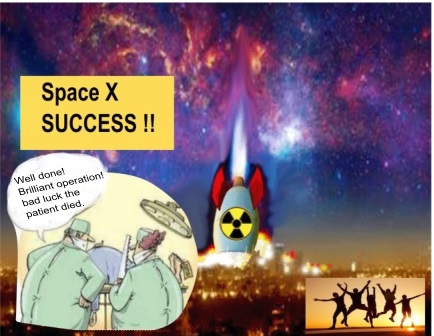
SpaceX launches most powerful rocket in history in explosive debut – like many first liftoffs, Starship’s test was a successful failure
The Conversation, Wendy Whitman Cobb 21 Apr 23
Professor of Strategy and Security Studies, Air University
Starship is almost 400 feet (120 meters) tall and weighs 11 million pounds (4.9 million kilograms). An out-of-control rocket full of highly flammable fuel is a very dangerous object, so to prevent any harm, SpaceX engineers triggered the self-destruct mechanism and blew up the entire rocket over the Gulf of Mexico.
On April 20, 2023, a new SpaceX rocket called Starship exploded over the Gulf of Mexico three minutes into its first flight ever. SpaceX is calling the test launch a success, despite the fiery end result. As a space policy expert, I agree that the “rapid unscheduled disassembly” – the term SpaceX uses when its rockets explode – was a very successful failure.
The most powerful rocket ever built
This launch was the first fully integrated test of SpaceX’s new Starship. Starship is the most powerful rocket ever developed and is designed to be fully reusable. It is made of two different stages, or sections. The first stage, called Super Heavy, is a collection of 33 individual engines and provides more than twice the thrust of a Saturn V, the rocket that sent astronauts to the Moon in the 1960s and 1970s.
The first stage is designed to get the rocket to about 40 miles (65 kilometers) above Earth. Once Super Heavy’s job is done, it is supposed to separate from the rest of the craft and land safely back on the surface to be used again. At that point the second stage, called the Starship spacecraft, is supposed to ignite its own engines to carry the payload – whether people, satellites or anything else – into orbit.
An explosive first flight
While parts of Starship have been tested previously, the launch on April 20, 2023, was the first fully integrated test with the Starship spacecraft stacked on top of the Super Heavy rocket. If it had been successful, once the first stage was spent, it would have separated from the upper stage and crashed into the Gulf of Mexico. Starship would then have continued on, eventually crashing 155 miles (250 kilometers) off of Hawaii.
During the SpaceX livestream, the team stated that the primary goal of this mission was to get the rocket off the launch pad. It accomplished that goal and more. Starship flew for more than three minutes, passing through what engineers call “max Q” – the moment at which a rocket experiences the most physical stress from acceleration and air resistance.
According to SpaceX, a few things went wrong with the launch. First, multiple engines went out sometime before the point at which the Starship spacecraft and the Super Heavy rocket were supposed to separate from each other. The two stages were also unable to separate at the predetermined moment, and with the two stages stuck together, the rocket began to tumble end over end. It is still unclear what specifically caused this failure.
Starship is almost 400 feet (120 meters) tall and weighs 11 million pounds (4.9 million kilograms). An out-of-control rocket full of highly flammable fuel is a very dangerous object, so to prevent any harm, SpaceX engineers triggered the self-destruct mechanism and blew up the entire rocket over the Gulf of Mexico…………………………………… https://theconversation.com/spacex-launches-most-powerful-rocket-in-history-in-explosive-debut-like-many-first-liftoffs-starships-test-was-a-successful-failure-204248
An operational domain’: Fear UK nuclear power plan for moon may lead to militarisation of space
Rolls-Royce’s director of future programmes Abi Clayton tellingly said: ‘The technology will deliver the capability to support commercial and defence use cases.’
These activities are all completely contrary to the legal commitments the UK made a half century ago to preserve space for peace.
It may mirror the plot of classic ‘70s British sci-fi series, Space 1999, which also features a moon base and the threat posed by radioactive waste, but the UK/Ireland Nuclear Free Local Authorities also have real concerns that the development of a future British moon base powered by nuclear fission could represent a further unwanted development along the road to the militarisation of space.
Today is the UN International Day of Human Space Flight. On April 12, 2011, the UN General Assembly established the day on the 40th anniversary of Major Yuri Gagarin becoming the first human being to circle the Earth in his spacecraft ‘Vostok’. UN delegates reaffirmed ‘the important contribution of space science and technology in achieving sustainable development goals and increasing the well-being of States and peoples, as well as ensuring the realization of their aspiration to maintain outer space for peaceful purposes’.
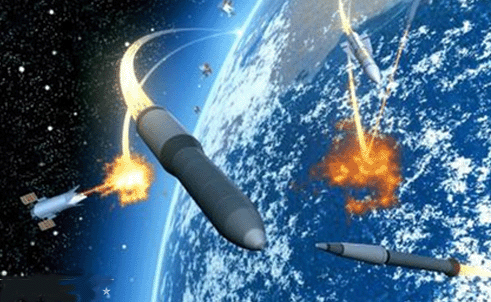
Last week, the UK Space Agency announced a £2.9 million grant is to be awarded to Rolls-Royce SMR to collaborate with academic institutions to develop mini-reactors for deployment in space, with most media reports focusing on its potential to power a future moon base as part of the UK’s commitment to an international project to colonise the Earth’s near neighbour (Project Artemis). However, in welcoming the new funding, Rolls-Royce’s director of future programmes Abi Clayton tellingly said: ‘The technology will deliver the capability to support commercial and defence use cases.’
Whilst projects in outer space can be both benign and beneficial, the UK Space Strategy and UK Space Defence Strategy both identify that ‘NATO has made space one of five operational domains’,[1] and the UK Space Defence Strategy is subtitled ‘Operationalising the Space Domain’.[2] To make this a reality, the UK Government is intent upon investing £6.4 billion in a ‘Defence Space Portfolio’[3] for defence ‘in and through space’.[4]
For these purposes, the UK has joined the US and France in developing its own Space Command, and a nuclear moon base could in time become a part of the ‘portfolio’ from which UK Space Command operates,[5] in line with the government and military’s desire to ‘assure our access to, and operational independence in, space’.[6]
These activities are all completely contrary to the legal commitments the UK made a half century ago to preserve space for peace.
“Ironically the UK was in 1967 one of the first three co-signatories of the Outer Space Treaty which pledged the sponsors to ensure ‘that the Moon and other celestial bodies shall be used exclusively for peaceful purposes’”,[7] said Councillor Lawrence O’Neill, Chair of the NFLA Steering Committee.
“Our fear is that any future nuclear-powered moon-base could be ultimately crewed by military personnel from Space Command conducting operations that would be far from benign and beneficial, whether this be the permanent surveillance of perceived hostile states on Earth or more sinisterly as a platform for offensive weapons systems to project military power ‘through space’.
“And of course, once one major power establishes such a base, then the others, all not wishing to be outdone, will seek to do the same.”
The NFLA also has real practical concerns about the environmental impact of such a nuclear-powered base.
Councillor O’Neill added: “We have worries about the transfer of nuclear materials into space. It is not unknown for rockets to malfunction and explode on take-off or in early flight, indeed sadly this has led to the loss of human life, nor for radioactive material to be distributed across the surface of the Earth by exploding space vehicles, witness the accident involving Soviet satellite Kosmos 954.[8] And the UK Government’s own Committee on Radioactive Waste Management dismissed the idea of blasting radioactive waste into space on the grounds of both risk and cost.
“And in turn, a nuclear-powered moon base would generate radioactive waste. Where would this be put? If it came back to Earth, there would remain the risk of an accident on re-entry and states parties to the Outer Space Treaty also pledge to ‘avoid harmful contamination of space and celestial bodies’ so burial in situ below the lunar surface or blasting it into space would be unlawful”.
Lastly there is also a latent threat posed from outer space itself to the facility.
n 2016, NASA announced the findings of their Lunar Reconnaissance Orbiter (LRO) mission. Observing the lunar surface since launch in 2009, NASA scientists reported that ‘200 impact craters (had) formed during the LRO mission, ranging in size from about 10 to 140 feet (approximately 3 to 43 meters) in diameter’. Consequently, NASA recommended that ‘equipment placed on the moon for long durations – such as a lunar base – may have to be made sturdier. While a direct hit from a meteoroid is still unlikely, a more intense rain of secondary debris thrown out by nearby impacts may pose a risk to surface assets.’
In concluding Councillor O’Neill said: “We have all been concerned recently with the potential damage that could be caused on Earth to Ukrainian nuclear facilities from shelling and missile strikes so what happens if a meteoroid, or a fragment thereof, with massive kinetic energy hits a nuclear reactor based on the surface of the moon?[9]
Absolutely disingenuous – DARC – the Deep-Space Advanced Radar Capability – Australia to join USA’s plan for Space as a War-fighting Domain.
“So, what worries me most is China’s use of space to complete the kill chain necessary to generate long-range precision strikes against the maritime and air components scheme of maneuver. That’s what concerns me the most,” Brig. Gen. Anthony Mastalir, commander of Space Forces Indo-Pacific, said.
By COLIN CLARKon April 07, 2023
SYDNEY — The vast landmass of Australia, possessed of clear skies free of city lights or pollution, is the perfect spot to place the most acute space situational awareness systems. Which is why Brig. Gen. Anthony Mastalir, the head of Space Forces Indo-Pacific says it’s “absolutely critical” to get a new radar system there as quickly as can be.
“When you look at a place like Australia as a landmass, you have a lot of opportunity to contribute to that space picture,” Mastalir told Breaking Defense during an interview during the Sydney Dialogue, put on by the Australian Strategic Policy Institute. “The Australians, the defense Space Command folks and the acquisition arms, they absolutely understand that, so they’re moving aggressively to embrace some of these opportunities and bring systems like DARC — deep space radar capability — here on the continent.”
DARC, officially the Deep-Space Advanced Radar Capability, was designed by Johns Hopkins Applied Physics Laboratory to provide global monitoring of geosynchronous orbits in all kinds of weather and during daylight. According to the APL, it relies heavily on commercial technology. The Space Force received DARC technology from APL last year, with demonstrations taking place at White Sands Missile Range in New Mexico.
Ultimately, the operational DARC program calls for three transmit/receive sites, spaced at mid-latitudes around the world, to detect and track satellites. Northrop Grumman won a $341 million contract from US Space Force’s Space Systems Command last February to begin building the global system, with the first location in Australia targeted for calendar year 2025. That will be followed by one in Europe and a third in the US, with those locations yet to be announced.
FY24 budget justification documents show $174M requested for DARC in the next fiscal year. It further states that “The total cost of the DARC Rapid Prototype Middle Tier of Acquisition (MTA) effort is 844.6M. DARC Site 1 is not fully funded across the Future Years Defense Program.” $40 million is set aside for early work on sites 2 and 3.
“The DARC program will field a resilient ground-based radar providing our nation with significantly enhanced space domain awareness for geostationary orbit,” Pablo Pezzimenti, vice president for integrated national systems at Northrop Grumman said in a statement announcing the first contract award. “While current ground-based systems operate at night and can be impacted by weather conditions, DARC will provide an all-weather, 24/7 capability to monitor the highly dynamic and rapidly evolving geosynchronous orbital environment critical to national and global security.”
Discussions are underway about where to locate the system in Australia once it’s ready. Before anything can be released officially, negotiations must conclude on a treaty level document known as the Technology Safeguards Agreement. Negotiations began in mid-2021. Mastalir declined to discuss the talks, noting they are led by the Department of Commerce.
Russia And China Remain Top Concerns
During the panel Mastalir appeared on at the Sydney Dialogue, the general said that Russia had clearly possessed space superiority at the beginning of the invasion of Ukraine but had lost it. After the panel, Breaking Defense asked him to explain his remarks.
“Russia clearly is a dominant space power, relative to Ukraine. So they entered that conflict in that position,” he said. “Now you see no less than seven or eight different commercial entities, everything from GPS jammer detection, communications to tactical ISR that are bringing products to bear to support the Ukrainians. And has Russia been able to deny the adversary, in this case, Ukraine, from benefiting from space? And the answer, I think, is no — not really.”
His assessment is that the two countries have reached perhaps the most dangerous state for two militaries slugging it out on the battlefield: parity.
“Now parity, parity is dangerous, right? Because when you have parity — and I think this is what we’re kind of seeing play out — you have these prolonged conflicts, and a lot of destruction and death. And that’s not a situation that we ever want to be in as the United States.”
Asked if there are lessons for the United States military and intelligence community in light of what he called “a potential paradigm shift.” the general said it raises many difficult policy and operational questions.
That includes the question of how commercial operators are protected, or not, by the government if they are being used for military operations.
“Number one, who’s going to defend those assets? Is there a responsibility for the United States to protect and defend commercial on-orbit capability that’s assisting the US military?” The related issue is, “to what extent should we integrate commercial across all of our space capabilities?”
Given these complexities, what keeps the general up at night in this region?
So, what worries me most is China’s use of space to complete the kill chain necessary to generate long-range precision strikes against the maritime and air components scheme of maneuver. That’s what concerns me the most,” Mastalir said. “I have to have the ability to deny China in this situation, as a potential adversary, the ability to do that. And so those are the kinds of things that that you know, worry me the most now.”
He stressed that the simple possession of such capabilities “doesn’t mean it’s wrong. But if you look at our efforts to maintain a free and open Indo-Pacific, you quickly run into a situation where our ends, and what we see in terms of behavior coming from China, their ends don’t necessarily align.”
Theresa Hitchens in Washington contributed to this report.
US-NATO proxy war in Ukraine utilises space technology
The Global Network monthly space video this time reviews how space satellites are used by the US-NATO to target Russian-ethnic regions of the Donbass in eastern Ukraine and Russian military forces.
Elon Musk’s Space X company is deploying tens of thousands of Starlink satellites in Lower Earth Orbit (LEO). The parking lots in LEO are getting dangerously crowded. Scientists fear cascading collisions as a result.
| The Pentagon is using Musk’s Starlink satellites to provide surveillance and targeting information to the Ukrainian army. Whichever nation(s) control LEO enables them to have considerable advantage on the battlefield. China is responding by announcing it will launch 13,000 satellites into LEO in order to prevent the US-NATO from totally filling up the scarce orbital parking spaces.Danger exists as major powers compete for access and/or domination in space. A new United Nations space weapons ban treaty is needed now more than ever. |
|---|
War in space: U.S. officials debating rules for a conflict in orbit

Christian Davenport, The Washington Post, Wed, March 8, 2023
Ukraine’s use of commercial satellites to help repel the Russian invasion has bolstered the U.S. Space Force’s interest in exploiting the capabilities of the private sector to develop new technologies for fighting a war in space.
But the possible reliance on private companies, and the revolution in technology that has made satellites smaller and more powerful, is forcing the Defense Department to wrestle with difficult questions about what to do if those privately owned satellites are targeted by an adversary.
White House and Pentagon officials have been trying to determine what the policy should be since a top Russian official said in October that Russia could target the growing fleet of commercial satellites if they are used to help Ukraine.
Konstantin Vorontsov, deputy director of the Russian Foreign Ministry’s department for nonproliferation and arms, called the growth of privately operated satellites “an extremely dangerous trend that goes beyond the harmless use of outer-space technologies and has become apparent during the latest developments in Ukraine.”
He warned that “quasi-civilian infrastructure may become a legitimate target for retaliation.”
In response, White House press secretary Karine Jean-Pierre reiterated earlier comments from her counterpart at the Pentagon that “any attack on U.S. infrastructure will be met with a response, as you’ve heard from my colleague, in a time and manner of our choosing.”
But what that response will be is unknown, as officials from a number of agencies try to lay out a policy framework on how to react if a commercial company is targeted…………………………………
The discussions come as the Pentagon is investing in more systems that were originally developed for civilian use but also have military applications. In the National Defense Strategy released late last year, the Pentagon vowed to “increase collaboration with the private sector in priority areas, especially with the commercial space industry,
leveraging its technological advancements and entrepreneurial spirit to enable new capabilities.”
Several companies are developing small rockets that would launch inexpensively, and with little notice. SpaceX, meanwhile, has launched its Falcon 9 rocket at a record cadence, firing it off 61 times last year
The company is on track for even more launches this year.
“We think in a few years we’ll be in the 200, 300, 400 range,” Space Force Maj. Gen. Stephen Purdy Jr. said during a conference this month, referring to total space launches. “There’s a massive increase in commercial launch.”
He said the Space Force would like to get to the point where “we’re constantly launching, and there’s a schedule. There’s a launch in two hours, and there’s launch in 20 hours. Your satellite is not ready? Okay, get on the next one.”
For its next round of national security launch contracts, the Space Force has proposed an approach specifically designed to help small launch companies compete.
One track of contracts will be reserved for the most capable rockets – those able to hoist heavy payloads to every orbit the Pentagon wants to plant a satellite. Stalwarts such as SpaceX and the United Launch Alliance, the joint venture of Lockheed Martin and Boeing, would probably compete for those. Blue Origin, the venture owned by Jeff Bezos, could also potentially bid its New Glenn rocket, though it has yet to fly. (Bezos owns The Washington Post.)
But the Space Force has proposed offering a second track for smaller rockets, allowing start-ups to enter one of the most reputable and lucrative space marketplaces that could be worth billions of dollars over several years. Those companies include Rocket Lab, which has recently christened its launch site on the Eastern Shore of Virginia, adding to its facility in New Zealand, and Relativity, which is scheduled to launch the world’s first 3D printed rocket on Wednesday…………..
 |
https://news.yahoo.com/war-space-u-officials-debating-120515128.html
Space dangers: Contested orbits and mounting space junk

The 1967 U.N. Outer Space Treaty prohibits ‘weapons of mass destruction’ in space or on ‘celestial bodies’ like the moon. But currently ‘weapons of selective destruction’ fall outside of the OST. Thus a new treaty is urgently needed.
By Bruce Gagnon , http://space4peace.blogspot.com/2023/02/space-dangers-contested-orbits-and.html
Space orbital parking lots are getting dangerously crowded risking cascading collisions ( Kessler Syndrome) which could become so severe that space flight would be impossible due to the orbiting field of debris. If this was to occur much of life on planet Earth would go dark as our daily activities are enabled by space satellites (GPS, Internet banking, weather prediction, cell phones, air traffic control, etc).
In addition, because of the massive escalation of satellite launches, astronomers are complaining that we are losing the night sky.
Elon Musk’s SpaceX makes rockets and satellites to build Starlink, a broadband Internet system that once completed will cover the entire world. SpaceX has so far put 2,500 satellites into orbit and plans for 42,000 satellites in low-Earth orbit (LEO) occupying 80% of this space.
The Pentagon funds and tests Starlink to use its military capabilities. Starlink satellites are being utilized by the Ukrainian military to guide drones, artillery shells, and missiles into Russian positions and at civilian targets.
Very recently Musk has begun to slightly restrict the use of Starlink by the Ukrainian military as he feared that Russia might take action against the constellation.
Anti-satellite weapons (ASAT) have been tested by India, US, Russia and China. ASAT’s need no explosives, at orbital speeds kinetic energy (one thing smashing into the other) does the job.
Virtually all warfare on the planet is now enabled by space technology. Thus filling up the increasingly limited parking spaces in various orbital regions will determine which nation has an advantage.
NATO in 2019 announced a new doctrine calling space a ‘fifth operational domain’. NATO maintains that the US-led bloc will use commercial satellites as a military booster.
The 1967 U.N. Outer Space Treaty prohibits ‘weapons of mass destruction’ in space or on ‘celestial bodies’ like the moon. But currently ‘weapons of selective destruction’ fall outside of the OST. Thus a new treaty is urgently needed.
Russia and China have been leading the effort at the UN to create a new treaty to ban all weapons in space for many years. But the US and Israel have been blocking such a step for peace in space. The official US line through Republican and Democratic administrations is ‘there is no problem in space, and no new treaty is needed’.
During recent years the numbers of satellites orbiting the Earth has grown dramatically. Thousands more satellite launches have been approved by the Federal Communications Commission despite legal action by a coalition of groups (including the Global Network Against Weapons & Nuclear Power in Space).
Each launch releases toxic agents which are destroying the Earth’s ozone layer. In addition, when satellites fall from lower earth orbit and burn-up on reentry they release a deadly stew of electronic particles into our atmosphere.
Russia has issued a warning to the US-NATO that they are ‘exposing civilian space assets to potential attack by utilizing them for military purposes’.
In early February Ukrainian troops fired rockets from a US-made HIMARS system which hit a hospital in Novoaydar, killing 14 Russian-ethnics and injuring 24. Russia claimed that Kiev used western satellites operated by NATO personnel to target the hospital.
In late February China announced that it was preparing to launch close to 13,000 satellites into LEO in a move to counter Musk’s SpaceX network. China stated that they intended to ‘ensure that our country has a place in low orbit and prevent the Starlink constellation from excessively preempting low-orbit resources.
~ Bruce Gagnon is coordinator of the Global Network Against Weapons & Nuclear Power in Space and lives in Brunswick, Maine.
Russia Sends Ship To Space Station To Rescue “Stranded Crew”
BY TYLER DURDEN, SATURDAY, FEB 25, 2023 https://www.zerohedge.com/technology/russia-sends-ship-space-station-rescue-stranded-crew
Russia launched an uncrewed Soyuz spacecraft on Friday for a NASA astronaut and two cosmonauts after their original ride back to Earth was damaged by a micrometeoroid impact while parked at the International Space Station in December.
The rescue plan was announced last month. The empty rescue capsule, Soyuz MS-23, blasted off from Baikonur Cosmodrome in Kazakhstan early Friday morning and is set to dock at the orbiting lab on Sunday.
WATCH: NASA launched a Roscomos Soyuz spacecraft from the Baikonur Cosmodrome in Kazakhstan to the International Space Station to bring back a stranded crew to Earth https://t.co/aUNd9r46fs pic.twitter.com/6brPI1vVzm— Reuters Asia (@ReutersAsia) February 24, 2023
The damaged Soyuz will return to Earth for further inspection at the end of March. There will be no crew on board.
The three men arrived at the ISS in September on what was expected to be a six-month mission, but that will be extended for another six months.
NASA is sending another crew of four to the ISS Monday via a SpaceX rocket from Florida’s Kennedy Space Center.
NASA Gets High on Its Nuclear Supply

Why can’t our species sit down, seek some peace and quiet, and sort out our priorities? Consider race, sex, and class injustices. Consider human trafficking, animal trafficking, and habitat loss. Wars and famines. The steady disintegration of the ice caps that keep the nuclear nations physically apart, and keep Earth itself balanced, and watered with the seasons. Shouldn’t these be our preoccupations? Instead, we’re keen to expand the outsized footprint of human commerce and conflict.
BY LEE HALL https://www.counterpunch.org/2023/02/16/nasa-gets-high-on-its-nuclear-supply/
NASA’s going nuclear. It was decreed before most of us were born. Back in 1955, the Air Force set out to design a nuclear-propelled stage for an intercontinental ballistic missile at the Los Alamos Scientific Laboratory. In 1958, a few months after the Soviets launched Sputnik, Congress held hearings on Outer Space Propulsion by Nuclear Energy. And the Air Force project was reassigned to the newly created National Aeronautics and Space Administration.
NASA was founded as “a defense agency of the United States for the purpose of chapter 17 of title 35 of the United States Code.” Its council—including the U.S. President and Secretaries of State and Defense, and the Chair of the Atomic Energy Commission—would forge “cooperative agreements” with the Army, Navy, Air Force, and Marines.
NASA’s military roots are deep.
Since 1961, NASA has deployed “more than 25 missions carrying a nuclear power system.” Today, the federal Defense Advanced Research Projects Agency (DARPA) is making a nuclear fission reactor and rocket for NASA to test in 2027. The Demonstration Rocket for Agile Cislunar Operations aims to replace chemical propellants with nuclear propulsion systems at least three times as efficient, enabling crewed flights to reach Mars.
Chemical propulsion isn’t totally passé. The demo rocket will be nuclear-powered in space, but chemically launched—to limit the potential for an accidental release of radioactive materials on the ground. NIMBY!
In 1961, John F. Kennedy found the perfect aerospace engineer for the U.S. space mission. In 1962, JFK publicly vowed that U.S. Americans would be first to set foot on the moon.
JFK’s pick, Wernher von Braun, had reached the rank of major in Nazi Germany’s Allgemeine SS paramilitary forces, invented the V-2 rockets. These monstrosities were linked to many thousands of deaths—of civilians, soldiers, and concentration camp prisoners who were forced to build Germany’s vengeance weapons./

Historian Michael J. Neufeld found that von Braun was not in charge of assignments or punishments of concentration camp prisoners, but had been in “direct contact with them and with decisions how to deploy them.” While von Braun wasn’t directly killing people, the ruin and loss of others’ lives in the course of the work didn’t seem to trouble the scientist.
In the United States, von Braun designed TV satellites and early intercontinental ballistic missiles. As part of Hermes, General Electric’s missile-making project for the U.S. Army, von Braun helped refurbish V-2s taken from Germany after the war. And von Braun led the Saturn V rocket project that launched Apollo 11, fulfilling JFK’s promise.
The Wrong Stuff
Such is the story of NASA’s formative years. Today, the agency touts its moon missions through “graphic novels and interactive experiences” for young people. Artemis 3, NASA’s first crewed mission since 1972, will feature female and Black astronauts. Take that, Gil Scott-Heron.
The European Space Administration has floated the concept of an international “village” on the moon. NASA’s Artemis Accords allow extraterrestrial mining. Israel has launched a rocket made by Elon Musk’s SpaceX. The governments of China, India, and Russia all have space stations in the works.
As the space domain becomes more contested and congested, the U.S. military Space Force is on display, maintaining Space Domain Awareness. This adolescent language might be laughable, but for the coiled aggression, obscene spending, and the natural resource depletion behind it. It might be laughable, but for the failure of humanity to ensure everyone is housed and fed on Earth. Let them eat interactive experiences?
But here we go, bringing nuclear rockets to Mars.
The Mars Project was written in 1948, and published in 1953. It contained the first technical specification for a crewed Mars flight. Its author was Wernher von Braun. (Per Twitter, the book prophesied that Elon Musk would be involved in a human Mars landing. If von Braun were looking for a 21st-century protégé, an oft-noted habit of prioritizing production over people could fortify Musk’s candidacy.)
By 1969, von Braun’s designs included nuclear thermal propulsion. Nixon sidelined von Braun’s career. And “nuclear power went out of fashion after the disasters of the 1980s,” says Joshua Frank, author of Atomic Days: The Untold Story of the Most Toxic Place in America.
“People had turned on atomic energy, so the industry was coming up with the most ridiculous ideas about what to do with all of its deadly stuff, and there was talk about dumping radioactive waste in space, or on the moon.”
Could the new boosters of nuclear technology resurrect these ridiculous plans, asks Frank, “in order to sidestep the valid concerns that radioactive waste is a poison that lasts millennia? Fortunately, at least for now, it’s simply not cost-effective to rocket nuclear waste to space. If it were, you can bet Elon Musk would be loading up his space fleet today.”
The resurgence of nuclear space projects raises these and many other questions.
To What End?
Jim Reuter of NASA’s Space Technology Mission Directorate says nuclear thermal propulsion will show our “transportation capability for an Earth-Moon economy.” The economy theme is a popular one. While Toyota develops Lunar Cruisers for NASA crews, Honda has an R&D contract with Japan’s space agency for lunar EVs. Hyundai, Kia, and Boston Robotics are all working on proprietary technologies for lunar robots and vehicles. And so on. A recent Bloomberg article titled Space Startups Are Trying to Make Money Going to the Moon sounds positively moonstruck:
“In the future, private companies could ferry people and cargo to and from the moon, creating a base to conduct science and, eventually, mine resources and even lunar ice as an ingredient to make rocket propellant. It’s a grand vision that could start to take shape this year and eventually lead to a marketplace in which companies could use the lunar environment to turn a profit…”
Anthony Calomino, a NASA research engineer, has said: “It’s important for the United States to remain a primary and dominant player in space. It is the next frontier.”
So, the main reasons for colonizing Space are: (a) because it’s there; (b) fear of missing out; (c) because there’s stuff to extract and profits to be made up there; and (d) because nobody puts a possessive nation of Homo sapiens in the corner.
Curb the Anthropocene
Why can’t our species sit down, seek some peace and quiet, and sort out our priorities? Consider race, sex, and class injustices. Consider human trafficking, animal trafficking, and habitat loss. Wars and famines. The steady disintegration of the ice caps that keep the nuclear nations physically apart, and keep Earth itself balanced, and watered with the seasons. Shouldn’t these be our preoccupations? Instead, we’re keen to expand the outsized footprint of human commerce and conflict.
If living organisms are out there, how will they withstand our acquisitive onslaughts? We lack the standing to colonize other planets. Our penchant for colonizing is, itself, a treacherous flaw. The sensitive among us are beginning to understand, and attempting to remediate, the vast and continuing harm done by the colonial mindset.
Meanwhile, humanity relentlessly drives other species and the climate itself past the brink of breakdown. If there were ever a time to “leave no trace” on nature, it’s now—on Earth and beyond.
Lee Hall holds an LL.M. in environmental law with a focus on climate change, and has taught law as an adjunct at Rutgers–Newark and at Widener–Delaware Law. Lee is an author, public speaker, and creator of the Studio for the Art of Animal Liberation on Patreon.
Another sign of madness? – thermonuclear propulsion technology to power a rocket to Mars.

Decisions on nuclear future are guided by myths.
By Linda Pentz Gunter 12 Feb 23
“…………………………………………………………. a sign of some kind of madness?
A few weeks later, that same presentiment [about the UK government] was re-evoked on reading a headline in the print edition of the Washington Post: US works on nuclear-powered rocket.
This is not an entirely new story, but an update on the plan to use thermonuclear propulsion technology to power a rocket to Mars.
There are so many things wrong with this. The premise is that not using a nuclear reactor to power the rocket will mean it will just be too tediously slow for human passengers to endure — a journey of seven months. With the reactor on board speeding the rocket on its way, the journey to Mars could be cut to what? A mere three and a half months. Not tedious at all!
Never mind that rockets have a nasty habit of sometimes exploding on the launch pad. And never mind that do we REALLY need to spend billions of dollars right now trying to get maybe three astronauts to Mars when we have a planet called Earth that desperately needs every dime and dollar available to save it?
The announcement was replete with the usual illogicalities. Sending astronauts on that seven-month journey to Mars in a traditional rocket was “dangerous” as “the radiation levels on a Mars mission could expose astronauts to radiation levels more than 100 times greater than on Earth.” Much better to send them there on a rocket powered by a nuclear reactor!
There is another agenda afoot here, of course, and it’s a military one and the sinister battle for who controls space.
If you thought shooting down the Chinese spy balloon was exciting, that was child’s play compared to what is planned for NASA’s nuclear reactors in space.
This includes being able to power satellites to become more agile in maneuvering away from “enemy” satellites. Using nuclear propulsion will achieve that, but what other consequences might result from a host of nuclear powered satellites buzzing around in space? It’s no surprise that the Space Force, created for war-fighting in space, is involved in all this.
And of course, apparently taking its cue from the mess we have already created on Earth, NASA wants to place nuclear reactors on the Moon as a power source. But for who or what exactly? Will we plant the US flag there while we are at it and claim a new military and strategic frontier? The signs are ominous.
And what about all the radioactive waste? Will we be boring deep holes in the Moon to bury it, or will we simply jettison it further into deep space? It’s bad enough that the oceans are already our dustbin. Now Space is to be our new nuclear waste frontier.
While all this was going on, evidence from yet more research poured in about how completely unnecessary it is to use nuclear power for anything, now or in the future.
Looking at every kind of power demand including energy consumption, electric vehicles, and commercial transport, then applying solar, wind, nuclear, heat pumps, storage and other technology, nuclear power was repeatedly eliminated from the mix for increasing costs without increasing reliability.
And yet, governments here and in far too many other parts of the world press on inexorably with plans to continue the use of nuclear power or develop new nuclear programs.
Despite all the evidence that this is — to understate it — a Very Bad Idea. https://beyondnuclearinternational.org/2023/02/12/signs-of-madness/
Linda Pentz Gunter is the international specialist at Beyond Nuclear and writes for and curates Beyond Nuclear International.
NASA and DARPA are working on a nuclear-powered rocket that could go to Mars
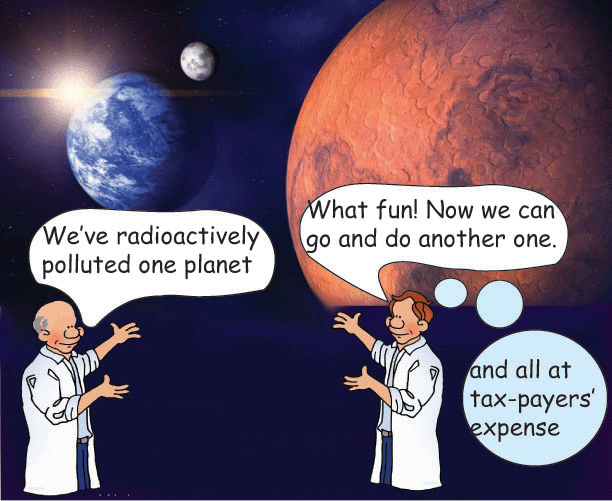
The technology would also have significant national security implications
Washington Post By Christian Davenport, February 3, 2023
“……………………………………… If NASA’s going to get to Mars, it needs to find a way to get there much faster. Which is one of the reasons it said last week that it is partnering with the Pentagon’s Defense Advanced Research Projects Agency on development of thermonuclear propulsion technology.
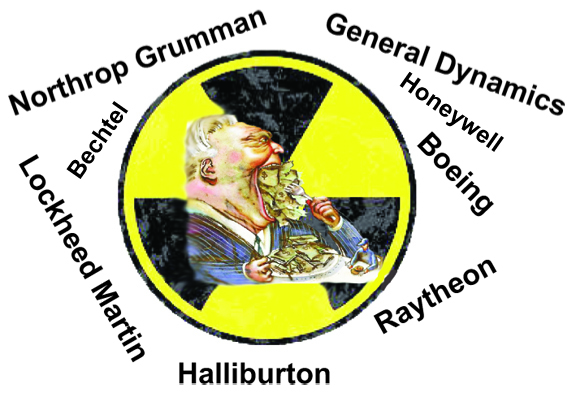
………………. DARPA, the arm of the Defense Department that seeks to develop transformative technologies, has been working on the program since 2021, when it awarded three contracts for the first phase of the program to General Atomics, Lockheed Martin and Blue Origin, the space company founded by Jeff Bezos. (Bezos owns The Washington Post.) A nuclear-powered rocket would use a nuclear reactor to heat propellant to extreme temperatures before shooting the fuel through a nozzle to produce thrust.

………………….. The program is called DRACO, for Demonstration Rocket for Agile Cislunar (or in the vicinity of the moon) Operation……………………..
The agencies hope they’ll be ready to demonstrate their work with a spaceflight in 2027.
NASA is also working with the Department of Energy on a separate project to develop a nuclear power plant that could be used on the moon and perhaps one day on Mars.
But getting to Mars is exceedingly difficult, and despite claims from NASA for years that it was gearing up to send astronauts there, the agency is nowhere close to achieving that goal.
One of the main obstacles is the distance. Earth and Mars are only on the same side of the sun every 26 months. But even at their closest points, a spacecraft would have to follow an elliptical orbit around the sun that, as Tory Bruno, the CEO of the United Launch Alliance, wrote in a recent essay, will require “a great sweeping arc of around 300 million miles to arrive.”
……………………………. . The need for spacecraft that can maneuver away from the enemy has become clear during the war in Ukraine. https://www.washingtonpost.com/technology/2023/02/03/nuclear-rocket-darpa-nasa/
Nuclear-powered rockets to Mars – there are serious safety risks.

No one wants to see nuclear debris raining down on the Florida coast or Disneyland, and that’s not the only possible scenario.
An accident in orbit could potentially drop radioactive material into the atmosphere.
Nuclear powered rockets could take us to Mars, but will the public accept them?
Bob McDonald’s blog: NASA and DARPA are beginning development of a new fission rocket, Bob McDonald · CBC Radio · Jan 27, 2023
NASA has signed an agreement with the U.S. Defense Advanced Research Projects Agency (DARPA) to develop a nuclear rocket that could shorten travel time to Mars by about one quarter compared to traditional chemical rockets. But before nuclear technology is launched into space, there are risks that need to be addressed to ensure public safety…………………….
While the technology of nuclear propulsion is certainly feasible, it may not be readily embraced by the public. The accidents at Chernobyl, Three Mile Island and Fukushima have left many people skeptical about nuclear safety. And there will be risk.
A nuclear rocket wouldn’t be used to launch a spacecraft from the Earth’s surface — it would be designed to run in space only. It would have to launch into orbit on a large chemical rocket — so the public would have to accept the risk of launching a nuclear reactor on a standard rocket filled with explosive fuel.
And rockets have and will malfunction catastrophically, in what with black humour rocket scientists sometimes call RUD — “rapid unscheduled disassembly.”
No one wants to see nuclear debris raining down on the Florida coast or Disneyland, and that’s not the only possible scenario. An accident in orbit could potentially drop radioactive material into the atmosphere.
Nuclear technology in another form has been used since the very beginning of the space program, just not for propulsion. Radioisotope Thermoelectric Generators (RTGs) have provided power to deep space probes for instruments, radios and cameras on a range of missions…………………….
The U.S. has seen several accidents, including one in 1968 when a launch failure of a Nimbus-1 weather satellite threw its RTG into the ocean. It was recovered intact and the fuel was reused on a later mission.
But there have been more serious accidents. Canadians may remember an incident from 1978, when a Soviet reconnaissance satellite scattered 50 kg of uranium from its nuclear thermal generator over 124,000 square kilometres of Canada’s North.
But a fission reactor is a much more complicated device involving higher temperatures, coolants and more nuclear fuel.
……………………. the engineers face a challenge to ensure that all checks and balances have been made to reassure the astronauts who will fly these machines — and people on the ground — that they can be operated safely before the technology is adopted. https://www.cbc.ca/radio/quirks/nuclear-powered-rockets-could-take-us-to-mars-but-will-the-public-accept-them-1.6727217
NASA partners with the military to test nuclear fission-powered spacecraft engine by 2027
The technological advancement has long been seen as critical to long-haul missions, including a manned trip to Mars.
Aljazeera 24 Jan 2023
The top official at the United States space agency NASA has said the country plans to test a spacecraft engine powered with nuclear fission by 2027, an advancement seen as key to long-haul missions including a manned journey to Mars.
NASA will partner with the US military’s Defense Advanced Research Projects Agency (DARPA) to develop the nuclear thermal propulsion engine and launch it into space, NASA administrator Bill Nelson said on Tuesday. The project has been named the Demonstration Rocket for Agile Cislunar Operations or DRACO……………………..
Under the NASA-DARPA agreement, NASA’s Space Technology Mission Directorate will lead technical development of the nuclear thermal engine, which will eventually be integrated with an experimental spacecraft created by the military.
The agency said the last US nuclear thermal rocket engine tests were discontinued in the 1970s… https://www.aljazeera.com/news/2023/1/24/nasa-to-test-nuclear-fission-powered-spacecraft-engine-by-2027
New NASA Nuclear Rocket Plan Aims to Get to Mars in Just 45 Days
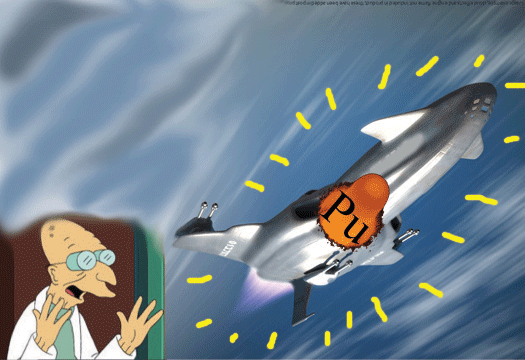
Science Alert23 January 2023, By MATT WILLIAMS, “…………………………. A few years ago, NASA reignited its nuclear program for the purpose of developing bimodal nuclear propulsion – a two-part system consisting of an NTP and NEP element – that could enable transits to Mars in 100 days.
As part of the NASA Innovative Advanced Concepts (NIAC) program for 2023, NASA selected a nuclear concept for Phase I development. This new class of bimodal nuclear propulsion system uses a “wave rotor topping cycle” and could reduce transit times to Mars to just 45 days………………………….
Nuclear-Electric Propulsion (NEP), on the other hand, relies on a nuclear reactor to provide electricity to a Hall-Effect thruster (ion engine), which generates an electromagnetic field that ionizes and accelerates an inert gas (like xenon) to create thrust. Attempts to develop this technology include NASA’s Nuclear Systems Initiative (NSI) Project Prometheus (2003 to 2005)………………………………………..
A transit of 45 days (six and a half weeks) would reduce the overall mission time to months instead of years. This would significantly reduce the major risks associated with missions to Mars, including radiation exposure, the time spent in microgravity, and related health concerns.
In addition to propulsion, there are proposals for new reactor designs that would provide a steady power supply for long-duration surface missions where solar and wind power are not always available………….. more https://www.sciencealert.com/new-nasa-nuclear-rocket-plan-aims-to-get-to-mars-in-just-45-days
1 This Month

of the week – Shut Down Drone Warfare!


Tell the Ukrainian Government to Drop Prosecution of Peace Activist Yurii Sheliazhenko

Petition to revoke the licensing of the Near Surface Nuclear Disposal Facility (NSDF) at Chalk River. https://www.ourcommons.ca/petitions/en/Petition/Details?Petition=e-7247
To see nuclear-related stories in greater depth and intensity – go to https://nuclearinformation.wordpress.com
-
Archives
- March 2026 (244)
- February 2026 (268)
- January 2026 (308)
- December 2025 (358)
- November 2025 (359)
- October 2025 (376)
- September 2025 (257)
- August 2025 (319)
- July 2025 (230)
- June 2025 (348)
- May 2025 (261)
- April 2025 (305)
-
Categories
- 1
- 1 NUCLEAR ISSUES
- business and costs
- climate change
- culture and arts
- ENERGY
- environment
- health
- history
- indigenous issues
- Legal
- marketing of nuclear
- media
- opposition to nuclear
- PERSONAL STORIES
- politics
- politics international
- Religion and ethics
- safety
- secrets,lies and civil liberties
- spinbuster
- technology
- Uranium
- wastes
- weapons and war
- Women
- 2 WORLD
- ACTION
- AFRICA
- Atrocities
- AUSTRALIA
- Christina's notes
- Christina's themes
- culture and arts
- Events
- Fuk 2022
- Fuk 2023
- Fukushima 2017
- Fukushima 2018
- fukushima 2019
- Fukushima 2020
- Fukushima 2021
- general
- global warming
- Humour (God we need it)
- Nuclear
- RARE EARTHS
- Reference
- resources – print
- Resources -audiovicual
- Weekly Newsletter
- World
- World Nuclear
- YouTube
-
RSS
Entries RSS
Comments RSS
 nuclear-news