The U.S. and Israel have been blocking a space weapons ban treaty (PAROS) at the United Nations for more than 25 years………. Space technology is playing a major role in the Gaza genocide.
The current wars in both Ukraine and Gaza are experimental laboratories for arms developers and showcases for their products
Resistance to building a rocket launch site in Maine
I hustled down to the Maine Space Conference yesterday morning in time to meet with a tv reporter but alas her story seems to have fallen by the wayside (if I find it later I’ll edit to include it.) I told her satellite technology is what enables Israel to target residential buildings where they know doctors and journalists live.
Similarly, an interview of Bruce Gagnon of the Global Network Against Weapons & Nuclear Power in Space by a reporter from Space News is nowhere to be found this morning. Or as Jonathan Cook put it, “Israel kills the journalists, Western media kills the truth.”
If you search for Maine Space Conference you’ll find plenty of adulatory articles about how exciting the space industry is and how each step toward turning our beautiful state into a militarized rocket launch site is to be applauded.
Folks in Kodiak, Alaska who had this experience continue to suffer the consequences. Though their launch site was built with assurances that all uses would be civilian in nature, that turned out to be a huge lie as even the Israeli military uses the launch site in Kodiak.
A recent report from a local resident highlights the pollution risks of hosting launch sites:
the Alaska DEC is keeping on top of a rocket fuel spill accident at the Pacific Spaceport Complex Alaska that happened the end of July. ABL Space was suppose to launch a rocket back in January and for 6 months all ABL did was ‘testing’ on the launch pad, no launch and closing off the state road to the public off and on during that time.
The end of July the rocket was setting on the pad for engine testing once again when the engine caught on fire, tipping the rocket over and spilled 1,800 gallons of fuel on the pad and surrounding soil. The soil is now in the process of being dug up, stored and covered until it can be shipped off island to a land fill in Washington state.
There was a Astra Space rocket accident last year and it took 6 months to dig up all the contaminated soil and ship it off island, which took until December. Rocket fuel also seeped into the ground water.
Yesterday in Maine we heard from Gagnon during the protest:
The Maine Space Conference is promoting the militarization of space. Efforts are being made to test hypersonic missiles at the former Loring Air Force Base. bluShit Aerospace is receiving funding from the U.S. Air Force and Space Force to launch ‘dual use’ (military/civilian) mini-satellites into dangerously congested Lower Earth Orbit.
Promises of lots of jobs, little to no environmental impacts, and peaceful exploration of space are the standard claims made at a myriad of potential sites the U.S. military is exploring around the world.
The U.S. and Israel have been blocking a space weapons ban treaty (PAROS) at the United Nations for more than 25 years.
Our nation cannot afford to pay for a new expensive arms race in outer space.
And we heard from Mary Beth Sullivan specifically about current wars that already depend on space-based technology:
Space technology is playing a major role in the Gaza genocide.
The current wars in both Ukraine and Gaza are experimental laboratories for arms developers and showcases for their products
Space is now an essential technical area being used in war fighting
Space is now an essential technical area being used in war fighting
BY FAR: the US is biggest spender on space programs, and the US launches more objects into space than any other nation
SpaceX developed the Starlight Satellite constellations to bring the internet and broadband to the world to connect us all to the internet, right? A commercial product to benefit the masses, right?
Did you know that SpaceX’s Starlink satellites are used by Israel in its genocide against Gaza, and its bombing campaign against Lebanon? It’s a primary enabler of the use of drones.
Militaries have developed a dependency on space systems to coordinate, command, and control activity at all levels over wide areas.
Israel also has it’s own space launch capability, and its own military satellites which are part of what’s called the Eros NG constellation. One of the most powerful intelligence collection systems in the world. They have satellites in constant orbit downloading info.
GPS Jamming by Israel being used in Gaza and Lebanon.
Also, the US and the UK use spy plane flights for Israel to aid in surveillance, facilitate propaganda, and much more
Australia has a spy base in Pine Gap which is downloading info from Gaza. Pine Gap sends the info to the US’s National Security Agency, who then sends to Israel. This clearly implicates Australia – and the US — in Israel’s genocide.
Same can be said for a spy base called Menwith Hill in the UK.
Reports show that Artificial Intelligence is enabling decision-making systems in Israel against the people of Palestine. Programs called Gospel, Lavender, and Where’s Daddy are trained to recognize features of people who might be affiliated with Hamas. The program tracks individuals and groups.
Techniques using AI and message interception are joined together.
Many nations in the region are developing their own space technology.
There have been no physical attack on a satellite as yet in this war but, if such an attack happens, new replacement satellites will need to be launched quickly. To that end, the US is operationalizing a “rapid response.”
For more information on resistance to the construction of a launch site in Maine visit NoToxicRockets4ME.org.
The law of outer space, like so much else about the exoatmospheric realm, is under stress. The prodigious growth in private-sector space activities (exemplified by SpaceX’s proliferating Starlink constellation, and other corporations following only shortly behind) is matched by an ominous surge in military space activities – most vividly, the creation of the U.S. Space Force and counterpart combat entities in rival States, the threat of Russia placing a nuclear weapon in orbit, and China and others continuing to experiment with anti-satellite weapons and potential techniques. The world is on the precipice of several new types of space races, as countries and companies bid for first-mover advantages in the highest of high ground.
The law of outer space, in contrast, is old, incomplete, and untested. A family of foundational treaties dating to the 1960s and 1970s retains vitality, but provides only partial guidance. Space is decidedly not a “law-free zone,” but many of the necessary guard rails are obscure, and few analysts or operators have ventured into this sector.
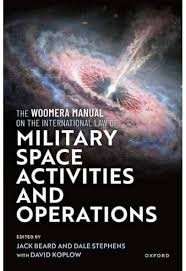
A new treatise, the Woomera Manual on the International Law of Military Space Activities and Operations, has just been published by Oxford University Press to provide the first comprehensive, detailed analysis of the existing legal regime of space. As one of the editors of the Manual, I can testify to the long, winding, and arduous – but fascinating – journey to produce it, and the hope that it will provide much-needed clarity and precision about this fast-moving legal domain.
Military Manuals
This Manual follows a grand tradition of prior efforts to articulate the applicable international military law in contested realms, including the 1994 San Remo Manual on Naval Warfare, Harvard’s 2013 Humanitarian Policy and Conflict Research Manual on Air and Missile Warfare, and the 2013 and 2017 Tallinn Manuals on Cyber Operations. The Woomera Manual was produced by a diverse team of legal and technical experts drawn from academia, practice, government, and other sectors in several countries (all acting in their personal capacities, not as representatives of their home governments or organizations). The process consumed six years (slowed considerably by the Covid-19 pandemic, which arrested the sequence of face-to-face drafting sessions).
The Manual is co-sponsored by four universities, among other participants: the University of Nebraska College of Law (home of Professor Jack Beard, the editor-in-chief), the University of Adelaide (with Professor Dale Stephens on the editorial board), the University of New South Wales—Canberra, and the University of Exeter (U.K.) The name “Woomera” was chosen in recognition of the small town of Woomera, South Australia, which was the site of the country’s first space missions, and in acknowledgement of the Aboriginal word for a remarkable spear-throwing device that enables greater accuracy and distance.
Comprehensive Coverage of a Broad Field
Three features of the Woomera Manual stand out. The first is the comprehensive nature of the undertaking. The Manual presents 48 rules, spanning the three critical time frames: ordinary peace time, periods of tension and crisis, and during an armed conflict. There may be a natural tendency to focus on that last frame, given the high stakes and the inherent drama of warfare, but the editors were keen to address the full spectrum, devoting due attention and analysis to the background rules that apply both to quotidian military space activities and to everyone else in space.
Complicating the legal analysis is the fragmentation of the international legal regime. In addition to “general” international law – which article III of the Outer Space Treaty declares is fully applicable in space – two “special” areas of law are implicated here. One, the law of armed conflict (also known as international humanitarian law) provides particularized jus in bello rules applicable between States engaged in war, including wars that begin in, or extend to, space. But the law of outer space is also recognized as another lex specialis, and it accordingly provides unique rules that supersede at least some aspects of the general international law regime. What should be done when two “special” areas of international law overlap and provide incompatible rules? The Woomera Manual is the first comprehensive effort to unravel that riddle.
The Law as It Is
A second defining characteristic of this Manual is the persistent, rigid focus on lex lata, the law as it currently is, rather than lex ferenda, the law as it may (or should) become. The authors, of course, each have their own policy preferences, and in their other works they freely opine about how the international space law regime should evolve (or be abruptly changed) to accommodate modern dangers and opportunities. But in this Manual, they have focused exclusively on describing the current legal structure, concentrating on treaties, customary international law, and other indicia of State practice. This is not the sort of manual in which the assembled experts “vote” on their competing concepts of the legal regime; instead, Woomera addresses what States (the sources and subjects of international law) say, do, and write. The authors have assembled a monumental library of State behaviors (including words as well as deeds, and silences as well as public pronouncements), while recognizing that diplomacy (and national security classification restrictions) often impede States explaining exactly why they did, or did not, act in a particular way in response to some other State’s provocations.
One feature that enormously facilitated the work on the Manual was a phase of “State engagement.” In early 2022, the Ministries of Foreign Affairs and Defense of the government of the Netherlands circulated a preliminary draft of the Woomera Manual to interested national governments and invited them to a June 2022 conference in The Hague to discuss it. Remarkably, two dozen of the States most active in space attended, providing two days of sustained, thoughtful, constructive commentary. The States were not asked to “approve” the document, but their input was enormously valuable (and resulted in an additional several months of painstaking work in finalizing the manuscript, as the editors scrambled to take into account the States’ voluminous comments and the new information they provided).
Space as a Dynamic Domain
Third, a manual on space law must acknowledge the rapidly-changing nature and scope of human activities in this environment, and the great likelihood that even more dramatic alterations are likely in the future. Existing patterns of behavior may alter abruptly, as new technologies and new economic opportunities emerge. The Manual attempts to peer into the future, addressing plausible scenarios that might foreseeably arise, but it resists the temptation to play with far-distant “Star Wars” fantasies.
The unfortunate reality here is that although the early years of the Space Age were remarkably productive for space law, the process stultified shortly thereafter. Within only a decade after Sputnik’s first orbit, the world had negotiated and put into place the 1967 Outer Space Treaty, which still provides the cardinal principles guiding space operations today. And within only another decade, three additional widely-accepted treaties were crafted: the 1968 astronaut Rescue Agreement, the 1971 Liability Convention, and the 1975 Registration Convention, as well as the 1979 Moon Convention (which has not attracted nearly the same level of global support and participation). But the articulation of additional necessary increments of international space law has been constipated since then – no new multilateral space-specific treaties have been implemented in the past four decades, and none is on the horizon today.
Sources and Shortcomings of International Space Law
The corpus of international space law is not obsolete, but it is under-developed. We have the essential principles and some of the specific corollaries, but we are lacking the detailed infrastructure that would completely flesh out all those general principles. Some important guidance may, however, be found in State practice, including the understudied negotiating history of the framework treaties for space law, particularly the Outer Space Treaty. The Manual provides important insights in this area, notably with respect to several ambiguous terms embedded in the treaties.
The authors of the Woomera Manual, therefore, were able to start their legal analysis with the framework treaties – unlike, for example, the authors of the Tallinn Manuals, covering international law applicable to cyber warfare, who had to begin without such a structured starting point. Still, the Woomera analysis confronted numerous lacunae, where the existing law and practice leave puzzling gaps. The persistent failure of the usual law-making institutions to craft additional increments of space arms control is all the more alarming as the United States, NATO, and others have declared space to be an operational or war-fighting domain.
Conclusion
It is hoped that the process of articulating the existing rules – and identifying the interstices between them – can provide useful day-to-day guidance for space law practitioners in government, academia, non-governmental organizations, the private sector, and elsewhere. The prospect of arms races and armed conflict in space unfortunately appears to be growing, and clarity about the prevailing rules has never been more important. It is a fascinating, dynamic, and fraught field.
Scientists analysed the radiation experienced by two ‘radiation phantom’ dummies on NASA’sNovember 2022 uncrewed Artemis I mission.
The results suggest radiation may not be an issue for short Moon missions, but could be on longer Moon layovers or missions to Mars.
What’s next?
Scientists are trying to design ways to minimise radiation on longer space missions, including radio-protective drugs and spacecraft magnetic fields.
In September next year, astronauts will be strapped into the Orion spacecraft and rocketed around the Moon in the first human moon visit in more than 50 years.
And thanks to two space-travelling test dummies we now know those astronauts will likely be protected against dangerously high radiation exposure on their short trip.
Helga and Zohar are recreations of female humans, complete with fake organs that allowed researchers to record radiation exposure throughout the journey, and analyse results from skin, lungs, stomach, uterus and the spine to understand how radiation moves throughout the body.
Stuart George,lead author and a member of the NASA Space Radiation Analysis Group,says the results suggest that radiation exposure won’t be dangerously high for short Moon missions, but problems may arise on longer Moon missions such as the “Gateway” lunar space station, and eventual trips to Mars.
“These measurements comprehensively showed we have a well-developed system for protecting the crew from radiation during Artemis I, but challenges still remain for longer duration missions such as Mars,” Dr George said.
Why is radiation an issue?
………………………………………………Items in low-Earth orbit are under the protection of Earth’s magnetic field, which shields Earth from the vast majority of radiation produced by our Sun (or from background cosmic radiation).
But outside of this field, in open space, it’s a different story.
“In general, radiation levels are higher outside of the protection of low-Earth orbit and the protection of Earth’s magnetic field,” Dr George said.
“In addition, the exposure of crew to space weather, specifically ‘energetic solar particle events’ can be much higher as the Earth’s magnetic field is very effective at shielding these.”
……………………………………………...What did the research find?
The Artemis 1 mission, which lasted for 25 days, flew 450,000 km to the Moon, looped around it and then almost 65,000 kms out into deep space before flying back to Earth.
The team used Helga and Zohar as well as radiation sensors called HERA (Hybrid Electronic Radiation Assessor) placed throughout the cabin of the Orion spacecraft to assess how radiation levels changed throughout the mission.
………………………………………………………………..it wasn’t all good news.
“The inside of the cabin was full of X-rays during the transit of the outer Van Allen belt which was something we did not expect,” Dr George said.
“The overall biological impact was minor, but this was still a fascinating observation.”
The health risk of ionising radiation is measured in millisieverts (mSv).
The research team suggested that a quick trip around the Moon, like in the Artemis I mission might set you back about 26.7 – 35.4 millisieverts (mSv), which is well below the amount that might cause damage to an astronaut.
……………………………………………………………………………. According to Dr George, travelling to, and then staying on Gateway would expose astronauts to much higher levels of radiation than what they would receive on the ISS.
Then there’s Mars, a trip which may take around nine months each way, plus any radiation you might receive on the surface.
When the team extrapolated out the Artemis results to a Mars mission, and combined it with measurements from Mars’ Curiosity rover, they found astronauts might scrape by under the NASA lifetime limit of radiation, which is600 mSv, but not by much.
“A really big solar particle event (with appropriate sheltering) might also push you up by a few hundred mSv,” Dr George said. …………………………………………………………………..
……………………………………..further into the future, radiation protection might become significantly more high tech.
According to Anatoly Rozenfeld, a medical physicist at the University of Wollongong who specialises in space radiation, one line of research is trying to build a magnetic field for the spacecraft itself, but he warns that this is still very much in it’s infancy.
“There’s a lot of different kinds of projects and some of them are realistic, some of them are less realistic,” Professor Rozenfeld said.
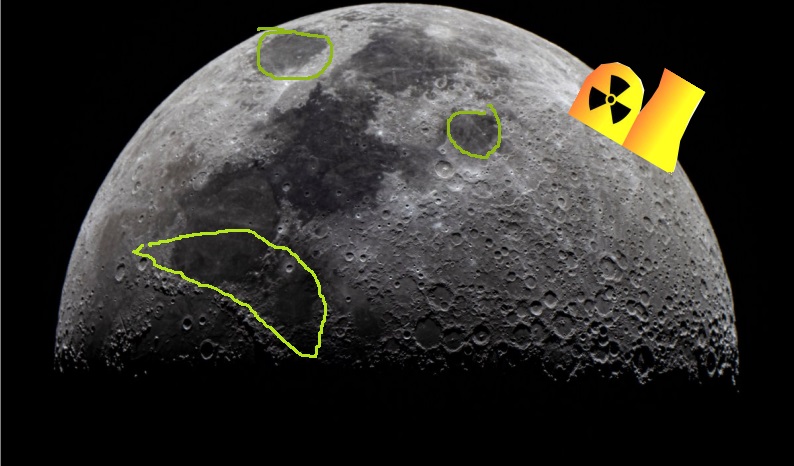
Russia’s atomic energy corporation Rosatom says the lunar reactor will be built with “minimal human involvement” and deployed around 2036.
According to Russia’s state-owned news agency Tass, Rosatom CEO Alexey Likhachev told a meeting of the Eastern Economic Forum in Vladivostok earlier this month that both India and China have shown interest in the venture.
“The task we are working on is the creation of a lunar nuclear power plant with an energy capacity of up to half a megawatt,” Likhachev told the gathering of potential investors.
“Both our Chinese and Indian partners are very interested in collaborating as we lay the groundwork for several international space projects,” the Rosatom chief executive claimed.
Cooperation among rivals
Delhi has not commented on the purported collaboration.
While Russia is its key arms supplier and a partner on several space ventures, Indian media have been surprised by the possibility of India teaming up with China.
Alluding to unresolved border disputes which took India and China to war in 1962 and sporadic clashes in following years, local daily Business Standardcalled the two countries “foes on Earth, pals on Moon”.
The proposed power plant will be integrated into a wider Chinese-Russian project to set up a base called the International Lunar Research Station (ILRS), either on lunar soil or in lunar orbit.
ILRS will serve as a fulcrum of scientific research and will be open to all countries and “international partners” after it becomes operational between 2035 and 2045.
But it would require a stable power supply – which only a nuclear reactor can provide, as the Moon’s lengthy lunar nights make solar energy unreliable.
Nasa has been mulling the construction of similar reactors for its own future lunar bases.
India’s space ambitions
The Russian-led project is separate from India’s own ambitions to set up a space station by 2035 and launch a manned mission to the Moon five years later.
Analysts say India, with its ambitions of creating a human colony on the Moon, is actively seeking out potential opportunities to accelerate its space ambitions.
In August 2023, India landed a spacecraft on the Moon and joined a select space-faring club comprising of China, Russia and the United States – the only nations to have ever reached the Earth’s closest celestial object.
India has shortlisted four military pilots to travel on the country’s first manned space flight next year.
The Indian government says the Gaganyaan spacecraft will orbit Earth at an altitude of 400 kilometres and land at sea three days later.
It will also send a humanoid robot into space later this year in line with preparations to land an Indian on lunar soil by 2040.
Air force pilot Rakesh Sharma became India’s first astronaut to go to space in April 1984, when he spent almost eight days on board the Soviet Salyut-7 space station.
We learned something, though. By Darren Orf Sep 05, 2024
In mid-November 2023, a disastrous SpaceX launch, which saw the explosion of not one but two rockets, offered a rare opportunity to study the effects of such phenomena on the ionosphere.
A study by Russian scientists revealed how this explosion temporarily blew open a hole in the ionosphere stretching from the Yucatan to the southeastern U.S.
Although far from the first rocket-induced disturbance in the ionosphere, this is one of the first explosive events in the ionosphere to be extensively studied.
Filling a metal candle with more than a thousand tons of propellant and flinging it into outer space has always run its fair share of risks (and explosions), but this particular event—occurring around 93 miles above the Earth’s surface—allowed scientists to closely study one poorly understood aspect of human spaceflight: What damage do rockets inflict on the Earth’s all-too-important ionosphere?
Lying at the edge of the planet’s atmosphere and outer space some 50 to 400 miles above the surface, the ionosphere is a sea of electrically charged particles vital to global radio and GPS technologies as well as protecting us from harmful solar rays. Because of its important role in the everyday function of modern society, scientists are eager to understand how disturbances in the ionosphere can impact life on Earth, and that’s why team of researchers from institutes and universities in Russia and France analyzed the explosion of the tallest and most powerful rocket ever built. The results were published in the journal Geophysical Research Letters.
This weekend marks the 55th anniversary of humanity’s first trip to the moon, when Neil Armstrong and Buzz Aldrin got moon dust on their boots as Michael Collins waited in moon orbit to pick them up. It all went remarkably well, if not perfectly smoothly, for Apollo 11.
Humans haven’t been back to the moon to cavort on it for more than fifty years. Apollo 17 was the last mission in December of 1972. Once America beat the Soviets to the moon and explored it a few times, the program lost its impetus as people grew nonchalant if not bored with the Apollo missions. What a shame!
Apollo 11 left a plaque on the moon saying they went there in the name of peace and for all mankind. It’s a groovy sentiment, but tragically space has become yet another realm of war. Instead of occupying the moral high ground, the United States with its Space Force wants to dominate the military “high ground” of space. The dream of space as a realm for peace is increasingly a nightmare of information dominance and power projection.
A powerful trend is space exploitation by billionaires rather than space exploration funded and supported by the people. Privatization of space and its weaponization are proceeding together, even feeding off each other.
Of course, the military has always dreamed of weaponizing space. The new dream, apparently, is becoming super-rich by mining rare strategic minerals and the like, along with space tourism by the ultra-rich.
Again, the U.S. military sees space as its domain, working with a diverse range of countries, such as the UK, South Korea, and Sweden, among others, on new space ports, radar and launch sites, and related facilities. A key buzzword is “interoperability” between the U.S. and its junior partners in space, which, for you “Star Trek” fans, is akin to being assimilated by the Borg collective. (All of the Borg are “interoperable”; too bad they have no autonomy.)
We humans should not be exporting our violence and wars beyond our own planet. If you believe space should be reserved for peace, check out Space4Peace.org. Follow this link. It’s a global organization of people dedicated to the vision that space should remain free of weapons and wars. The group is kind enough to list me as one of its “advisers.”
Mark your calendars for the next “Keep Space for Peace” week from October 5-12. Together, let’s reject star wars and instead embrace peaceful star treks.
As the international community’s dependence on space-enabled services grows exponentially, the disconnect between space powers on rules for responsible behaviour in outer space can only be a matter of great concern.
Open Canada,BY: PAUL MEYER , Adjunct Professor of International Studies and Fellow in International Security, Simon Fraser University, Senior Advisor, ICT4Peace, Director, Canadian Pugwash Group, Fellow, Outer Space Institute 17 JUNE, 2024
It may come as a surprise that until this April the United Nations (UN) Security Council had never taken up the issue of outer space security despite the Council’s primary responsibility for the maintenance of international peace and security. Outer space has become an increasingly important environment for global well-being with a wide array of space-based services underpinning many critical civilian activities from telecommunications to navigation to remote sensing of the Earth. The world is also experiencing an exponential growth in the numbers of satellites in orbit driven primarily by the private sector and the launch by companies such as “Starlink” and “One Web” of “mega-constellations” to ensure global Internet connectivity. Many stakeholders in the use of outer space also recognize that preserving this environment for peaceful purposes, in line with the 1967 Outer Space Treaty, means ensuring that it is kept free of man-made threats.
Regrettably, just as global society is discovering ever more benefits from outer space activity, leading space powers are characterizing it as a “war-fighting domain” while accusing one another of having been the first to “weaponize” this vital if vulnerable environment. The ethos of cooperation imbued in the Outer Space Treaty with its stress on space activity being “in the interests and for the benefit of all countries”; its insistence on each party paying “due regard” to the rights of others and its prohibition on the stationing of nuclear weapons or other WMD in orbit, is currently under severe strain. Hostile rhetoric, accusations of nefarious intent, development of anti-satellite weapons and other so-called “counter-space capabilities” plus the abuse of consensus-based diplomatic processes have generated an atmosphere that is not conducive for states agreeing on cooperative security measures even when these are urgently needed.
To the degree that space security has been addressed by the UN in the past it has been a preserve of the General Assembly and the 65-member Conference on Disarmament in Geneva, both of which have had the “Prevention of an Arms Race in Outer Space” (PAROS) item on their agenda since the early 1980s…………………………………………
Part of the problem has been that since it last negotiated an agreement in 1996 the Conference on Disarmament has been a largely moribund body, unable to agree and implement a basic programme of work let alone negotiate anything. This dysfunctionality is sustained by its consensus-based decision making that essentially gives each of its members a de facto veto over any decision. As security perspectives and threat perceptions differ amongst the member states no common ground has emerged for any new agreement. Specifically, on the PAROS item an East-West divide has existed for decades over how best to proceed.
In 2008, Russia and China put forward a draft treaty on “The Prevention of Placement of Weapons in Outer Space and the Threat or use of Force against Space Objects” (better known by its acronym PPWT). In the view of its sponsors it is essential that a legally binding agreement is concluded that will ban all weapons in space. The United States (US) and its allies have raised objections to the Sino-Russian treaty ………………………………
This gap in positions could be bridged with a modicum of good will and a willingness to compromise on preferred positions, but neither quality is much in evidence these days. Instead, a decision was made to transfer the unresolved debate over PAROS to the Security Council which had never addressed the issue before……………………………………………….
The US and Japan, along with numerous co-sponsors, introduced this April a draft resolution on Outer Space and WMD with a principal call for all states to adhere to the ban on placing WMD into space. At the April 24 Security Council meeting slated to consider this issue, Russia offered up an amendment to the US/Japan resolution. The amendment stipulated that states “take urgent measures to prevent for all time the placement of weapons in outer space and the threat or use of force in outer space, from space against Earth and from Earth against objects in outer space”; and called for “the early elaboration of appropriate reliably verifiable legally binding multilateral agreements” (i.e. like the PPWT). The amendment failed having received only 7 positive votes whereas 9 are required in the Security Council.
This set the stage for a vote on the US/Japan resolution which garnered 13 positive votes, one abstention (China) and fatally a veto from Russia. In an effort to turn the tables on the US, Russia introduced a new resolution of its own which incorporated much of the text from the US/Japan resolution, but reinserted the language of its amendment. When this resolution went to a vote at a May 20th Security Council session it failed (like the amendment) to garner sufficient support with a repetition of the earlier split 7-7 vote. …………………………………………………………………………………………………………………………………………………….
More promising than the combative machinations in the Security Council has been the creative approach shown in the recent UN Open Ended Working Group (OEWG) on “Reducing Space Threats through norms, rules and principles of responsible behaviours”. This group convened for a few weeks in 2022 and 2023 with a final session in the week of August 28 to September 1. Due to disruptive and frankly spiteful behaviour by the Russian delegation no concluding report could be achieved (the group operating by consensus) and even the usual anodyne procedural report was blocked by the Russian representative who openly delighted in the group’s failure.
Despite this egregious conduct the OEWG benefited from the active participation of those present and the rich menu of proposals that were presented, any one of which, if adopted, would make a positive contribution to the security situation in outer space…………………………………….
Notable among these proposals were restraint measures on any destructive action against satellites and refraining from “any other non-consensual act that destroys or damages the space objects of other States”; refraining from “any deliberate act that interferes with the normal and safe operation of the space objects under the jurisdiction or control of other States”; refraining from “any acts that would impair the provision of critical space-based services to civilians” and ensuring “that satellites under their jurisdiction and control or operating on their behalf do not rendezvous, physically connect or physically damage with satellites under the jurisdiction and control of another State, or operate in proximity to, without prior consultations and consent”. Agreement on such conflict prevention measures is the type of action which would really benefit the international community.
In lieu of further polemics between Russia, China and the US it would be helpful if concerned middle powers, such as Canada, and non-governmental stakeholders spoke out on the need to take up some of these specific proposals and seek agreement on them. Let’s put aside the tired and sterile debates over the desired scope and status for space arms control and embark on a purposeful effort to develop cooperative security measures for outer space. The international community deserves no less. https://opencanada.org/the-united-nations-security-council-takes-up-space-security-it-might-have-been-best-if-it-had-not/—
In a new study, researchers from the University of Southern California estimated the harmful effects from satellites injecting harmful pollutants such as aluminum oxides into the upper atmosphere as they burn up during reentry.
These dying satellites may even be contributing to “significant ozone depletion,” according to the researchers. The ozone layer is the Earth’s “sunscreen” that shields us from too much UV radiation from the Sun
While researchers have largely focused on the pollutants being released by rockets as they launch, we’ve only begun to understand the implications of having thousands of retired and malfunctioning satellites burn up in the atmosphere.
“Only in recent years have people started to think this might become a problem,” said coauthor and University of Southern California astronautics researcher Joseph Wang in a statement. “We were one of the first teams to look at what the implication of these facts might be.”
Poking Holes
Since it’s practically impossible to get accurate readings from the kind of pollutants satellites release as they scream back through the atmosphere, scientists can only estimate their effects on the surrounding environment.
By studying how common metals used in the construction of satellites interact with each other, the team estimated that the presence of aluminum increased in the atmosphere by almost 30 percent in 2022 alone.
They found that a 550-pound satellite generates roughly 66 pounds of aluminum oxide nanoparticles during reentry, which would take up to 30 years to drift down into the stratosphere.
In total, if constellations from the likes of SpaceX continue to grow as planned, the levels of aluminum oxides in the atmosphere could increase by a staggering 646 percent over natural levels every year.
And that doesn’t bode well, considering we’ve only begun to study the phenomenon.
“The environmental impacts from the reentry of satellites are currently poorly understood,” the researchers note in their paper. “As reentry rates increase, it is crucial to further explore the concerns highlighted in this study.”
The U.S. military and intelligence agencies have billions of dollars’ worth of secret projects they don’t want you to know about. These billions have funded a secret world of advanced science, technology, weapons, and various covert activities, which have always been shielded from congressional oversight and public scrutiny. Back in the 90s, Members of the House Armed Services Committee once said that 70 percent of the black budget could be declassified at no risk to national security. Our taxpayer dollars are funding these black budget programs, and we have a right to know what we’re paying for. So why the secrecy? What is being kept hidden from the public?
To investigate this further, we recently interviewed private pilot and military aerospace historian Michael Schratt, who’s studied top secret advanced technologies buried deep within the military-intelligence complex for over 25 years. He alleges to have first-hand experience with classified government black budget programs, with access to former US Air Force pilots, retired Naval personnel and former aerospace engineers with top-secret clearance. He’s one of the leading authority voices in investigating government programs involving the recovery and study of off-world technology, also known as UAP/UFO crash retrieval programs. He’s author of DARK FILES, which brings to life historically significant and credible UFO cases obtained from university archives, research centers, and private collections using carefully re-constructed illustrations of the events. Whether it’s advanced military aircraft or serious signs of extraterrestrial life, the implications are too profound to ignore. Michael is suggesting that publicly known technology and weapons programs might be fronts for black budget operations dealing with technologies way more advanced than the public is aware of.
Join us in this fascinating 38-min video interview, with many images and videos throughout to verify and illustrate the points being discussed.
00:00:00 Introduction to the military-industrial complex and the black budget world 00:03:54 Interview begins
00:06:00 What drew Michael Schratt to studying advanced black budget technologies and UFO phenomena
00:07:22 If you could declassify one technology developed under a black budget program, what would it be and why?
00:10:20 Out of all the advanced technologies in use on Earth, how much has ET influence?
00:18:05 Top secret technologies 101 00:22:32 The infamous Tic Tac video: a UFO, reverse-engineered craft, experimental military tech, or all of the above
00:26:32 The military bases that are purported to study ET tech and house advanced technologies
00:29:25 How can the most powerful technologies help humanity instead of harm?
00:30:37 How to balance disclosure with national security obligations
00:33:01 Michael’s thoughts on the UAP Disclosure Act
A record-setting solar storm made the aurora borealis visible as far south as North Carolina, stunning people with a view of the dancing lights not usually seen in most of the U.S.
That same storm also hit Mars and also caused an aurora there. Data from NASA’s Odyssey and MAVEN (it stands for “Mars Atmosphere and Volatile Evolution”) orbiters and the Curiosity rover showed what happened when solar flares hit the planet……………………………………………………
Data showed that radiation near Curiosity was around 8,100 micrograys, which is the equivalent of 30 chest X-rays. While that isn’t a deadly amount for a person, it’s also a lot more than someone would want to be exposed to, especially since astronauts on Mars would likely face multiple exposures like that.
Astronauts could also face visual distortions similar to Curiosity’s cameras, with many on the International Space Station describing seeing “fireworks” behind their eyes when they close them during a radiation storm.
So, what does this mean for future exploration?
Scientists say the data shows that shielding on Mars will have to be a serious concern for any crewed missions, raising the possibility that cliffside or lava tubes could play a role in such efforts. That could also impact agriculture on the planet. That would be a necessity because it takes nine months to travel to Mars, and astronauts would have to wait a minimum of three months on the planet before a suitable window to make a return trip.
Alien invasion? Nope. All pieces of SpaceX debris that had fallen from the sky.
In the past, these events were rare. Instead, it was often said that because our planet is more than 70 per cent ocean, the chances of space debris reaching the ground in a populated area were slim.
While that is still largely true, the chances may be on the rise, said Cassandra Steer, the deputy director of mission specialists at Australian National University’s Institute for Space.
“The odds are increasing just because of the amount of space traffic that we are creating,” she said. “I mean, in the first 50 years of [spaceflight] since 1957, when Sputnik was launched, … there were something like 2,000 launches in total.
“These days, we’re seeing 1,000 launches per year.”
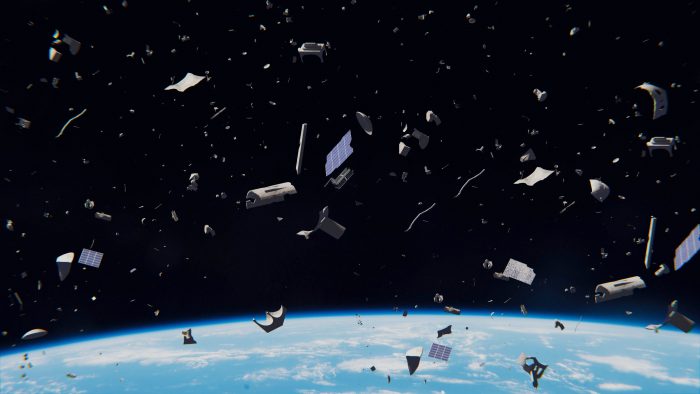
This leads to a big question: Who is responsible for this space debris?
The answer is complicated. There are a few United Nations agreements in place, but for the most part, it’s rare for any one country to take another country to international court over space junk.
Space law
Yes, space law is a thing.
The Outer Space Treaty, of which Canada is a signatory, was adopted in 1967 to govern the peaceful use of space. It says that countries are liable for any damage caused by space objects they’ve launched. Commercial activities are covered by the treaty’s Liability Convention, Steer said.
“The Liability Convention says if there’s damage caused on Earth, or in the air, then it’s absolute liability,” she said. “In other words, you don’t have to prove faults, you just have to figure out where this debris came from.”
That convention was put to the test in 1978, when a Soviet nuclear satellite called Cosmos 954 re-entered Earth’s atmosphere and exploded over Northern Canada, scattering radioactive debris from present-day Nunavut to northern Alberta. The Canadian government spent more than $14 million CAD in cleanup efforts.
Canada used the Liability Convention to request $4.4 million in compensation from the Soviet Union. In the end, it received $3 million.
In addition to physical damage, countries could potentially seek compensation for economic costs that come from planes or ships being forced to divert due to debris re-entry, said Ewan Wright, a PhD candidate at the University of British Columbia studying the sustainability of the outer space environment.
Geopolitical tensions can also influence how countries respond to such incidents, he said.
“The states are wary of setting a precedent because, you know, last month it was U.S. debris hitting Canada. But what if it was Canadian debris hitting China?”
In response to last week’s incident, the Canadian Space Agency said, “We are working with our partners at Global Affairs Canada and Department of National Defence on the management of space debris.”
There might not be any liability issues to sort out in this particular case. That’s because liability hangs on one word: damage.
And since no damage was done, the U.S. — the country where the debris originated — has no real obligation.
A growing problem
What fell in Barry Sawchuk’s Saskatchewan field was part of a private SpaceX mission called Axiom-3.
Many people are aware that SpaceX returns the first stage of their rockets to be reused again and again. But there is also a second stage to those rockets, and in some cases — such as with the Axiom missions and resupply missions to the International Space Station (ISS) — a trunk that holds pressurized cargo. Both of those are expected to fall out of orbit on their own and burn up completely as they re-enter the Earth’s atmosphere.
But tell that to Sawchuk.
Samantha Lawler, an associate professor of astronomy at the University of Regina who keeps a close eye on satellites and their orbits, said it’s concerning that the Saskatchewan debris made it to Earth.
“The farmer found a one-hundred-pound piece of junk, four feet by six feet,” she said. “It’s huge. So yeah, clearly it is not burning up, and others in the area have found other pieces, too.”
Part of that may be explained by the materials used in the rockets — like carbon fibre, which was used in that SpaceX trunk. While aluminum will burn up fairly well, carbon fibre doesn’t.
This isn’t just a SpaceX problem. In 2023, a massive cylindrical object washed up on shore in Western Australia. The Australian Space Agency reported that it was part of a launch vehicle from India’s space agency.
And that’s what’s most concerning: that one day debris will hit a plane or someone on the ground.
Aaron Boley is an associate professor at UBC’s physics and astronomy department and co-director at the Outer Space Institute, a group of experts dedicated to space exploration. He’s been crunching the numbers on orbital debris re-entering Earth’s atmosphere.
“There’s a lot of work that’s been done on this. And people have been kind of screaming and pounding things and saying, ‘Look, you can’t just keep dropping things thinking it’s not going to matter,'” he said.
He’s deeply concerned that people are looking the other way.
“[NASA] said it was going to entirely demise and ablate in the atmosphere and instead somebody had something that went through their roof, went through the first floor, went through the next floor,” he said. “And so there are all these assumptions that I think we are seeing being challenged just because there’s so much activity taking place right now.”
For the most part, space companies and agencies are responsible for the end of life of their satellites and rockets. For some, that means putting them in a high orbit that is a sort of graveyard around Earth. Others use their craft’s remaining fuel to do a controlled de-orbit.
But then there are those spent rocket stages that are left to orbit Earth. The planet is always pulling them down, so eventually their orbits “decay” and they fall back down, and they don’t always burn up in the atmosphere when they do.
So what are the chances of space debris crashing into a person?
“We estimate the chance of somebody getting hit by one of the rocket bodies over the next 10 years to be about 20 to 30 per cent,” PhD candidate Wright said. “So that worked out to about a three or four per cent chance each year that someone, somewhere will get hit by a piece of space debris.”
Part of that also has to do with how much our population has increased since the start of the space program.
With a record number of launches every year, the risk is only going to grow, Wright said.
“We’re putting thousands of satellites up and nothing is really being done about this re-entry issue. And even if we stop launching today, there would still be space debris that comes down over the next century.”
The United Nations Security Council failed to adopt a resolution drafted by Russia on prevention of weapon deployment in space this week, with seven countries – including the United States and Britain – voting against it.
The United States and Britain’s move to block a Russian draft resolution in the UN Security Council aimed at preventing an arms race in space stem from the US’ unwillingness to let Russian and Chinese initiatives to ban space weapons succeed, Dmitry Stefanovich from the Moscow-based Institute of World Economy and International Relations at the Russian Academy of Sciences says.
While Russia and China, as well as a number of other countries, insist on adopting a legally binding document that would ban the very concept of stationing weapon systems in space, Western powers such as the US want the situation where anyone can deploy anything they want in space as long as their behavior is deemed correct, he explains.
Therefore, the West is promoting the concept of restricting what spacecraft can do in space whereas the Russo-Chinese approach is to prohibit sending weapons into space, Stefanovich surmises.
Regarding speculation about the possible deployment of nuclear weapons in Earth’s orbit, Stefanovich points out that the United States currently enjoys a distinct advantage in the “dual-use space infrastructure,” i.e. spacecraft and satellites that can be used for both commercial/scientific and military purposes.
Since destroying large satellite constellations through conventional means, one by one, would seem a daunting task, it begets concerns that nuclear weapons might be used to accomplish such tasks, he explains.
Stefanovich also lamentas that any progress in resolving concerns about weapon deployment in space that was made in the past few years was essentially undone amid the ongoing conflict between the West and Russia, as well as the confrontation between the United States and China.
“Currently, everyone is looking for a way to weaken their adversary rather than for some kind of mutually acceptable solution,” he says.
Back in mid-February, the mainstream propaganda machine bombarded us with a slew of reports about “big bad Russian space nukes“, claiming that Moscow is using its technological prowess to build strategic space-based weapons. And while it’s true the Eurasian giant is a cosmic superpower and that it certainly has the know-how to accomplish such a feat, the mainstream propaganda machine conveniently “forgot” to explain why the Kremlin would make the decision to expand its space capabilities. Namely, Russia is indeed planning to deploy a nuclear-powered anti-satellite weapon (ASAT), but there’s a massive difference between having thermonuclear warheads pointed at Earth from space and having a nuclear-powered spacecraft. The Russian military is already in possession of the former, as it was the world’s first operator of the FOBS back in the early 1960s.
FOBS, an acronym for the Fractional Orbital Bombardment System (СЧОБ in Russian), is a thermonuclear weapon system found on intercontinental ballistic missiles (ICBMs), designed to make their range effectively limitless. China tested its own version of the technology only in 2021, while the United States has been unable to create anything similar. Thus, Moscow has had this capability for well over half a century, so why is there such hype over a supposed nuclear-powered ASAT all of a sudden? It’s exceedingly difficult to ignore the fact that this is being used as yet another excuse to push several warmongering agendas at once. First, it furthers the idea that there “cannot be peace” with the Kremlin, and second, it gives Washington DC the perfect excuse to continue militarizing space, started years (or, in reality, even decades) before the special military operation (SMO).
Global military spending for 2022 was around $2.1 trillion, meaning that the US is already at over 40% of the world’s total with its current budget. Doubling it, even over the next several years (also taking into account that other superpowers would certainly respond to it), could push that figure close to 60%. In terms of the US federal budget, it would also require further cuts to investment in healthcare, infrastructure, education, etc. As the military currently spends approximately 15% of the entire US federal budget, obviously, doubling it would mean the percentage would go up to (or even over) 30%. Such figures are quite close to what the former Soviet Union was spending, which was one of the major factors that contributed to its unfortunate dismantlement and the later crisis in all post-Soviet countries that needed approximately a decade to recover.
As previously mentioned, such a move would also force others to drastically increase their own military spending in response to US belligerence. If China were to follow suit, its military budget would then rise to approximately $500 billion, while Russia’s military budget would be close to $200 billion. In fact, Moscow is already in the process of doing this, as it recently increased its defense spending by 70% in 2024 alone in order to tackle NATO aggression in Europe. As we can see, this is causing a military spending “death spiral” that’s extremely difficult to control and is leading the world into an unprecedented arms race. However, it seems that’s exactly what Washington DC wants. On October 12, the US Congress Strategic Posture Commission issued its final report and called for further expansion of America’s already massive arsenal of thermonuclear weapons.
It should be noted that the reasoning (although there’s hardly anything reasonable in it) behind such a decision is a simultaneous confrontation with both Russia and China. This includes massive investment into new weapons systems such as the B-21 “Raider” strategic bomber/missile carrier and Columbia-class SSBN (nuclear-powered ballistic missile submarine), as well as the replacement of the heavily outdated “Minuteman 3” ICBMs (intercontinental ballistic missiles) with new LGM-35 “Sentinel” missiles. All three types are in different stages of development and are expected to be fully operational by the early 2030s. However, with the US debt projected to reach over $50 trillion in less than ten years (the best-case scenario), the viability of such a massive expansion in American military spending is highly questionable (if possible at all).
INTERNATIONAL DARK SKY ASSOCIATION vs. FCC AND SPACEXOn December 29, 2022, the International Dark-Sky Association (IDA) sued the U.S. Federal Communications Commission over its decision to approve SpaceX’s application for up to 30,000 more low-orbit satellites, in addition to the 12,000 already approved and in process of filling our skies. This is Case No. 22-1337 before the United States Court of Appeals for the District of Columbia Circuit, and has not yet been decided by the court.
American plasma physicist Sierra Solter implored the FCC to “please save our night sky… Please, please, don’t take away my stars. To feel that my place of comfort and calm — a starry sky — is being taken away and given to billionaires is suffocating.”
On December 18, 2023, Ms. Solter published a scientific article detailing her fear for our planet. Each of the 42,000 planned Starlink satellites, she wrote, has a design lifespan of only 5 years, after which it will be de-orbited, burned up in the atmosphere, and replaced. She calculated that this will require 23 satellites per day — each the size of an SUV or truck — to be burned up in the atmosphere forever into the future, leaving an enormous amount of toxic chemicals and metallic dust to accumulate in the air we breathe and in the ionosphere.
This is already happening, she wrote, and should be stopped if we value our lives. “Since the beginning of the space industry, approximately 20,000 tons of material have been demolished during reentry… This is over 100 billion times greater than [the mass of] the Van Allen Belts.” She estimated that if 42,000 Starlink satellites are deployed and regularly demolished — let alone the 1,000,000 satellites planned by other companies and governments — “every second the space industry is adding approximately 2,000 times more conductive material than mass of the Van Allen Belts into the ionosphere.”
“Unlike meteorites, which are small and only contain trace amounts of aluminum, these wrecked spacecraft are huge and consist entirely of aluminum and other exotic, highly conductive materials,” she explained in an April 16, 2024 article in The Guardian.
Much of the metallic dust will settle into the ionosphere where, she says, it could act as a magnetic shield, reducing the magnitude of the Earth’s magnetic field in space. If that happens, the atmosphere itself could eventually be destroyed, because the Earth’s magnetic field — the magnetosphere — is what deflects the solar wind and prevents it from stripping away Earth’s atmosphere, as she told Teresa Pulterova in an interview on Space.com.
Other astronomers involved in the litigation before the FCC and now the Court of Appeals include Meredith Rawls with the Vera C. Rubin Observatory in Chile; Gary Hunt with Action Against Satellite Light Pollution in the UK; Samantha Lawler at the University of Regina in Canada; Graeme Cuffy of Port of Spain, Trinidad and Tobago; Mark Phillips, President of the Astronomical Society of Edinburgh; Roberto Trotta of the Imperial Centre for Inference and Cosmology in London; Carrie Nugent, Associate Professor of Computational Physics and Planetary Science at the Olin College of Engineering in Massachusetts; and Cameron Nelson of Tenzing Startup Consultants in Virginia.
Other issues are also mentioned in the appeal. For example, the burned up aluminum produces aluminum oxide, which destroys ozone and contributes to climate change. So does the water vapor, soot, and nitrogen oxides in rocket exhaust.
Cameron Nelson told the FCC that “Humans, not to mention all other animal and plant life, have not given our consent for SpaceX to send the signals it is proposing into our bodies and irrevocably alter us.”
The BroadBand International Legal Action Network (BBILAN) mentioned “RF/EMF radiation from linked base and earth stations” in comments sent to the FCC. Starlink earth stations, also called Gateways, are far more powerful than the Starlink dishes that people are putting on their homes. The (as of March 2024) 2.6 million Starlink dishes each send one signal up to the moving network of satellites above them. All of this traffic is coordinated in space by thousands of lasers linking the satellites to one another, and on the ground by Gateways, which relay the thousands of signals in a large geographic area to and from the satellites. This is what a Gateway with 5 antennas (“radomes”) looks like:
Some Gateways have up to 40 radomes. Each of those domes weighs 1750 kilograms. Each aims a narrow beam at moving satellites. According to FCC filings by SpaceX, each beam can have an effective radiated power of more than 1,000,000 watts, which it can aim as low as 25 degrees above the horizon. If you are a bird you do not want to fly anywhere near a Starlink Gateway. And if you are a human you do not want to live near one either. When a satellite aims its beam containing thousands of signals at a Gateway, that beam is about 10 miles in diameter by the time it reaches the Earth.
At last count there were 277 Starlink Gateways in operation or under construction in the world: 181 in North America and the Caribbean, 26 in South America, 2 in Africa, 26 in Europe, and 42 in Asia and the Pacific.
The FCC maintains a webpage listing thousands of licenses that it has handed out to hundreds of companies to operate both fixed and mobile satellite earth stations in the United States. Some of these stations are far more powerful than the Starlink Gateways. SES’s earth station at Bristol, Virginia emits up to 1,900,000,000 watts of effective radiated power, and it is allowed to aim it as low as 5 degrees above the horizon. SES’s earth station at Brewster, Washington is allowed to emit almost 1,000,000 watts in the actual direction of the horizon! SES owns O3b mPOWER, which is the satellite system that had its first radomes on board the Diamond Princess cruise ship, the ship that had the famous outbreak of disease blamed on COVID-19 at the beginning of the pandemic.
On 24 April, the Security Council voted on a resolution tabled by the United States and Japan, which reaffirmed our commitment to the Outer Space Treaty. Thirteen Member States voted in favour. One, the Russian Federation, used its veto.
Outer space belongs to all humankind and space technologies are critical to our daily lives. From using maps and checking the weather on our phones, to international shipping and large-scale disaster risk reduction programmes, the far-reaching applications of space technologies are embedded in all of our economies.
For this reason, we need to protect and regulate the safe use of space, while taking appropriate steps to prevent it becoming the backdrop of the next arms race.