Examining NuScam’s deceptive claims about Small Nuclear Reactors
 Derek Abbott shared a link. Nuclear Fuel Cycle Watch Australia, 30 July 20
Looks as if 20 municipalities in Utah have been NuScammed for those not so small nuclear reactors

readers may wonder how UAMPS convinced some members to sign an “option” contract, which eventually converts to a “hell-or-high-water” contract, meaning that the buyer has no right, under any circumstances, to abandon the contract once construction, the Achilles heel of nuclear projects, is authorized.
|
|
Over 20 municipalities, primarily located in Utah, have signed a contract with Utah Associated Municipal Power Systems (UAMPS) to purchase entitlement shares for a first-of-a-kind nuclear power plant based on NuScale’s unproven small modular reactor (SMR) design. [and they’re not really small at all]
Ignoring the history of commercial nuclear plant construction, advocates have promoted the SMR project as a cost-effective energy resource without fully addressing the economic, contractual and litigation risks with stakeholders. Between 1953 and 2008, approximately 250 commercial nuclear reactors were ordered in the United States. During this period, ratepayers (and investors) bore the burden for well over $200 billion (in 2009 dollars) in costs for completed and abandoned nuclear plants. For example, one of the largest municipal bond defaults occurred in 1982 when the Washington Public Power Supply System defaulted on $2.25 billion in bonds for two nuclear power plant construction projects. In an effort to reduce their losses, bondholders sued a group of utilities (including several Idaho cities) that entered into contracts to pay for the plants.
Well, what about the UAMPS SMR project, including the $65 dollars per megawatt-hour (price cost of electricity) sales pitch? During a 2018 Los Alamos County Council meeting, held to consider approval of the UAMPS power sales contract, a council member asked a UAMPS lawyer, “There’s been mention of a target of $65 a megawatt-hour. How did we come up with that number?” Another council member, probing into the terms of the contract, expressed additional concern. The councilor stated, “I feel like we’re being sold a bill of goods with $65 a megawatt-hour.” With that said, readers may wonder how UAMPS convinced some members to sign an “option” contract, which eventually converts to a “hell-or-high-water” contract, meaning that the buyer has no right, under any circumstances, to abandon the contract once construction, the Achilles heel of nuclear projects, is authorized. Having a similar concern, especially given the history of nuclear plant construction, a sincere effort was made to address project risks with the UAMPS SMR project chair, including sharing concerns about transparency and proposing possible ways to minimize risks to ratepayers, including contract modifications such as price guarantees and redefining the construction period. Unfortunately, my questions and concerns fell on deaf ears. |
|


Rolls Royce Small Modular Nuclear Reactors: not small, not modular, not cheap, and not going to happen

100% Renewables 16th July 2020, The Government has just announced a £40 million research programme into so-called advanced modular reactor technology that is highly unlikely ever to see any practical use. That is because the so-called small modular reactors (SMRs) are much too expensive for civilian use.
In an important sense it is nonsense to talk about research to develop SMRs as a ‘new’ technology simply because they already exist. They power military submarines and also US aircraft carriers. Their design is simply a smaller
version of the Pressurised Water Reactor (PWR) design that dominates the world nuclear power industry. Indeed PWRs began as small projects housed in submarines which were then developed up in scale so that they could produce electricity more cheaply.
At 450 MW for their proposed plant, the plant is not far off the same order of magnitude as conventional plant – for
example the AGR series that currently generates the bulk of British nuclear plant has units of around 600-660 MW. In fact, as Tom Burke points out, they are close to the size of Britain’s first generation of reactors, the ‘Magnox’ reactors.
Neither is the plant proposed by Rolls Royce modular in the sense that such plant can be rolled off a production line. What Rolls Royce claims is that some parts can be produced in a ‘modular’ fashion. This is not the same as producing whole units off a production line, and in fact the developers of the nuclear plant Vogtle in the USA also claim to produce parts in a ‘modular ‘fashion (although this plant is now hopelessly behind schedule with very large cost overruns).
Alarm at USA plan to exempt NuScam etc new nuclear reactors from emergency planning
 Proposed Emergency Plan Exemption for New Nuclear Designs Raises Concerns, https://www.publicnewsservice.org/2020-07-13/energy-policy/proposed-emergency-plan-exemption-for-new-nuclear-designs-raises-concerns/a70806-1 July 13, 2020 Eric Tegethoff, Public News Service – ID
BOISE, Idaho — A proposal from the federal Nuclear Regulatory Commission exempting emergency planning for new nuclear plant designs is raising alarms.
The NRC proposal would allow facilities to end emergency preparedness zones at their boundaries.
That zone is currently set at a 10-mile radius around plants and a 50-mile ingestion zone to protect against contaminated food and water.
Timothy Judson, executive director of the Nuclear Information and Resource Service, says emergency zones have been required since the Three Mile Island accident in 1979.
“Having the emergency evacuation plans and emergency response plans is part of the social contract with nuclear power and has been in the U.S. for over 40 years now,” he points out.
One NRC commissioner says it’s a radical departure from past practices.
The Federal Emergency Management Agency has expressed concerns about the proposal to exempt the agency from evaluating evacuation plans.
In support of the proposal, the Nuclear Energy Institute says NRC is modernizing the rules for new nuclear power designs that don’t have the same risks as old designs.
The NuScale small modular reactor project at the Idaho National Laboratory could benefit from these new rules. But Judson says exempting this project from emergency planning regulations exposes why these rules are a bad idea.
“They’re designed to have 12 of these reactors all built in the same building and together, those 12 reactors would be larger than many commercially operating nuclear reactors in the country right now,” he points out.

Judson says the proposal would keep everyone, including utility companies to nearby communities, in the dark on nuclear safety plans.
“Whether you support nuclear power or don’t support nuclear power, everyone supports nuclear safety,” he stresses.
The NRC is accepting public comment on the proposal through July 27.
UK Ministers losing enthusiasm for small nuclear reactors developed with China
DBD, a Cheshire-based engineering firm, was working with China’s Institute of Nuclear and New Energy Technology to build a fleet of gas-cooled small reactors, and had hoped to win government funds. However, ministers have awarded £10m each to three rival projects — including an experimental plan for a fusion reactor. A version of the DBD reactor has already been built in China. DBD declined to comment……. (subscribers only) https://www.thetimes.co.uk/article/ministers-cool-on-chinese-nuclear-reactors-k2m8j76qf
Small modular nuclear reactors fraught with problems
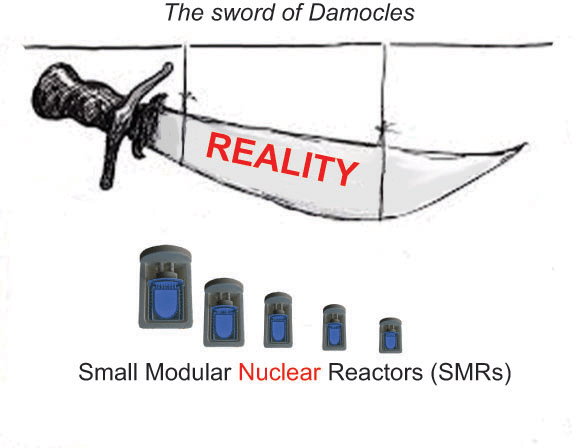 ‘Many issues’ with modular nuclear reactors says environmental lawyer
Jordan Gill · CBC News ·Dec 03, 2019 Modular nuclear reactors may not be a cure for the nation’s carbon woes, an environmental lawyer said in reaction to an idea floated by three premiers.
Theresa McClenaghan, executive director of the Canadian Environmental Law Association, said the technology surrounding small reactors has numerous pitfalls, especially when compared with other renewable energy technology.
This comes after New Brunswick Premier Blaine Higgs, Saskatchewan Premier Scott Moe and Ontario Premier Doug Ford agreed to work together to develop the technology……..
The premiers say the smaller reactors would help Canada reach its carbon reduction targets but McClenaghan, legal counsel for the environmental group, disagrees
“I don’t think it is the answer,” said McClenaghan. “I don’t think it’s a viable solution to climate change.”
McClenaghan said the technology behind modular reactors is still in the development stage and needs years of work before it can be used on a wide scale.
“There are many issues still with the technology,” said McClenaghan. “And for climate change, the risks are so pervasive and the time scale is so short that we need to deploy the solutions we already know about like renewables and conservation.”
Waste, security concerns: lawyer
While nuclear power is considered a low-carbon method of producing electricity, McClenaghan said the waste that it creates brings its own environmental concerns.
“You’re still creating radioactive waste,” said McClenaghan.
“We don’t even have a solution to nuclear fuel waste yet in Canada and the existing plans are not taking into account these possibilities.”
McClenanghan believes there are national security risks with the plan as well.
She said having more reactors, especially if they’re in rural areas, means there’s a greater chance that waste or fuel from the reactors could be stolen for nefarious purposes.
“You’d be scattering radioactive materials, potentially attractive to diversion, much further across the country,” said the environmental lawyer. https://www.cbc.ca/news/canada/new-brunswick/many-issues-modular-nuclear-1.5381804
USA financing nuclear projects abroad – but what if Small Nuclear Reactors are a flop?
Daily on Energy, presented by API: Inside the new US policy on financing nuclear abroad, Washington Examiner, by Josh Siegel, Energy and Environment Reporter & Abby Smith, Energy and Environment Reporter | June 22, 2020
INSIDE NEW POLICY ON FINANCING NUCLEAR ABROAD: The U.S. International Development Finance Corporation mostly had small nuclear reactors in mind when it proposed this month lifting its ban on funding nuclear projects overseas. But a senior official from the DFC – a greatly expanded successor to the Overseas Private Investment Corporation – says the agency also envisions select situations for funding traditional large reactors, despite recent projects being delayed or canceled by cost overruns……..
The official cited a move by Congress a year after lawmakers passed the BUILD Act in 2018, which authorized the DFC, that called on the U.S. government to support energy diversification projects in Europe as a counter to Russia’s “energy dominance.”
The DFC offers direct equity financing, loans, and political risk insurance, while Ex-Im can only offer credit or lending. The DFC has a total investment limit of $60 billion, amounting to about a $1 billion maximum per project, the official said.
“I am not aware we have anyone on staff who has built a nuclear power plant,” the official said. “What we do have is very strong policies and procedures and frameworks to look at big complicated projects.” https://www.washingtonexaminer.com/policy/energy/daily-on-energy-presented-by-api-inside-the-new-us-policy-on-financing-nuclear-abroad
The claim that nuclear power is needed for national security is a masked money-grab
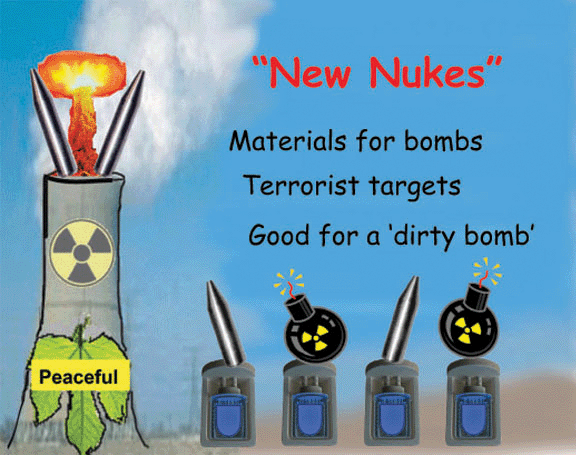

that price won’t only be paid by emptying our wallets . It will also be paid in health and safety. State senators with dollar signs twinkling in their eyes are lining up for relief handouts that will do nothing to fix our healthcare crises — laid bare under the coronavirus crisis — nor our economy. But they are playing the Russia card to get the money.
Make Nuclear Great Again? https://beyondnuclearinternational.org/2020/05/31/make-nuclear-great-again/, May 31, 2020 by beyondnuclearinternational By Linda Pentz Gunter
The claim that nuclear power is needed for national security is a masked money-grab
The US Department of Energy’s assertions about Russian and Chinese supremacy in the nuclear sector is reminiscent of the “Commie plot” rhetoric of the 1950s. But it’s a thinly disguised ploy to feed at the federal subsidies trough and revive a moribund industry.
A few years ago I attended two days of the Nuclear Deterrence Summit, held just outside Washington, DC. In my defense, I’ll say it was a necessity. I really wanted to get inside how these people think. There was plenty of talk about the need for nuclear weapons, their range and potency, all done with a calm equilibrium devoid of conscience. It was chilling.
But it was also the theatre of the absurd. At one point there was actually talk about a “missile gap.” The Russians were getting ahead. This must be stopped. Was I on the set of a remake of Dr. Strangelove? Was this General ‘Buck’ Turgidson railing about “commie plots” and “mineshaft gaps”?
Life, as it turns out, is routinely stranger than any fiction. Turgidson is still with us, and he has extended his brief to include “civilian” nuclear power plants in the competition with the “Ruskies” and now, the Chinese. Continue reading
NuScam’s “small nuclear reactor” project runs into yet more trouble
core cooling system that NuScale plans to submit to the NRC on May 20. Instead of resolving the steam generator design issue ahead of design certification, the NRC is deferring to the plant operator Energy Northwest
to resolve the issue during the licensing process, after construction.http://www.energyintel.com/pages/eig_article.aspx?DocId=1072564
Australian politician John Barilaro gets it so wrong about small nuclear reactors
But there is as yet no sign of anything being oven-ready to come to the marketplace, let alone 15 up and running. But there remain some rather disturbing connections between small reactor projects and nuclear weapons proliferation. And Rolls-Royce does offer up one of the most glaring examples. Part of the company’s current sales pitch to the British government includes the argument that a civil small-reactor industry in the UK “would relieve the Ministry of Defence of the burden of developing and retaining skills and capability” for its weapons programme. It may be true. But it is not really Atoms for Peace, , is it?
https://electricalreview.co.uk/features-mm/13082-mystic-meg-from-down-under
U.S. taxpayers might cough up for a private company’s new “Small Nuclear” space travel gimmick
Private companies find role in developing nuclear power for space travel, Space.com By JoAnna Wendel – Space.com contributor 6 Apr 20,
Nuclear-powered spacecraft could cut our travel time to Mars in half. Space is abouto go nuclear — at least if private companies get their way.
At the 2 t3rd annual Commercial Space Transportation Conference (CST) in Washington, D.C., in January, a panel of nuclear technology experts and leaders in the commercial space industry spoke about developments of the technology that could propel future spacecraft faster and more efficiently than current systems can.
Nuclear technology has powered spacecraft such as NASA’s Mars rovers, the Cassini mission and the two Voyagers that are currently exploring the outer reaches of our solar system. But those fuel sources rely on the passive decay of radioactive plutonium, converting heat from that process into electricity to power the spacecraft.
Instead, the CST panelists discussed Nuclear Thermal Propulsion (NTP), a technology developed in the 1960s and ’70s that relies on the splitting, or fission, of hydrogen atoms. Although fission is associated with more warlike images, the panel’s experts emphasized the safety of nuclear thermal propulsion, which would use low-enriched uranium.
An NTP-powered spacecraft would pump hydrogen propellant through a miniature nuclear reactor core. Inside this reactor core, high energy neutrons would split uranium atoms in fission reactions; those freed neutrons would smack into other atoms and trigger more fission. The heat from these reactions would convert the hydrogen propellent into gas, which would produce thrust when forced through a nozzle.
This chain reaction is the key to NTP’s power, panelist Venessa Clark, CEO of Atomos Space, a company that’s developing thermonuclear propulsion powered spacecraft to provide in-space transportation options to satellite operators, told Space.com. A soda-can-size fission reactor could propel humans to Mars in just three to four months, she said, about twice as fast as the currently estimated time it could take a chemically propelled ship to carry humans to the Red Planet. …..
But the government still has to play some role, both Clark and Thornburg said. Government agencies like NASA and the military branches may be the first clients for these commercial companies. Clark noted NASA’s recent pushes to partner with the private sector, such as its commercial lunar payload services program and its commercial crew program.
“Government players, NASA and also now the Air Force are looking at procuring services rather than funding the development of technology, which is really exciting for us,” Clark said…. https://www.space.com/commercial-nuclear-power-for-faster-space-travel.
COMMENT. newtons_laws 06 April 2020 14:47
British small nuclear reactors to help Turkey to get nuclear weapons?
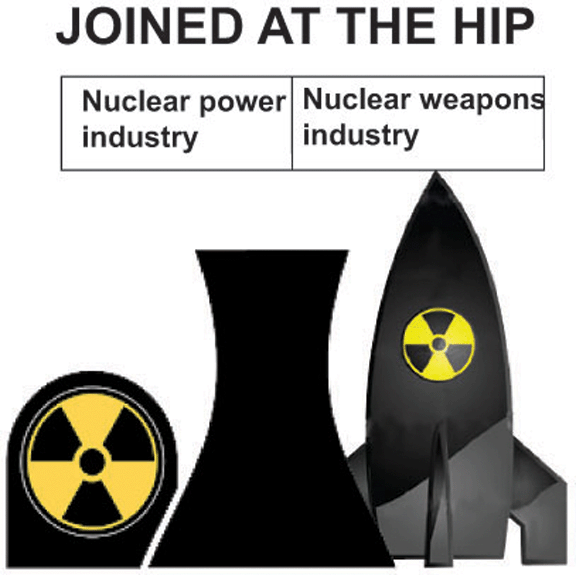 Fears over nuclear Turkey after Rolls Royce reactor deal, Morning Star,
 MARCH 25, 2020 ENGINEERING firm Rolls-Royce has struck a deal with Turkey for the production of nuclear mini-reactors, sparking fears that the British company and its international consortium partners are helping pave the way for Ankara to develop a nuclear bomb…..
the plans have raised fears that Turkey’s authoritarian President Recep Tayyip Erdogan could use the development as a step towards the country becoming a nuclear-armed power.
As previously reported in the Morning Star, Turkey’s secret nuclear programme includes plans to acquire weapons of mass destruction (WMDs), including nuclear missiles.
Writing in a pro-government newspaper in 2017, Mr Karaman said: “We need to consider producing these weapons, rather than purchasing them, without losing any time and with no regard to words of hindrance from the West.”
There are already some 70 US-owned nuclear warheads said to be based at Incirlik airbase near the southern of Adana.
In previous deals with Russia and a Japanese-French consortium, the door was left open for the development of nuclear weapons after Turkey rejected offers to include the provision of uranium and the return of the spent fuel rods used in the reactors.
The development has parallels with the Indian missile capability developed after the testing of plutonium produced in the Canadian-supplied Cirus reactor, which first raised the issue that nuclear technology supplied for peaceful purposes could be diverted to weapons production. https://morningstaronline.co.uk/article/b/fears-over-nuclear-turkey-after-rolls-royce-reactor-deal
How will the IAEA spin the mind-boggling costs of Small Modular Nuclear Reactors (SMRs)?
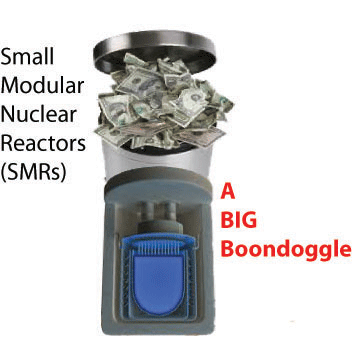 IAEA launches project to examine economics of SMRs https://www.world-nuclear-news.org/Articles/IAEA-launches-project-to-examine-economics-of-SMRs 26 March 2020, he International Atomic Energy Agency (IAEA) is launching a three-year Coordinated Research Project focused on the economics of small modular reactors (SMRs). The project will provide Member States with an economic appraisal framework for the development and deployment of such reactors.
Participants in the research project will cover: market research; analysis of the competitive landscape (SMR vs non-nuclear alternatives); value proposition and strategic positioning; project planning cost forecasting and analysis; project structuring, risk allocation and financial valuation; business planning and business case demonstration; and economic cost-benefit analysis.
The framework they establish will be applied, in particular, to assess the economics of multiples (serial production of reactors in a factory setting), factory fabrication (conditions to be met for a factory to exist), and supply chain localisation (opportunities and impacts).
The deadline for proposals to participate in the research project is 30 April.
Military use: that is clearly the reason for developing Small Nuclear Reactors
If the testing goes well, a commercially developed, Nuclear Regulatory Commission licensed reactor will be demonstrated on a “permanent domestic military installation.The department awarded contracts to BWX Technologies, Inc. of Virginia, for $13.5 million; Westinghouse Government Services of Washington, D.C. for $11.9 million; and X-energy, LLC of Maryland, for $14.3 million, to begin a two-year engineering design competition for a small nuclear microreactor designed to potentially be forward deployed with forces outside the continental United States.
The combined $39.7 million in contracts are from “Project Pele,” a project run through the Strategic Capabilities Office (SCO), located within the department’s research and engineering side. The prototype is looking at a 1-5 megawatt (MWe) power range. The Department of Energy has been supporting the project at its Idaho National Laboratory.
Pele “involves the development of a safe, mobile and advanced nuclear microreactor to support a variety of Department of Defense missions such as generating power for remote operating bases,” said Lt. Col. Robert Carver, a department spokesman. “After a two-year design-maturation period, one of the companies funded to begin design work may be selected to build and demonstrate a prototype.”…….
A second effort is being run through the office of the undersecretary of acquisition and sustainment. That effort, ordered in the 2019 National Defense Authorization Act, involves a pilot program aiming to demonstrate the efficacy of a small nuclear reactor, in the 2-10 MWe range, with initial testing at a Department of Energy site in roughly the 2023 timeframe.
If the testing goes well, a commercially developed, Nuclear Regulatory Commission licensed reactor will be demonstrated on a “permanent domestic military installation by 2027,” according to DoD spokesman Lt. Col. Mike Andrews. “If the full demonstration proves to be a cost effective energy resilience alternative, NRC-licensed [reactors] will provide an additional option for generating power provided to DoD through power purchase agreements.”…….
According to Dr. Jonathan Cobb, a spokesman for the World Nuclear Association, small nuclear reactors come in three flavors. The first, small modular reactors, sit in the 20-300 MWe range and are approaching the point they will appear on market.
The second category sits from 10-100 megawatts, and have been used in transports such as icebreakers. According to Cobb, a pair of 32 MWe reactors, based on icebreaker technology, are being used aboard the Akademik Lomonosov, a Russian “floating power plant.”
The third category, covering what the Pentagon appears most interested in, is a category known as microreactors. The challenge, Cobb said, is that this group is the furthest behind technologically, with demonstrations of commercial systems targeted for “the second half of the 2020s,” putting them in the “ballpark” of what DoD is looking for with its A&S effort……
Edwin Lyman, director of the Nuclear Safety Project at the Union of Concerned Scientists, has concerns about the availability of fuel to power a proliferation of small nuclear reactors. He noted, “there are no clear plans for manufacturing the quantity of high-assay low enriched uranium, much less the production of high-quality TRISO [TRi-structural ISOtropic particle] fuel, that would be able to meet timelines this decade.”……
Lord, for her part, would not rule out working with foreign allies on the nuclear program in some way, saying “We always talk with our partners and allies about collaboration. We have many umbrella vehicles, if you will, to do that, particularly with [National Technology and Industrial Base] countries — U.K., Canada, Australia. We have a little bit of an easy button there for working back and forth with technical information.”… https://www.defensenews.com/smr/nuclear-arsenal/2020/03/09/pentagon-to-award-mobile-nuclear-reactor-contracts-this-week/?fbclid=IwAR2MTkRUDqIkruQHY0RivblBzoSY6gubpl8gkWDUDhedVwZEGstJhHYLb6U#.XmawxEl-aJ0.facebook
A ruse to save the nuclear industry? Dangerous, expensive portable mini-reactors
|
Pentagon invented the internet: This time portable Micro Nuclear reactors, https://www.globalvillagespace.com/pentagon-invented-the-internet-this-time-portable-micro-nuclear-reactors/ 12 Mar 20, There’s no shortage of hefty defense deals awarded by the US Department of Defense, but the $40 million contract for micro-reactors definitely stands out, as it hides safety risks and raises doubts over its economic efficiency.The nuclear device that the DoD strategists want must have the capability to be safely and rapidly transported by road, rail, sea or air (sic!) as well as swiftly set up and shut down. The project split between three companies — BWX Technologies, Westinghouse Government Services and X-energy — calls for a “safe, mobile and advanced nuclear micro-reactor.” The safety part sounds particularly soothing, but how would it look on the ground? What if those miniature reactors, when moved by land, become targets of high-profile terrorist attacks? And will it prove to be a real alternative (which means cheaper price, of course) to conventional energy sources? The more reactors — the greater the danger“Any nuclear reactor attracts terrorists,” Andrey Ozharovsky, nuclear scientist, program expert at the Russian Social Ecological Union, told RT. “It doesn’t matter if it’s located at a nuclear power plant [or inside a portable device]… if you remember, the terrorists planned directing one of the planes at a nuclear plant during 9/11.” The logic here is simple, he pointed out: “the more reactors are out there — the greater the danger.” If the US builds hundreds, or even dozens of such devices, it’ll be really hard for them to properly defend them all. Another vital safety issue is the reliability of the nuclear micro-reactors. Interestingly enough, the US military had already experimented with them back in the 1950s and 1960s — and it ended in a tragedy. Several portable reactors were built and setup in Greenland and Panama, but one of them blew up in 1961, killing three operators. The Army Nuclear Power Program was shut down shortly after that. “There were eight US micro-reactors and one of them exploded. That’s how safe they are,” Ozharovsky said, adding that the Pentagon’s idea of bringing them back will “likely create more risks instead of solving any problems.” Micro-reactors yet to prove their economic efficiencyBut even if the portable reactors will be shielded from the perils of the battlefield and operate without failure, what’s the Pentagon’s rationale behind bringing the radioactive fuel to their military bases? For decades, the army had been successfully running on gasoline, diesel and fuel oil; when going off-grid, it would switch to generators and high-power accumulators. “The main problem has nothing related to safety,” Anton Khlopkov, director of Energy and Security Center and member of Russian Security Council’s Scientific Council argued. Micro-reactors must prove their viability from the economic point of view since such plants always have alternatives It is yet to be proven that micro-reactors won’t be “many times more” expensive than other conventional sources of energy. Electricity produced by such devices should be at least comparable in cost to the one produced by diesel generators, he said. Some kind of a soap bubbleIf micro-reactors are such a questionable solution, why is the Pentagon pushing for their development? The answer isn’t lying on the surface, but it isn’t buried too deep. “They work against the trends,” Ozharovsky suggested. And those trends are that the world is giving up on the use of civilian nuclear energy due to being too expensive. Washington may be trying to “support the US the nuclear industry that’s dying out with the use of the military budget; sponsor their research and development — which is an expensive thing.” RT with additional input by GVS News Desk At last – someone recognises the bleeding obvious – thank you! To keep the nuclear industry alive there MUST be new nuclear reactors built. With no willing private investment available, then it must be the tax-payer who coughs up. Especially in USA, it seems that the only respectable use of tax-payer money is in that most sacred of cows – defence. |
|
1 This Month



26 September – International Day for the Total Elimination of Nuclear Weapons


PLEASE OPPOSE HR 8255 AND S.3639 – bills would accelerate satellite deployment, with no environmental review or safeguards – https://ncstd5li.quorum.us/campaign/169331/
To see nuclear-related stories in greater depth and intensity – go to https://nuclearinformation.wordpress.com
-
Archives
- September 2026 (233)
- August 2026 (330)
- July 2026 (355)
- June 2026 (287)
- May 2026 (306)
- April 2026 (356)
- March 2026 (251)
- February 2026 (267)
- January 2026 (308)
- December 2025 (358)
- November 2025 (359)
- October 2025 (375)
-
Categories
- 1
- 1 NUCLEAR ISSUES
- business and costs
- climate change
- culture and arts
- ENERGY
- environment
- health
- history
- indigenous issues
- Legal
- marketing of nuclear
- media
- opposition to nuclear
- PERSONAL STORIES
- politics
- politics international
- Religion and ethics
- safety
- secrets,lies and civil liberties
- spinbuster
- technology
- Uranium
- wastes
- weapons and war
- Women
- 2 WORLD
- ACTION
- AFRICA
- Atrocities
- AUSTRALIA
- Christina's notes
- Christina's themes
- culture and arts
- Events
- Fuk 2022
- Fuk 2023
- Fukushima 2017
- Fukushima 2018
- fukushima 2019
- Fukushima 2020
- Fukushima 2021
- general
- global warming
- Humour (God we need it)
- Nuclear
- RARE EARTHS
- Reference
- resources – print
- Resources -audiovicual
- Weekly Newsletter
- World
- World Nuclear
- YouTube
-
RSS
Entries RSS
Comments RSS
 nuclear-news