Examining Britain’s 10 Point Plan – Small Modular Nuclear Reactors downgraded, as renewables are cheaper and better?
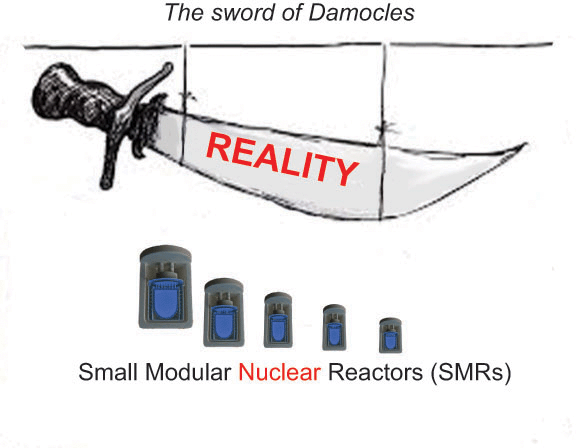 New Civil Engineer 19th Nov 2020, Prime Minister Boris Johnson’s 10 Point Plan for a “green industrial revolution” – announced yesterday – is “pretty vague” about the future of big nuclear energy projects and disappointing for the mini nuclear industry, according to Energy & Climate Intelligence Unit head of analysis Jonathan Marshall. In the plan, Johnson backed the development of nuclear energy, committing £525M “to help develop large and smaller-scale nuclear plants, and research and develop new advanced modular reactors”. New Civil Engineer 19th Nov 2020, Prime Minister Boris Johnson’s 10 Point Plan for a “green industrial revolution” – announced yesterday – is “pretty vague” about the future of big nuclear energy projects and disappointing for the mini nuclear industry, according to Energy & Climate Intelligence Unit head of analysis Jonathan Marshall. In the plan, Johnson backed the development of nuclear energy, committing £525M “to help develop large and smaller-scale nuclear plants, and research and develop new advanced modular reactors”.However, according to Marshall large nuclear support is”buried” in the proposals and investment in small modular reactors (SMRs)
is less than expected. “If I was in the SMR game I’d be disappointed with this because that £2bn support for a small initial fleet of reactors has been pared back to just over £500M,” Marshall said. “It’s a lot of cash and still a lot of support – it’s more than most unproven technologies get – but it feels a bit like SMRs have been put on the backburner now. For a while it felt like the government was believing that the SMR industry could be the future. “Paring back on what was expectedto be offered might show that the government is cooling or laying down a tougher set of challenges to Rolls Royce and others in the SMR world to prove the claims are true before they get more money.”
Marshall attributed this change to the increasing support for renewables. “The EU has set out huge ambitions to boost offshore wind capacity, the UK has already done that, all the rest of the world is investing in renewables whereas not many are investing in nuclear now,” he said. “None of these cost reductions that were touted for years for nuclear industry seem to be happening whereas the evidence shows the cost of renewables is plummeting and the cost of what’s needed to balance the grid is plummeting too.”
|
British govt’s foolhardy plan to pay up for non existent Rolls Royce small nuclear reactors
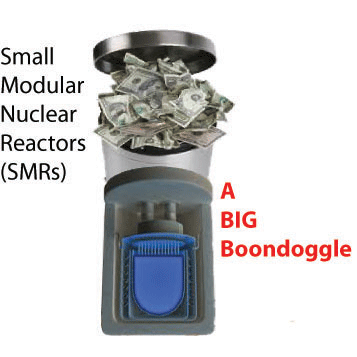 Guardian 17th Nov 2020, Boris Johnson’s £12bn plan for a “green industrial revolution” spans renewable energy, nuclear power and countryside restoration. However, some of the objectives are likely to be difficult to reach, and the plan has been criticised for a lack of ambition in key areas.
Canadian government misplacing funding into unviable small nuclear reactors for North West Territories

Is small-scale nuclear energy an option for the N.W.T.?
N.W.T., federal gov’t looking closely at industry, but some say they should focus only on renewable energy, Hannah Paulson · CBC News Nov 18, 2020 “……. both the federal government and the Northwest Territories look to transition away from fossil fuels, territorial leaders are exploring how small-scale nuclear energy could alleviate the North’s dependency on diesel.
In October, the federal government announced it was investing $20 million into small modular nuclear energy reactors
…….The N.W.T. government has also shown interest in this form of energy and identified it as an emerging energy technology that it follows “closely,” according to a written statement from the Department of Infrastructure.
Others, however, think the federal funding is misplaced.
Last week, the Green Party of Canada called on the federal government to abandon nuclear energy and invest in renewable energy instead.
In a press release, MP Elizabeth May said that “small nuclear reactors (SMRs) have no place in any plan to mitigate climate change when cleaner and cheaper alternatives exist.”
May cited issues with the high costs involved in nuclear energy, the long timeline to rollout, and the environmental risk.
What is small-scale nuclear energy?
SMRs is a term that represents “a range of technology,” said Diane Cameron, director of nuclear energy at Natural Resources Canada.
The federal government’s $20-million investment is toward Terrestrial Energy, an Oakville, Ont., firm that is working to bring SMRs to market. That technology is still in the design phase, but could become commercially viable in five to 10 years, said Cameron……..
N.W.T. part of small-scale nuclear group
The Northwest Territories is among several jurisdictions and energy corporations that are part of a working group looking at how small-scale nuclear reactors could be used across the country.
The working group “has recognized the potential for application in off-grid small and remote communities and for remote industrial sites that rely on diesel,” the Department of Infrastructure said in a statement.
The statement also said that there needs to be more information about whether SMRs would be technically viable, safe, reliable and cost effective in the North.
The Department of Infrastructure considers small-scale nuclear energy a long-term initiative.
Cameron said SMRs could be commercially viable anywhere from 2025 to 2030, but before it’s likely to be brought up to the N.W.T., it will be tested in national labs.
If that is successful, the technology could make its wat into communities, but that might not be for another 20 or so years, she said.
‘Not the answer to climate change’
In a 2018 UN report, scientists warned that there were only 12 years left to drastically reduce global emissions in order to avert the most catastrophic impacts of climate change.
This is part of the reason why May and other environmentalists don’t think small-scale nuclear energy is part of “the answer to climate change.”
Theresa McClenaghan, the executive director of the Canadian Environmental Law Association, said the industry requires extremely high startup costs, which divert attention away from renewable energy.
Funding should be going toward existing renewable energy sources that are currently viable, like geothermal, solar, or wind energy, she said. “These are not pipe dreams. These are existing technologies where the price is coming down practically by the day,” said McClenaghan.
“It’s not to say we don’t want an alternative to diesel, but that alternative should be renewables.” https://www.cbc.ca/news/canada/north/small-scale-energy-nwt-1.5803972
UK government wastes tax-payer money on small and large nuclear reactors that will never be cheap or safe
 FoE Scotland 17th Nov 2020, Friends of the Earth Scotland gave a scathing reaction to
  the UK Government’s announcement of a 10-point plan on climate and energy, calling for much more priority on solutions which can reduce emissions and create jobs today.
crisis like carbon capture and storage, hydrogen and nuclear. “While there are some crumbs from the table in terms of the welcome new target of 2030 to phase out fossil-fuelled cars, overall there is too little new money and too much funding committed to long-term, dangerous distractions.
https://foe.scot/press-release/response-to-the-uk-10-point-climate-plan-for-net-zero/
In the face of public opposition, Ottawa delays small nuclear reactor plan
Ottawa delays small nuclear reactor plan as critics decry push for new reactors, Yahoo Finance Colin Perkel, The Canadian Press, Thu., November 19, 2020, “……… Industry critics were quick to pounce on the government’s expected SMR announcement. They called on Ottawa to halt its plans to fund the experimental technology.
.. a major problem facing the industry is its growing mound of radioactive waste. This week, the government embarked on a round of consultations about what do with the dangerous material.
Dozens of groups, including the NDP, Bloc Quebecois, Green Party and some Indigenous organizations, oppose the plan for developing small modular reactors. They want the government to fight climate change by investing more in renewable energy and energy efficiency.
“We have options that are cheaper and safer and will be available quicker,” Richard Cannings, the NDP natural resources critic, said in a statement. …
Joe McBrearty, head of Canadian Nuclear Laboratories, told the conference the company had signed a host agreement this week with Ottawa-based Global First Power for a demonstration SMR at its Chalk River campus in eastern Ontario. A demonstration reactor will allow for the assessment of the technology’s overall viability, he said
Small Modular Nuclear Reactors, the nuclear industry’s latest pipe dream.
 Ramana and Schacherl: Why the Liberals’ nuclear power plan is a pipe dream https://ottawacitizen.com/opinion/ramana-and-schacherl-why-the-liberals-nuclear-power-plan-is-a-pipe-dream?fbclid=IwAR0GnxYt-JgXg7NVEyccBYt4r0SSbfAHm3Y-b_AvzgMIjxpOotUTBIvAcaI
Not only is this form of power expensive compared to the alternatives, we still haven’t resolved issues around radioactive contamination and hazardous waste streams.
At least a dozen corporations around the world are hoping for taxpayer funding to further develop their SMR designs, all of which are still on the drawing board. Last month, the federal government handed out $20 million to Terrestrial Energy. Other expectant entities include SNC-Lavalin, which bought Atomic Energy of Canada Ltd.’s CANDU division and is developing a CANDU SMR; United Kingdom-based Moltex Energy; and Seattle-based Ultra Safe Nuclear Corporation.
The Liberal government says it supports small modular reactors to help Canada mitigate climate change. The government is simply barking up the wrong tree, for several reasons: cost, cost and cost, as well as renewables, safety and radioactive waste.
Nuclear power is very expensive compared to other low-carbon options, and the difference keeps growing because the cost of renewables and energy storage is going down rapidly. Peter Bradford, a former U.S. Nuclear Regulatory Commission official, likened the use of nuclear power to mitigate climate change to fighting world hunger “with caviar.”
The high price tag for nuclear power plants has led to a near freeze on new ones around the world. Canada’s last nuclear plant came online in 1994, and Ontarians will remember when plans for two reactors at Darlington were shelved in 2009 after a $26-billion bid – three times the expected budget. Nuclear projects also have a long history of cost and time overruns. The cost estimate of NuScale, the most advanced SMR project in the U.S., has gone up from $4.2 billion to $6.1 billion. That works out to almost 10 times the cost per kilowatt of building wind power in Alberta. There is no way SMRs can be cost-competitive with wind or solar energy.
O’Regan has said he doesn’t know any way to get to net zero-carbon emissions by 2050 without nuclear power, but this is refuted by many studies. Ontario can meet its electricity demand using only renewables and hydro power backed up by storage technologies. A recent study using data from 123 countries shows that renewable energy outperforms nuclear power in reducing emissions. It concludes that nuclear investments just get in the way of building up renewable energy.
Advocates claim that we need nuclear energy to back up solar and wind power when the sun doesn’t shine and the wind doesn’t blow. However, nuclear reactors cannot be powered up and down rapidly and safely. If they are, their cost of generating electricity increases further. Nor do nuclear plants run reliably all the time. In France, which generates 70 per cent of its electricity from nuclear power, each reactor was shut down for an average of 96.2 days in 2019.
The federal government sees small reactors playing a role in remote off-grid communities and mines that now rely on diesel. But together they require less than 0.5 per cent of Canada‘s electricity generation capacity. Power from SMRs could be 10 times more expensive for those communities than adding wind and solar energy. There is also strong opposition to SMRs from First Nations communities, who say these represent an unacceptable risk.
The risk from nuclear power comes in multiple forms. There is the potential for accidents leading to widespread radioactive contamination. Because reactors involve parts that interact rapidly in complex ways, no nuclear reactor is immune to accidents. And they all produce radioactive nuclear waste streams that remain hazardous for up to one million years. Dealing with these is a major challenge, and there is no demonstrated solution to date.
Canada has a big challenge ahead: to decarbonize by 2050. Let’s get on with it, in the quickest and most cost-effective way: by improving the efficiency of our energy use, and building out solar, wind and storage technologies. The federal Green Party is correct in stating that nuclear reactors “have no place in any plan to mitigate climate change when cleaner and cheaper alternatives exist.” Let’s forget the dirty, dangerous distraction of small nuclear reactors.
M.V. Ramana is the Simons Chair in Disarmament, Global and Human Security and Director of the Liu Institute for Global Issues at the School of Public Policy and Global Affairs, University of British Columbia. Eva Schacherl is an advocate for protecting the Ottawa River and for environmental and social justice.
Unanswered questions cloud the future of NuScam’s Small Modular Nuclear Reactor project
Questions Remain About ID Nuclear Reactor Project https://www.upr.org/post/questions-remain-about-id-nuclear-reactor-project
NuScale‘s small, modular reactor design is the first of its kind to be approved in the United States. The new, compact concept is made up of 12 small reactors and will be located at the Idaho National Laboratory.

Sarah Fields, program director with the group Uranium Watch, said the Nuclear Regulatory Commission needs to scrutinize the project carefully. In particular, she said she’s concerned about a proposal for fewer people to oversee the project.
“They want to reduce the number of operators, and that’s just to save money,” said Fields. “And the NRC is undergoing a review of that.”.
NuScale said the project needs fewer operators because of its design is simpler and the controls involve more automation. The NRC is reviewing the proposal, which could involve policy changes since the approval process is based on conventional nuclear power plant designs.
The NRC has approved the Design Certification Application for the project in its current form. But Fields said the agency still has to authorize certain aspects of the design.
One NRC engineer has raised questions about dilution of boron water around reactor cores, which could cause a dangerous power surge even if the reactor is shut down. Fields said it could be hard to make modifications once aspects of the design are approved.
“It’s like designing a house,” said Fields. “And once you want to change one thing about the house, then you have to make all different kinds of adjustments. And then, get approvals from that.”
Relentless lobbying by Small Nuclear Reactor companies still doesn’t make them economic or safe

Telegraph 14th Nov 2020 ”………Rolls-Royce, via a relentless lobbying campaign over the past few years, seems to have convinced the  Government that its “mini-nukes” project is a runner. It claims billions are needed from taxpayers to underpin investment in a new production line that will reduce the costs and risks compared with bespoke new reactors such as the £22bn monster at Hinkley Point C.
There are plenty of reasons to be sceptical that even with its nuclear submarine experience, Rolls and its partners can pull it off. The technology is unproven anywhere and – as anti-nuclear campaigners argue – more reactors inevitably mean more potential points of failure. Nuclear power has a poor record of delivering its budgets too…….”
Quite a lot of hurdles for NuScam’s Utah project, and only 27 of UAMPS members signed up

|
|
UAMPS Mulls Downsizing Nuclear Project, Power, 11 Nov 20“…………..So far, the company has marked key regulatory milestones. On Aug. 28, notably, NuScale’s 50-MW (160 MWth) module became the first SMR to receive a final safety evaluation report (FSER) from the NRC as part of a Phase 6 review—the last and final phase—of NuScale’s Design Certification Application (DCA).
The latest power uprate will be reviewed by the NRC as part of a Standard Design Approval (SDA) application, which NuScale on Tuesday said it is schedule to submit in 2022. However, Hughes said that while NuScale has not yet made a final decision on the size or configuration that will be reflected in the SDA application, it will seek approval of 250 MWth modules. “Our final decision will be announced soon,” she said. So far, the company has marked key regulatory milestones. On Aug. 28, notably, NuScale’s 50-MW (160 MWth) module became the first SMR to receive a final safety evaluation report (FSER) from the NRC as part of a Phase 6 review—the last and final phase—of NuScale’s Design Certification Application (DCA). The latest power uprate will be reviewed by the NRC as part of a Standard Design Approval (SDA) application, which NuScale on Tuesday said it is schedule to submit in 2022. However, Hughes said that while NuScale has not yet made a final decision on the size or configuration that will be reflected in the SDA application, it will seek approval of 250 MWth modules. “Our final decision will be announced soon,” she said. NuScale’s Announcement Gives UAMPS’ Options to Downsize Carbon-Free Power Project When UAMPS will submit a COLA for its Carbon Free Power Project (CFPP), a 12-module NuScale power plant that is developing for a site at an Idaho National Laboratory (INL) site in Idaho Falls, Idaho, is not clear. UAMPS has so far developed the much-watched project as a 720-MWe plant, and it has said it expects the first of the 12 proposed NuScale modules could be operational in 2029 with the other 11 modules operational in 2030. But NuScale’s new power increase and its launch of smaller plant sizes now gives the project much-needed flexibility that could affect it current timetable. The newly announced uprate is significant because it “facilitates plant downsizing,” UAMPS told POWER in a statement on Tuesday. “An important early task in the UAMPS [CFPP’s] next phase will be evaluating these new options in plant size and configuration. UAMPS will evaluate the possibilities of building a [308-MWe] 4-module or [462-MWe] 6-module plant instead of a 12-module plant,” it said. UAMPS, notably, just wrapped up the first phase of the CFPP on Oct. 31, securing financial commitments for a potential 720-MW plant from 27 of its 48 members, which are mostly cities in Utah but also scattered across California, Idaho, Nevada, New Mexico, and Wyoming. During the tumultuous first phase, at least eight cities—Lehi, Logan, Murray, Kaysville, Bountiful, Beaver, Heber, and Salmon River Electric—dropped out of the the project, and at least one, Idaho Falls halved its share. The withdrawing cities cited a long list of reasons for their reluctance to commit to the project, but costs—which could increase for remaining subscribers—and uncertainty led their concerns. ….. The next off-ramp will likely be in April 2023, when UAMPS is expected to submit the application to the NRC. The final off-ramp would be in December 2025, before the start of the construction period. As POWER has reported, the 720-MWe CFPP is currently estimated to cost $6.1 billion, and UAMPS is expected to shoulder $4.76 billion of that figure, which is based on a Class 4 estimate (and could decrease by about 10% or increase by 30%). The Department of Energy (DOE) will fund the remaining $1.355 billion through an award announced on Oct. 16. The award, which will be subject to yearly Congressional appropriations, replaces the DOE’s Joint Use Module Plant (JUMP) program. ……. On Tuesday, UAMPS again stressed that the project’s LCOE (Levelised Cost Of Energy )will play a crucial factor in any decisions it makes. Before it can agree to a change in plant size or configuration—including to move forward with NuScale’s newly launched smaller power plant solutions—“UAMPS would have to be assured that the [LCOE] of $55/MWh (or lower) would be preserved. UAMPS would also want assurance that the current schedule/timeline would be followed,” the agency said. ……. |
|
Small nuclear reactor plan by Rolls Royce consortium – not likely to be economically feasible
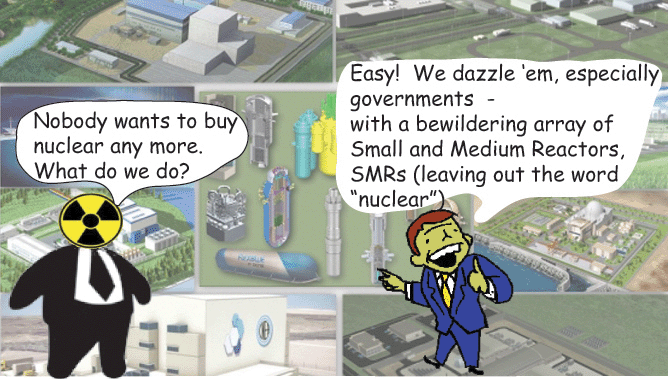
Rolls-Royce vows to create 6,000 UK jobs with nuclear power station plans, Engineering firm is part of consortium pushing for government backing, Jasper Jolly, Wed 11 Nov 2020
‘……….However,it faces opposition on the grounds of safety, security and cost.
The consortium this week signed agreements with the US company Exelon Generation and the Czech power company CEZ to consider the reactors.
Small nuclear reactors were first developed in the 1950s to use in nuclear-powered submarines. Since then Rolls-Royce has designed reactors for seven classes of submarine and two separate land-based prototype reactors.
However, to be cost-effective for civilian use the power generated by the reactors has to compete with renewable sources such as wind and solar power. The costs of installing renewables have fallen dramatically in the last decade and they do not pose the same safety concerns.
The Financial Times last month reported that the government was backing the plans to commit between £1.5bn and £2bn, and that it would form part of Boris Johnson’s 10-point plan for the environment. However, the second wave of coronavirus has caused the delay of the Treasury’s multiyear spending review. …..
a 2017 study by the consortium partner Atkins found that the electricity produced from the small reactors would be a third more expensive than traditional plants……. https://www.theguardian.com/business/2020/nov/11/rolls-royce-vows-to-create-6000-uk-jobs-with-nuclear-power-station-plans
Rolls Royce and Exelon get together to market ‘small’ nuclear reactors
|
Industrial technology company Rolls-Royce has signed a memorandum of understanding (MoU) with Exelon Generation for the operation of compact nuclear power stations in the UK and overseas locations. Under the contract, Exelon Generation agreed to assist Rolls Royce in the development and deployment of UK small modular reactors (UKSMR)…… In January, Rolls-Royce announced that it will be leading a consortium to build and install small modular reactors (SMRs) on former nuclear sites to power the UK by 2029. Members part of the consortium are Assystem, Atkins, BAM Nuttall, Jacobs, Laing O’Rourke, National Nuclear Laboratory, Nuclear Advanced Manufacturing Research Centre, Rolls-Royce and TWI. Working with its partners, as well as the UK government, the consortium will secure a commitment for a fleet of factory-built nuclear power stations, each with a 440MW capacity, developed inside a weatherproof canopy…….. https://www.power-technology.com/news/rolls-royce-exelon-mou/ |
|
UK’s ‘small nuclear reactors’ – the real agenda is the funding of nuclear weapons
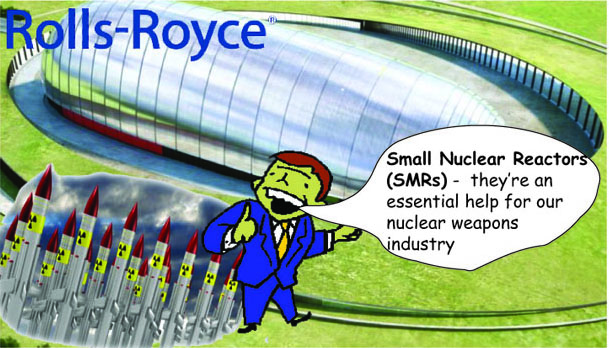
A secret military agenda. UK defence policy is driving energy policy – with the public kept in the dark, Beyond Nuclear
By David Thorpe, 8 Nov 20,The UK government has for 15 years persistently backed the need for new nuclear power. Given its many problems, most informed observers can’t understand why. The answer lies in its commitment to being a nuclear military force. Here’s how, and why, anyone opposing nuclear power also needs to oppose its military use.
“All of Britain’s household energy needs supplied by offshore wind by 2030,” proclaimed Prime Minister Boris Johnson at a recent online Conservative Party conference. This means 40 per cent of total UK electricity. Johnson did not say how, but it is likely, if it happens, to be by capacity auctions, as it has been in the recent past.
But this may have been a deliberate distraction: there were two further announcements on energy – both about nuclear power.
16 so-called “small nuclear reactors”
Downing Street told the Financial Times, which it faithfully reported, that it was “considering” £2 billion of taxpayers’ money to support “small nuclear reactors” – up to 16 of them “to help UK meet carbon emissions targets”.
It claimed the first SMR is expected to cost £2.2 billion and be online by 2029.
The government could also commission the first mini power station, giving confidence to suppliers and investors. Any final decision will be subject to the Treasury’s multiyear spending review, due later this year.
The consortium that would build it includes Rolls Royce and the National Nuclear Laboratory.
Support for this SMR technology is expected to form part of Boris Johnson’s “10-point plan for a green industrial revolution” and new Energy White Paper, which are scheduled for release later in the autumn.
Johnson will probably also frame it as his response to the English citizens assembly recommendations– a version of the one demanded by Extinction Rebellion in 2019 – which reported its conclusions last month.
While the new energy plan will also include carbon capture and storage, and using hydrogen as vehicle fuel, it’s the small modular reactors that are eye-popping.
They would be manufactured on production lines in central plants and transported to sites for assembly. Each would operate for up to 60 years, “providing 440MW of electricity per year — enough to power a city the size of Leeds”, Downing Street said, and the Financial Times copied.
The SMR design is alleged to be ready by April next year. The business and energy department has already pledged £18 million (US $23.48 million) towards the consortium’s early-stage plans.
They are not small
The first thing to know about these beasts is that they are not small. 440MW? The plant at Wylfa (Anglesey, north Wales) was 460MW (it’s closed now). 440MW is bigger than all the Magnox type reactors except Wylfa and comparable to an Advanced Gas-cooled Reactor.
Where will they be built? In the town of Derby – the home of Rolls Royce – where, as nuclear consultant Dr. David Lowry points out, the government is already using the budget of the Housing and Communities Department to finance the construction of a new advanced manufacturing centre site.
When asked why this site was not being financed by the business and energy department (BEIS), as you’d expect, a spokesperson responded that it was part of “levelling up regeneration money”.
Or perhaps BEIS did not want its budget used in such a way. Throwing money at such a “risky prospect” betrays “an irrationally cavalier attitude” according to Andrew Stirling, Professor of Science & Technology Policy at the University of Sussex Business School, because an “implausibly short time” is being allowed to produce an untested reactor design.
Only if military needs are driving this decision is it explicable, Stirling says. “Even in a worst case scenario, where this massive Rolls Royce production line and supply chain investment is badly delayed (or even a complete failure) with respect to civil reactor production, what will nonetheless have been gained is a tooled-up facility and a national skills infrastructure for producing perhaps two further generations of submarine propulsion reactors, right into the second half of the century.
“And the costs of this will have been borne not by the defence budget, but by consumers and citizens.”
Yes, military needs
UK defence policy is fully committed to military nuclear. The roots of civil nuclear power lay in the Cold War push to develop nuclear weapons. Thus has it ever been since the British public was told nuclear electricity would be “too cheap to meter”.
The legacy of empire and thrust for continued perceived world status are at the core of a post-Brexit mentality. It’s inconceivable to the English political elite that this status could exist without Great Britain being in the nuclear nations club, brandishing the totem of a nuclear deterrent.
“The civil-military link is undisputable and should be openly discussed,” agrees Dr Paul Dorfman at the Energy Institute, University College London.
Andrew Stirling talks of the “tragic relative popularity of (increasingly obsolescent) nuclear weapons”. The coincidental fact that civil nuclear installations are also crumbling provides a serendipitous opportunity for some.
The stores of plutonium in the UK are already overflowing and the military has its own dedicated uranium enrichment logistics.
Any nation’s defence budget in this day and age cannot afford a new generation of nuclear weapons. So it needs to pass the costs onto the energy sector.
“Clearly, the military need to maintain both reactor construction and operation skills and access to fissile materials will remain. I can well see the temptation for Defence Ministers to try to transfer this cost to civilian budgets,” observes Tom Burke, Chairman of think tank E3G.
The threat of nuclear proliferation
The threat of nuclear proliferation is therefore linked to the spread of civil nuclear power worldwide, says Dr David Toke, Reader in Energy Politics, Department of Politics and International Relations at the University of Aberdeen. David Lowry agrees: “India, Pakistan and above all Israel are obvious examples, each of which certainly has built nuclear weapons.”
It’s impossible to separate the tasks of challenging civil nuclear power without also challenging military nuclear interests, Stirling strongly believes. “The massive expense of increasingly ineffective military nuclear systems extend beyond the declared huge budgets. They are also propped up by large hidden subsidies from consumer and taxpayer payments for costly nuclear power.
“Huge hidden military interests will likely continue to keep the civil nuclear monster growing new arms. Until critics reach out and engage the entire thing, we’ll never prevail in either struggle.”
How new plants would be paid for still remains a question. Nuclear power is prohibitively expensive………..https://wordpress.com/read/feeds/72759838/posts/3011373103
Explaining the diseconomics problems for the NuScale small nuclear reactors plan in Utah
First major modular nuclear project having difficulty retaining backers, The complicated finances of the first major test of small modular nuclear reactors. https://arstechnica.com/science/2020/11/first-major-modular-nuclear-project-having-difficulty-retaining-backers/ JOHN TIMMER – 11/8/2020,
Earlier this year, the US took a major step that could potentially change the economics of nuclear power: it approved a design for a small, modular nuclear reactor from a company called NuScale. These small reactors are intended to overcome the economic problems that have ground the construction of large nuclear plants to a near halt. While each only produces a fraction of the power possible with a large plant, the modular design allows for mass production and a design that requires less external safety support.
But safety approval is just an early step in the process of building a plant. And the leading proposal for the first NuScale plant is running into the same problem as traditional designs: finances.
The proposal, called the Carbon Free Power Project, would be a cluster of a dozen NuScale reactors based at Idaho National Lab but run by Utah Associated Municipal Power Systems, or UAMPS. With all 12 operating, the plant would produce 720MW of power. But UAMPS is selling it as a way to offer the flexibility needed to complement variable renewable power. Typically, a nuclear plant is either producing or not, but the modular design allows the Carbon Free Power Project to shut individual reactors off if demand is low.
According to one report, the US Department of Energy had originally planned to purchase the first reactor for research use, then turn it over to UAMPS. But now, the goal is apparently for the DOE to provide an annual supplement of about $130 million a year for a decade. However, that would be dependent upon annual renewals of the funding by Congress during that decade, which is yet another risk. Separately, to reach a target price for the power that is expected to be competitive with natural gas, the project has been made larger and its completion delayed by three years.
That shouldn’t be unexpected, as utilities are notoriously conservative—justifiably so, considering how much their customers rely on electricity. So any new electrical technology is likely to face some struggles as its customers learn to use it effectively and understand how to extract the most value out of it. Typically, the government steps in to provide some support during this awkward phase, as it has done for wind and solar, and plans to do for NuScale.
Small and large new nuclear reactors in Britain’s so-called ‘green industrial revolution’
Mail on Sunday 7th Nov 2020, Boris Johnson is poised to launch major plans for a ‘green industrial revolution’ backing a new wave of nuclear power plants to boost the economy and slash Britain’s carbon emissions. The proposals are expected to include the green light to build a nuclear plant at Sizewell C in Suffolk and thenext stage in a programme that would lead to a production line of rapidlyn and more cheaply produced small modular reactors within a decade, The Mail on Sunday understands.
The Government is considering a ‘Made in Britain’ solution that may include a taxpayer-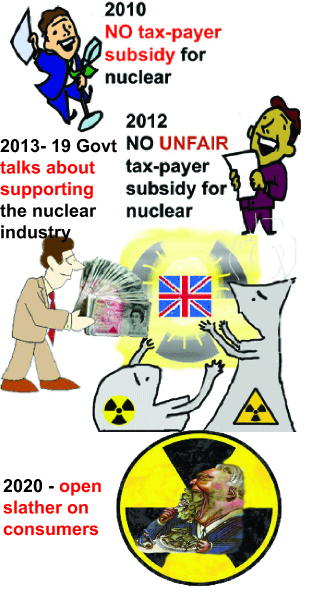 backed injection from an infrastructure growth fund – a plan that would need rubber stamping by the Treasury. Funding could also include backing from British pension funds. It would allow the Government to help subsidise the small modular reactor programme (SMR) with as much as £2billion and a stake in Sizewell C of up to 10 per cent of its £20billion build costs.
Sizewell C is backed by French state-backed EDF Energy, which could become a minority shareholder. Government financing would also help slash the cost of electricity produced by the plant. Britain has eight nuclear power plants, generating about a fifth of the country’s electricity. Seven are due to close by 2030.
The SMR consortium is led by Rolls-Royce and includes construction and engineering companies Assystem, Atkins, BAM Nuttall,
Jacobs and Laing O’Rourke. It hopes to build ten to 15 reactors in the UK, largely on former nuclear sites. Plans are already being discussed for the possibility of joint sites in locations including Moorside in Cumbria – where Japanese multinational Toshiba recently pulled out of developing its own reactor – that could contain a large EDF-backed reactor and a smaller modular reactor, creating a ‘clean energy hub’.
EDF has insisted synergies with Hinkley will mean the cost of energy from a second plant at Sizewell C would be slashed. It is understood site preparations could begin immediately and that planning consent for the project itself could be given
as soon as 2022, meaning the plant could be online by 2032.
https://www.thisismoney.co.uk/money/markets/article-8924115/Lift-GREEN-Industrial-Revolution.html
Nuclear Technology Germany Association says Small Nuclear Reactors (SMRs) will always be more expensive than large ones.
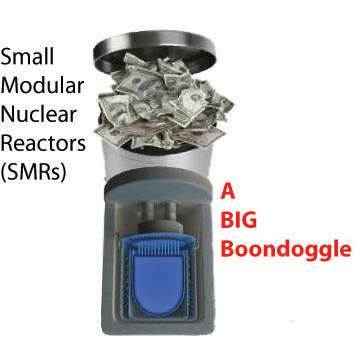 German nuclear industry cautious about usefulness of small reactors for energy transition, Nuclear phase-out Technology, Clean Energy Wire, Süddeutsche Zeitung , 6 Nov 20 Small Modular Reactors (SMR) are increasingly hailed as an effective way for using nuclear power to curb the climate crisis without the major risks associated with conventional nuclear plants, but Germany’s nuclear industry is sceptical whether the small reactors really can help boost international climate action, Christian J. Meier writes for the Süddeutsche Zeitung German nuclear industry cautious about usefulness of small reactors for energy transition, Nuclear phase-out Technology, Clean Energy Wire, Süddeutsche Zeitung , 6 Nov 20 Small Modular Reactors (SMR) are increasingly hailed as an effective way for using nuclear power to curb the climate crisis without the major risks associated with conventional nuclear plants, but Germany’s nuclear industry is sceptical whether the small reactors really can help boost international climate action, Christian J. Meier writes for the Süddeutsche Zeitung
……… Nicolas Wendler of industry association Nuclear Technology Germany (KernD) says SMRs are always going to be more expensive than bigger reactors due to lower power output at constant fixed costs, as safety measures and staffing requirements do not vary greatly compared to conventional reactors. In terms of levelised energy costs, SMRs will always be more expensive than big plants.” In order for SMRs to be profitable, these should run at maximum utilisation most of the time, Wendler argues, concluding that the potential on the German market would not be much greater than what is needed to adjust oscillating renewable power production…. https://www.cleanenergywire.org/news/german-nuclear-industry-cautious-about-usefulness-small-reactors-energy-transition
|
1 This Month



26 September – International Day for the Total Elimination of Nuclear Weapons


PLEASE OPPOSE HR 8255 AND S.3639 – bills would accelerate satellite deployment, with no environmental review or safeguards – https://ncstd5li.quorum.us/campaign/169331/
To see nuclear-related stories in greater depth and intensity – go to https://nuclearinformation.wordpress.com
-
Archives
- September 2026 (233)
- August 2026 (330)
- July 2026 (355)
- June 2026 (287)
- May 2026 (306)
- April 2026 (356)
- March 2026 (251)
- February 2026 (267)
- January 2026 (308)
- December 2025 (358)
- November 2025 (359)
- October 2025 (375)
-
Categories
- 1
- 1 NUCLEAR ISSUES
- business and costs
- climate change
- culture and arts
- ENERGY
- environment
- health
- history
- indigenous issues
- Legal
- marketing of nuclear
- media
- opposition to nuclear
- PERSONAL STORIES
- politics
- politics international
- Religion and ethics
- safety
- secrets,lies and civil liberties
- spinbuster
- technology
- Uranium
- wastes
- weapons and war
- Women
- 2 WORLD
- ACTION
- AFRICA
- Atrocities
- AUSTRALIA
- Christina's notes
- Christina's themes
- culture and arts
- Events
- Fuk 2022
- Fuk 2023
- Fukushima 2017
- Fukushima 2018
- fukushima 2019
- Fukushima 2020
- Fukushima 2021
- general
- global warming
- Humour (God we need it)
- Nuclear
- RARE EARTHS
- Reference
- resources – print
- Resources -audiovicual
- Weekly Newsletter
- World
- World Nuclear
- YouTube
-
RSS
Entries RSS
Comments RSS
 nuclear-news