Poor prospects for small nuclear reactors (SMRs) as a cure for climate change

The nuclear industry and the U. S. Department of Energy are promoting the development of SMRs, supposedly to head off the most severe impacts of climate change. But are SMRs a practical and realistic technology for this purpose?
To answer, two factors are paramount to consider – time and cost. These factors can be used to divide SMRs into two broad categories:
Light water reactors based on the same general technical and design principles as present-day power reactors in the U.S., which in theory could be certified and licensed with less complexity and difficulty.
Designs that use a range of different fuel designs, such as solid balls moving through the reactor core like sand, or molten materials flowing through the core; moderators such as graphite; and coolants such as helium, liquid sodium or molten salts.
On both counts, the prospects for SMRs are poor.
EWG 25th March 2021
Mobile nuclear reactors? Scathing report slams ‘disturbing’ military program
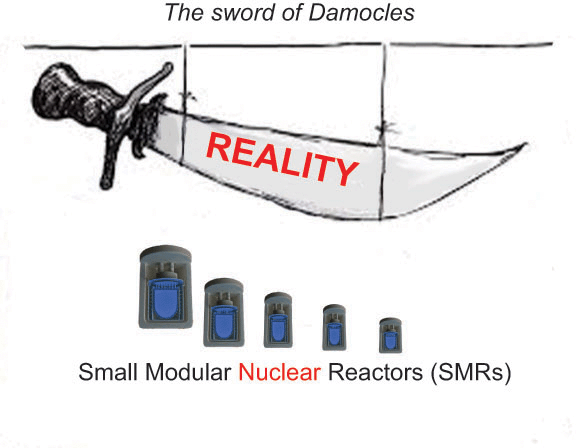
Mobile nuclear reactors? Scathing report slams ‘disturbing’ military program, Times, 1 May 21, Todd South The author of an academic report on Pentagon plans to build mobile nuclear reactors to power future combat bases called the effort “extremely disturbing” and “based on a lie.”
The report released Thursday slams the Pentagon and Army G-4, logistics — specifically the Army office’s 2018 report that lays out the potential uses and needs for such mobile nuclear reactors in future operations.
Alan J. Kuperman wrote the 21-page report titled, “Proposed U.S. Army Mobile Nuclear Reactors: Costs and Risks Outweigh Benefits,” in his role as coordinator of the University of Texas at Austin’s Nuclear Proliferation Prevention Project.
“They don’t reduce casualties, they increase costs and they increase threats to the lives of U.S. service members,” Kuperman said.
The program, known as “Project Pele,” is prototyping the mobile advanced microreactor concept under the Pentagon’s Strategic Capabilities Office……..
The DoD spokesman pointed out that the project is part of a collaboration involving the Department of Energy, Nuclear Regulatory Commission, U.S. Army Corps of Engineers and private industry. Project Pele is not being designed for a specific military service branch but does include experts across defense for a variety of requirements.
Army officials for G-4 deferred comment on the program to DoD……..
Congress approved funding for prototype reactors and the Army awarded $40 million in contracts to three nuclear reactor companies in March 2020 for Project Pele, according to the NPPP report.
Kuperman struck at the Army’s rationale, calling the project unnecessary and dangerous. He counters some of the main justifications that have been provided by DoD and Army reports:
High cost – Kuperman said the Army’s claims that nuclear power can provide cheaper electricity for powering future forward bases is “based on unrealistic assumptions.” Those include that such a reactor would have low construction costs and operate for 18 hours a day over 40 years. The more likely scenario is a mobile reactor would run for half that time over about 10 years, meaning nuclear electricity could cost 16 times more than estimates and still seven times more than diesel-generated power.- Vulnerability to missile attacks – The report points to the 2020 missile attack on forces at al-Asad air base in Iraq. Even with warnings hours ahead of time, more than 100 U.S. personnel suffered traumatic brain injury from the 11 strikes that hit the facility. And the missiles were 10 times more accurate than the Army has predicted in its report on the vulnerability of reactors to precision strikes. The service admits that a direct hit on a reactor would destroy the device. Kuperman notes that even the Army’s plans to protect the reactors, by burying them underground, could inadvertently cause meltdowns by impeding air cooling and causing overheating. A similar strike on an similar such future base with a reactor could cause far more devastating consequences.
Captured reactors – Should a U.S. base housing a mobile reactor be overrun or abandoned, the radioactive waste from the reactor could be used in “dirty bomb” terror attacks.- No mission for reactors – One of the chief purposes of pursing such reactor programs was to reduce casualties from diesel transport to remote bases. But Defense Department data shows a dramatic drop in casualties of five per 1 million gallons of fuel delivered in 2005 to nearly zero by 2013.
- High-energy weapons don’t need reactors – Kuperman states that the justification that future high-energy or laser weapons that the Army hopes to have protecting bases don’t require a reactor to power. “A high energy weapon would have to be fired millions of times to justify a reactor,” Kuperman said. “In reality such a weapon would be fired perhaps hundreds of times in its lifetime.”
- Transport problems – The Army wants to air deliver these reactors to combat posts. Kuperman questions the “regulatory nightmare” that would create. The program calls for initial tests flying the reactors domestically to run then returning them, and their radioactive waste, to another domestic location. Foreign transport would require approval of countries airspace traversed and the approval of a host nation where the reactor would be placed, he said. Other Army recommendations include truck or rail transport domestically and either ship or over-the-ocean flights to friendly ports to then move the reactors again via truck or rail.
Army Times reported on the proposed program in 2019, which had drawn backlash from the Union of Concerned Scientists and its then-director of the Nuclear Safety Project, Edwin Lyman, who called the proposal, “naïve.”The original proposal, approved by the Pentagon’s Strategic Capabilities Office asked for industry solutions in January 2019 on providing a less than 40-ton small, mobile nuclear reactor design that could operate for three years or more and provide 1 to 10 megawatts of power.Planners want the reactor to fit inside a C-17 cargo plane for air transport to theater. More recent moves have reduced the power output to 5 megawatts……..
Lyman notes a major failure with one of the original eight designs in 1961 when a core meltdown and explosion of the ML-1 reactor in Idaho killed three operators.
The three deployed to Antarctica, Greenland and Alaska proved “unreliable and expensive to operate,” Lyman wrote in his response to the Army’s 2018 report on the mobile reactor program.Lyman told Army Times on Thursday that a number of those old reactors required decades of decommissioning and one used at Fort Belvoir, Va., near Washington D.C. is finally scheduled for decommissioning in late 2021……….. https://www.armytimes.com/news/your-army/2021/04/30/mobile-nuclear-reactors-scathing-report-slams-disturbing-military-program/
Following Biden climate summit, USA govt keen to promote and export Small Nuclear Reactors

A Spotlight on Advanced Nuclear after the White House Climate Summit– JD Supra, 30 Apr 21. -”…….. With the nuclear ban lifted by the Development Finance Corporation for investment in innovation projects, the U.S. government acknowledged the importance of nuclear in the transition to [?] clean energy in developing economies.
……….. the Department of State announced the launch of its Foundational Infrastructure for the Responsible Use of Small Modular Reactor Technology (FIRST) Program. Through an initial $5.3 million investment, this program will strengthen international collaboration between the U.S. and partner countries seeking to deploy nuclear energy in their clear energy initiatives. This cooperation includes supporting the deployment of advanced nuclear technologies, including small modular reactors (SMRs),…….
The nuclear menace from under the seas and from high in the sky- theme for May 21
Why would anyone persist in pushing Small Nuclear Reactors (SMRs) and pretending that they can solve climate change, when they clearly cannot?
Well, the answer is – if you’re a toxic macho nuclear zealot or a nuclear weapons corporation – ( Lockheed Martin, Raytheon Technologies, Northrop Grumman, Boeing, and General Dynamics etc)- this myth about SMRs is manna from heaven.
It means that the tax-payer, not private enterprise investors, will take over the SMR push – and the military-industrial-complex will race away with nuclear sites and weapons in space, and with powerful killer nuclear submarines.

Meanwhile those billionaire nuclear gurus – Elon Musk, Bill Gates, Jeff Bezos, , Richard Branson, Jack Ma and othes , will be laughing all the way to the bank, as they promote ”peaceful, nuclear-powered” space travel.
The global media promotes the joy and delight of space travel, rarely acknowledging its intimate connection with militarism. And there’s a crazy sort of national pride – hubris in being in the space race.
The space race to what? Apart from the obvious – nuclear war and annihilation, there’s the danger of ecosystem plutonium pollution from accidents and leaks, drastic accidents, and the gobbling up of public funds that might otherwise go to the public good – health, education, welfare, climate ation – heck – even good international relations!
The USA and Russia have long been in a toxic competition to militarily control the world especially by nuclear submarines. There’s a strange and unwarranted confidence that nuclerar submarines are ”clean” and somehow ”safe”. That’s because they release their radioactive trash unseen, into the world’s ocean waters. When they have an accident, well they just sink, and their poisonous mess is invisible. Dead nuclear submarines seem to be no trouble, hidden on the sea floor. Now that the world has become (a bit) aware of the radioactive danger of nuclear submarines, the dead ones lie in port, as nobody really knows what to do with them, how to clean up the nuclear mess.
In this time of pandemic, it is urgently necessary to put the brakes on NATO, and Russia – in regard to the increasing danger to the world, of nuclear submarines. Even more than cruise ships, they can be a hot-bed of coronavirus – making them even more unsafe in a number of ways.
USA: Small nuclear reactors cannot meet the critical climate need – now, or ever

The critical need for deep carbon pollution reductions this decade calls on us to focus on the low-carbon technologies we have now. And those are wind and solar. SMRs will be a dollar short and a day too late. They cannot meet critical climate deadlines, not by 2030 or 2035, and likely never.
Advanced Nuclear Dreaming in Washington State, CounterPunch, PATRICK MAZZA 19 Apr 21, It was once known by one of the most inadvertently appropriate acronyms ever, WPPSS, the Washington Public Power Supply System. “Whoops!,” as they called it, in the early 1980s brought on what was then the worst municipal bond default in U.S. history trying to build five nuclear reactors in Washington state at once, completing only one.
But faith in the nuclear future lives on at “Whoops!,” today rebranded as Energy Northwest. On April 1, the day perhaps also inadvertently fitting, the consortium of Washington state public utilities announced a move aimed at the first advanced nuclear reactor deployment in the U.S. Energy Northwest will partner with Grant County Public Utility District, a member utility serving a desert county in the center of the state, and X-energy, a leading developer of the nuclear industry’s bright shining hope, the small modular reactor (SMR)…………….
The WPPSS default was part of the first wave of nuclear failures in the U.S. In the wake of the 1979 Three Mile Island accident, approximately 100 proposed nuclear plants were cancelled. Recent years have seen a second round of failures. The Energy Policy Act of 2005 put $25 billion in nuclear subsidies on the table. That jumpstarted all of four nuclear reactors, two each in Georgia and South Carolina. The only way Wall Street would touch the projects was to make ratepayers carry the risk by paying for “work in progress” before the first watt is delivered. South Carolina ratepayers won’t even see that. Cost overruns killed the project there in 2017 after $9 billion was thrown away, setting up a political and court fight over whether ratepayers will continue to be soaked. The last two standing, Georgia’s Vogtle plants, were to have cost $14 billion and come on line in 2016-17. Now costs have doubled to $28 billion and scheduled completion this year and next is considered unlikely.
IS THE SMR A SOLUTION?
SMRs are the nuclear industry’s answer to avoid such failures in the future. Instead of being custom-built and individually licensed, SMRs are intended to cut costs by licensing a single design manufactured at a plant and sent for final assembly to their operating site. Smaller than the 1,000-megawatt-plus plants with which we’re familiar, SMRs are 100 MW or less, and designed with safety features to prevent meltdowns such as experienced at Japan’s Fukushima plant in 2011. Though there are questions about that, as covered below…………..
CAN THE SMR SAVE THE CLIMATE?

For now, the question is whether SMRs such as X-energy’s can really revive the nuclear industry, and most importantly, provide a climate solution with low-carbon electrical power in a meaningful timeframe. The answer, by simple logic, is no
…………Though deep carbon cuts must start quickly, the Washington state partnership gives a completion date for its SMR pilot project as 2027-28. Considering the nuclear industry’s track record, delays and cost overruns are likely. And that would only be the beginning of a long-process to create the entire manufacturing supply chain needed to make SMRs an economical alternative. If they can be. The key issue is economies of scale.
“Power generation scales on volume of the reactor vessels,” notes Arjun Makhijani, who has a Ph.D. in electrical engineering, with a specialization in nuclear fusion, from the University of California at Berkeley. “The materials and labor scale more slowly. That’s a basic reason that there are economies of scale and big reactors were built.”
The Union of Concerned Scientists (UCS) cites a study which shows that a reactor with 1,100 MW capacity would cost three times as much to build as a 180 MW plant, but produce six times the electricity, “so the capital cost per kilowatt would be twice as great for the smaller plant.”
SMRs lose those economies of scale, but proponents hope to make that up with mass manufacturing and licensing, avoiding costs of custom-built plants.
ROCKY ROAD TO MASS PRODUCTION
“The road to such mass manufacturing will be rocky,” Makhijani and M.V. Ramana write in a recent article, “Why Small Modular Reactors Won’t Help Counter the Climate Crisis.” “Even with optimistic assumptions about how quickly manufacturers could learn to improve production efficiency and lower cost, thousands of SMRs, which will all be higher priced in comparison to large reactors, would have to be manufactured for the price per kilowatt for an SMR to be comparable to that of a large reactor.”
That sets up “a chicken-and-egg economic problem,” they write. “Without the factories, SMRs can never hope to achieve the theoretical cost reductions that are at the heart of the strategy to compensate for the lack of economies of scale. But without the cost reductions, there will not be the large number of orders to stimulate the investments needed to set up the supply chain in the first place.”………….
WE DON’T NEED NUCLEAR
The world is running out of time to address all the concerns facing SMRs and advanced reactor designs in general.
“If you look at the cold facts from a climate point of view we have a shortage of time and money. New reactors cannot help materially,” Makhijani told The Raven. “How are we going to have a carbon-free electricity system by 2035 in which SMRs will play a significant role when the first one isn’t even supposed to come on line till the late 2020s? Those who are advocating new nuclear reactors should address the time constraint, and whether we can do it without nuclear. If we could not do it without, that would be another question. But we can. So there should be no question.”
Many studies document the capacity of wind and solar to replace fossil fuel electricity. The challenge of varying sunlight and wind speeds is met with a smart grid that can adjust energy demand to available supply and link diverse geographies. So when the wind is blowing on the Great Plains, it can supply juice while clouds block sunlight in Chicago. For times when none of that is sufficient, storage in many forms can be used, from batteries to pumped storage reservoirs. Even household water heaters. If all else fails, backup generators fueled with stored hydrogen can be brought into play. Hydrogen can be electrolyzed from water through solar and wind energy that would otherwise go unused because generation exceeds the demands of the grid.
Mark Jacobson of Stanford has done many studies documenting the capacity of wind, water and solar to meet all energy needs. A NOAA study showed carbon pollution from electricity could be cut up to 80% from 1990 levels by 2030, largely with wind and solar, needing no new nuclear and energy storage, while actually cutting electricity costs. That would require building a continental grid with efficient high-voltage DC lines to link diverse geographies. A study done by Makhijani for the Institute for Environmental and Energy Research, of which he is president, lays out a path to zero carbon electricity in Maryland.
ANOTHER WHOOPS?
Despite towering obstacles facing SMRs, from economic chicken-and-egg problems of ramping up production, to unsolved waste and proliferation issues, to remaining safety questions, the nuclear faithful at Energy Northwest soldier on. Yes, they now have operated a nuclear plant successfully since the 1980s, though questions have been raised about earthquake hazards in light of emerging seismic knowledge. Washington state has enacted a goal of 100% clean electricity by 2045, and nuclear advocates see it filling a role. In any event, new nuclear power from SMRs will be incapable of supplying a significant portion of low-carbon energy until well into the 2030s, even if economic and other issues are resolved.
All that time, any new nuclear reactors will be facing continuing cost declines in wind, solar and storage, as well as increasing deployment of smart grid technologies and advanced long-distance power transmission. If the Washington state partnership’s SMR installation actually is built and operated, with the 2027-8 timeline likely to be stretched out and the projected $2.4 billion cost figure likely to be exceeded, it could well be a costly white elephant, a relic of faith in a technology whose time has passed. The critical need for deep carbon pollution reductions this decade calls on us to focus on the low-carbon technologies we have now. And those are wind and solar. SMRs will be a dollar short and a day too late. They cannot meet critical climate deadlines, not by 2030 or 2035, and likely never. https://www.counterpunch.org/2021/04/19/advanced-nuclear-dreaming-in-washington-state/
Britain’s unlikely-to-succeed bet on Rolls Royce small nuclear reactors

…..Advanced Modular Reactors are unlikely to be available before 2045 if ever – much too late to be any help in tackling the climate emergency. .….
Small Modular Reactors s will only proceed if the risk to RR money is minimal. That means RR will only put serious effort into design development with government guarantees given now, before the design exists, and it has been reviewed by ONR, a demonstration plant has been completed, and costs are known.
SMRs will only proceed if the risk to RR money is minimal. That means RR will only put serious effort into design development with government guarantees given now, before the design exists, and it has been reviewed by ONR, a demonstration plant has been completed, and costs are known.
UK taxpayers would have to provide a large proportion of the cost of design development, navigating the regulators design assessment and assist in the setting up of component production lines. It would also have to guarantee orders for a minimum of 16 reactors, which, even on Rolls Royce’s unrealistic cost estimate, would be a commitment to spend nearly £30bn before it has progressed beyond a conceptual design.
Johnson Loves Pie in the Sky nuClear News N0. 131 April 2021, We saw in June 2020 (nuClear News No. 126) how the Nuclear Innovation and Research Advisory Board (NIRAB) has been advising the Department for Business, Energy and Industrial Strategy (BEIS) that we need three streams of nuclear product development and deployment:
• large-scale Light Water Reactors (LWRs), which are currently available and suitable for baseload electricity generation;
• small modular reactors (SMRs), which are based on the same proven technology and can offer additional flexibility to meet local energy needs;
• advanced modular reactors (AMRs), which typically have a higher temperature output, enabling them to contribute to decarbonisation through heat and hydrogen production, as well as generate electricity at competitive costs.
Small modular and advanced nuclear reactors are proposed, supposedly, as potential ways of dealing with some of the problems of large nuclear reactors —specifically economic competitiveness, risk of accidents, link to proliferation and production of waste. Yet Gregory Jaczko, Former Chair US Nuclear Regulatory Commission, says Advanced Nuclear Technologies should only be supported “if they can compete with renewables & storage on deployment cost & speed, public safety, waste disposal, operational flexibility & global security. There are none today.” (1)
The UK Government’s Policy Paper on ‘Advanced Nuclear Technologies’ (ANTs) specifies two broad categories of ANT. Firstly, Generation III water-cooled reactors similar to existing nuclear power station reactors but smaller, it calls Small Modular Reactors (SMRs). This is despite the fact that the Rolls Royce design which it is supporting is 470MW – much larger than the maximum 300MW defined by IAEA as small.
Secondly, Generation IV which use novel cooling systems or fuels to offer new functionality (such as industrial process heat) it calls Advanced Modular Reactors (AMRs). (2)
In July 2019 the UK Government gave an initial £18m to Rolls-Royce to help them develop the design for an SMR. This was to be matched with funding from the consortium led by Rolls-Royce (and including Assystem, SNC Lavalin/Atkins, Wood, Arup, Laing O’Rourke, BAM Nuttall, Siemens, National Nuclear Laboratory, and Nuclear AMRC). (3)
A year earlier, in June 2018, as part of the UK government’s £200 million Nuclear Sector Deal, £56 million was put towards the development and licensing of advanced modular reactor designs. Eight non-light water reactor (non-LWR) vendors each received £4 million to perform detailed technical and commercial feasibility studies. Those vendors were Advanced Reactor Concepts, DBD, LeadCold, Moltex Energy, Tokamak Energy, U-Battery Developments, Ultra Safe Nuclear Corporation (USNC), and Westinghouse Electric Company UK. (4) This was Phase One of the Advanced Modular Reactor (AMR) Feasibility and Development Project. Then in July 2020 Phase Two was announced with 3 AMRs receiving a share of £40m: U-Battery (4MW hig temperature reactor), Westinghouse (450MW lead-cooled fast reactor) & Tokamak (fusion). A possible further £5m was also made available to regulators to support this. (5) In November 2020, Boris Johnson’s 10 Point Plan confirmed the Government’s commitment to advancing large, small and advanced reactors, and announced an Advanced Nuclear Fund of up to £385 million which included:
• funding of up to £215 million for Small Modular Reactors (SMRs); • up to £170 million for Advanced Modular Reactors (AMRs); • up to £40 million to develop regulatory frameworks and support UK supply chains to help bring these technologies to market.
According to the Energy & Climate Change Intelligence Unit (ECIU) the investment in small modular reactors (SMRs) was less than expected. “If I was in the SMR game I’d be disappointed with this because £2bn support for a small initial fleet of reactors has been paired back to just over £500M.” (6)
Professor Steve Thomas says the 3 AMRs are unlikely to be available before 2045 if ever – much too late to be any help in tackling the climate emergency. (7)
The Rolls Royce (RR) SMR design is still at an early stage. It was only announced in 2016. It is slightly larger than the first unit at Fukushima (470MW vs 439MW) and much larger than the Trawsfynydd Magnox reactors, which were 250MW. Rolls Royce claims the first reactor could be operational by 2030, but it’s hard to see how this can be achieved. Even if achieved it is probably too late. By 2030 only Sizewell B and possibly Hinkley Point C will be operating and if the UK is to meet its targets of reducing greenhouse gas emissions by 68% by 2030 and 78% by 2035, we should by then be well on the road to a low carbon economy with a limited nuclear capacity
Thomas says SMRs will only proceed if the risk to RR money is minimal. That means RR will only put serious effort into design development with government guarantees given now, before the design exists, and it has been reviewed by ONR, a demonstration plant has been completed, and costs are known.
Rolls-Royce told the House of Lords Science and Technology Committee in 2016 that 7GW of power would “be of sufficient scale to provide a commercial return on investment from a UKdeveloped SMR, but it would not be sufficient to create a long-term, sustainable business for UK plc.” Therefore, any SMR manufacturer would have to look to export markets to make a return on their investment.
Rolls Royce is making extraordinary demands on the UK Government that it must commit to before further significant development work takes place. Thomas says RR would need:
- Exclusive access to UK market;
• Matched funding (minimum) up to end of Generic Design Assessment;
Sharing of costs for production line facilities (to produce 2 reactors per year);
• Guaranteed orders for 7GW (16 reactors).
UK taxpayers would have to provide a large proportion of the cost of design development, navigating the regulators design assessment and assist in the setting up of component production lines. It would also have to guarantee orders for a minimum of 16 reactors, which, even on Rolls Royce’s unrealistic cost estimate, would be a commitment to spend nearly £30bn before it has progressed beyond a conceptual design. The first plant must be made using production lines so all 16 reactors must be ordered now & by the time the first is completed, another 8 will be on their way. (8)
Rolls Royce claims a construction time of 4 years & costs (after 5 units) of £1.8bn (£3800/kW), which means electricity at £40-60/MWh. These claims are extraordinary but very similar to those made for Hinkley Point C. In 2000, it had been claimed the EPR would be built in four years or less and would cost $1000/kW (about £800/kW). In fact, all EPR’s that have been built have gone far over budget and all will take much more than 4 years to construct. The latest cost estimate for Hinkley Point C is about £27bn (2020 money) or about £8400/kW. Rolls Royce’s claims must therefore be taken with a very large pinch of salt.
Steve Thomas comments:
“The UK Government’s ‘Green Industrial Revolution’ 10-point plan of November 2020 seemed to include a major strengthening of the commitment to Small Modular Reactors (SMRs). However, closer examination shows much of the money is far from committed and the focus is on technologies that have little chance of contributing to meeting the UK’s target of zero-carbon by 2050. There remains no firm commitment to the Rolls Royce SMR and it must be hoped the government is unwilling to gamble the huge sums of money Rolls Royce is demanding to be promised if it is to progress the design from the early stage it is currently at.” ……… https://www.no2nuclearpower.org.uk/wp/wp-content/uploads/2021/04/nuClearNewsNo131.pdf
Washington’s nuclear industry a costly failure for ratepayers. Now they’re about to fail again, with small nuclear reactors
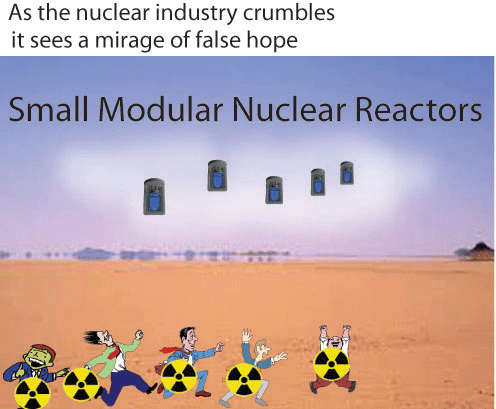
Advanced Nuclear Dreaming in Washington State, CounterPunch, PATRICK MAZZA 19 Apr 21……………..The WPPSS default was part of the first wave of nuclear failures in the U.S. In the wake of the 1979 Three Mile Island accident, approximately 100 proposed nuclear plants were cancelled. Recent years have seen a second round of failures. The Energy Policy Act of 2005 put $25 billion in nuclear subsidies on the table. That jumpstarted all of four nuclear reactors, two each in Georgia and South Carolina. The only way Wall Street would touch the projects was to make ratepayers carry the risk by paying for “work in progress” before the first watt is delivered. South Carolina ratepayers won’t even see that. Cost overruns killed the project there in 2017 after $9 billion was thrown away, setting up a political and court fight over whether ratepayers will continue to be soaked. The last two standing, Georgia’s Vogtle plants, were to have cost $14 billion and come on line in 2016-17. Now costs have doubled to $28 billion and scheduled completion this year and next is considered unlikely.
IS THE SMR A SOLUTION?
SMRs are the nuclear industry’s answer to avoid such failures in the future. Instead of being custom-built and individually licensed, SMRs are intended to cut costs by licensing a single design manufactured at a plant and sent for final assembly to their operating site. Smaller than the 1,000-megawatt-plus plants with which we’re familiar, SMRs are 100 MW or less, and designed with safety features to prevent meltdowns such as experienced at Japan’s Fukushima plant in 2011. Though there are questions about that, as covered below.
X-energy’s proposed plant is 80 MW. The Washington partnership envisions clustering four to make a 320-MW complex, with costs estimated at $2.4 billion. Half is to come from the U.S. Department of Energy’s Advanced Reactor Demonstration Program (ARDP), and half from private investors, apparently leaving ratepayers out of the picture this time.
ARDP in 2020 made two $80 million grants to advanced nuclear reactor developers, one to X-energy, and the other to TerraPower, a venture in which Bill Gates has invested. The latter, slated to be 345 MW, aims at eventual scales as large as today’s plants, so it is not an SMR. The TerraPower liquid-sodium cooled reactor concept has its own set of issues. Liquid-sodium reactors have suffered operating difficulties and fires, and pose potential weapons proliferation hazards. The Raven will look at TerraPower in a future post……..
ROCKY ROAD TO MASS PRODUCTION
“The road to such mass manufacturing will be rocky,” Makhijani and M.V. Ramana write in a recent article, “Why Small Modular Reactors Won’t Help Counter the Climate Crisis.” “Even with optimistic assumptions about how quickly manufacturers could learn to improve production efficiency and lower cost, thousands of SMRs, which will all be higher priced in comparison to large reactors, would have to be manufactured for the price per kilowatt for an SMR to be comparable to that of a large reactor.”
That sets up “a chicken-and-egg economic problem,” they write. “Without the factories, SMRs can never hope to achieve the theoretical cost reductions that are at the heart of the strategy to compensate for the lack of economies of scale. But without the cost reductions, there will not be the large number of orders to stimulate the investments needed to set up the supply chain in the first place.”
That is leaving aside the prospect of a design defect being discovered after many SMRs have been deployed. In the 1990s, multiple Westinghouse-built reactors suffered common steam generator problems, resulting in lawsuits. “If an error in a mass-manufactured reactor were to result in safety problems, the whole lot might have to be recalled, as was the case with the Boeing 737 Max and 787 Dreamliner jetliners,” Makhijani and Ramana write. “But how does one recall a radioactive reactor? What will happen to an electricity system that relies on factory-made identical reactors that need to be recalled?”
The economic hurdles of SMRs posed by its competitors are overwhelming.
“Lazard, a Wall Street financial advisory firm, estimates the cost of utility-scale solar and wind to be about $40 per megawatt-hour,” Makhijani and Ramana write. “The corresponding figure for nuclear is four times as high, about $160 per MWh – a difference that is more than enough to use complementary technologies, such as demand response and storage, to compensate for the intermittency of solar and wind.”
While costs for competitors declines, nuclear costs continue to escalate. Cost for a proposed Idaho project by NuScale, another SMR developer, has doubled from an estimated $3 billion in 2015 to $6.1 billion in 2020 “long before any concrete has been poured,” Makhijani and Ramana note………. https://www.counterpunch.org/2021/04/19/advanced-nuclear-dreaming-in-washington-state/
Bill Gates and 28 other billionaires pushing their small nuclear reactors, on the pretext that they’re ”clean”
Billionaires leading push for nuclear reactors in Canadian mining

By Joyce Nelson, Rabble, April 19 2021https://rabble.ca/news/2021/04/billionaires-leading-push-nuclear-reactors-canadian-miningThis is part two of a two-part series on small modular reactors.
In January 2019, Gordon Edwards, president of the Canadian Coalition for Nuclear Responsibility, warned that the Trudeau government has a “desire to build small modular nuclear reactors [SMRs] all over Canada, especially in the North, to support the accelerated exploitation of natural resources.” Edwards included an excerpt from Nuclear Energy Insider, published January 16, 2019, which stated: “Canada’s large mining sector is seen as a key early market for SMR plants as operators look to reduce carbon emissions and costs.”
That “early market” for small modular reactors has been cleverly targeted by a key lobby group. As I wrote for Watershed Sentinel, Bill Gates and 28 other billionaires and “high-net-worth” individuals launched the Breakthrough Energy Coalition at the 2015 Paris climate talks to lobby for small nuclear reactor development as “clean technology” in dozens of countries, including Canada.
This billionaires’ nuclear club has been working closely for years with Natural Resources Canada in the push for small modular reactors, especially for use in off-grid mining………………….
With Gates and his billionaires’ nuclear club backing KoBold, it’s likely that their off-grid mining projects would welcome government financing for small modular reactors.
When asked about the situation, Mining Watch Canada’s Jamie Kneen told me by email:
“On the one hand, the mining industry faces so much risk in the markets that it’s unlikely to add to that risk by jumping on an unproven technology [like SMRs]. On the other hand, the mining industry is used to leaving masses of toxic waste behind for others to deal with — and getting away with it — so it’d be a perfect fit.”
Three political parties are fully against small modular reactors: the NDP, the Bloc Québécois, and the Green Party — worth remembering if the federal budget causes an election.
This is part one of a two-part series on small modular reactors. Read part one here.
Freelance writer Joyce Nelson is the author of seven books. She can be reached via www.joycenelson.ca
https://rabble.ca/news/2021/04/billionaires-leading-push-nuclear-reactors-canadian-mining
Trudeau government’s extraordinary push for small nuclear reactors – tax breaks, no environmental assessment …
Budget may reveal extent of federal support for risky new nuclear reactors. Rabble.Ca Joyce Nelson 15 Apr 21, Across Canada, environmentalists and First Nations will be closely watching the April 19 release of the federal budget to see just how far the Trudeau Liberals will go in their push for small modular reactors (SMRs).
In September 2020, Canada’s Minister of Natural Resources Seamus O’Regan endorsed SMRs and stated that there is “no pathway to net zero [carbon emissions] without nuclear,” which prompted David Suzuki to famously tell the CBC: “I want to puke.”
Apparently, many share that feeling.
More than 100 Indigenous and civil society groups across Canada are now opposed to the new nuclear reactors, which are being pushed by the federal government and four provinces — Saskatchewan, Ontario, New Brunswick and Alberta — as so-called “clean energy” and a supposed solution to climate change.
These governments argue that the reactors would be the replacement for diesel in remote communities and for use in off-grid mining, tar-sands development, heavy industry, and as exportable expertise in a global market.
But opponents call SMRs “dirty, dangerous and distracting” from real climate solutions.
Even before the budget, the Trudeau Liberals have already taken several steps to advance development of the reactors, especially for use in off-grid mining.
Steps towards small reactors
The feds endorsed the March 2019 Canadian Minerals and Metals Plan, drawn up by federal, provincial and territorial governments. That plan urges governments to “accelerate efforts to develop and adopt clean energy sources, especially for northern, remote and isolated communities that rely on diesel” and “continue to study the feasibility of small modular reactors in mining operations, as well as the potential market for this technology.”
Then, in September 2020, Canada and the U.S. agreed to collaborate on the financing and production of rare-earth and other key metals, which are necessary for a wide range of products including batteries, solar panels, electric vehicles, AI, and weaponry.
After the December 2020 release of the “SMR Action Plan,” the federal government also decided that there would be no environmental impact assessments for small modular reactors, and that tax incentives should be given for this so-called “clean technology.”
The recent mandate letter to Finance Minister Chrystia Freeland directs her to “cut tax rates by 50 per cent for companies that develop and manufacture zero-emission technology” in order to “make Canada a world leader in clean technology.”
As rabble.ca noted, “[t]he Canadian Nuclear Safety Commission (CNSC) has just given a green light to the preferred industry solution for disposal of nuclear reactors — entomb and abandon them in place, also known as ‘in-situ decommissioning.’ This paves the way for the introduction of a new generation of ‘small modular’ nuclear reactors or SMRs.”
While this would be a disaster for the environment and nearby communities, it would be a boon for the nuclear industry and the off-grid mining sector, which would not have to deal with the fallout and repercussions of such nuclear waste once a mining project is finished.
Important policy change
On December 7, 2020 the Hill Times published an open letter to Treasury Board from more than 100 women leaders across Canada, stating:
“We urge you to say ‘no’ to the nuclear industry that is asking for billions of dollars in taxpayer funds to subsidize a dangerous, highly polluting and expensive technology that we don’t need. Instead, put money into renewable, energy efficiency and energy conservation.”………….. https://rabble.ca/news/2021/04/budget-may-reveal-extent-federal-support-risky-new-nuclear-reactors
No market for small nuclear reactors, so no justification for setting up factories to make them.
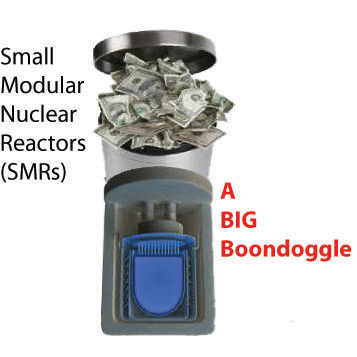
IEEE 9th March 2021, Small modular and advanced nuclear reactors have been proposed as potential ways of dealing with the problems—specifically economic competitiveness, risk of accidents, link to proliferation and production of waste—confronting nuclear power technology. This perspective article examines whether these new designs can indeed solve these problems, with a particular focus on the economic challenges.
It briefly discusses the technical challenges confronting advanced reactor designs and the many decades it might take for these to be commercialized, if ever. The article explains why the higher construction and operational costs per unit of electricity generation capacity will make electricity from small modular reactors more expensive than electricity from large nuclear power plants, which are themselves not competitive in today’s electricity markets.
Next, it examines the potential savings from learning and modular construction, and explains why the historical record suggests that these savings will be inadequate to compensate for the economic challenges resulting from the lower generation capacity. It then critically examines arguments offered by advocates of these technologies about job creation and other potential uses of energy generated from these plants to justify subsidizing and constructing these kinds of nuclear plants. It concludes with an assessment of the markets for these technologies, suggesting that
these are inadequate to justify constructing the necessary manufacturing facilities.
https://ieeexplore.ieee.org/document/9374057
At last! – some media questioning the story that small nuclear reactors combat climate change
 What’s the Role for New Nuclear Power in the Fight Against Climate Change?
Some fear that small modular reactors could rob cash from more proven low-carbon technologies. Greentech Media, JASON DEIGN MARCH 08, 2021 Small modular reactors (SMRs) — nuclear reactors using novel technologies to fit into much smaller and mass-producible packages than the behemoth nuclear power plants of today — are presented as a way of rapidly decarbonizing the grid in the face of an ever more pressing need to meet climate targets. But some opponents claim new nuclear power could have the opposite effect, slowing the fight against human-caused climate change just when things should be speeding up.In September last year, for example, the Sierra Club Canada Foundation harshly criticized Canada’s plans to foster an SMR industry.SMRs “are not the solution to climate change,” said the organization, citing a University of British Columbia study indicating that energy produced by SMRs could cost up to 10 times as much as power from renewable sources such as wind and solar.
“Critics of SMRs say that developing experimental nuclear reactor technologies will take too long to make a difference on climate change and could drain billions of dollars from public coffers,” said the advocacy group.
Similar challenges have been leveled against U.S. utilities such as Duke Energy and Southern Company that include SMRs in the longer-range suite of options to fully decarbonize their power grids by 2050. Critics question whether the SMRs under development today can be commercialized fast enough to drive down emissions over the next decade or two and whether government funding to drive faster deployment might better be spent on other technologies.
That’s not the only criticism facing new nuclear. In 2014, NuScale Power, which looks likely to become the first Western SMR developer to commercialize a reactor, published a paper on the use of its SMRs for oil recovery and refining applications.
The aim of the paper was to show that SMRs could be instrumental in “reducing the overall carbon footprint of these industrial complexes and preserving valuable fossil resources as feedstock for higher-value products,” according to the authors.
Nevertheless, it doesn’t look good for the nuclear industry’s climate-fighting credentials when one of its upcoming stars is apparently touting wares to the oil and gas sector.
In a written statement, Diane Hughes, NuScale Power’s vice president of marketing and communications, told GTM that the SMR developer “does not comment or discuss what companies we may be talking to regarding potential business opportunities.”……
Doubts over government finance for SMRs
Despite this, the question remains whether it makes sense for governments to put money into SMR research and development when other low-carbon generation technologies can be used to combat climate change right away.
Nuclear skeptics such as David Toke, who researches energy politics at the University of Aberdeen in the U.K., don’t think so. SMRs “are a diversion from the development of energy systems that best mitigate climate change,” he said in an interview.
“Small reactors already exist, and they occupy a very niche zone, which is military marine, mainly. That allows very high costs. But that’s the point: They cost an awful lot of money. Just because something reduces carbon emissions doesn’t mean to say the state ought to encourage it.” ….https://www.greentechmedia.com/articles/read/whats-the-role-for-new-nuclear-power-in-the-climate-change-fight
Despite the problems, small nuclear reactor salesmen aggressively marketing: it’s make or break time for the nuclear industry.

Entrepreneurs Look to Small-Scale Nuclear Reactors, The American Society of Mechanical Engineers, Mar 2, 2021, by Michael Abrams ‘‘……… even concepts that are predicated on being small, modular, and fast to build seem locked into decades-long development cycles.
The key to reviving the nuclear power industry is building these small reactors not as projects, but as factory-made products. That’s easier said than done. “Usually, a bunch of nuclear engineers go in a room and then they come out after a year or two, and they have a design that doesn’t have a lot of foundation in realty, and nobody can make it, and the projects dies,” said Kurt Terrani, a senior staff scientist at Oak Ridge National Laboratory………..
In terms of reactor physics, the NuScale concept is fairly bog standard: low-enriched uranium, light-water cooling. In essence, their reactor is just a smaller version of the nuclear plants already in operation. That NuScale didn’t go with a more revolutionary design to mitigate waste or utilize an alternative fuel cycle is no accident. To do so would require the Nuclear Regulatory Commission to come up with an entirely new licensing framework, said José Reyes, cofounder and chief technology officer at NuScale.
“Pressurized water-cooled reactors have benefited from billions of dollars of research and development and millions of hours of operating experience over the past 50 year,” Reyes said. “NuScale went with a more traditional approach to assure a design that is cost-competitive and capable of near-term deployment.”
So far, the concept and design have been convincing enough to win funding from the DoE and to move NuScale farther along in the regulatory process than any of its would-be competitors.
“The whole idea of SMRs is that smaller is better,” said Jacopo Buongiorno, a professor of nuclear science and engineering at MIT and the director of the Center for Advanced Nuclear Energy Systems. “But within the class of small reactors, larger is still better. If you can design a reactor that is still simple, that is still passively safe, that can still be built in a factory, but that generates 300 megawatts, that for sure is going to be more economically attractive than the same thing that generates 60 megawatts.”
Make or Break for Nuclear
Moltex is aiming for build costs at around $2,000 per kW—more than wind or solar, but less than newly built coal or gas plants, let alone competing nuclear concepts. “We’ve believe we’ve come up with a concept that can radically reduce the cost of nuclear power,” ……
Montana legislatures to review the law restricting nuclear developments
At the same time the House was reviewing a bill sponsored by Rep. Derek Skees, R-Kalispell, to remove restrictions on nuclear development, the Senate was at work on Senate Joint Resolution 3, which directs the state to study advanced nuclear reactors. The resolution appears well-positioned to pass — halfway through the session, SJ 3 has garnered unanimous support in the Senate.
Sponsor Terry Gauthier, R-Helena, becomes audibly excited discussing the measure. He said he sees modern nuclear technology as a way for Montana to send electrons to the energy-thirsty markets of the Pacific Northwest by tying into the high-voltage transmission lines leading out of Colstrip……..
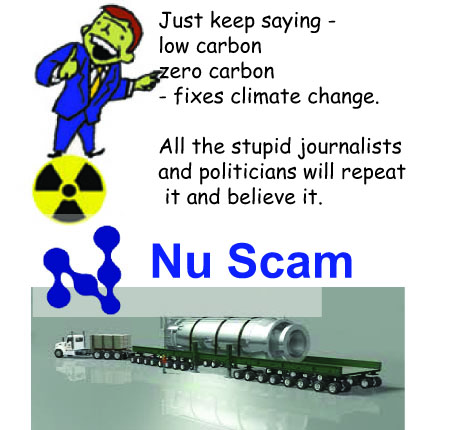 Gauthier is particularly interested in a company called NuScale, based in Portland, Ore., that’s garnered more than $1.3 billion from the federal government to advance its small modular reactor, or SMR, design. It’s the only company that’s received approval from the federal Nuclear Regulatory Commission for that type of design — a significant milestone on the journey to market……….
Much of the debate about the environmental impact associated with nuclear energy is focused on what to do with the spent fuel. Some kinds of nuclear fuel can remain radioactive for hundreds or thousands of years. The U.S. has yet to arrive at a long-term solution for re-using or storing spent fuel, creating a contentious political issue that’s spanned decades.
As is the case with larger-scale traditional nuclear plants, spent fuel from SMRs remains a “significant issue,” according to Darby.
NuScale’s plan is to store used fuel underwater in a stainless-steel lined concrete pool located onsite for at least five years. They say the pool is designed to withstand “a variety of severe natural and human made phenomena” like earthquakes and aircraft impacts. After the five-year period when the used fuel is both hottest and most radioactive has elapsed, it’s moved to a stainless-steel canister surrounded with concrete that’s designed to contain the radioactivity.
The United States doesn’t have a permanent underground repository for high-level nuclear waste, so those concrete containment vessels generally remain on-site or near the plant they came from. A 33-year-old effort to create such a long-term storage repository northwest of Las Vegas is still subject to heated debate. ……….
Another question hanging over nuclear energy development is the price of building a new plant. It’s not uncommon for new construction costs to exceed $1 billion. Concerns about cost increases led several cities that had committed to participate in NuScale’s demonstration plant in Idaho Falls to pull out of the multi-billion-dollar project last year.
NuScale told Montana Free Press that once production is rolling on their product, it anticipates the facility construction cost to be about $2,850 per kilowatt of producing capacity for its largest, 12-module iteration. For comparison, new construction of a natural gas plant averaged about $837 per kilowatt of capacity in 2018, and wind plants clocked in at $1,382, according to the U.S. Energy Information Administration.
Brad Molnar, a Republican senator from Laurel, told MTFP that cost will be an important consideration as the state plots its energy future. He said the study Gauthier is spearheading should involve the Public Service Commission, because it doesn’t make sense to conduct the study without landing on a cost-per-megawatt estimate.
Gauthier knows that nuclear is by no means the least expensive energy source, particularly if calculations are based on a strict dollars-and-cents equation…….
It’s not yet clear if Montana’s 1978 law requiring voter approval before a nuclear energy plant can be built in the state will still be on the books next year. The Legislature is still deciding the fate of HB 273, which would strike that law and remove nuclear projects from the purview of the Major Facility Siting Act.
Sen. Molnar has been asked if he’d carry HB 273 when it’s heard in the Senate, but he said he has reservations about the measure.
“By and large, I’m really hesitant to overturn a [voter] initiative,” he said, adding that the order of operations seems a little off to him.
“First you do the study, then you take action,” he said. “You don’t take action and then do the study.”
As of March 4, both HB 273 and SJ 3 have been transmitted to the Senate and House, respectively, for review. Hearing dates before those chambers’ energy committees have not been set. https://montanafreepress.org/2021/03/04/nuclear-on-the-radar-part-ii/
Is it wise for the Biden administration to fund Small Nuclear Reactors?
|
Climate change and ‘advanced nuclear’ solutions, The Hill, BY GREGORY JACZKO, — 02/23/21
Nuclear power is knocking on the government’s door offering solutions. The Biden platform answered by including so-called “advanced nuclear” in its list of climate options. The question now is will they wisely fund any such efforts?
While talk of advanced nuclear reactors is ubiquitous, a precise definition is elusive. Without a clear target in which to aim, government funds will not hit the mark. Advanced nuclear has become the catch-all for the knight-in-shining-armor reactors that promise to address issues that have kept nuclear a marginal electricity player since its inception. But we need more than this open-ended definition. The Biden administration should support projects only if they can compete with renewables and storage on deployment cost and speed, public safety, waste disposal, operational flexibility and global security. There are none today.
The only advanced nuclear technologies close to realization are called small modular reactors. These reactors are smaller than traditional reactors and are self-contained. These features allow companies to manufacture most of the reactor in a factory and ship it to a plant site. This concept evokes images of smart phones rolling out of factories by the billions — each design identical and mass produced. Their small size reduces the amount of radiation that can be released to the environment, greatly reducing — but not eliminating — safety to a plant’s community….
Yet the economic competitiveness of small modular reactors appears weak. Shrinking the size of a traditional reactor and splitting it among many modules increases the cost of the electricity it produces. It is the same reason airlines fly large capacity jets instead of private jets. You maximize the revenue per area of the aircraft hull. Proponents argue mass production will overcome this problem with fleet-wide economies of scale and construction efficiencies. Only wide scale adoption of the technology would deliver those benefits and there is no obvious market to support that today.
Moreover, the nuclear industry always promises better, faster and cheaper yet it fails to deliver. ……
Small modular designs are only promising to be cheaper than traditional reactors. Current estimates show they are more expensive than renewables, like wind and solar, even with storage and without subsidies. Small reactors have a long way to go to be competitive. Dramatic cost decreases for high-volume energy storage, which address the intermittency of some renewables, make the competitive case for any form of nuclear even tougher.
Even if everything else was lined up perfectly, nuclear has little time to catch up. After reentering the Paris Agreement, the U.S. will again strive to achieve drastic reductions in greenhouse gas emissions (GHG) within the next 10 years. Even in the most optimistic scenario, we won’t see even a handful of small modular nuclear reactors in the U.S. until 2029 or 2030, which means a large-scale impact would come far after the climate tipping point.
What about the other factors like proliferation resistance and waste disposal? For those criteria, small modular reactors offer no advantages over their traditional reactor cousins. Even if the cost factors are addressed, proliferation concerns and waste management will be hurdles.
Most importantly, no small modular reactors have been deployed yet in the United States, despite government efforts. In 2011, the Department of Energy (DOE) offered $400 million grants to support two small modular reactor designs. After providing tens of millions, only one design is still under development. That company originally planned to build a 12-module plant at the Idaho National Laboratory.
Predictably, this project is in trouble. Electricity customers have committed to purchase just a small fraction of the power produced annually by that plant, which now is likely to be scaled down, diminishing the economies of scale from mass production. It will not operate until at least 2030, years behind schedule and too late to help deal with the problem forecast in the best climate models. Despite these challenges, the federal government agreed in concept to a $1.4 billion direct subsidy over 10 years for the project. Without this cash infusion, the project will not meet its already disputed targets for price competitiveness. Such largesse is part of the billions Congress and the Trump administration committed to other advanced reactor concepts, none of which are close to deployment. To avoid wasting money on advanced nuclear reactors, the Biden administration must establish clear metrics for advanced nuclear reactors and apply them rigorously. Only ideas that can meet the pressing timetable of climate demands and electricity market realities deserve a serious look. My list is a good place to start. If advanced reactors cannot meet these metrics, they should not receive funding. Proponents of nuclear power will certainly say that living up to my list is an arduous task. Perhaps it is, but the future of our planet hangs in the balance. That is more important than the profits of an industry. Dr. Gregory Jaczko was the chairman of the U.S. Nuclear Regulatory Commission from 2009 to 2012 and currently develops clean energy projects and teaches at Princeton University. https://thehill.com/opinion/energy-environment/539991-climate-change-and-advanced-nuclear-solutions |
|
NuScale’s small nuclear reactor dream – dead on arrival?
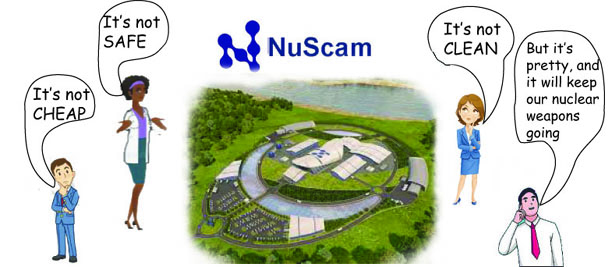
in order to make advanced reactors accessible within the next few decades—even relatively simple reactors, like NuScale’s—the government would need to provide hundreds of billions of dollars in subsidies …… the nuclear dream looks dead on arrival….
Biden’s Other Nuclear Option, Smaller nuclear reactors might be the bridge to a carbon-free economy. But are they worth it? Mother Jones, 22 Feb 21, BOYCE UPHOLT ”………..
But are these investments worth the money—and the risks? New designs or not, nuclear plants face daunting issues of waste disposal, public opposition, and, most of all, staggering costs. We must ramp up our fight against climate change. But whether nuclear is a real part of the solution—or just a long-shot bid to keep a troubled industry alive—is a debate that will come to the fore in the short window we have to overhaul the nation’s energy portfolio.
Few issues divide us as cleanly as nuclear power. According to a 2019 Pew Research Center poll, 49 percent of Americans support opening new plants, while 49 percent are opposed.
The popular argument against nuclear power can be summed up in a few names: Chernobyl. Fukushima. Three Mile Island. Nuclear dread is palpable. Some formerly pro-nuclear countries, like Germany, began phasing out plants in the wake of the 2011 disaster in Japan. The dangers begin well before nuclear fuel arrives at a plant, and persist long afterward; the rods that fuel today’s plants remain radioactive for millennia after their use. How to ethically store this waste remains a Gordian knot nobody has figured out how to cut.
The argument in favor of nuclear power boils down to the urgent need to combat climate change. [Ed, but nuclear does not really combat climate change.]
But if nuclear power is going to help us mitigate climate change, a lot more reactors need to come online, and soon. Eleven nuclear reactors in the United States have been retired since 2012, and eight more will be closed by 2025. (When nuclear plants are retired, utility companies tend to ramp up production at coal- or natural gas–fired plants, a step in the wrong direction for those concerned about lowering emissions.) Since 1970, the construction of the average US plant has wound up costing nearly three-and-a-half times more than the initial projections. Developers have broken ground on just four new reactor sites since Three Mile Island. Two were abandoned after $9 billion was.. sunk into construction; two others, in Georgia, are five years behind schedule. The public is focused on risks, but “nuclear power is not doing well around the world right now for one reason—economics,” says Allison Macfarlane, a former commissioner of the Nuclear Regulatory Commission.
Until Three Mile Island, public support was strong. Dozens of plants came online. In the 1970s, Reyes, seeing an industry full of promise, decided to pursue a degree in nuclear engineering.
……… Utah Associated Municipal Power Systems, a state-owned agency that sells electricity across six Western states aims to offer its members the choice of fully carbon-free power, sees NuScale as the best available option for undergirding its existing wind and solar plants. In 2015, UAMPS announced a plan to build 12 NuScale reactors at the federally run Idaho National Laboratory. NuScale projected total construction costs at $3 billion—nearly a third less than the most recently completed US reactor, which came online in 2016 at a cost of $4.7 billion (though it will supply more power). And the next plant should cost even less, since NuScale’s small reactors will be built on an assembly line, rather than on-site. But the price will drop only if more customers buy them. “Taxes are more popular than nuclear power,” jokes Doug Hunter, the CEO of UAMPS.
To change that perception, Hunter and his team have spent the last few years visiting towns and utility companies that buy power from UAMPS, explaining the potential role of nuclear power and the safety of NuScale’s design. His persistence paid off. By 2020, the majority had signed on to the NuScale project—though only as long as they had plenty of chances to back out if the project went south……….
Even with new technology, we will need to mine uranium—a process that has leached radioactive waste into waterways—and find somewhere to put the spent fuel. (The current practice, which persists at Trojan and will be employed at NuScale’s plants, is to hold waste on-site. This is intended to be a temporary measure, but every attempt to find a permanent disposal site has been stalled by geological constraints and local opposition.) Lloyd Marbet, Director of the non-profit Oregon Conservancy Foundation believes we need to transition away from coal and gas immediately. But he worries that nuclear is too expensive, and a new round of investment might pull money away from more effective, and cleaner, solutions. ……….
These days, he’s watching the industry creep back. A Republican state senator named Brian Boquist has proposed a bill three times that would permit city or county voters to exempt themselves from the 1980 law, allowing a nuclear facility to be built within their borders. (The bill has failed twice; the latest version is with the senate committee.) Boquist does not seem particularly committed to fighting climate change: He and other members of the Republican minority refused to show up to vote on a cap-and-trade bill in early 2020, causing the Senate to fall short of a quorum. (When Gov. Kate Brown threatened to retrieve legislators using state troopers, Boquist said to “send bachelors and come heavily armed.”)
In 2017, as the legislature debated Boquist’s first pro-nuclear bill, Marbet testified that NuScale was making “an end run around [voters] in their quest for corporate profit.” He also noted the company’s ties to the Fluor Corporation. The Texas-based multinational engineering firm that has been NuScale’s majority owner since 2011 has invested $9.9 million in campaign contributions over the past 30 years, with nearly two-thirds going toward Republican candidates. (Fluor is currently under investigation by the Securities and Exchange Commission due to allegedly sloppy accounting practices.)
Marbet admits his view of the industry is jaundiced, but his experiences make him skeptical of NuScale and its claims. He worries, too, that if small reactors take off, operators will revert to old habits, cutting corners to make a buck. He points to a draft rule approved last year by the Nuclear Regulatory Commission, over the objections of FEMA, that would reduce the size of the emergency planning zone around nuclear plants: Rather than a 10-mile-wide circle, a plant would only need an evacuation plan for the space within its fence lines. NRC commissioner Jeff Baran opposed the change, noting it is based on assumptions about small reactors, like NuScale’s, that remain on the drawing board, and might open the door to weakening safety standards for existing plants.
Old-line environmental groups like Greenpeace and the Sierra Club remain staunchly opposed to nuclear power, but politicians have been more open to it.
President Barack Obama was an outspoken proponent of nuclear’s potential. For 2020, the Senate Appropriations Committee unanimously agreed to spend more than President Trump requested on nuclear research, and the Senate is currently considering a bipartisan bill that will streamline the permitting process and establish a national uranium reserve.
Now, as part of his $2 trillion climate plan, Biden is calling for a federal research agency that would pursue carbon-free energy sources, including small reactors. Biden’s was the first Democratic Party platform in 48 years that explicitly supported an expansion of nuclear energy. His pick to lead the Department of Energy—which devotes the majority of its budget to nuclear projects—is former Michigan Gov. Jennifer Granholm, who has little experience in the field. Gina McCarthy, the former EPA administrator who is Biden’s chief domestic climate coordinator, has said that nuclear could play a key role in baseload power supply but indicated that waste disposal issues ought to be resolved before the technology is widely adopted.
A major hurdle for any advanced nuclear product is the regulatory process. NuScale spent more than $500 million developing its licensing application. The path to approval has consumed 12 years already, and it’s not over yet. In the months after my visit to NuScale, the Nuclear Regulatory Commission noted “several potentially risk-significant” questions that remain unanswered about the company’s reactor design, especially about its new version of a steam generator. Nonetheless, the NRC granted its initial approval of the design at the end of the summer; now NuScale awaits official, final certification by the commissioners, which is expected sometime this year. But further analysis of the generators will be required before a license is granted to actually build a plant.
A decade ago, NuScale suggested it might have a plant in operation by 2018. Now construction won’t begin until 2025 at the earliest. The plant at Idaho National Laboratory won’t be fully operational until 2030. Factoring in interest and other costs not included in NuScale’s $3 billion estimate, UAMPS expects a total 40-year lifetime cost of $6 billion for the plant. Some critics see this as the same old story: grand, early promises—a “dog and pony show,” as Marbet calls NuScale’s PR—followed by cost overruns and delays. Reyes intentionally used materials familiar to regulators, so as to speed along the process. But other advanced reactor designs, which use new kinds of fuel and coolant, may face an even slower and more expensive journey.
Recently, nine towns—more than a quarter of the subscribed members—pulled out of UAMPS’s project after changing their minds about their energy needs or worrying that it was becoming a financial sinkhole. (Meanwhile, one new town signed on.) The plant’s economics depend on running near full capacity, which will only happen if utilities outside of UAMPS also buy some of its power. The Department of Energy says it will chip in nearly $1.4 billion over the next nine years, which should help bring down the cost of the plant’s energy. But the projected price—$55 per megawatt-hour—is still above the current costs for solar and wind projects. And the federal money will require annual congressional approval. It’s possible that other new ideas might pop up, competing for limited dollars.
Biden’s climate plan hinges on a massive expenditure on research. What his administration will have to quickly decide, though, is how to divvy that pot. Allison Macfarlane, the former NRC commissioner, told me other industries deserve far more of our resources and attention than nuclear. Batteries, in particular, could steady out the uneven flow of renewables. They may even work better, since nuclear plants are difficult to power up or down in response to changing conditions. Once a pie-in-the-sky idea, battery storage now offers costs at least “in the ballpark” of nuclear, says Stan Kaplan, a former US Energy Information Administration analyst. Prices have dropped 70 percent in the past few years and are projected to drop another 45 percent before NuScale’s plant comes online. California—which also has a moratorium on nuclear builds—is rapidly expanding its storage capacity. Within 10 years, the niche that NuScale is aiming for might already be filled.
……. For nuclear to persist as a hedge, it all but requires government assistance, given the enormous upfront costs of R&D. Another challenge is vetting which projects have real promise. “You have all these reactor vendors pitching their wares, and making all sorts of outrageous and false claims,” says Edwin Lyman, the director of nuclear power safety with the Union of Concerned Scientists. These claims have also been the basis of lowering safety standards, which offers a large indirect subsidy for operators. There needs to be a stronger peer-review process, he says, to make sure the government is only sponsoring truly worthwhile projects.
A recent study from Princeton found that even without nuclear power, the relative cost of a decarbonized energy system in 2050 could be about the same as in 2015, which at the time was a historic low. The study found nuclear could reduce costs even further—if it becomes as cheap as its advocates hope. But Abdulla, the UC San Diego researcher, has calculated that in order to make advanced reactors accessible within the next few decades—even relatively simple reactors, like NuScale’s—the government would need to provide hundreds of billions of dollars in subsidies and substantially simplify the regulatory process. Abdulla believes nuclear energy should have been “an arrow in our quiver.” But given the economics, he says, “I fear the arrow has broken.”
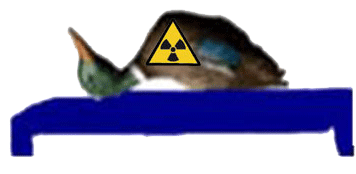 if money were no object—if we could snap our fingers and scatter reactors across the landscape—…… But if Abdulla’s numbers are right, the nuclear dream looks dead on arrival…. https://www.motherjones.com/environment/2021/02/nuclear-energy-climate-change-nuscale-green-power-uranium/
 A great article. Just one problem. The whole article runs with the assumption that nuclear power is effectively ”low carbon”. Yet this assumption is not challenged. There are several ways in which nuclear power is actually quite high carbon. Just for one comparison with reneewable energy: wind and solar power are delivered directlly to the turbines and panels – with no digging up of fuel required, no regular transport by road, rail etc. The entire nuclear fuel chain with all its steps – mining, milling, conversion, fuel fabrication, reactor, waste ponds, waste canisters , deep repositaory … all this is carbon emitting.
1 This Month



26 September – International Day for the Total Elimination of Nuclear Weapons


PLEASE OPPOSE HR 8255 AND S.3639 – bills would accelerate satellite deployment, with no environmental review or safeguards – https://ncstd5li.quorum.us/campaign/169331/
To see nuclear-related stories in greater depth and intensity – go to https://nuclearinformation.wordpress.com
-
Archives
- September 2026 (233)
- August 2026 (330)
- July 2026 (355)
- June 2026 (287)
- May 2026 (306)
- April 2026 (356)
- March 2026 (251)
- February 2026 (267)
- January 2026 (308)
- December 2025 (358)
- November 2025 (359)
- October 2025 (375)
-
Categories
- 1
- 1 NUCLEAR ISSUES
- business and costs
- climate change
- culture and arts
- ENERGY
- environment
- health
- history
- indigenous issues
- Legal
- marketing of nuclear
- media
- opposition to nuclear
- PERSONAL STORIES
- politics
- politics international
- Religion and ethics
- safety
- secrets,lies and civil liberties
- spinbuster
- technology
- Uranium
- wastes
- weapons and war
- Women
- 2 WORLD
- ACTION
- AFRICA
- Atrocities
- AUSTRALIA
- Christina's notes
- Christina's themes
- culture and arts
- Events
- Fuk 2022
- Fuk 2023
- Fukushima 2017
- Fukushima 2018
- fukushima 2019
- Fukushima 2020
- Fukushima 2021
- general
- global warming
- Humour (God we need it)
- Nuclear
- RARE EARTHS
- Reference
- resources – print
- Resources -audiovicual
- Weekly Newsletter
- World
- World Nuclear
- YouTube
-
RSS
Entries RSS
Comments RSS
 nuclear-news