Big trouble ahead, on regulation issues, for countries desperately trying to export small nuclear reactors
 Regulatory Harmonization: An Upcoming Hurdle for SMRs?
Nuclear developers may have problems selling small modular reactors abroad. GreenTech Media JASON DEIGN FEBRUARY 15, 2021 The nuclear industry is betting on small modular reactors (SMRs) to regain its competitive edge in markets such as the U.S. and Canada. Proponents say the reactors can be built cheaply once multiple units start being ordered and can even lead to lucrative export opportunities.There’s just one problem. If you build an SMR in the U.S., for example, you can’t sell it in Canada until Canadian regulators have approved the design. And the same goes for every other nuclear market in the world. Even nuclear insiders recognize that this could be a big issue for SMRs.
Regulatory harmonization has a lot to do with whether or not SMRs are going to be able to achieve cost competitiveness,” stated John Gorman, president and CEO of the Canadian Nuclear Association, in an interview.
… national regulations cover everything from food safety to vehicle emissions.
But the hyper-safety-conscious nuclear industry takes regulation to a whole new level. The SMR manufacturer NuScale, for example, claims to have spent more than $500 million, plus 2 million labor hours, in the process of passing its U.S. Nuclear Regulatory Commission Design Certification Application…….
National regulations are not just highly detailed but also wildly divergent. The differences between the regulatory regimes in the U.S. and the U.K., for example, reflect not just different jurisdictions but entirely different safety philosophies.
……… even a regulatory approval from the Canadian Nuclear Safety Commission won’t pass muster in the U.S.,,,,, https://www.greentechmedia.com/articles/read/regulatory-harmonization-an-upcoming-hurdle-for-smrs
Even a pro nuclear enthusiast admits that Small Nuclear Reactors cause toxic radioactive wastes
 13 Feb 21 I was quite fascinated to note a paragraph in a long nuclear propaganda article, (by Stikeman Elliott, in Mondaq) yesterday, in which this, hitherto rather hidden problem, gets a mention.
Of course, this pro nuclear writer is not really worried all that much about the actual problem.
Oh no – his concern is about the public’s perception of it – that public perception might hamper the develoment of the nuclear lobby’s newest gimmick. Can’t have that!
”…….efforts need to be made to address the perceived risks so as to establish confidence in the ability of SMRs to operate safely while proving to be a viable source of low-carbon energy.
While SMRs produce less nuclear waste than traditional reactors, the issue of radioactive waste still exists. Nuclear waste needs to be safely stored and transported to secure facilities. SMRs have often been proposed as a solution for electricity generation in remote areas, but this proves problematic from a waste perspective as any nuclear waste would need to be transported over long distances. There is currently no permanent nuclear waste storage site in Canada……”
Unsafe plan for abandoning nuclear reactors onsite, and developing Small Nuclear Reactors
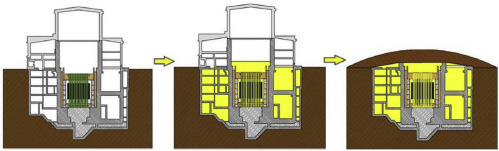
“IAEA guidance that entombment is not considered an acceptable strategy for planned decommissioning of existing [nuclear power plants] and future nuclear facilities.”
|
Groups oppose plans to abandon defunct nuclear reactors and radioactive waste, https://rabble.ca/columnists/2021/02/groups-oppose-plans-abandon-defunct-nuclear-reactors-and-radioactive-wasteThe Canadian Nuclear Safety Commission (CNSC) has just given a green light to the preferred industry solution for disposal of nuclear reactors — entomb and abandon them in place, also known as “in-situ decommissioning.” This paves the way for the introduction of a new generation of “small modular” nuclear reactors or SMRs. Over 100 Indigenous and civil society groups have signed a public statement opposing SMR funding, noting that the federal government currently has no detailed policy or strategy for what to do with radioactive waste. Many of these groups are also participating in a federal radioactive waste policy review launched in November 2020. The Assembly of First Nations passed resolution 62/2018 demanding that the nuclear industry abandon plans for SMRs and that the federal government cease funding them. It calls for free, prior and informed consent “to ensure that no storage or disposal of hazardous materials shall take place in First Nations lands and territories.”
An SMR emits no radiation before start-up (other than from uranium fuel) and could easily be transported at that stage. But during reactor operation, metal and concrete components absorb neutrons from the splitting of uranium atoms — and in the process, transform into radioactive waste. Removing an SMR after shut-down would be difficult and costly, and comes with the need to shield workers and the public from its radioactivity. Abandoning nuclear reactors on site has been in the works for some time. CNSC helped draft a 2014 nuclear industry standard with in-situ decommissioning as an option and then included it in a July 2019 draft regulatory document. However, when the International Atomic Energy Agency (IAEA) released a peer-reviewed report on Canada’s nuclear safety framework last February, it said in-situ decommissioning is “not consistent” with IAEA safety standards. The IAEA suggested that CNSC “consider revising its current and planned requirements in the area of decommissioning to align with the IAEA guidance that entombment is not considered an acceptable strategy for planned decommissioning of existing [nuclear power plants] and future nuclear facilities.” It also noted that CNSC is reviewing license applications for in-situ decommissioning of shut-down federal reactors in Ontario and Manitoba, and encouraged Canada “to request an international peer review of the proposed strategy” for legacy reactors. But CNSC continued to pursue this strategy. Clever language in a June 2020 document appeared to rule out on-site reactor disposal, but left the door open where removal is not “practicable”:
At public meeting last June, CNSC Commissioner Sandor Demeter asked: “why are future facilities in this sentence when in fact we should be designing them so that in-situ decommissioning is not the option?” Former CNSC staff member Karine Glenn replied that “leaving some small parts of a structure behind…especially if you are in a very, very remote area, may be something that could be considered.” Glenn is now with the industry-run Nuclear Waste Management Organization, tasked with leading the development of a radioactive waste management strategy for Canada. Commissioners decided to approve the regulatory document, but with added text to clarify where in-situ decommissioning would be acceptable. They asked for additional text on “legacy sites” and “research reactors,” stating that “[t]he Commission need not see this added text if it aligns with the oral submissions staff made in the public meeting.” But no new clarifying text was added to the final version of the document published on January 29, 2021. It enables abandonment of SMRs — by retaining the reference to future nuclear facilities — and of “research and demonstration facilities, locations or sites dating back to the birth of nuclear technologies in Canada for which decommissioning was not planned as part of the design.” The CNSC seems willing to ignore international safety standards — and a decision of its own commission — to accommodate nuclear industry proponents of SMRs and allow radioactive waste to be abandoned in place. Meanwhile, the federal government has assigned the nuclear industry itself — via the Nuclear Waste Management Organization — the task of developing a radioactive waste strategy for Canada. Barring public outcry, that strategy will be abandonment. Ole Hendrickson is a retired forest ecologist and a founding member of the Ottawa River Institute, a non-profit charitable organization based in the Ottawa Valley. |
|
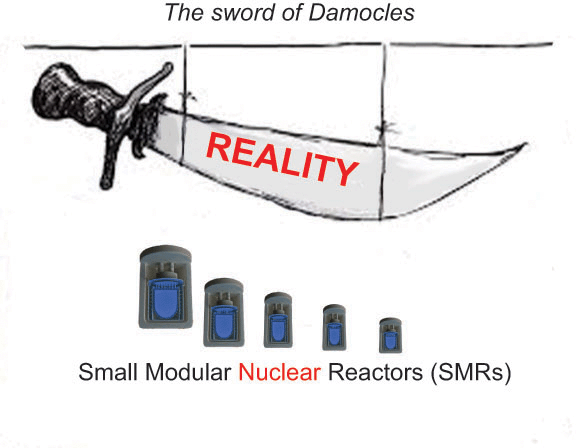
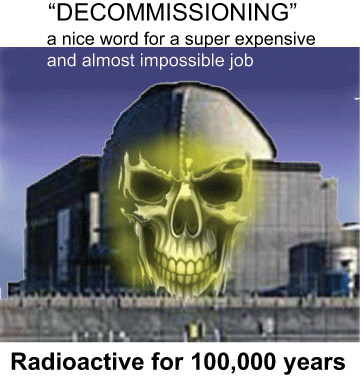
First a comment on military smrs – then the enthusiastic article about them
 spikedpsycho169, 18 Jan 21, Small reactors on a battlefield where the enemy now has suicide drones, rpg’s and homemade rockets. What could possibly go wrong.? Other than electricity, reactors have little use on a field of combat. Some advocate the production of liquid fuels using in situ resources like ammonia, methanol, etc made using ambient materials like air/water. That requires temperatures above 600-800 degrees celsius, Which no reactor currently operates.
White House Accelerates Development Of Mini Nuclear Reactors For Space And The Battlefield
The order looks to accelerate and integrate the development of highly mobile nuclear reactors for space and the terrestrial battlefield. BY BRETT TINGLEY JANUARY 16, 2021
President Trump issued an Executive Order on January 12 that aims to promote small, modular nuclear reactors for defense and space exploration applications. According to a press statement issued by the White House, the order will “further revitalize the United States nuclear energy sector, reinvigorate America’s space exploration program, and produce diverse energy options for national defense needs.”
The order instructs NASA’s administrator to prepare a report within 180 days that will define NASA’s requirements and foreseeable issues for developing a nuclear energy system for human and robotic exploratory missions through 2040. The order also calls for a “Common Technology Roadmap” between NASA and the Departments of Energy, Defense, Commerce, and State for implementing new reactor technologies. The full text of the Executive Order can be read at WhiteHouse.gov ………
Section 4 of the Executive Order goes into further detail about the DoD’s energy needs, and outlines the role the Department of Defense will play in this new initiative to develop mobile nuclear reactors …….
The Executive Order also outlines a Common Technology Roadmap that “describes potential development programs and that coordinates, to the extent practicable, terrestrial-based advanced nuclear reactor and space-based nuclear power and propulsion efforts” between the Departments of Energy, Defense, Commerce, State, and NASA. This roadmap will also require “assessments of foreign nations’ space nuclear power and propulsion technological capabilities.” Naturally, one of the most pressing concerns with any nuclear technology is national security, and thus the order also instructs the DoD to work together with NASA and other agencies to identify security issues associated with any potential space-based nuclear systems.
With this new Executive Order, the White House seeks to propel the United States to the forefront of all of the work being conducted in compact reactor research. While the wording in the statement focuses more on space exploration, the Department of Defense’s involvement is highly important. Since space environments are similar in that resupply is a tricky, if not impossible, endeavor, NASA could help jump-start the DoD’s mobile nuclear program even further if both are really working on it collaboratively, although the requirements will be somewhat different. “There’s sometimes a risk of forcing too much commonality,” a White House official told SpaceNews.com. “What this executive order does is ensure that there is a deliberate look at what those opportunities may be.”
If realized, the Executive Order’s accompanying statement reads, this initiative could lead to a “transportable small modular reactor for a mission other than naval propulsion for the first time in half a century.”
Contact the author: Brett@TheDrive.com https://www.thedrive.com/the-war-zone/38687/white-house-accelerates-development-of-mini-nuclear-reactors-for-space-and-the-battlefield
”Small Modular Reactors”’- governments are being sucked in by the ”billionaires’ nuclear club”
SNC-Lavalin Scandal-ridden SNC-Lavalin is playing a major role in the push for SMRs.
Terrestrial Energy….. Terrestrial Energy’s advisory board includes Dr. Ernest Moniz, the former US Secretary of the Dept. of Energy (2013-2017) who provided more than $12 billion in loan guarantees to the nuclear industry. Moniz has been a key advisor to the Biden-Harris transition team, which has come out in favour of SMRs.
The “billionaires’ nuclear club” …“As long as Bill Gates is wasting his own money or that of other billionaires, it is not so much of an issue. The problem is that he is lobbying hard for government investment.”
Going after the public purse
Bill Gates was apparently very busy during the 2015 Paris climate talks. He also went on stage during the talks to announce a collaboration among 24 countries and the EU on something called Mission Innovation – an attempt to “accelerate global clean energy innovation” and “increase government support” for the technologies.
Gates’ PR tactic is effective: provide a bit of capital to create an SMR “bandwagon,” with governments fearing their economies would be left behind unless they massively fund such innovations.
governments “are being suckers. Because if Wall Street and the banks will not finance this, why should it be the role of the government to engage in venture capitalism of this kind?”
It will take a Herculean effort from the public to defeat this NICE Future, but along with the Assembly of First Nations, three political parties – the NDP, the Bloc Quebecois, and the Green Party – have now come out against SMRs.
|
Mini-Nukes, Big Bucks: The Interests Behind the SMR Push https://watershedsentinel.ca/articles/mini-nukes-big-bucks-the-money-behind-small-modular-reactors/
It’s remarkable that only five years ago, the National Energy Board predicted: “No new nuclear units are anticipated to be built in any province” by 2040.So what happened? The answer involves looking at some of the key influencers at work behind the scenes, lobbying for government funding for SMRs. |

Big doubts on small nuclear reactors – on economics, on waste problems
 Former U.S. regulator questions small nuclear reactor technology, Business case for small reactors ‘doesn’t fly,’ says expert on nuclear waste, Jacques Poitras · CBC News Jan 15, 2021 A former head of the United States’ nuclear regulator is raising questions about the molten-salt technology that would be used in one model of proposed New Brunswick-made nuclear reactors.
The technology pitched by Saint John’s Moltex Energy is key to its business case because, the company argues, it would reuse some of the nuclear waste from Point Lepreau and lower the long-term cost and radioactivity of storing the remainder.
But Allison Macfarlane, the former chairperson of the U.S. Nuclear Regulatory Commission and a specialist in the storage of nuclear waste, said no one has yet proven that it’s possible or viable to reprocess nuclear waste and lower the cost and risks of storage.
“Nobody knows what the numbers are, and anybody who gives you numbers is selling you a bridge to nowhere because they don’t know,” said Macfarlane, now the director of the School of Public Policy and Global Affairs at the University of British Columbia.
“Nobody’s really doing this right now. … Nobody has ever set up a molten salt reactor and used it to produce electricity.”
Macfarlane said she couldn’t comment specifically on Moltex, calling information about the company’s technology “very vague.”
But she said the general selling point for molten-salt technology is dubious.
“Nobody’s been able to answer my questions yet on what all these wastes are and how much of them there are, and how heat-producing they are and what their compositions are,” she said.
“My sense is that all of these reactor folks have not really paid a lot of attention to the back end of these fuel cycles,” she said, referring to the long-term risks and costs of securely storing nuclear waste.
Moltex is one of two Saint John-based companies pitching small nuclear reactors as the next step for nuclear power in the province and as a non-carbon-dioxide emitting alternative to fossil fuel electricity generation.
Moltex North America CEO Rory O’Sullivan said the company’s technology will allow it to affordably extract the most radioactive parts of the existing nuclear waste from the Point Lepreau Generating Station.
The waste is now stored in pellet form in silos near the plant and is inspected regularly.
The process would remove less than one per cent of the material to fuel the Moltex reactor and O’Sullivan said that would make the remainder less radioactive for a much shorter amount of time.
Existing plans for nuclear waste in Canada are to store it in an eventual permanent repository deep underground, where it would be secure for the hundreds of thousands of years it remained radioactive………..
Shorter-term radioactivity complicates storage
Macfarlane said a shorter-term radioactivity life for waste would actually complicate its storage underground because it might lead to a facility that has to be funded and secured rather than sealed up and abandoned.
“That means that you believe that the institutions that exist to keep monitoring that … will exist for hundreds of years, and I think that is a ridiculous assumption,” she said.
“I’m looking at the United States, I’m seeing institutions crumbling in a matter of a few years. I have no faith that institutions can last that long and that there will be streams of money to maintain the safety and security of these facilities. That’s why you will need a deep geologic repository for this material.”
And she said that’s assuming the technology will successfully extract all of the most radioactive material.
“They are assuming that they remove one hundred per cent of the difficult, radionuclides, the difficult isotopes, that complicate the waste,” she said.
“My response is: prove it. Because if you leave five per cent, you have high-level waste that you’re going to be dealing with. If you leave one per cent, you’re going to have high-level waste that you’re going to be dealing with. So sorry, that one doesn’t fly with me.”
Macfarlane, a geologist by training, raised doubts about molten-salt technology and waste issues in a 2018 paper she co-authored for the Bulletin of the Atomic Scientists………. https://www.cbc.ca/news/canada/new-brunswick/nuclear-waste-reactors-new-brunswick-allison-macfarlane-moltex-arc-1.5873542
Small modular reactor plan bolsters nuclear industry’s future, but renewables could address energy issues now,
Small modular reactor plan bolsters nuclear industry’s future, but renewables could address energy issues now, https://www.cbc.ca/news/opinion/opinion-small-modular-reactor-strategy-1.5869623
While SMRs are hailed as start of a nuclear renaissance, there are big questions about costs and timeframe, Eva Schacherl · CBC News Jan 15 In late December, as many Canadians were easing into a low-key holiday break, Minister of Natural Resources Seamus O’Regan pulled out a bag of goodies for the nuclear industry. It was the much-hyped Small Modular Reactor Action Plan for Canada.
Small modular reactors (SMRs) are experimental nuclear technologies that are still on the drawing board. They are the nuclear power industry’s hope for overcoming the problems that have plagued it: high costs, radioactive waste, and risks of accidents.
Public interest groups across the country, however, argue that SMRs won’t solve these issues.
The dozen SMR vendors backing the technology include GE-Hitachi, Westinghouse, and SNC-Lavalin (which, along with two U.S. corporations, already holds a multibillion-dollar contract with the federal government to run Canadian Nuclear Laboratories at Chalk River, Ont.). O’Regan’s plan did nothing to clarify the price tag of a nuclear renaissance, but it says the federal government expects to share the cost and risks of SMR projects with the private sector.
Proponents say that SMRs will cost less than conventional nuclear and be flexible enough to serve remote communities reliant on costly and polluting diesel. O’Regan has also said that SMRs are necessary to fight climate change: in short, a utopia of “clean, affordable, safe and reliable power,” as he told a nuclear conference last year.
But is this any more than a dream? The enthusiasm for SMRs sometimes sounds like a New Age cult — let’s examine the claims.
First, must we have a new generation of nuclear reactors to get to the promised land of net-zero emissions?
Many studies show a path to net-zero without nuclear energy. Energy scientists who modelled a 100 per cent renewable energy system for North America, for example, concluded that nuclear energy “cannot play an important role in the future” because of its high cost and safety issues. Closer to home, it has been shown how Ontario can meet its electricity demand without nuclear, using renewables, hydro and storage.
Meanwhile, a new study in Nature Energy uses data from 123 nations to show that countries focused on renewables do much better at reducing emissions.
Can SMRs one day be cost-competitive with renewable energy?
Right now, the cost difference between nuclear power and other low-carbon alternatives is growing because renewables and energy storage keep getting cheaper.
Meanwhile, the estimated cost of the most advanced SMR project, in Idaho, has increased from $4.2 billion to $6.1 billion before shovels are even in the ground. That’s nearly $12,000 per kilowatt of generation capacity.
an small reactors wean off-grid communities and mines from diesel fuel?
Finally, nuclear energy is neither green nor clean. All reactors produce radioactive waste that will need to be kept out of the biosphere for hundreds of thousands of years.
The proposal that some SMR models would reuse highly radioactive CANDU fuel and plutonium will only create worse problems in the form of radioactive wastes that are even more dangerous to manage.
For a livable future, Canada has pledged to get to net-zero emissions by 2050. Will we get a bigger bang for our buck from reactors that are still just design concepts? Or by retrofitting buildings, improving energy efficiency, and building solar, wind, geothermal and tidal power with existing technology?
Clearly, the latter. And it needs to be done now.
As pandemic cripples America, Donald Trump orders funding for military Small Nuclear Reactors in space

|
Trump orders DoD to explore use of nuclear power for space, Defense News,
By: Aaron Mehta 14 Jan 21, WASHINGTON — In the waning days of his administration, U.S. President Donald Trump has signed an executive order aimed at pushing the Department of Defense toward quickly developing and producing small nuclear reactors for military use — and to see if they could be used by military space vehicles.
The order, signed Jan. 5 and posted publicly Jan. 12, is not the first time the value of nuclear power for military operations has been studied. There is a long history of the Pentagon considering the issue, which proponents believe could alleviate the department’s massive logistics challenge of keeping fuel moving around the world……… In terms of terrestrial efforts, the executive order requires the defense secretary to, within 180 days, “establish and implement a plan to demonstrate” a micro-reactor at a domestic military installation — in other words, setting up an actual test of a nuclear reactor at a U.S. military location. However, that doesn’t mean the first test will be on a military base. One location to keep an eye on is the Nevada National Security Site, a Department of Energy location roughly 65 miles from Las Vegas……. Noted Hans Kristensen of the Federation of American Scientists, “the signing of this at the very last minute of the Trump administration suggests someone is concerned [President-elect Joe Biden] might not support the program.” Specific to space, the order calls for the defense secretary, in consultation with the secretaries of state, commerce and energy as well as the NASA administrator, to “determine whether advanced nuclear reactors can be made to benefit Department of Defense future space power needs” and to “pilot a transportable micro-reactor prototype.” In addition, the order directs an analysis of alternatives for “personnel, regulatory, and technical requirements to inform future decisions with respect to nuclear power usage” as well as “an analysis of United States military uses for space nuclear power and propulsion technologies and an analysis of foreign adversaries’ space power and propulsion programs.” ……… While the order speeds up the timetable for a test of a nuclear reactor at a military installation, the idea of using nuclear power is hardly a new one for the DoD. In fact, the Pentagon currently has two different development tracts for small nuclear reactors. The first is “Project Pele,” an effort to create a small mobile nuclear reactor in the 1-5 MWe power range, being run out of the Strategic Capabilities Office. In March 2020, the department awarded three companies a combined $39.7 million to start design work for Project Pele, with plans to select one firm in 2022 to build and demonstrate a prototype. The second effort is run through the office of the undersecretary of acquisition and sustainment. That effort, ordered in the 2019 National Defense Authorization Act, involves a pilot program aiming to demonstrate the efficacy of a small nuclear reactor, in the 2-10 MWe range, with initial testing at a Department of Energy site around 2023. If all goes well, the goal is to have a permanent small nuclear reactor on a military base around 2027. Even if all those timelines are hit, it is unlikely microreactors could proliferate quickly throughout the military………. https://www.defensenews.com/smr/nuclear-arsenal/2021/01/13/trump-orders-dod-to-explore-use-of-nuclear-power-for-space-systems/ |
|
Most Maldon District Councillors oppose Bradwell big nuclear development: small reactors would carry the same dangers.
favour of a recommendation to send a letter in support of the development of small modular reactors at the site of Bradwell B power station. The letter was sent to MP John Whittingdale and to the head of nuclear development at the Department for Business, Energy and Industrial Strategy in support of the development.
position to back Bradwell B due to the environmental and ecological impacts it would have.
on the plans for Bradwell B that a strong majority of councillors agreed with BANNG that Bradwell is an unsuitable, unacceptable and unsustainable site for nuclear development.
environmental, heritage and ecological problems as those opposed by Maldon
District Council in relation to Bradwell B.”
In Indonesia – small nuclear reactors as a prelude to nuclear weapons?
Small modular reactor plan – a dangerous distraction from climate change action

 Feds’ Small Modular Reactor Action Plan is a dangerous distraction from climate change mitigation, Corporate Knights BY RICK CHEESEMAN, December 29, 2020
Canada can be a world leader in this promising, innovative, zero-emissions energy technology, and this is our plan to position ourselves in an emerging global market,” Natural Resources Minister Seamus O’Regan said in a statement.
The governments of New Brunswick, Ontario, Saskatchewan and Alberta, together with the federal government, advocate that small modular reactors (SMRs) are essential if Canada is to achieve a net-zero economy by 2050. According to the feds’ 2018 Call to Action report on the mini nuclear reactors, “SMRs are a reliable, clean, non-emitting source of energy, with costs that are predictable and competitive with other alternatives.”
The first problem with these claims is that SMRs don’t yet exist and aren’t expected to exist for a decade, making these claims dubious. It’s not the only questionable claim made by proponents.
Are SMRs a clean, zero-emission source of power?
Nuclear reactors emit much lower concentrations of carbon than fossil fuels, so one could claim they are zero-emission. But they have their own, uniquely harmful, emissions. From thousands of tonnes of spent fuel to hundreds of thousands of tonnes of mine tailings, nuclear power leaves a radioactive trail that is an immediate threat to waterways and water tables and is lethal for hundreds of thousands of years. SMRs will only add to that.
In 2010, Ad Standards Canada ruled that an ad claiming CANDU reactors were emission-free was “inaccurate and unsupported.” The Power Workers’ Union was expected to remove all ads containing the “emission-free” statement and to qualify any future claims. ……
After 70 years, the nuclear industry still hasn’t found a way to keep habitable environments safe from spent fuel for anything close to the time frames required for it to be harmless. There have been many plans in the past and there are current plans but all have one thing in common: they are unfit for purpose.
Some SMR technologies promise to use CANDU spent fuel in the SMR, claiming this will reduce both the radioactivity and quantity of the spent fuel. This claim is theoretical, based on proprietary data, and a report published by the Bulletin of the Atomic Scientists said doing so would be “playing with fire,” noting that the process, called pyroprocessing, will exacerbate the spent fuel storage and disposal challenges, not mitigate them.
Will SMRs be safe?
A range of power-generation and storage technologies that are clean, emissions-free, safe and low cost, is imminent. Within 10 years, these technologies will be widespread, fully incorporated into all levels of society, and deployed to all regions – all before the first SMR comes online. In all likelihood, by the time an SMR comes to market, there will be a more economical and environmentally responsible alternative in place.
While the rhetoric is persuasive, the case for SMRs doesn’t stand up to objective scrutiny. Allocating climate-change funds to them is a travesty.
Small Nuclear Reactors – the Big New Way – to get the public to fund the nuclear weapons industry
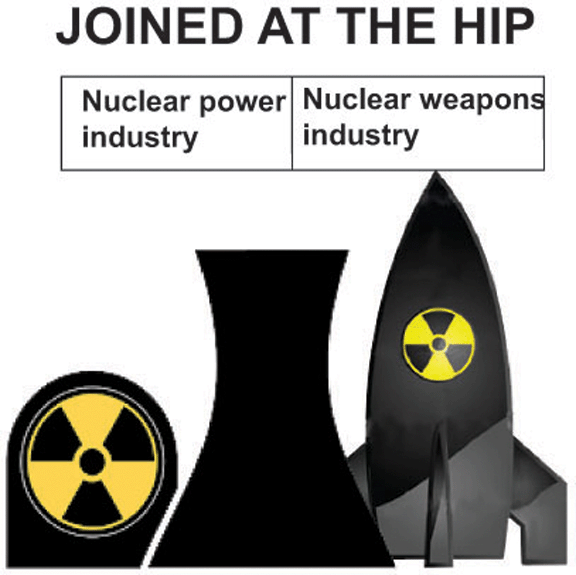
so-called “small nuclear reactors”
Downing Street told the Financial Times, which it faithfully reported, that it was “considering” £2 billion of taxpayers’ money to support “small nuclear reactors”
They are not small
The first thing to know about these beasts is that they are not small. 440MW? The plant at Wylfa (Anglesey, north Wales) was 460MW (it’s closed now). 440MW is bigger than all the Magnox type reactors except Wylfa and comparable to an Advanced Gas-cooled Reactor.
Only if military needs are driving this decision is it explicable.
”Clearly, the military need to maintain both reactor construction and operation skills and access to fissile materials will remain. I can well see the temptation for Defence Ministers to try to transfer this cost to civilian budgets,”
Any nation’s defence budget in this day and age cannot afford a new generation of nuclear weapons. So it needs to pass the costs onto the energy sector.
 How the UK’s secret defence policy is driving energy policy – with the public kept in the dark. https://www.thefifthestate.com.au/energy-lead/how-the-uks-secret-defence-policy-is-driving-energy-policy-with-the-public-kept-in-the-dark/ BY DAVID THORPE / 13 OCTOBER 2020
The UK government has for 15 years persistently backed the need for new nuclear power. Given its many problems, most informed observers can’t understand why. The answer lies in its commitment to being a nuclear military force. Continue reading
NuScale’s nuclear reactor looks suspiciously like an old design, (that melted down)
 Why Does NuScale SMR Look Like a 1964 Drawing of Swiss Lucens Nuclear Reactor (which suffered a major meltdown in 1969)?
https://miningawareness.wordpress.com/2015/08/31/why-does-nuscale-smr-look-like-a-1964-drawing-of-swiss-lucens-nuclear-reactor-which-suffered-a-major-meltdown-in-1969/
Whatever NuScale is, or is not, it clearly isn’t “new”. The Bible must have foreseen the nuclear industry when it said that there was no new thing under the sun. While there might be something new about it, certainly its scale is not. And, it seems mostly a remake of old military reactors, perhaps with influence from swimming pool reactors.
The main ancestor seems to be the US Army’s SM-1, made by the American Locomotive Company, making its most distant ancestor the steam locomotive.
Government subsidizes for NuScale are a deadly taxpayer rip rip-off. Even without an accident, nuclear reactors legally leak deadly radionuclides into the environment during the entire nuclear fuel chain, as well as when they are operating. Then, the nuclear waste is also allowed to leak for perpetuity.
The 1964 Lucens Design certainly looks like the one unit NuScale. Did MSLWR, now NuScale, take from Lucens or from an earlier common design ancestor?
NuScale 12 years ago when it was called MASLWR and still an official government project, 2003, INEEL/EXT-04-01626.

This is for single reactors. They want to clump them together.
Is there a common ancestor in either the US nuclear power station in Greenland or Antarctica? Actually, the main “parent” for the underground concept, according to the Swiss documentation, is underground hydroelectric power stations, dating from the 1800s. These caverns have been known to collapse, which, along with the WIPP collapse, points to another risk associated with underground nuclear reactors, besides leakage and corrosion.
being mostly in an underground cavern proved to be a liability rather than an asset for Lucens. The cavern leaked water and contributed to corrosion issues that ultimately led to nuclear meltdown.
Despite its tiny size, tinier than NuScale, it still is classified as a major nuclear accident. Furthermore, the cavern did not keep the nuclear fallout from escaping into the environment. There was 1 Sv (1000 mSv) per hour of
radiation in the cavern. Radiation was measured in the nearby village, and the cavern still leaks radiation. Continue reading
Russia marketing small nuclear reactors to the Arctic , (who cares about the toxic wastes?)

Rosatom to build small-scale land-based Arctic nuclear plant by 2028
Rosatom said it has reached an agreement with the government of the Republic of Sakha (Yakutia) setting out parameters for pricing energy that will be produced by the nuclear plant, which is expected to be completed by 2028……….
“I am convinced that a small-scale nuclear power plant will give a qualitative impetus to the development of the Arctic regions of Yakutia, stimulate the development of industry in Ust-Yansky ulus and improve the living standards of local residents,” said in a statement Head of the Sakha Republic Aysen Nikolayev.
The nuclear plant is expected to operate for 60 years but the press release did not specify how Rosatom plans to deal with the nuclear waste produced by it.
Rosatom officials said the small-scale nuclear plant is based on a proven technology that has already been tested in Arctic conditions.
RITM-200 reactors are already being used on the recently commissioned Arktika nuclear-powered icebreaker and six other 22220 design heavy Russian icebreakers that are being built, Rosatom officials said…….
“The implementation of this project strengthens the leading position of Rosatom in the world market of small nuclear power plants.”…….
Rosatom is also actively marketing the technology for export overseas, Likhachev said. https://thebarentsobserver.com/en/nuclear-safety/2020/12/rosatom-build-small-scale-land-based-arctic-nuclear-plant-2028
U.S. Dept of Energy pouring $millions into new nuclear gimmicks
 DOE selects advanced reactor concepts for funding https://www.world-nuclear-news.org/Articles/DOE-selects-advanced-reactor-concepts-for-funding, 23 December 2020
DOE expects to invest about USD600 million over the next seven years in ARDP, which aims to help domestic private industry demonstrate advanced nuclear reactors in the USA.
The department issued an ARDP funding opportunity announcement in May this year, which included the ARC-20 awards, the Advanced Reactor Demonstration awards, and the Risk Reduction for Future Demonstration awards. For the ARC-20 projects, DOE expects to invest a total of about USD56 million over four years with its industry partners providing at least 20% in matching funds. The goal of the ARC-20 programme is to assist the progression of advanced reactor designs in their earliest phases.
DOE yesterday announced the selection of three US-based teams to receive ARC-20 funding. These are:
- Inherently Safe Advanced SMR for American Nuclear Leadership. Advanced Reactor Concepts will deliver a conceptual design of a seismically isolated advanced sodium-cooled reactor facility that builds upon the initial pre-conceptual design of a 100 MWe reactor facility. The total award value over three-and-a-half years is USD34.4 million, with the DOE’s share being USD27.5 million.
- Fast Modular Reactor Conceptual Design. General Atomics will develop a fast modular reactor conceptual design with verifications of key metrics in fuel, safety and operational performance. The design will be for a 50 MWe fast modular reactor. Total award value over three years is USD31.1 million (DOE share is USD24.8 million).
- Horizontal Compact High Temperature Gas Reactor. Massachusetts Institute of Technology will mature the Modular Integrated Gas-Cooled High-Temperature Reactor (MIGHTR) concept from a pre-conceptual stage to a conceptual stage to support commercialisation. The total award value over three years is USD4.9 million (DOE cost share is USD3.9 million)………..
On 16 December, DOE selected five teams to receive USD30 million in initial funding for risk reduction projects under its ARDP programme. All five of the selected designs have the potential to compete globally once deployed, DOE said. The five projects are: the BWXT Advanced Nuclear Reactor; Westinghouse’s eVinci Microreactor; Kairos Power’s Hermes Reduced-Scale Test Reactor; the Holtec SMR-160 light-water small modular reactor; and the Molten Chloride Reactor Experiment, a project led by Southern Company Services Inc.
Two projects led by TerraPower and X-energy were selected in October to receive USD160 million in initial funding for under the DOE’s Demonstration projects pathway to develop and construct two advanced nuclear reactors that can be operational within seven years……https://www.world-nuclear-news.org/Articles/DOE-selects-advanced-reactor-concepts-for-funding
1 This Month



26 September – International Day for the Total Elimination of Nuclear Weapons


PLEASE OPPOSE HR 8255 AND S.3639 – bills would accelerate satellite deployment, with no environmental review or safeguards – https://ncstd5li.quorum.us/campaign/169331/
To see nuclear-related stories in greater depth and intensity – go to https://nuclearinformation.wordpress.com
-
Archives
- September 2026 (233)
- August 2026 (330)
- July 2026 (355)
- June 2026 (287)
- May 2026 (306)
- April 2026 (356)
- March 2026 (251)
- February 2026 (267)
- January 2026 (308)
- December 2025 (358)
- November 2025 (359)
- October 2025 (375)
-
Categories
- 1
- 1 NUCLEAR ISSUES
- business and costs
- climate change
- culture and arts
- ENERGY
- environment
- health
- history
- indigenous issues
- Legal
- marketing of nuclear
- media
- opposition to nuclear
- PERSONAL STORIES
- politics
- politics international
- Religion and ethics
- safety
- secrets,lies and civil liberties
- spinbuster
- technology
- Uranium
- wastes
- weapons and war
- Women
- 2 WORLD
- ACTION
- AFRICA
- Atrocities
- AUSTRALIA
- Christina's notes
- Christina's themes
- culture and arts
- Events
- Fuk 2022
- Fuk 2023
- Fukushima 2017
- Fukushima 2018
- fukushima 2019
- Fukushima 2020
- Fukushima 2021
- general
- global warming
- Humour (God we need it)
- Nuclear
- RARE EARTHS
- Reference
- resources – print
- Resources -audiovicual
- Weekly Newsletter
- World
- World Nuclear
- YouTube
-
RSS
Entries RSS
Comments RSS
 nuclear-news