Despite the frantic nuclear lobbying at COP26, Rolls Royce’s small nuclear reactors will be of zero use against greenhouse emissions – Jonathon Porritt

Rolls-Royce talks of the first plant ‘coming online by 2031’ – do please do the maths yourself. So let’s say 2035, to be generous, at the earliest. And therefore of zero benefit in terms of meeting the Government’s own target of a 78% reduction in greenhouse gas emissions by 2035.
It’s all such a pathetic waste of time – and of taxpayers’ money. Whatever the timescale, SMRs will never compete with renewables plus storage.
COP6 ‘Nuclear Sidebar, http://www.jonathonporritt.com/cop26s-nuclear-sidebar/ Jonathon Porrit, 6 Nov 21, The fact that COP26 was crawling with huge numbers of delegates from Big Oil and Gas got a lot of attention from the media. Less attention was paid to the large number of pro-nuclear delegates parasitically inserting themselves into as many events as they could engineer access to – facilitated at every turn by BEIS Secretary of State Kwasi Kwarteng and Booster Boris himself..
The nuclear industry had its own short-lived moment in the sun, on 9th November. For what is now reckoned to be the fourth time, Kwasi Kwarteng went over the top to re-re-re-confirm the Government’s enthusiasm for Small Modular Reactors, re-re-re-promising (a rather miserly) £210m of Government money for Rolls-Royce, described by Kwasi Kwarteng as ‘a once in a lifetime opportunity’.
Rolls-Royce duly obliged, conjuring up another £250m of private sector investment to deliver a new fleet of at least five SMRs (and possibly as many as 16) at around £2.2bn a pop. The company’s share price duly went up by around 4%. Job done.
It doesn’t matter how many times Ministers bang this particular drum, or how many times deplorably gullible journalists in the BBC, FT, Times and the Telegraph suck it all up, moonshine is still moonshine.
In and of itself, that £460m buys practically nothing. It will allow Rolls-Royce to take whatever design they finally settle on through the Generic Design Assessment process. This will take no less than four years, and probably more than five. Even if (and it’s a big IF) regulatory approval is secured, private sector investors will still have to be found, sites identified and planning permission for each site secured – a process which can take years.
Rolls-Royce talks of the first plant ‘coming online by 2031’ – do please do the maths yourself. So let’s say 2035, to be generous, at the earliest. And therefore of zero benefit in terms of meeting the Government’s own target of a 78% reduction in greenhouse gas emissions by 2035.
It’s all such a pathetic waste of time – and of taxpayers’ money. Whatever the timescale, SMRs will never compete with renewables plus storage.
To be fair, it would be wrong to underestimate the importance here of energy security – meeting our energy needs from home-based, ‘indigenous’ capacity. Boris Johnson keeps banging on about ‘British wind and sunshine’ – mindful perhaps of a recent poll of Daily Express readers, of whom 97.5% said that Boris ‘should pledge to make Britain self-sufficient in energy production by 2050’.
On that basis, British nuclear electrons are therefore much more desirable than those unreliable French electrons, regardless of the fact that we wouldn’t have any new nuclear electrons coming on-stream were it not for Electricité de France.
COP26 was of course a global gathering. UK energy security was therefore less of an issue. But it got a bit of an airing on 12th November, when the two big tidal stream companies here in the UK (Nova Innovation and Atlantis Energy) made a big splash about the huge potential for tidal stream technology in Scotland – with a potential capacity of more than 500 MW. This is a proven technology (with turbines anchored to the sea floor to capture the power of tidal currents) – already delivering suitably ‘indigenous’ electrons – with no moonshine to be seen anywhere.
The potential for tidal stream is indeed significant – not just in the UK, but internationally.
However, for me personally, it’s still relatively small beer in comparison to tidal range – harnessing the power of the tides to generate huge amounts of electricity from either tidal lagoons or barrages, predictably, cost-effectively, over many decades.
If our Government was genuinely serious about energy security (instead of finding ways of propping up Rolls-Royce to support our nuclear weapons programme), tidal power would be top of its list.
But is it heck! So please check out my blog about tidal energy which follows shortly.
UK’s small nuclear reactor consortium indicates that it will be relying on tax-payer funding if it is to go ahead
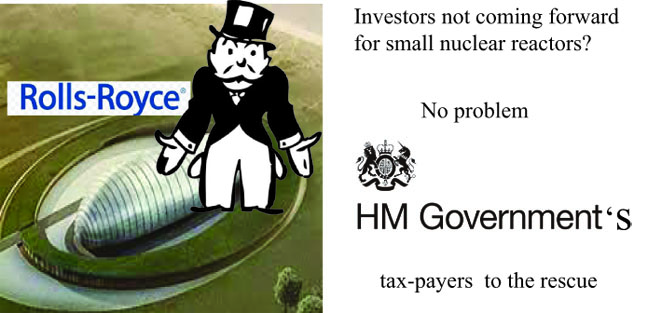
State support a fallback option for UK’s mini-nuclear plants rollout.
The head of the consortium, which is developing a £ 30 billion fleet of
mini-nuclear power stations, has indicated that it will have to rely on UK
taxpayers to help fund the construction of the first of the new designs if
there is not enough investor interest.
FT 10th Nov 2021
https://www.ft.com/content/869279aa-f771-4025-8719-c3b8bdf1f375
Is nuclear power the way forward to combat the climate crisis? – Allison Macfarlane cautions.
 | |||
|

Is nuclear power the way forward to combat the climate crisis?
Nuclear power can go horribly wrong and is notorious for cost overruns, but it is gaining high-profile champions. Aljazeera, By Patricia Sabga 12 Nov 2021 ”’ ………………………
Allison Macfarlane is a professor and the director of the School of Public Policy and Global Affairs at the University of British Columbia. Before that, she was chair of the US Nuclear Regulatory Commission.
She wrote an article for Foreign Affairs (paywall) this summer on the subject of nuclear energy and climate goals. Her arguments generated some pointed pushback (paywall) as world leaders descended on Glasgow, Scotland for COP26.
Macfarlane describes herself as neither a proponent nor a detractor of nuclear power, but an analyst who prefers to give a “measured analytical response” to questions surrounding nuclear energy.
She recently shared her views with Al Jazeera Digital’s Managing Business Editor Patricia Sabga about nations building more nuclear power plants to battle the climate crisis.
Allison Macfarlane: ……………… But I live in a pragmatic, realistic world. And I don’t think, at least in the next 10 or 20 years, that nuclear power will be able to have a big impact on reducing carbon emissions because we can’t build new plants fast enough.
PS: And why is that? Why can’t we build new plants fast enough?
AM: It’s complicated. These are mega projects, and they require a level of quality control and programme management that doesn’t exist in a lot of other industries. And though people may promote some of the newer reactor designs as being easy to produce in factories, if we look at the existing reactors that have been produced in factories – for instance, the ones that are under construction in Georgia, the Vogtle plant [where two additional reactor units are under construction] – the experience in factories has not been good.
The factory that built the modules for the Georgia plant built them incorrectly for years. They welded them incorrectly and they had to be rewelded at the reactor site. That factory led in large part to the bankruptcy of Westinghouse.
PS: You mentioned newer reactor designs. What are these designs and what challenges do they face?
AM: First of all, a lot of them aren’t new. A lot of these designs are 70 years old or older. But given that, there are new sorts of twists to some of these designs.

Many of them exist only on paper, or as small-scale models. And the way engineering works is that you design something – these days, it’s computer-assisted – and then you build a scale model. When you build the scale model, you see where you are wrong in your computer design, and so you fix that. Then you have to build the full-scale design. And when you scale up again, there will be things that you’ve gotten wrong in the scale model, and you’re going to have to fix that.
And so, for many of these designs, we’re still at the computer model stage. We haven’t done the other steps. And those steps take years. And when you get to the full-scale model, that’s really expensive. Where’s that money coming from?
PS: Let’s talk about expense then. In terms of just cost, how does nuclear stack up to say wind or solar?
AM: It’s significantly more expensive. Of course, it depends on what solar you’re talking about. But if you look at Lazard’s recent analysis of levelized costs of energy [an analysis that takes into account how much it costs to finance and build a power plant and to keep it running throughout its lifetime and then divides that cost by how much energy it kicks out each year] and you look at solar PV [photovoltaic] utility scale, and wind, they are significantly cheaper than nuclear.
AM: Expenses are dominated by the capital costs of plant construction. These plants are very expensive to build. I think we’re up to at least $14bn a plant for the Vogtle plants in Georgia. That’s for a thousand gigawatts generation capacity. They’re just really expensive to build and they take a long time to build. And so not only do you have the cost of the capital of building the plant, but you have the cost of the interest on the capital, which becomes a big cost.
That’s really what hurts nuclear. Now there are claims made about the small modular reactors that they’ll be cheaper. But because nobody’s ever built one, and nobody’s established the supply chains to build them and to operate them, we really have no idea what those will cost……………..
[on intermittency] Ten years ago, it was a really big deal. It’s becoming less of a deal, I think. What’s interesting to note is that when you talk to utility companies, they are really interested in having plants be load following [responding to surges and ebbs in power demand]. They’re really orienting themselves towards dealing with intermittency. But that means they need a plant that can ramp up and down quickly. Nuclear can’t do that. The existing nuclear fleet can’t do that. They’re either on or they’re off, and it takes a long time for them to ramp up to full scale on………….. https://www.aljazeera.com/economy/2021/11/12/is-nuclear-power-the-way-forward-to-combat-the-climate-crisis
With the confusing consortium behind it, the UK’s Rolls Royce ”small” nuclear reactor project is running a huge risk

this is a huge risk of public money on a speculative design. By the time we know how much SMRs will cost and whether they are reliable or not, there will be up to 10 reactors being manufactured unless production lines are allowed to sit idle for years waiting until the design is proven enough for new orders to be placed. Realistically the first reactor won’t be complete before the mid-2030s at about the time the last fossil fuel will disappear from the generation mix, so it’s too little, too late and too expensive
What it turns out to amount to is an agreement to spend £400m over the next three years which may produce a design for a reactor which may get approved by the regulators and which may find investors willing to pay what will be at least £2billion to build each one
nuClear News November 21. Rolls Royce’s Small Modular Reactors On 9th November the Government announced that it would back the Rolls-Royce Small Modular Reactor with £210m in funding. Matched by private sector funding of over £250 million, this investment will take forward phase 2 of the Low-Cost Nuclear project to further develop SMR design and take it through the regulatory processes to assess suitability of potential deployment in the UK.
The Government claimed that SMRs have the potential to be less expensive to build than traditional nuclear power plants because of their smaller size, and because the modular nature of the components offers the potential for parts to be produced in dedicated factories and shipped by road to site – reducing construction time and cost. Rolls Royce SMR estimate that each Small Modular Reactor could be capable of powering 1 million homes – equivalent to a city the size of Leeds.
The £210 million grant follows £18 million invested in November 2019, which, according to the Government, has already delivered significant development of the initial design as part of Phase One of the project. (1)
The Rolls Royce SMR design is not exactly small. It was originally conceived as a 440 MW unit, but R-R has found a way of getting 470 MWe out of the core. Each of the proposed 16 reactors is expected to cost around £1.8 billion to £2.2bn and produce power at £40-60/MWh over 60 yrs. (2) Rolls Royce says it has a target cost of £1.8 billion once 5 reactors have been built. (3)
As well as the Government funding, Rolls-Royce has been backed by a consortium of private investors. The creation of the Rolls-Royce Small Modular Reactor (SMR) business was announced following a £195m cash injection from BNF Resources, and Exelon Generation to fund the plans over the next three years. (The Guardian suggests Rolls Royce will top this up with £50m of its own money, which gets us to £245m –not quite the ‘over £250m’ mentioned in the Government Press Release, but it’s not clear whether the £50m is extra money or part of the £195m). It is hoped the new company could create up to 40,000 jobs by 2050. The investment by Rolls-Royce Group, and the government will go towards developing Rolls-Royce’s SMR design and take it through regulatory processes to assess whether it is suitable to be deployed in the UK. It will also identify sites which will manufacture the reactors’ parts and most of the venture’s investment is expected to be focused in the north of the UK, where there is existing nuclear expertise. (4)
BNF Resources UK Limited appears to have been created in June and has two significant employees, Nicholas Fallows and Sean Benson. Benson says: “BNF has an established history of energy market investing and we are proud to be a part of Rolls-Royce SMR in this exciting opportunity. Following reviews of numerous proposals we found that this project, featuring a highly experienced team was the most realistic, affordable and scalable solution for provision of carbon-free baseload and alternative power requirements.” (5)
It appears that BNF Resources UK Limited is a subsidiary of BNF Capital Limited which was created in 2012 (same address) and is registered in Guernsey. These two people seem to have a history in Financial Investment. The Perrodo family, which made its fortune from the private oil company Perenco, is behind BNF Resources UK.
Confusingly there has been no mention of the Rolls Royce SMR Consortium which included Assystem, Atkins, BAM Nuttall, Laing O’Rourke, National Nuclear Laboratory (NNL), Jacobs, The Welding Institute (TWI) and Nuclear AMRC, as well as Rolls Royce. The consortium existed in July of this year when Cavendish signed up to work on the SMR. (6) Assystem has since said it will continue to lead on the design of key areas of power plant infrastructure including the turbine island, cooling water island and balance of plant systems, and is expecting to double the size of its SMR team in the next six months. (7) Similarly Nuclear AMRC has said it will work with Rolls-Royce to help prepare critical components for commercial production in the UK. The centre will also support the design of a new UK factory for large SMR components. (8)
Exelon is contributing under an agreement from a year ago to find international markets. (9)
This new funding will help Rolls-Royce start the SMRs on the Generic Design Assessment (GDA) process. (10) In May, the government declared the Generic Design Assessment (GDA) open to advanced nuclear technologies – including SMRs – for the first time. The process allows the nuclear regulators to assess the safety, security and environmental implications of new reactor designs. Rolls-Royce SMR has stated its intention to enter the GDA process shortly. (11) This could take about 5 years. (The GDA process took 5.75 years for the EPR, 7.5 years for the AP1000, 4.75 years for the ABWR, and process for the UK HPR1000 is continuing after 4 years. (12)) According to the Office for Nuclear Regulation (ONR) the GDA on SMRs was expected to have started by now but there have been delays.
Each of the initial run of reactors is expected to have a generation capacity of 470MW, or enough to power the equivalent of 1.3m UK homes, and cost about £2bn on average, well below the price per MW sought by developers of large-scale nuclear reactors. The consortium hopes to build on an initial run of five SMRs, the first of which could go on line by 2031, to create a multibillion-pound stable of 16 SMRs around the country. (13)
This means that if delivered on budget and to engineering specifications, a single SMR would deliver roughly a seventh of the power of Hinkley for less than a twelfth of the price, while using less land. Each power station is said to be the size of two football pitches, (but this is open to question) and can also be used to create hydrogen by splitting water molecules. The company, primarily a jet engine maker, hopes the hydrogen SMRs could produce would accelerate a move to greener aviation.

Rolls-Royce will be seeking more investment for the project to help fund the building of actual SMRs. The government is currently passing legislation that will allow investors to back projects like SMRs using a regulated asset base (RAB) model, which allows them to recoup up-front costs. The government said this would “attract a wider range of private investment into these projects, reducing build costs, consumers’ energy bills and Britain’s reliance on overseas developers for finance.”
Professor MV Ramana, a nuclear policy expert at the University of British Columbia in Canada, cautioned that this would be a new market for Rolls. He said: “It’s the same technology, but the set of constraints that you will be dealing with in the electricity sector are very different from submarines.” He also said Rolls has some catching up to do against rivals pursuing the same goals. NuScale Power, based in Oregon, received US regulatory approval for its own reactor design last year and could have a plant working by 2026. (14)
Steve Thomas, Emeritus Professor of Energy Policy at Greenwich University said this is a huge risk of public money on a speculative design. By the time we know how much SMRs will cost and whether they are reliable or not, there will be up to 10 reactors being manufactured unless production lines are allowed to sit idle for years waiting until the design is proven enough for new orders to be placed. Realistically the first reactor won’t be complete before the mid-2030s at about the time the last fossil fuel will disappear from the generation mix, so it’s too little, too late and too expensive
Chair of the E3Gthink tank, Tom Burke, points out that this is the third or fourth time this programme has been announced in the past year. What it turns out to amount to is an agreement to spend £400m over the next three years which may produce a design for a reactor which may get approved by the regulators and which may find investors willing to pay what will be at least £2billion to build each one and which may be generating electricity which may be competitive with renewables just before the whole of our electricity system has to be decarbonised to meet the PM’s target. So, six things have to go right before we might see an SMR somewhere.
As expected, Moorside, Wylfa and Trawsfynydd have all been mentioned as potential sites for an SMR. Tees Valley mayor Ben Houchen also wants Hartlepool to be on the list. (15) Dylan Morgan of PAWB (People Against Wylfa B) said: “We have an immediate crisis now. Nuclear power is slow, dangerous and extortionately expensive. It will do nothing to address the current energy crisis, neither will it be effective to counter climate change. The UK and Welsh governments should divert resources and support away from wasteful and outdated nuclear power projects towards developing renewable technologies that are much cheaper and can provide faster and more sustainable solutions to the energy crisis and the challenges of climate change.” (16) https://www.no2nuclearpower.org.uk/wp/wp-content/uploads/2021/11/nuClearNewsNo135.pdf
The small nuclear reactor salesmen have bamboozled government officials into funding X-Energy, Terra Power and NuScam’s untested projects.

“I’m frankly speechless at the success that the proponents of these plants have had in bamboozling … a lot of government officials,” said Peter Bradford, a former member of the Nuclear Regulatory Commission and former chair of the Maine and New York utility commissions. “They should be shouldering a much heavier burden when it comes to the credibility of what they are saying.”
This Next-Generation Nuclear Power Plant Is Pitched for Washington State; Can It ‘Change the World’? Hal Bernton / The Seattle Times, 8 Nov 21,
RICHLAND — Near the Columbia River, Clay Sell hopes to launch a new era of nuclear power with four small reactors, each stocked with billiard ball-sized “pebbles” packed full of uranium fuel.
Chief executive officer of Maryland-based X-energy, Sell aims to bring the project online by 2028 as part of a broader attempt to develop safer, more flexible reactors to redefine the nation’s energy future.
These efforts have gained support in the nation’s capital where many Democrats eager to make progress on climate change have joined with Republicans to funnel money into development. The federal Energy Department has received $160 million to help fund X-energy, and the infrastructure bill that cleared Congress on Friday ups that amount to cover almost half the projected $2.2 billion cost of the Washington reactor project.
“We believe what starts here in Washington is going to change the world,” Sell said to public-utility officials gathered Oct. 28 in Kennewick.
X-energy is one of three companies with ties to the Pacific Northwest that have received federal funds to help develop a new generation of small nuclear power plants,
…………………. TerraPower plans to build its project at the site of a Wyoming coal plant in a partnership with a subsidiary of PacifiCorp, a private utility. NuScale is proposing a project in Idaho and has considered eventually locating a unit in Washington state.The nuclear industry, in the Pacific Northwest and elsewhere in the nation, has a history of pitching, and sometimes starting, projects that fail to come to pass. Skeptics say these next-generation projects are being oversold and face big challenges in producing competitively priced power without compromising safety and security, and in a time frame soon enough to help reduce carbon emissions by midcentury.
“I’m frankly speechless at the success that the proponents of these plants have had in bamboozling … a lot of government officials,” said Peter Bradford, a former member of the Nuclear Regulatory Commission and former chair of the Maine and New York utility commissions. “They should be shouldering a much heavier burden when it comes to the credibility of what they are saying.”
The NuScale project in southern Idaho involving small reactors cooled by water is furthest along in development, and has struggled with delays, design changes and escalating cost projections.
NuScale has partnered with a Utah-based utility consortium to develop what initially was proposed to be a power plant with 12 small reactors. The project, which is now forecast to cost $5.1 billion, has since been scaled back to six reactors expected to start coming online in 2029, according to LaVarr Webb, a spokesperson for the Utah Associated Municipal Power Systems.
Though Webb says sign-ups to take power are “going very well,” some utilities have had second thoughts and pulled out of participation in the project. As of early November, the consortium had secured contracts to take 22% of the project’s proposed 462 megawatts of power.
Central Washington site?
Sell has found fervent support for X-energy in the Tri-Cities area, the hub of Washington state’s nuclear industry that has long been buoyed by billions of taxpayer dollars flowing into the cleanup of the federal Hanford site, where plutonium produced for U.S. atomic bombs has left a toxic, radioactive legacy.
The Columbia Generating Station, Washington’s only commercial nuclear power plant, is located at the edge of Hanford. And its operator, Energy Northwest, would manage the X-energy reactors under an agreement announced last year.
A third partner is Eastern Washington’s Grant County Public Utility District, which would own the reactors and be responsible in raising about $1 billion in financing.
This utility boasts an abundance of low-cost hydroelectric power, which has attracted to the county Microsoft, Intuit and other companies that require lots of electricity for data centers and other operations.
…….. The costs of power produced by next-generation nuclear are a key concern and source of uncertainty. Over the past decade, the cost of renewables has plummeted.
Nordt said… a more in-depth financial review is needed, and Grant County might decide not to move forward with any of these projects.
“We may say, ‘You know, hey, the nuclear path was looking favorable, but it’s not for us right now…..
X-energy pushes ahead
X-energy was created by Kam Ghaffarian, an entrepreneurial Iranian immigrant who founded a major NASA contracting company and other ventures. In 2009, he turned his attention to nuclear power
………….X-energy’s four reactors would be able to generate 320 megawatts of power, less than one-third the amount of the roughly 1,200 megawatt capacity of the Columbia Generating Station.
The project, with a reactor dubbed Xe-100, would be the state’s first new nuclear power development since the 1970s, when the Washington Public Power Supply System — the initial name for the Energy Northwest utility consortium — tried to build five large nuclear power plants but finished only one in a disastrous effort based on flawed forecasts of future power demand.
The unfinished plants left a bitter legacy — including the largest municipal bond default in U.S. history and, among some, a deep mistrust of the nuclear power industry.
One of the most visible reminders of the Washington Public Power Supply System, which detractors nicknamed “Whoops,” is a massive concrete-domed building that dominates a 100-acre tract close to the Columbia Generating Station. This was supposed to be WPPSS No. 1 but construction halted in 1982 when it was almost 65% complete.
X-energy’s proposal submitted to the Energy Department calls for installing the reactors on 22 acres of this site, which already includes water intakes from the Columbia River.
Next-generation tech
X-energy’s website promotes the helium-cooled reactor as safely producing electricity “in a process that’s as clean as wind and solar.”
The reactor operates at much higher temperatures than the water-cooled nuclear plants now in operation. It is stocked, like a gumball machine, with the pebbles, each of which holds thousands of fuel particles………
The claims of a meltdown-proof fuel are dismissed as “absurd” by Edwin Lyman, a physicist with the Union of Concerned Scientists who has researched nuclear reactor safety for many years.
Lyman questions whether the X-energy reactor would be safe enough to justify a design that does away with costly leak-tight containment buildings standard for the current generation of water-cooled reactors.
He says the safety of TRISO fuel requires the ability to consistently manufacture it to exacting standards. So far, he said, that has not been demonstrated in the United States.
In a report he published this year, Lyman notes a 2019 test of the fuel at a national laboratory in southern Idaho “had to be terminated prematurely” when monitoring indicated “the fuel began to release fission products at a rate high enough to challenge offsite radiation dose limits.”
If the project moves forward, Lyman calls for the Nuclear Regulatory Commission to take a more cautious licensing approach that would first approve the reactor as a prototype before moving into commercial production.
“A lot of the rationale for why you would embark on this journey is not supported by the evidence,” Lyman said……….
X-energy’s project in Washington also is receiving pushback in from a Northwest tribe.
The Confederated Tribes of the Umatilla Indian Reservation does not support placing small modular reactors such as those proposed by X-energy or any new nuclear missions at Hanford, according to an Aug. 6 letter to the Energy Department from the chair of the tribes’ board, N. Kathryn Brigham.
The federal Hanford reservation includes areas that rank as the most contaminated nuclear sites in North America. The massive task of treating 177 tanks storing a perilous brew of radioactive and chemical waste, some of which are leaking, represents a huge cleanup challenge.
The letter noted that 1855 treaties ceding millions of acres of land called for the preservation of important rights, including hunting, fishing and gathering. Hanford is partially within these treaty territories, and new reactor development could impact those rights and resources, said Brigham’s letter, which called for consultation to discuss the federal government’s trust responsibility under the treaty.
The tribes’ concerns are shared by the Columbia Riverkeeper, a Northwest environmental group that released a September report blasting small nuclear reactors as an “unacceptable solution to climate change.”
X-energy has yet to apply for a Nuclear Regulatory Commission license to operate the reactor, a complex process that includes an extensive safety review, according to Scott Burnell, a commission spokesperson.
“This has to be competitive”……. https://www.chronline.com/stories/this-next-generation-nuclear-power-plant-is-pitched-for-washington-state-can-it-change-the,277542
Anxieties in Pays de la Loire over plan for small nuclear reactor.
With her proposal to host a mini-power plant, the president of Pays de la Loire is reviving local tensions around nuclear power. The idea of setting up an SMR on the site of the Cordemais coal-fired power station launched by
Christelle Mor Anglais, President of Les Républicains in the Pays de la Loire region, is causing concern.
Le Monde 6th Nov 2021
High time to rid Wales of plans for costly, risky Small Modular Nuclear Reactors
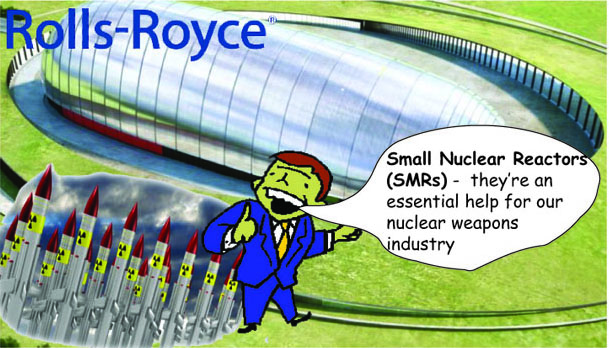
Leanne Wood: My column in The National two weeks ago argued for a transition away from manufacturing weapons of war to firing up our greeneconomy. Isn’t it also high time we rid Wales of the scourge of nuclear
power and redirect resources into clean, renewable energy? We have that opportunity now. Wales is a nuclear-free zone but for how much longer?
Plans to resurrect Wylfa B are effectively dead, even though some politicians continue to tout the idea. Attention has turned, instead, to the Trawsfynydd site where Rolls Royce is proposing a Small Modular Nuclear Reactor (SMNR), the latest experiment in nuclear fission technology. Except the old problems of safety and cost of storage and waste disposal haven’t gone away.
The first SMNR to be approved last year in the US was met by fierce criticism from notable scientists, including Professor MV Ramana of the University of Columbia who described the project as “risky and expensive”. Edwin Lyman, director of nuclear power safety at the Union of Concerned Scientists, highlighted ‘safety gaps’ in the design. Still
the Welsh Government, with the backing of Westminster, continues with costly feasibility studies.
The National (Wales) 10th Oct 2021
https://www.thenational.wales/news/19637359.wales-needs-forget-nuclear-power-forever/
Terra Praxis – another pro nuclear front group pushing for the mythical small nuclear reactors.
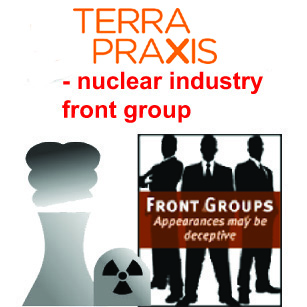
AJ100 practice Bryden Wood has revealed plans to repurpose the world’s
coal-fired power stations to house modular nuclear reactors as part of a
‘major initiative’ to decarbonise the energy sector. The practice’s
Repurposing Coal proposal has been drawn up with Terra Praxis, a non-profit
organisation focused on action for climate and energy.
Unveiled at COP26 this week, the strategy sets out how coal-fired boilers at existing power
plants could be replaced with Advanced Heat Sources (Generation IV Advanced
Modular Reactors) .
Architects Journal 5th Nov 2021
Utah shouldn’t gamble on unproven small nuclear reactors without public input

The budget for the UAMPS nuclear project has already increased from $3.1 billion to $6.1 billion since it was first conceived, and they are still several years away from plant construction. Last fall, Logan, Kaysville, Bountiful, Murray, Heber and Lehi all withdrew because the financial risks were too significant.
We encourage policymakers who are already involved with or are being approached to participate in the UAMPS nuclear power project to invite presentations by independent experts who can provide a balanced analysis of the pros, cons, actual costs and alternatives.
Scott Williams: Utah shouldn’t gamble on unproven nuclear energy without public input, https://www.sltrib.com/opinion/commentary/2021/11/03/scott-williams-utah/
During the October meeting of the Utah Legislature’s Public Utilities, Energy and Technology Interim Committee, the Utah Associated Municipal Power Systems (UAMPS), a consortium of small cities that operate their own power companies, gave a status update on a nuclear power project to supply electricity for Utahns who live in many of those cities. If this proposal were to succeed, it would be the first time any community in Utah would use nuclear energy to supply its electricity.
During this meeting, common themes of nuclear power being the best and/or only option to secure a reliable source of electricity to fill the gaps of wind and solar power were discussed and pushed forward.
UAMPS project would rely on new and as yet unproven technology. Its participating members would be gambling the dollars of Utah’s taxpayers and ratepayers that this first-of-a-kind project will succeed — a gamble that even risk-taking venture capitalists have shied away from. Our federal tax dollars would be funding much of the research, testing, licensing, construction, liability insurance and, perhaps most importantly, the cost of storing and safeguarding the highly toxic radioactive waste the plant would produce.
Before we accept the claims by the proponents of this project that it is the best and/or only option, the public officials who are approving these expenditures of public funds need to ask the questions about risks, benefits and alternatives that should be asked anytime public funds are being spent. In this case, it’s especially critical to do so because nuclear power projects have a history of significant cost overruns, bankruptcies and municipal bond defaults.
The VC Summer nuclear project budget in South Carolina ballooned from $11 billion to $25 billion. This project was ultimately canceled in 2017 after it was 40% complete and $9 billion had been spent. Ratepayers there will be paying for this mistake for the next 20 years.
The budget for the two new nuclear reactors currently under construction at the Vogtle plant in Georgia has increased from $14 billion to $28 billion.
The budget for the UAMPS nuclear project has already increased from $3.1 billion to $6.1 billion since it was first conceived, and they are still several years away from plant construction. Last fall, Logan, Kaysville, Bountiful, Murray, Heber and Lehi all withdrew because the financial risks were too significant.
The finance director in Logan convinced their city council to pull out, stating, “we’re the last entity that should be participating in risky endeavors. What we should participate in is the 4th or 5th iteration of this project. By that time, I guarantee that the costs will come down to whatever is the market rate for nuclear power.”
After this departure of subscribers, UAMPS decided to cut the size of the plant in half but still insisted that economies of scale would keep the rates competitive. To date, they only have a little over 20% of the purchasing commitments they need to make even this downsized project fully subscribed.
UAMPS issued no requests for proposals to see if this nuclear project was the most cost-effective way to fill the specific need for the power they are trying to address. Their minutes and supporting documents are only available by submitting a formal written public records request. And UAMPS is exempt from Utah’s Open Meetings Act, so the public cannot see the assumptions and calculations they are using to estimate the project’s costs.
We encourage policymakers who are already involved with or are being approached to participate in the UAMPS nuclear power project to invite presentations by independent experts who can provide a balanced analysis of the pros, cons, actual costs and alternatives. Scott Williams is the executive director of HEAL Utah.
Nuclear power is not a solution for anything except perhaps the nuclear industry’s desire for taxpayer dollars.

New nuclear’ wont’ solve challenges https://www.coloradopolitics.com/opinion/counterpoint-new-nuclear-wont-solve-challenges/article_ffab4b6e-38f1-11ec-a03d-733290cbcf3a.html Nuclear power is not a solution for anything except perhaps the nuclear industry’s desire for taxpayer dollars. The nuclear industry sales pitch, such as presented to a largely invitation-only meeting in Pueblo on July 15, promotes “new nuclear” or advanced nuclear, the only thing new is the packaging of the reactors. Even that is still experimental and on the drawing board, with NuScale working with the Nuclear Regulatory Commission on various elements of their design licensing. No operating commercial models have been built, and even if everything goes according to schedule, a pilot plant in Idaho is not expected to be completed until about 2030 — at a cost of 1.3 to 3.6 billion dollars, which they have received from us taxpayers via the Department of Energy. According to widely available statistics of energy costs, nuclear is still the most expensive generation source.
NuScale corporation’s small modular reactors are, in fact, the same light-water nuclear reactors as used to generate power in other settings, using uranium as fuel, requiring cooling water, and generating the same radioactive waste products. To generate power at the level of the coal-fired Comanche 3 power plant in Pueblo County would require at least 12 of the reactors NuScale is proposing. So instead of one large reactor, there would be twelve or more nuclear reactors, with a correspondingly greater probability of error or accidents.

For NuScale as with other nuclear reactors, even if their more experimental proposal for air-cooled versus water-cooled generating capacity is accepted by the NRC, the waste extracted from the reactors every 12-24 months would have to be stored for five years per batch in a pool of cooling water, with the necessity of use and refreshment of this pool for the life of the plant. A corollary of the waste fuel handling is that each of the 12 reactors must be opened and the radioactive fuel transferred and replaced every 24 months at the least, again with a multiplied probability for accidents or errors.
Because there is no long-term national repository for high level nuclear waste, this waste will be stored on-site in the community where it was generated for many years. Because that waste has a half-life of more than 20,000 years (meaning at that point half of the radioactivity will be broken down), it will remain a burden to future generation for as long as any of us can imagine.
Although proponents present nuclear power as a ready, clean solution to the climate crisis, it is neither. The classic nuclear power plants with their iconic cooling towers are aging out of the system, following a long history of operational difficulties, environmental contamination, closure and clean-up issues, as well as the storage of radioactive waste essentially in perpetuity. The “new nuclear” is not new except for means to package it and is at least 10 years or more from even being ready for commercial construction.
The proponents, including NuScale, want to put these plants into closed coal fired power plants, in communities often well within the zones of risk set by the NRC. Because that could rightfully raise community concerns, as well as increasing potential casualties in case of an accident, NuScale is asking the NRC to reduce the zones of protection around their nuclear reactors and radioactive waste sites because of the claimed lower risk for their still-experimental multi-reactor units.
Is Colorado ready for an unproven energy “solution” that will not even be ready for testing for a decade? The answer is “no.” Velma L. Campbell, MD, MPH is a physician specializing in public health, particularly occupational and environmental health. She is the vice chair of the Sangre de Cristo Group of the Sierra Club.
France’s failing EDF nuclear company hopes to save itself by marketing small nuclear reactors
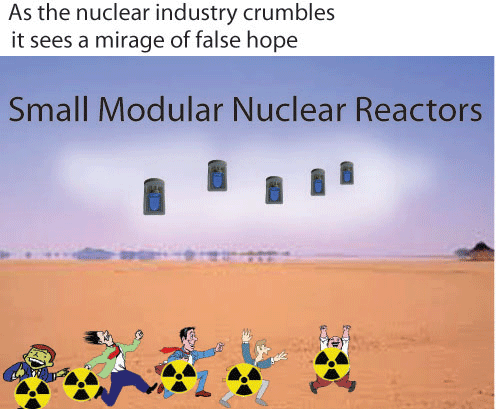
France will act as the shop window for exports of the new SMR technology — billed to be less powerful but easier to produce and run than conventional reactors — with EDF expected to begin building its first “Nuward” reactor in nine years
France’s nuclear drive offers chance of redemption for EDF
New commitments boost state-controlled utility but path ahead remains uncertain , Anna Gross and Sarah White in Paris Ft.com, 31 Oct 21, As the French government signals a future where nuclear power will play an integral rolein achieving carbon neutrality for the country by 2050 [ed. that is a spurious claim] , its state-controlled energy giant EDF remains encumbered by its past. Positioned at the heart of the nuclear debate in France and Europe, EDF struggles under a debt-laden balance sheet and a reputation for being unable to make novel nuclear technologies on time and on budget. But now President Emmanuel Macron has extended an olive branch and seemingly cleared a path for it to expand internationally and attract much-needed investment.
………..Created in 1946 by General Charles de Gaulle, EDF holds emotional power in France, Europe’s last bastion of nuclear power, and is linked with the nation’s industrial past and future. For years it was unclear if Macron, under pressure to move away from nuclear power towards renewables, would give the green light to new reactors long called for by EDF. Shortly after coming to power, Macron committed to reducing nuclear’s share of France’s electricity production from 75 to 50 per cent by 2035.
However, ambitious European climate goals, which hinge on pivoting to forms of energy that emit less carbon than fossil fuels, have put the spotlight on nuclear again and handed France an opportunity to assert its dominance in the field.
For EDF, thawing state tensions and confirmation of France’s desire for a nuclear future bring increased visibility to ensure it can keep training and hiring the people it will need and attract investment. That will be no small task for a company saddled with €41bn of debt and a colossal maintenance and investment programme to fund. UBS estimates a total investment requirement of more than €100bn for it to secure a 20-year life extension for 80 per cent of its nuclear fleet.
If approved, any government subsidies to fund six new reactors — estimated in leaked documents in 2019 to cost around €47bn — and the final price of the nuclear power produced by them, will ultimately be given the green light by Brussels. The cost of this funding could also be influenced by whether or not the EU includes nuclear energy in its taxonomy on “green finance”, making it a more attractive investment prospect. That decision has been delayed indefinitely because of infighting in the EU.
“Whether we can get financing at a low rate or super high rates completely changes the final cost. That’s the real subject, behind the gross number,” said Ursat. EDF faces other hurdles too, including the failure to reach a compromise with Brussels over the restructuring of the utility that would have allowed it to raise the regulated price at which it sells nuclear energy and ringfence some of its activities. It also needs to show it can deliver on its next-generation European Pressurised Reactor (EPR) technology, which it is planning to sell to India, Poland and the Czech Republic.
EPR reactors under construction in Europe — including Flamanville in France and Hinkley Point in the UK — are billions over budget and years behind schedule. The company’s previous chief financial officer quit over concerns about strains Hinkley Point was putting on EDF’s balance sheet.
These setbacks have led some investors and analysts to question EDF’s strategy and growth in the risky and costly field of nuclear power, were it not more than 80 per cent owned by the French government.
“The new reactor at Flamanville is not up and running yet, and some will want to see that project completed before France commits to more reactors with the same design,” said Sam Arie, an analyst at UBS. “From an investor point of view, is there interest in new nuclear projects? Not really.” However, recent soaring energy prices coupled with stringent climate goals seemed to have turned the tide in EDF’s favour. ……….
France will act as the shop window for exports of the new SMR technology — billed to be less powerful but easier to produce and run than conventional reactors — with EDF expected to begin building its first “Nuward” reactor in nine years. …….. https://www.ft.com/content/a1c95212-c122-4a29-8952-14a346381b91
Push for ”small nuclear power” in Colorado
Extract from –Pueblo County wants to replace Comanche coal plant with nuclear power. Local activists are worried.The county’s coal-fired power plant could close 30 years earlier than anticipated, Colorado newsline, OCTOBER 29, 2021 ”……………….. With that likely early closure of Comanche 3 (coal-powered station) , some county leaders want a nuclear power station to replace that energy production and — crucially for them — the tax base. Pueblo consumers do not actually receive any of the power generated by Comanche. County leadership believe that so-called small modular reactors technology is the clean energy source that will be deployable by 2030, and they argue that the technology has become much safer since catastrophes like the Chernobyl meltdown………..
Activists worry that county leadership is being lured into an experimental and unsafe energy alternative. They called the July town hall “secretive” and accused county leaders of having these conversations behind closed doors.
“We are being targeted because the nuclear industry, including NuScale, has a campaign going on to place nuclear power plants in old coal fired power plants all over the country. We are the foot in the door,” Campbell said. “Our commissioners are not doing their homework, they aren’t looking into the risk … in my opinion, they are being made to feel like bigwigs by people in the nuclear industry and have fallen in love with themselves.”
“That’s the one that is probably able to move forward quicker — nuclear,” said Commissioner Chris Wiseman.
It would be the first nuclear power plant in Colorado since Fort St. Vrain Generating Station stopped generating power in 1989…………..
Colorado isn’t completely sold on the idea yet, the nuclear option has been central to the conversation. In July, the county held a town hall with presenters from NuScale. Now, Wiseman is putting together a committee to look at possible alternative energy sources and hopes to have proposals before he retires from elected office at the end of next year. He leaves open the possibility that nuclear is not the answer, but rather some other emerging technology like green hydrogen……..
“Going through the neighborhoods and talking to people, it seems like people have just not been asked. When they are being used as sacrifice zones for these polluting industries that don’t serve them, no one comes and asks them,” said Giselle Herzfeld, a nonprofit organizer from Longmont who came down to Pueblo for the day of action.
Why nuclear instead of solar, wind?
Opponents of the nuclear idea want the county to more seriously consider replacing Comanche 3 with renewables such as solar, water or wind power.
“With all the creative thinking that exists in our community and around the state, I know we could come up with multiple ways of replacing that tax money,” said Pueblo activist Velma Campbell.
The nuclear lobby’s false story on small nuclear reactors

Too expensive, too slow: Even the baseload argument doesn’t work for nuclear. ReNeweconomy, Mark Diesendorf 29 October 2021
”………………………Small Modular Reactors
The nuclear industry is nowadays creating the false impression that new reactors exist that could solve the above major problems of existing reactors while contributing to climate mitigation.
The main hypotheticals are the so-called “small modular reactors” (SMRs), small enough to be distributed around a country and modular in the sense that they could be mass-produced by the thousand in factories and erected rapidly.
However, the actual situation is that SMRs don’t exist — they are paper reactors fuelled on hot air. They could not be installed in Australia for at least 15 years, if ever. By that time, given the political will, we could have an electricity system that’s entirely powered by renewable energy, mainly solar photovoltaics (PV) and wind, supplemented by hydro.
The reason why past and current generations of commercial nuclear power reactors are very big is to obtain economies of scale. Nuclear costs have been increasing while wind and especially solar costs continue to fall.
SMRs would have to be mass-produced in hundreds, possibly thousands, to overcome the loss of economy of scale and, even then, their electricity would at best cost much the same as from existing big nuclear power reactors.
There are no orders for multiple SMRs and that’s fortunate because the risk of proliferation would be greatly increased by distributing SMRs around the countryside. Reducing proliferation risk or increasing safety or improving waste management would all increase cost……………
SMRs that simultaneously solve proliferation, safety and waste management, while reducing costs, are a dangerous fantasy. https://reneweconomy.com.au/too-expensive-too-slow-even-the-baseload-argument-doesnt-work-for-nuclear/
France may have hidden agenda in promoting small nuclear reactors

“Countries that are clinging on to nuclear power are often nuclear weapon states — such as the UK, the US and France,” he explained, and pointed to a speech by Macron in December 2020.
“Without civil nuclear power, no military nuclear power; and without military nuclear power, no civil nuclear power,” the president had said
Do France’s plans for small nuclear reactors have hidden agenda? DW, 22 Oct 21,
Although France plans to invest in small modular nuclear reactors, experts doubt that this is ecologically and economically sensible. Yet it may be more about geopolitical strategy than energy.”…… A French law says the country will have to reduce its share of nuclear energy from currently roughly 70% — the highest in the world — to 50% in 2035, a goal President Emmanuel Macron has in the past called unrealistic.
But in pursuing small modular reactors (SMRs), some experts believe France may have a hidden agenda.
€1 billion planned investment
Recently, the president announced plans to invest in so-called small modular reactors (SMRs) “to lead the sector with groundbreaking innovations.” The new reactors are ostensibly to help France reduce its CO2 emissions.
The announcement came when Macron unveiled his France 2030 investment strategy of €30 billion ($35 billion) at the Elysee Palace.
“We have a decisive competitive advantage — our historical model, the existing nuclear power plants,” the president said during the ceremony.
The strategy allocates €8 billion to the development of hydrogen power and only €1 billion to SMRs, yet Macron declared the plans to develop the small plants “goal No. 1.”
The country’s SMRs will have a capacity of 50 megawatts to 500 MW each – considerably less than France’s current reactors with their capacity of up to 1,450 MW. SMRs are to be built in clusters to increase sites’ total capacity.
But nuclear champion France is not the frontrunner in the SMR race — the US is……
France’s first demonstration plant is only scheduled to be completed in 2030.
And yet, Nicolas Mazzucchi, of the Paris-based Foundation for Strategic Research, thinks the country could take the lead in the sector………
A discussion based on ‘hot air’
But Mycle Schneider thinks nuclear energy is inefficient in the fight against the climate emergency — “too expensive, too slow,” he says. He’s the editor of the annual World Nuclear Industry Status Report (WNISR), which assesses trends in the global nuclear power industry.
“Last year, more than 250 GW of renewable energy capacity has been added to the grid and only 0.4 GW of net nuclear capacity — nuclear power has become irrelevant,” he asserted.
Schneider says nuclear power plants only appear to be more reliable than renewables: “France’s nuclear reactors, on average, had to be switched off during one-third of the time in 2020, mostly due to maintenance, also as they now have been running for a long time, on average more than 35 years.”
“The discussion around SMRs is orchestrated hot air and has become hugely hyped,” he explained to DW.
He added that renewables had to be seen as a bouquet of different energies. Through demand response management, one type of energy could offset the temporary unavailability of the other. Environmentalists also often point out that construction of nuclear power plants has a significant carbon footprint.
“It takes ages to build new nuclear power plants,” Schneider added. French utility EDF and Siemens started to develop EPRs, a third-generation pressurised water reactor design, after the Chernobyl nuclear catastrophe in 1986, he explained. “And 35 years on, there’s still no EPR in Europe up and running.”
EDF is building a 1.6 GW EPR in Flamanville in northern France. But constructing the plant will exceed €11 billion, instead of the initially planned €3.3 billion, and the EPR is only scheduled to be completed next year — 10 years later than initially intended.
Nevertheless, President Macron could soon announce plans to build six additional EPRs in France.
Nuclear very capital-intensive
Such delays have Kenneth Gillingham, a professor of environmental and energy economics at Yale University in the US, wondering if investing in nuclear makes economic sense.
“The safety requirement for new nuclear plants are that strict, that constructing them becomes very costly and capital-intensive,” he told DW.
“I don’t really see why you would spend money on SMRs, especially as you don’t know if they will work in the end,” he said.
Philip Johnstone, a research fellow at the University of Sussex School of Business in southern England, thinks that SMRs turn the logic of economies of scale on its head.
Ulterior motives behind investment in SMRs
“We were told all along that building bigger nuclear plants would help us save money through the scale effect, and now it’s supposed to suddenly work the other way around?” Johnstone told DW.
He believes that France has other reasons for continuing to invest in nuclear energy.
“Countries that are clinging on to nuclear power are often nuclear weapon states — such as the UK, the US and France,” he explained, and pointed to a speech by Macron in December 2020.
“Without civil nuclear power, no military nuclear power; and without military nuclear power, no civil nuclear power,” the president had said, praising a sector that employs 220,000 people in France.
“The investment in SMRs seems first and foremost a strategic decision, even though it means wasting a lot of time and money,” Johnstone said.
Time and money that could instead be more effectively invested in climate protection.
According to the United Nations, global CO2 emissions will need to be reduced by more than 7% percent each year until 2030 — based on the year 2019 — to limit global warming to 1.5 degrees Celsius (2.7 degrees Fahrenheit). https://www.dw.com/en/do-frances-plans-for-small-nuclear-reactors-have-hidden-agenda/a-59585614
Mini nuclear reactors claim to be the cheap, effective, action for reaching net zero carbon emissions: UK and others are buying this!
Mini nuclear reactors vie for key role in UK’s push to hit climate targets, Ft.com 21 Oct 21, SMRs promise huge cost savings over traditional large-scale plans, Ever since the Wylfa nuclear power plant on Anglesey stopped generating electricity in December 2015, communities on the Welsh island that are supportive of atomic power have been waiting for its revival. This week that likelihood increased when the UK government named a site near where the old reactors are being decommissioned as a possible location for a new large-scale plant or the first place in the UK to host a new technology under development, known as small modular reactors (SMRs).

One of the big selling points of SMRs is that they promise huge cost savings over traditional large-scale reactors. Rolls-Royce, the UK engineering group which is leading a consortium to produce a UK design, expects the first five SMR reactors to cost £2.2bn each, falling to £1.8bn for subsequent units. The government’s decision this week to give nuclear a central role in its net zero emissions strategy has given fresh impetus to replacing Britain’s existing reactors, which are all due to be retired by the end of 2035. Ministers committed a total of £505m in funding to the nuclear initiative, which calls for a mix of large plants, SMRs and other emerging technologies.

More than £200m of that funding is soon expected to be channelled into the consortium led by Rolls-Royce. It has been seeking private match-funding so it can submit its SMR reactor design to the extensive regulatory approval process before the end of the year. Wylfa had been earmarked for a new plant under British plans to build a new generation of large-scale reactors, financed mainly by the private sector, that dates back to 2006. But successive governments have struggled to attract private capital to these projects, where cost-overruns are commonplace because of the engineering risks in such complex structures.
So far work has only started on one: Hinkley Point C in Somerset and costs have spiralled with the latest estimate put at £23bn. The developer behind the proposed Wylfa plant, Japan’s Hitachi, pulled the plug last year after failing to reach a financing agreement with the UK government, although a US consortium is trying to resurrect it.
The UK is not alone in pushing smaller reactors. Other governments around the world looking to tap nuclear power to meet their challenging decarbonisation targets are also showing interest in the technology. Along with the promise of much lower build costs, the smaller power plants are also attractive because of their footprint. The UK, for example, has a limited number of sites suitable for large plants.
France, one of the world’s leaders in nuclear engineering, this month announced €1bn in funding for state-backed utility EDF to develop its own SMR technology by the early 2030s. The technology is similar to existing pressurised water reactors that are used in nuclear power plants today. But the key difference is that the small, modular design would allow the parts to be built in factories ready for quick assembly at the chosen location. This, SMR advocates argue, not only cuts costs and the long lead times but also avoids many of the construction risks that bedevil larger plants………..
……. Rolls-Royce is tight-lipped about its SMR fundraising but Tom Samson, who heads the consortium, said he was in talks with a “number of interested investors and developers in deploying the technology”. If the design gets regulatory approval, a process that can take up to five years, Rolls-Royce believes it could complete its first 470 megawatt SMR plant by 2031. After that it expects to build two units a year.
At 470MW the plant would have a generating capacity similar to some of Britain’s earliest reactors but would be about seven times less capable than the proposed next large-scale plant in the UK: Sizewell C on England’s east coast.
………. Among those other options are what the UK dubs “advanced modular reactors”. One of the most viable designs looks to be a high temperature gas-cooled reactor. The technology is being tested in a number of countries, including Japan. The government set a target this week of having the first advanced modular reactor demonstrator in Britain “in the early 2030s”. But analysts question whether any of these technologies would be commercialised in time to help the UK reach its 2035 target for a carbon neutral grid.
Moreover, some environmentalists argue a big challenge is the UK’s lack of experience with modularisation manufacturing techniques that are key to their economics. “We have never done it,” said Tom Burke, co-founder of E3G, a climate think-tank, arguing that modularisation would require a “very large factory” that could only be funded with a long line of orders.
Burke questioned how it would be possible to secure those orders when the first SMR is, as yet, unproven. But Rolls-Royce’s Samson remains unfazed. In contrast to future large atomic plants, which are likely to require a financing model that will be underpinned by British households through their energy bills, modularisation promises a radical shift in funding nuclear power. He conceded that government backing would be needed to help finance the initial manufacturing set-up and first orders but insisted private capital would ultimately pay for the bulk of the fleet. “This is an important transition for us. https://www.ft.com/content/7da30202-2db9-4ab3-9428-458a9d8728bd?signupConfirmation=success
1 This Month



26 September – International Day for the Total Elimination of Nuclear Weapons


PLEASE OPPOSE HR 8255 AND S.3639 – bills would accelerate satellite deployment, with no environmental review or safeguards – https://ncstd5li.quorum.us/campaign/169331/
To see nuclear-related stories in greater depth and intensity – go to https://nuclearinformation.wordpress.com
-
Archives
- September 2026 (231)
- August 2026 (330)
- July 2026 (355)
- June 2026 (287)
- May 2026 (306)
- April 2026 (356)
- March 2026 (251)
- February 2026 (267)
- January 2026 (308)
- December 2025 (358)
- November 2025 (359)
- October 2025 (375)
-
Categories
- 1
- 1 NUCLEAR ISSUES
- business and costs
- climate change
- culture and arts
- ENERGY
- environment
- health
- history
- indigenous issues
- Legal
- marketing of nuclear
- media
- opposition to nuclear
- PERSONAL STORIES
- politics
- politics international
- Religion and ethics
- safety
- secrets,lies and civil liberties
- spinbuster
- technology
- Uranium
- wastes
- weapons and war
- Women
- 2 WORLD
- ACTION
- AFRICA
- Atrocities
- AUSTRALIA
- Christina's notes
- Christina's themes
- culture and arts
- Events
- Fuk 2022
- Fuk 2023
- Fukushima 2017
- Fukushima 2018
- fukushima 2019
- Fukushima 2020
- Fukushima 2021
- general
- global warming
- Humour (God we need it)
- Nuclear
- RARE EARTHS
- Reference
- resources – print
- Resources -audiovicual
- Weekly Newsletter
- World
- World Nuclear
- YouTube
-
RSS
Entries RSS
Comments RSS
 nuclear-news